
BOOK 2
Chapter 25
Abraham begat Isaac;
And Isaac begat Jacob;
And Jacob begat Judas...
And Judas begat Phares...
And Phares begat Esrom;
And Esrom begat Aram;
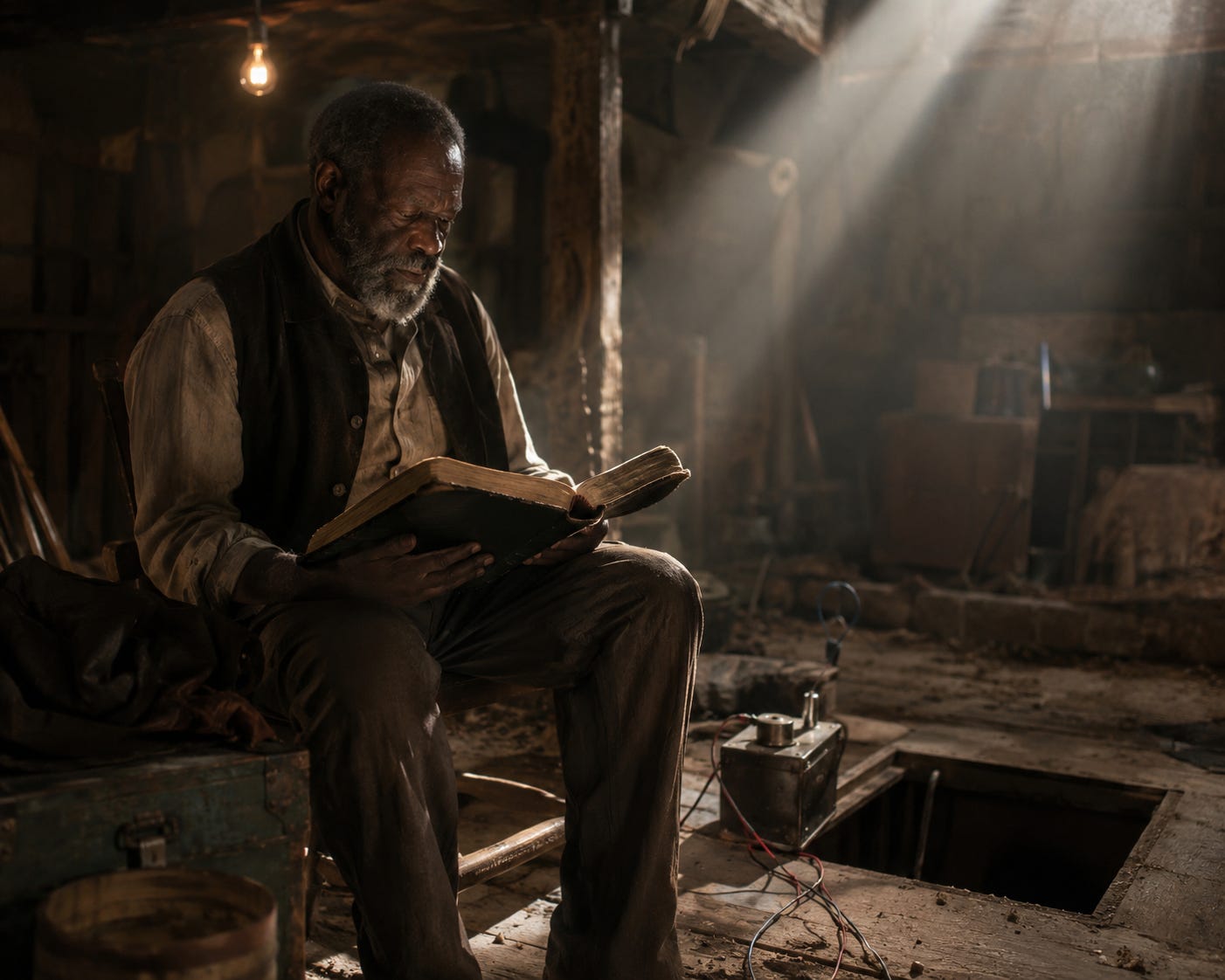
“And I am?” Robert Jones fingered the page he was holding carefully, studying the words with great intensity. “I am? I am. I say I am, but am I?. What am I before my Lord God?” At first the list of names made no sense to him. Why were they in the Holy Book? They were just names, with no connection to anything that he could make any meaning out of. But something attracted him to that particular page, and to the words, something that held him, and caused him to keep reading.
And Aram begat Aminidab;
And Aminidab begat Naasson;
And Naasson begat Salmon;
And Salmon begat Booz...
And Booz begat Obed...
And Obed begat Jesse;
As he read the names, he was reminded of Old Jack, someone he had met during his days at Lexington. Old Jack’s real name was completely different, but was a name that could not be said properly by anyone, it was so filled with clicks and clucks and other guttural noises that were incomprehensible. He called himself Koo-ki-ka-ki-ki-ki-ka-na, or so it sounded, anyway. He also called himself Atif, interchanging the two randomly. By the time Jones met him, the old fellow had not yet reconciled himself to being called Old Jack and would spit out his true name in his own language whenever he had a chance. His owner was a professor of Theology and Biblical Revelation at Washington College, not far from VMI, someone who had done missionary work in Africa. It was not allowed to bring slaved Africans back to the CSA according to the law, but Pickett had explained to Jones that it was common for the government to look the other way in most of these cases when it was a personal matter, especially if it had anything to do with preachers doing the Lord’s work. Yes, Old Jack was quite a character in more ways than one. Jones read on:
And Jesse begat David the King;
And David the King begat Solomon...
And Solomon begat Roboam;
And Roboam begat Abia;
And Abia begat Asa;
And Asa begat Josaphat;
It was gripping, somehow, to recite the names, word by word, one syllable at a time, as if they were a list of sounds, and not names at all, just sounds that created their own meaning after saying them often enough. Or maybe they were some kind of secret code. Some said the Bible was filled with secret meanings that only the few would ever understand.
Old Jack often told Robert Jones that words had secret meanings, and that even though words were the creation of men, they could never truly be understood by most men, only by those with special powers. He claimed to have those special powers himself. One day, for no particular reason, Old Jack grasped Jones by the forearm while they walked past stalls heaped with green beans, and summer squash, radishes and onions, eggplants and watermelons, hanging cheeses and strawberries, early apples and late peaches. They were at the farmers’ market down on Taylor Street, the largest market young Jones had ever seen, and on display was every kind of produce from every corner of the Shenandoah. Old Jack didn’t seem interested in buying food for the reverend’s dinner, though. He seemed to be shuffling along, looking bored and distracted, and when he saw Jones he came right over and grasped him by the forearm, clutching him with strong fingers and over-long nails that bit into Jones’s skin.
They paced together up and down Taylor Street for quite a while as Old Jack told his story. He said he was a poet, and that he learned his trade as a young man in Sofala. Later, in his middle years, he went to Mombasa where he chanted his poems every morning near a mosque. He was made a Muslim as an older child, and as a good Muslim he would not sing, but rather intoned the verses with a powerful voice that carried far. Passers-by would leave behind a piece of fruit, or tomatoes, or eggs, or even a chicken for the pleasure of his poems. He perfected the Maishari cadences, sacred songs so he said, which were very much more difficult and complex than anything a Christian could understand. Over time he became quite famous, and men would come from very far to hear him. The further they came, the greater the gift they would leave at his feet. He had dreams to study and become an imam one day, but unfortunately he was abducted as he was declaiming and reciting his poems one clear cold morning. It was the Maishari meter, the rhythm, he claimed, that opened the doorway to understanding the true meaning of words. Thinking back, Jones thought he could see a glimmer of truth in what Old Jack was trying to tell him. He continued reading:
And Josephat begat Joram;
And Joram begat Ozias;
And Ozias begat Joatham;
And Joatham begat Achaz;
And Achaz begat Ezekias;
And Ezekias begat Manassas;
For many years Old Jack served the master who had purchased him, a rich merchant from Nairobi, a man of faith who answered the call of the muezzin every day as scrupulously as he collected every farthing due on his accounts. The merchant was content to have his new servant chant to him only once in a while, on a whim and without warning, so that each time the poems would be like new. Sometimes it would be at a feast, such as a wedding attended by a hundred or more, and his invocations would be accompanied by much clapping and good cheer. Sometimes it would be in the lean hours of the night, with no one else to hear his words other than the master. No matter when or where, Old Jack would keep the rhythm meticulously; quatrains of sixteen syllables with a measured caesura in the middle of each line, and within the space encompassed and created by meter and words he would find solace and even happiness. Twice that he could remember, three times perhaps, his poems were so powerful and said with such strength that they had cast him into a holy frenzy that surrendered him, trembling, at the feet of Great God Himself.
Jones never forgot what the old man had said about the dominion of words. He felt that same tug as he read from Matthew’s list of Hebrew ancestors, but there was something else that came over him as well, a cold numbness that wrapped around his heart. Maybe Old Jack was feeling the same icy grip when he stopped to talk to him that summer day on Taylor Street, the strangled feeling that the end of time was drawing near. He went on to finish his story, telling Jones of his loneliness and pain while enslaved in the house of his master. Eventually, and slowly, he lost the mastery of the Maishari cadences, and his poetry grew weak and withered. His voice shriveled up like the nether parts of an old, old bull, and his master grew displeased with him. As a final sign of displeasure, Old Jack was brought to an auction market at Fort Jesus where many foreigners came to buy, and was sold to the itinerant preacher who shipped him back to the strange and beautiful country of the Valley of Virginia.
Using his forefinger as a guide, Jones continued his reading:
And Manassas begat Amon;
And Amon begat Josias;
And Josias begat Jechonias...
And Jechonias begat Salathiel;
And Salathiel begat Zorobabel;
And Zorobabel begat Abiud;
Old Jack died not long after that, they said of old age and the dropsy. Jones was very young at the time and had not learned much about life as yet. But looking back, he grew to believe that the old man had died of a broken heart. He had lost the one bit of magic that had made him special, and he turned into an empty flask once the vital fluids of his poetry had drained away. And when he had gone, there was nothing left of him, not even his name, because it was surely not Koo-ki-ka-ki-ki-ki-ka-na. There was no entry for him in the long list of his ancestral line, only a blank space where his name and the art of his words should have been written down. In the short time they had been together Jones did not come to learn whether the old man had any children back in Africa, living offspring that would allow at least a residue of his identity to be left behind.
Jones slammed the Bible shut, not wishing to read any more, feeling weak. Names, lineage, identity had no meaning in the end. In the end was only...the end, the terminus of the journey, where the tracks of this life intersected with eternity. That was all that mattered, the ultimate destination, already preordained. His mother had told him, at her end, that she had already been a long time dying, and that along the way she had suffered a thousand little deaths. None of it mattered, not the deaths of her other children, or her dear brother, or the myriad daily oppressions and miseries that were suffered onto her body over the years. She told her son that her life had been lived like a blade of long grass, bent by wind and rain, worn down by snow, and cast in shadow by clouds above. But like the grass, she had lifted her body up each day to seek the sun, and allow its fingers to touch her face with sisterly affection, and like the grass she could not look back or feel any regrets. She had fought each day of her life, his momma told him, to reach the final day, when she would be reunited with all those who had passed before and fought before, and that is what she swore him to do as well. Fight. Fight to reach the end.
His momma had come back into his life no more than ten years before. Pickett had been true to his word, eventually. He had promised to reward Jones by finding his mother, and if alive, to reunite her with her son. It was a shrewd reward. A payment, really. Payment for the murder of Merope. It was her death that was fixed as the price of finding his mother after so many years of separation. Merope, such a beautiful woman. And so different from her daughter Madeline.
Merope was George Pickett’s last wife, and the mother of his only living child, the one name that would be marked down and scribed in stone when Pickett’s own life was erased. It was a surprise wedding, the two of them, consummated in a rapid fire of frenetic activity. It all happened while they were stationed in El Paso. Pickett was Colonel of the Second CSA Colored Cavalry at the time, punishment duty for unruly, lascivious, and demeaning behavior directed at the daughter of Fort Bragg’s Commandant the previous summer. The Second CC was tasked to border patrol, and naturally Pickett’s interpretation of his orders included the freedom to initiate frequent incursions into Mexico proper.
The border with Mexico in those days was chaotic, a porous, volatile blend of armed confrontation with regular troops from either side and guerrilla raids by bands that were no more than horse thieves and smugglers. Mexico was in a roiling state of revolution, and the fighting spilled over the border into Texas as Mexican National troops and revolutionaries fought for regional dominance. The greatest danger to the ranchers and scrub farmers of southwest Texas came from the guerrilla band of Pascual Orozco. His marauders had perfected the strategy of attacking isolated ranches or haciendas and confiscating livestock that was then sold back to buyers along the border. Deals were transacted either for CSA gold or for weapons, and were the lifeblood of Orozco’s guerrilla operations. Pickett swore to destroy the Orozquistas, hanging every one of them along the banks of the Rio Bravo if necessary.
At times his Troop would disappear for a week or two at a time, often to return with a gaggle of prisoners said to be captured in battle. Rumor had it that the dark ones were put up for sale, and that west Texas ranchers would take almost anyone who could pass for Negro, or part Negro. At the right price of course. Whether money changed hands was never proven, but it was true that most of the prisoners generally disappeared under mysterious circumstances within a month of their arrival, and that large numbers of Texan tourists would serendipitously appear on the barren, beautiful, straight streets of El Paso at or near the times of the raids. Jones heard the stories, believed them to be true, and was filled with disgust at thinking that Pickett was nothing more than a plunderer purveying in human flesh. The fact that Pickett spent almost every night drinking and whoring was further proof that he had degenerated into evil ways.
It came as quite a surprise to Jones when Pickett instructed him one day to come along when he led the regiment on patrol the next morning. That had never happened before. Jones was not good with horses, hated to ride for extended periods, and abhorred the desert even more, but Pickett was firm. “Come on, Jones,” he mocked. “This here is a cavalry outfit, and the troopers are your people, same as you, no better or worse. Anyway, a few days in the saddle will harden up your ass and shrivel up your balls. Make a man out of you.” He laughed at Jones as he often did, with a sonorous, insincere civility and an enormous, twisted smirk to his lips.
The troop rode out at military dawn the next morning, making a wide sweep northwest and west at an unhurried trot. Rumor among the men was that they were headed for Las Cruces, but that would prove to be wrong. The land was pure desert, an opaque purple and brown in the half-light, turning a dull ocher as the sun rose, dotted with the grotesquely contorted, ghostly figures of cactus rising up among low lying boulders. It occurred to Jones that this was a land that the devil himself wouldn’t care to visit. The heat was overwhelming; in a short time, Jones felt his shirt soaked in sweat. He began to pray for release from the torturous patrol, buried his chin in his chest, and pulled his hat down over his forehead. Pickett swung close by and waived his arm grandly at the empty landscape surrounding them. “What do you think, Jones? Beautiful, ain’t it?”
Jones was miserable with the heat and dust, and the mere fact of being on horseback for hours, and allowed himself a scowl. “I think instead of patrolling it we should give it away to the first one willing to take it off our hands. Mister, If the Mexicans want it, let them have it. For that matter, let the Canadians have it, or the Germans.”
Pickett nodded with a mock show of gravity. “We is negotiatin’ with the Japanese right now. C’mon, it’s not that bad. Anyway.” He stopped himself and grew suddenly more serious, nodding at the troopers riding with them. “Anyway, if we wasn’t patrolling here we’d be patrolling somewhere else, somewhere just as Godforsaken. That’s what we do as soldiers, Jones, it’s never particularly appetizing work. We have a duty, and we follow it.”
Still irritable, and mopping his brow with a handkerchief, Jones gestured at the cavalryman next to him. “Bet he doesn’t have much to say about it, does he? I mean being a nigger and all.” As soon as the words left his mouth he regretted saying them. Since Nicaragua a bond had formed between Pickett and Jones, but a bond no stronger than a thin strand of straw, a bond that could be broken easily and without remorse. Jones always kept in mind the vivid memory of what had happened to old Rufus.
Pickett reached over, grabbed the reins from his hands, and pulled both his own and Jones’s horse to a halt. “These here are soldiers. Some of ‘em served with me in Cuba. Any one of ‘em would kick your ass to hell,” he snarled. “I thought you learned proper behavior back in the jungle.” He whirled around in his saddle, seeking, seething. “Sergeant!”
A narrow, gaunt looking fellow, light brown enough to blend into the desert sands, his features partially submerged under an expansive slouch hat, came cantering up to join them. There were no salutes and no words were exchanged. He merely gave Pickett an inquisitive look.
“Sergeant Powell, see this man? Eleven lashes, good ‘uns, when we make camp.”
As he thought about that day, Jones shook his head in dismay. He did not at the time believe that he would be whipped, thinking that Pickett was only trying to frighten him. And besides, he was owed a debt for carrying Pickett on his back through uncharted jungle, wasn’t he? He saved the man’s life, didn’t he? But whipped he was, bound to an impromptu whipping post right after supper, as if he were the dessert to the day’s proceedings. And not by the thinly sergeant, either. Instead, a certain corporal Meeks was given the honor, a strapping young man who was a slightly smaller version of Promise Stone. The young corporal did not behave at all in accordance with what his name suggested as he set himself to his assignment. He had the peculiar inclination to call out a woman’s name with every stroke he applied, which offered Jones a very brief diversion from the searing agony of the strikes against his back. With each whipsaw of his arm and wrist Meeks made a call: ‘...Maria...Isabella...Teresa...Anna...’ Meeks seemed more excited with each name ‘...Verghinia...Elizabetta...Renata...’ He leaned into his work, and soon the names were shouted with a bellow ‘...Grisele...Alejandra...Miranda...’ Even in the cool of the desert night Meeks became flushed and sweaty with his work. He stopped before the last great lash was delivered, asked for a drink, and downed a small flask of whiskey. The final blow was delivered with a flourish, a great show of whipping the long leather lash back and forth in the air in great arcs of increasing power before crying out a name as if he were at the bedside of his dying mother, or in the fleeting arms of the first and last love of his life ‘....Manuela!’
Jones barely heard the last name echo in the shadows of the night before he lost consciousness, lapsing into a deaf and dumb, unsensing state that hovered somewhere between deep sleep and darkest coma. Just before he became unconscious, just as the whip was snapping down for its final strike against his wounded, bleeding flesh, he conjured up a name as well, one that flashed across his mind and soul with a despairing hatred...’PICKETT’.
He was resurrected the next morning by the ministrations of one of the troopers. His back had been cleaned and washed thoroughly, bandaged with clean dressings, and now stank of iodine. The pain at first was unbearable, but as Jones was assisted to his feet he found that he could walk with help.
Meeks came to him. “Sorra, brotha’. Followin’ orders.” He did not seem sorry, though.
Pickett wandered by with a tin of coffee in his hand but said nothing. In later years Jones would have sunk to his knees and prayed. Prayed for guidance. Prayed for forgiveness. Prayed for the soul of George Pickett, and all the troopers in the regiment. But he had not as yet made his final acquiescence to the Will that guided all human actions. So instead of praying, Robert Jones festered with pain, and humiliation, and anger. As Pickett had taught him, he did not show fear. He walked through the camp with head erect, and with steady eye, but in his heart he nursed a burning fury and made the coldest of calculations. Somewhere, sometime, somehow, he would kill George Pickett, even if it cost his own life. That would be revenge sweet enough to justify any pain that could possibly follow.
On the second day they turned west and crossed the Rio Bravo, which was nothing more than a deep, wet rut on the desert floor, and veered due south into endless, empty desert. That night, under a mirror-clear mantle of sky and stars, Pickett gathered his command around a hissing bonfire that licked the air with dry, red-hot flames, and ordered them to be at ease. He wore a duff brown coat without insignia and carried a poncho over his arm. He spoke quietly, without any show of emotion. “Men, anyone who wants to come with me tomorrow needs to know that I’m going on a raid beyond Juarez. I can’t order you to go with me, because the raid I’m plannin’ is illegal. I’m doin’ this on my own and without orders, so anyone who wants to sit here until we get back can do so. But I want you to know a few things first. The most important thing is, I’ve got some information about the location of a detachment of Oroszquistas to the south of town on the National Road. If we can hit them hard and by surprise I think that will be the end of them, at least for now, and we can kiss goodbye to these regular patrols. Second thing is, they’ve got some of Señor Pasquale’s gold with them, gold he’s using to buy off Los Rurales, the local militia.”
At the mention of gold the troopers began to hoot and clap their hands, wave their hats in the air and shout Pickett’s name. The sergeant, standing on a saddle to increase his height, waved his arms to quiet them down. “Shut up, you sonsabitches,” he shouted. “Let the colonel finish!”
And that was when Pickett weaved his magic. It had something to do, for sure, with the way he canted his head, and something with the way he spread his arms straight up, as if about to plead the Lord’s forgiveness for the sins of his men, or the way his eyes gleamed, or his voice vibrated in the thin desert air, or how his hair hung and swung in tight little ringcurls down his neck. It could have been all those things, or none, because it was the perfect pitch of his smile, and the whiteness of his teeth, and the dimpling of his rounded jaw that won them over, as it always did. “And boys,” he purred, “Here’s the third thing. There’s girls where I’m goin’, boys, plenty of ‘em, and they’ll take a black man just as well as a white man, maybe for a little of that gold I was talkin’ about. And I can tell you right now that I’m gonna be gettin’ myself one little lady for this hand, and a bottle of hard tequila for the other! Now who wants to join me?”
And with that said, the men erupted with cheers, throwing their hats in the air. The sergeant sprang from the majestic height of the grounded saddle to use his hat as an imaginary dancing partner and began a waltz, kicking up sand as he performed neat pirouettes in his thickset boots. Jones grimaced and shook his head in dismay when he saw the reaction of the Troop. Company C, Second Colored Cavalry, was heading not to glory but to hell, and their commander was responsible. Jones had been around the military long enough to understand the importance of discipline and obedience to orders. He had seen men court-martialed for failing to follow instructions from a superior officer. Yet here was Pickett, boldly and baldly announcing that he was flouting orders and raiding on his own authority. No wonder the men’s behavior so quickly degenerated into that of a mob. An armed mob at that. He vowed again that Pickett would see his last patrol. Surely, there would be an opportunity during the coming raid to take his life. Jones did not have a gun, but he had several knives, used to prepare the colonel’s daily mess. While the brigand band marauded, there would come a moment, without doubt, when he could slip a blade between that awful man’s ribs. The world would be free of a slave merchant, the Army would be free of a degenerate officer, and he would be free of a cruel and uncaring owner. What might happen to him if he was suspected of Pickett’s murder did not once permeate his thoughts.
As the Troop saddled up the next morning, Sergeant Powell strode over to speak to Jones, waving his arms to signal that he should stop packing the Colonel’s kit. “Boss says you stay here.”
“Stay here? Why?” Jones was dumbfounded.
“Dunno. Sergeants don’t ask Colonels any questions, see?”
Jones quickly felt a sense of dread come over him. “What am I supposed to do here all alone?”
The sergeant handed over a pistol, a new Browning model 1910, the type that was a favorite among CSA cavalrymen. He did not attempt to hide an audible, derisive snicker. “He says you guard our packs, you and Tiberius.” Tiberius was the Company’s dog, a bull mastiff with massive jaws and vicious possessiveness. “If any banditos come along, don’t worry, the dog will protect you, just don’t get in his way.” He walked away, laughing under his breath.
The Troop disappeared in a short while, swarming like a cloud of flies buzzing towards the horizon. Jones spent the morning in his tent, letting his anger flare within him, allowing his rage to consume him. Every abuse, every slight, every insult to his manhood swirled through his thoughts like a vivid moving picture, feeding his fury even further. Even though he sat in shade, protected from the violence of direct sunlight, heat began to radiate upwards from the furnace of desert sand beneath him. The crawling bite of coloradillas tortured his neck and groin, and a violin spider scuttled over his leg, searching for prey. He was in a hell of torment. Jones drank some tepid water but felt dizzy and lay down on his side. Sweat began to pour over his forehead and around his eyes, blurring his vision with a foggy haze. He began to imagine how he would kill Pickett. He could picture the man’s astonished expression as Jones placed the muzzle of a gun to his temple, or the blade of a knife to his throat. He could hear Pickett’s pleas for mercy, and hear his death rattle.
The rising temperature outside the tent took its toll, forcing Jones to remove his shirt and use it to sop up the trickles of sweat appearing on his face, and chest, and back, but he remained determined to continue his daydreams of revenge, transfixed by the image of his owner slowly bleeding to death. His brow furrowed with concentration and his eyes closed in fierce focus as he imagined in detail every drop of blood dripping slowly down Pickett’s neck, and chest, and arms, and belly, and slowly trickle over groin and hips and legs and calves, and slowly over feet and ankles, slowly...slowly...slowly...
Very nearly, he did not see the old woman until she was almost upon him. When he did see the silent brush of her shadow on the sand, he almost could not make sense of it. His mind could not comprehend that there might be someone at his tent flap until he bent over to look outside. Even when he did see her, he could not believe what he saw. She was old, wrinkled in her arms and body, her face creased like the bed of an old and dried up desert creek cracked by ten thousand sunrises. Her eyes shone with a dark green light, as if illuminated by a rotting lime. She was dressed in native fashion, with a long, tasseled rebozo draped over her head to protect her from direct disturbance by the sun. She smiled at him, opening a mouth marred by wide gaps between her remaining teeth, and gestured for him to come with her. Jones spat in his hands and rubbed them furiously to convince himself he was awake and not dreaming or hallucinating and then arose to follow her. They walked through desert sands for a long time, avoiding the dried up desert sage, saguaros, and shrunken creosote bushes that dotted their path. Occasional scorpions scurried around his feet, and he could see the black shadows of buzzards as they floated by in effortless, patient flight. A long row of Joshua trees rising in a straight line into the distance marked their path forward.
They climbed a low-lying mound. The woman turned to speak to him, saying words that sounded directly in his mind. “Open your mind and be respectful,” she said. “This is a tumulus that protects many that have passed.” And then she pointed.
Jones turned to look. His legs buckled at what he saw, and he fell to his knees, clasping his hands, collapsed in strength and spirit. An ocean of bones lay before him. Arm bones, shanks, hips, skulls, jawbones, vertebrae, ribs, and the myriad small bones of the hands and feet, tarsals and metatarsals, hyoid bones from the neck, flat sternums, tiny stapes and the odd looking vomer, phalanges, ulnas and sphenoids, and diminutive pisoids. The bones covered a vast expanse, filling a punched out craterous bowl dug deep into the earth, a great kettle stretching to the extremity of his vision. In some places the skeletal remains were moving, heaving and shifting as if trying to force themselves back into alignment, cracking and snapping with tidal movements that rippled from one end of the crater to the other. Jones knew where he was, understood it completely. He knew the story as if it were buried deep within his heart, told by a prophet who had lived very long ago. He had read the prophet’s story as a boy; he was now seeing the truth of the story as a man:
He led me back and forth among them, and I saw a great many bones on the floor of the valley, bones that were very dry. He asked me, “Son of man, can these bones live?”
The old woman said nothing, but continued pointing.
Jones prayed, remembering the Scriptures:
Then he said to me: “Son of man, these bones are the people of Israel. They say, ‘Our bones are dried up and our hope is gone; we are cut off.’ Therefore prophesy and say to them: ‘This is what the Sovereign Lord says: My people, I am going to open your graves and bring you up from them; I will bring you back to the land of Israel.’ “
Jones bent his head in submission. “Is that what you’ve brought me here to learn? That the great God above can reassemble even the dead long dead?”
“No.”
“What, then? Why bring me here?”
“Look inside your heart.”
“I feel nothing in my heart except love for the Lord.”
“You feel hate.”
Jones dared a glance at the woman’s face. She seemed softer, younger. Her eyes had grown to enormous size, and in her eyes were mirrored his own, which mirrored hers, and again, and again, and on and on a hundred times, a hundred thousand times, and on forever. He thought of Pickett, whose face appeared to him, right next to hers. “I understand.”
“No, not yet. You wish to believe you do, just like you wish to believe you are saved and will live for eternity.”
The old woman was changing as he watched. The wrinkles on her face dissolved, and the smooth sheen of youth appeared over her arms. The rebozo fell to her shoulders, revealing a graceful swan-like neck and black tightly curled hair that glistened with a varicolored iridescence in the glare of the sunlight. She stretched a brown hand to touch his head. Jones felt his chest heave with a sob, and as her fingers touched his forehead he felt the heavy weight of saving grace fall upon him.
“Those are not bones, are they?” He simply thought the words, he did not need to utter them aloud.
She pointed at the cauldron of moving, restless bones just as the first flickers of flame appeared among them. “There is fear.” She pointed at a mandible. “There is desire.” She indicated a tibia that began to crack. “There is doubt. There is wonder, and curiosity, and there is craving, deceit, lust, honor, pride,” pointing each time to a different bone. She waited a moment, and fires flared among the bones with great heat. Then she pointed at a thorax, totally intact but completely empty of its internal viscera, now all gone. “There is love.” The bones began to move, stirred by the flames, flowing as if the current of a mighty river were pushing them towards some far-distant destination. And as the river of bones flowed by, a perfect skull appeared, grinning as if it knew it was traveling at last to its secret final resting place. And the old woman pointed again. “And here is belief.”
And as she spoke those words, other things appeared, odd looking pieces of tissue and meat and sinew and fat, and Jones recognized a kidney, and then a liver, and a heart, and lungs, and the flayed muscles of an arm, and lips chattering in the boiling heat, and an eyeball empty of sight, and all the fleshly pieces of man and woman, mixed in with bone, and all were moving quickly in a rapid circular current, a great soup of humankind stirred by a mighty, unseen hand. “It’s all one thing, isn’t it?” Jones shouted, as if he needed to be heard above some unseen storm of wind and lightning.
The woman seemed to study him carefully for a moment. “Form. Feeling. Faith. They are one.”
“They live together. And when one dies the other dies.” Jones felt the wash of understanding come over him like a powerful fall of water cascading from the sky above. “But the soul lives, isn’t that right? The other things die, but the soul lives?”
“God does not die.”
“And the soul? The soul does not die? It becomes one with God?”
“God does not die.”
“But me? What about me?”
And there it was. There it was said.
Great sadness seemed to radiate from the woman, or perhaps a great serenity, or both, both feelings weaving in and out, one within the other. “You can learn everything you want to learn when you are ready.” She raised both arms with palms up, eyes raised, standing orans over the kneeling Jones. Her chin moved almost imperceptibly in the direction of the swirling, churning, burning cauldron that swept by at their feet. He heard her voice. “When you are ready, just step over.”
The vision ended then, falling away from his eyes like the gentle dew of a desert morning. Jones was not yet ready to step over then, but with the passage of years he had become ready. He was ready now, this very moment. The outcome of his life’s struggle would soon be known. But on that day in the desert, he had finally succumbed to the will of his Maker completely, and so his hatreds had fallen away, molted like excess skin. Ambition, vengeance, and even anger had been cast aside as he allowed himself to follow the road that had been prepared for him, understanding that acceptance was the only and final virtue. And so he accepted Pickett when he returned to camp the next day, fully and unconditionally, without love or hate, desire or distaste, without slowness or haste.
The Troop rode back in good order, but many of the men appeared drunk, and many more collapsed into deep sleep as soon as they arrived back in camp. Three or four were missing. They drove back a newly acquired wagon crowded with miserable appearing captives, male and female, and not a few children. And George Pickett, waiving his hat triumphantly, rode in all his splendor at the rear of the column, with a young woman seated behind him, clutching him tightly around his waist.
Sergeant Powell wheeled his horse up to speak to Jones. “Any trouble?”
“None.” Jones jerked a thumb in the direction of the young woman, raising an eyebrow.
Powell took his time responding. “Her name is Merope. The boss really likes her, if you know what I mean.”
“What happened?”
“Nothin’ much we couldn’t handle. Followed El Camino Real south until it intersected with a dirt road heading east to a place called Rancho Palo. Hacienda was owned by a man named Martinez, it was nothin’ more than a dried out piece of shit, a tinderbox sitting out in the middle of the desert. Martinez and the boss have done business before, a coupl’a times. Horses, cattle, things like that. Orozco’s men were there, about ten of’m. Surprised the bunch. The fight wasn’t nothin’, really. Two, maybe three got away, took care of the rest real good. We found some gold, alright, but no booze. And no women willing to keep us company, except for her.” He jerked his finger in Pickett’s direction.
Jones watched as Pickett carried her into his tent. The tent flaps fell shut. “What’s her story?”
“You curious, man? We all is.” The sergeant gave a gritty chuckle. “I think she’s the reason the boss was so bugged to raid.” He pointed to the open wagon holding the captives. “The ranch hands were sayin’ that she be an orphan from Juarez, raised by the priests at the Cathedral of Guadalupe. A real young thing. Only been at Rancho Palo a few months, brought down to the hacienda to be a servant to Mrs. Martinez. They says that she was pretty much used up by Señor Martinez, though. Well, the Colonel I guess took exception to that, because he shot up Señor Martinez pretty bad and then watched him die. And here she is. Wonder if he’ll be selling her.”
She was not sold. Rather, she seemed to have woven a spell over George Pickett, and had her way with every request she made of him. Jones had never seen his owner so smitten. Back in El Paso he ensconced her in the Paso del Norte hotel, the best in town. He bought her a new dress of cotton and crinoline, shoes that laced up to her ankles, and saw to it that her hair was bobbed and curled. Overnight, she was transformed from a dark-haired servant girl into a sloe-eyed lady. Pickett could not seem to get enough of her, seeing her every day, and occasionally staying overnight in her room. Every time he did that, of course, he violated army regulations that required him to sleep at his headquarters on the post. He didn’t seem to care about that, though, or much of anything other than Merope.
As for Jones, Pickett acted as if nothing had happened in the desert. He had Jones driving Merope around in the brand-new Siemens Protos motorcar that Pickett had ordered from Germany. It was a Type G, able to do forty miles per hour, but there were no roads capable of sustaining that kind of speed. Instead, Jones contented himself with a leisurely pace, usually in second gear, that suited the arid heat of the city, and Merope liked it that way. She would sit in the back of course. Pickett had somehow acquired a German feldmutz that he insisted Jones should wear instead of an ordinary driver’s cap, though it looked ridiculous and offered no real protection from the heat and sun. Usually, Merope was impatient to get to the post, where she would meet Pickett, and so they would go there directly; down St. Louis Street, past the depot, then a right onto palm lined Montana Street and on to Bliss Street directly to the fort. She did not speak English, and he did not speak Spanish, but they managed well enough through signs and gesticulations. She would spend the day at the post, that young thing did, almost always doing nothing but follow Pickett around. Later in the day, Jones would bring either her alone or both of them back to the city. For Jones, it became a regular treadmill made somewhat pleasant by the powerful machine he was able to drive. And, truthfully, by Merope’s presence in the car.
Jones made a point of not looking too hard at white women. He knew that could be very dangerous and was most often a fatal mistake. But Merope was not really white. She was a buttery brown, very soft around her eyes, with a prim mouth that revealed brilliant teeth when she laughed. She was big around the top and slim around the middle, about what any man would want, and she knew how to sit with her bottom just so, a mystery wrapped in an invitation. Jones didn’t mind feasting his eyes on her when he could; she was certainly a fine sight to see. One day just a few weeks into their routine, after picking her up at the hotel, she handed him a small piece of paper. There was an address written on it, a house off Alameda Avenue, near Washington Park. She made it clear she wanted to be taken there. The house was an ordinary clapboard with no distinguishing features, other than a sign hanging on the porch:
William Nelson
Dentist
Veterinarian
Notary Public
Merope hurried to the door. Someone opened it. She reappeared in about an hour.
The next day, they made the same stop, and again the next. Jones was sure he knew what was going on but said nothing. It was none of his business, after all. Little more than a week later Pickett shocked Jones and everyone else on the post by marrying Merope. The wedding was held at the Fort Bliss chapel, attended by only a few officers. Jones stood at the back of the church, and as he heard the couple exchange vows he could feel the hair at the back of his neck rise. He knew that trouble, big trouble, was just around the corner.
It was. The couple moved into new quarters on the base, suitable for newlyweds. At first Merope appeared to revel in her new role as First Wife among the very small group of officer’s wives on the base. They were all white, of course, and as Jones could have predicted, most had no intention of befriending the raven haired, dark skinned beauty just because Mad George Pickett decided to marry her. They remained aloof by and large, leaving Merope with the worst enemy a bored and beautiful girl could have: time on her hands. Soon enough, she began to find ways to occupy her time while her husband was out on patrol.
Jones prayed for the girl. He prayed for Pickett. He prayed for the other wives, who were consumed with jealousy and scorn for the woman they considered a tramp, and even worse, as he sometimes heard them say, a river nigger. His prayers did not change Merope, however. Before too long, she was observed going out on picnics with one or the other of the few single officers on the post. Unfortunately, it didn’t end there. Jones could remember very distinctly one particular warm and gentle late fall evening when he saw her being driven off the base by Captain Parker. Captain Parker was a married man. A beautiful silver dollar moon, a beaver moon they said, was rising low on the horizon as the single-horsed buggy disappeared over the arid, quiet sandy hills behind the base, and Jones found himself thinking two things. First, that it was the second full moon of autumn. It was no coincidence, he thought, that it was the start of rutting season. Second, that Mrs. Captain Parker had the shrillest shriek on the post, and under the best of circumstances could not shut her mouth. He knew then that matters would not end well.
Not that he blamed the Captain. There was something about that very female looking girl that was special. Her lips formed a small bow, curving into an enchanting smile even during ordinary small talk, and the shimmer of her laugh bounced from tongue to teeth and somehow to the tip of her nose, and lit her eyes with a delicious looking licorice hue that reflected a dusky inner light. Her waistline ran just a little bit lower and her hem line just a little bit higher than proper, and the most fleeting glimpses of ankle and calf were enough to set any man to thinking hard about what might come to be if things fell just right. Even Jones might think that way from occasional time to occasional time.
Soon enough, the talk was everywhere, among the officers, their wives, and eventually the enlisted men. Her husband, though, seemed oblivious to it all. Jones found it touching to see the older man walking hand in hand with his young wife. He couldn’t and wouldn’t say anything of course, but one day, during his bath, Pickett spoke up about Merope.
“She’s a hell of a woman, Jones.”
“Yes sir.”
Pickett paused a half heartbeat. “What do you think of ‘er?”
“She is a hell of a woman, sir.”
“You ever think of gettin’ married? Havin’ kids? If I was to allow it?”
Jones could barely respond. He was pouring scalding water into the bath to keep it hot and had to stop himself to keep from spilling some onto Pickett. He’d thought about taking a wife from time to time, and the same thought would recur occasionally in future years as well. He felt his destiny was to know no such comfort. A spark of anger flared somewhere within him, but only briefly, extinguished by a snippet of scripture: A wife of noble character is her husband’s crown, but a disgraceful wife is like decay in his bones... “No. Not me. The only family I want to see is the one I already have, where-all I’ve come from. I don’t know if they’re alive. My sister Maude. My momma.”
Pickett shot him a keen look. “You want to be reunited? You’re a grown man now.”
“That’s right. But a man’s connections to family can be mighty powerful. Don’t end easy.”
Nothing more was said on the subject that day, and in any case the events that ensued shortly after, in rattling sequence, overwhelmed Pickett’s attention. The very next day, Merope announced that she was with child, due in little more than six months. Pickett could barely crow more than he did, strutting around like a cock-o’the-walk and accepting congratulatory handshakes like a teen-age boy. He even clapped Jones on the back and, in the rarest of displays, offered him a cigar. Mister had never been more happy.
Two days later Captain Parker’s wife Hilary presented herself at the Colonel’s headquarters office, very formal and haughty, with her narrow chin pointed upwards at an impossible angle. Jones was not present in the office at the time, he was in the private quarters across the way, shining shoes, but Mrs. Parker was able to generate both a high pitched yelp and a sonic rumble many times more powerful than her diminutive size would suggest was possible. Her words traveled easily through the desert air, and what she said could be heard by almost anyone on the post who had a mind to listen. “Colonel Pickett,” she shrieked, “Your recently acquired wife is responsible for the greatest misery ever inflicted on a loving family, far worse than any single act in the whole history of the human race. Why, sir, I will not stoop to denigrate anyone, but I tell you plainly that if I see her sniffing around my husband again, I will consider her to be no better than the lowliest breeding bitch on this outpost, and I won’t hesitate to discharge my brand new Remington side-by-side right into her little rodent eyes. Twelve gauge, mind you, and believe me I know how to use it. And no jury of my peers would convict me, given how she’s flaunting herself in the face of every man this side of the Rio Grande. I wouldn’t be surprised if she’s thrown herself at the enlisted men already, seeing as she seems to need a new man every week...”
At this point there were some garbled sounds that emanated from Pickett, not too pleasant sounding, and then Mrs. Parker, and very soon after she was seen being escorted out of headquarters by gray haired Sergeant Major Nolan, the oldest soldier in the Second CC, who was careful not to come too close to the livid lady as she swept down the steps and out onto the street. Jones, naturally, had paused in his shoe shining to absorb the whole matter, and only at the end realized that Merope was sitting on the edge of a couch near an open window, taking in every word, her face set in stone. Without hesitation Jones hurried over to see Pickett. The Colonel was sitting calmly at his desk, writing.
“Why you here?” He growled the words without looking up. “Don’t you got work to do?”
“Don’ know. Thought you might want me, though.”
Pickett gave an evil grin. “Now that you mention it, I do. Get my dress uniform cleaned up and ready, get it shiny as new.”
“Mister?”
“You nosy sunnabitch. Alright, I’ll tell you. Gonna have a duel, Jones, Captain Parker and me. Got to. Writing out a challenge right now. One of us is gonna have to die. Can’t both of us live after what I just heard from his dear little lady.” Pickett leaned back in his chair and stroked his chin thoughtfully. “Funny how things work out, sometimes.” He gave Jones a sharp glance. “There’s gonna be no doubt that baby she’s carrying is mine, hear?”
The duel was set for the following Sunday morning. Parker chose sabers, supposedly because he had been some kind of fencing champion back at Ole’ Miss. It was rumor, of course, no one knew for sure. Seconds were chosen, the time was picked, the place marked out. That was when the course of events became murky. Word came that a herd of cattle had been raided down at Markham’s ranch, called the Double M, not twenty miles distant from the post. Old man Markham and a few of his men had surrounded the rustlers, probably some of Orozco’s gang, and had them holed up in a barn. Markham was pretty damned mad and was planning to burn them alive or shoot them dead, or both. Troopers were needed immediately to take hold of the situation before a massacre triggered another border war.
In later days, most people said that Parker volunteered to take a squad down to the Double M and calm things down. The duel was not for three more days, and he would be back in plenty of time. Besides, it was said he would do anything to get away from Mrs. Parker, even for one night, and that he would rather sleep on steaming sandy ground under an open sky than sleep within the stifling confines of her bed. There were others, though, who claimed it did not happen that way. Some said different. Maybe while swapping stories under the deep cover of night below a cloudy overcast, when the embers of a campfire might be burning down, or, maybe, bent over a bottle of rum, when tongues might be loosened and memories might run as free as a wild deer. There were a few who would claim to know the real truth, a claim made with half mutters and contorted lips or flicking glances. They said that Parker didn’t want to go, but was egged on by Pickett, who accused him of being afraid to stray too far from the protection of Mrs. Parker’s petticoats, and that Parker was forced to agree for the sake of honor to lead four men to the Double M ranch, promising to return within three days’ time to pierce Pickett’s heart with a blade of steel.
The promise was never kept. The squad was ambushed on its way, wiped out to the last man. They were discovered the next morning by none other than old Markham himself, who was riding up the trail to Fort Bliss, herding the group of Mexican cattle rustlers that he had wisely decided to capture rather than kill. Poor Parker was found hanging from a Ponderosa pine, stark naked, with his severed genitals stuffed into his gaping mouth. The other men were not spared mutilation either. How they were ambushed, and who had killed them, forever remained a mystery.
When the news reached the post, delivered by a rider who pounded up to the headquarters building on a lathered horse, and who promptly vomited upon dismounting, the message was understood by all. It would be war. And sure enough, war, grim war, war without pity would be declared. There would be no more raids. There would be no more prisoners. The time for killing had come. The women and children were dispatched to Fort Worth, including the newly bereaved Mrs. Captain Parker, who expertly commanded a beautiful chestnut colored bay, with her shotgun sheathed in prominent display on its flank.
Over the next few weeks the fort began to hum with activity. The Tenth Colored Cavalry Regiment, the Buffalo Soldiers, were the first to arrive. In short order, regiments from Texas, Louisiana, Alabama, and smaller units from about every state in the Confederacy concentrated in the immediate environs of Fort Bliss, converting the small frontier outpost into a major military base within a fortnight. War was declared by Congress, the country was in a frenzy, and President Bacon declared that the Mexican State of Chihuahua, or a goodly portion of it at least, would constitute adequate compensation for the outrages suffered at the hands of the border terrorists. Pickett sniffed the wind, inhaled deeply, and breathed in the opportunity for glory. He moved quickly. Major General Henry McCaine was due to arrive in a week’s time with a brigade of Carolinians and would assume field command of the gathering army, including Pickett’s small unattached unit. Pickett was hell bent to act before the General could take charge, and in just five days he had the entire Second Colored Cavalry, together with two batteries of artillery, equipped and ready for action. One week to the day after Captain Parker’s death, seven hundred fifty troopers rode out of the fort at two o’clock in the morning, to the amazement, dismay, and confusion of the regular army infantry units camped nearby.
They headed northwest once again, just as they had at the time of Jones’ last sortie from the post. It seemed scarcely possible, but it was actually hotter than it had been previously, and the dust stirred up by thousands of hooves, combined with the heat, made Jones feel lightheaded. He struggled to keep himself upright in the saddle, and barely took note as the Troop passed into Mexico over the same section of muddy river they had traversed before. The arrival of the evening’s cool finally revived Jones, rejuvenating him with the excitement born of danger and the unknown. He felt no fear, though. He felt a burning inside, as if a flame lit within him by a greater power was giving all the comfort and guidance he could need.
They camped on the same hillock as before, a spur of chaparral that had served as their base during the previous raid. It rose high over a carpet of desert that gleamed white in the moonlight and offered unobstructed views for miles in all directions. Jones took comfort in that, and took comfort in the company of veteran soldiers spoiling for the enemy to appear. He felt safe. The Milky Way arched overhead, a coruscating cascade of stars that glimmered with eternal light, stretching far over his head, and the head of everyone who had come before him and everyone who would follow, stretching a billion years from the beginning of mankind to its very end in the far future. Jones knelt to pray, clasping his hands fervently in the sight of his awesome God. Words from the psalms came to him as a deep peace settled over his mind and spirit. “When I look at your heavens, the work of your fingers, the moon and the stars, which you have set in place, what is man that you are mindful of him, and the son of man that you care for him?” As he dwelled on the sanctity of the ancient poem, he heard other words drifting through the soft night air. It was Pickett’s voice he heard, strong and animated, speaking to a group of his officers by a campfire nearby.
Jones ventured over to listen. Pickett was squatting on the ground in a circle of men, his white officers, all leaning over an oversized map spread on the ground, some on hands and knees. He was using a pencil to point as he spoke. “So, as y’all can see, this is the tactical key, men. Let me show you again.” He tapped the pencil at one edge of the map. “Here is El Paso. Right across the river directly opposite is Juarez. Here is the Camino Real, the old road that skirts Juarez on the west, just a few miles from where we are camped right now, and it links up with the National Road which runs due south to the capital city, Chihuahua. Any supplies coming to Juarez must come up this road, the road from Chihuahua to Juarez. There is no other, and the surrounding terrain is impassable desert. And right here, about thirty miles south of Juarez, is a village called Samalayuca.” He traced a line on the map with the pencil. “It’s almost halfway between Juarez and Chihuahua. I’ve been there, and believe me there’s nothing there except mud huts, sand, dried out lake beds, and dunes. Enough clean water, though, to make it worthwhile, that’s all. But it does have one thing that’s important.” He tapped emphatically at a spot on the map. “Just west of the road a couple hundred yards is this low mountain ridge. Sierra de Samalayuca. Mostly rocky, towers a couple of hundred feet up, with sandstone terraces that are perfect for gun emplacements. This ridge commands the road. Hell, it commands the entire territory. Men, we get ourselves and our Hotchkiss guns up there, and we can hold off the entire goddamn Mexican army. Nothing will get through to Juarez without our permission, and we won’t be givin’ any invitations. Juarez will starve. They’ll have to surrender. Seven, at most ten days. That’s it. We hold out ten days and the war is over.” He leaned back, satisfied, as the officers murmured among themselves, tracing out the route with their fingers.
One of them spoke up. “What about enemy opposition?”
“Just a few vaqueros, no more.”
“One detail, Colonel.” It was Sergeant Powell, standing a few feet behind the tightly huddled group of white officers, somewhat apart but somehow included, arms clasped over his chest, studying the map with lips pursed.
Pickett rose up to face the Sergeant. In the irregular flicker of the firelight, Jones could not distinguish which man was officer and which was enlisted man, which was white and which was black, which was in command and which was bound to obey. “Go ahead, Powell, what is it?”
“Beggin’ the Colonel’s pardon sir. I been down there too, you remember, I was wit’choo at the same time. How exactly you gonna get there? The entire area for miles around is sand dunes, some real high. Los Medanos they call it, because that’s all it is, sand dunes. The horses will have a real hard time, but the pack mules won’t make it at all. An’ without the mules we ain’t gettin’ the Hotchkiss cannon up the mountain. Twelve guns, three mules to the gun. An’ that’s a fact. Another twenty or so needed for ammo and fodder. An’ that’s another fact.”
Jones did not know much history, and almost nothing about the great captains of the past. Napoleon, Alexander, Caesar, Genghis, and even Washington were unknown to him, names without meaning, nothing but vague legends from long ago. But he did know about David, and Joshua, and Jonathon, and the enigmatic Joab. He understood that they possessed a power over other men, giving others to believe even when it seemed the odds were hopeless. Whatever Jones thought about Pickett, he could see that his master wielded that power as well, changing men in some magical way, filling them, charging them with the will and the hunger to achieve victory.
Pickett turned to face the officers who squatted and kneeled at his feet. He raised his voice, turning slowly as he spoke and spreading his arms widely to encompass every campfire on the knoll. “And here is the greatest fact of all, sergeant. These men. These men right here. ‘Cause these are not ordinary men, or ordinary soldiers. These are men who have been lashed to the great ordeal of soldiering for many years, men with cool eye and grim mouth, men who can measure the odds to the nearest grain of sand and raise themselves up to meet the moment to the nearest second. I know their mettle. I know where they’ve come from, every one, and I know the burden they bear. They have already felt the pain this life can bring but can still dream the dream of becoming something greater than themselves. Look up, all of you! There course the stars! They will rise and fall, night by night, long after our names are obliterated and become less than the desert dust. God knows, the world will go on after us, blessed or cursed, good or evil, sane or insane, free or slaved. But while we are here, while the red blood rushes through our bodies, and our hearts pound, and our thoughts soar beyond the limits of the stars above, let us do something that we alone can do, something wonderful, something that will live until the last one of us draws his final breath. That is the only fact that matters.”
At the end, no one clapped. There were no whoops, ululations or shrill cries, and no hats were thrown in the air. The men seemed to settle more deeply onto their blankets and bask in the warmth of their fires, each man contemplating the moment and preparing for the day to come. Pickett sat down cross legged, his face suffused with a ruddy glow from the flare of the flames, seemingly lost in his own thoughts as well. In that moment Jones perceived a great truth. Pickett was powerful because he spoke the truth as it was revealed to him. He believed everything that he said, as surely as Jones believed the written words of God. Somewhere within him a flame glowed just as surely as it did in Jones, guiding him along the path already chosen for him, whether he knew it or not.
They travelled by night to avoid the heat of day, but made no attempt to hide their movements as they looped around Juarez to approach Samalayuca from the rear. Giant sand dunes loomed before them on the third day, great smooth featureless mounds that undulated like relentless waves. By the fourth day horses and mules were buried up to their fetlocks in sand as they laboriously heaved their loads up and down over ever larger and steeper dunes. On the fifth day they camped next to a water hole that appeared as if by magic out of the desolate sands of Los Medanos. A great noise was made by the men with the discovery of two sets of skeletal remains just a hundred yards from the small pond of water that perked out of the sand. Stories were quickly invented about the two, who died within easy sight of their salvation. To some it made no sense. How could two men die simultaneously just a minute or two from lifesaving water? To others it made perfect sense that two comrades would either live or die together, regardless of how close they came to the turbid water hole.
Pickett instructed Jones to stop there, and together with two soldiers bury the remains. The bones had bleached out, and each weighed no more than a feather as they were tossed into a shallow pit. A few tattered remnants of cloth were all that remained of their clothing. The digging was accompanied by a great deal of sweating and cursing on the part of the soldiers, and Jones found himself to be dizzy headed by the time they were done. It was past dawn as the work was completed, and the heat began to radiate up from the ground below their feet, a scorching heat that burned relentlessly through the soles of their boots. As they finished filling in the unknowns’ tomb, something caught his eye. It was a curious appearing crystal, an aggregate of several crystals that adhered together to make a multifaceted, lucent crystalline rock the size of an orange. One of the soldiers told him it was a common thing to be found around those parts. It was called a desert rose.
The two soldiers trudged off to join the rest of the Troop when the internment was completed. Jones lingered behind. He wanted to pray over the anonymous bundle of bones that once supported two human lives, but he found himself entranced by the desert rose he held in his hand. It reflected light like a prism, casting a rainbow of colors across the burial mound as he toyed with it. For an instant, as he stared into the depths of the crystal, he thought he could glimpse the two men who had died, just as they were in the flesh. A great heat came over his brow, and he fell prostrate as he held the crystal before him. The images became very clear, and the faces of the two men refracted into the stillness of the early morning air, as if projected onto an invisible screen. They both had thickly woven hair and sparse beards. The men were neither black nor white, but one was dark and one was light. The light one gazed at Jones without a smile. We were trying to find a road that would take us where we wanted to go, he said. We tried so hard and finally we found it. We had to kill many to find the way. The dark one extended a muscular arm straight ahead and pointed. You are on the road now. Now that you are on it you must never leave it. Both men grimaced with the grim and lockjawed grin of death. Then the images slowly dissolved into the tan colored sand covering the newly buried bones.
Jones planted the desert rose carefully onto the brow of the burial mound, crawling over burning hot sand on hands and knees. The crystal seemed to scintillate with life as it caught the sun’s rays and radiated the beams back out in every direction. The light streamed over his skin, like a soft spring rain that washed the desert sand from his body. Jones felt the presence of the two men lying beside him, pressing very closely. In a moment he could also sense the angel from the jungle, and then the old woman who appeared at his tent, all of them lying next to him, above and below him, mixing into his depths, giving off a living warmth that distilled deeply into his being. The crystal he had set down so reverently continued to flash and gleam, creating a texture of crystalline opalescence. Rays of bright sunbeams wove themselves into sparkling gemstones, coalescing onto a distant road that gradually unveiled before him, a road that disappeared in a straight line into a far, far away horizon. Jones was content, very content, to know he was on the road at last.
The entire campaign was over in weeks. The Second CC secured its passage to the Sierra Samalayuca through herculean effort, at times dragging their mountain guns by hand over the resistant desert dunes. Once they fortified their positions on the jagged apices of the long ridge, they commanded an invincible citadel. Their guns held sway over all the approaches to the National Road, and thus held the key to the resupply of Juarez. Military maneuver for the Mexicans was stalemated by Pickett’s bold move, and as the war quickly ground to an end the newspaper coverage of the campaign hailed him as a worthy son to his father. Some even dared to compare him to the supreme and god-like Lee. Soon after the brief border combat came to a jagged, sputtering end, Pickett was interviewed by a Richmond reporter. When asked about what drove him to undertake the risky flanking maneuver that ensured the quick victory, Pickett nonchalantly answered “L’audace, toujours l’audace!” His casual response became the next day’s headlines. No one understood it at the time, perhaps not Pickett himself, but that interview marked the beginning of his road to the presidency. He became an overnight paragon of Southern military genius, encapsulating in a few words the mood of the entire country.
The Regiment’s return to Fort Bliss was marked by a cool reception from other units. There were many in the Army who did not appreciate the fact that the war’s most daring thrust was made by a black outfit. Pickett was publicly shunned by a number of officers, but that was not his only concern. He might be acclaimed as a hero, but his wife had developed an ever-growing reputation for promiscuity. As the stories of Merope’s infidelities swarmed around him like an angry horde of hornets, Pickett took to drink and disappeared into his quarters for days at a time. The sound and fury of their spousal clashes could be heard throughout the base, and became more fodder for public ridicule directed at the misfit couple.
Merope didn’t seem to care about any of it. Her pregnancy progressed robustly but did not inhibit her in any way. Instead, she gloried in her freedom to come and go as she wished, despite the swelling in her belly. She had learned how to operate their exotic new automobile and drove into the city about every day. Pickett appeared powerless to stop her or influence her ways, and was grimly determined not to send her away until after she gave birth.
Late one night he called Jones into his room. He was pacing, agitated, in his woolen underwear. Merope had left in the early afternoon and had yet to return. Jones knew it was not the first time. Pickett appeared old that night, much older than the vigorous horse soldier who had so recently stormed the Samalayuca at the head of a regiment. His cheeks were hollowed out and sprouts of grey competed with dark blond at the edges of his temples and forehead.
“You think she’s alright?” He collapsed on the edge of the bed as he hid his face in his hands.
Jones thought carefully before answering. “She’s been able to take care of herself pretty well.”
“I’m thinkin’ of the baby.”
“Yes sir.”
“Baby’s gonna come into this world under some tough circumstances.”
“Many a baby been born under worse. Some much worse.”
“I know that, dammit! Don’t you preach to me, boy, or I’ll need to eddicate you pretty quick.” Pickett deflated as quickly as he flared. He stared at the floor morosely, the picture of dejection. “Truth is, Jones, can’t live like this no more. And I can’t raise a child in this kinda shit, neither.”
“Well. You’re the father.”
“Wanna be rid of Merope, Jones. I been thinkin’ hard. Don’t want a divorce. I’d know she’s still out there. You know, doin’ whatever she’s doin’ and carryin’ on like she is...You get me, right?”
Jones felt a shiver at the nape of his neck. In a heartbeat, he did understand. He watched silently as Pickett retrieved a snub nosed, matte black handgun from his waistband. It was one of his favorites, a British Bulldog, a weapon he generally carried in a side pocket of his service overcoat. “Mister, what are you planning to do?”
Mister said nothing at first. He held the gun tentatively before tightening his hand on the broad wooden grip and fingering the trigger lightly. “You know, Jones, you kinda got me thinkin’ that day you were talkin’ about your momma. I miss my momma too, all these years, so I know how you must feel.”
Jones felt a hard fist clenching his heart. “Yus sah.”
Pickett pointed the gun idly in the direction of Jones, holding it at arm’s length. He squinted down the short length of the barrel, aiming it towards Jones’ head. “This pistol chambers a .442 cartridge. Webley. Devastating at short range. Turn a belly into chuck ground.” He abruptly tucked it back into his long johns. “I want you to help me, Jones. Help me and I will show my gratitude in a tangible way.”
“You’ll free me?”
Pickett did not hesitate. “Absolutely not. Much too valuable to me. Besides, you wouldn’t last a week out there. You’d starve or be strung up, or both.” He jerked a thumb over his shoulder. “Naw. Won’t set you free. But I’ll make you a vow. You do this thing for me and I will find your ma if she’s alive. I’ll find her, buy her, bring her to you, and set her free.” He paused, raising his eyes to meet Jones squarely. “My word on it, as a gentleman. I’ll do that for you. You just have to do what I need for you to do. Right after the baby is born.”
The idea was insane, born of the despair felt by Pickett, but something about the proposal grabbed hold in Jones’s mind, took root, and grew slowly, day by day, fertilized by foggy remembrances of his mother, and cousins, and his plantation boyhood in Florida. Remembrances that connected him to a past that had seemed long dead and suddenly sprouted again, completely alive. He had reconciled to being alone, with no history to speak of and a future that could end any time at the whim of his owner. For the first time in a long time, he allowed himself to dream that he could reforge the links in his family line, engrave his name onto the scroll of all those names that preceded him, and in one stroke make the last years of his mother’s life as comfortable as possible. He never directly assented to Pickett’s proposition, but never denied that he would consider it. He found himself glancing surreptitiously at Merope’s waistline from time to time, estimating size and progression, and the likely date of confinement. He became mesmerized by mental images of a baby’s development within the womb, imaginings that were based on nothing more than fantasy, and tried to visualize the infant as it might appear upon delivery.
No one could imagine the baby girl that was eventually birthed, however. She had the same wrinkled and peeling face and hands that other newborns might have. But there, any resemblance ended. Her body and extremities were alabaster pale, marbled by thin blue veins that networked below a pellucid skin. The thin tufts of hair on her head were white, the pupils of her eyes were lucent grey, and her nails were ivory white, as if a pallid spirit from the dead had come to inhabit her living body. She did not look like George Pickett’s baby. She did not look like Merope’s baby. She did not look like anybody at all who was known in those parts. The doctor performing the delivery had never seen anything like it, and earnestly confided to Pickett that he should brace himself, as the infant could not be expected to live.
She did live, tenuously at first, but in the days that followed seemed to gain strength, her cry changing from a mewling warble to a lusty howl. Pickett had arranged for a wet nurse, a stocky Mexican woman with broad face and braided hair, and that seemed to suit Merope just fine. In a week or two she was taking drives out into town for hours at a time. Someone said she was seen once in Socorro, sitting at a bar with legs crossed, a row of empty glasses lined up in front of her and a row of eager cowboys lined up in back of her. If there was any thought of reconciliation after the baby was born, that hope was dashed quickly and irrevocably. Pickett announced the baby would be named Madeline, would be raised Anabaptist, and would be sent to his cousin in Virginia to grow up in the genteel environment of the family estate. Then he summoned Jones to his quarters one night.
The hazy smell of alcohol permeated the room; he had been drinking heavily again. This time, a pint of peach brandy was wedged precariously into his waistband instead of a gun. As Jones entered the room Pickett abruptly withdrew the bottle and hurled it at Jones’ head, missing by a generous margin. Shattered glass shards tumbled across the floor tiles in a hundred directions. Neither man seemed to care.
“Mister, you should be more careful.”
“I don’t give a good godamn shit. That bottle is like my life, broken in a million pieces. Got a wife who’s proba’ly out with the dogcatcher, and a baby girl that looks like a freak at the county fair. What’s next, a court martial? Better yet, a firing squad, put me outta my misery.”
Jones watched as Pickett edged himself unsteadily towards the bed, and using it as support he slowly slid to the floor. “Want me to draw a bath?”
“No.” Pickett’s eyes narrowed into feline slits that glowed, two beacons roving across a desolate shore. “I want you to kill Merope.”
Jones was then more than thirty years of life, old enough to have lived through much. He had seen more than his share of death. He had seen men killed, dying before his eyes in various postures and stances, dead by bullets and disease, occasionally by accident, and at least once by whipping. He had never done any killing himself, but had come close a time or two, and his scriptural readings had taught him that killing another human being could be justified under the right circumstances. He stared at Mister, who leaned against the bed frame clutching at his belly as if grasping at an awful tumor. Jones frowned and opened his mouth to speak.
Pickett held up his hand, acting to ward off an untenable verdict. “It wouldn’t be in exchange for the deal I offered, though I will honor my pledge to you, just as I promised. But I’m not trying to make a deal like that, not now. You knows me pretty good, don’t you, Jones? You know I can’t go back on this. If you don’t do it, Jones, I swear I will. Everyone will know right away it was me. I’ll be caught quick. Hanged probably. No way of knowin’ what will happen to you then. Now, you do it, and we will make the perfect alibi. Sergeant Powell will swear you was with him and the boys playing cards. The sheriff will look the other way, I promise. He don’t care about harlots masquerading as married women. You see, Jones, you can save me. You can save my life. You done it once before. Now you can do it again.”
An image of Pickett lying unconscious in his arms quickly flashed through his mind, but Jones could not bring himself to respond.
“C’mon, Jones. She’s a whore.”
“And you? You any better?” Jones pointed at the shards of glass scattered over the floor.
“I’m telling you.” There came a long pause. “I’m askin’ you…” Pickett lowered his head, exhaling deeply.
Jones sighed deeply as well. He had been out of sorts all day, feeling a premonition coming over him, touched by a sense that he was being led somewhere by the hand, like a child who needed help to find his way. For a moment he thought he could hear the two skeletons of Samalayuca whispering to him. They had killed many, they said. How many, or did it matter? He remembered one of the men extending an arm, pointing. Was he pointing to the road ahead or the road behind? How many skeletons were strewn in their wake? How many bones scattered during their quest for salvation? Jones closed his eyes, much as he did when he was a boy, shutting out the world as if it was not really there.
Much later, looking back, Jones could not remember with certainty all that happened. A deep cloud engulfed him, a fog that seeped into his mind and memory, obscuring his thoughts. The shadows of the two dead men overwhelmed him, suffocated him, concealed him within a mantle of solitude. They shrouded him within a darkened tent, staked by the fingers of a bony hand, spitting secrets in their native tongue, tracing sacred symbols in the sand, singing every song that could be sung. Those were the only clear memories Jones would have. He could not remember if Pickett spoke to him, or appeared angry, or struck him. He could only remember that he found himself standing unsteadily, with the Bulldog somehow in his hand. He suffered through a momentary haze of disorientation, unsure whether he was meant to shoot Pickett, or Pickett first and then himself. He thought he could remember sitting down on the floor, propping himself against the bed frame next to Pickett. He spoke, but could not remember whether he spoke to himself or spoke aloud. “Mister, you are the whore. More, much more than Merope could ever be.” In time, he could not be sure he spoke at all.
Later, he thought he could remember standing somewhere within the radiant arc of a full moon, the sheen of its brilliance shining upon his face, and that maybe, just maybe, he was in front of a small white clapboard house with a square sign hanging silently in front. With a turn of his head, a nod of his neck and a twist of his wrist he was suddenly inside, kneeling outside a room enshrined within the very heart of the house. He could hear prayers coming from within the room, low sibilant plaints broken by deep sighs of pain and rapture, hope and resignation. His throat and chest began to burn and his vision clouded as he entered the room, believing he would find a miracle, hoping to see Daniel standing in glory in the midst of leaping flames, but finding a solid wall of black instead. He could not see whether Merope and her lover were hiding in the blank recesses of the room. It was possible they were lying somewhere in the corners, ready to be found, since anything might come true in the dark. He could not remember, though, if they were there, or whether they were gone before he entered. Did he shoot them dead with the British Bulldog gun that was in his hand? He remembered seeing an explosive streak that rent the darkness, or it might have been a shooting star that gave off a brief light before it died. Were they there, lovers entwined like serpents before a pagan altar, victims of a carnal sacrifice, or had they left beforehand after all, climbing a delicate, lucent latticework of moonlight to escape to some other place? His eyes had blinded, his ears had deafened, his mind had silenced, he was intoxicated by the fumes of forgotten hours. He did not know what happened.
In the days that followed there was much commotion and bustle. People came in and out of Pickett’s quarters, there was shouting and invective, silent prayer and invocation, and much grave talk in quiet monotones. Men, important men, came to speak to Jones, but only briefly. He answered their questions only briefly in turn. One day Pickett went on patrol, but curiously left Jones behind alone. By the time of his return, Jones had righted himself, like a ship limping intact out of a howling gale. Reading from Scriptures had helped, the Book of Isaiah especially. The fog of uncertainty had lifted, and his senses were restored. Upon his return Pickett seemed to understand immediately that Jones was now himself again, but asked no questions. They never spoke of Merope again, as if she had never existed. Her identity atomized into the haze of some unknown past, a ghost dissolving itself into the desert sands, shifting with the wind, piling high and thinning down, burying here and unveiling there, and all that had been Merope was resorbed into the cauldron of long lost time. Her name disappeared into the velvet softness of the forgotten, struck from the list of those who once held breath.
They left Texas, posted to Tennessee, then Mobile and Augusta. Pickett made powerful friends, men who sought him out and propped him up. He learned to dress like a gentleman and speak like a preacher, told palpable lies to gain election, and was sworn as Senator from Virginia.
One day a carriage arrived at the Richmond home, and a short, gray-haired, frail appearing negress shuffled out. Pickett had found Jones’ mother, for many years a domestic in the home of Thomas Montgomery Bell of Georgia, Speaker of the House of Representatives and for decades one of the most powerful and influential men in the country. God had placed her no more than five miles from Pickett’s home. She came to Jones with a vivid mind, a bad kidney, and a small woven cloth cross pinned neatly to her lapel, very much like the one Jones had retrieved from the time of his jungle passage so long ago. She proved to be a reservoir of reminiscences and wonderful teachings, so many that Jones almost felt reborn again as he soaked in her wealth of wisdom. He learned that she had lived much, learned much, and done much over the span of years. As was bound to be the case, his life changed over the next few years, and deepened, as he took on new duties and challenges. All the while he remained bound to his faith, which grew ever stronger. If there ever were any nagging doubts they slowly faded away.
He had no doubts this day, especially this day. On this day, Jones was ready to encounter his Lord, and expected that he would do so. His enemies were outside, surrounding the house he was in. For some reason they had not come crashing through windows and doors as yet, giving him time to read the Savior’s genealogy and allowing him to ponder over its meaning. As he closed his Bible he felt content. His legacy would not be a name added to a string of ancestors receding into a dimly lit past. He might not be remembered at all, and like Merope might simply evaporate into the delicate, unformed mist of human history, or melt into the icy freeze of hopes and prayers and longings that marked the pilgrimage of this life on Earth. But he would leave something behind, something without shape or form. Hope, maybe, or belief. Hope that one day all his people would be truly free, and belief that they would be given the power and strength to march on until then. Today he would play his last part, ending one journey and beginning the next. And soon, so very soon he would see the Face he had so long waited to see, and bask in His warmth.
He opened the small trap door in the floor of his basement room. Right next to it was a tangle of wires connected to a dark oblong metal box. It was called a detonator. When the moment came, all he had to do was close the switch on the box, as he had been shown to do by the Louisiana man with the twisting eyebrows. What happened next would follow in obedience to God’s plan for Robert Jones, and he was in full acceptance of that plan, knowing he would not see its fruition. All that mattered was that the enemy came close. Come, he thought. Come into my temple. Come pray with me. Jones bowed his head as the story of Samson came to mind.
At first, he thought of the ending, the part of the story when Samson brought the house of the Philistines crashing down upon them. He wanted to believe he was like Samson, set aside for special service to the Lord from the day of his birth, and spoke the holy verse he had memorized with silent voice:
For he shall be a Nazirite to God from the womb
And he shall begin to save Israel from the hand of the
Philistines
After a moment’s contemplation, he remembered an earlier part of Samson’s story. It told that Samson went to the city of Gaza one night to lie with a prostitute. Long ago, when preacher Nabuchadnezzer’s wife first read the story to him, Jones did not understand what a prostitute was all about, and she would not explain it to him. Over time he learned, and now at the close of his life he understood what it meant even more deeply. A service rendered for a fee. Whether hateful or pleasurable, in the hot glare of noon or the cold depth of night, willing, reluctant, knowing, ignorant, angry, serene, deliberate, uncaring. None of that mattered. It was a simple barter, a service of body for a payment of...what?. A twinge of sadness and a stirring of anger came over Jones. I’ve been a prostitute all these years, he thought. I’ve been a prostitute to Pickett this long time, for every time I bent my knee, for every word that went unsaid, for every act in which I acquiesced. I didn’t mind. I told myself I had to, because I was helping my people, that because of me things would be better. That was my payment. Those were my dues. I paid willingly, even though through tears.
There was a crash of broken glass, and loud thuds came from the floor above. Jones climbed halfway down into the confined crawl space beneath the trap door. The time had come at last. They were coming to destroy him, and with his death the nation would rejoice, and the people in their pride would glory in their ignorance and arrogance, and cross their legs in comfort on their settees, and forget once more all those in bondage, and order tea and fried ice cream to be served. But, their armor was sure to grow thin and their ardor for killing was sure to grow weary, and they would learn to their regret, just as Pharaoh did, that the ways of the Lord are ever righteous. Jones’ death would buy just enough time for justice to be meted out.
An acrid smell reached his nostrils and his eyes, and he began to tear up and cough almost immediately. A burning gurgle erupted from his throat as he became blinded. He felt faint, and understood that he would be unconscious in seconds. His foot slipped and he fell further into the pit beneath the floor, but he kept the detonator securely in his grasp with his finger on the switch. Just before he toggled it on, Jones imagined his death. As he closed his eyes he could see it all, just as if it had already happened. It would be like the wedding feast he had never had; there would be no celebrants, no singing and no wine. It would be a small affair, and intimate.
Chapter 26
Jona wanted the escape. He didn’t know what it would feel like, but he didn’t care and he wanted to try it at least once. He watched carefully as Mick slumped back against the bulkhead with a languorous nod of his head, using his pagri as a cushion against the cold metal. Without shifting, he offered the pipe in Jona’s general direction, waving it through a dense screen of smoke, and Jona accepted without hesitation. The bowl was hot. Its fumes curled up towards his nostrils, as if seeking him, knowing just where to find him, to touch him in just the right way. As he inhaled he wondered what might happen. Would he hallucinate? Would his brain conjure images of flying sheep or talking pigs? Or would he settle into a state of torporous dreamery? Would he walk along the embankment of a canal on Mars, illuminated by a mulberry sky, or swim through Neptune’s undersea vastness, gamboling among yellow reefs in the company of dolphins? What he really hoped for was release from all consciousness. A deep sleep would be best, withdrawn from any thought or image. An unblemished sleep, free of any feeling or remembrance. An empty sleep, void of any content or connection. A sleep that would bring him to the very margin of annihilation, to the very end of the endless ribbon that coiled around and around inside his mind. A sleep that would bring him to the beginning.
He took a deep, inhaling breath. Pale smoke penetrated his mouth and lungs, saturating the tissues of his body, perfusing his brain with a sudden rush. And then he took another, savoring the soporific effect, and again, and yet once again.
Slowly, like a hungry lion prowling in every crevice of his mind, visions chased him, clawing at him.
Sights and sounds spun round, harpies of the past both real and invented. Dark, indefinite colors oozed from a congested palette of anger, fear, self-loathing and remorse. And the darkest hue, and most vague of all: deep longing. Collisions of fright and desire bounced back and forth in a montage that blurred imperceptibly into a dreamy uncertainty. He took a photograph of the moment, just as it was, with himself in it. With glacial precision he examined it carefully, appreciating every curve and shadow. Then he photographed the very same moment once again. Were the pictures the same or did that moment look different? The harder he studied them, the more blurry they became, the more uncertain around the edges, the more indefinite the subject. He looked harder, first through a magnifying glass, then a microscope, then a telescope strong enough to see to the edges of the galaxy. No matter how hard he tried to see, the pictures faded further and further, until they blended into identical images of nothing at all, and right before his own eyes Jona disappeared and was gone forever.
A steady drumbeat began to pound in the background, a martial rhythm propelled by the tramp of sandled feet and iron-shod horses. Jona materialized again, mounted on the back of a bull elephant, the sword of Al-Rashid in his hand, a talwar at his belt and the armor of Roland on his chest. He surveyed the great host that surrounded him, master of everything within his view. He was sworn, he was praised, he stood before the multitudes whose banners were unfurled, greater than Xerxes, wiser than Solon, stronger than Gilgamesh. Marielle was by his side, her newly golden hair tinged with red, breathing deeply in his ear as she hugged his hand close to both her breasts. The scientists and great men stood and bowed in the darkness as he walked by, the name of Lord Jona was on the lips of everyone who cheered, and history itself roared his story. It was a glorious, wonderful panorama, painted with pigments and pastels on a vast canvas, an unknown Caravaggio brought to life. It was picture perfect.
Slowly, a subdued note twirled down from the sky above, no weightier than a piece of spinning tinsel, darkening the landscape. Then came a pause, then the music started again, then a longer pause, an elegant fermata without precise beginning or end, then it blared again. Duke Ellington’s band began to play, trombone and trumpet and saxophone fusing into Bach’s Toccata in D, and as the music played the crowds dispersed with sullen blasphemies and hateful backward looks. Soon, only Marielle was left, but she too slowly melted in his arms, leaving only a sorry river of lament flowing through his heart. A great void, a loneliness without description overcame him, crushing him, and he ceased to breathe. From the corner of his mind Jona saw Elfieda and Alex, but they did not seem to see him. They ran away together, laughing, naked as the day of their birth, and when he followed he found them bathing in a lake and making love for all the world to see. Jona watched also, squinting as if peering into a Petri dish, feeling both the boil of envy and the thrill of craving fill the emptiness within him. He wanted to watch them more closely, to see every intimate detail, and hear every sound and sample every smell, and wanted very much to be a part of Alex and of Elfieda. But the closer he came to them the further away they seemed, growing smaller and smaller until they were nothing more than eighth, then sixteenth, then thirty second notes, vibrating motes, tiny tittles marking the place where they had passed. Suddenly, his vision blackened, like a movie reel spinning round its last coil, and mercifully the picture came to an end.
Jona continued to inhale, partly aware and partly unconscious and unknowing, breathing in the divine fumes that floated towards him, elevating him. He wanted more.
A new picture appeared, bright and glossy, one laden with blood and anguish, pierced with piteous shrieks and cries, and rived by the pleas of innocence uttered by the guilty. And Jona’s face was there, in the center of the photograph, with tears streaming from both eyes, pouring into a flood of waters that floated him, spinning like a top, down a cataract of sorrows. He spoke to the waters and they spoke to him, but in their own language. Jona could hear the words, just barely, erupting from the bubbling and streaming and eddying, and the words grabbed at him, pinching and pricking as if he were a great fish being pierced by barbs and hooks that dragged him downwards, ever downwards, as if all creation had turned inside from outside.
A parade of words marched by, step by step, cadence by cadence:
I was born and I was raised
I was told that I could find myself by hiding from the world,
So I embraced insanity by chasing the true word,
And what am I
I was a fool when I thought that I was wise,
It was the truth that chained me to these lies
There was a memory that turned into right now
We had a love we lost
I never quite knew how
Look at me
Why do I turn both left and right
Am I afraid of someone coming in the night
What do I fear
And is it near
Hiding in plain sight
And then there is that other thing, that thing,
The words I dare not ever say, that thing so old and yet so new,
That thing I can or cannot do
So here am I but incomplete,
I’m like a blind man tapping sadly, sadly down an empty street,
and like a newborn I can hear but I cannot speak,
So HEAR, Oh Jona, hear the words proclaimed
Here, right on this spot
About who you are and who you’re not:
So easily are you lashed to frenzy,
So quickly are you blandished,
So singular in your beliefs,
So common in your practice,
So lofty in your prayers,
So vulgar in your actions,
So desirous of love,
So drawn away to hatred,
So sensual in desire
So timid in your lust
So racked by pain
So moved by ecstasy,
So vast in your pride
So shallow in your vanity,
Oh, Jona, how you thirsted after pain!
Oh, Jona, how you ached to lick your heart’s last drop!
Oh, Jona, how you lie there all alone
Content while time is dropping like a stone
Until there’s nothing more to see or hear
And you are here, you are here,
Yet somehow absent, lost, completely gone with not a trace,
Your hazy picture marked by just an empty space...
Slowly, Jona’s eyes fluttered closed, the pipe dropped from his hands, he felt a deep release and for the first time in such a long time he slipped into a solemn peace.
In the past week Andrews had come to hate boats more than ever. He had come to hate ocean voyages even more. And he had come to hate Murphy much, much more. He hated Murphy because he was crude, because he was a drunk, because he was a bully, because he made no pretense of interest in their assignment, and most of all because he was making every effort to sabotage Andrews’ relationship with Lieb. The plan from the beginning had been to have Andrews forge a bond with Jona, create a sense of friendship, and earn the man’s trust, a plan that both agents had agreed to. A plan, in fact, that had been proposed by Murphy himself. Since the three had reunited, though, the older agent had done everything possible to undermine Andrews. It began over dinner the first night after they were together. Andrews described how they had been able to find Jones with the help of a Russian official at the Interior Ministry. He didn’t reveal Duranty’s assistance. It had taken time, and money, and considerable effort, even at the risk of some personal danger, he explained, to track down Lieb.
“Don’t believe that bullshit, doc,” Murphy had snorted. “We didn’t do nothin’ but wait at our hotel. Our greenbacks did all the talking. Sounds like you went through hell, my good little doc, but there was nothing dangerous in what we did, except that we had to use the hotel’s shitcans at our own risk.”
But there had been danger. Murphy was just too much of an ass to tell the truth. Of course, it was also possible that Murphy had been too drunk to remember anything that happened. As foreigners in Moscow, they were allowed to purchase as much vodka as they wanted, for nothing more than pennies a bottle, and Murphy had taken full advantage. That turned out to be a blessing in disguise. Having that much liquor available in a town where ordinary citizens were on a strict quota made the agents instantly popular. Using American dollars sprinkled liberally with vouchers for vodka, Duranty arranged a meeting with a functionary at the OGPU; someone, he told them, who could begin to untangle the web of threads that would lead to Lieb and his friends. Of course, the meeting had to be under wraps since both Andrews and Murphy were in Russia under dubious authority. The meeting was to be at a tram station on the “A” line. Their instructions were to get off at the Danilov stop and wait there. The agents’ foreign clothes would identify them to their contact, someone named Bogdonovich, who would approach them at the right moment. It seemed straightforward enough, but at the last moment Murphy refused to go.
“Lieb can go to hell as far as I’m concerned.” Murphy was very drunk, or hungover, or alternating between both, lying inert on his bed, and refusing to budge. “He screwed us royally. That includes you too, bub. Your happy little career kissing the FBI’s ass has gone down the toilet, you can bet on that. I’m not liftin’ a finger to find him, and neither should you. He took off on his own, now he can find his way back on his own, so please convey my sincerest best wishes. And P.S., he can go fuck himself. Make sure you tell him.”
Andrews tried to reason with him. “But they’re expecting us both. If you don’t come our contact might become spooked and the whole deal will be off.”
Murphy crossed his arms and rolled away from Andrews. “Tough shit. I ain’t going.”
“If you don’t get up right now, I will put this in a report to Nanny.” Andrews had to hold himself back from grabbing Murphy by the neck. They weren’t likely to get another chance like this; it seemed like their only hope to draw a bead on Lieb’s whereabouts. “You’re either on this mission or you’re not.”
Murphy snored in response, unmoving.
Andrews went alone, regretting that he was unarmed every time a passenger stared quizzically in his direction. Unexpectedly, the tram ride proved to be a pleasant surprise, one of the few good moments so far in Moscow, offering broad views of the wide boulevards circling the center of the city. Murphy was right about one thing. The mission had turned into a nightmare since Berlin, and he could feel his career come crashing down around him. Word had obviously gotten back to Washington about their abject failure to control Lieb, and now all communication with his contacts had been severed. There had been no further telegrams, no long-distance phone calls, no summons to the Swedish embassy to pick up cable messages. He was completely in the dark about what Washington wanted done, so unless he heard to the contrary, he was still determined to find Jona Lieb and get him somehow to Atlanta.
Looking out the tram window he could see the thick red walls of the Kremlin in the distance. Moscow was a strange city, an exotic place populated by people who were inscrutable in demeanor and very abrupt, and often rude, in their behavior. The architecture, the climate, the stores, the way people dressed, everything about the city was stifling, and he couldn’t wait to get as far away as possible. If he could only get the information leading to Lieb that he needed, that was exactly what he intended to do. The gentle rock of the tram lulled him into a brief demi-daydream. He wondered what it would be like to be a Russian Commissar, one of Stalin’s henchmen, being driven in a ZIL limousine down the middle of Red Square. He wondered what it felt like to fire orders to anyone within shouting distance, and to know that the orders would be followed with alacrity. He wondered how someone with that kind of power lived day to day. Like a king, for sure. Like the Tsars must have lived. The best food, the most beautiful women, the finest dachas were all there for the having, for anyone with the guts and discipline to make it that far.
His drowse slowly dissolved into a bright blue space humming with cicadas and the buzz of bumble bees. Fragrant roses and jasmine lined the edges of an arbor. Murphy was sitting at a wicker table, wearing a straw boater and a white linen suit, happy as a clam. Andrews knew that in his dream he was in Mobile, in Alabama, watching his mother serve Murphy and some other, unidentified men whose features were lost in the murmuring summer shadows of a time long gone. She was serving them daiquiris, and they were all very drunk. Murphy wrenched the glass from her hand, then clutched at her waist, pulling her towards him, and she resisted, but he pulled her much harder, smothering her, suffocating her, choking her so that she couldn’t protest, or scream, or even breathe...
The loud ring of the tram’s bell snapped him out of his reverie. It was not his stop, but a dozen or so passengers filed out and an equal number filed in. Several gave Andrews a hard stare. One, a middle-aged woman wearing a red and white polka dot kerchief, came to a full stop to bend down and examine him carefully before taking her seat. An enormous purple mole at the corner of her mouth seemed to come within inches of his face. The stares were the same ones he had endured for as long as he could remember, the careful, scrutinizing gazes that attempted to measure him, quantify him, identify him, all within the scope of a few seconds. His mother had called it the auctioneer’s stare. It was one of the very few things he could remember her telling him as a boy.
“First thing is about white people, they’s all want to know whether you’re white yourself. It don’t matter whether you blue or red or yellow, they don’ care and they’ll sort that out later as they pleases. They just want to know, right off, is you from a white tribe. It’s an automatic thing, they don’t even think about it, like decidin’ whether they lookin’ at a cow or a pig. Johnnie, God has granted you a great gift. You looks pretty white. Your hair is straight and combs kinda nice, your nose is good, your lips are real fine, you got everything you need to pass, and so that’s exactly what you’re gonna do. Grow up and pass. And then make some money so all of us can eat decent.”
Andrews shook his head as he thought about those words. It was all about the money. Money bought decent food, clothing, a car. With more money, a house. Real money, white man money. But with even more, much more, there came power, a concept beyond his mother’s ability to understand. And power he was grimly determined to achieve, and then he would be able to deal with misanthropes like Murphy. A thought suddenly flashed through him, rapidly, like the flick of a serpent’s tongue. Is she alive? Is ma still alive I wonder? It didn’t matter terribly much; she had been dead to him for many years in any case. He almost never thought about her and felt no guilt about it. Andrews rejected the concept of guilt. Still, it was fair to say that he wouldn’t be where he was today if it wasn’t for his mother’s courage. She was the one who sent them safely north, him and his sister.
He remembered some of what happened, though he was young at the time, maybe five years old, or six at most. His sister had told him stories about it too, enough to make it seem as if it all had happened yesterday. Their little family had been shipped from Mobile to Chattanooga, where his mother was contracted out to a lumber mill. She was bitter about it, saying she was dealt out because her age did not suit their owner’s satisfaction any longer. The work was hard, and crippling accidents among the workers on the line were common, especially when fatigue set in. He could still see her face as she came home one night, trudging in from a long day at the factory, sobbing that they were working her to death. She was tired to exhaustion, her back was locked up, and she said she wouldn’t be able to make it much longer. There was no recourse, though. They lived in ramshackle prefabricated cabins packed closely together in a shallow dale next to a briskly running stream, not a quarter mile from the plant. The creek’s near edge was as far as they could go. Men on horseback rode up and down the far bank day and night, their dogs behind them, armed and ready to shoot. It was said the only open road out of the narrow valley led right back up to the factory, and everyone seemed to believe that was true. A cemetery was situated at the top of the hill not far from the factory gates, with a section set apart for the workers who died on the job, a grim reminder of the ultimate fate they all faced, workers and their children alike.
They were allowed church services by the Company pastor, who was white of course. One Sunday the preacher approached his mother after services were over. His mother was not overly religious most times, but she usually put on a big show of whooping and hollering during any prayer saying, and that particular morning she knelt and shook and writhed, calling out for mercy and salvation. Andrews was repulsed by the mental image of her silly gyrations. Whether she truly felt a holy fit come over her or not, that day she impressed the preacher, who was newly come to that particular flock. He pulled her apart from the others, held her hands in his, spoke earnestly to her for several minutes, and she spoke to him as well. At the end, he pinned a simple cross made of cloth on her collar, blessed her, and dismissed her with a pat on her head. In later years, Andrews’ sister would soften the story of their escape by saying their mama seemed at peace from that moment on.
A soft scratching at the door came just a few nights later. Little Johnnie was awakened by the noise, one of the few clear memories he had of that night. His sister remembered crying, but her mouth was quickly muffled by their mother, and both children were then rapidly whisked away from their decrepit hovel. Were there two men? Four? Did their mother have a chance to give them a final embrace or parting kiss? Were there any last words, perhaps a promise sworn that the chain would never be broken? All memories of those last moments together were lost forever, entombed in the past. The children were carried in the dead and dark of a moonless night to the cemetery at the top of the hill. Andrews had only a vague recollection of what happened then, but his sister remembered vividly, and had told the story often. ‘We were buried alive, Johnnie! We were interred in a tomb! And we was rose out of it on the third day!’
They were hidden in the burial vault of a rich family named Jones. The interior was capacious, but almost pitch black even before their only candle died out. A thin stream of light fanned in through a small vent in the dome. There were three large coffins pushed into a corner and two small ones were stacked on the wall above them, silent witnesses to the ordeal of the living. Andrews and his sister were visited only once while they were entombed, given fresh clothes, blankets and hot food, and warned repeatedly to remain silent at all times. His sister was in a continuous state of terror, but he slept soundly through a good portion of their time in the underground sanctuary. No sounds could be heard from the world outside, and though they hoped to see their mother at any moment, she never came. They were taken out a few nights later, when the moon was just a thinly cut crescent, a sliver of ice suspended low on the horizon. Well before the dawning came, they were hidden in the basement of a lonely whitewashed house perched on a mountain ledge overlooking their little valley. They were moved the next night, and again the next. Andrews had no direct recollections of those days. All he knew were the stories told by Augusta, recreated in his own mind to form imagined memories, the sallow ghosts of events long dissipated within the hollows of time.
He did remember the final part of his journey, down the river and over the Notch. How could he forget? That memory simmered within him, bubbling up from time to time, usually unexpected and uninvited.
They were taken out of a barn loft in broad daylight on the fifth or sixth day of their escape from the tomb. After their many days in darkness the sun shone so bright and hot that it was blinding, but Johnnie was eager to see everything. A broad brown river ran sluggishly past them, flowing due north. A crude landing made of unfinished logs jutted out a few feet past the shoreline, partially obscuring a wooden barge lashed down with dozens of barrels. There were three men on the pier. Andrews imagined they were all white, but the only one he could clearly recall was Mr. Clark, which was either his last name or his first, as the men with him simply called him Clark. He had a round puffy face framed by irregular patches of ferocious gray beard, and his clothes smelled of fried fatback and tobacco. Whenever he spoke the others moved quickly, and he too moved quickly, with herky jerky movements that made it seem as if he were locking and loosening every one of his joints with every motion he made. The two children were carried onto the barge, where Clark inspected one of the barrels very carefully. Andrews remembered that it seemed enormous, but of course he was only a child. The wooden cask was constructed cleverly, in such a way that its bottom half was hollow. The upper half was filled with molasses, so that anyone prying open the lid would see only the syrupy dark fluid filling the top compartment. The entire barrel could be lifted by two strong men. With Johnnie and his sister squatting or sitting down, it would form a perfect hiding space when it was positioned over them.
Johnnie refused to follow instructions. He began to sob in fear, crying that he would not sit in the dark again, and ran around the deck in tears until he was caught and subdued by one of the men. Mr. Clarke then lifted him up by his arms, and examined him as carefully as he had examined the barrel. ‘He’s alright’, he had said. ‘He can pass. Just hide the girl. We’ll sit him down next to us.’ He poked Johnnie sharply on the chest.’You my brother Hezekiah’s son, understand? My nephew Tolbert if anyone asks. Otherwise keep your mouth shut.’ After that stern admonition he ordered everyone to gather in a circle holding hands. Clark removed his hat and lowered his head in submission. ‘Now let us pray,’ he intoned, ‘That God may give us strength:
Fight my enemies, Lord!
Attack my attackers!
Shield me and help me.
Aim your spear at everyone
who hunts me down,
but promise to save me.’
Andrews shook his head disgustedly at the memory. The claptrap of nonsense that Clark called a prayer was still lodged within him, a thorn in his throat, still remembered in its entirety, choking him with fury at its absurd appeal. It was not God who saved them. It was the night, and the forest, and the rain. And luck.
The three men poled the barge away from the pier and pushed downstream. Johnnie sat, leaning against the barrel hiding his sister, but not daring to say a word to her. She in turn stayed silent. The shallow river was called the Obey, and in some spots was hardly a river at all, nothing but a creek with steep sides lined by thick shrouds of dense shrubbery, stands of swamp oak, hickory and lonesome beech. But the Obey served their purpose, streaming slowly but surely north and northwest, propelling the barge steadily with its sluggish flow. When the sun was high they stopped in a small cove formed by some fallen timber. A narrow shoreline of sand and pebbles, lined by tall river rushes, gave them space to stretch their legs. Augusta was allowed outside the barrel just long enough to gobble down some food and to relieve herself. Johnnie prowled up and down the muddy riverbank, picking his way through blooming honey locusts and wild jasmine, darting here and there to gather up a few dozen sweet tasting rough rockshells. The river was a dark green, coated with the thick, slimy accretions of its hundred mile journey. All seemed quiet.
The soldiers emerged from the tree line abruptly, in a silent surge of gray clad motion. Johnnie was startled at first but was reassured when he saw Mr. Clark sipping his coffee calmly, as if the soldiers’ sudden appearance was quite expected, nothing more than the arrival of some old friends. One of them seemed to be in charge. He spoke very roughly to Mr. Clark, and made a big show of examining papers, flipping them back and forth, and shouting questions. A few of the men boarded the barge, stomped on the deck forcefully with hobnailed boots as if squashing roaches, and poked at the barrels with the muzzles of their guns. At a shouted command from their leader they opened the top of a cask at random. Johnnie could hear one of the soldiers call out a report: ‘Molasses!’
The commander did not seem completely satisfied. He strode onto the barge himself, surveyed it with arms akimbo, kicked a few of the barrels, and had more harsh words for Mr. Clark, who answered in a pleading voice. ‘Lieutenant, I can’t help it if Celina is near the Kentucky line. I’ve got a delivery to make, ain’t I?’
Eventually, the officer formed up his squad to retreat into their hidden forest redoubt. At the last moment, he cast a long look in Johnnie’s direction, wrinkled his brow as if puzzled, and called him over with a barking command. First, he had Johnnie stand at attention, which Johnnie did with a proud arch to his back. Then, he unceremoniously ran his fingers through Johnnie’s hair, felt the skin of his cheeks, pinched his nose, and examined his teeth. He searched Johnnie’s face earnestly with a look that Andrews would come to know well in the future. Finally, he commandeered the bucket of oysters still clenched in Johnnie’s hand. ‘Who’s the kid?’
Mr. Clark said something in return that Andrews could not remember. He could only recall - no, feel - his own anger at the theft of the rockshells he had worked so hard to find. In future years others had tried to take from him, to steal what was his, but he never allowed it again. And he was grimly determined not to allow either Murphy or Lieb to rob him of the glittering opportunity, now achingly within his reach, to advance himself.
As the barge continued its unhurried journey downstream, a slow pelting rain began. The day was cool, and soon a thick mist blanketed the water, obscuring the river completely. The flatboat floated silently, suspended in the fog, sightless and soundless. Soon the sky darkened, and Mr. Clark and the other men became obscured as well, becoming blackened phantasms wielding long wooden wands that magically propelled them across unknown waters. Johnnie thought they were sailing to heaven.
‘Walker’s bend! Look sharp!’ Mr. Clark hissed the words as if they were passing the gates of hell. Slowly, the men poled the barge to a bumpy halt under the enormous branching arch of an elm tree. One of the men jumped off and disappeared into the fog. Splashing noises receded into the darkness as he disappeared, and many minutes later announced his return long before he could be seen. Johnnie stood attentively, absorbing everything. The man reappeared, pointing ahead of them. ‘The creek is right there alright. Don’t see no one around.’
Mr. Clark did not hesitate. ‘Let’s go!’
Augusta was quickly snatched out from her hiding place, frightened but dry, and both children were herded ashore. The rain was falling harder, and the elm tree gave no protection from the steady beat of raindrops coming down. Very quickly they were soaked to the bone. Mr. Clark seemed to be nothing more than a dim form muffled by the darkness, but his voice was clear and steady when he spoke. ‘The land of milk and honey is not far from here, not more than four miles. We will go along the creek for a few miles, and then cross over a mountain and through a notch to the other side. Patrols are everywhere, and only God can tell what will become of us, but if He who rules over all will vouchsafe a safe passage, you will be free by morning.’
And they set off, the two children with Mr. Clark and one of the men. The third man was left behind with the barge. The first part of their march was only a dim memory to Andrews. The rain fell in heavy bursts intermittently, and he could only remember the heavy sway of sodden boughs above their heads and the whine of wind through branches. All was pitch black. They followed the course of a narrow stream for an interminable time, picking their way carefully over rocks and fallen tree branches. Soon they began to climb, he could remember, as they followed the creek closer to its source. Little Johnnie began to tire and whimpered with fatigue. Mr. Clark told him to hush, hefted him up onto his shoulders, and they pushed on.
Finally, an enormous rock loomed before them, gleaming so pearly white that it almost shone despite the gloom. Mr. Clark waved them to a halt, set Johnnie down on the ground and embraced both children, pointing ahead into the unknown dark. ‘There it be.’ He whispered the words so softly that they almost went unheard. ‘Straight ahead is No Man’s Land, over that little ridge right there. We’re gonna follow up and through the notch and down the other side, and there be Kentucky. God has blessed us with fine weather, but there are patrols all about, and dogs, and mines, and wire everywhere. It may be that our next greeting will be in paradise, so prepare yourselves to meet the Lord.’ Mr. Clark kneeled down with painful slowness and recited a prayer. Johnnie could not hear the words, they were lost among the sounds of dripping rain, sighing branches, and gurgling water, worthless words that were lost as surely as if never said, dispersed into an uncaring universe.
There was no trail. A primeval forest carpeted the mountainside, keeping them to a crawling pace as they zig zagged their way up the slope. Mr. Clark signaled them to stop from time to time so that he could swivel his head from side to side, listening and looking carefully before moving on, and once he had them pause and crouch down for a few moments while the squeal of wild pigs cleaved through the sounds of the downpour. Thick drops of rain poured down on them in drenching bursts, as the wind gently fluttered the massive tree branches roofed overhead. It was a perfect night for escape.
They came to a clearing. Even in the darkness the contours of the landscape ahead could be made out. It looked as if a tornado had collided with the mountain, cutting a sharp swath through the trees a hundred yards wide across their path, stretching left and right as far as could be seen. A gigantic cannon ball careening through the forest could not have created a straighter furrow of open ground, leaving fallen tree trunks scattered along the edge of the field like toppled bowling pins. Johnnie could see a metallic fence running along the length of the field, but it was different from any he had ever seen, with ribbons of steel coiled thickly against wooden posts set into the ground ten or fifteen feet apart. And beyond the curling wire was a wide ditch with a black and unseen bottom, and beyond the ditch another steel wired fence. Without thinking he tugged on Mr. Clark’s sleeve. ‘What do we do now?’
Andrews could still recall how the man grinned at him with gaping mouth. ‘Just watch, boy.’ The children were instructed to lie still while he and his friend raced to the barbed wire fence. They both retrieved what looked like oversized scissors from their packs, and within minutes they had cleared a narrow space, wide enough to allow one person at a time to pass. They scurried back to the timber line. Mr. Clark spent some time inspecting some of the fallen trees, each one neatly chopped down when the open field was cleared. He pointed to one decisively, a cedar sapling with peeling brown trunk and but a few branches. The men dragged the tree to the opening in the fence, then pushed it far enough to span the ditch. It was so dark that the far end of the trunk was lost in the mist, but Johnnie could see what they were doing and jumped up and down with glee. They had made a bridge. A bridge to freedom.
Noise erupted. Initially, with the first splash of sound, little Johnnie did not understand what was happening. They had just cleared the second fence line and were headed for the trees across the field when he heard a dog barking. The sound didn’t travel well through the saturated air, but he heard it distinctly, making him stop. Mr. Clark also turned around to look, and then Johnnie heard another sound, also very clearly. An eery whizz streaked through the falling raindrops like a bolt of electricity, touching Mr. Clark in his chest and knocking him over just as if he were one of the pines that were chopped down and left to rot along the tree line. Johnnie bent over to stare at him, uncomprehending. Mr. Clark lay slightly on his shoulder, arms at his side as if locked in place. He looked at Johnnie from the corner of his eyes, and his jaw worked up and down frantically, without making a sound. Abruptly, all movement stopped. Johnnie was grabbed by the other man roughly, raised up by the shirt collar, and then everything became motion and fury and deafening din as a fusillade exploded from the forest behind them.
As they ran, an eruption of explosions flashed from a dense clump of trees just ahead of them as well, giving the appearance of startled fireflies snapping on and off in the darkness, and angry scraps of dirt began to spray round their feet. It seemed to Johnnie that they were being shot at from the woods ahead. He tried to stop and turn, but the man held on to him grimly, practically lifting him off the ground as he raced forward. Augusta kept running just ahead of them, shouting words that made no sense, screaming piercing shrieks in the deadfall of surrounding night. Soon, voices could be heard coming from the trees ahead. ‘Run!’ they said. Hurry!’ they shouted. ‘Come to the side of the Lord!’ they urged. Then, tripping and gasping, they fell into the tangled thickness of the woods. Foreign hands grasped them and held them. Overcome, Johnnie began to cry, feeling at last what his mother had wanted him to feel. Free. At last, free.
Much later, during the memorial service for Mr. Clark, the heroic leader was lauded as a Christian man who died for what he believed in. Looking back, Andrews was never able to understand that. After all, it would have been more admirable to live for what he believed in. And what was it he believed in, anyway? How would he explain himself if he could come back, if he had the chance? It seemed stupid, almost incomprehensible, to lose everything just to save two children, when there were millions left behind. It was a calculus that did not make sense. He didn’t live long enough to get money, or fame, or even gratitude for his effort. He got nothing. Even now, Andrews did not credit Mr. Clark with anything that was particularly honorable, noble, or generous. The man had made his choices in life, and like anyone else, had paid for his decisions, nothing more or less. The most important thing, and the lesson to be learned, was that he lost. Anyway, there was nothing noble about helping to free a shackled slave. Not at all. It was expected. It was owed.
During the service there was much howling and crying, many shouts of mourning, and calls and prayers. At the end, a stout, ruddy faced woman was introduced to Johnny as Mr. Clark’s widow. She was weeping heavily, and a plain white handkerchief daubed at the tears streaming from her eyes. ‘Are you the boy? Are you the boy what was saved? Don’t you have nothin’ to say to me?’ she sobbed with a deep heave. ‘My husband died to save you. Don’t you have nothin’ to say?’
Andrews shook himself, blinked, and turned to stare out the tram window while he roused himself to full wakefulness. The tram wheels whirred beneath his feet with a faint vibration, then shuddered as the tram came to its next stop. The wailing question from so long ago bounced back and forth within his mind, desperate to be answered. He had answered then the only way he knew. It was the most honest answer he could give, maybe the most honest answer he had ever given. ‘No,’ he had said. ‘No, I ain’t got nothin’ to say. Hungry, that’s all.’
The Danilov tram stop opened onto a small green park across from an enormous walled enclosure, appearing much like a medieval fortress. Inside, Andrews could see what seemed to be some kind of church, or perhaps a monastery. Several ancient gold onion-shaped domes and a tall spire jutted defiantly up above an otherwise drab cityscape. The square outside was teeming with passersby, some idling and some walking purposefully. A small squad of soldiers in great brown overcoats, their rifles held haphazardly, stood aimlessly near the gates set in the great walls of the compound. They were talking among themselves and didn’t appear particularly observant to the bustle around them. Everyone seemed to be dressed for deepest winter, even though bright sunshine streamed down through an azure sky. Andrews grabbed at the lapels of his suit jacket reflexively, feeling out of place and decidedly alone. He seethed with resentment at Murphy and his drunken apathy. He should have been there, at his side. Now, exposed as he was, there was nowhere to hide and no foreseeable help if the meeting went sour. Even worse, there might be no meeting at all.
Someone approached. Andrews tried to act naturally by walking slowly along the edge of grass bordering the street curb. He came to a stop beneath a tree, its naked branches not yet responsive to the earliest strokes of spring and offering no shade or privacy. A woman strode up, stopped brazenly before him, and inspected his face. She was in a loose-fitting brown uniform with rectangular lapel insignia, green with red piping. An enormous bronzed red star was stitched above her left breast pocket, proclaiming her importance to the common public. Without hesitation she prodded Andrews in the chest with her forefinger. “You are the American?”
“Andrews. Bogdonovich?”
She did not answer immediately. Her eyes flitted over his face, then his chest and feet. Abruptly, she grabbed his shoulder and hissed into his ear. “Kto vy raboteyete?”
Andrews was startled by her intensity, but the words meant nothing to him. He grinned in response. “American.”
She grinned back. “Yes. American,” Still smiling, she moved very close to Andrews. He could feel her fingers touching the buckle of his belt, almost fondling, then slide up his shirt over his abdomen, and then over his chest. The American stood stock still, alarmed and uncomprehending. Abruptly, she tore open the right side of his suit jacket and stood back. She leaned close to read the tailor’s label. “Gray and Lampel, New York,” she murmured half aloud. Quickly, she took a few steps backwards, retrieved a small soft-bound book from her pocket, and thumbed through it furiously. She came to a page that she scanned with her finger, stopped, and addressed Andrews sharply. “Nice suit. Where did you get the suit?”
In a flash, Andrews understood. “My tailor, for years. Gray and Lampel. Madison Avenue. Address in the 500’s, don’t remember exactly.”
The Russian gave Andrews a searching look and put her reference book away. “I believe you are American, as you say. At first I took you for Romanian.” She sniggered. “Maybe gypsy, eh?”
Andrews understood that was his cue to snigger and laugh in return. He did, then extended his hand. “John Andrews.”
“Yes, I know. I am Bogdonovich Nestorina. You had some questions? Come with me.”
They marched in silence side by side for a few hundred yards. Bogdonovich pointed to a bench and sat. People streamed by at a continuous pace, including a troop of school children herded along by their teacher. An old man sat on the bench next to them, smoking at a leisurely pace. Andrews sat down uncomfortably. “Is this really a good place to talk?”
Bogdonovich adjusted her beret, tucking in any stray wisps of hair. A pair of green chevrons flashed on the sleeve of her tunic. “There are no secret meetings in the People’s Republic, Mr. Andrews. That is something that happens only in your American movies. Any attempt at secrecy is a sure way to be exposed. Tell me your business.” Her English was crisp and carefully enunciated.
He did, speaking quickly. He told her everything already recounted to Duranty, quite sure she had already been briefed thoroughly by the Englishman. She in turn listened attentively and without interruption, stone faced and with barely a blink. At the end, she remained inscrutable, staring into space as if waiting for a cosmic relay to transmit her next instructions. At last, she stood up briskly. “Good. Now come.”
Andrews did not hide his confusion. “What do you mean? Come where?”
“You come now. Tell my superior everything. Make a report. Then we will see.”
“No, wait...I thought this was a direct deal with you. You understand, don’t you? Your help for some American dollars. That was the deal we set.”
Bogdonovich merely grinned and raised her hand high as if hailing a cab. In seconds a long black sedan pulled up before them. She jerked her thumb towards the car. “No more American movies, Mr. Andrews. Get in.”
As the car roared off Andrews collapsed onto the thickly cushioned leather seat. The automobile was a French made Talbot. Very expensive. A snippet from Duranty rang in his ears: Always remember that the Soviet secret services are like the Mafia. Just without honor.
“Tell me, Mr. Andrews, where is your associate, Mr. Murphy? We were expecting both of you.”
“Yeah, well right now he’s indisposed, if you know what I mean.” Andrews mimed swigging from a bottle.
The Russian agent seemed surprised. After a moment she reached over to pat Andrews on the shoulder, giving a half smile in his direction. “Good agents are so hard to find. Our organization appreciates true professionals.”
Damn right, Andrews thought. I am a true professional. Murphy can go to hell, I’m on my own from now on.
As they rolled north along a broad, almost empty boulevard, a long pale building appeared on their right. Andrews recognized the edifice, and understood where they were going with certainty. It was the Polytechnic Museum on Novaya Square, one of the public places where Duranty had insisted they meet after their first encounter at his apartment. As usual, he had behaved like a secretive little bureaucrat overwrought with his own sense of importance, yet had nothing meaningful to tell them. A half mile further on there would be another building, set in another square, a place called Lublyanka. Andrews knew about Lublyanka, but only as the mythical seat of the Soviet secret police, a stopping point for those on their way to execution. Or, if they were lucky, to a work gang. Duranty had told them a popular joke making the rounds in Moscow.
Question: What is the tallest building in Moscow?
Answer: Lublyanka. You can see both heaven and Siberia from there.
For those unfortunates who were incarcerated inside the building, within its walls could also be seen a certain courtyard where a firing squad kept permanent residence. For many, their last view of this world was a brown brick wall and a final, obliterating blindfold.
The building faced a broad paved square of concrete and macadam, completely barren in appearance, with no traffic coming or going. It was as if several acres of ground had been sterilized, creating an enormous isolation ward in the middle of a great metropolis. They entered by a door in the rear and Andrews was ushered along soft green and brown corridors. The only sounds were the sharp clicks of their heels on brisk parquet floors. There was no elevator. They climbed three flights of polished stairs, entered a brightly lit hallway lined with closed oaken doors, and stopped halfway down its length. Bogdonovich gave a shallow grin, knocked on a door marked ‘8’, motioned Andrews to stay, and entered quickly. There was no sound from within. Short minutes later, she swung the door open with a flourish.
“Come in, John Andrews!” A heavyset man in an oversized suit waived from within. “Welcome.”
The room was drab gray, the walls pitted and dented, but a colorful bouquet of roses and violets dominated the desk. Andrews slouched in, shook an offered hand, and squared his stance.
“Sit, please, and be at ease.” The man leaned forward on clasped hands, looking much like a doctor about to offer a prognosis. “I’ve been looking forward to meeting you, John Andrews. May I call you John?” His English was excellent but accented, a mixture of New York and Glasgow.
“And you are...?”
“Feel free to call me Billy, or Will if you prefer. Welcome to Russia, John. You’ve been here a little while now.” He glanced quickly at a paper on his desk. “Twelve days. Pity you didn’t come here right off, we could have had a grand time together.”
“Billy...” Andrews tried to feed into the conversation without trying to seem abrupt. “We need help...”
“I know, John, I know. Don’t worry, I can help.” He paused for a heartbeat. “I noticed you said ‘we’ a moment ago. Too bad about Mr. Murphy. It’s sad to see people unravel in that way.”
“Well. He’s under the weather right now. Still need your assistance though.”
“That’s the spirit! Carry on until the mission is accomplished no matter the obstacles! In this building we admire that, as I’m sure you can appreciate. And it seems that right now Mr. Murphy is more of an obstacle than a help.”
“Uh-huh.” Andrews decided to tread carefully. “Right now I need all the help I can get. I need to find Lieb.”
“Of course.” Billy began to drum his fingers on the desk, as if waiting for an overdue order to arrive.
There was no clock in the room and Andrews dared not look at his watch. After what seemed like an interminable time he relented. “O.K. What do you want in return for your help?” He could not help a sarcastic laugh. “Nobody gets something for nothing, I know that real well.”
Billy retrieved a pocket watch from his jacket, checked it, and held up the palm of his hand. “Wait, John. Can you wait just three minutes more?”
Andrews said nothing. He sat silently, waiting for whatever surprise his host had in store. For some reason, a vision of his mother appeared to him, smiling and full of life. He willed the image down, away from him, as if pushing a large object into a box barely too small. Only the vestigial trace of her upcurved smile remained, a bridge spanning from one epoch of his life to another. He squinted with ferocious intensity. This was the wrong moment to entertain any thoughts of the past. He needed to concentrate on the here and now. He rejected any possibility that he did not have complete control over his own thoughts and actions. Without realizing it, he slammed his fist upon the desk before him, as if to frighten demon memories away. Just as he did, a thunderous, rolling crash swept through the air with a palpable vibration. Astonished, Andrews rocked back in his seat.
Billy checked his watch again. “Sorry about that John, I was about to warn you. They were a minute early today for some reason. The firing squad, I mean.” He shook his head sorrowfully. “So many laggards, so many enemies of the state, so many obstacles in our way. Really very sad, actually. Look, John, do you believe in ghosts? You know what I mean. Spirits of the dead?”
Andrews shook his head. How many people had just been shot? He was suddenly very tired. “Of course not.”
“Neither did I, until I started my work here. Now I do believe in them, completely. They are everywhere in this building, John. They are right here, right now. And they are lamenting. It’s curious, you see. They are not lamenting that they have lost their lives, like the poor souls who just lost theirs a moment ago. No, no, not that exactly. They are lamenting what they didn’t do while they were here. They whisper about it constantly. I can hear the whispers now. So many opportunities lost, so many possibilities gone forever. That’s what gives me strength now, John. The endless chances that lay ahead. Aren’t you intrigued by that? Don’t you hear those voices too? Inside you?”
Andrews shifted in his seat uncomfortably. Somehow, the stocky Russian had touched a nerve. A sensation of unease shivered through him. “I’m just an agent on a mission, that’s all.”
“No, John. You are much more than that, my friend.” He ruffled some papers on his desk, reading carefully. “A street kid from Baltimore with a Magna Cum Laude from Princeton.” He looked up quickly with a smile. “Please don’t be offended by this, John. Surely you, of all people, can understand that it’s our job to know these things? An odd thing, though. We couldn’t find a birth certificate in Baltimore. Or anywhere, for that matter. In your country that usually means only one thing. Sorry. I should say in your adopted country.”
Andrews sank back even further into his chair, exhausted. “I need to find Lieb.”
“I can help.”
“Alright.”
“Good. I’m glad we have an understanding. The possibilities are endless, John, and I’ll be there with you every step of the way, especially when you get back to Washington. O.K.?”
“O.K.”
Billy leaned over his desk, hands clasped again. “Would you like us to deal with Mr. Murphy? It occurs to me that he might be here illegally. We also have moral codes about drunkenness and so forth. No more obstacles?”
The room blurred for just a moment, turning slightly red. Andrews shook his head, and as he did, he caught sight of something in the corner, propped against the wall. It was a bulky console phonograph. “You like music?”
Billy jumped out of his chair, genuinely excited. “Yes I do! Would you like me to play something?”
Andrews nodded assent and the burly Russian immediately wound the cabinet’s handle furiously. With great care he placed a record on the turntable and took a few steps back, crossing his arms in satisfaction. Abruptly, the room was filled with an eerie wailing sound, a musical shrieking that raised the hairs on the nape of his neck. “What the hell is it?”
“The Banks of Loch Lomond. I fell in love with bagpipes during my time in Scotland. That, and the taste of Lagavulin. Or, I should say, the smell of it. I admit it’s eclectic, John, but the Scots and the Russians have the same thing in common; we both cry through our music. Each note sheds a tear for us. One day I hope I can make you understand. It’s a weakness of mine, I hope you don’t mind my confiding in you. The world is not as straightforward as one might think. There are many ups and downs ahead, but may I say I’m really glad to see you’re with us now. I am proud to stand at your side from this day on. Meantime, we will find Jona Lieb M.D., and you will get the credit. All the credit in the world.”
That had been almost two weeks earlier. Lieb certainly understood that it was Andrews who had made the effort to track him down. Apparently, some high ranking Russian official had briefed the transient fugitive after they left Istanbul, emphasizing Andrew’s role in tracking Lieb. The problem was that Lieb didn’t seem to care. Murphy wasn’t helpful of course, but Lieb had sunk into a deep-seated indifference that made him unresponsive to any of Andrews’ techniques of engagement. He had agreed to carry on to New Orleans and Atlanta, but only because he didn’t seem to have the energy or interest to do anything else. Andrews had recently learned that Lieb was smoking opium provided by one of the ship’s hands, a laskar with the odd name of Mick. There was nothing he could do about it, though, unless he could find some additional supply to stoke Lieb’s reliance on opium. And, in turn, reliance on him as someone who could be counted on during Jona’s moments of need. Right now, though, Andrews did not have access to opium and Lieb was impervious to any corrective intervention. In the end, it didn’t really matter. The only thing Lieb had to do was go through the motions, appear at the right moments, and say the right things to the right people. Andrews would then be free. They would all be free.
The ship’s horn blew three successive blasts, then three more, then three more, loud enough to wake the dead. New Orleans was nearby. Andrews ran up to the deck just as the sun began to break through the early morning mists. He wasn’t able to make out the shore clearly, but straight ahead an enormous overhang slowly emerged from the fog. Neither end of it could be seen, but he knew it was a bridge, a metal span connecting one side of the Mississippi to the other. A pilot boat appeared suddenly at the ship’s side, nuzzling close. The approaching docks were not yet visible, but sounds came to Andrews through the hazy mist. The cranking squeal of cranes, the bark of sputtering engines, and soon the sounds of men’s voices were heard, some shouting, some laughing, some singing snatches of song that blended deeply into the fog. Dock workers, he thought. Andrews was back in the South, back where he had started, but no longer the little Johnnie who had fled so long ago. He had wondered how he might feel when he returned, and was pleased to find he felt nothing at all. The pilot boat erupted with three whistles of its own, and then a long, sustained, high pitched, almost painful shriek.
The sound brought back the memory of the bagpipe recording played by Billy, plaintive keening notes from far away weaving in and out among the dawning sounds of New Orleans, weirding music from the past awakening the new day. Andrews knew that he had sold himself cheaply to the Russians, but time would tell how much he would ultimately get back in return. They wanted information, especially the kind that would be available to him once he joined the FBI. In turn, he would get money, and they would facilitate his advancement, courtesy of other turncoats in the organization. It was a desperate business, he knew, but no challenge was too great. John Andrews contemplated the emerging skyline of New Orleans as it hove into view. This place is a shit hole, he thought. But it’s a stepping stone, and I don’t mind stepping in shit on my way up. I’ll just buy a new pair of shoes when I get there, and throw these away. Throw everything away.
Chapter 27
Madeline felt fidgety. She squirmed in her chair as she rubbed her shoulder, trying to massage relief into her arm. Stabbing waves of pain, some like ice cold pinpricks and others like searing hot flames, fanned up and down and back and forth from her shoulder to her wrist. It was curious that the pain came and went without reason. It was curious that she felt any pain at all, since she could not remember injuring her arm in any way. Perhaps it happened during her therapy sleep, and Dr. Kotmeyer had forgotten to mention it to her. Of course, he was such a kind and caring soul, he might not have wanted to bother her with any unnecessary details about what happened while she was asleep. Naturally, she was in no mood to complain, now that she was doing so much better.
She had been awakened several days before, the previous Wednesday or Thursday, or Saturday at the latest. She remembered nothing from her deep sleep, not even how long she had been kept unconscious. She had no memory of it, none. It was all gone, that whole time, like a scrap of paper thrown into a wastebasket and forgotten. All she knew was that Dr. Kotmeyer had been by her side every moment, attending to her every need. He was a wonderful doctor. No, he was a miracle worker. The fires within her were subsided, the anger had dwindled, and the visions, all the awful visions, had ebbed as surely as a tide receding into a bottomless ocean. All because of Dr. Kotmeyer. Everything was wonderful, except for the pain pricking at her arm.
She had asked him about it, but his answer was very difficult to follow. Something about nerves, and sensations, and thresholds, and other dense matters that only a brilliant man, as he was, could talk about, expounding as easily as a bird chirping about the daybreak. After all, he dealt with the human mind, and nothing could be more difficult to comprehend. Only a genius, someone as sophisticated as the brain itself, could treat the problems that Maddy had suffered with for so many years. She realized how deep and knowledgeable he was after a conversation they had shortly after she had awakened. It was about her father. He had come to visit her, her father had. She recognized him, of course, but was shocked at his appearance. His eyes were sunken, his hair was flaccid and oily and his skin pale. She mentioned her concern later to Dr. Kotmeyer, who said that her father had the weight of the world upon his shoulders, and that his duties were aging him quickly. “Anyway,” he. said, “You should reconcile yourself to the fact he is older now. No one lives forever, you know,”
What a strange thing that was to say! Maddy had been alive all her life, and had never died. Dr. Kotmeyer, nurse Bessie, even the thin black woman who cleaned her room every day, they had all lived all their lives, hadn’t they? They were all living all the time, weren’t they? When Dr Kotmeyer said things like that, it was not complicated to understand how complicated everything was. But yesterday he had brought her wonderful news.
“Your father is coming back to Atlanta next week, and he would like to see you then.”
“That’s wonderful, Doctor. And I would like to see him too. You know I love him so.”
“This time around he would like to meet you outside of this place, somewhere else, an environment that is not so…medicinal.”
“Oh, that’s a wonderful idea. That would make me very happy.”
“His message says that he is coming to town to make a speech, and he would like you by his side.”
Madeline squealed with giddiness. “That would be a joy! I love speeches!”
Dr. Kotmeyer nodded his head with an air of astute insight. “I think you’re ready for that next step back to normalcy, Madeline.”
Madeline had clapped her hands gleefully, suppressing the urge to hug Dr. Kotmeyer. “Thank you, thank you, Doctor. You’ve made me so happy!”
That had happened the day before, and Madeline could not wait for Dr. Kotmeyer’s next visit. She wanted to thank him, but she also simply enjoyed seeing him and being near him. He made his rounds every morning, and he seemed happy when he came to see her that particular morning. That made Maddy glad. He worked so hard, it was nice to see him relaxed for a change, and she wanted so much to please him for all he had done for her. He smiled when he greeted her, but she could tell that he was also attending to medical business as he began his questions.
“Well, Madeline, how are you feeling today?”
Her mind raced as she answered. “In the usual way.”
That didn’t seem to be the right answer. He squinted at her with his good eye. “What do you mean by that?”
“Just as a normal person would. I feel through my skin, through the nerves in my skin. I think that’s what you taught me, though I might be wrong. But you’re the doctor. You can explain much better.”
“Yes, yes, through your skin and so forth. But that’s not what I mean. How does your mood feel today?” His happy appearance transformed abruptly into a glower.
This time, Maddy did not allow herself to feel hurried. After some careful thought, she answered gravely. “My mood feels mostly through my sentiments, I believe. Sometimes through my passions and beliefs.” She thought that was a very good and comprehensive response, under the circumstances.
Dr. Kotmeyer’s face creased into a thousand crinkles, and his good arm and hand flailed against his knees for a few moments. He took a deep breath before continuing. “No, that’s not it at all. I’m trying to understand what’s going on inside that head of yours. What are your sentiments feeling like today?”
That, she thought, was an even more difficult question. A sentiment was not an easy thing to tackle, after all. “Why, I’m not sure, if you must know. I can ask, but I don’t always get an answer back right away. Sometimes my sentiments are hard to reach. Maybe in a day or so. I’ll be sure to let you know.”
For a moment, it seemed that Dr. Kotmeyer was going to jump out of his chair. He tugged at his bow tie nervously and glared at the nurse standing nearby. “Madeline, you understand I’m trying to help you?”
“Thank you, doctor. It makes me feel so happy to hear you say that. I am really very grateful.” The words gushed out of her spontaneously, and she instantly felt a bit embarrassed by them.
“Well then, please explain. How can you not be in touch with your own feelings? Alright, I mean your own sentiments?”
Madeline felt a ringing in her ear, a noise that sounded briefly, very briefly, like the rush of wind over a desolate and deserted moor. Her forearm began to pulse with a deadening pain, as if something were trying to erupt out of her, and she began to rub at it. “But Dr. Kotmeyer, I think that’s the problem. They’re not my sentiments after all.”
“What can you possibly mean by that?”
“Aren’t they your sentiments? Your feelings?” Maddy found herself whispering. “Didn’t you plant them in me, deep inside, while I was asleep? New feelings? Better feelings? To make me feel well? Now I have to come face to face with them, and make them mine, don’t you think?”
Dr. Kotmeyer propped his fist under his chin, staring at Madeline intently. She thought he looked sad somehow, with his false eye drifting off to one side, as if it were asleep, or staring into some other, imaginary world. She wanted to say something to comfort him, but after a brief moment she thought better of it, deciding instead to interrogate her sentiments, since that was something he obviously wanted her to do. With luck, she might connect with at least one of her feelings and report back to him about how it was managing that day. She was sure he would be happy to hear about it.
Eventually, he spoke to her, in the kindest possible way, because he was a very, very kind man. “Madeline, what is it that you’re feeling or not feeling today that you did or didn’t feel before?”
A very deep question like that deserved an honest answer. “I really don’t know for sure. But I am not seeing the times to come anymore, for one thing.”
“And that makes you feel better?”
“Oh, very much so. The future was always frightening. I am much better off with just the now, the right now.”
Dr. Kotmeyer adjusted his glasses to eye Maddy more closely. “Do you wish you could see anything in your future right now?”
“Not really.” Maddy hesitated noticeably. “Maybe just one thing, maybe.”
“Does it have to do with finding a companion? Someone you can love and who can love you in turn?” Dr. Kotmeyer smiled with encouragement.
“Oh, no. Not that at all.” Maddie shrugged her shoulders dismissively, then swiveled her head rapidly left and right, giving the impression that she was looking for an exit from the room. “No. I just wish I could have a chance to see when the moment is going to come. You know what I mean? The big moment. The moment when it’s too late to turn back, you know? When all the bridges are burnt, and nothing can return to how it was, and then nothing is left but the moment that’s going to happen, and then what’s going to happen after that, and after that, and we’ll never be able to go back to how it was before, no matter how much we want to or how hard we try. I wish I could see when that exact moment is going to come.”
“So you can try to stop it?”
Madeline laughed, a great horse laugh and giggle that gradually petered out. Dr. Kotmeyer at times could be very funny. He had a wonderful personality, really. “Why should I try to stop it? I want to see the moment, enjoy it, and then watch this entire shitpile that we call our world come tumbling down, and it will, you know, and I’ll be laughing every second. And by the way, everyone can then go straight to goddamn hell, and they certainly will, the nurses with their starched dresses, and the awful white coated orderlies with their grimy pants, and the little black servant girls with their urine stained aprons. And after that the phony generals, and the crooked cops, and the puffed up politicians, and the goddamn tycoons, and....you get it. Everyone, and everything. Gone, gone to ruins, crashed into a hole in the ground, waiting to be discovered by some archeologist one day, digging through the damn dirt. Not you, of course, Dr. Kotmeyer. You’ll be with me, and we’ll both be laughing our asses off, won’t we.” Madeline began to laugh again, this time louder.
The nurse turned towards the medication tray, reaching for a syringe, but Kotmeyer grasped her wrist to stop her. He moved his lips as if trying to say something, but no sounds came out. He toyed with the fringe of tallis that fell below the edge of his vest, continuing to mouth words without a sound, looking like he was praying silently. Eventually, he arose, very slowly and almost painfully, and noiselessly, leaning heavily on his cane. The only sound to be heard was a slow and steady shuffle as he left the room without looking back.
Madeline smiled as he left. It was good to see him so active; it was undoubtedly good for his health to move regularly. She had been worrying about how sedentary he seemed to be. In reality, she worried about every aspect of his well being. His diet, his sleeping habits, even his bowel pattern were all important to her. She made a vow to find out more about those matters, so that she could monitor Dr. Kotmeyer with the care and attention he deserved. It was also good to see her nasty nurse leave the room, trailing after the doctor like the rabid little she-bitch that she was.
Feeling very content, Maddy lay back on her bed, drinking in her surroundings. The room was brightly lit and airy, matching her spirits. There were no windows, but gold striped wallpaper lined the walls in a faint mimicry of sunbeams streaming down from above. A beautiful bouquet of deep burgundy roses mixed with white peonies, much admired, was on display at her bedside. The note pinned to one of the stems was from her father, which was odd, since she was fairly certain it was Dr. Kotmeyer who must have sent the flowers. He was considerate in that way, the very paragon of a sensitive soul. She reached for the vase, wanting to hold it, but pain bubbled up abruptly, searing towards her forearm with exquisite linearity, as if the lancinating sting was drawn by a plumb line. She began to rub her arm ferociously, kneading the flesh down to the bone. Suddenly, she noticed something remarkable, something she had never seen before. Her arm began turning different colors, ranging from pale ivory to maroon red. She watched, entranced by the varicolored exhibition. It was not a rash or a mottling. The skin of her arm seemed to blend from one hue to another in its entirety, as if it were a neon sign flashing slowly through the colors of the rainbow.
As she watched, the pain subsided, but her arm continued to flush in different colors. Orange, emerald, yellow, purple and lavender each had their turn. And, as each color effloresced, a different emotion tapped at her, very lightly at first, but more intensely with the blush of each new tint. She tolerated red, linked with fear, and mauve, which made her feel fatigued. But sapphire flared with a deep emptiness, a fathomless hollow that breathed with shallow whispers of despair. Maddy rubbed her arm even harder, willing the flesh to come off, but the colors kept revolving, one by one. Terrified, she tore at the small card on her vase of flowers and removed the pin hidden among the stems.
It was a hat pin, three inches long and tapering to a fine needle point. One of the voices coming from her arm and sounding in her head told her what to do. Slowly, very slowly, she inserted the pin into her forearm, pushing further and further until the forest green discoloration of her arm began to fade. She removed the pin, but reintroduced it when brilliant orange began to appear, this time pushing the needle far enough to tent the skin on the opposite side of her forearm. It did not occur to her that she felt no pain. The colors vanished, fleeing like the evening star before the dawn, and with them the rustling that resonated from her arm to her brain subsided. A thin rivulet of blood appeared, streaming over her knuckles and hand, dripping drop by drop onto the clean white linen of her hospital bed. She didn’t mind. She thought she could think clearly again, and almost as soon as she thought so, an idea came to her. It was a crazy idea, and she knew it right away, but she thought it was worth a try.
She began to scarify the skin of her wrist, stroking the pin back and forth with greater and greater force. Soon, much more blood began to pour out as she dug and scraped the needle deeper and deeper, and then she saw the spit-spit-spit of bright red blood as it erupted in tune with the beat-beat-beat of her heart, and that made her glad. When small bits of tissue began to emerge from the open wound she smiled triumphantly. She thought that surely this would work. “Can you feel it?” She cried out the words with heartfelt glee. “Dr. Kotmeyer, can you feel it? Can you feel the sentiment?” She was sure he did. He must. He would feel what she was feeling, wouldn’t he? He was very sensitive, after all, and would want to join Maddy in the joy that was spewing over her. She was very sure that he would feel the luxuriant and velvety throb that she was feeling, at the same moment and in the same way, a feeling they could share, and talk about, and remember fondly the next time they were alone together.
She brought her wrist to her mouth and licked off a drop or two of blood, just a little bit, not too much, then murmured a few words to herself, feeling very satisfied. “When you come tomorrow,” she heard herself say, “Let’s have a party.”
Pickett was impatient. “Well, Davidson, what do you think?”
Davidson stared back stolidly for a moment, pushing the folder back across the desk firmly. “Garbage. Tripe. Against everything we stand for.”
“What the hell! What’s wrong with it?”
It was Davidson’s turn to be irritated. “Did you read any of the material I sent you?”
“Not one bit. Look, in case you hadn’t noticed, my plate’s been kinda full, ya know?”
Donald Davidson was an educated man and usually had a world of patience. Not this time, though. He arose from his chair with authority, leaned his hands on Pickett’s desk, and lowered his voice to assume it’s most professorial tone. “You’re painting a picture without a vision. What is your vision for the country, not just now, but in ten, twenty, even fifty years from now?”
“Dammit, that’s exactly what the speech is about. What we are. What we want to be. That is what I’m tryin’ to say.”
“No sir. Your speech is about what you want the government to be. What about us? What do you want us to be? And our children, and their children?”
Both men lapsed into silence. Davidson retrieved the folder, opened it, and studied it carefully. “This is some sort of simultaneous philippic against the status quo and a manifesto for our future?”
“I guess. A legacy, you might say.”
“You know what our brethren up north are saying about us, of course. They revile us for our provincialism, our backwardness, our system of labor. Even for our belief in God. Looks to me like you agree.”
“I could shoot you where you sit for that insult.” Pickett tented his fingers expectantly.
“In all honesty it’s hard to see otherwise. You extol the virtues of industrialization, the factory, cityscapes of broad avenues and sky-scraping towers, as you put it. Nothing about rustic back roads, the bonds of family and community, or unshakeable faith in the Creator.”
“You’re right. It ain’t about moonlight and magnolias, that’s for sure. It’s about bringin’ us into the twentieth century, just a few years later than everyone else.”
“But how we got here is important. Our traditions, our history. Our culture.”
“”Screw culture. I got a country to run.”
“Mr. President, you ever see anyone with amnesia? They’re lost, aren’t they? They may have suffered the greatest of degradations in the most remote of backwoods hollows, but they’re still better off with their memory than without it. We in the South are not a scrap heap of geography. We are a living, breathing entity, with memories and connections to our past, a noble creature trying to survive in a hostile world. Don’t destroy us.”
“You talk like we’re some kind of animal. That’s very poetic, comin’ from a poet. Well, I am tryin’ to tame the animal, not destroy it.”
“No. You’re trying to corner it. And if you do, anything might happen.”
Pickett rose to his feet and began to pace back and forth. He turned abruptly to face Davidson. “You remember the Scopes trial?”
“Of course. Before you say anything further, the trial was not about scientific truth succumbing to ignorant fundamentalism. It was about the rights of any community to believe as they think is proper. What could be wrong with that? Surely, we are not all cut from the same cloth?”
“It was an embarrassment, and you know it. And slavery is an embarrassment. Need to move on with the times, and believe me, the world is watching.”
Davidson lapsed into silence. Pickett stared at him, waiting, expecting. Almost casually, Davidson reached into his coat pocket and retrieved a sheet of yellow foolscap. “I want to read something to you.” Then he went on:
I’ve known rivers
I’ve known rivers ancient as the world and
The flow of human blood in human veins
My soul has grown deep like the rivers
I bathed in the Euphrates when dawns were young
I built my hut near the Congo and it lulled me to sleep
I looked upon the Nile and raised the pyramids above it
I heard the singing of the Mississippi when Abe Lincoln
went down to New Orleans, and I’ve seen its muddy
bosom turn all golden in the sunset
I’ve known rivers
Ancient, dusky rivers
My soul has grown deep like the rivers.
Pickett breathed deeply. “That was powerful. Yours?”
“No, of course not.” Davidson shook his head sadly, his mouth set in a grim straight line. “Not mine. That was written by a black boy, claims to be a poet. Up North… Don’t you see?”
“Frankly, I don’t see shit. Look, Davidson, I asked you for help with my speech, not poetry, not philosophy.”
“If you do what you say you want to do, in five or ten years there will be a hundred like him down here right in our backyard, then a thousand.” He tapped at the sheet of paper with a bony finger. “A thousand of him, and nothing can remain the same ever again. Not sure it can remain the same with just one, with just him. It will all become a tunnel with no exit. Is that what you want?”
“Davidson, you are wrong. We’re in the tunnel right now, trapped, with no way out. I refuse to accept that. Whether it’s desert, jungle, mountains, I’ve learned there’s always a way out. There’s got to be a way we can shake loose these chains and I’m going to find it.”
“Then you will be responsible.”
Pickett gave a great grin, creasing his cheeks ferociously. Very slowly, he unwrapped a cigar and lit up. After a few puffs he began blowing smoke rings, enjoying himself enormously. Almost as an afterthought he turned towards Davidson and puffed one in his direction. If anything, his smile grew wider. “Well, that’s the thing, my friend...” He blew an enormous ring that wafted with great deliberation towards the ceiling. “It’s well known. I don’t have a responsible bone in my body.”
Later, when alone, when the lights were low and the shades pulled down, Pickett felt some regret about his meeting with Davidson. He had wanted help in polishing up the words he had written so laboriously over the past weeks, words that would liberate his people from an unendurable thralldom. Instead, he hadn’t been able to stop himself from puffing up with the arrogant pride of hyperbole, the same reaction he had every time the going got tough, or talk got heated, or emotions became too deep to ignore. Well, that’s the way he was, and he was not about to change now.
He tried reading the first page of his speech, but gave up after a few moments, overcome by a sense of fatigue. He was also groggy from the four or five shots of whiskey that had found their way into him. A decanter of whiskey sat on his desk contentedly, either half finished or half full. He tossed the entire folder onto the desk, next to his empty glass. It seemed inert as it lay there, a clean white rectangle superimposed on lustrous mahogany, but he sensed the power within those pages. There was a primal energy there, a smoldering fire ready to erupt and rend thread from thread, friend from friend, past from present. It was peculiar, he thought, that a few written words might change everything that had come before, and lead to a new beginning. A new birth.
The words made him think instantly of Jones. Poor, deluded Jones. How often he had talked about being reborn, and urged Pickett to take up the cross, as he called it, and to believe. It was all bullshit, of course. George Pickett had no illusions about himself. He had broken up inside his own skin many times, collapsed into ruins and then reconstructed himself once again. He had come back from the brink more than once and never succumbed, and over time he had determined to survive one more hour, one more mile, one more turn of the track. He would subdue the baying hounds of history, he would make his mark, and nothing would be left the same. There would be a new start if he had anything to say about it, without any breast beating or confessionals. Alright, then. A new birth.
Not that Jones was completely crazy. He was wily enough, and understood something important about Pickett. They never talked about it, ‘course, but it was out there, in the open, for both of them to see. Hell, for anyone to see, if they cared to look closely enough. George Pickett had never been for anything except himself, and the solemn truth was that he was nothing but an empty casing, as empty as a discarded shell. Beneath all the bravado, and the charmer’s smile, and the gallant hair, there was nothing. He was a seventy year old man with an empty home and a vacant heart. His daughter was insane, he had no true friends, not even Barkley, and the days to come were sure to be mere shadows of the days gone by. And so he had taken up the great cause of the day, this day, convincing himself that it was necessary and noble, a bold stroke that would make his name indelible. And, in a way, it was all because of Jones.
Two shafts of light beamed across the darkened room, streaming through narrow spaces between the shades and windows. Pickett watched, mesmerized by the turmoil of tumbling motes rigidly confined within the parallel rays that played across his desk. My God, he thought. Just like Kentucky. If there is a God, he would let me forget. His mind began to whirl with memories, churning, tumbling like the violent twists of purple and gold that swirled within the violet clouds of a prairie storm. He wanted to pretend the storm was still far off, crouching ominously on a distant horizon, but the deluge came upon him quickly, uninvited, drenching him with sadness, and regret, and reproach.
Memories of Kentucky poured over him like suffocating rain, buffeting him with aching reminders of that day. The worst thing was, none of it needed to happen. It was his pride, his irrational vainglory, that had driven him to act as he did. If it were not for Jones, whose daily presence was a constant reminder of what had happened, the same vanity would have erased the memory from his mind. Pickett poured three fingers worth of amber fluid into his glass and downed half of it in one great swallow. The drink numbed him somewhat but allowed more thoughts to pierce through the cloudy veil of memory, like fingers jabbing at him in the darkness. The truth was, it was Jones and Pea Ridge that had opened the floodgates of shame and regret, pushing him over the edge and brought him to the road he was on now. After Pea Ridge, he could not put Kentucky away.
Looking back, Pickett could recall that he never wanted to go to Pea Ridge. He was urged by friends and supporters to attend the solemn remembrance ceremonies for the sixtieth anniversary of the lost and forlorn battle, and to allow his voice to be heard before a crowd. It would be his first foray into public speaking, the first finger-in-the-wind moment, the first time the hero of the Chihuahuan war would expose himself to the scrutiny of ordinary citizens. It was supposed to be watermelon easy, and to an extent, it was. He was greeted like a hero, feted by local veterans’ associations, and handled by the press as if he were a head of state. All in all, not bad for a recently demobilized chicken colonel. And the speech was not bad. It had been written by a committee of his handlers and fell easily from his lips. A tent was set up on the battlefield grounds, adjacent to the cemetery, and although it was a raw early March morning, a considerable crowd had gathered, as much to hear the army band play as to hear the patriotic speeches. Pickett recited the usual paean to the glorious dead, praised their sacrifice, and repeated the necessary nostrums about the indebtedness of the living, and so on and so forth. At the end he gave a big grin, and the crowd went wild. His agent said it went swell, but if his life depended on it Pickett could not repeat a single word of what he had said. Taking several nips right afterwards made things all the better.
That night he was obliged to attend a reception and Grand Ball put on by the DOC in the town of Rogers, about twenty minutes away by automobile. Jones had helped dress him, and like the other servants was left behind in lodgings in the small hamlet just outside the military park. Pickett remembered it as a blustery and cold evening, overcast, with just the barest shiver of frosty mist obscuring the countryside. He was cold when he arrived at the cotillion, and very shortly after began to feel colder still. The hall was drafty and somewhat dank, and the affair was the kind he hated; formal, stuffy, and worst of all, dry. After an interminable time shaking the hands of strangers he would never meet again, he ducked out to the back veranda to light a cigar. Without realizing it, he began mumbling to himself, telling himself he would be better off as a corporal in a company of colored troops than preening with the lickspittles clawing at him inside the ballroom. Icy darts of cold penetrated his skin, and he began to shiver.
“Cold night, sir.” A dark form emerged from the far end of the porch, hand to his forehead in salute.
Pickett, taken by surprise, whirled towards the man defensively. In a flash, though, he could see the collar tabs of a major in the Confederate States Army, 11th Arkansas regiment. A good outfit. Not elite, though. “Cold enough, Major. Wish we could warm it up some.”
Without hesitation the major reached into his coat and withdrew a silver flask, shining almost unnaturally bright as he extended it towards Pickett. “You would honor me, sir.”
“Don’t mind.” Pickett tried not to guzzle as he took a long swig. It was rye, and it burned pleasantly going down. “It is indeed honorable for gentlemen to share liquor, Major. What’s your name?”
There was just a moment’s hesitation. “Lincoln, sir.” Then, with an upward lift of the chin, “Thaddeus Lincoln, Ashley County. Prettiest county in Arkansas, sir.”
Pickett smiled. The fellow had just the kind of defiant spirit he would want to see in a regular army man. “Any relation?”
“No sir.” He paused before forging ahead. “But...but people say your father was a friend of... uhmm...you know.”
“People say?”
Lincoln gave a flustered cough. “I apologize, sir. No disrespect intended. I would like you to know that I’ve read everything I could find about you. Colonel Pickett, you have been my idol since I was a boy. Cuba, Nicaragua, Texas, Mexico. I’ve read all your adventures. You are a hero, sir, my hero, and why the army did not recognize your achievements I have never understood. Many others feel the same way.”
Pickett allowed his cigar to glow to a deeply embered red before taking a long inhale. The army. It had been his life, his sustenance for forty years, and then one day he had been told to get out as unceremoniously as a nameless John thrown out of a hooker’s bed. It was the business in Kentucky the previous year that had put the last nail in his coffin. Now it was done, it couldn’t be helped, and no amount of apology could change it. “So you want to know about my father and old Abe? It’s true, most of it. Some of it, at least. My father was down and out before the war, stationed in Illinois. Lincoln was a lawyer, some said a well to do lawyer. Some money was loaned, and some advice given. That was the tall and short of it. I guess my father owed him some, and that’s the way it stayed. Always felt obliged to him. Sorta friends, I think. Our family has no regrets in remembering his generosity.”
“And that’s why your father was the one chosen when the time came to apprehend him.”
“Don’t really know about that. Wasn’t much of an arrest, now, was it? Father just walked into the man’s office together with a few of the boys and informed Lincoln he was a prisoner. You might think that the president, no matter how much of a tyrant and how big a gorilla, would flee if he could, but he never tried, almost as if the world had ended for him. He was sitting, they say his feet was propped up on his desk, deserted and alone, the last government man in Washington. My father always said that old man Lincoln looked as if he were in a trance, twitchin’ pretty still. The only thing he did was to point at a big chestnut tree out on the lawn, he pointed and then he said ‘That’s a hanging tree, ain’t it?’ Of course, he was never given that satisfaction.”
The major appeared thoughtful. “Still, the way he ended up was pretty rough.”
“I guess.” Pickett chortled softly. “But I been crazy a time or two myself. Ain’t we all?”
Both men laughed, with the easy laugh of comfortable security, the kind of laugh that defined the difference between power and weakness, permanence and frailty, sympathy and pity. For both of them at that moment, the world lay substantially at their feet, a landscape they could peruse at their leisure.
A grey painted car came out of the dark, screaming up the driveway, careening to an abrupt halt in front of Pickett and Lincoln in a spray of dirt and pebbles. A sergeant in a long gray coat jumped out and saluted the major. “Sir,” he shouted. “Captain Longwood sends his compliments and wants you to know there has been an abduction, up in Pea Ridge. He requests you come to battalion HQ right away.”
Pickett had served along the frontier long enough to understand exactly what the message meant. Every month or two small bands of irregulars from the north infiltrated the southern lines. Generally, they engaged in some sort of mayhem, either by defacing public buildings, breaking up railroad tracks, or ransacking private property. Every once in a while, they abducted blacks from the locality, brought them north, and released them with great displays of moral fervor, usually with New York Times or Chicago Tribune reporters in miraculous attendance. In most cases nothing could be done to stop them, unless a patrol literally blundered into them. The border could not be defended in its entirety, that was simply impossible. Patrols, dogs, listening posts, airplanes, barbed wire and wide trenches could only do so much to stop intruders. Of course, that worked both ways. Newly minted CSA Rangers traditionally crossed No Man’s Land into the north, a rite of passage that required them to scrawl a message to their opposite numbers, preferably on the side of a tank, or car, or barracks. It was something young bucks did for fun, as a show of bravery, perhaps, or defiance, or disdain. Young second lieutenant Pickett had done the same himself, once, eons ago, when life meant nothing more than an early morning’s yawn.
Major Lincoln snapped a salute to the sergeant and turned towards Pickett. “Sorry, Colonel. Got to go.”
Pickett casually flicked away the stub of his cigar. “Take me with you, Major.”
Lincoln almost tripped over himself as he stooped down to enter the car. “I can’t do that, sir. You have no authority here.”
“I’m still a colonel in the regular army.” It was a blatant lie, something Lincoln was sure to know was untrue. “Besides, Pea Ridge is where I left my man. He might be one of the victims, and he’s my property. I have just as much vested right to deal with this as you do.”
The young major could hardly be expected to make a wise decision under the circumstances. He acquiesced, and by the time they arrived at headquarters Pickett was barking orders as if he were the battalion commander. The situation was both hopeless and chaotic based on the briefing they received. A pack of venomous rascals, between five and eight in number, had entered the village, broken some windows, vandalized a few shops, and then swooped down upon Legler’s hotel. They demanded whiskey from old man Legler, then made their escape with several servants in tow. On their way in or out, it wasn’t clear, they had defaced some of the monuments at the cemetery.
Pickett was stunned at the scope of the raid. “Wait just a goldarned second. How many slaves were taken from that hotel?”
The sergeant answered meekly, averting his eyes. “All of four of them, sir.”
The report staggered Pickett. He could feel his face flush with hot anger, a pounding wave of unreasoning fury that spilled over any and all boundaries. The self-serving bastards had robbed him! Jones had cost him a pretty penny, and was worth even more now. Besides, he had given good service, and now he had been stolen by northern terrorists. A long litany of grievance, animosity, and an almost feudal hatred flamed within him, making his chest heave in anger. Pickett was not about to allow Jones to simply evaporate into the thin night air. His eyes flared, seizing hold of the major in a grip of fury. “What kinda shit ass outfit you runnin’ here? Where are your mobile troops? Shooting craps in the cemetery instead of shooting infiltrators?”
Lincoln stiffened up and glared back. “Sir, I have five hundred men to patrol forty miles of border. They can’t be everywhere. And for the record, sir, I demand you retract your statement, which offends my personal honor. My troops are first rate, and will not be slandered by anyone.”
Before either man could say another word the sergeant clicked his heels and saluted the Major. “What are your orders, sir?” He bellowed the words in a tone loud enough to shake both men from their confrontation.
Lincoln seemed relieved by the interruption. Pickett veered his gaze away from the major, some of his rage momentarily diffused. He stroked his forehead then growled an apology that sounded like a pre-dawn barrage of rockets. “My regrets Major, I was overwrought. I mean no disrespect to Arkansans or to your troops, who have a reputation of ferocity unequaled in the army. Now, get on the radio. Get dogs up to the cemetery. Set them on the scent where the monuments were trashed. C’mon, get some men and let’s get up there pronto. We’re going to kick some tail tonight.”
Lincoln smiled back. “Geronimo!”
The national cemetery was laid out just north of Little Sugar creek, along the base of a ridge, carved out of thickets of scrub oak, clumps of dwarf pine and scattered ash. White crosses gleamed in orderly rows radiating from a central plaza that was dominated by a monumental granite statue looming over the battlefield, a martial figure symbolizing the glory of the valorous dead. Pickett knew it to represent Nike, the winged goddess of victory, arm upraised and sword in hand, pointing defiantly north. As he got closer, he could see, despite the gloom of night, that the sword was broken off at the haft. It now seemed that Nike was scowling angrily, mouth open and eyes glaring, pointing impotently in the direction of the enemy and demanding retribution.
At the base of the statue a squad of soldiers was clustered together near the debris of the fractured sword. Two of them were holding the leashes of harnessed coonhounds. The men saluted and one of them held up a pair of torn leather gloves. “Sir! These were left behind! My hounds have taken up the scent for sure.”
Pickett felt an immediate surge of satisfaction. “Major, tell your men to start tracking these bastards. Shoot on sight. We can always ask questions later. Or not.”
Without another word, the dogs were kept leashed but given free rein and the group set off at a steady pace. It didn’t take long for the baying bark of dogs on the scent to pierce the night air, but as they maneuvered into the darkness of surrounding forest the trackers quieted, and soon there were no sounds except for the crackling snap of boots on broken twigs. Before long the dogs stopped weaving to and fro and, panting loudly, aligned themselves like arrows. They headed due north, heaving strongly against their harness stays, pulling their handlers through rough brush and undergrowth without hesitation.
The small squad of six men moved along a short line no longer than twenty yards wide, guardedly, stooped cautiously forward, rifles at the ready. Lincoln and Pickett followed warily a few yards back. In those days officers were issued southern-made reproductions of the 1911 framed Colt. Lincoln carried his held downwards and to the side as he walked. Pickett preferred the Belgian 1910 model .38 Browning he had purchased in the back room of a bar back in New Orleans a few years before, and rarely went anywhere without it. It was semi-automatic, light, very accurate to one hundred feet, and besides, it was the type gun used to assassinate Archduke Franz Ferdinand. He made a point of buying it on the black market as soon as he could, purchasing it with the last Federal greenbacks in his possession. In his opinion, there could be no better endorsement for a weapon than its use in a famous murder.
He kept it holstered under his shoulder, using both his arms to pry away low lying branches as they trudged steadily, gradually climbing upwards through an undulating declivity at the eastern edge of Pea Ridge. After no more than a mile Pickett felt his heart racing and his head pounding with fatigue. He was no longer the young guacho of the west Texas plains, but pride, anger and simple stubbornness kept him from falling behind the others. Mainly, he wanted Jones back. He told himself it was the principle of the thing, a principle worked out over many battlefields and sanctified by the dead bodies of many young men. The sanguinary conclusion drawn from history was straightforward. He was entitled to the ownership of his own property, and Jones was without question his property.
That some men could own other men was a part of the human condition, something as old as mankind, and it was simply the case that some men were better than others. Hell, some blacks were unquestionably better than others. It got confusing sometimes, for sure. He had known men like old Rufus, and others like him, and a few Indians as well, who were better soldiers than some of the bloated, boastful trash that made its way into the regular army. There were too many mama’s boys from good families and long bloodlines, too many who treated their time in the army as if it were a stop at the outhouse on their way to the drawing room. He had never found skin color to determine courage on the field of battle, and he knew for a fact that everybody’s entrails looked exactly alike.
Still, servitude in its basest and most primitive form was how the system worked, and what the government decreed to be the law of the land. And, if he believed all the Bible thumpers, that’s what God decreed as well. It was not about right or wrong, or justice, not even about the human heart. It was about order. System. Form. Shake it up, change it, and chaos comes. Up becomes down, left turns to right, and then there’s no need to bother asking about the righteous soul, or truth, or humanity, because life then becomes nothing more than a nightmare of random pain and sorrow. Pickett had survived skirmishes by squads, engagements by regiments, and wars by great armies. He had lived through ghastly scenes of death piled upon death, and was sworn to prevent that kind of horror from spreading to his people and his country. And so he would find Jones, return him to his proper and orderly place, and punish the perpetrators of this crime. Their punishment might prove to be harsh, but it would be necessary in order to maintain the decreed order of things. Pickett had lived through his own measure of cruelest sorrow, the kind that had finally scoured out every last atom of emotion from within him. He had loved one woman in his life, loved with his entire being, and later in life lusted after another with an uncontrollable fire of the flesh. In between had been a pale flower who lasted less than a year before expiring from lack of niceties. All were gone from this world, and both time and liquor had conspired to erase them from his mind. He had virtually nothing else left except a pretentious pride, an all-encompassing armor that protected him from any wound.
That’s why he had fought Willy Adair.
The dogs slowed suddenly, sniffing at the ground frantically. One of them began to bark furiously, a high pitched, urgent bay that sent shivers through Pickett. One of the men pointed at a small, innocuous clearing that opened up immediately ahead. By the weak light of cold, thin night air it seemed to be a patch of dried out grass and dandelion. “Careful here,” he warned. “Sink hole. They’re all over in these parts.”
Pickett nodded grimly, skirting the edge of the sink hole with the other men as the dogs took up their chase once more. Can’t sink no further than I already am, he thought. Willy told me that once, but I guess he was wrong then. Still had a ways more down to go.
William Adair had been his last friend. His last true friend, anyway. He was grandson to the legendary Cherokee general and chief, William Smith Adair. The grandfather had been a loyal son of his nation and a friend to the fledgling Confederate state. The Cherokee had many reasons to cast their fate in with the south, none more compelling than the belief that the Confederacy could give them the kind of autonomy the North would never abide. William Smith Adair had proven to be a courageous and resourceful general, stinging Federal forces with repeated raids and lightning incursions that neutralized the enemy’s superiority in numbers. He had fought on the very field that Pickett was now walking, Pea Ridge. Willy followed in his grandfather’s footsteps by joining the army. By the time he reported to Pickett he was already an accomplished leader of men, an expert horseman, and sound tactician. What made the man, though, was that he had balls of steel when it came to poker, and the stomach of a leviathan when it came to drinking. He came to Pickett as a squadron Captain and soon became his friend and confidante.
Pickett was with a superb outfit at the time, Third VaCav, stationed at Big Stone Gap. In just a few months he was due to receive his brigadier’s stars, finally, and would leave that desolate corner of the frontier forever. His new command assignment could be anywhere, but the hero of Juarez was sure to be given a plum posting. Maybe back to Texas. Even better, Havana, where the cigars were rich, the rum was potent, and the women were plentiful. Wherever he was sent, he was determined to take Willy with him. They patrolled together, drank together, cussed together, and on the rare occasions when opportunity offered, whored together. In an informal way, Pickett developed a sense of ownership over the young man’s career, almost as if Willy were an adoptive son. He saw to it that Captain Adair was given every opportunity to shine in the execution of his assignments, and duly noted each accomplishment in detail, together with a suitable endorsement in the young man’s service record. Willy seemed appreciative, though moody at times, almost as if chafing to accomplish more and greater exploits. Pickett figured he needed either a wife or a slave to even his keel.
Life on the Appalachian border was severe in the winter, intolerable in the summer, and spring hovered uncertainly between the two. It was the fall, the somber time of transition that sparkled most of all. Life still buzzed, but, unconsciously aware of what was to come, was beginning its downward roll into the dark funnel of winter. Colors of yellow and red limning the silhouettes of forested cliffs erupted against the sparkling azure of mountain skies. Groves of oak, sycamore, and hickory, still fully fleshed from the bounty of summer, stood as silent witness to the passage of the seasons. The slow, eternal tempo of the earth’s mysterious journey through the universe was registered from every sunlit summit to every hidden, dark, and mysterious dingle and dale. It was in that season, in late September, that Pickett and Adair had their falling out.
They were taking a leisurely ride, ostensibly to inspect some of the outlying vedettes that stood guard along the border. The day was ebbing but was still glorious, and warm, and as they rode slowly and carefully through thickets of solid oak and flimsy laurel, both men reminisced about their past. Pickett told story after story about battles won and lost, desperate and deadly encounters, and heroic deeds, mostly by men long dead. Pickett had told the stories before, many times, but took no heed of his past repetitions.
Adair listened attentively at first, but as one yarn spun into another, he began to chuckle, loudly enough for Pickett to hear. “You are enamored of glory, Colonel,” he said. “Nowadays, we don’t know what glory is.”
“It’s the only thing we leave behind, Captain. The only thing. The footprint that is etched on the ground, the thing people will see, and scratch their heads about one day, and ask, ‘Did he really do that?’ Everything else means nothing. The politics of the day, all the bullcrap we squabble over, the problems that drain down to the ones who follow us...All that shit means nothing to me, for the simple reason I won’t be here. Only glory remains, my own personal mark you might say, kinda like pissing my name in the snow. Everything else dies.”
Willy didn’t respond right away. They trotted at a slow pace, weaving along a tortuous forest path of reddened brown and yellowed green, soaked in the diffused light of the day’s last glow. After a short while he reigned his horse to a stop under a tall, arrow straight poplar and pointed to the heavy green branches that radiated out from it’s trunk like spokes on a wheel. “Can’t agree. See this tree here, it never dies. I guess my people believe it’s sacred for that reason. We never really die either. Our ghosts live on, that’s what we believe. They’re walking this forest right now and right here, my father and my grandfather too, just the same way we do.”
Pickett was about to respond with a burst of sarcastic profanity when a sudden movement among some bushes not twenty yards away caught his eye. A dimly seen form darted out, running directly away from them, disappearing into a dense thicket of laurel and holly. Pickett swept his hat off his head and waved it in the air. “Well, that ain’t no goddamn ghost! Come on!”
Both horsemen launched themselves in pursuit. Within moments they found themselves entangled among dense overhanging vines and thickly grown low lying brambles. The going was slow. The horses whinnied and snorted in protest, but after great effort they broke into a small, moss covered clearing. Simultaneously, both men pointed to the top of an enormous spruce tree that rose up, towering like a massive cathedral over the clearing. A stock still form, the wraith from the bushes, clung to one of the topmost branches. It was a girl.
She was chocolate black, thin, dressed in denim overalls and blue work shirt, and wearing boots thick and sturdy enough to climb the Rockies. She did not move a muscle, even when Picket called out to her. “The jig is up! Come down outta that tree right now!” He waited a few seconds, but the girl seemed to curl up even tighter, clutching the tree branch like a life preserver.
He called again. “Y’all come on, I ain’t gonna tell y’again. Believe me, I will shoot you in your curly little head if you don’t!” Pickett withdrew his Browning from its holster and brandished it in the air.
“Colonel, don’t!” Willy raised his hand in a cautionary gesture.
Pickett ignored him, spurring his horse closer to the tree. “I said now!”
The girl did not respond. Instead, she began to make moaning noises, quavering sounds that were muffled by the dense greenery surrounding her makeshift nest. For a moment Pickett was fooled into thinking the sounds were coming from the tree itself, as if the tree were speaking to him, giving report on the uninvited squatter perched near its summit. Then, with a start, he realized the girl was singing. He couldn’t make out every word at first, but as he strained to listen the words became clearer, and the young girl’s voice became more vibrant and alive as the words spilled out from her niche on high:
Ef I had wings like Noah’s dove,
I’d fly up da river to the man I love.
Fare thee well, O Honey, fare thee well.
I’se got a man, an’ he’s long and tall,
Moves his body like a cannonball.
Fare thee well, O Honey, fare thee well.
One o’ these days, an’ it won’t be long,
Call my name an’ I’ll be gone.
Fare thee well, O Honey, fare thee well…
The words again became muted, burrowing themselves into the sighing wind, and the fraying motion of tree against sky, and the slow waving of wooden limbs that wrestled one with the other to find escape. Just as suddenly again, her voice emerged from its secret hiding place:
Ef I had listened to what my mama said,
I’d be at home in my mama’s bed.
Fare thee well, O Honey, fare thee well.
Pickett sat quietly on his horse, mesmerized by the singing of the song. When she finished, and nothing further was heard other than the wind-swept ruffle of leaves and soft grinding creak of swaying boughs, he shook himself as if awakening from a deep sleep. For no reason, or for reasons known only to the dark spirits of the forest, or the demons of the jungle, or the furies that swept the desert wastes, he felt a raging frenzy fill him, an angry red cowl that descended upon him, clothing him completely, erasing any conscious thought or purpose. “Come down now!“ he screamed. A heartbeat passed, then two, then three at most, and when there was no answer he fired his gun almost without aiming, hoping to destroy whatever it was that had beckoned him with its call.
A small bundle of blue jeans fell quietly from the tree, making no sound as it plummeted into a dense clump of dying serviceberry twigs. The gunshot sound disappeared quickly, borne off by a gentle mountain breeze, and then everything returned to how it had been, without a disturbance of sky or earth to mark what had just occurred.
Adair turned ashen as he dismounted and knelt to examine the body. “Colonel, she looks barely fifteen.” He gave Pickett an accusatory stare. “Seems like a harsh thing, sir, very harsh, to kill a girl that young for no particular reason.”
“Just oiling the machine, Willy, that’s all. Just oiling the perpetual machine.”
“It’s not right.”
Pickett heaved a sigh, breathing out some of the demons that possessed him. But not all. “Are you questioning me, Captain?”
“I am, sir. I am questioning you. I am questioning this whole damn thing, in fact, and I have been for longer than I care to say. It’s not right to be doing what we’re doing, Colonel, killing people wanting to escape to a better life, or capturing them just to send them back to whatever hell they’re trying to leave. That shouldn’t be the job of a soldier, sir. There’s no glory in that.”
Pickett felt the old familiar feeling rise within him, a blend of anger, and cruelty, and a primitive pride of place. It was the reward he felt with each moan and gasp of the enemy on the field of battle, a reward he felt with every petty savagery he doled out to those who came within his orbit. And the feeling was quickened because it was Willy who challenged him, the son of a bitch he had thought was his friend. He leveled his pistol in Adair’s direction. “Captain, consider yourself under arrest. Return to base and confine yourself to your quarters until further orders.”
Willy scowled with a look of both disbelief and hatred. “What about her?”
“Leave the remains. They will be taken care of by and by.”
Later that day, Pickett had the dead girl’s body strung up from the same spruce where she had sought refuge. He directed that a placard be hung from her neck, writing out the words himself. It read:
Do not take this
Slave body down.
Ever.
One of the soldiers tied a handwritten note to her boot, a lampoon that made Pickett smile when he read it the next day. It read:
Chnge of policy can be requested of Col Pickett, Cmmding.
Application fee 1/5 of Tnssee bourbon or 10 Cohibas.
Pickett liked it. The way the note was attached, it swung slowly back and forth at eye level for a man on a horse, dangling as it did. He read it again a second time, stroking his chin thoughtfully. The extemporaneous humor reflected good morale. It was good, he concluded. Real good.
He waited two days to call Willy into his office. He figured that was enough punishment and allowed the excitable young man adequate time to calm down. It was understandable that Willy might be questioning their mission. Any young man might question authority from time to time; it was a common phase of maturation. Soon enough, Adair would see the necessity of what Pickett had done, and if needed, he would do the same himself one day. Pickett had an unopened bottle of Old Grand Dad, spirited in across the border from Kentucky, sitting on his desk, and he intended to bury the hatchet by downing a few with Willy. It was late in the afternoon, a time when the sun set high over the western mountains, lingering along their rocky rims only briefly before making its final descent. Pickett had pulled the shades as a precaution. There was no need to let the enlisted men see him drinking, and drink heavily was what he intended to do. He’d already had three or four or more shots before Willy arrived, leaving him neither quite sober nor quite drunk as yet.
He grinned a bit when Adair first came in, stiff and formal, saluting as if he were on a Presidential review. “Well, Captain,” he said with mock severity. “I hope you’re ready to accept your punishment.” Pickett waited a beat or two, then pointed to the bottle with a broad smile.
He was already reaching for their glasses when Adair gave a curtly edged response. “Colonel, sir, I am requesting a transfer to another duty.”
Pickett almost tipped over the bottle of bourbon, completely shocked. “What’re you talkin’ about? Transfer where?”
“Frankly, colonel, anywhere.”
Pickett at that time was aging, but his mind was still strong, slowed only slightly because of the liquor in his blood. The bourbon bubbling through his brain kicked in, creating a dull image of Adair superimposed on many another from the past, some who had insulted or demeaned him, others who had simply tested him. Some had died, and some had escaped, but none had vanished from the angry reservoir of his memory. With great deliberation he arose to his full height and calmly drew his revolver, placing it casually on his desk. He didn’t really have to think through what he was about to say; he had said words just like them, or very close, other times in the past, words meant to give clarity, and end any uncertainty about what needed to be done next. “Not surprised to hear that, coming from a yellow assed redskin like yourself.”
Willy appeared staggered, but only briefly. He understood, as well, what needed to be done. Both men were now locked into an intricate ballet, a pax de deux, a formal and rigid dance that could only have one denouement. “Sir. My honor requires satisfaction for those remarks. Unfortunately, we are constrained by the disparity in our rank. An immediate apology from you will have to do.”
“Bullshit!” Pickett felt bitter gorge rising into his throat. “You worthless piece of shit, you traitor, the only thing coming to you is a bullet right through your smarmy, self righteous eyes. A request like that could torpedo the general’s star that’s comin’ to me, and that ain’t gonna happen. You will pay for your insubordination, either on a field of honor or at the dock of a court martial.” He paused to take a deep breath, then jerked his thumb over his shoulder. “Kentucky is over there, right over the line. Tomorrow morning. Take your uniform off. Revolvers at forty paces. We each bring one man. We’ll need two to carry your useless, sorry sack of shit back to base. Now dismissed.”
Adair saluted smartly, wheeled sharply, and marched out of the room. Just before leaving, though, he snapped a glance backwards. Pickett saw the look, settled back into his chair, and unwrapped a cigar. He understood Willy all too well. The young man had been raised to believe in the noble and the true, and, well... in glory. He dreamt of great deeds and lasting fame. Willy wanted everything George Pickett had wanted as a young man, maybe even more. For Pickett, though, somewhere along the way those dreams had turned into whiskey-fed fantasies. He took a few puffs gingerly, watching the smoke drift slowly towards the ceiling. Noble Willie, he thought. You think you are better than me, Wiilie, you sanctimonious bastard, standing high above all the turds that dot the landscape. But that’s not how this world works, believe me. You know what they say, my friend? Cineri gloria sera venit. With a rapid motion of arm and wrist he snaked another shot. Fame comes too late to the dead.
Predestination was not something Pickett could believe in. Anyone who had marched through a battlefield strewn with the dead and dying, anyone who had stood tall while the bullets flew past with their demon-shrill cry, anyone who had measured their span of life in the seconds it took to point a weapon and take one step forward, anyone at all who faced immediate extermination understood that life came and went on a whim, unplanned, and without much consequence no matter how the roulette wheel might spin. Even so, George Pickett had a clear vision of what was destined to happen when he and Willie next met.
The small party of five horsemen trotted slowly through dell and glen, up and down vine riven paths, and skirted lonely hollows that harbored solitary shacks. Pickett had brought Jones along maybe because he knew that Jones detested horse riding, or maybe because he knew Jones would be repelled by what he was going to witness. Or, maybe to help with a dead body. Despite the fall of leaves the foliage was still quite dense, but crossing the frontier was no more difficult than pointing their horses northward, a simple matter of working along the crest of a narrow ridge. It was a cloudy day, the morning was hazy, and they had no warning before they erupted into an oblong, clover-covered pasture dotted with dying columbine. Pickett halted and pointed ahead. He said one terse word. “Kentucky.” As if on cue, two grey-white shafts of light flashed downwards through the overhanging branches of a royal oak, as straight as two tall pines. Pickett waved at them, then attempted to grasp and crush one with his fist, but the beam of light merely darted around his hand and forearm, mocking him.
It was said that a crucifixion was a workman-like event, without the aura of any particular cosmic significance or importance beyond the simple mechanics at hand. The participants had the requisite technical skills, all the necessary steps and procedures were well known, and everyone involved knew their role in completing the task. A duel was no different, and generally ended the same way: someone died. The seconds conferred briefly but intensely, exchanged very serious and important comments in low pitched, urgent voices, marked out the ground to be trodden, then conferred again. Each antagonist was approached with an offer to defer the contest if only he would confess his wrongdoing, or acknowledge his waywardness, or offer a reparatory apology. The contestants of course refused all such solicitudes, preferring to examine their weapons studiously for clogging, or dirt, or any other potential malfunction that might dictate the difference between survival and annihilation, exoneration and humiliation. The entirety of the performance was scripted, an elaborate rendition designed to make the outcome, whether life or death, appear to be an almost ancillary afterthought.
Jones observed quietly from beneath a peeling birch tree, his mouth twitching from time to time as if he were trying to form the words he wanted to say. Finally, and with a groan of effort and some agitation, he approached Pickett. “Mister, don’t do this. You’re comin’ along in this life, and in the not too far off you will have to answer for what you do. The Lord Himself once spoke to his angels, and said, ‘That is enough! Do not kill any more people.’ I beg you, mister, stop what you’re doing. You gotta value your own soul.”
Pickett remembered those words very well, and could remember his answer to Jones equally well. He used an expression he had learned as a boy, in Latin. Even as a boy, with the stars and the moon still ahead of him, waiting to be captured and used as marbles in the game of life, the words had touched him with the imprint of a deep truth. As time went on and he survived everyday torments and triumphs, the phrase came to capture everything he felt about himself, and what he felt about the meaning of life itself. He snarled out the words and laughed when he saw the confusion in Jones’s face. “Do you hear that, Jones? I do not care. Now shut your trap before I stuff it with dirt.” Pickett began humming a tune, a little ditty he had composed long ago in remembrance of the ancient phrase, then sang it softly:
Non fui, fui, non sum, non curo.
Softly he sang it, true, but just loud enough for anyone nearby to hear.
As custom dictated, the duelists said nothing to one another as they met in the middle of the field. Willy bowed courteously. Pickett ignored him. Back to back, they began their measured march of twenty paces each. Pickett closed his eyes, sure of the outcome, thinking of nothing at all. When he turned to face his adversary, he stood very still, smiled his fabulous smile, and kept his head erect. Willy took very careful and patient aim, and fired. The shot went wildly to the right, kicking up a clod of earth yards away. An exaggerated, deliberate miss. Adair holstered his gun and crossed his arms, almost as if waiting for the teacher to grade his performance. Pickett took a slow lick of his palm, drew his Browning up, grinned again, and proceeded to shoot.
The bullet struck Willy in the lower chest, just below the left nipple. His breathing was agonal by the time Pickett knelt by his side, but his eyes remained focused, without the frantic rolling and darting and searching that was common for many before the light of life evaporated forever. Pickett felt the jubilant bloodlust swell within him, exulting in the death of the man who had so recently been his friend. He leaned close to hear Willy’s last gasping words.
“You’ll be going to white man’s hell, Colonel. For your white man sins. All of you...down. Down to hell.”
And Pickett had simply laughed, and flashed his brilliant teeth. “No, Willy. I ain’t goin’ to hell. And neither are you. None of us will. Not to hell, son, and not to heaven either. I’m sorta gonna dissolve when the time comes, just like you’re doin’ right now.”
As he scuffled in the darkness of thickets and brambles along the base of Pea Ridge, Pickett both remembered Willy and simultaneously tried to put his memory away. There was no point in reliving what had happened or dwelling on the pain in the young man’s face as he expired. Willy had his beliefs, and Pickett had his own, and the two had gone their separate ways with finality. It did bother him, though, but only from time to time, to remember what Willy had said about going to hell. Well, first of all, there was no hell. But even if there was, Pickett had no reason to believe he deserved punishment for anything he had done in his life. He was a soldier, and was serving his country, and that was all that needed to be said, or believed. He would lay his own life low if he needed to and would lay low anyone else if he needed to. A soldier’s life had always been that way, from ancient times onwards. There was comfort in that. The same thoughts revolved in his mind, over and over, burying themselves deeply within him as he stumbled through low lying thickets. He leaned abruptly towards Lincoln. “Major, how about another snort?” He hissed the words, hoping the enlisted men would not hear.
Lincoln began to reach into his overcoat when the tracker dogs suddenly leapt forward in a frenzy, clawing and pawing through fallen leaves and branches. Then, just as suddenly, both dogs stopped. One of them came to a point, standing rigidly still, directing his snout towards a large hazelberry bush. Upon closer inspection, the bush appeared to be canted at an odd angle. One of the men pushed it over, and a small crevice among some large boulders was revealed. It was a cave entrance.
Lincoln approached the cave, crouched carefully, and called out firmly. “C’mon out, the game is over!” When there was no answer, he shouted out more forcefully. “I’ll give you ten seconds. We have grenades and a flame thrower!”
A rustle, and then a mumbling, inarticulate response was heard, floating into the night air from the hidden creatures in the cave. The stolen slaves stumbled out first, Jones third in line. As he emerged he looked around quickly and strode purposefully to Pickett. His face was rigid, a mask hiding any clue to what he might be feeling. When he spoke, though, it was through lips that barely parted, as if the words were ejected somehow from deep within his body, without the need for tongue or throat.
“Hello Mister.”
“Hello Jones. You almost made it.”
“I’m a pretty old dog. Not particularly lookin’ for a new kennel.” He pointed towards the cave. “What’r you gonna do with them?”
The northern terrorists had emerged. There were six of them. They were very young and very old. The youngest was a boy of thirteen or fourteen, the acne on his face clearly visible in the glare of the electric torches. The oldest had pure white hair cascading out the back of his hat and almost to his waist. They stood as prisoners always stood, in various postures of defiance, and fear, disbelief and confusion. Pickett would soon dispel any confusion.
“Major!” He spoke with the sharp bark of command. “Round this bunch up. They are obviously spies, don’tcha think? And they’re outta uniform. Round them up, I say, and show them some southern justice. Ain’t that right, boys?”
The men yipped and hooted, poking at the prisoners with the muzzles of their guns. Major Lincoln remained unmoving, an uncertain look on his face. He turned his back to his men, facing Pickett, and spoke softly. “Colonel, what do you mean?”
Pickett snorted in disgust. “I mean string ‘em all up.”
“Colonel, I think that’s a crime. It’s against military convention.”
“Alright, alright. In that case just shoot’m. Begin with that geezer with the white hair. Form up your men.” Without waiting for a response he turned to the squad sergeant and pointed at the prisoners imperiously.
“Colonel!” Lincoln had a note of desperation, almost a plea in his voice rather than a command. “They should be tried! They deserve that much justice at least.”
Pickett drew his Browning smoothly and pointed it at the sergeant. He spoke very evenly, making no attempt to raise his voice. “We are the only justice to be had. Sergeant, shoot the one with the long tail of hair. I can see that he is attempting to escape. Stop him.”
The sergeant snapped a salute and without hesitation leveled his carbine at the old man, who dutifully removed his hat, placed it over his chest, and attempted to come to attention.
“Wait.”
At first, Pickett wasn’t sure who had spoken. He glanced briefly at the major, and then at the men of the squad, who were also looking around apprehensively.
It was Jones. He strode purposefully to interpose himself between the sergeant and the elderly prisoner. “Wait,” he repeated, drawing out the word so that it seemed to stretch with a pensive echo, like a long sad song about forlorn yesterdays. “Wait,” he said. “Shoot me instead. Have mercy on him. If you must kill, then kill me.” He raised his arms straight up in a gesture of obeisance, and raised his gaze to the sky above.
It was said so simply that it appeared quite natural, almost to be expected, an ordinary act of bargaining at the butcher shop or leather goods stall. Pickett could scarcely believe what he was seeing. He swung his pistol towards Jones. “Outta the way, right now.”
Jones said nothing, merely rolling his eyes heavenwards.
“I mean it Jones. Y’ ain’t immune to the law.”
Jones remained motionless. The old man behind him sank to his knees, but remained calm.
Pickett felt a tidal wave of thoughts rush through his mind, a thousand sounds and images from times past, of dead men and happy faces, of death rattles and loud laughs, and fleetingly, of soft breath, warm upon his neck. He stepped back, maybe for the first time in his life, and lowered his gun.
“Glory be to God!” It was Jones, exclaiming loudly as he clasped his hands in jubilation.
Pickett turned away without a word, grimly retracing his steps down the hill as Lincoln had his men formed up the slaves and the prisoners. Glory be to God, he thought as he trampled carefully through the underbrush. That’s how Jones sees the world, that’s all he needs to explain everything. Glory be to God. For the briefest moment, he had a vision of God pissing His own name in the snow, nonchalantly and without a care in the world, engraving his identity for eternity.
The events at Pea Ridge had all transpired a decade ago, in some ways a lifetime ago, a time as long gone as his childhood days. Now he was president of a country collapsing from within, and he was tormented with the uncertainty of how to make things right and create order out of chaos. Just like in the army, the human race had its different ranks, each with different duties. Whites and blacks. Catholic and Baptist. Italian and Irish, men and women. All in their own pecking order. That kind of thinking made sense to him, and made the world seem orderly. In the end, though, it did not matter what he thought. It was only important what the rest of the world thought. If Japanese and French and British thought the opposite, then he would play along to save the CSA from simply splintering apart.
Abruptly, he grasped the Manila envelope on his desk, retrieved it, and read the note Davidson had written, clipped to the top of his speech:
The modern world is changing, invading, destroying
Everywhere we look we can see the signs, like the droppings of a
forest beast:
Abstract art.
Interpretive dance.
Jazz.
Central banks
Conglomerates
Homosexualism
Atonal music
International Industrialists
Atheists
The invaders are a danger to us, as surely as any army crossing the
Ohio, and must be repelled.
Pickett read the list carefully. God, but don’t he sound like Jones, he thought. He had reassured Davidson that he would carefully consider his note. Of course, he barely meant it. We’re not repelling them, friend. Hell, we’re inviting them in. Don’t care if it’s right or wrong, don’t care what history will say or who all is hurtin’ or hootin’. It’s got to be done and I’m the one to do it. Without hesitation he flipped the typewritten pages of his speech to the last one, and scrawled his signature. He reached for his liquor, sniffing before downing it. For the briefest moment he could see, almost feel, a girl in blue denim falling quietly from the sky. Had to be done, he thought, and I was the one to do it. As usual, he was quite content that he was nothing more than an empty vessel, with no scruples to speak of.