
Chapter 22
“Jona, I have idea.”
That’s how it began.
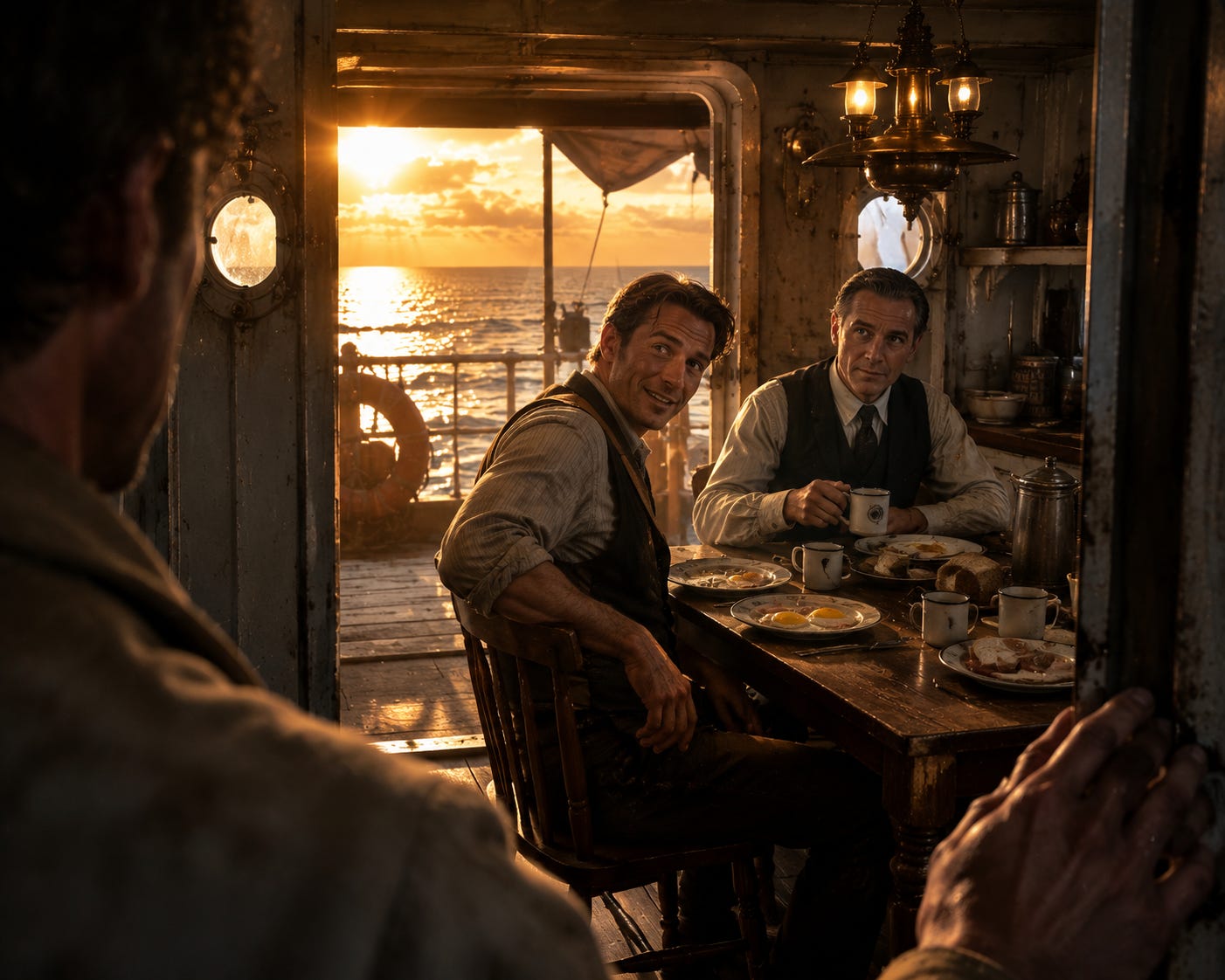
The three friends were brooding silently in Elfieda’s hotel cubicle. It was cold in the room, made to feel even colder by the streaks of sleeting rain that brushed past the only window. Jona stared outside vacantly, with no thoughts of any kind, and no desire to move from where he stood. Elfieda and Alex lay on the bed, stretched out side by side. Elfieda was on her back, with eyes closed. Alex was on his stomach, head cradled in his arms, an unlit cigarette propped in his mouth. He grunted as he reached for matches.
“It’s crazy idea. If you’re interested, I vill tell you.”
Jona did not answer. He leaned against the freezing window, seeing nothing but the condensation of his breath on the glass pane. He held his breath every few moments, just to watch the vaporous layer recede rapidly, then breathed out deeply again to watch the misty residue expand, creating a thin patina of cooling carbon dioxide and oxygen, a chimerous reflection of his life. It, like so many other things, would disappear forever the instant he moved on. It seemed like ages that they were caged in the small hotel room, and Jona had ceased to care about anything. He was vaguely hungry, and the stubble of beard on his chin and neck caused a chaffing sensation. He was aware of nothing else. Emptiness enveloped him. Marielle was gone away, taken to somewhere in Siberia, exiled to some ghoulish prison camp. He was in Moscow with false identity papers, just as likely to be swept up as she had been. There was no way to get to her, and there was no way home, at least no easy way home. Somewhere in the back of his mind some other thoughts pricked at him, but they faded away without much effort, leaving his mind completely blank.
“Jona, you hear?”
He said nothing, but gestured for a smoke.
Alex swung his legs around, rearing up on the bed. Elfieda also sat up, rubbing her forehead as if awakening from a bad dream. The single naked light bulb hanging from the ceiling continued to flicker, as it had all day, giving both of them the appearance of uncoordinated, herky-jerky movements. Alex offered an almost empty pack of Fatima cigarettes.
“Look, ve must make a plan. You go back home or not.”
Jona lit up and took a deep drag. The room immediately became permeated with a smell of bitter, rotting, smoky incense. He cast a quick look in the direction of Alex. “What do you mean? Stay here?” He returned his gaze to the opaque gray outside the window. “No.”
“Alright, then vhat? Go to the Swiss embassy?”
Jona felt a surge of anger race through him with electric intensity. “I don’t know, Alex. Why don’t you tell me. You too, Elfieda. Why don’t you both tell me? You’re the ones who got me into this back in Berlin. It’s OK for you two, you’re like two little peas in a pod, aren’t you.”
“Jona, leave Elfieda alone. I tell you one time only. No more warnings.” Alex stood to his full height. In the confines of the small room he loomed over Jona with monstrous immensity.
Thoughts began to click into Jona’s head, at first disjointed but then organizing faster and faster, snowballing into an avalanche of images and words. Marielle. His father. Lenny, for some absurd reason. Andrews. Koehler. Marielle. He hung his head, taking another deep pull on his cigarette. “Sorry Alex, Elfieda. It’s really tough...” In another place, in another time, Jona would have started to cry, and he almost did. Elfieda rushed to embrace him as he heaved a sigh.
“We’ve all felt what you’re feeling now, darling.”
“Alright, both of you.” Alex swung his arms over their shoulders, then spun Jona around. “Stay here. Go home. Time to speak. “
“I’m not sure I have a home, Alex.”
“Good first step. Honesty. Adventure now over, right?”
Jona sucked deeply on the cigarette, inhaling it as if it were nourishment. “Yes. Maybe. I guess so. I don’t know.” He looked at Alex quizzically. “What’s your crazy idea?”
“No. First tell me. Adventure over?”
“Fuck yourself. What’s your idea?”
Alex sat back on the bed, smoking quietly. He snapped a glance at Elfieda. “Tell him.”
“Darling.” She tugged at Jona’s waist with both hands. “Alex and I are returning to Germany.”
“That’s insane!” Jona was staggered. “Germany! They’ll find you! They’ll arrest you! They’ll, they’ll...” He caught himself. “But why? You love it here. This is your home now.”
“Because that is where we are needed, Jona. In the viper’s nest, right in the center. We cannot just run away from what is happening.”
Jona sat down next to Alex, his head hanging low. “It’s so dangerous for you both.”
Elfieda continued quite calmly. “We still have many friends there. And we will have each other. Jona, listen to me my darling.” Her voice hummed, striking a perfect pitch of serenity. “There is one more thing. Alex and I are going to marry. As soon as we can. It is our pledge to love each other, friend to friend and lover to lover, until the end.”
A long silence ensued. Jona puffed quietly, numbed and without any show of emotion. A long black shadow passed through him, piercing right into him, obscuring any feelings of anger, or regret, or longing. For the briefest second he had a vision of Elfieda’s pale blond hair swaying back and forth right before his eyes, dancing to the slow tempo of his beating heart, but that memory dissolved rapidly into thin forgetfulness, leaving only emptiness. It occurred to him that he was feeling despair, but that thought also evaporated quickly, a meaningless description of an uncaring sentiment. Elfieda grasped his arm and rested her head on his shoulder.
“You can come vit us, Jona. Maybe Berlin is funny now, ve have some laughs together. You find a girl there. Vhat you think?” Alex knew the answer before he asked.
Though his hip was throbbing and a burning sting was shooting down his leg, Jona struggled to his feet to face Alex. “That’s not all, is it? What did you mean before when you said you had an idea?” he demanded.
Alex snapped his eyes towards Elfieda, who nodded her head. He sighed deeply. “I have a friend, Jona. A comrade from the var, like a brother. Not far from here, just outside Moscow, in place called Fili. He has airplane there. Many airplanes. He can fly them in Russia. He can fly them anyvhere he vants to, whenever he vants to.”
“Elfieda, Have you ever met this fellow?”
“Jurgens? No. Alex has told me about him. Alex saved Jurgens’ life. Did he tell you?.”
“Ah yes. Saved his life. And isn’t that just like Alex.”
They were strolling through the Hermitage gardens, soaking in the few slanting rays of sunlight that beamed down through unhappy slate gray skies. Elfieda held Jona’s hand tightly, as if he were a mischievous boy primed to run away at any moment.
Alex had left that morning, catching a bus to the Moscow suburb of Fili. Before leaving he had explained to Jona about his friend Jurgens, a Fokker pilot during the war who was shot down by the French. Jurgens managed to crash land his plane, but in the middle of No Man’s Land, somewhat closer to the French lines than to the German. It was obvious to soldiers on both sides that he was injured, bleeding badly, and could not extricate himself from the cockpit. Alex made his move when the poilus, who initially raked the downed Fokker with rifle fire, abruptly stopped shooting. He was able to snake his way two hundred yards to the downed pilot and carry him back to safety.
Jona could not fathom that kind of bravery. “What made you do it?” he had asked when he first heard the story.
“It vas the end, Jona. The end of the var. The Kaiser vas just abdicated. Ve all knew it vas going to be over soon, maybe even that day. As it happened, it vas the next day. I thought the inferno should not be fed anymore. No more meat into the cauldron, not that close to the end.”
“Yes, but I’m sure the enemy didn’t necessarily feel the same way.”
“But they did. Most did. The French boys stopped firing vhen they saw me running to the plane. I could hear some of them cheering. I could also hear the officers screaming out their orders, probably to shoot me. Nobody did, though. I ran to the plane and back until my guts burst, but really I didn’t haff to. Could have valked. The killing vas over. Jurgens lived. That vas good enough for me.”
“And he’s a Kozy now, living in Moscow?”
Alex laughed with that particular laugh he had, more laced with brittle sarcasm than joy. “No. Not Kozy, not close. Might be Nazi now, I don’t know. Still a pilot, working at Junkers plant in Fili.”
“Wait, I’m confused. Isn’t Junkers a German company, an aviation firm? What are they doing in Moscow? Russia and Germany...They hate each other, right?”
Alex laughed again, more gently this time. “Sure, Jona, sure. Hate each other, sure. But after the var, everybody else hate them both even more. Russia for having the Bolshies. And Germany for having the Germans. So, only possible friend is each other. Germans agree to set up plant in Russia for development of airplane types. Remember, peace treaty ending the var said no more air force allowed for Germany. Germans cheat on peace treaty, and Russians share in research. Good for both. Junkers company gone now, whole base taken over by Russians. Jurgens was at Lipetsk first, Russian air base, training with the Luftwaffe. I met him there in 1924, very happy, flying Fokker 13’s, living the dream of testing new airplanes. Then transferred to Fili, stayed behind to run whole operation for the Soviets. He’s in charge now. Everything. Rich man.”
Jona was staggered by the irreality of what he heard, almost as if a mischievous sprite had entered the room and sat down casually next to both of them to join in the conversation. “The Luftwaffe training at a Russian air base? Sharing research? Testing new models? It seems impossible, doesn’t it?”
Alex answered concisely. “No. Not really. Everything possible. You’ll see.” He left for Fili a short while later with a smile and a wave.
As he walked in the park with Elfieda late that afternoon, Jona wondered what Alex would learn from Jurgens. “Don’t worry,” he said with more confidence than he felt. “He’ll find a safe way back to Germany for both of you. His friend will help.”
“I’m not worried, we’ll be fine.” Elfieda gave Jona a searching look and grasped his hand more strongly. “And you? What about you, Jona? You will be fine?”
“Don’t know. I have to dig down, try to find something I can do, something I can understand, something I can live for, some purpose in all this shit.”
They were just passing the Hermitage theater as a crowd of children came running out its doors, whooping and shouting, herded together by pale faced and leather lunged teachers. The day was shutting down rapidly as the oval stump of sun receded behind a low-lying bank of purple clouds that obscured everything that lay beyond.
Elfieda watched the children as they spilled out into the street, then stopped, turning Jona towards her to look into his eyes, squinting, as if peering towards a far horizon. “If you find her, will you be happy?”
Lieb shrugged. “Marielle? Don’t know.”
“Do you truly love her? It’s important for me to know this one thing, Jona.”
“Yes…. Elfieda?”
“Darling, what is it?” She stroked the knuckles of his hand twice, three times, then stopped and pulled on his hand. “What’s worrying you?”
Jona stopped mid stride. “Tell me. Can love just leave or does it always stay? Even if the other person is gone, does it linger. I’ve been thinking that it might be like a modest perfume, maybe like rosewater, always there.”
They resumed walking in silence. Elfieda abruptly stopped, turning to grasp Jona by both shoulders. “With time, anything can wash away. Rosewater. Love. Even sin. Anything.”
“But the memory stays, right? Forever?” Jona seemed frantic. “This is important. I need to know this. Does it last forever?”
“What you need to know right now is whether you still love Marielle. Do you feel it, do you feel it in your heart ?”
He gave Elfieda a sharp shove, wrenching himself away from her. Jona could feel his face contorting, disfiguring with rage, and hear the blood pounding in his ears. His words roared in a tornado of sudden rage, spawned by some hateful wound draining from deep inside himself. “Why don’t you just go to hell! All of you, just go to hell! How am I supposed to feel anything about anything? You ask me ‘How do you feel, Jona,’ and ‘Are you happy, Jona, are you in love, Jona, is everything good, Jona?’ Well guess what, I have no goddamn idea. Not about anything anymore.” He sat down on a nearby bench and buried his head in his hands. Soft sniveling sounds shook out from his quivering head and shoulders, erupting as short, guttural invocations to uncaring gods.
Elfieda sat down next to him, embracing his neck. She tried to cover his face so that passersby would not see his grief, but people stopped and stared. “Darling, darling,” she moaned into his ear. Her voice heaved with the pain she felt for him. “Patience, the hurt cannot last. It ends for all of us, I promise. You are not the only one whose mind and soul have come undone. I once walked the same road you’re on now, believe me. Nothing can erase the stain of sorrow in your heart, Jona, but I’ll be by your side tomorrow and together we can make a brave new start. So come, darling. Come. Come now. Come and bind your wounds to mine.”
They walked back to the hotel arm in arm. Jona limped heavily all the way there, in horrendous agony with every step. He swayed against Elfieda, clutching her. Without warning, he blurted out the first thought that came to him. “Do you really think sin can be dissipated?”
“What are you asking, darling?”
“You said sin can be washed away. You said it.”
She glanced at him, fearful that he was becoming incoherent and clasped him even more tightly. “I don’t actually know…Your question is so odd, I don’t know how to answer.”
They lapsed into silence, but Jona appeared mor and more agitated. Elfieda stopped, pulled on his arm and turned to face him. “What is it, Jona. Why are you so upset?. Speak to me.”
“You and Alex are getting married. Right?”
“Yes, darling. I explained it to you. We love each other.”
Jona took a deep breath, then another, as if he were trying to recover from a race that was hopelessly lost. “Then, if I also loved you, would that be a sin?” He turned his head away. “Because I would sin for love. Over and over, if I could.”
Elfieda said nothing, turned and began shepherding him back to her hotel. In the room, she guided him onto the bed and patiently helped undress him completely, carefully extricating his legs from his trousers to avoid stretching his hips and causing him pain. She disappeared briefly, to return with a towel soaked in hot water that she draped over his forehead. Then she undressed herself and lay down upon him, breast to breast, and kissed his face. The room first whirled and then steadied, centering on the small space between their eyes, filled only by the quiet breath that flowed from one to the other. Jona shivered, and Elfieda held him all the more tightly, holding him with her arms as tightly as if she were holding the past to herself, not willing to let it part from her. Jona thought of Alex, and felt guilt wash over him, almost as if he were committing an awful transgression against an awesome law, an ancient law, a commandment that should never be broken. He felt the stabbing sensation of sin pierce straight through to his heart. But if this was sin, he could not stop; it was a cup he was eager to drink. And so he lay with Elfieda, deep into the night, holding with desperation, unspeaking, aching for her kiss, wondering if everything was nothing more than this, and sinning, sinning, sinning…sinning while in silent bliss.
Later, deep in sleep, his father came to him. Not as he was at the end, but as a young man, with sparkling eyes, cleft chin, and dimpled creases on his cheeks when his mouth spread wide in smile. It was Jona’s first year away at school, he was no more than eleven. They walked along the Deerfield River, clambering nimbly over every angular, moss covered boulder with easy alacrity, laughing at how marvelous it was to make their own path, a trail for just the two of them along the densely thicketed shoreline. His father clambered to the top of an enormous rock that stood at a turn in the roaring stream, a craggy boulder with the power to bend the river to its will, subduing the rushing waters enough to curve them around itself. He grinned at Jona as he spoke. “Do you truly love her, Jona? I need to know this one thing.”
“First, you tell me something dad. Do you truly love her? You know who. I’ve got to know this one thing, too.”
“I will tell you if you tell me whether you believe in sin. You were so worried about it just now.”
“It doesn’t matter. Even if there is something called sin, it can be washed away.”
His father grinned and pointed at the boulder they were standing on. “This rock has been here for a thousand years and the river has not washed it away. Sin and love are no different. They stay.”
The scene dissolved just as he was about to climb up the rock, receding into the hidden chamber of mock truths and primal fears that are the sphere of dreams. A city street then appeared in his vision, expanding rapidly. Jona found himself sitting next to Koehler. They were at Cafe Blue Sky, in Berlin. It was in the afternoon, before their opera engagement, and they were sitting at an outdoor table with all the bustle of the city surrounding them. Jona was drinking blue tea and Koehler was cradling a blue espresso cup while smoking his pipe.
Koehler grinned at Lieb. “You look as eager as Leander climbing up to Hero’s room, Herr Doktor. Have you fallen in love?”
Jona was feeling giddy with the excitement of the day. “Tell me, Professor, do you believe in love?”
“Silly boy. Of course. Love animates everything. The cosmos moves to the rhythm of love.”
“It’s just that I’m not sure what it is. How will I know it? Of course, I’ve read about it, and talked to others. But what if I can’t tell when the moment comes?”
“Oh, you mean like the problem posed by form and sensation.”
“No idea what you mean. Please explain, Professor.”
A clock ticked in the corner of Jona’s mind, a soft but insistent tick-tock. In his sleep he knew that when the moving hands touched the coming hour a bell would chime and he would awaken and everything he already knew about the world’s great questions would come spilling out into his awareness, a deluge that would drown out the story playing out in his dream, and the gentle pretense he was acting out. But in his dreamy state an unseen master of ceremonies, a creative maestro, hovered in the background and decreed that Koehler was to continue his part in the dream a bit longer before dissolving back into the inchoate slime of Jona’s unformed thoughts.
“The question is about whether we can ever really know anything without experiencing it first. Imagine a man blind from birth. Give him a ball and a cube to play with every day. Let him explore both objects as much as he wishes and instruct him carefully about which is the ball and which the cube. Then imagine his sight is restored. Place the ball and the cube on a table a few feet away and ask him if he could identify each one properly just by looking at them. Could he?”
Jona was now sitting high atop the rock by the river, overlooking the surrounding forest. Koehler was sitting next to him, puffing on his pipe patiently. “No, professor. No. The knowledge must be transferred from the hands to the eyes in order to know which is which.”
“So the eyes can only know when they are first informed by the hands? And the hands informed by what the eyes can show?”
“Correct.”
Koehler was persistent. “But if the man is instructed, taught once again with words while actually looking at the two objects, if they are carefully described, could he not identify each one?”
“No.” In his dream, Jona was surprised to find that it was now his father speaking. Koehler had disappeared. “No.” He turned his cavernous eyes towards Jona. “No. The senses must first be satisfied. Nothing else is real.” He poked a finger into Jona’s chest, straight into his heart, leaving nothing but a neat, small hole to show for it. “Nothing else is real.”
“So, love is not real?”
His father laughed, a great bellow, his mouth gargantuan. “We were talking about sin.”
Jona opened his mouth but could not speak. Smoke enveloped him, the fumes from Koehler’s pipe, twining around his body, pressing against him, pushing, tightening like the coil of a vine, then relaxing, then tightening again to the slow beat of his heart, tick-tick-ticking.
A tinny clock alarm rang. Elfieda reached over Jona’s chest to click it off. She turned into him and caressed his cheek. “Up, darling. Alex will be back soon.”
Lieb turned his head away, unable to look into her face. When he spoke, it was with a low croaking voice, brittle as ice. “I just don’t know, Elfieda, I can’t be sure.”
“About what, darling?”
“About what you asked me yesterday. About Marielle, whether I love her. Or whether I only want her.” Jona stifled a sob welling up. “Or whether I’m pretending about everything or imagining it all. I just don’t know.”
“Jona, dearest, you’d better decide quickly. Alex is making arrangements right now with Jurgens. We talked it over, and we decided that before we return to Germany we’re going to help you. We’re going to find her, Jona. We’re going to find Marielle, the three of us.”
Vnukovo airport looked deserted. The trip from Fili was not long, just over an hour, but the cold night air had seized them within minutes of taking their seats in the back of the lorry being driven by Jurgens. Alex sat between Jona and Elfieda, hugging them both tightly, but to no avail. By the time the truck stopped at the airport entrance, Jona was shaking uncontrollably.
It was just after four, of a desolate and foul looking morning when they pulled up to the small, brightly lit red guardhouse controlling the main gate. Floodlights covered the area, and receded at regular intervals left and right, giving shape to the general outline of the airport. The runway lights were off, leaving a void as black as middle earth in the near distance, and the vague outlines of support buildings, warehouses, and hangers floated as black silhouettes in the far distance. All except one, a tall hangar that reflected a shining light as brightly as a Roman temple.
Jurgens and Alex entered the guardhouse, spending a maddening amount of time inside before scurrying out just as the main gate began to roll open. Alex gave a thumbs up sign as he sprang onto the bed of the truck with Jona and Elfieda.
“I told you,” he shouted triumphantly. “Jurgens runs this place like it’s his home. He goes back and forth between the production factory in Fili and here every day. Run everything, does everything. Maybe even distribute the bread.”
When they met Jurgens the day before, he had seemed cold and detached, even with Alex. Elfieda was worried that Jurgens would abandon them, but Alex remained unruffled. He assured them that the German aviator had agreed to help them wholeheartedly and had begun to draw up flight plans that same day. Alex and Elfieda had used the last three days purchasing coats, sweaters, boots, dry food, and miscellaneous camping gear. They had spent almost the last of their money navigating Moscow’s intricate backstreet black market, terrified of being caught in the process.
It all became exceedingly real to Jona when they pulled up to a concrete apron fronting the brightly lit hangar. An airplane of gigantic proportions, the largest he had ever seen, had come alive with a deafening thrum of its four engines. The force of the prop blast caused the truck to tremor, as if the hot breath of a monstrous dragon was flaming down upon them.
Jurgens jumped out of the cab and motioned them into the hangar. They gathered around a table covered by a map of Russia. Jona could see lines drawn on the map, marked in ink, radiating from Vnukovo eastward across the Russian land mass. Jurgens appeared ebullient. His taciturn expression of the day before was transformed by a wide, even smile. He shouted some words at them, too quickly for Jona to follow over the roar of the engines.
Alex translated. “He say this is special flight, maybe make vorld record.” He waited as Jurgens spoke further, and then pointed at the airplane. “He is saying this is specially modified JU K51. Right now civilian plane for transport and mail but one day will be perfect bomber that Germany and maybe also Russia will buy. Who knows, maybe Japan too.” They watched as Jurgens animatedly drew his finger across the map. Alex became rock still as his gaze travelled along the lines drawn across the face of Russia.
“Darling, what is it?” Elfieda clutched his arm.
Goldstein mumbled a few words to her, then glanced at Jona. He raised his voice to be heard above the relentless throb of engine noise. “He can take us very close to vhere ve vant to go, very close. There is small airstrip nearby the prison camp, outside town of Alexandrovskoye, very close to the island. One problem, though.”
“What’s that?”
“Runway seven hundred meters long.”
“What’s wrong with that?”
“Plane needs eleven hundred to take off.”
Elfieda fell asleep, looking drugged, almost as soon as they were airborne. Jona felt drawn as tight as a wire, shifting restlessly, trying to find a comfortable position that would alleviate the lancing pain in his hip and leg. They were seated on long metal benches that ran the length of the cabin fuselage, facing inward. Dim lights overhead provided feeble illumination. Jona sat alone, opposite his friends, but when Jurgens announced that they were at their cruising altitude of one thousand meters he crossed over to sit with Alex.
The burly German smiled wickedly. “Are you sick of sitting in your own shit yet?”
“Yes. Yes. No.” Jona hesitated. “May-”
Alex cut him off. “I know, I know. Maybe!”
They both chuckled for a moment. Without thinking, Jona grasped Alex’s hand. “I need to tell you something.”
Alex shook him off roughly. “Tell me nothing. All vill be O.K. Jurgens flies us there, three thousand kilometers, drops us off. Land six, seven, kilometers from island. Nazino island, in middle of river Ob. Whole Island is KZ, lightly defended, maybe by old men, the kind vith beards and thick glasses, and also aunties vith aprons and big asses. Ve have gear, food, guns. Ve go there, find Marielle, take her out. Jurgens fly to Tomsk, nine hundred kilometers away, refuel and resupply. Come back in three days just like Jesus. Brings chocolates and cologne. Pick us up, fly back to Vnukovo. Russians kiss his fanny vhen he announce historic flight vith new time record, three thousand kilometers in twelve hours twenty minutes, done by Soviet aircraft. The Brits will pay attention, I guarantee. Then next day fly us to Lublyanka, some shit-hole in Slovenia I think. Ve cross to Austria at Graz. Vill need a car or a donkey, but ve vill find. From there everything good.” He snapped his fingers. “Today Monday. Sunday vill be in Berlin.”
Silence overcame them, succumbing only to the grumbling drone of the engines. Jona rubbed his forehead with both hands. “I’m afraid,” he said simply.
“Told you before. Everyone live vith fear.”
“Alex, I need to know something. Why are you doing this? This whole thing is insane. You could be somewhere safe. Why?”
Goldstein reached over to pat Jona on the head. His eyes were made luminous by the reflection of a dull light directly overhead. “Sometimes you are so stupid, amazes me.” He nodded his chin towards Elfieda. “She love you. How, vhen, vhere, I don’t know. Why, really don’t know. Vants you happy. Vants you in love also. Something like that. If she vants, then I vant too. Nothing else important to me.”
Lieb collapsed backwards on the metal bench, feeling helpless. “But the two of you are getting married. I don’t understand.”
“O.K., Jona, O.K. not to understand. You haven’t lived enough, haven’t seen enough to understand.” Alex placed a massive hand on Jona’s shoulder and began to squeeze, squeezing his shoulder bone to the very brink of pain, so that Jona cringed, and only then released his grip. His lips twitched in half snarl, half sneer, half smile. “You felt that, yes? No, you haven’t felt enough. I love her to death. And she me, to death. Everything else just hot breath on cold morning, disappear in seconds.”
“We must be mad. Do you think we’re going to die?”
“Yes.”
“Yes?”
“Yes. But not today, Herr Doktor.” And then Alex laughed, a laugh that filled the cabin and vibrated through the airplane’s metal frame, resonating louder than the engine noise, louder than any fear or doubt, louder than the trumpet blast of reason, and just for a brief moment, louder than the screams in Jona’s head.
Stillness. Suffocating, white stillness. Even the airplane’s revving engine noise was muffled by the icy carapace of snow that coated the ground, the trees, the very universe surrounding them. The trio of Alex, Elfieda and Jona stood silently, transfixed by the sight of the K-51 skimming past them, taking impossible aim at the end of the clearing that marked the runway’s edge. Elfieda squeezed Jona’s hand with crushing strength, willing the massive wings to lift off the ground. At the last possible instant, the plane’s nose rose up, barely clearing the dense mass of forest that possessed the earth in every direction. Jurgens did not turn around to fly back over the clearing, or waggle his wings, or acknowledge in any way the forlorn looking group that was left behind. The airplane receded rapidly into the far distance, disappearing in minutes into the thin haze of clouds above.
“Let’s go.” Alex broke the silence with abruptness. He adjusted the rifle slung crossways over his shoulders, strapped on his backpack, and pointed Jona towards the compact sled they had brought with them. The compass bound to his wrist flashed in the lucent, snow reflected light. “Dark in two hours, maybe less. Go four kilometers due south. I push sled, Jona you ride. Elfieda you follow by five meters, no closer. And no further.”
Jona climbed gratefully onto the low-slung sled, being cautious not to dislodge the canvas covered bundles carefully prepared and strapped down by Alex. The other two laced up their snowshoes, and the small expedition set out over the snowpack at a slow and steady pace. Only then, riding within their hushed bubble of snowy isolation, was Jona struck by the enormity of what they were doing. He glanced backwards at Alex, gliding forward stolidly, and then at Elfieda a few yards behind. Streams of misty breath billowed from both of them, dissipating rapidly in the frigid air. My God, he thought, I’m responsible for all this. They are here, risking their lives on account of me. And I’m risking my life with them. All because of someone I loved once, someone I haven’t seen or heard from in half a year. Marielle’s face floated before him, smiling as she often did, with lips somehow downturned as her brown eyes sparkled. Jona blinked, but she would not leave him.
After their first meeting, Jona had given no further thought to the impish girl with short curly red hair, ivory skin and confident lift of chin. But when they met again, he became entranced by her immediately, as if he was seeing her for the first time. He was at the Brigades. It was an ordinary Friday night, percolating with the usual smell of coffee and beer, drenched in the usual roiling squall of earnest, intense discussion. Jona was looking for somewhere to sit down when he felt two arms embrace him from behind. His first sensation was the weak but definite smell of lilac. His second was the touch of two breasts pressing into his back. When he turned around, there was Marielle, hair stringing down under her hat and over her forehead. Her lips moved, and in the shadow of the dimly lit hall assumed a vague and hidden shape, a chiaroscuro smile that highlighted the lustrous beam of her eyes. Then she reached up to kiss him lightly on the cheek and passed her hand around to gently touch the nape of his neck. Her touch was electric, shooting through him with a thrill that raced down his spine again and again.
They talked, they drank wine, they kissed. She told him about her classes at the New School, and the wondrous freedom that came with knowledge and understanding of the human condition. He told her about his work performing postmortems. She confessed that she was frightened of what the future would bring to humanity. He confided that he was ashamed of his many failures. She struck the table with her fist, decrying the unjust executions of Saccho and Vanzetti. He told her about his recent deposition in the murder case of an obese mafioso. She declaimed that all ownership was nothing more than theft, that the evil moneyed classes were exploiting ordinary workers, and that either a communist revolution or an anarchist implosion was needed to cleanse America of its many sins. He told her she had lovely hands, something he could scarcely believe he had the audacity to do.
Later, when they were alone, Jona had his first experience in touching a woman. Marielle gave freely, smiling her Cupid smile, offering the warm promise of more with each mischievous gaze into his eyes. From that day onwards she occupied his thoughts day and night. He daydreamed about her, imagining the two of them embraced in every possible way. In his fantasies he brought himself to the edge of intimacy with Marielle, but not beyond. He always stopped himself. He did not wish to imagine that far. He found himself burning to only be with her, like a fevered monk sacrificing everything of this world to seek a cloistered place of prayer.
He should never have said a word to his father. When Marielle asked him to escape to a new life together, he should have fled with her, hand in hand, just as if they were two lovers emerging from the suffocating depths of night into the radiance of a new day. He would have been king, and she would have been queen, and they would have ruled together over the realm of their own destiny. But he did. He did tell his father. He told him everything, in fact.
Jona had taken the train to Boston, meeting his father in a nondescript coffee shop on Boylston Street. He had been with Marielle the night before, the night she begged him to leave everything behind, and he was worried that the smell of her perfume permeated his clothing and would be noticed by his father. It was clear that Earnest Lieb was in a bad mood; he barely looked up from his eggs as Jona slid into a chair next to him.
“Well,” he barked, “Any luck in identifying neurotransmitters from your isolates?”
“No, dad. Still trying.”
“Adrenaline precursors? A logical target.”
“No.”
Lieb slapped his hand down on the table, hard. “Then you’re being sloppy in your preparation. I’ve told you once, I’ve told you a thousand times that careful setup and preparation are everything. You’re too lazy to do it properly.”
“Dad, I want to talk to you about something else....” And then Jona told him. About Marielle, and that he planned to marry her, and move away to a small town, possibly in Wisconsin, or Kansas, and open an office as a general practitioner, and leave the soot and toil of New York behind him.
Earnest Lieb had long before mastered the art of listening carefully, at least when he wanted to. At first he said nothing and simply stared with intense ferocity into Jona’s eyes. After a short while he averted his gaze and began to toy with his fork and knife. When Jona finished, his father said nothing, continuing to play with his utensils as the minutes dragged on. Finally, he looked up at Jona and pointed the knife in his direction. “See this? It’s a useful tool, isn’t it?”
“Sure, dad. Very useful.”
“It changed humankind. More than that, it changed the world after it was invented. The ordinary relation of man to his world was changed forever. All because of the knife.” He held it up to the light, examining the blade carefully.
Jona felt he had to say something. “Sure, dad. Everything changed.”
Lieb puffed out his chin, a sure sign that he was going to lecture Jona. “Now you answer this question, young man. Is the knife the most important human invention?”
After a few moments’ thought, Jona answered. “Yes, dad, I think possibly yes, it definitely could be.”
“No, son. Not the most important.”
“The wheel, then.”
“No.”
Jona hung his head in contemplation. He could feel his father’s eyes boring into him, challenging him. He knew he could never answer correctly. For the moment, Marielle drifted out of his mind. “Not sure.”
Earnest Lieb tapped the table with the knife. He tapped harder and harder, tap-tap-tapping as if impatient with the slow pace of time, tapping a secret code that would open an underground cavern filled with ancient wonders. He grinned as he tapped, or smirked, licking his lips to lap up stray wisps of egg yolk. His eyes, one brown and one gray, narrowed into slits. Even when he stopped, the sound of tapping reverberated in the air. He leaned forward, a sign that he was ready to share a small sliver of wisdom. “The leash, son. The leash.”
Jona jumped on the idea. “You’re right, dad. The leash! Domestication of livestock! Primitive man could farm more successfully. Population growth. Cities became possible. All because humans could leash animals.” Jona felt happy and excited to share the insight with his father.
Earnest Lieb threw his head back and began to laugh, a loud, deep cachinnating explosion that made him stand up and lean forward just to take a sucking breath before breaking out in more guffaws. He ignored the nervous glances that came from others sitting nearby. After a few moments he sat back down, still heaving with mirth. He leaned close again. “Leash animals? No, Jona. Not leashing animals. Leashing humans. Learning to leash other human beings, to govern others of your own kind, to bend them to the will of someone else, to your will, one by one, then by the dozens, the hundreds, the thousands. To control the most dangerous creature on the planet. That was the most important lesson learned by humankind, it’s greatest discovery.”
And then the roar of laughter returned, resounding like the staccato sound of clapping, or rapping on a door shut fast. Bundled up and crouching on a sled ten thousand miles from Boston, Jona could still hear the laughing as his father told him he was a fool to think about marriage, and about becoming husband to a wife. He rubbed his blanched cheeks to bring back circulation to his face and clenched his teeth grimly. I understood what you were saying, dad, he thought. Sometimes we become captive to an idea, or a feeling, or to someone else, and can’t escape. But what you didn’t understand is that sometimes we don’t want to escape. Jona shook his head, as if his father were standing right before him. And sometimes the leash binds the one holding it.
The temperature had been just above freezing when they first landed, but now began to drop precipitously. Jona could sense that he was losing feeling in his feet despite the double layer of woolen socks encased within his thick leather boots. They were traveling through moderately sparse woods, leaving a long scar of tracks in the pristine snow. The forest surrounding them was mixed fir and pine, with beech, cedar and aspen trees sprinkled irregularly in every direction. The trees cast long dark wakes in the snow as the light began to wane. Alex appeared to be tiring. He slowed to a crawl, stopped, then abruptly accelerated off to their left, with Elfieda struggling behind. Alex began to run faster and faster, and began to shout incoherently, maniacally, possessed by some newly arrived and unseen demon.
Then, abruptly, they burst into an oblong clearing. Jona shook his head in disbelief at what he saw. A pond lay directly before them, with misty wisps of steam rising gently from its surface. The snow line ended a foot or two from the water’s edge, revealing a narrow ribbon of bare earth covered by a low splash of green shrubs and brown moss climbing out of the rocky ground. Alex shrugged himself out of his gear and ran towards Elfieda, hugging her. “Hot springs!” He shouted with delirious joy. “Hot springs, can du believe it!”
Elfieda rushed to the verge of the pool, placed her finger in the water, then splashed at it like a child. “I’ve read about these! The water feels like a hot bath! Very hot. Come on, everyone get into the water! Alex! You, too, Jona!” Without another word she shook off boots, socks, and clothing, and plunged naked into the water.
Alex grasped Jona’s arm tightly, not letting him move. “Let her have her fun. It’s just below freezing right now, not too bad. Vhen she’s ready to get out she’ll need a fire. Ve vill all need a varm fire. And hot food. It will get much colder.”
It took them thirty minutes to cut down a reedy poplar, trim the branches, and start a fire well away from the tree line. Jona tried to help, but could do almost nothing of real assistance except light the tinder that Alex had packed carefully in a small steel can. Elfieda stayed in the pond the entire time, laughing at them as they worked.
“Come on you two, it’s marvelous in here. I can feel tiny fish nibbling at my skin, it feels delicious. What’s the matter, afraid of a little fish? Or are you afraid of a little girl?”
Finally, when they had the fire crackling and spitting furiously, Alex began to laugh at her as well. “Alright, I’m coming in before any bears come by. They’re hungry this time of year, just waking up. They like girlie meat, you know. Get ready, I like girlie meat too!”
He stripped quickly and lunged into the water. The two began to frolic together, two bathers in a pool, swimming in a strange, exotic kingdom where frost and heat cohabited like two comfortable lovers. They called Jona to come in, but he shook his head, refusing, contenting himself with minding the fire which now roared and flickered higher than his head. Both Alex and Elfieda sat low in the water, exposing only their heads, but Jona could tell that they were embracing tightly. He turned his gaze away, then turned his back towards them, not wishing to see any more. He froze in mid-motion.
A man was standing no more than ten feet away.
He stood in a shallow swale next to a nearby pine tree, dressed so cleverly in white that he blended completely into the slanting arches of snow laden branches. He held a rifle, swinging the muzzle languidly between Jona and his friends. Alex had left his gun on the ground next to the campfire. Without a moment’s thought Jona took a step in that direction.
“Stoyte!” The stranger’s weapon swung up sharply, steadied in the direction of Jona’s chest. “Ne dvegaytes!” The man glided smoothly towards the edge of the fire, motioning Jona to back off. He wore short skiis, also white, with the odd addition of fur at the tips. Without any effort he retrieved Alex’s rifle, slung it over his shoulder, sidled close to the fire, and turned a curious gaze towards Alex and Elfieda.
Alex was stock still, his face impassive. He remained hunched down, almost completely submerged, as if he were preparing to dive underwater and swim away. The Russian made a brief survey of the entire scene, pursing his lips, evaluating, calculating danger and subtracting advantage. After a few moments’ hesitation he finished summing up, and with his mental computations of greater threat and lesser threat completed, he carefully raised his rifle and aimed it at the head of Alex.
“Bitte! Bitte!” Elfieda broke the silence with a choking cry, croaking in German, then in her broken Russian. “Ne boytes’. My iz Germanii!”
The man paused, then lowered his rifle. “Vy nemtsy?”
“Da! Da! Ja!”
Alex pointed at Jona, jabbing his finger to get the man’s attention. “On amerikanets!”
Without explanation the stranger slung his rifle and took two long sliding strides towards Jona, fumbling with a canvas haversack he had at his side. He retrieved a thick, compact book, opened it, and ran his index finger along a line as he read. “Hello, I am a man from Russia. Hello, I am your friend. I am Evgenii. Hello, how are you?” He spoke the words surprisingly well, then left the page to speak directly to Jona without reading. Long plumes of vapored breath billowed from his mouth and nostrils as he enunciated carefully. “You are American? Talk.”
Jona was dumbfounded, and almost paralyzed by the shock of his encounter with the Russian. Elfieda called to him from the pond. “Darling, talk to him, please. Call him by his name.”
Lieb shook himself out of his stupor. “Yes. Yes I am. An American. It is nice to meet you, Evgenii. It’s surprising, really, to meet you like this, unexpectedly.” Jona paused briefly, and then blurted out, “Actually, you surprised the piss out of me. Where the hell did you come from?”
Evgenii smiled, shook off his glove, and extended his hand. “You are real American, I can tell. It is luck today for me.” He waived at Alex and Elfieda. “Vystupit’! Come out!” He opened his book again and read carefully. “I am Evgenii Simonaidovich. I am a student at University under arrest. I come to embassy to ask for asylum political. How can it be this way. Thank you for your assistance. Good day.”
Jona shook his head, not comprehending. He scrutinized the stranger’s appearance carefully. A dense beard obscured his face, but his earnest gray eyes revealed a youth in his early twenties. “I don’t understand. What are you saying?”
The young man smiled again, a wider grin this time, and tapped his book. “They want to kill me here. I want to go to America.”
Evgenni was proud of the fact that he had been arrested three times and escaped three times. With Elfieda’s help he explained that he had been an engineering student at the university in Omsk. It was his dream to build bridges and dams, sewer systems, and one day, perhaps, and by the will of God, municipal electrical grids. He had never been interested in politics, refused to participate in communist youth league activities, and jeered at any of his fellow students who joined KOMSOMOL. The local NKVD watched him closely, fed by information from classmates. They also watched him for another reason. He came from a family of Old Believers, and he adhered to the traditional beliefs and practices of the ancient Christian Popovtsy. There was nothing new in this. Old Believers had already been persecuted for generations untold, and it was no different under Stalin.
His first arrest was for nothing at all. He left the flat he shared with three other students to take a walk and smoke a cigarette. Two foul smelling men apprehended him at his door and threw him into the back of a car. When he asked why he was detained they merely laughed and said “Quota.” There was no trial. An official at the police station wrote his name down in a leather edged ledger before he was put in a truck with a few others and taken to a logging camp near Novosibirsk. He escaped easily in less than a week, walking out of the camp in the middle of the night, guided by the permanent dawn of early summer, with only an axe in his hand and the clothes on his back. He learned the vagrant’s lesson very quickly: Hide near tracks for long enough and a train is sure to come by. Even in Siberia.
Evgenii was naive enough to believe he could return to Omsk and hide in his Godfather’s house. He was picked up within a moth, beaten moderately, and after his name was entered in another, smaller ledger, he was sent to a camp even further away, outside of Krasnoyarsk. This facility was enclosed by barbed wire, and the prisoners were required to work at hard labor every day, mostly repairing railway tracks. The trains still came by, but now there was no way to hop aboard. The guards were sometimes brutal and drunk, and at all other times drunk and brutal. Beatings were a part of everyday life, and of everyday death. The winter passed and summer came again, and the horizon was again highlighted by deep auburn and azure pigments when the sun bowed low before swinging upwards again.
Once the roads opened, groups of women were brought into the camp from time to time, generally to the dining hall. This was an event that gathered almost all the guards, all eager to be with the women. Evgenii was never able to learn where they came from, the women. Some prisoners said they were treasonous Muscovites. Others stated with certainty that they were Tungus women, rounded up by the authorities in order to destroy the native Tungus tribes once and for all, and depopulate Siberia for the Russians. When the women were brought in, others came as well. Hunters, hermits, trappers, and mystics from the surrounding forests also flocked to the camp to join the guards, whether invited or not. First, they would drink, then drink and sing, then just drink again until sotted. Then, at some convenient point, raping would begin. Of course, it wasn’t really known whether the women were paid or not, but it very much sounded like rape. The prisoners could hear the women’s imprecations and prayers from across the camp, and ultimately their cries and screams. It was not unusual to find a body placed neatly at the doorstep of the dining hall the next morning, ready for burial. They were always fully clothed when laid out that way, as if they had dropped by for some bread and soup the night before, when their spirit left them unexpectedly. After observing a few of these nights, it became easy to plan an escape by digging under the perimeter fence. By this time, Evgenii knew the train schedule of the Trans-Siberian railway intimately well.
It took him a month to get to Ufa, where he had a cousin working a fishing boat on the Belaya River. Unfortunately, his cousin turned him in immediately to a local kopy and went to the extra effort of publicly denouncing him to the reporters of the town’s daily gazeta. This time he was beaten severely for days on end, and eventually underwent a formal trial. He was convicted, of course, and sentenced to ten years in prison in Sakhalin. The island of Sakhalin was at the very eastern fringe of the Soviet empire. It was so far to the east that the sun itself was barely awake in the morning as it arose from the sleepy waters of the Pacific. In Sakhalin Evgenii became just another zek, an inmate in a fortress prison overlooking a desolate, rock-strewn shore. It was impossible to escape, but it was very possible to simply walk out if someone should happen to leave the gate open. This proved to be a feasible option because the devoted comrades who operated the prison were also capitalists of the first order.
It was the following year, in summer once again, when his Godfather appeared at the prison gates to negotiate his release. He came with a sack of Gitanes and Gauloises Bleu in tow, with the promise of more once Evgenii was released. Apparently, this was how business was done on Sakhalin, as Evgenii was not the only one to vanish from the prison rolls that year. Later, he learned that the cigarettes were a gift from Bishop Theofractes, who was aware of Evgenii’s plight and who was himself in hiding with other Old Believers in the fastness of the snow swept taiga. Where he procured them, God could only know.
So here he was at last for more than a year now, safe in the middle of a desolate nowhere, far from prying eyes, hiding in an abandoned banya near the river, and plotting his escape to America. And now that he had encountered Jona and Alex and Elfieda, and understood who they were and what they were about, he offered to assist. He would bring them to Nazino Island, a place which he knew well and where he had hunted before the arrival of the prisoners, and would help them extricate Marielle. In return, they would help him escape Russia.
When the story was finished Evgenii pointed at Jona excitedly. “You help me, American. God brought you here to help me.”
They were sitting around the fire on springy fir branches, basking in the tongues of heat that flared from the flaming logs. Small cinder sparks floated upwards, dancing crazily in the semidark of endless evening. Evgenii had cut and crushed some tendril-thin currant branches that he was boiling to make tea, and the smell just now began to waft over them. Jona barely felt the touch of cold on his cheeks and nose, and felt relieved that the pain in his back and hip had gone dormant. He wanted to be kind to Evgenii, but even if the young Russian’s fantastic story was true, there was no way to offer help. “I’m sorry, my friend. I can’t help you.”
“Anyway, it was not God that brought us here.” Alex broke in with some vehemence. He was sitting the furthest away and was cradling his rifle closely. “You can believe anything you want. It was an airplane that brought us here.”
Evgenii began talking rapidly in response, almost laughing as he spoke. Elfieda translated for him. “Alex, he says that it was more than an airplane that transported us here, it was something else, something very near to our souls. He says it was God who moved us. Nobody would come to this place unless moved by God or Stalin, either one. Anyway, he saw our plane. That’s why he tracked us. He thought we were the police, maybe looking for him.” She waited as the Russian spoke further. “And he says that if he saw the plane, then the people on the island must have seen it as well. They are very hungry, and will be looking for us.”
Jona was astounded at what he heard. “Does he think they’re expecting us to bring food?”
Elfieda said a few words to Evgenii, who answered tersely. Elfieda remained quiet for a moment, and wrapped herself tightly within her own arms. She seemed to bob forward, almost as if in prayer, then spoke barely loud enough to be heard over the crackling of the fire. “No. Not looking to bring food. He says they will be looking for us. They will be looking for...us, Jona. It has become an island of cannibals.”
Jona slept long after the others awakened, and even then lay in a deep, torporous daze with eyes closed, lying quietly within the safety of his sleeping bag. The sounds of utensils clanking together, the bubbling of boiling water, and Elfieda’s low pitched murmurs blended into the vast silence of the taiga. He imagined himself as no more than a tiny speck lodged in a remote corner of an overwhelming canvas of white and green that compressed all of them into crushing insignificance. I don’t care, he thought. The time has come. The journey ends. We are going to find Marielle. He felt excitement. He couldn’t wait to go. He felt fear. He wanted to stay. He sat up abruptly, emerging from his rainproof cocoon with an uncontrollable shudder.
Elfieda approached, a barely formed silhouette drifting towards him in the murky gloaming of early morning. She held a small tin bowel in her hand, proffering it towards Jona. It smelled like stew. “Eat this. We will all need our strength today.”
Jona sniffed. “What is it?”
“Alex said you would ask. Our new friend is a trapper.” She pointed at the bowl. “Our potatoes and onions. His polecat and squirrel. Don’t make a face. Eat it.”
Evgenii insisted that they first disperse and cover up the campsite, using pine boughs to sweep the area. Eventually he seemed satisfied with the results, and indicated they should pack up. “River is four versts from here, where banya is. Island two versts from there. I have boat at banya. He pointed south and smiled at Jona. “Come. America this way!”
They reached the river as the sun approached its maximum height above the treetops. The Ob raced by at a rapid pace, raising green and brown wavelets that peaked with irregular crests at midstream, pushing tenuous lattice works of frazil ice forward at dizzying speeds. Ice borders flattened everything at the water’s edge, revealing the wide, irregular breadth of the river. A brown furred bear meandered lazily along the far side, barely curious about the new intruders. Evgenii skiied directly to a small boat that was clearly visible at the river’s edge, inverted and propped up against a house-sized boulder, and was soon joined by Alex.
After inspecting the boat, he led them up a short slope and back into the forest. The banya was a wooden shed made of rough hewn planks, partially sunken so that it blended silently into the surrounding timberland. Inside, it reeked of rotting fish, but once a fire was started the single roomed cabin warmed up nicely, and Jona was grateful to shed his coat. After putting a pot to boil for tea, Evgenii waived his arm for attention. He spoke once again through Elfieda. He explained the general layout of the camps on the island: one each for the male and female prisoners and a separate camp for the guards. The total number of prisoners couldn’t be more than a thousand. The guards did almost no guarding, content to randomly intimidate and humiliate individual inmates who crossed their paths. They spent most of their time drinking or whoring with women in exchange for food. They could not care less if someone escaped, since it was certain death in the surrounding ice bound wilderness without adequate food and clothing. The camp commandant was almost never there. It was said he spent most of his time with his mistress in the village of Nasino. If they approached the island early enough, they could tie up at the main dock, take a well marked path to the women’s quarters, and be out within one hour. Merely brandishing a weapon would be sufficient if they came across any difficulty. He didn’t think there would be any need for shooting. They would rest that night and leave very early the next day. Then, an airplane would appear by magic, and whisk them all away to America. Compared to his past ordeals, Evgenii thought it would be easy.
Jona’s sleep that night was deep and dreamless. The sky outside was vague gray when he closed his eyes, and opaque pewter when he awoke. The fire flickered dimly, loosing its energy stingily into the surrounding space, a direct challenge to the natural order that ruled the outside kingdom of cold. Two arms slipped around him, touching him lightly around his waist, bringing warmth where there had been numbing emptiness. It was Elfieda, clasping him closely from behind, just as Marielle had done so long before. They said nothing, laying together until weak beams of light slanted across their faces from the only window in the hut.
Others began to move, and the morning rustle began. Soon they were drinking tea and eating biscuits as calmly as if planning a morning’s nature walk. Alex and Evgenii left the banya carrying the oars they would need, and to prepare the boat. Elfieda joined them with a small package of food as Jona watched from the window.
After a short inspection Alex returned to the shed, where Jona was waiting with mounting anxiety. He cradled a rifle in one arm and had another slung over his shoulder. “I have talked vith the Russian. Ve are leaving you here. Need someone to vatch supplies.”
Jona began to shudder as he had the day before, unable to stop his extremities from tremoring violently. “Please, Alex, please. Please don’t leave me.” He began to whimper.
“Vhy? You safe here.”
“Please don’t leave me alone. I’m afraid.”
Alex twisted his lips as he sometimes did, giving a look that was both sad and pitiless, remorseful and inflexible. “Sorry, Jona. I am sergeant and you are private. Ve go. You stay.”
“I know why you’re leaving me. It’s because of this.” Lieb pointed at his legs, still convulsing uncontrollably.
“Does not matter vhy.”
“Can’t you leave Elfieda with me?”
Alex shook his head. “Need her to row. Coming upstream on way back.” His voice softened. “Island is right around bend in river.” He jerked a thumb over his shoulder. “Be there in thirty, forty five minutes. An hour at the very most. Evgenii take us to women’s camp. Find Marielle. Ve come back this afternoon. Vill not leave you. Promise. You have your pistol?”
Jona dumbly nodded assent.
Elfieda and Evgenii came up. The Russian was smiling from ear to ear. “Be happy, new friend. We go to Hollywood soon! Dooglas Fairbanks the junior, Irena Pickfor, martini sours! This is for you, help you pray for safety.” He fished a small wooden object out of his pocket and handed it to Jona.
It was a miniature icon made of wood, no more than three inches by two, slightly warped and heavily pitted at the edges. Jona stared at the image. The tempera had eroded in places, but the gaunt face of a sad appearing, wimple shrouded woman was clear. At her chest clung the partially obscured image of an infant. “I wouldn’t know what to do with this.”
Evgenii spoke to Elfieda who answered for him. “He says it will give you strength and comfort, Jona. You can keep it or not. As for me, darling, you know I will never abandon you. We won’t be long. Tonight, you will be with the girl you love.” She bent over and kissed him squarely on the lips, a kiss that blushed with warmth despite the cold, then turned away to join the others in the boat.
The boat was a simple kizhanka, nothing more than a sturdy, large sized rowboat. Jona stood at the shoreline to watch it disappear as the river currents carried it rapidly around a sharp turn several hundred yards away. He wanted desperately to climb to the top of a nearby boulder, so that he could see a longer length of the river as it twisted and bent on its onerous, frigid journey to the arctic. As it flowed north, the river engulfed the small island where Marielle was held captive. Jona wondered whether Marielle would understand when she was found by Alex and Elfieda. He imagined her smile when she realized he had come for her, that despite his infirmities he had braved thousands of miles of hardship and danger to be at her side. For you, Marielle, he thought. This was all for you. He repeated the words over and over, all for you, all for you, rubbing the icon as he did, imagining her face when they would meet. Without thinking, he raised the icon to his lips and kissed it, murmuring to himself. All for you Marielle. Finally, I understand what love is.
Jona returned to the hut and lay down, feeling exhausted and almost overcome with the exertions of the last two days. He fell on the bed, covered himself with blankets, and cowered underneath the rough wool until he could hardly catch his breath, pretending he was at the prow of the kizhanka, alert to the face and form of Marielle, ready in an instant to sweep her up and carry her to freedom. Even as he did so, a feeling tugged at him, dragging him downward with a sense of dread, submerging him under the weight of the unknown, and unknowable...
When he regained consciousness the light creeping through the window was again the dusky slate of evening time. He checked his watch, and checked again. Eleven hours since the others had left. Jona stumbled to his feet with a gnawing pain in his belly, dressed as quickly as he could, and made his way painfully down the snowy slope to the river’s edge. A light rainy sleet was falling, like the fine spray from a waterfall, gently stinging his face. Despite the burning in his leg and back, he crawled and pulled himself to the top of the boulder at the water’s edge and positioned himself looking north.
He could see nothing but the molten lead of the river, twisting left and right, overwhelmed by the vast armies of thickly settled trees spreading in every direction, like a dense dark fog obscuring everything lying below. As time passed the sleeting slackened, and the sky brightened. Finally, the sun’s dim crescent edge peered down at him over the canopy of trees. Jona began to shake spasmodically, uncontrollably. He realized abruptly that it was not eleven hours since his friends’ departure. It was now the next morning. A full day had gone by and they were still gone. He was alone, completely alone, in a place he did not know and could not comprehend, subject to everything and lord of nothing.
Jona stretched himself out on the top of the boulder, still gazing in the direction of Nazino. He wondered vaguely whether he was going to die where he lay. He was suddenly very thirsty, and felt the undeniable churn of hunger within him. A desperate yearning for a cigarette clawed at him. For a moment, he considered climbing down from his slag-like rock and going back to Evgenii’s banya, but the same brown bear he had seen the day before had meandered back, and though he was across the river he was now on his hind legs and sniffing in his direction.
For some reason, Jona remembered the feeling of serenity he felt in Moscow, and the hidden place within him that was both safe refuge and destination. It’s alright. It’s all going to be alright. The cosmos will be kind. In the end everything will be alright. Without meaning to, he retrieved the small icon from his pocket and studied it. A representation, he thought. A totem. Something meant to give good luck, meant to ensnare the stupid...or bring a sense of peace, even if it’s only a phony peace. Jona’s mind felt fatigued, his thoughts jumbling together. Abruptly, his thinking cleared like the sudden parting of waters. A leash. Right, dad? Another one of your secrets I’ve discovered, isn’t it. A loose end that I’ve finally connected. Jona laughed hysterically and began to rub the icon, rubbed furiously as he laughed, rubbed for the pure pleasure of it and laughed with a baying laugh, his very laughter invoking the sun and stars and moon. “Come on, icon!” He shouted into the wind, into the vastness of the forest, into the power of the river that swept everything before it. “Come on! Come on, sad lady! Come on, little baby! Come on! Bring me luck!”
The icon slipped from his hands and clattered down the face of the rock, falling into a crevice deep below him, lost from sight.
The boat appeared.
It turned the bend in the river as if on a shimmering cloud, a fata morgana driven by oars that from a distance looked like majestic wings beating in the air. Jona stood and waved his arms frantically, and saw that someone, probably Alex, was also waving. The more that Jona waved, the more Alex gestured, and soon he began to brandish his gun, pointing it repeatedly at Jona. Overwhelmed with joy, Jona turned to clamber down the rock.
The bear was before him. It was halfway up the boulder, not more than ten feet away. It had approached silently, but once Jona looked its way it first growled, then stood on its hind legs and let out an ear splitting roar. Even though it was standing well below him, its head rose higher than Jona, and spittle from its open jaws flicked onto Jona’s face. In senseless terror, he collapsed backwards and scrabbled to the very top of the rock, kicking violently with numbed legs and feet. He tried desperately to remember the few words that Evgenii had told them about encountering bears. Cower, he had told them, and keep cowering in submission no matter how they roar. Unless they start to eat you. If they start to eat you, run as fast as you can. Maybe you’ll be lucky.
There was nowhere to run. The bear approached, carrying with it a fetid odor and goblets of foul slobber dripping from its teeth. It loomed high over him as Jona scratched at bare rock in frenzied panic. An enormous, clawed paw obliterated the sky, hovered, and prepared to descend with crushing force.
The bear then swayed, rocked back and forth once or twice very gracefully, as if executing a precise pas de bourrée, then tumbled backwards. A split second later Jona heard the reverberating crack of a rifle shot. Alex loped across the icy river edge, his weapon still at the ready as he approached the bear carcass. “Jona, come down fast,” he shouted.
Jona’s heart was pounding as he descended. He could barely control his arms and legs as he climbed down. The bear was dead. The kizhanka had pulled up on shore. There was Alex. There was Elfieda. There was Evgenii. They were lifting a canvas-shrouded form out of the boat. A body, inert. The three hurried the body up the slope towards the banya. Lieb lagged far behind, overcome by pain piercing his left hip and thigh. His body was crushed. His mind was a chaotic mixture of apprehension and confusion. He could go no farther, and simply sat down on a rotting timber to recover.
No one came for him. The dwelling’s single window flared with garish yellow light, and pale puffs of smoke erupted from the chimney. There was no sound but for the swirling, flowing murmur arising from the river. The door opened at last and a form emerged. It was Elfieda. She rushed to his side and helped him up. “She’s alive, darling. But she’s...” The painful squeeze on his arm spoke louder than any words.
“Why didn’t you get me sooner?” Jona felt anger spewing upwards, erupting with all the frustration and fear he had pent inside. “I am a doctor, damn it! What’s her condition?”
“Darling, we wanted to clean her up a bit before you see her. You’ll understand.”
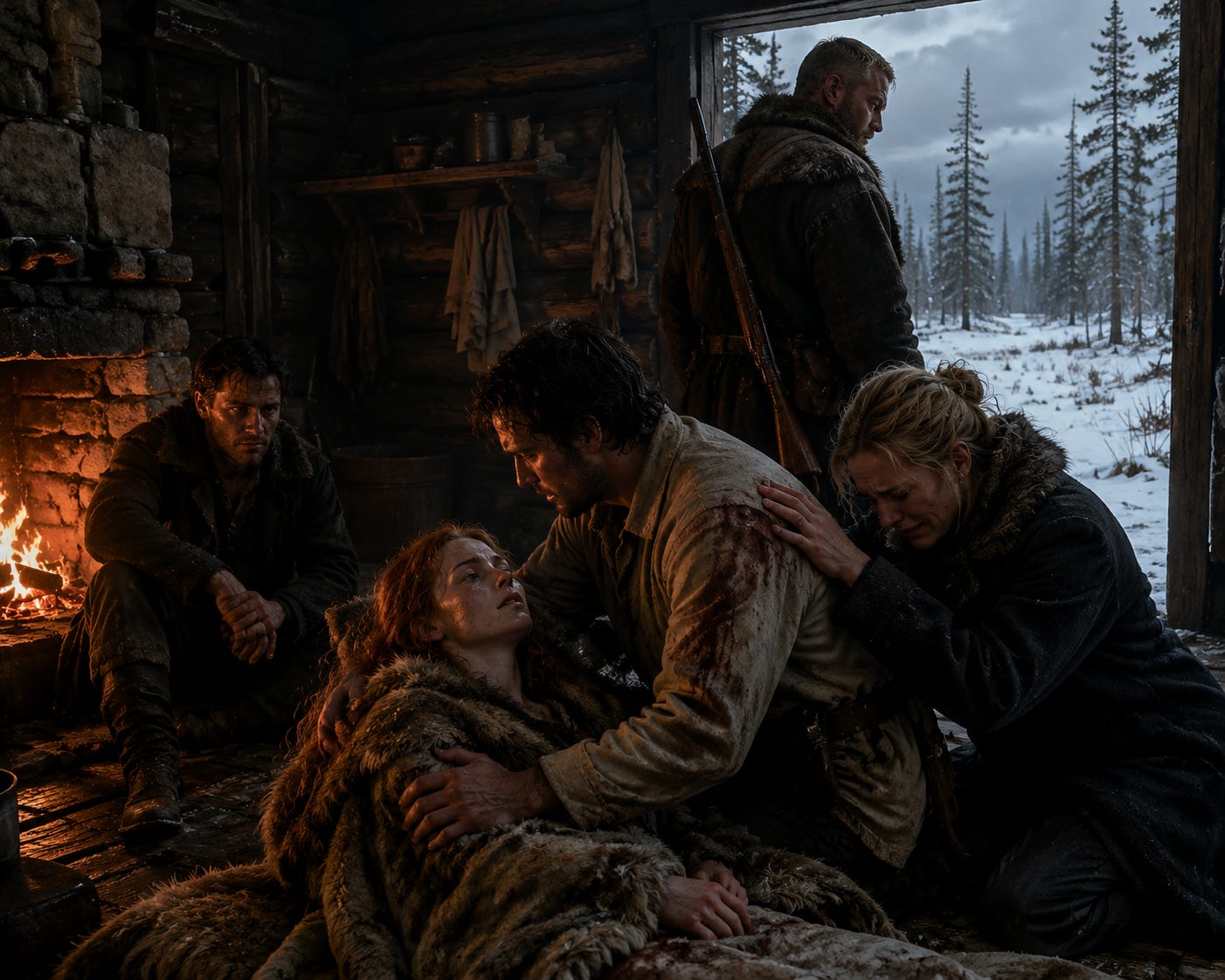
Despite the fire, the room was dark. Alex stood at the window, looking away from them and out at the river below. Evgenii was sitting on the floor to one side of the fireplace, his face impassive. A young woman was laid out on the rough stone paving that served as a hearth. Her breathing was labored and stertorous, a harsh cycle of inhalation and exhalation that varied irregularly. Jona knelt at her side. It was Marielle. She appeared ten years older than he remembered. Her lustrous red hair was matted down in thick clumps that whorled around bare patches of bald scalp. Deep fissuring excoriations were at the corners of her mouth, and her skin had taken on a leathery appearance. But it was Marielle.
A dark stain of blood seeped through the rabbit fur blanket covering her chest. He motioned to Elfieda to remove it.
She hesitated. “Please, Jona, don’t.”
“Remove it,” he barked.
He knelt at Marielle’s side as the covering was removed. Two large oval welts of angry red covered her upper chest. Fragments of muscle bundles and the pale white edges of rib cartilage protruded from the margins of the wounds, and blood oozed vigorously from a latticework of hundreds of small blood vessels in the exposed tissues. There could be no meaningful treatment that could be offered for the visceral exposure and steady blood loss she had suffered. Jona almost fell backwards in shock. He had never seen anything like these wounds. He could barely utter a word. Her breasts had been cut off.
“What happened?”
Elfieda knelt down next to Jona, embracing him with one arm. “We found her. But it wasn’t as we expected. She was not with the other women in the camp. We questioned them. They told us she had been taken that morning by a group of men, taken into a small wood nearby. We followed very carefully. Alex led the way. We could hear the men in the woods, but Marielle never made a sound. We thought maybe she was being raped. When we found them...” Elfieda broke down and began to cry, unable to continue. Alex and Evgenii remained motionless. Her sobbing continued for several minutes. The fitful flares of light from the fire lit her tears, transforming them into lucent pearls that adorned her face as they bled down the curve of her cheeks.
“What happened then?” Jona spun towards Alex. “Tell me, tell me everything. What happened then?”
Alex cast a weary look at Jona, as if burdened with an unbearable weight. “This vas a place vhere they eat human parts, obvious many times already. The men vere savages, they had no shame, like fiends. There vere some bodies on the ground, opened up, parts missing. Legs, arms, thighs, things from inside too...More horrible than anything I saw during the var. They had Marielle tied up on tree trunk. I could see red hair. They cut off breasts earlier in day, bleeding badly, she vas unconscious, maybe dead. Could not tell. I hear them talking, laughing. Breast meat a delicacy for them, I could hear them begging for it. There vere tventy, tventy five of them, at least ten vith guns.” He gave Jona a direct, piercing look. “Could do nothing my friend. It vas my decision. Gave order to hide and vait. Ve vaited. They cooked. Made stew from hell. They ate. Others came, alldrinking. Ve hid more. They leave in morning. Then ve take Marielle.”
Jona shook his head, torn between thanking Alex and cursing him. “You took so long. I was afraid.”
“Another thing, Jona. Important. I had to shoot a guard. He vas at the dock when ve arrived vith Marielle. Looking at boat. No choice.” Alex turned his gaze outwards once again, staring intently at the river. “Von more thing again. I think someone saw us, heard the shot. Maybe they following us.”
Evgenii spoke rapidly, his voice rising as he talked, appearing agitated. Elfieda explained. “He says it’s too bad Alex had to shoot the bear. Evgenii thinks they would have heard the shot, and know what direction to come in. Also, he says something else, Jona.” She glanced rapidly at Alex. “He says we should move out now, before they come. If they come this way we’ll be trapped here. He’s leaving on his own right now. He says it will be better if we split up.”
Jona struggled to his feet painfully, unable to bear weight on his left side. “I agree. Let’s get going. She may have a chance if we can get her some help.”
Alex put up a cautionary hand. “Jona, vait. The truth is that ve can’t take both you and Marielle. Only one sled. Elfieda and I have talked. Ve three - you, me, her - stay here vith Marielle, or ve leave her behind.” He hesitated briefly. “You decide.”
Jona crumpled to the floor once again, now in agony. A memory of Marielle came to him, smiling brightly. He felt her touch, felt her fingers as she stroked his cheek and her cool, cool lips as she kissed his neck. He could smell the citron fragrance in her hair. The vision departed as tears blurred the world around him. His mind spun as he tried to grasp onto something, anything that made sense.
Everything has a meaning. Everything has an explanation. Everything has a beginning. Everything has an end. The words cycled through him over and over, at greater and greater speed, until he felt his brain would explode. The picture of a zebra burst into his mind. As a boy, during his convalescence, he came across pictures of a lion killing a zebra, subduing the unfortunate prey by clamping its jaws around the zebra’s snout until it sank to the ground, paralyzed in surrender. The images were terrifying to Jona. His father explained, though, that nature and biology had not forsaken the victim, and that at the end the animal anesthetized itself in such a way that it felt no pain even as it was ripped apart. When Jona asked how that could be, his father answered that it was rapture. Before succumbing to the tearing of its flesh the animal was given to feel an ecstasy that transported it, like Charon’s boat, from mortal life over to immortal death. Jona imagined Marielle as her flesh was torn from her body by predators, slipping into an intoxicated trance of exaltation. In that moment he wanted to follow her, blend himself with the Marielle of his memory, and flee the awful pain in his heart.
“How can I leave her,” he sobbed, wiping away tears as they brimmed in a torrent. “How can I go on at all? Go where? Do what? Live on in this cruel, fucking cruel world. And why?”
Elfieda knelt down to embrace Jona. “Love is the only answer to cruelty, Jona. The only thing worth living for.”
He shrugged her off, coughing in agony. “Don’t touch me. I don’t want to feel anyone or anything. I loved her yesterday. I still do, but now sh’s…like this.”
Marielle gasped, an audible exhalation that seemed to emanate directly from her body, not her throat, a grunt that disgorged from a hidden cave deep within her. Jona threw himself down by her side, moaning. Her eyes were open, pupils constricted, oscillating back and forth in search of… What? The light of the fire? His face? Truth? Understanding? Her lips compressed and opened. Jona was sure she was saying his name, barely able to see through the tears falling like a waterfall. I love you. He couldn’t say the words but they ripped through his mind over and over. I love you…I love you…
“They’re here. They haff turned the bend.” Alex said the words calmly. “Douse the fire.”
Everyone turned to stare at Jona.
Alex spoke with a quiet hiss. “Jona. Go or stay?”
“What will they do to us?”
“Go or stay?”
“But what will happen if they find us?”
“Quick, not much time. Go? Stay?”
Jona’s thoughts blurred and he found himself unable to speak clearly. His vision narrowed down to a thin cone focused on Marielle’s face, down to every line and pore on her forehead and chin. She was barely recognizable, but it was her, the same girl who had once breathed a new life into his soul. He found himself mumbling. “Yes, I think so...No.”
Marielle stopped breathing.
Time stopped as well, or blurred, or weaved in and out, as if poking its head into the room from time to time, a dispassionate observer of a minor drama.
Marielle was dead, but then she was alive again, breathing. Evgenii said something, but then he was gone, leaving no trace behind. Elfieda was at his side, but then she was sitting in a far corner, head down and weeping. Alex was at the window, but then at the door, his hand on the latch. Time flew as the moments crawled.
“Jona,” Alex said softly. “It’s too late.”
The wind snapped again and again at the roof of the banya, a rhythmic beating that kept pace with Jona’s breathing. He imagined himself on skiis, racing gleefully away, laughing at his pursuers as he fled to parts unknown, to distant China, or Egypt or to the winding Amazon. He realized with a sense of defeat that he had refused to escape not so much because he loved Marielle, but because he had been too paralyzed to move.
The door burst open. Armed men poured into the hut, guns leveled, shouting commands in hoarse voices. Four, five, six, then eight men surrounded Jona and Alex and Elfieda, gesturing them to sit on the floor in the center of the room, a few feet away from Marielle. Ghostly gray light filtered in, casting smooth charcoal shadows on the walls. A wave of cold air drifted in from the outside. For a moment everything was silent and motionless, a perfect photoengraving cast in shades of dull steel.
A man sauntered in through the door. He was large, clad in a black greatcoat, wearing a tight fitting papakha that was dwarfed by his massive head. A long row of medals covered his chest, each one shining with a dull burnished sheen in the faint light captured within the darkened room. Striding with the air of someone in supreme control, he circled the little group sitting in a tight cluster on the floor, scrupulously examining each in turn as if searching out the freshest turnip at market. His examination of Marielle was brief; he merely jabbed at her inert form with the toe of his boot. He stopped abruptly in front of Jona, gazed at him thoughtfully, then lifted Jona’s chin roughly using one finger. Jona found himself staring at two blood streaked brown eyes that studied him intensely.
“Van holodno?” His voice was surprisingly high pitched, almost feminine.
Jona said nothing.
“Ve golodney?”
“I am an American. I don’t understand what you’re saying.” Jona hung his head and went on in a whisper. Tears continued to track over his cheeks. “Please don’t hurt me.”
The man straightened himself and made a peremptory gesture towards the open doorway. Another man scurried in, a gnome of a man with deeply ruddy cheeks and long leathery gullies lining his face. He ripped off his hat, revealing the white polish of a bald head. He also lifted Jona’s chin and scrutinized his features carefully. The gnome brought his own face very close to Jona, inches away. He opened his mouth to speak, but the words that drawled from his lips at first sounded foreign and unintelligible, and their meaning lagged behind the spoken sound, almost as if a time delay was needed for an invisible translator.
The small man talked with a sharp nasal twang, shaping his voice to sound pleasantly surprised, raising and lowering the pitch of his words, just as folks did back in his native Texas. “Well, well, well, if it ain’t Doctor Junius Lieb, son of the renowned Doctor Earnest Lieb, I do believe. It’s been some time and trouble finding you, sir.” He bent at the waist with a pretentious bow. “Your humble servant, sir, my name is Adalius Pecker, and may I say you and your accomplices here are in a heap, I would say in a very world, of trouble. And this gentleman here, the Comrade Commissar, is going to see that you pay dearly for your indiscretions, which are too many to enumerate at the moment. Isn’t that right, Comrade Commissar?”
The Commissar gave a thin grin, ignoring the gnome, and in labored, carefully enunciated English spoke to Jona. “I am Barzajian. You look like your father.”
Chapter 23
In his dream the night before, a woman came to him. She was soft, and spoke with tender words and loving caress. Promise Stone had been with women in the past, but not many and not in a very long time. So, he was glad to welcome this woman of his dreams and planned to hold her softly and make love to her roughly. But she removed her bonnet from her head, and shook out her black, black hair, and began to sing instead. In his dream the words at first made no sense, but slowly he caught on, and recognized a song he had heard quite often before. It was an old spiritual called You Can Have All Dis World But Give Me Jesus, one that he himself had sung a time or two, long ago. And when he recognized it, he clasped the woman’s throat and squeezed hard to make her stop, but she kept singing anyway, not stopping until he opened his eyes and let the dream slip away, returning sullenly to the nightly haunts where it was born.
That night he slept poorly, and almost let the dawn pass by unnoticed, insensible to the early light. In the same way, and for the same reason, he was unaware that Tim and Tom had left the storeroom much earlier, and without a sound. The rough, hay stuffed mattress he used for a bed lay right under a window, placed there so that the sun’s first rays would prick him awake. It had always been that way, for as long as he could remember. He had lived a life at hard labor, arising early and sleeping late, all to satisfy the needs of someone else. What he wanted out of life was of no account by this time in the course of his years on this earth, and no amount of dreaming could ever really make a dream come true. But in that case, and if this was the small and negligible life he was given to live, he had long ago determined that someone would have to pay. Not in money, maybe, but in the currency of pain. Someone would have to pay in heartbreak for all the sorrow he had suffered, and his friends had suffered, and the family he had never known had suffered. As far as Promise Stone was concerned, that payment had come due, and the pained hatred that filled his mind and soul would never subside until every last debt was collected.
When he did awaken, he felt slow of body and dull of mind, fatigued when he should have felt refreshed. He did not get up right away. Instead, his dream made him think back. He didn’t want to think back, it made no difference now to do so, but he couldn’t help it. He remembered a mid-May day, warm enough but not yet furnace hot and steaming. He was working a plot by the river, put to ploughing fields that were too wet from recent rains. The day before he was harvesting rye on the hillside, but now he was told to plough cotton for the third time over the same field that had not taken to tilling before, only to find it was still too muddy. He told the farm’s driver, a scarce looking man named Coughlin, to put him back to reaping rye, but the arrogant bastard cursed at him to do as he was told. The mules were played out and beaten low, tempers were running high, and Stone came close to making a rush at the stick-thin stoat of an Irishman then and there.
The day ended badly, with little pools of water oozing up to fill the long files of cloven earth. There would be no cotton planting any time soon. Coughlin sauntered over to Promise Stone like a man walking down from a high place, as if he was descending just long enough to take a piss on someone’s porch. Stone was sitting on the broad butt of a long furrow, his legs shin deep in mud, eating fried peanuts dipped in oil. He didn’t much care if the driver stood there all day; he wasn’t planning on talking to him any time soon.
It was Coughlin who spoke first. He bent down to whisper right into Stone’s ear, crooking his neck to talk, and as he did, his blue eyes caught the bright shine of early evening sunlight. “I had Dora at the hush harbor last night. Be takin’ her there again tonight.” He smiled genially, and gave Stone a pat on the head. “I had her good. She called your name a time or two, but at the end she was callin’ mine.”
It was hard to recall what Promise felt in that moment or how and why he felt the way he did. He didn’t love Dora, but she said she was carrying his child and she was swelled up with a baby that was due in September, a future obligation that didn’t mean too much to him. But he hated the idea that she was touched by Coughlin, and that he had any pleasure by her. There was also something else. It was the fact the man patted him on the head, like a dog being coaxed for a quail hunt. Can’t ever let a white man pat me on the head, he had thought, but the thought was more like the streak of a lightning bolt, flashing with hard power and running him through and through, from his eyeballs to his bowels.
The sun was beginning a graceful descent, getting ready for a night of rest before the sweat and toil of the next day’s work, dealing out deep black shadows as a warning that it was almost gone. Stone and Coughlin were at the far end of the farm, in a shallow valley that eased downhill to the slow running brook that marked the estate line. No one was in sight. The act, when it happened, was easy work, grabbing Coughlin by the neck and holding him at arm’s length until his life juices poured out of him, leaving a dry and wrinkled husk behind, and then throwing that husk into the mud brown waters of the creek. It was as if Promise had exploded, like salt on fire, burning with a flame that could not be tamped down by fear. In fact, he felt no fear, no fear at all. And no remorse, and no guilt or doubt. In a Georgia minute he had shed his former self, sloughing off whatever he had been, and became a creature consumed by an unceasing desire for vengeance.
Escaping the estate had been no big deal, and the Underground had found him soon enough, and now he worked for a new driver, Mr. Jones. Promise considered him to be a savior, and like with any salvation, chances were he might be goin’ to heaven, or he might be goin’ to hell, but it didn’t matter either way to Promise Stone. Revenge would be served either way, the road made smooth by his deliverer. That was why he was very willing to lay down his life for Robert Jones.
Orkhum waddled into the storeroom and made a beeline towards Stone. He swiped at Stone with his booted foot but missed. They both knew he had missed purposefully. “What the hell you think this is, a country club?” He snarled the words but kept a little distance away from Promise. “Come on, get off your lazy ass. You goin’ on a little trip. You been rented out today.”
As he spoke an elderly man with full white beard poked his head into the room but remained scrupulously outside the door. He was white, stooped, and frail looking. Orkhum waved to him in acknowledgement, then pointed a heavy finger at Stone. “Get going. You his boy today.”
Stone had never been rented out before, though he’d heard about it. It didn’t matter any to him, one way or the other. The old man ushered him to the front seat of a waiting car and then drove off without a word, doing his best to see the road by squinting through thick lensed glasses. Promise didn’t know anything about cars, but could see that their auto was ancient, maybe as old as the decrepit driver. As they left the city behind, the road became first bumpy, then muddy, and eventually turned to nothing but pebbles and dirt. A fine talc dust soon covered both of them, prompting the old man to pull a pair of goggles over his eyes. He rapidly became metamorphosed into an ivory colored snapping turtle, still angling his head forward to see the road.
He screeched suddenly. “Can’t see shit. What about you?”
Promise considered whether he should say anything at all. After a moment, he relented. “Naw.”
The old man glanced his way two or three times. “D’ya know where we’re goin’?”
“Naw.”
“You been rented for the day. Ten bucks, that’s a pretty penny for just one nigger for just one day. Mr. Carmichael rented you. Know who that is?” He had to shout the last words, as the car was now vibrating badly.
“Naw.”
The old man made a noise, half laugh and half grunt. “You’ll see soon enough.”
The countryside they passed through was lush green woods, mostly scrub pine intertwined with towering oak and cedar. Wherever the land was cleared there was decay. Houses were abandoned and boarded up, barns were collapsed, fences broken down. Stone took it all in attentively. Words escaped him, meant for no one. “There are no crops, no mules, no cows, not even goddamn chickens. No niggers, that’s why.”
The old man didn’t hear and didn’t answer. The road twisted higher as they went on, and now the trees were thicker, clustered into thick forest groves in low lying hollows and ascending in fluted disorder to unseen heights that peaked above them. A long, sweeping turn in the road brought them out of the forest and out onto a broad plateau. Arrayed before them, like a scene in a painting, were farm buildings, corrals, and neat wood fenced pens. A massive red bricked mansion stood on a low prominence overlooking the estate. Stone looked around quickly, until he sighted a double row of low-lying wooden cabins, not far from the corn fields that stretched into the distance. He clenched his teeth and folded his arms, satisfied that it was no different here than anywhere else.
The driver pulled up to one of the huts and pointed a finger. Stone obeyed the instruction, sauntered with an exaggerated, arrogant, cocksure gait up to the door, and entered. First, he felt heat and humidity, and sensed the noxious inhaled smell of rotting wood. Then, he saw a young woman sitting at a table, hands folded. Her complexion was clear, her skin light brown, and there was something in the way she sat and something in the way she spoke that stopped him cold. She was the most beautiful woman he had ever seen.
“What’s your name?” she asked. “You’re real name, Promise.”
Stone did what he usually did. He stood without a word, stiffening his back and towering over the woman, glaring. He wondered briefly whether he would have to kill the girl who sat so confidently, gazing at him with nut brown eyes. She was beautiful, but she might also be dangerous.
“You are confused, I’m sure, and I understand your caution, but we’re on the same side, believe me. Already know about you. Didn’t know how big you are, though. You are Promise Stone. You’ve been given a job, an important job. We call it a mission. You were told to work at the department store, Samuels Brothers, and wait for instructions. Also, you were told to find a way to get upstairs to WSB, the radio station. Have you found a way to get upstairs?” She asked the question sharply, with an unmistakable tone of authority.
“Don’t know who you are. Don’t know what you’re talking about.”
The young woman seemed to smile at that. She sat back in her seat and reached for a tarnished tin coffee pot on the table. She smiled again, a wide mouthed smile, the kind of smile that could roll back gates of pain and sorrow real quick, a pearly smile that pledged warmth and the deep touch of human connection. She lifted an eyebrow. “Want some?”
Promise softened. He sat down and reached for the cup she offered, making sure to touch her fingers with his. He felt something twinge within him, passing from top to bottom, a feeling that he wanted very much to be exactly where he was, sitting across from this woman, the woman from his dream. “What’s your name?”
“I am Marla. I like your name, Promise. It must mean something. What are you a promise of?”
He shook his head dumbly. He’d never been asked that before. “Don’t know. It was my momma’s promise, I guess. I had nothin’ to do with it.”
Marla poured coffee for herself, then swilled her cup gently. “You’re right about that, I suppose. What do you think she was promising?”
Stone felt Marla’s eyes boring into him, probing into him. It made him uncomfortable, a squirming sensation that was new to him. “Don’t know. Better days. Freedom one day. Get to heaven and stuff like that. Don’t really know.”
“It’s such an unusual name. It makes me think of something to come. Something that is going to be but isn’t here yet. Maybe a promise from her to be with you again one day. Is she living?”
Stone shook his head. “Don’t know. Don’t think so.”
Marla reached across the table and grasped his hand. “In that case, do you believe in life after death, Promise?”
He shook his head. “Naw. I don’t. That’s a tall tale, probably made up to keep us in line while we’re in this here world. That’s what I think.”
“And if you are wrong?”
“I decided when I was a kid that I don’t have to become anythin’ or believe nuthin’. I just have to be. When the end comes, then the end comes and I don’t have to be any longer. Seen it happen that way plenty enough. Pretty ordinary.”
“Are you ready for that time, when the calling comes?” Marla tightened her grasp on his hand.
“Hell yes.”
“What if the time is soon, very soon?”
“I’m fine with it, if it’s causa somethin’ bigger than me, stronger than me, somethin’ I can’t whip. But hell, I can whip just about anythin’.” Stone paused, withdrew his hand, and took another careful look at Marla. She was young alright, but not as young as he thought at first. Her skin was powder smooth, stretched softly by high cheekbones and velvet smooth lips that tugged with a smile at each corner. “Why all this talk? Why you brung me here?”
Marla seemed to visibly shrink before him, lowering her head in a submissive pose. “I didn’t. My father did. He’s got orders for you.”
“Your father? He’s Carmichael?” Promise gaped in astonishment. “So you his child? You his slave?”
Marla nodded. “Me, my sisters, my brothers. And my mamma. All slaves to him.”
Stone got to his feet, his face contorted into a deep, disfiguring scowl. “The son of a bitch! They’re all the same, aren’t they, pat you on the head wit’ one hand and stab you in the back wit’ th’other. If I get the chance, he’ll pay.”
“You’ve got your chance. I’m here. I’m Carmichael.” The door swung open with a loud crack. A man stood there, as wide and tall as the door itself. His hair was finely curled and white, his skin as black as sable.
They sat around the dinner table in the master’s house. Stone was given the chair of honor at the head of the table, with Carmichael sitting right next to him. In the glow of electric light cascading from a crystal laden chandelier, Carmichael’s face was cast into sharp relief, like two sides of a half moon. One side was flush with animated motion. The other was obscured, an ebony landscape absent of any landmarks. His eyes were heavily lined and puffy, giving the best clue to his true age. He was old, well into his seventies. Despite his years, he seemed vigorous enough in his speech. He was holding Promise captive with a lengthy harangue, a passionate monologue of argument, remonstrance, and persuasion.
“You got to understand the system, boy, and work the system. Turn it to your advantage, like I have. The smartest thing I ever did was take slaves. Took me fifteen years to buy my first wife, the rest came easier. Gave me standing in the law, once I owned property. I can go into court, or at least my lawyer can. Got to be white, you understand how it is. But I have standing anyway, because the one thing the system understands is ownership. House. Land. Slaves. All those is holy in the state of Georgia, you understand. That’s the system. Then, and only then, I can help my people.”
Marla poured sweet tea for them, touching Promise on the shoulder as she did so. He shrugged her away. “What about your kids. You got your own kids as property.”
“Promise Stone, now you listen to me. That’s how I protect them. Long as I own them, and pay my taxes, nothing can happen to them, and they stay right here. If they was free, anybody could arrest them on some trumped-up charge, and just like that” - he snapped his fingers - “They’re put to service, and contracted to a shipyard in Carolina, or a steel mill in Alabama. Yes sir, this is the way forward. Wish I could own more. Wish I could own a million more.” He sipped contentedly from his drink. “See, I’ve figured it out, Mr. Stone. This is how the black man will free himself, little by little. Use the system. I’ve studied this in books.” He leaned towards Promise and touched his forearm. “I can read, you know. This is how people have done it forever. We’re not the only ones been slaves. Use the system. That’s where I don’ agree with the Underground right now. Too much killin’ goin’ on. Don’ misunderstand me, I’m one hundred percent for the UR, always have been. That’s why I’m so trusted, y’ see.” The tone of his voice abruptly hardened. “Too bad I got to have a few of my people workin’ back there.” He jerked a thumb in the general direction of the corn rows that filled the window views. “But I gotta keep it lookin’ real. You understand how it is.”
Carmichael leaned back in his seat, fished around in his jacket pockets, retrieved a cigar, and lit it with a great show of clipping, chomping, lighting, and puffing. He didn’t offer one to Promise. The room was quickly filled with great rings of gray smoke, puffed expertly one after the other. One or two brushed past Stone’s face.
Carmichael was a very large man, larger even than Promise. But he had gone to fat. He sat with a curve in his spine and had long hairs growing out of his ears. The old man would be no match for Stone. Promise briefly toyed with the idea of strangling him right then, holding his throat until his lips turned blue, and his puffy eyes bulged out from their sockets, and all breath left his body. But if he did, he would not learn why he was summoned, and what his instructions might be. And, based on what he could see, Marla would not sit idly by and watch her father murdered. It didn’t make sense to him, but somehow, he had a feeling brewing within himself that Marla was someone he did not want to hurt.
He occupied himself with rubbing his knuckles. “Why am I here?”
“Got somethin’ for you.” Carmichael arose from his seat laboriously and left the room, exhaling breathy sqeaks with each step.
While he was gone Marla cast her eyes downward and remained silent. Promise stared at her, willing her to look up at him, feeling a hunger growing. Finally, he spoke. “Come with me. C’mon. We’ll go someplace and never come back.”
Without looking up she shook her head. “We’ll be caught.”
“That’s tomorrow. We’ll have tonight.”
A long silence followed. Marla took a deep breath, and seemed to smile, more to herself than to Stone, still without looking up. “You may be alright with tonight. I need more. Lot’s more.”
“Yeah? And what if the end is coming, just like you said? Soon? Real soon?”
She gave him a look he had seen before, in others. A sloe-eyed halfway look, born of a fearful tremble and a desperate yearning. It was a look Dora had given him once. She wanted to escape, she had told him, to be free of everything. To be free of this life altogether, to become someone else and something new, but to remember somehow, to keep just one link in the chain that connected her to herself. She had begged Promise to take her to that place, wherever it might be and wherever they would have to go, and she would stay by his side forever. It was crazy talk, the kind that Promise Stone had no time for. They could run across tree shrouded lanes and lie in bushes, but they would never escape the truth of who they were. That was a fairy tale.
Carmichael huffed back into the room, struggling with a large valise. He placed it carefully next to Stone. “Take a careful look, make sure you can recognize it. Gonna have it crated and delivered to the store. Your job is to keep an eye out for it. When it arrives next week sometime, open the crate and hide this in the warehouse. Someone will come along to tell you what to do with it.”
Promise Stone examined the suitcase carefully, judging its size and weight, memorizing the blue color and smooth leathered texture. There was something inside, something heavy. Carmichael and Marla watched him attentively. He answered laconically, effortlessly. “Alright,” he said, and nothing more.
Carmichael wheezed a sigh, and stood up. “Good. In that case, go with Marla. She’ll put you to work at some ploughin’. Got to make it look real to the others, you know. You understand how it is.”
“The entire purpose of our policy is to preserve ourselves as we are, to avoid the rash excesses of modernization, to cherish the sanctity of our institutions, and to maintain our great nation as it was handed down to us by our revolutionary forebears...” Patton paused in his reading. “What do you think of that, mother? Did you notice I put the ‘p’ words together for effect, just like you told me?”
His mother placed her cup of tea carefully on her knee, pursed her blood red lips, and let out a long sigh. “It sounds so old and dull. Can’t you spruce it up a bit, perhaps a joke at the end. What about a barber joke. People love barber jokes. Also, you could have used more ‘p’ words. Prick is a ‘p’ word. So is pussy. Sometimes, Georgie, you really are a pussy.”
Patton rubbed his bald head ruefully, seeking to relieve the tension building up within his skull. “O.K., O.K., I get it, mother. What’s wrong with it?”
She arose purposefully and began pacing back and forth, lips still pursed, brow set, and hands clasped behind her back. “First of all, who do you think will be listening to your little speech?”
“Why, everyone, of course.”
“Georgie, don’t be stupid.” She snapped the words out in a stern tone. “Who will really be listening? Some Appalachian hillbillies? No. And who would care, anyway? Politicians? Congressmen? Maybe, but they already know what you’re all about, that’s been no secret for years now.” She whirled around to confront Patton, forcing him to lean back in his seat. “No,” she hissed. “There are two parties listening. One is big business. And they want one thing. Order. Give them order. Calm. Predictability. A chance to make money, big money. That’s how Mr. Hitler is winning in Germany, and that’s how you’ll win. Don’t worry about all the little people. Little people just want to be safe. They’ll give up anything for safety. For most of them, being free means having the freedom to drink a few beers without someone telling them how to do it. You satisfy the big boys and the rest will come around.”
George Patton licked his lips helplessly, trying to assimilate everything he was being told. “And the other? You said there were two parties I will be speaking to.”
“Oh yes.” Ruth Patton leaned very close to her son, grasping him on both shoulders, almost touching foreheads with him, narrowing her eyes with intense ferocity. “The others. The others who want to smash things up, take away our privileges by giving them to someone else, deprive us of our birthright, raise up a people who can hardly stand on their own, much less walk. The others, who lick themselves with the satisfaction of being on the moral right side while they enjoy every moment and every benefit of a system that we’ve built up with our blood and sweat, on what they claim is the moral wrong side. Those others.” She smashed a fist into an open palm. “Those others, you will tell to go to hell, Georgie, straight to flame licking freaking hell! And on their way to hell you’re going to capture them, and beat them, and scourge them, and imprison them, and slaughter them, and pile their bodies up as if they were no more than anonymous pork bellies sent to market. And one more thing. We’re going to create an army of patriots, and informants, and enforcers, who know how to do whatever is needed to protect this country. Militias who understand they have a higher calling than simply following the rules. The Governors can all go to hell, beginning with that piss-head Huey Long. We will have secret police, just like the Russians and the Germans, to stamp them out, stamp all the traitors out!” She stopped, and bent to lean her head on Patton’s chest, spent. For a moment she seemed to lose her breath, then gave several violent coughs.
“You all right, mother?”
“Yes, darling.” She slapped him on the cheek playfully, then again, harder. “I’ll be much better when you rewrite the godawful turds you just read to me, and make a speech that will galvanize the country. Be bold! Look at Mr. Hitler! That man has ideas that you can use, Georgie. I know you’re not the smartest boy, my dear, but study Hitler. Do what he does, and you can’t go wrong. He wrote a book, Goddammit! Follow him and you’ll go down in history.”
“Fine, mother, I will, I will. You think the president will go along?”
“Pickett? He’s already got his balls cut off. He’s a moron, anyway. A failure in the army and a failure as a president. He’s nothing but the creation of the Richmond papers. It’s a travesty that he’s sitting in the Executive Mansion and you aren’t. You’re the real war hero anyway, operating behind the scenes so that unfortunately, people don’t know all that you’ve done. Honestly, I think Pickett got VD years ago, what with all the women he’s screwed, and now it’s gone straight to his brain. Surely you don’t think you’ll have any trouble handling him, do you? If you do just call me in.” She made a scissoring motion with two fingers. “I’ll know exactly what to cut next. You just call me.”
“Fine, mother, I’ll sure as hell do just that.” Patton answered with irritation, swatting at the fine downy hair at the nape of his neck. His annoyance swelled further when the telephone on his desk began to ring with a loud clamor. His first inclination was to just ignore it, but his mother swiveled around to give him a cross look and pointed imperiously in the direction of the ringing. He answered the telephone by swinging it up to his ear with a violent motion. “I told you never to interrupt me while I’m with mother. This better be Goddamn good.” He growled the words with deep, feral menace. After a few seconds he jerked himself to a stand, almost as if he were coming to attention. As he listened his brow furrowed into deep grooves that extended completely across his forehead, arching up and down as he screwed his eyes into narrow slits. When he placed the telephone back on its cradle he did so very gently. He gave his mother a fierce smile.
“Georgie, what is it? You look like the cat that ate the canary.”
Patton could hardly restrain himself. “We got him, mother, we got him!”
“Who, you goose?”
“Jones, mother. Pickett’s nigger, Jones. They know where he is and got him surrounded. Right here in Richmond. Got him at last!”
His mother paused, sifting the news. “Does Pickett know?”
“No way he can know. Those are Army troops out there. My boys.”
“Then what are you waiting for?”
“Mother, what in hell you mean?”
She stretched her arm and pointed a finger at the door with casual grace. “Get out there, dummy. You be there when they nab him. Someone’s got to take the credit. And besides...” She paused for effect. A small trickle of discharge dripped from the corner of her nose. “Pickett will learn you were the one who captured his boy. He’ll understand the message. I’ve told you before, Georgie, so many times. Never miss a chance to sink the dagger. Sink it deep. Do it with a smile, honey.”
Koehler was thinking of Rilke, trying to remember every detail of his young face as it shone somberly in the light of an auburn September sun. He remembered the time clearly; they had just left the Alte Pinakothek and had eagerly seized an empty sidewalk table at a coffee house across the way, on Arcisstrasse. Both were exhausted, both were famished, and both were exhilarated by their tour of the museum. Koehler was in the last stages of completing his thesis at the time and knew his days in Munich were numbered. He didn’t know whether he would ever have another afternoon to spend with the young poet. Koehler himself was young then, and like any youth dreamed of love, and fame, and adventure, and all the other exotic fruits to be found in the mysterious garden that summoned him forward from the future. He had wanted so, so much to walk through that garden with Rilke, to learn from him, to laugh with him, to lay down among the soft rays of early morning sun with him and breathe in the meaning of everything that had been and was and was yet to be. But that was impossible, was it not, and none of it would happen. On that particular day, though, Koehler did not yet know that dreams could expire as quickly and permanently as the aroma of a rose, or a deep sigh. Or even as quickly as a person, here one morning and gone the next. His younger sister Claretta had been a gentle dream that vanished just like that, swallowed up one night without mercy, devoured by a relentless sickness.
So, on that day Koehler had ushered Rilke through the venerable galleries of the Alte Pinakothek, discoursing proudly about the details of this or that masterpiece, the history of the artists, their times, the pigments they mixed, and their choices of canvas or wood. Rainer Rilke was by nature quiet, and said very little during the tour. Koehler had deliberately started with the eighteenth century galleries, then worked his way to the seventeenth century, then Renaissance, and concluded in the Medieval sections, a march backwards in time to a place where he felt most comfortable. He paused for effect before a piece by Maister Steffan Lochner, then lectured on about it, trying to sound as professorial as possible. It was a depiction of the Crucifixion, one frame from a polyptich that once adorned an unknown altar. Koehler had never studied it exhaustively, but he knew it to be a wonderful example of late northern Gothic work by a master craftsman. Though not elaborate, it nonetheless projected energy and color, the figures were flexible and very human, and the work’s smooth silken surface conveyed the sense of a timeless void, an empty, eternal space fulfilled by a scene from the Passion.

When they finished at the museum, Koehler felt somewhat awkward, realizing that he had pontificated too elaborately and for much too long, and was worried that he had somehow embarrassed his guest by his show of superior knowledge. As they took their seats at the cafe, though, he was relieved to find that Rene was energized, full of questions and observations, and quite unabashed by Koehler’s ramblings. Almost bubbling, he described several of the works from memory, detailing what he liked about each in turn. He could not stop himself even after their coffee and buttered brotchen were served, continuing to drink, eat and talk all at the same time. The dark aroma of the coffee blended perfectly with the dense discussion of geometric theory and representational meaning, just as the golden brown goatee at the tip of his chin bobbed up and down in perfect pitch with his words.
“I want to thank you for explaining the Lochner, that was marvelous.” Rilke had a way of saying simple things that gave them gargantuan importance.
Koehler felt a surge of warmth course through his chest and neck. “What did you like about it?”
He didn’t answer right away. It was in that moment when his face took on the ruddy glow that Koehler remembered, as the nearly fallen sun showered its last rays down the length of the avenue, lighting the museum buildings, the surrounding park, and Rilke all at the same time with its final touch of the day. A trace of sadness flitted across his eyes. “They were so limited back then, weren’t they.”
“Well, of course, they didn’t have the technology we have today. But technology isn’t necessary for the creation of art. You know about the drawings in the caves at Altamira? The ancients had no tools but were still able to leave behind inspired images from their world.”
“That’s not what I’m talking about.” Rilke hesitated briefly. “No, that is what I’m talking about. What I mean is that they were so limited in what they could create. For the cave dwellers it was about the animals they hunted. For the medieval masters it was about religious faith and symbology. They could not stray too far or too often from that necessity. The Virgin orans. Christ in Majesty. Annunciation. Crucifixion. Saints of all descriptions. They could not break the shackles of their world to expand their vision. Trapped in time.”
“Not true.” Koehler jumped at the challenge. “Tapestries depicting historic battles, bronze statues of kings on horseback, ornaments of fine gold filigree - there were many examples of free expression. Have you been to Verona?”
“Of course not. Have you?”
“No, but I know that the cathedral there has columns that rest on the backs of carved griffins! Imagine the nerve of the architect who proposed putting pagan images to support the porch of a cathedral. They were not as limited as you may think.”
“Merely examples of the human thirst for free expression. But these were exceptions, not the rule. How sad to think there were so many wonderful minds, so many soaring spirits that were caged, unable to walk freely, not even in the tiny universe of their small town or valley.” Rilke paused to sip from his cup, letting the porcelain lip linger on his mouth as his eyes withdrew deeply into their orbits. The sun was almost gone, and the only sound came from a small flock of pigeons that settled down nearby, fussed about briefly with their strutting gait, then flew off again to disappear in the darkening sky. It was a moment that Koehler could remember in every detail, down to the soft shadow cast by the coffee cup held in Rilke’s hand.
“What are you thinking, Rainer?”
“I wonder whether we are still walking in a valley, just a bit larger than in the past, but still confining. We are still caged. Life is so precious, and should never be wasted, and the past traps us so. And you?”
“Well, you can’t change the past.”
“Really?” Rilke crinkled his eyes, causing them to gleam with luminous power. “Do you believe so? What if we could, though? What if we could change the past by how we live today? What if our actions right now could change what came before?”
A vision of Claretta floated into Koehler’s mind, and almost immediately he felt the salty sting of tears brimming up in his eyes. His throat tightened as he choked out a response. “That can’t happen. The past is done.”
Rilke leaned over the table, coming close to Koehler. “Are you sure?” He asked insistently, almost as a demand. “Tell me something. Some of the old masters painted scenes of the creation. Adam and Eve, prophets and kings, seas and stars. Which was the best?”
Koehler answered automatically, without thinking. “The Guelfi alter piece by diPaolo. It includes the expulsion from Paradise. Sheer genius.”
“What if you could redo it completely? Reinvent all of Creation? Which scene would you take out? Replace? What new scenes would you create?” Rilke spoke with great intensity, almost hissing his words. “What if you could remake all of history, what would you do?”
Koehler remembered that he sat there, speechless. The question was so preposterous he couldn’t fathom an answer. Eventually, he muttered something in response, almost against his will. “Our actions now cannot change the events of the past. The past is immutable.”
Rainer seemed to consider his words, sitting back with a thoughtful frown. As he sipped his coffee a small trickle wound down his cheek, a few small drops that dripped their way downwards towards his chin relentlessly. For an odd reason Koehler was reminded of the four rivers of fate, the rivers that converged from the very ends of the earth to meet in Paradise. Rilke stared sightlessly, as if in a trance, enmeshed in the moment. Finally, he simply repeated the one word “Immutable.”
The scene had played itself out in Koehler’s mind hundreds of times over the years, each time ending the same way. Their evening had ended soon afterwards, foreshortened and unsatisfactory. Within a few days Koehler left for Berlin. They never met again. Oh, a few letters here and there, and simple, straightforward messages sent through friends, but nothing more. The current of life carried them along in different ways and to different places, with different ends in mind. Even so, the memory rewound itself over and over, and from time to time the same question burrowed through his thoughts; if I could remake creation what would I change?
He had been too young then, too strong and confident to truly answer, or to answer truly. The world was as it was, and he would deal with each day of his life as if choosing luscious grapes, selecting one at a time as he wished, consuming completely, and choosing again. But now, oh now, now how he could answer! The swollen grapes had turned to blemishes, and scars, and wounds that festered without healing. Could creation be undone, and redone again? Should it be redone? Or would it be better yet to allow an uncaring yawn to be left in its place, leaving nothing behind but a vacant dawn and empty space?
Koehler had now returned to Arcistrasse, and the museum grounds, and the very same coffee house of so long ago, still standing unchanged after forty years. He had asked for that specific meeting spot, partly out of whimsy, and attachment, and sentiment, but partly also because he remembered Rilke’s question. It was absurd to think that he could change the past by what he did today, wasn’t it? Even so, when Reinhard summoned him, Koehler asked if they could meet at the old cafe, and Heydrich had agreed,
Heydrich was driven to the curb right in front of Koehler, and an SS aide in resplendent uniform quickly opened the door of his radiantly clean Mercedes roadster. Heydrich looked magnificent in the car, and the car looked magnificent with Heydrich in it. Unlike their last meeting, he was now in full dress regalia; black uniform with silver-surfaced brass buttons, glossy black belt, holstered Luger, and broad red swatch of cloth on his left arm with a black hakenkreuze on a white field. The effect was meant to be electric, but Koehler no longer felt the old, intimate thrill of pride and excitement. The time when he could be proud of anything had long fled, like a wandering begger pleading for crumbs of sustenance.
“Herr Professor, you look well.” His greeting was as blustery as it was empty.
“Why did you call me?” Koehler had warned himself to be careful. The best thing with people like Heydrich was to be simple, direct, and always obedient.
“Excellent opening. Let’s get to business.” He reached into his uniform pocket, retrieved a beet-colored envelope, then slid it across the table in Koehler’s direction.
“Can’t you just tell me?” Despite his own admonition, the elderly professor felt anger welling up violently within him.
“Of course. For a friend I would do anything, as you know. There has been a change of plans. Or, should I say, a return to plans.” Heydrich briskly opened a lustrous cigarette case and tapped a cigarette between his lips. It was lit, quickly and efficiently by his aide, a testament to his excellent training.
Anger turned to fear, the kind of deep, profound fear that eliminated all thought and intuition. Koehler felt the pounding of a hammer over his temples, and a familiar, lightheaded sensation that shrouded his vision. He tapped at the envelope. “What?”
Heydrich laughed, an honestly felt laugh that made him pause in mid puff. “I can hardly believe it myself. It’s your old friend Lieb. The young one, that is. He has reappeared, like a rabbit pulled out of a top hat. The story is incredible. It’s all in here.” He also tapped at the envelope, jabbing it with his finger as if sending a message in code.
“What does that mean?” Koehler felt a million thoughts swirling in his head, unable to make any sense of any of them.
“It’s obvious, isn’t it?” Heydrich rose abruptly, motioning his aide to get back into the limousine. “Your instructions are all there. You are going where Lieb is going. Don’t be afraid, I’ll be in touch.”
Koehler did not see the car speed off. He paid no attention to the stares of patrons sitting at adjacent tables. He ignored the waiter’s request for his order and sat staring dully at the envelope laid before him, almost hypnotized, insensate to every sound and motion surrounding him. A few moments earlier he had thought he was free, absolved of all prior sins, released from his prison of torment and cast upon the torpid, slowly flowing river that would inevitably carry him to final oblivion. Abruptly, that gradual release from life’s affairs was made impossible.
He ordered an American whisky, a secret vice that he rarely indulged, and very quickly another, and then another, and yet another, until his brain reeled in a hazy fog. He lit up his pipe, savoring each puff as if each would be the last. The late afternoon passed into evening and then imperceptibly into night. City lights obscured all but a few stars in the sky, but Koehler found himself gazing upwards, seeking them out. And then he found himself staring at a couple sitting at an adjacent table. He thought they looked like Jews. Why are you here, he thought. Why are you still here? The present moment is but a mirage. You can’t run from the past and the future is coming to find you. Don’t you understand what is going to happen here? Rainer Rilke’s face floated before him once again, its aquiline features lit by a late afternoon sun. Oh, Rainer, you were so foolish to believe as you did. We can barely change the future, much less the past. Sometimes it seems as if we’re not in the here and now at all. Instead, we’re stumbling directly from the past into the future, without ever stepping into today.
Koehler craned his neck, trying to identify the brightest star in the washed out canopy that arched over him, already profoundly attenuated by the glare of streetlights. He remembered being told that the light coming from any star he could see had already been traveling for hundreds, perhaps thousands of years. Nothing could change the course of light beams over that time, and nothing in human imagining could alter the course of history since the stars first shed the rays that now touched his eyes. Whatever was now was actually past. If I could change the story of creation, what would I change? A star appeared to him, high in the dome of dark night sky, twinkling with a blue-white luminosity. Koehler did not know its name and had no idea how far away it might be. He imagined, though, that it might be among the most ancient of stars, perched at the very edge of the universe, a star that had waxed once, and was now waning in strength as the cosmos grew older. For some reason, Heydrich’s chiseled image appeared before him, smiling wickedly. If I could change the story of my creation, what would I change? Who would I add and who would I take away? He struggled to remember one of Rilke’s poems, memorized long ago, one that barely shone through the sodden blur in his mind. It was unfinished in the days they knew each other, but Koehler had read it when completed much later, and it was linked forever to his memory of their afternoon at the museum. It gave him a measure of consummation and pleasure, and filled him always with a deep wonder about how differently life might have gone if they had not parted ways that day:
a billion stars go spinning through the night,
blazing high above your head.
But in you is the presence that
will be, when all the stars are dead.
Chapter 24
Fading.
Fading sounds of honking horns, of heels clashing on city streets, of languorous murmurs in a thousand tongues, of waves dashing to and fro in endless pizzicato, of donkeys braying their wordless songs.
Fading smells of spitted lamb roasting on charcoal, of rotting ocean grasses draping a sea wall, of pungent spices toasting over copper pans open to the arid Asiatic air, of horse droppings slicked along ancient, cracking cobblestones.
Fading sights of slender minarets looming tall in the dark, of royal blue tiles glimmering on the ground, of strings of lights blooming in the murk of night, of squatting temples crouched and hungry, looking dead but very much alive.
Fading, fading quickly. All of Jona’s senses seemed to be fading quickly, overwhelmed by the pounding of his heart and the fear clutching at his throat. He limped, wanting to run, and was silent, wanting to scream. His guide held on to his arm tightly and firmly, at times lifting upwards to keep Jona from slumping to the ground. Jona had no thought of pretending to be strong. Everything around him turned into a limpid background as he struggled to keep himself from falling into irretrievable panic.
An ancient appearing dinghy was waiting for them, tied up at a small jetty next to the old Galata bridge. The bridge arched upwards over the wine dark water below, and was brightly lit, casting a haze of radiance upwards, almost like a halo suffusing the lower reaches of an enormous, star-filled cupola of sky. The boat was moored on the west side of the span, bobbing rapidly to the urgent rhythm of wave and tide. Though the boat was overcome by shadows, as they walked out onto the tiny dock they were nonetheless in full view of the white uniformed toll collectors sitting at their posts no more than ten feet above their heads. No matter the late hour, there was traffic of all kinds plying back and forth on the bridge. Cars and trucks of every size and description competed with casually strolling pedestrians, horse drawn carts, and an occasional flock of unruly sheep. Jona wondered idly what the toll might be for sheep or goats.
He was boarded quickly onto the boat, and then rowed steadily and powerfully by a four man crew out to the low slung ship waiting for them in the channel, a scant few hundred yards away. Jona felt almost paralyzed and had to be carried up the gangplank and then into the bowels of the ship, down a narrow corridor and into a dim, confined cabin. He was placed on a rough feeling bunk. The overhead light was shut, revealing total darkness. Smells, sounds, sights were now faded completely. Fear, anger, hope receded. Memory dissolved, then morphed again, then dissolved once more. The past and all that had happened escaped, fleeing down narrow tunnels of reality or bursting into vast caverns of imagination, howling as if dying, or as if just born.
He slept.
Time corkscrewed backwards, carrying Jona, his memories, and all that had happened, to the moment in the banya when Barzajian first appeared; an overwhelming specter that filled the very air with his power. Jona could vaguely recall that sometime in the remote past his father described Barzajian as an interesting man, a cunning man, an unscrupulous man, but a friend nonetheless. He was actually a frightening man. Jona remembered that more than anything, he exuded menace like an exotic aroma. The burly officer smiled benevolently at times, only to scowl with anger immediately afterwards. He could speak benignly and sympathetically, only to bellow with vituperative expletives a heartbeat later. Of one thing there was no doubt; he was the one in command, the supreme arbiter of right and wrong, pass and trespass. It was he and he only that would decide who should live and who should die, and when, and where, and how.
He had almond shaped brown eyes that bore down as intently as the eyes of an unforgiving saint. When he removed his hat he appeared surprisingly young, younger than the diminutive Pecker, with broad smooth cheekbones that barely withstood the onslaught of a thick brown beard covering the lower reaches of his face. Impossibly, he appeared both kind and malevolent, solicitous and dismissive, angry and understanding. Over time, Jona came to recognize that Barzajian could speak at intervals as if every word had dire meaning, but would also talk freely and casually about trivial matters, as if he hated the void of silence,
“You do look like your father,” he growled. He paused only briefly enough to allow his eyes to flick over the entire scene, taking in Marielle’s unmoving form, Elfieda, and Goldstein’s hulking presence. “How old are you now? What are you doing here? Who are these others? What are they to you?” He seemed combative even though he gave a half grin as he spit out his questions.
Jona nodded dumbly. “Yes, I am.”
Barzajian erupted angrily. “What did you say?”
“Yes, I am my father’s son.”
“Are you mocking me?” Barzajian’s lips contorted spasmodically. Then he laughed, a booming laugh that set his men to chuckling as well. “Yes you are!” He shouted the words as if announcing a newborn. “That’s what I loved about your father. Always a comment like that, always slightly off center. Sometimes insolent.” He paused, and brought his hand to the revolver holstered at his waist. “Always without a care about the consequences.”
Pecker seized the moment to speak up, twanging his words in a squeaky voice. “Good thing is, no one will ever know what happened to him in this Godforsaken wilderness. Mr. Commissar, sir, I suggest the deed be done now rather than waiting.” He gestured at Goldstein and Elfieda. “These two also.”
“And this one?” Barzajian poked at Marielle’s inert form with the toe of his boot. “What would your government like done with this one?”
“Tell you the truth, don’t give a hoot about her. Jesus shit, what the hell happened to her anyway? Wolves? Give her a decent burial in a hard to find place, the least you can do for whoever the hell she is. Really just interested in the good doctor here.”
Elfieda fell prostrate on the ground and began to sob in loud, irregular gasps. Alex took her hand, holding tightly, his face set in stone. Jona sat in a trance, numb from the waist down, not realizing that he also was beginning to sob.
Barzajian surveyed all of them intently, stroking his beard as he glared. Great thick trails of frozen breath streamed from his mouth and nostrils, giving him the look of a mythological monster born of a frightening fairy tale. “I understand. My government gave me very loose instructions, Mr. Pecker, to do much as I please. Now that we are all together at last, we can proceed.”
He raised his voice and barked out instructions to his men. Without hesitation, four soldiers pounced on Pecker, knocking him to the floor, and dragged him out the open door. It seemed as if the little Texan was too shocked to understand what was happening to him. It took several moments before he began to thrash and shout in a shrieking scream. “Hey, what’s goin’ on! What the hell, you’ve got the wrong guy!” The wailing of his voice faded as he was pulled outside, then transformed into even shriller siren screams, and then the loud reports of two gunshots erupted through the pristine quiet of the forest. Pecker’s cries were no more, silenced as if smothered by the pure white snow that suddenly cascaded from the trees surrounding the cabin.
Within the banya Elfieda continued to sob, and Jona could feel the stinging salt of tears touching his lips. He could barely catch his breath, and was about to slump over in collapse when Alex reached over to steady him. For an eternity there was no sound and no movement. The four soldiers came back, stomping their boots free of snow, facing their commander, ready for new orders. Abruptly, Barzajian stooped down towards Lieb, bringing his face so close that the tips of his whiskers almost touched Jona’s face.
“That was for your father,” he growled. “I hope you are deserving of him. He was the greatest man I have known in my life.”
The light blackened, as if beckoned urgently by a beaming ghost.
Jona was told afterward that he fainted. He could remember nothing until the next day, when he awakened to the smell of hot, strong tea coming from a pot boiling over a steady lick of flames in the fireplace. A thin stream of tired sunbeams from the single window provided added light. Jona looked around quickly, rubbing his eyes to clear his vision. The cabin was empty. With a painful struggle he raised himself up and shuffled to the door. A blast of numbing cold brought sight of two soldiers right outside, carefully gutting and butchering a deer strung up on a tree branch. They paid no heed to him as their bare, bloody, pale hands plied expertly over the unmoving carcass. There were drenching stains of blood on the pure white snow. Jona could not tell if the dark red smears were from the dead deer or from the dead Pecker man. He strained to look inside again, then turned to search left and right as far as the riverbank.
They were gone. Alex and Elfieda were gone. Barzajian was gone. Marielle. She was gone as well. Jona screamed something incoherent in the direction of the soldiers, but they just laughed at him. When he cried out Barzajian’s name one of the soldiers waved his bloody knife in Jona’s direction and pretended he was about to throw a long piece of intestine at him. Jona slumped against the door, feeling the familiar, sickening sense of fear and nausea begin to overwhelm him. I give up, he thought. I can’t do this anymore. I want to go home. Against his will, he began to laugh, raising his head up high and letting peals of laughter erupt from his throat with convulsive force. Dad, you always told me to take control. I am the master of my fate, right? How am I doing so far? In control enough for you? I’m not even the master of my own excrement. How about I go slip on a banana peel and fall off a cliff into the mouth of a lion for my next act? Abruptly, he stopped laughing and banged his head gently against the door frame. I know I’m going crazy, he thought. That would be a fitting ending, wouldn’t it. Just go insane, clinically insane, and walk into the forest stark naked. Put a sign on me, it’ll say ‘Here am I. Do whatever you will’.
Inside once again, he curled up on the long rough hearthstone, allowing the fire’s warmth to envelope him. Images flicked quickly on and off, some as clear as portraits, others notional, understood but not seen. Marielle smiled at him, her perfect teeth gleaming as she lay in a moonlit bed. Alex, seen only from behind, with broad shoulders stretching the seams of a long black leather coat. And Elfieda. The only person in the world he could be sure still loved him. Did love him. He knew she was dead. They were all dead, he was quite certain of it, snuffed out by Barzajian and his thugs. Whatever they had been was gone now, dissolved, their existence now no more than a chemical reaction in his brain, creating a memory that would slowly, inexorably decay until he too was gone. Jona began to shiver, just as he had the day before, consumed by rapid fire bursts of pain coursing down his spine. He did not hear the door open.
“Comrade Lieb! I am back!” It was Barzajian, otherworldly- appearing in his enormous fur hat and the greatcoat that fell to his heels, barely skimming the floor.
Jona propped himself up on an elbow and considered his words carefully. He had an instantaneous vision of himself running through the forest completely bare, like a primordial beast lost forever in the vastness of the taiga. Then he saw himself being tossed roughly into a snowy drift, his body perfectly white, marked only with a single small black hole in the middle of his forehead. “Go fuck yourself, asshole.”
Barzagian grinned amiably, strolled over to Jona, and viciously kicked out the arm he was using to support himself. “I am familiar with those words, my young friend.” He smiled widely, causing his beard to fan out even further from his face, as if deliberately creating a display of menace. “I loved your father. I don’t love you yet. Be careful.” He bent his leg as if to kick again but stopped in mid-motion when Jona flinched away.
Writhing in pain, Jona howled a scream that brought the two soldiers running inside the cabin, with guns at the ready. His right forearm was already swollen and livid. “Bastard,” he snarled. “You killed my friends and now you broke my arm. Go to hell. I don’t need your love.”
Barzajian squatted down next to Jona, peering into his face attentively. “By God. You are a man, but you act like a boy. Just like your father said.”
“What do you mean, ‘like my father said’? Did he talk to you about me?” Jona sat bolt upright, allowing his injured arm to rest at his side. “What did he say?”
He was rewarded with a look of deep concern and a conciliatory tone. “I hope that is just a contusion on your arm. I am sometimes abrupt, I know. My friend Lieb told me I was too rash...No, the word he used was volatile. Like a fire. You think first, then act, he would say. Only a true friend would give such wise advice, eh? I never saw him do anything without thinking first. Always in control.”
A quick vision raced through Jona’s mind, of his father removing his belt with a rapid sweep of his arm, face red and contorted in anger. “Where are the others? Are they dead? Am I dead and just don’t know it yet?”
“I am sorry to hear you saying such things.” Barzajian spoke gravely, making a show of sitting down close to Jona and touching him on the shoulder. “Lieb, the young woman with the red hair will die without medical attention. I had her taken back to the island where there is an aide station. We are summoning a doctor from Nasino. Maybe a miracle will happen. At least she has a chance there. Not here.”
Jona felt the hot flush of tears burning into his eyes. A sob escaped him, then another. “I wanted so much...” He could not continue. His body heaved with spasmodic inhalations as teardrops fell in a flood down his face.
The burly Armenian sat back with a bemused smile on his face. “Crying like this, from a man, is strange for me, Lieb. Usually I see this only when a man is under threat, right at the end of everything, like when having a dagger at the throat, ready to slice the artery right here.” He barked out some words and one of the soldiers quickly handed him a bayonet. Barzajian tapped the tip of it at Jona’s neck. “You are an interesting person. I want to learn more about you, and for your father’s sake I want to help you.” He tossed the bayonet across the floor, reached into a coat pocket, and retrieved a small, folded piece of paper, offering it towards Jona. “Look. Your friends are well. Read this.”
Tears welled up in his eyes so thickly that Jona was barely able to see clearly enough to make out the letters. There were no lines on the paper, so that the words were written at an odd angle across the page, giving the appearance of a quickly scribbled note. There were small wet spots splashed on the paper. He touched one with his forefinger, rubbed it, and brought his finger to his lips. “Why is the paper wet?”
Barzagian scowled, and poked Jona sharply in the middle of his chest with a clenched fist. “It was written in the boat. Got wet. Got wet from water. From river. No more questions. Just read.” He gave a quick hand signal and the two guards edged closer, looming over Jona.
Drying his blurred eyes with one hand, he brought the small scrap of paper close with the other and squinted at the words before him. The note began abruptly, without a date or time. It was from Elfieda.
Dearest Jona - darling please don’t be cross with me or with Alex. We are going back to the island with Marielle. From there we will return to our homeland. The commissar said he will help us. If we don’t go now we will miss our chance. You must not come with us. You must go in a different direction, and we would be a burden if we went with you. Much as I want to kiss your face one last time, it is so much better this way. In this world of tears, we will have many more chances to cry, there is no need for a sorrowful goodbye. I believe in wiedersehen, and so must you – we will meet again one day. Go your way Jona, your voyage is not done. We will try to send you word about Marielle if we can. Do not forget me, darling, and do not forget Alex. Do not forget the road we have taken. It is only we, Jona. There is nothing else, nothing - E...
The last few letters of her name were smudged by a large damp spot that spread with stellate borders to saturate the breadth of her signature. Jona looked up at Barzajian, who sat with arms folded and a thin smile of satisfaction.
“You see? All is good, correct? No problem here, no problem to worry about. Barge will take them downstream to Obdorsk, the river is clear now all the way to the Arctic. From there, railroad to Nadym. From there, the world. You are satisfied, no?”
Jona shook himself to a stand, clutching the coat of one of the soldiers for support and holding his injured arm at his side. He heaved with pain once or twice before he could speak. “What choice do I have. This is not the end, believe me. I’m going to find them the first chance I get.”
Barzajian sprang nimbly to his feet. “Your father was not so sentimental. He left many behind when he had to, except one time that I know of. That is one reason I loved him so. He was always practical. And practical men can be predicted. You are different.”
“What are you doing here, anyway? How did you find us? And who was the bald man you had shot?” Jona spoke tersely, without care, determined to get answers.
Barzajian clapped his hands in delight. “Good, good! Now you sound like a practical man too! Let’s sit down and have some tea.” He gestured to the soldiers to serve them as they sat at one of the benches fronting a derelict stove. Steaming cups of tea, crackers, and thin slices of pickle were brought to them by the soldiers, who now seemed very friendly. One of them threw a pan heaped with a slab of raw venison onto the fire. The sizzling aroma of frying meat made Jona realize he was ravenous.
After a few sips of tea Barzajian extended an arm to clap Jona on the back. “You are lucky to be alive, young Lieb. Your little escapade here was no secret in Moscow. Such secrets can’t be kept. The German pilot kept us well informed from the first. He was not really a Nazi, you know, just a mitlaufer and very willing to be turned when he first came to Russia. Puts up a good act. Fortunately for you my connections with Dr. Lieb are well known and I was offered the choice to investigate or not to investigate. I chose to help. The little bald rooster was a Southern American. He seemed to know a great deal about your travel plans and expressed the desire of some in his government to stop you. We will inform them regretfully of the accident that sadly took his life. Next time don’t send a Texas cowboy to Siberia, eh? Anyway, I was pleased to see their government is like ours. Sometimes the nose does not know what the ass is shitting!” He laughed uproariously at his own joke, slapping his thigh with pleasure.
“Why?” Jona mumbled, feeling numbed by what he was being told. His mission, the purpose of his journey, was completely forgotten in the jumble of days and nights since he had first met Elfieda in Berlin. A vision of Andrews swam briefly through his mind, then disappeared. Andrews, and Murphy too, were long gone, nothing more than transient ghosts in the backwaters of his memory.
“Can only speculate. You will find out for us when you get to Richmond, and report back.”
It was Jona’s turn to laugh. “Go to Richmond? You’re crazy if you think I’m going anywhere than home.”
Barzajian remained unruffled, sipped his tea quietly, and snapped his fingers in the soldiers’ direction. One of them strode over with a pack of cigarettes, placed one in Barzajian’s mouth and struck a match. Jona salivated at the first scent of crisp acrid smoke. Barzajian gave a creamy smile. “You want one?”
Jona nodded.
“Then ask.”
“Please. If you don’t mind.” With another gesture the command was given, and in a moment Jona was almost euphoric, inhaling deeply and allowing the corrosive fumes to settle within him before exhaling again. The stinging lance of pain in his leg subsided.
“I am surprised to hear that you want to abort your excursion, Jona. I would think your sense of duty would command you to continue...Your father would not have stopped.”
Jona spit his words out through a cloud of smoke. “As my friend Alex would say, fuck off. I’m going home.”
Barzajian pursed his lips, took a puff on his cigarette, let out a plume of smoke, then casually reached out and slapped Jona hard across the face. “You still don’t understand your situation, do you. It’s always nice to be polite.”
“No, please...I’m sorry for what I said. Please don’t hurt me.” Jona flailed in terror, almost falling from the bench.
“Why in the world would I hurt you?” Barzajian’s big smile returned almost instantaneously. “I want to be your friend, as I was to your father.”
“Yes, tell me about that. How were you friends?” Jona tried to calm himself by breathing in enormous draughts of tobacco smoke, coughing like a thirsty man drinking at a well and struggling to ingest water too quickly.
“Well, at first it was business, but over time it became personal. Truly, truly, I tell you he was a great man, and he helped me much.” He waited a beat. “Are you sure he is dead?”
Jona had the feeling that Barzajian was like a bank teller, handing over just exactly the amount needed to complete a transaction, no more and no less. “Yes. I was at the funeral. How did you meet?”
For a moment it seemed that he was going to answer. Instead, he barked out rapid fire orders, and the soldiers scurried quickly away. “My young acquaintance, do you know what this is?” He pointed to the cast iron stove that stood before them, covering most of the wall space on that side of the cabin. He didn’t wait for an answer. “It is a special device to make steam. Look, different levels. There at bottom is where we make the fire. Above are put rocks that are heated up by fire below. Then water is poured there, above the rest. Then steam comes out from pipes, makes a sauna. Very hot. That is what banya is for, after all. We rest now, and eat fried meat and pickles. Later, we will enjoy sauna together, and we will talk. We will be friends.”
Layers of hot mist flowed over his skin, engulfing, overcoming all his senses. Beads of sweat invaded the creases and edges of his body, merging into a thin film of perspiration. Jona lay prone on his bench, naked, soaking in the heat as if it were a vital nutrient that restored and healed. Both fear and fatigue were fled. His arm no longer throbbed in pain. His mind was blank, enervated, empty of any thought, and time was paused and lost in the flowing vapors. On the bench next to him, also prone, Barzajian lay motionless.
“This is good, Lieb?”
“Delicious.” With his eyes closed, Jona imagined that Elfieda was lying next to him, stroking his hair. A fleeting whimper shivered through his mind.
“Next is this.” He gestured to one of the soldiers standing attentively nearby, who began to massage Barzajian’s back and neck. “You want, too?”
Jona watched dreamily, barely able to keep his eyes open. “Sure, why not?”
“Lieb, I did not always have servants like now. I was from nothing, from nowhere, a small village near the ruins of Antioch. You have heard of the ancient city?”
“I thought you were Armenian.”
“Ah. No. Simple lie. Sorry, it was a necessary lie at the time but don’t remember why right now. Life is like that, full of necessary lies, or people get unhappy with you. No, Antioch. Walls all torn down, it is just an empty hilltop covered with stones now. I herded sheep up there every day as a boy, and I could see what it was once, and I could dream I was a prince in the palace, overlord of everything within my sight. It was that dream I followed. What about you?”
Jona shifted slightly to fix Barzagian with a direct stare. “You swear my friends are safe? Swear it.”
“I swear by the Holy Virgin Mother,” he answered in a grave voice. “They are safe and under my protection, as I told you.”
“And Marielle? The one bleeding?”
Barzagian sighed in response. “Yes, I understand how it is between the two of you. Your blond friend explained. She is safe, Lieb, but I don’t know…”
“I want to go and see her myself, on the island. I want to make sure she is getting medical care.”
“No, I can’t allow that. Our arrangements for departure are already made. We’ll be leaving shortly.” The words came out like a low whistle, ragged but melodious. “You can see her back in New York one day. Maybe.”
Jona crawled back inside himself, closed his eyes, and lay still as warm puddles of perspiration pooled along his spine. “My dream ended when I contracted polio.” He surprised himself with the honesty of his answer. “Maybe I never wanted to admit that, but it’s true. Polio made everything impossible and then made everything easy. I could never live up to my father’s expectations, so why try? But I did want to do this one, crazy thing, the reason I’m here. I wanted Marielle back. My true love, you could say, at least once upon a time. It became like a game, though, and if I died trying, that was part of the game, like a play death, not real. Now I understand how insane, insane, insane this whole thing was.” His voice rose to a violent hiss as he spoke, only to subside to a whisper. “I’m better now, though. Smarter. No more chances, believe me.”
“That was wonderful, Lieb, wonderful. That’s why I love people, all people. Talk to them in the right moment and you can hear such compelling stories. I know, I have heard quite a few. I am like God, I think, because I am a lover of all mankind in that way. To hear people’s words at just the right moment, it is like they are praying. But Lieb, there is still a mission, no?”
“No. No more mission, no more games, no more make believe letter deliveries, cloak and dagger chicanery, no more stupid bullshit. I was right in the beginning, not to want to go. I guess I just wanted to play with a new toy and make new friends. And become something.” A deep silence wrapped itself around both men, like the gentle waves of steam that lapped over them, unseen but felt. Jona allowed the feeling to wash over him, lulling him like the lap of warm water on a lazy shoreline. A sensation came over him, an odd contentment, as if he were being born anew. He collapsed into a fugue state, content to drift mindlessly, and barely took notice as Barzajian’s aide began to knead the muscles of his lower spine.
“Lieb, let me tell you a story. About your father.”
“Up to you. Don’t really care.” Jona felt his heart suddenly begin beating against the hard wood surface of the bench.
Barzajian forced a laugh. “Alright, but I’ll tell you anyway.
I met my friend Lieb, it was in October of 1917. I remember because it was at the same time the Kaiser came to Istanbul to visit the Sultan. It was a State Visit, to shore up support for the war, and all the arrangements had to be meticulous. It was not my department in charge, but the Sultan trusted me, and asked me to snoop around here and there to check that the preparations were going well. I was just another spy among many, believe me. So I went to Sirkeci station on the day before the Kaiser’s arrival to meet a fellow named Beyoglou, in charge of security. Adequate security was our nightmare at the time, because of Wilhelm’s well known flair for improvisation. What if he began to wander around the station waving the imperial baton in his good hand, saluting and clicking his heels in the direction of every subaltern he encountered? Even worse, what if he decided to meander outside the station before boarding his limousine? The entire prospect and the possibility of disaster was driving poor Beyoglou mad with worry. The last thing the empire needed was a repeat of the Archduke Ferdinand affair. The last thing Beyoglou needed was a date with a firing squad.
I was observing an inspection party out on the tracks. Believe me, every pebble of ballast on the railbed appeared suspicious, and one could not be too careful. We had men poking the rocks with wood staves to make sure there were no hidden bombs. Well, up comes Beyoglou, hurrying over to me as fast as he could. Now, you have to imagine Beyoglou. I loved him as a kanka, an old friend of many years, and many were the times we spent at a hammam together, just as you and I are doing now. But, it must be said that he was a very large man, very large. Around the middle, you understand. Rumor was, he was corpulent because of his love of kadaiif, and that he had at least a dozen every day, brought in from a Greek bakery over in Phanare. Well, for him to hurry towards anything other than the honey smell of pastry was a sign that something was wrong.
‘Effendi’ he called. That is what they called me in the old days, as a sign of respect. ‘Allah, may his name be blessed a thousandfold, has directed your steps to me!’ That is when I knew for sure that there was trouble, since Beyoglou believed in nothing but expensive shoes and finely powdered opium, and definitely not in God. Truthfully, neither did I, and that was one reason we were like brothers.
I tried to calm him down, even though I myself was somewhat alarmed, but he would not be pacified. ‘Tell me what troubles you my friend. Have you discovered a plot against the German emperor?”
‘No. But there is trouble.’ Then he went on to explain. Someone had disembarked at the station. Someone without proper papers. He announced himself as a North American, yet carried a passport from the Confederate country of the south. And he was someone famous, someone who had won the Nobel prize. It seemed as if he had materialized out of thin air! And that was not the end of it. He said he was a friend of the Kaiser, who was expecting to meet him when the royal party arrived in the City the next day! Beyoglou was beside himself. ‘Help me Barzajian, I beg you. What should I do? You have the ear of the Sultan. He favors you, mashallah. I am but a lowly officer in his service. Please, please, take this man off my hands, and let me resume my proper work. You are better suited to know what to do with him. I will promise to help you one day in return.’
Well, what could I say to such a request? ‘Tamam,’ of course. That means OK, as my friend Lieb taught me to say in later years. It was easy to say yes because I was quite sure the mysterious visitor would prove to be a madman and imposter, some kind of crazy charlatan with a wish for death. Throw him in jail or throw him away, and the whole business would be over. And so, I walked over and met the great Doctor Lieb in a small room in the station master’s office, sitting at a desk and smoking as cooly as if waiting for a cup of chai. Almost before I could say a word, he spoke to me as a professor would speak to a student.
‘The Sultanate will not survive this war, no matter who wins,’ he said. ‘Do you want to be part of a dying regime or prosper in the future that is coming?’ He breathed the words as if he was offering me a dozen kestane. Just like that. Now what should I do in a case like that, please tell me? Have him shot out of hand? Tortured and flayed? Imprisoned as a spy? No. I dismissed the guards, shut the door, and sat down to hear more of what this remarkable man had to say. And it was all true, and I knew it. The empire was a rotting cabbage that could only be saved by peeling it down leaf by leaf to the small nugget that was still barely viable. And that was not the only thing. The Bolsheviks were winning Russia, right next door. The great bear was awakening and was very hungry. It would be sniffing around for new food to devour, especially on its doorstep. I remember exactly what he said. ‘That is the great wave coming, and it will capsize this flimsy boat you are steering.’
Who could not respect such wisdom? I took him to my home that night and gave him food from my table; the best lamb from Konye, grapes from Smyrna, pistachios from Aleppo, cheese from Mount Argaeus and figs from Tripoli. Later, I offered him one of my women, a young one, and I think he was grateful for it. When the moment was right, I questioned him. ‘What did you mean that I could prosper in the future,’ I asked. And then he told me many things, marvelous things. His acquaintances were as thickly twined as the threads of a spider web. This was a man who had travelled the world, who had met many hundreds, who was known to thousands, who had saved millions. But as we both knew, it only takes one connection to make a man’s fortune. He spoke to me about some Russians he knew, high up in the Bolshevik chain. He told me he would arrange the introductions, if I were willing.
I was willing.
But that was not all. And here is one reason I say he was the greatest man I ever knew. There was an epidemic at the time. The Polis is a very old city, fabulously old, and incredibly dirty. There are streets and alleys, sooks, lanes and forgotten courtyards, houses that lie more under the ground than above. The vermin are legendary. Once a germ takes hold it cannot be eradicated. But that is exactly what Ernest Lieb proposed to do. It was smallpox, unusual for October. I am not as simple as you may think, young Lieb. I checked with many others, experts from Berlin and even Paris. There is no cure for smallpox, no treatment. But even so your father insisted that he go to Fatih district and do what he could. He understood the modern ideas of isolation and quarantine, and taught them. He directed me in the days that followed, and I obeyed. I can tell you many thousands were saved, and every day at the risk of his own life. There was no hospital he would not visit, no clinic he would not attend.
Would you believe it, the Kaiser actually asked about him. It was true that the Emperor of all the Germans was expecting to meet with the great doctor, in fact demanded to meet him. And because he demanded it, the Sultan demanded it. And because the Sultan demanded, Enver Pasha demanded it as well. They all wanted to meet him, the great man.”
Jona stifled a moan of pain and relief as his lower back was expertly kneaded. The steam had grown thicker, almost obscuring Barzajian’s bulky form, blurring it into a vague image of white and pink weaving in and out of detection. Images of his father began to whirl around with dizzying speed, as if caught within the whorls of steamy fumes. He could just catch a glimpse of another face as well, wafting in and out of view, a young woman’s, a face known and unknown, imagined and distorted, a face without nose, or eyes, or lips, hidden within the swirl of misty vapor that slowly spun around him in a lazy twirl. The great man, he thought. Healer. Teacher. Liar. Despite the massage, Jona’s left hip and leg suddenly began to ache and quiver with a fine tremor. “Who was Enver Pasha?”
Barzajian shifted on his bench ponderously, like a lurking tidal creature turning towards a muddy water bottom. “You amaze me, young Lieb. Your father asked the identical question when I approached him to make the arrangements for their interview. Of course, he already knew the answer when he asked the question.” He stopped to gaze at Jona for a few moments, as if expecting a response. “You really don’t know?”
“My father never mentioned him.”
“That is odd, since they became friends. Of sorts. Of course, Dr. Lieb was friends with everyone at one time or another. Enver Pasha ruled the Army. He was the most powerful man in the empire, much more powerful than the Sultan himself. Yes, the Sultan was Padishah and Caliph, but Enver Pasha’s cannon were more potent than any string of titles or the Sultan’s sacred tughra. It was he that agreed to enter the war on Germany’s side. It was he who dreamed of restoring the greatness of the empire. It was he who led all of us to ruin and disaster.”
Barzajian let out a great laugh. He continued his story:
“Well, not all of us. I did nicely, but it was with your father’s help. Enver Pasha hated me. He hated all Christians, thinking that the empire should return to its roots. Muslim roots. He hated the fact that I was in charge of the Tibbiyeh Nezareti. You understand, the Ministry of Health. I was appointed to my post long before, by the old Sultan, Abdul Hameed, let us say for services rendered. Services rendered in hard gold, by the way. And also, to show the Europeans that he was broad minded enough to have a Christian minister. He was bloodthirsty enough himself, justly earning the honorific of ‘Red Sultan’ by unleashing an apocalypse of slaughter on the Armenians. When word got out to England and France about his genocidal pogroms, they turned on him. This was not good, as they were the only ones standing between Abdul Hameed’s throne and the snapping jaws of the voracious Russians.
At the time, I served as his Cafedji-badji. His chief coffee maker. I accompanied him everywhere, and carried all my needed equipment on my back, even during his carriage rides from Yigliz to Beylerbeyi. That is, from one palace to another. That way he could stop whenever he wanted and order a coffee on the spot. Oh, how he loved coffee. Sadly, not his only vice. Mind you, now, I was not a white eunuch. I was no eunuch at all, in fact, and was never allowed past the third gate of the palace, anywhere near the Sultan’s harem. Even so, I did quite well for myself, you understand, by helping others, and they in turn would help me. Hameed took a liking to me, and only much later did I learn that it was because I reminded him of a son who died many years before in Bursa. And, maybe, I think, because I had accumulated a considerable sized purse by then.
He was very keen to read his ambassador’s reports, devouring them every morning after his modest breakfast. I remember so clearly the morning he summoned me, clad in a silken entari, majestic in his grace, sitting at his eggs. He showed me an article clipped from the London Times denouncing him for his persecution of Christians. ‘You are Christian aren’t you?’ he demanded to know.
‘No, exalted one,’ I answered. ‘I follow the teachings of the True Prophet, blessed is he to eternity.’
‘Yes, yes,’ he said. ‘But you’re still a Christian in truth, no?”
‘O wise one, Shadow of God on earth, I confess I am.’
‘Then you will take over as Minister of Health forthwith,’ he said. ‘You will see to the health of my people. First, the army. Then, my family. Then, the pashas, effendi, khedives, viziers, aghas and the beys and beylerbays everywhere throughout the empire, in that order. No need to worry about the Sh’iya, Maronites or Armenians, may they all be consumed in fire. But,’ he added, ‘you will still be commanded to make my coffee every day.’ And so I did, every day, using my secret recipe. I would bring the brew to a slow boil thrice, each and every time, in the name of the Father, Son, and the Holy Spirit, and he savored every cup. Life was wonderful for me; I had the best food, I lived in a palace, and I had the woman of my dreams, a Chinese girl who was claimed to be descended from Emperor Jingdi. She never asked a thing of me. I would have been content to die like a lapdog in the service of the Sultan.
Then a military coup brought Enver Pasha and his friends into power. You must understand the evil of that man. First, he usurped the throne of Hameed, and forced him to abdicate in favor of his brother Mehmed. Second, he tricked us into entering that terrible war on the side of Germany and Austria, a war we were in no condition to fight. Third, and most awful of all, young Lieb, he threatened to have me arrested. There were some accusations about missing medical supplies and inadequate stocks of medications. All nonsense. You can imagine his anger when the new Sultan favored me just as his brother had. I think it was the Blessed One’s way of poking the tiger in the eye a bit. In fact, if anything, I grew stronger. And I didn’t have to make coffee anymore.
Enver did not stop in his efforts to destroy me, though, and unfortunately events played into his hands. All because of a simple error, really. A clerical error, probably. A few tons of medical supplies, just a few, a very few, were lost on their way to the Army on the Caucasus front. Fifteen or twenty trucks, no more, thirty at most. More than likely they were rerouted to the Palestine front, who can know these things, but I was accused of crimes and misdemeanors that should have been laughable under other circumstances. However, it was well known that I was secretly a practicing Christian, and I knew that would be held against someone in my position. Of course, the great joke is that I was not practicing anything except tennis at the time. I felt the net being closed around me, and it was all coming to a head just as the great Dr. Ernest Lieb dropped into my life, as if heaven itself had decided to rain gold down upon my head.
I had a premonition that it would be wise to accompany your father when he met with Enver Pasha. I had reasonable grounds, since as Minister of Health I could answer any questions about the resources available to combat the various diseases afflicting our sorry empire as well as the troops on the front lines. Well, the Minister of War was furious to see the Minister of Health enter the room, let me tell you. Your father was magnificent, unfazed by anything Enver could say. He was like an army himself, a one-man army that went on the offensive, describing problems, solutions, strategies, requirements. I could see the stern face of Enver Pasha begin to soften under Lieb’s verbal barrage. He was wearing a red, tight fitting stambouline frock, and declared his surrender by beginning to undo the brass buttons one by one and lean his elbows on his desk.
‘How do you know so much about smallpox?’ He asked the question suspiciously, ready to pounce on any untoward response. ‘Have you ever treated such an outbreak?’
‘Yes,’ said your father. ‘I have just come from dealing with a similar epidemic in Alexandria. The approach is the same no matter where the contagion may occur.’
With that answer, my life was changed. I think Enver Pasha’s life was changed too. He almost jumped out of his seat. ‘You were just in Alexandria?’
Remember, my friend, that Alexandria and all of Egypt were occupied by the British, and the entire Mediterranean was controlled by our enemies. It was very much an English lake, with the French and Italians serving as their lackeys. It struck me that he had just been there, and now was able to suddenly appear in Constantinople, like a cunning djinn who could ride the winds at will. Without meaning to, I blurted out a question. ‘How did you get here from Alexandria?’
Did I mention, by the way, that your father played his hand like a magician? First showing one deck of cards and then another? He merely smiled at us. ‘I am not prepared to tell you all of that.’ He spoke in an easy tone, as if discussing the theater with friends. ‘I can only tell you that I came through Ayvali on the coast, then the train from Pergamum.’ He spread his hands as if producing a rabbit. ‘And here I am.’
Enver Pasha began to pace around the room. I thought I could hear him muttering to himself. For a moment I was sure he was going to call in the guards and have Lieb hauled away. Instead, he began to ask questions. ‘How long were you there? Who did you know there? Did you meet the Sultan of Egypt? What about the British High Commissioner?’
Lieb answered with great poise. ‘Of course, I met them all. The Sultan was most gracious to me. And without the help of Reggie Wingate, the new HC, I could not have accomplished anything.’
Satisfied, Enver Pasha settled back down into his chair. He carefully refastened every button on his coat, tugged at the lapels to make them straight, then folded his hands. You should know that he was a very confident man, an arrogant man. He knew his own power, and in his presence it was easy to feel intimidated. I was not afraid of him, but I was perhaps a bit uneasy when he glared at me the way he did that day. He spoke directly towards Lieb. ‘Do you know how the Ottoman Empire came into this war?’
‘Of course,’ was the easy answer. ‘You wished it so.’
‘It is true that I did. But even for me, stepping into the cauldron of hostilities would not have been possible without a reason. A trigger, you might say. And we were in fact supplied with the trigger. In the first days after war was declared between Germany and the Allies, two German warships raced through the Mediterranean, blocked off from returning home. They were chased by a more powerful squadron of the Royal Navy. By all rights the German ships should have been cut off, cornered, and destroyed, but they eluded the British naval elements in pursuit and eventually made their way here, to ‘Stamboul. They escaped, you see, and found sanctuary in our port. At the time we were still neutral, but the sensational arrival of the German ships electrified the country. The Kaiser was clever enough to award the boats to us, as a gift, a very expensive one. Within a few months we entered the conflict on their side, and we have been loyal allies since. So you see, a simple stratagem like that was enough to tilt us towards the path we are on now.’
‘Enver Pasha, why do you tell me all this?’ Your father asked with an air of distraction.
‘Dr. Lieb, let me tell you first how devilish our enemy is, how unscrupulous, how demonic. How very smart. With the start of the war they looked to consolidate their holdings. Egypt is the key to Suez and the canal, which is the key to India. Also, Egypt is in the backyard of Sinai, which is next to Jerusalem, which is next to Damascus. So their province of Egypt was critical to the war effort. The Khedive and ruler of Egypt before the war was Abbas. Unfortunately, he was here in our country when hostilities began, vacationing on the Bosporus. I don’t believe in fate or luck, but it was certainly unfortunate for Abbas that he was marooned there rather than being in Cairo where he belonged. The English decided that his uncle, Hussein Kemal, was more to their liking, and so they deposed Abbas and named Kemal the new Sultan of Egypt. Just like that, with the stroke of a pen, a new sultan was created. God could not be more efficient. So, they have their personal monkey now running things there, under their thumb, as you no doubt saw for yourself when you were there.’
Your father then asked again. ‘Enver Pasha, truly, why do you tell me all this?’ When Dr. Lieb spoke, It seemed more like he was confirming a time for a polo match rather than addressing the autarch of all the Turks.
There was a long quiet, as I recall. Enver Pasha stroked his mustache and sipped some water. He seemed very content. Have you seen the look in the eye of a trained peregrine after delivering its prey to the falconer? That was the look in his eye at that very moment, flitting back and forth between me and Lieb. I told you he was a man who was full of himself, very crafty, and when he leaned across the desk to unveil his thoughts, a curtain fell between us, a powerful curtain of steel, dividing ruler from the ruled. ‘I want you to go back to Alexandria, Dr. Lieb. You will take with you Abbas, the Khedive, the true ruler of Egypt, appointed by Allah, may His name be exalted. The people will receive him with open arms and rise up, and restore him to his lawful throne, and the English will be confounded. His presence there will be the trigger we need, the spark that will unseat the infidels and return Egypt to its rightful place among the ummat-al-Islamiyah, the community of our peoples. This you will do. And you,’ here he turned his unwavering gaze at me. ‘You will go with them both. Do this, and your place at the table of our councils will be assured forever, be you Christian or no. Everything else you are accused of will be dismissed.’ Thus spoke Ismail Enver Pasha, conqueror of Edirne, the august Birinci Ferik of the empire of the Ottomans.”
Jona could lie no longer. He swiveled to sit up, piercing the swirls of hot mist surrounding him as he rose. He could feel the blood drain from his head and the heavy pulsing of his heart as perspiration poured into his eyes, A sensation of tightness clutched at his throat as he spoke. “You went, right? You both did? He accepted the mission?”
Barzajian also sat up, a pink whale breaching through the heated vapors. Beads of sweat tracked down over his enormous belly. “You must be insane to even think that. Sneak into Alexandria with the Khedive of Egypt? How? The English army was in Palestine blocking the land route. We had no ships to go by sea. The idea was preposterous, nothing but crazy talk. We were completely cut off from Egypt.”
“But my father managed to get to you through the blockade...”
“Yes, alright, he did. But what of it? Still an insane idea. Do you want to know how he answered?”
“Yes, of course.”
“Come with me first.” Barzajian jumped to his feet quickly, spraying droplets of sweat onto Jona as he shook himself, shivering like a dog drying his fur.
Jona was surprised at how easily he was able to stand to his feet, without the familiar ache of pain in his hip or back. Barzajian grasped his hand and pulled him to the door. When he opened it, a shocking blast of frigid air swept in.
“Come on, it has to be quick!” he shouted. Without another word he dove chest first onto the snow, naked and spread eagled. His skin appeared ruddy red against a field of icy white. “Don’t wait a second! Do it!”
Jona fell forward, face first, onto the freezing blanket of soft snow, spreading his arms out as he saw Barzajian doing. He gritted his teeth, steeling himself against lancing, numbing, gelid pain. He heard a dim humming in his brain, a mindless noise with no thought attached. He felt nothing. No stabbing icicle cold, no burning freeze, only the crystallic sensation of skin on snow. Suddenly, a thought did come to him, a flashing stab of clarity penetrating the dense fog that engulfed him. He’s going to kill me here, right where I lay. Just like he killed the little gnome man... Just like he killed Elfieda and Alex. Jona pressed his face down, feeling the powdery touch of snow on his cheek, and closed his eyes.
“Do you like it?” Barzajian almost bellowed with glee. “I learned this in Bulgaria, in the mountains. We do this for five minutes. Then, we get up. The winner is whoever melts the snow more deeply with his chest!”
Jona listened, lost in reverie, eyes still closed. Winner, he thought. Win what? Win another day? Another life? Another dream?
After a short while Barzajian lifted himself heavily. “Alright, up you go too. Let’s see the mark you left.” When Jona did not move right away, he felt a firm kick in his back. “Come on. No cheating.”
Two concavities were imprinted in the snow, side by side, two shallow pits nestled in the vast expanse of forested taiga. Surprisingly, the one left by Jona was the deeper. “I win,” he whispered. He began to shiver as a freezing breeze gusted around and through him.
As they hurried back inside Jona could see that Barzajian’s face had darkened. They dressed in silence and sat wordlessly before the flaring fireplace. A soldier brought them a dense brown bitter tea to sip. Barzajian did not look at Jona when he spoke, preferring to stare at the spitting fire. “I cannot let you leave here unless you tell me everything. Everything. Names. Places. Times. Begin in New York.” He gestured with his hand, and the soldier came close again, his form distorted by the flicker of flames.
“I will tell you. First, tell me what happened with you and my father.”
“Young Lieb, I can make you tell me.”
Jona laughed with a forced, throaty ripple. His head was still buzzing. He almost felt as if he were someone else, a stranger coiled inside a foreign body. “We can do it the hard way, or the easy way. Your choice.” The words left his mouth without permission.
After just a moment’s hesitation Barzajian also laughed, shaking his head derisively. “Well and good. Just like your father’s son might speak. You want to hear it all?”
“Everything. Names. Places. Times. Begin in Istanbul.”
“You are a clever boy, then. Listen:
When Enver Pasha made his proposal - demand, really - your father did not hesitate to respond. ‘And what am I given in return for this?’
‘The gratitude of my government. The Sultan will give you a medal, maybe one made specially for you. My personal friendship. Also, money. Ten thousand English pounds.’
‘I want more. When I get back I want you to help me mount an expedition to Kars.’
‘Why there?’
‘I want to see firsthand what you’re doing to the Armenians. I want to witness the atrocities you are hiding from the world. The world should know the truth.’
I told you that no one surpassed Enver Pasha in power. With one clap of his hands he could have made your father disappear from the garden of life and wiped his name from its inscription among the stars. Maybe he saw something of himself in Ernest Lieb. Maybe he thought it was a fool’s errand in any case, and he would never have to deal with the American again. I think, though, that he really didn’t care who bore witness to what. Enver Pasha nodded his assent. ‘It shall be so. We have nothing to hide in Kars or anywhere for that matter. What are your needs for this mission?’
It was your father’s turn to get up and pace back and forth a few times, head down, arms clasped behind his back in deep thought. You know something, I learned a story as a little boy in my childhood home of Belgrade, an ancient myth. It was said that the goddess Athene was born out of the mind of Zeus, fully formed in an instant, and that the wisdom of the universe dripped like tears from her eyes. That was the same look in your father’s eyes, a gleam that shone like a searchlight. He turned back towards Enver Pasha and leaned forward, with both fists pressed down on his desk. It occurred to me in that moment that he had a thick neck and powerful wrists, something that surprised me. ‘Get us to Rhodos safely,’ he said. ‘I’ll take care of things from there.’ “
Jona held his breath as Barzajian spoke. Without realizing it, he had been expecting to hear the words just spoken, sensing that something at the very tip of his memory was trapped, dammed up, awaiting a future moment to unleash a sluice gate of remembrance. It was a card he had received, a picture postcard, from his father long ago, that welled up from his memory. The card was a work of enchanting magic that transported him to a mythical realm of danger, romantic honor, and high adventure. On its face was a slightly blurred color picture of two heavily turbaned men, dressed in flowing robes, both carrying an enormous kilij thrust through broad sashes at their waists. Jona could imagine, no, he could almost see bright red blood dripping from the curved blades. The men were lounging against the walls of an ancient turreted castle, and two arched white horses were shown in the background, tethered nearby. It was easy to picture the men launching themselves onto their high striding Arabian steeds, charging the enemy in the van of a great horde of warriors, green flags and swords held high.
Jona was still a schoolboy at the time, waiting impatiently for his graduation from Deerfield, and was hoping to see his father soon. The card informed him there would be no visit, that his father was very busy on a great endeavor that would brook of no interruption. At the bottom of the card was a final salutation, written in densely clustered words. It was similar in some ways to other exhortations he had received before, but distant and impersonal this time, as if not meant for Jona alone. It read like something intended for the curious crowds, words meant to be proclaimed as part of a great goodbye or a heroic valedictory recited before the waving flags of the multitude:
Until I am able to see you again, try to do your
best in everything you undertake, and do not
disappoint me.
Be frugal in your wants but not timid in your desires.
Be exacting in your preparation but bold in execution.
Be honest in your beliefs but not bound to mere convention.
Be abstemious in your behavior but enjoy the pleasures
that may come your way.
And most importantly be in control of your own self first
And as surely as blood flows from your four limbs to your heart
You will control your own future.
Do all this...
And your success in life will be assured.
The postcard bore an exotic stamp on the back, with Arabic writing, and a single printed word in Latin letters across its face - Rhodos. Jona had propped it up on his bureau and kept it there for months, face out, as a constant token of future adventures. The words on the back he memorized, a reminder of how much in his life was still left to be done.
“What is the matter, little Lieb? You seem bored. Want to hear the rest of the story?”
Jona nodded. “I already know. He went. You went also, and landed the Khedive in Egypt. You were successful, both of you, and became great friends as a result. That’s what happened, wasn’t it?”
Barzajian reared his head back and gave out a huge bellow, an honest laugh that shook him with a ferocious glee. He was still chuckling when he leaned over to pat Jona on the head. “You are such a little boy, aren’t you. Yes, that is the story of what happened. Or I can tell you another one, and you can decide which one you prefer to believe.”
“Tell me then.”
“We left the next day with a pouch of gold sovereigns as our only possession. Getting to Rhodos was ordinarily an easy enough proposition, but the island had been taken over by the Italians, our enemy in the war, and they had complete run of the place. We left a little fishing village on the Turkish coast called Fetiyeh at dusk, in a caique that was rotting from stem to stern. The Khedive and I were dressed in soiled and stinking sailor’s rags that smelled of dead fish, just as Lieb instructed, while he was dressed as a gentleman, either German or English as circumstances might require. The Khedive was very quiet during our time together, mostly smoking long thin cigars. He prayed when it was time to pray and ate when it was time to eat. He never let on whether he was happy or furious, eager or frightened. Poor man.
The seas were calm that night and brightly lit by a new moon that cast its luster like a broad silvery road across the slow and gentle waves. The captain knew the island of Rhodos well, but was afraid an Italian or Greek ship on patrol would apprehend us. A few additional coins placed in his pocket resolved his anxiety. Our course was set for a small harbor on the eastern coast of the island. Lieb told us there was little to fear in this direction; the Italian corvettes were more likely to be patrolling in the west, especially along the broad channels separating Rhodos from Karpathos and Crete, and the English were far to the east, towards Cyprus, and far to the north, covering the Dardanelles.
The next morning, we entered a tiny inlet crowded into the base of a cliff, a harbor so small it was hardly visible until we were right upon it. The sun was barely awake, no more than a thin rim of gold piercing through a red and purple haze on the horizon, but as it stretched its still dozing fingers further and further, I could see two things emerge from the dark violet of early dawn. One was the cliff face itself, a granite stele over one hundred meters high, crowned by the ruins of an ancient Greek temple. The temple’s marble columns, rising straight up into the sky so high above us, were aflame with an iridescent luster as they caught the morning’s growing light. The second thing I saw was a sleek, low prowed ship anchored at the other end of the lagoon. It was a sailing vessel with two masts, no more than thirty meters long, its sails tightly furled, and with a short black stack protruding like an awkward thumb from the center. Its hull was a dark grey, blending into the shadowy waters of the cove, making it hard to know where water ended and boat began. A flag fluttered at its stern, difficult to discern in the dawn’s light. Dr. Lieb studied the flag carefully through binoculars. ‘The Red Ensign,’ he said simply. It was a British ship. Your father was very pleased, actually the most pleased I had ever seen him. ‘That’s the ship I was hoping to find.’ He spoke quietly but could not hide the fire bursting inside himself.
Our captain was terrified. ‘Please, ‘ffendi,’ he begged. ‘What is to happen?’
‘Wait.’
Within a very few minutes a skiff with two men in it appeared and rowed rapidly to the side of our boat. Only one man boarded, hopping on deck with an easy strength. He wore an elegantly trimmed suit with vest. A bright gold watch fob peeked out when he stretched his arm. His shoulders were broad beneath his suit, his arms were long and moved with a casual grace, his teeth shone with a startling whiteness when he smiled, and his skin was blacker than the deepest ebony. He strode directly over to Dr. Lieb and gave a deep bow. ‘Plaisir, Monsieur, to meet again so soon. I trust no one has followed you. How may I be of service this time?’ He barely glanced in anyone else’s direction.
The two men briefly stepped away arm in arm, murmuring to one another, then Lieb motioned me to join them. ‘Sir, this is Monsieur Af’awad. And Monsieur Af’awad, meet Monsieur Barzajian, the person I was just talking about, the person we must deliver to Alexandria at all hazards.’
Af’awad clicked his heels and bowed courteously. I sensed right away that he had an aroma of perfume about him, possibly coming from his hair. Considering the wretched state of our boat, and of my coarse dress, he seemed completely out of place, as if he were just stopping by on his way to some kind of African gentleman’s club, or greeting us at the door of his haberdashery. When he spoke, it was with a surprisingly thin voice, and in an odd accent, somewhat a mixture of French and Italian with some guttural Moroccan mixed in. He extended his hand to me. ‘Kulan waanagsan. Kabbo! Allo! But if we are to be partenaires in affari you should know me as I really am. ‘Pelez moi Dzon Noir. Black John.’
Do not jump to the conclusion, as I did, that Black John was a pirate. As your father later explained to me, Mr. Af’Awad was more like a contractor, an agent, someone who could make things happen for his...um, clients. For example, transporting certain kinds of goods through irregular channels without regard to the technical requirements of import or export regulations. A profession I have come greatly to respect. Later, when we gathered on the foredeck of his boat, he was the soul of affability. He welcomed us to the good ship Aphrodite, proudly explaining that it was a grand ship, a Mistico vessel handed down from his grandfather to his father, and now almost one hundred years old. ‘Do not be fooled by her age,’ he told us. ‘This lady, like many ladies you may know, has certain sigrieti...ah, I mean to say secrets, that she does not willingly reveal.’ It seems that the Aphrodite had undergone extensive renovations, including installation of the most modern steam driven turbine engines. ‘If necessary we can run at twenty five knots. If the winds are right, the sails will give us three or four nodi more. We can outrun anything in the Aegean other than His Majesty the King’s fastest destroyers.” As he mentioned the King he removed his hat deferentially, placing it over his heart for just an elegant second or two. “So, we can go wherever we like. Isn’t that right, Dr. Lieb?’
Our plans were finalized that very day. Black John laid out two long navigational maps side by side. He pointed to our location. “We are here, in this place called St. Paul’s harbor.’ His finger moved slowly across the map, tracing a line over open ocean. ‘Here is Alexandria, almost due south. Four hundred forty nautical miles. I estimate a cruising time of thirty seven hours. If we leave at 1300 hours we will arrive at a conveniently dark hour.’
The Khedive was watching attentively and spoke up for almost the only time during the entire journey. ‘And where will you deliver us? Surely it is too dangerous to sail right into the harbor?’
Black John took a long moment to examine Abbas carefully, then surprised me by bowing respectfully with right hand over his heart. ‘Whoever you may be, Eccellenza, rest assured you will be disembarked in a location sicura. I promise this as your captain. Believe me, we have many secret ways.’ I never asked and never learned how Black John had comprehended the importance of the little bearded man in dirty ragged linens. Lieb swore he never revealed the Khedive’s identity.
We weighed anchor and sailed in the early afternoon. I confess that only then did I begin to feel regret and great anxiety about the whole affair. I understood, of course, the corner I was in, so cleverly orchestrated by Enver Pasha. If anything went wrong, I would never be able to return to the Sultan’s court. I would have to flee for my life, and like maggots, all the criminal accusations against me would multiply. I would become a fugitive. And if somehow we were successful, I would merely be back at my starting point. Charges could be leveled against me again at any time, at the whim of Enver and his cronies. I had measured my choices many times, and none were good. But on that day, as I watched a perfect sunset blossom off our starboard side, and the glistening of pure white light on the ocean’s surface, twinkling like a million stars, it also occurred to me there was a third possibility. Death. After all, I might be killed in this absurd adventure, which was nothing more than the last desperate howl of a dying government. I felt trapped in a forlorn, hopeless role, with no exit.
Our dinner that night was a soup of lentils and okra, food I could barely touch. I made my way to the bow of the ship, just to feel the wind at my beard. Little Lieb, I had many thoughts running through my head at that moment. You see me as I am now, an apparatchik of the Soviet government, a Commissar, someone with the power of - please excuse me for saying this - life and death over very many. But at that moment I felt very alone, and powerless, and touched deeply by the temporary nature of our business here in this world. I prayed to the Christian God, hoping for mercy in the later life. Your father came upon me just at that moment. Even though I was praying in my native Greek tongue he understood immediately what I was doing. I said nothing to him at first. He was smoking a cigarette, American, I think, and holding two glasses in his hand.
‘My God you fooled me,’ he said. ‘I heard your voice coming from the afterdeck and tracked you all the way to here. Are you throwing your voice like a ventriloquist?’
I shook my head.
He offered me one of the glasses. “You are a man of many modes. Polytropos, just like Odysseus. Come on. Take. Drink. It will warm your blood. You look like you’ve gone cold. What are you thinking?’
I was not at that time a drinking man, but I did take the glass, and drank. It was a Courvoisier, my first introduction to the seduction of European drink, and indeed it did steady my nerves. ‘You know,’ I told him, ‘Where I come from we have an old tradition, something that villagers have enjoyed for generations. We put on puppet shows with simple dolls. I saw many of these productions as a boy in Aleppo. Actually, they are shadow shows. Maybe one arm and one leg of a puppet can be moved by strings, that’s all. Very simple, but everyone gathers around in the village square to watch and to enjoy, and sometimes to laugh away the misery of the day. The most popular character is someone we call Karagoze. He is meant to portray a buffoon, like a village idiot, and though people laugh at his stupidity, in the end he always manages to say something wise. That is the essence of Karagoze. Usually, he is paired with another puppet called Hacivat, meant to be intelligent and worldly. There was one play in particular that I saw as a boy that I have never forgotten.
Karagoze spends one day talking to people who have recently escaped from an asylum. Crazy people. Soon, he begins acting crazy too, and is put into a bedlam for the insane. Hacivat is sympathetic and offers him a scheme to escape the bedlam. He proposes that Karagoze should join the army in exchange for his release. Karagoze objects to the plan, saying that in the army he might get shot and killed. He says he is not that crazy. Hacivat soothes him by saying that if he is killed, that’s alright, because in that case he is contributing to the welfare of the Sultan and the empire. Karagoze then asks if he will get a receipt for his contribution, so that he can turn it in for another life later on. Hacivat then leaves him with the lunatics. Oh, I can tell you that the people watching laughed and laughed at that show. As you can see, Dr. Lieb, I am feeling very sorry for my poor earthly self right now. I wish I could be allowed to stay in a bedlam for a little while as well, and get a receipt for my toil and service.’
Let me stop here for a moment and say something about your father. About his demeanor. About his eyes. They were a pale blue as I remember, almost gray, very striking. They were the eyes of a man of magic, of a mystic, a man who could see very far...who knows, maybe far into the future. They were the eyes of a healer. Truth sayer. Prophet. They were eyes that told a story. Not about him, but about the one looking into those eyes. And the story could be whatever one could want. Fortune? Heroism? Serenity? Fame? It was all there, deep in his eyes, a well of great waters waiting to be lapped up by the thirsty and sated alike. We stood not two feet apart, and the power of his eyes absorbed me completely in a spell that sucked up the past and present and what was about to come, wrapping it all around me like the silk and satin raiments of a martyr. He sat down, propping himself carefully on the gunwale, and I could see he was being thoughtful about what I said, staring out over the waves. Eventually he spoke to me, with words that pierced my heart.
‘Kaimeh, my dear unfortunate man, it is often said we are no more than ships that are passing in the night. But we’re not. We’re just running from each other’s fright. I too am afraid, just as you, but in a different way. I’m not afraid of uncertainty, or the future, or the end that will snuff me out. I only fear that I won’t have the strength to confront whatever is coming, and deal with it on my own terms, that’s all.’
‘And what do you think is coming?’
He just chuckled, took another long sip from his glass, and pointed behind me. ‘Anything. Well, for one, that!’
When I turned around, it was as if God Himself had thrown open the gates of hell, and the fiends of the underworld were now let loose among us. The heavens had blackened completely, as if all the stars in one half of the sky had been obliterated by one long swipe of a cloth, and as if our boat was sailing halfway between two worlds, one of calm and beauty, and one of demon black and fury. The moon still shone over the undisturbed half of the horizon, shedding enough light to show an oncoming mist and fog flecked with whitecaps, propelled in our direction at an astonishing speed. Before I could utter a sound, Black John jumped onto the deck with a gruff shout: ‘Meltem! Get down below!’
Have you ever been in one, Jona Lieb? A meltem? You cannot read about it. Words cannot explain it. Not this one, anyway. Much later, Black John told me that this was a freak storm, a gale stronger than any he had lived through, stronger than any ordinary meltem should be. But that was our destiny, I suppose. We crowded into a small cabin below deck, just your father, the Khedive, and me. There were six crew, and from time to time one scurried through on his way to the steering room forward or the engine room aft. For most of the time we were alone, and that was part of the terror.
The ship began first to heave up and down, then sway back and forth, the groaning and creaking of planks clashing with the sound of crashing waves. That was not too bad in the beginning, but in a short time the boat began to rise up in what seemed to be vertical climbs, only to plummet down with a great shuddering vibration. At first this was occasional, but then it became a constant, repetitive lift followed by a rolling fall, each time causing a sickening emptiness in the pit of my stomach. My small portion of dinner quickly came up, as did the brandy. I tried to stretch out on the cabin floor, but that did no good, and I found myself retching continuously in an agony of nausea and fear. The others were no better. Abbas was compressed into a corner, doubled up and squeezing himself. Your father stood up in the middle of the cabin, raising his arms up to hold tightly on to an overhead beam. His head and face became saturated with seawater, and he began to bellow like a caged bull, incoherently at first, but eventually I could hear him thundering over the high pitched screams of the wind, damning God over and over.
The end seemed to come very quickly after that. Water suddenly began to gush down from a gash in the deck above, pouring on us as if spewing through a vast funnel. And with the water came the noise, invading into our little space like an evil spirit made of nothing but sound. The furious howl of the wind weaved in and out of the sounds of the pounding of waves upon wood, and always with the steep rise and fall of the bow, continuing without letup. I was so dazed that the inching up of water to the level of my ankles barely pierced my awareness. Then, the sound of an enormous cracking explosion above our heads, followed by a dull, vibrating thud on the upper deck unleashed blind panic. I began to scream, or Abbas began to scream, or perhaps we both did. Your father screamed also, telling us both to shut up, and staggered to the cabin hatch. He placed his ear against it, listening for God knows what. For myself, I made the mistake of bringing my face square with a narrow side scuttle to look outside. At first there was nothing to see, but as the boat rose and fell I realized that I was looking at mountainous waves that reared high above my line of sight, each wave licked with foamy crests as if the ocean itself had turned rabid. I think I began to scream again.
Black John burst into the cabin at that moment, almost hidden within the folds of a yellow waterproof, propelled inside by a forceful rush of water at his back. I could see that he was shouting at us, but I could hear nothing over the howl of wind and water. He pointed at the hatch furiously, motioning us to get out, and finally I could hear him scream, ‘I tried to run her ahull but it’s no use. We’re breaking up. Get on deck, we’re winching down the lifeboat now’. It was difficult at first to move my legs, and I saw that a small table, partially submerged, had pinned me against the bulkhead. I realized that I was virtually numb from the knees down. Lieb helped me free, and the four of us embraced tightly as we emerged on deck. We entered a satanic fury of wind and sound, a world transformed into a black canvas of heaving waves whipped by the deafening roar and keen of the storm. Even in the darkness I was able to see that the boat’s topside was a shambles. Both masts were down, the mainmast gone completely and the mizzen apparently split in half, jutting up like a jagged finger pointing accusingly at a pitiless sky. Sheets of canvas, trapped under snapping stays, shrouds, broken spars, and miscellaneous debris, were flapping violently with a cracking noise that sounded like the discharge of massed rifles. Even worse, I was struck with cold horror to see that the fantail was under water.
And that is when everything ended for me. I remember Black John struggling in the wind and wetness to tie ropes around our waists and secure us to a jack line that was still intact. One moment I was clutching at the end of a tether, and the next I was completely submerged, staring into the cold, coal black of deepest ocean. I can tell you I didn’t panic and I didn’t feel fear. I felt nothing at all; I was numb to everything. After many, many minutes, maybe ten, or twenty, maybe an hour, I felt a slight tug of buoyancy lifting me upwards out of the depths, and it was then I panicked. Flailing and kicking, I broke the surface just as my lungs were bursting, gasping into a deep breath. Fate allowed me to breathe in air and not seawater, but only for the shortest second, and then I went down again, before coming back up once more. Towering waves churned over me, roaring, spraying green-white spittle in their wake, like great walls of gray liquid granite that hovered upright for an instant before curling downwards in a maelstrom of power. My life on this earth was measured in seconds.
At that instant I felt a tug on my ankle, and then my shoulder. It was Ernest Lieb. He had jumped in, you see, jumped into the cyclone of wind and waves, jumped in to save me. Why? Don’t ask why. He was heroic. He was insane. He calculated to the last millimeter. He threw his life into the hands of a random god. But save me he did. The others were already in the lifeboat, tossing up and down in the peaking swell. He pulled me onto a piece of timber easily enough, and that gave me momentary life, but I don’t remember how they managed to pull me into the dinghy.
I cannot recall very much for a long, long time after that. When I became aware again, the storm had quieted, the waves now no more than a slap, and the night was crystal clear. A dull gloaming shimmered along the horizon and the moon was low. It was still dark but would soon be dawn. There were five of us in the boat; Lieb, Black John, Abbas, a crewman named Sotiri, and me. The rest of the crew were missing, and Aphrodite was a ghost, gone from this world with a howl. The wind still gusted but gave off a musty sweet salt smell that foretold the coming calm. Looking out over the horizon, the stars were twinkling over an empty expanse of ocean. I began to believe that all would be well, until I heard Abbas begin to moan.
His head was cradled gently in Sotiri’s lap, and even in the moonlight I could see his hair was matted thickly with blood. I remember that Lieb shook his head. ‘I can’t swear to it,’ he said, ‘But I believe the wound may be mortal.’
Later, as the dawn gained strength and the first, preliminary probes of light appeared, Abbas appeared to stiffen up, posturing his neck backwards, and through gritted teeth the moaning grew louder. I felt his wrist. ‘His pulse is still strong. His mouth is so dry, though. We should give him some water.’ There were two jerrycans of water on the boat, lashed securely to cleats on the gunwale, and I made a move towards one of them.
‘No!’ Lieb stood up to grab me by the wrist, risking a tumble out of the boat as it heaved up and down. ‘We don’t have water to waste.’
‘But surely...’
‘No.’
Black John then pronounced the final verdict. ‘Effendi says no, then it must be so.’
I can tell you that it hurt me to see that man suffer, without the mercy of even a sip of water. I didn’t have much time to think about it, though, since we were all at work bailing out the boat as water crashed in repeatedly over the thwarts, especially when it rolled. By the time morning had fully dawned, the strength of wind and wave had calmed down even further, releasing us to the unrelenting assault of sun and the rising arc of temperature, increasing with every hour. Black John estimated that we could not be more than ninety miles south or southeast of Kasos. We had water, eight liters. We had ten cans of British army bully beef and monkey meat. Unfortunately, one of our oars was gone, but we all had shoes that we could use as paddles. Lieb told us to have courage, and that it could be done. We would row to our salvation. Lieb set the pace, his brow set with deep furrows, rowing as if his life depended on it. And he meant to keep his life.
By the time the sun had risen to the height of early afternoon I became sick. Whether it was the heat beating down or the effect of the pounding we took from the storm, or the fact I nearly drowned, I don’t know. I felt dizzy, weak, and nauseated. I placed myself at the prow, leaning over to gag and retch, which I did almost continuously. There was no food to release from my body. Small bloody clots of mucous came out of me, and I was in an agony of distress. Maybe fear as well; allow me to be honest. There was virtually no freeboard. We were dangerously down to the water line, so that the waves slapping over my face and head kept me awake. I could hear Lieb talking with Black John, and then Lieb abruptly announced, ‘Let’s throw him overboard now. No arguments.’ My brain was in a fog, I was barely conscious, and my stomach wanted to escape through my throat, but his words made me turn in his direction. I saw Lieb and Sotiri pick up the inert form of Abbas, and toss it casually over the side, as if dumping a load of unwanted trash into a back alley in Istanbul. Lieb saw me looking, and my blood ran cold. For a frightening moment I thought I would be next.
He smiled at me and winked. ‘He was almost dead. And we need to lighten the boat. No time for sentimentality. Don’t worry, we’ll make it.’
That was it. Do you see? That was him, that was his secret. Nothing would stop him from where he wanted to go. Absolutely nothing. The proper thing? The moral thing? Don’t make me laugh. Morality was born with the moment and died in less time than that, nothing more and nothing less, and could change from black to white in a heartbeat.”
Barzajian stopped, took a deep breath, and lit another cigarette. He did not offer one to Jona, and Jona did not ask. Minutes passed, marked by slowly coiling cigarette smoke that settled into a cloudy haze over their heads.
“Well? Go on. What happened?” Jona could not restrain himself.
“What happened? I’m here, aren’t I? We made it.” Acrid fumes streamed from Barzajian’s nose and mouth.
Jona erupted. “Bastard! You’re playing with me and enjoying every moment, aren’t you.”
Barzajian gave a soft chuckle. “Now, now. Do you know how old I am?”
“Fuck yourself.”
“Old enough to be your father. You should treat me with respect. Alright?”
Jona said nothing.
“Alright?” Barzajian’s soldier inched a half step closer.
“Alright.”
“Very good, you are learning. Last part:
We were picked up the next day. A French destroyer, the Renaudin. We were brought aboard, wet and shivering, and treated like distant relatives returning from the Congo. Lieb produced a UK passport, introduced Black John as his servant, and Sotiri and me as crew from the stricken Aphrodite. He explained that he chartered the boat to return him to Alexandria. You understand, to tend to the smallpox. He was brilliant, and the French completely gullible. I don’t know how they won the war. The Renaudin had been chasing a submarine and was on its way to Alexandria to refuel before taking up station again. We could not have been more fortunate. We were met there at the dock by a very proper lieutenant from the High Commissioner’s office. From the reception Lieb received, you would think that he was Khedive of Egypt.”
“Did you ever go back? Home?”
“Of course I did. Why not? Our friend Black John had more than one boat as it turned out, a beautiful yacht, the Sappho. He kept it berthed at a place called El-Alamein, not too far from the city. Your father stayed behind, and we said goodbye. But we were to meet again. As the war was ending and the Allies were tightening the noose around our necks, I escaped to Tbilisi. True to his word, the great doctor made some arrangements for me, through some friends. And,” Barzajian shrugged his shoulders, “I proved to be useful to my new comrades.”
“But you were to be arrested. You never succeeded in your mission. Abbas died.”
Barzajian drew one last puff from his cigarette before flicking it into the fire. “Did he? Sure he died? You know, something odd happened after your father returned to Alexandria, and to Cairo. There was a rumor, you see. A rumor that the Khedive of Egypt had returned, smuggled back into the country, and was rallying patriots to his banner. No one actually saw him, naturally, but the common people believed it was true. The British were terrified. Soon enough, word of his return spread far and wide. As far as ‘Stamboul, in fact. At court I was a hero. The Sultan thanked me himself. As a gesture of his appreciation, he gave me my freedom.”
“What do you mean, he gave you your freedom?”
Barzajian appeared bemused. “Exactly that. I was his slave, a kul, just as I had been slave to his brother Hameed. I was taken as a boy from Yiannina, didn’t I mention? He released me from my bondage. He set me free.”
Jona sat quietly, staring blankly into the ever-changing flames that sputtered, and leaped, and billowed. That was clever, he thought. The whole story was clever.
“And now, young Dr. Lieb, my tale is told. Time to tell yours.”
Jona took a deep breath and began talking, beginning with the night he received the telegram about his father’s death, but wandering in his story from time to time, remembering the magic of a hoot owl, and a pond covered with quacking ducks, and an exotic postcard from a place of high adventure.
Jona felt himself swimming, his arms and legs aching, barely able to keep his head above the water, which little by little invaded his nostrils, then his mouth, then lungs and heart and brain and soon he was nothing but water itself, flowing in an endless, mindless eddy without beginning or end, a puny current lost within the folds and turns and corners of time. He opened his eyes, startled, just before he dissipated into nothing.
The sleep had helped. The cabin he was in was very small, so he was surprised that he did not feel claustrophobic. The thrum of engines vibrated with a steady, even cadence, which was somehow reassuring. A very thin glow of grey poured through the porthole above his head, casting barely enough light to make out the bulkhead surrounding him. In the past week he had known worse.
Barzajian had accompanied him back to Moscow. Jona could swear that the Junkers airplane that flew them back was the very same one that had brought him to Siberia, this time with a different pilot. In Moscow Barzajian said goodbye abruptly and gruffly, promising to protect Jona. An assistant, Tomas, a young, sandy haired man who smelled of beer and onions appeared out of thin air and took charge of Jona. His special skills seemed to be an ability to avoid any eye to eye contact, and to support Lieb with one arm. They spent hour upon hour together during the journey not saying a word. Jona preferred it that way. He allowed himself to go blank, released from the pain or pleasure of any memory. His journey out of Russia was a rapid blur of motion after that. Airplane to Kiev. Same day, train to Donetsk. Two days hiding in a basement apartment with no windows in a desolate part of Makivikya district, for reasons unspecified. He thought he could hear gunshots in the streets at night. Overnight drive to Odessa, a twelve hour, bone crushing trip that left him crippled with back and hip pain. Trawler to Novorossiysk, in insufferable heat, fed only bread and pickled bream while hiding belowdecks. Finally, an oil tanker to Istanbul, arriving in the darkest hour before dawn. He was offloaded onto the pier in an empty oil barrel and hustled to a nearby brothel where he had spent the day agitated and fearful while Tomas slept.
And now, at last, he was free. The boat he was on was to take him to Marseille. An American consulate was there, where fresh papers could be provided and his travel documents restored. And then? Ship off to New Orleans? Train to Berlin? Go home? The original purpose of his journey seemed to make no sense any longer. His European goodwill tour had been abandoned, with precious little good will left behind. He would never be able to return to Germany under his own name again. Even if he could, he had no clue to contacting Alex and Elfieda, assuming they were still alive.
The two Federal bodyguards who were meant to usher him around were gone, leaving him to wander without assistance or direction.
He didn’t even have a letter to present to whoever was supposed to meet him in Atlanta, whether the president or someone else. So, the pleasant dream of restoring peace to two warring countries was no more than a fantasy.
As for returning to New York, he could hardly fathom resuming his former position, or greeting his former friends, or even living in his former apartment again.
Everything about his previous life seemed faded, like an old pastel, drained of vitality and meaning. I could never work for that old bastard Norris again, he thought. The truth is probably that I could never work for anyone again. Maybe I’ll move to Panama, and smoke cigars and drink coffee and rum, and pretend that I’m a doctor, and feel sorry for myself when my patients die, and blame my polio, and my father, and maybe the whole fucking world for everything that I can’t do.
But, the idea of finishing what he had started still buzzed around in his mind, very much like an annoying fly he could not swat away. Maybe he could forge a new identity down CSA way, make some money, get new papers and return to Berlin with a new identity. Maybe he could find Alex and Elfieda. Maybe they could tell him about Marielle. Maybe she was actually alive. Maybe the whole stinking world could still be made right…
Jona crawled out of his bunk slowly and painfully. He had slept fully clothed and now felt an itching and crawling sensation over his neck, groin, and back. He needed a bath badly. Tomas was nowhere to be seen, and there was no change of clothing available. Reluctantly, he decided to leave his cabin and look for someone to help him. A steep stairway right outside his door led upwards to the main deck. As he emerged, sunlight struck him in the eyes, almost blinding him with its intensity. The ocean was a deep violet, wrinkled with small wavelets that splashed with a gentle brush against the ship’s hull, nothing more powerful than a lugubrious fondling. Jona stood stock still, mesmerized by the beauty of the newly birthing day.
He scanned the horizon, which seemed so distant now, and dared himself to stare at the streams of light spraying from the sun’s disc as it rose up over the ocean’s edge, half caged and half free of its nocturnal confinement. He looked away quickly, taking in the immensity of the sky so far above, overwhelming as it pressed itself down, forcing itself upon the earth and water. And beyond the heavens he could see, he knew there were a thousand, a million other skies, unnamed and unknown but there nonetheless, and each of them in turn crowned with a corona of stars that went on and on without end. Jona stretched his arms out, straining to touch the infinity of motes and dots and points that careened away in every direction, never to be seen again. His thoughts raced, revolving in a rapid spin of memories. He imagined the narrow space within the airplane, and the tightly packed apartment in Moscow, and the suffocating banya in Siberia, and the other walled off rooms and cells and cubicles and compartments that had confined him for so long, and that had kept him from seeing the vastness of the world as it was. All this time he had been looking in when he should have been looking out. He vowed he would never be imprisoned again.
Jona’s eyes, burned by the sun, blurred and darkened momentarily, streaked with bolts of lightning and spotted with shimmering, varicolored specks. He visualized the faces of his most recent loves, of Marielle and Elfieda, and of Alex too. They seemed composed, their lips curled in semi-smiles, their eyes hinting at secrets that forged them all together with bonds stronger than life itself. For just a moment it was not dawn, but dusk, a deep purple dusk, and a song from some ancient world whirled into his mind like a gentle zephyr breezing through a moonlit bay, sighing, sad, but filled with sweetness yet:
When the deep purple falls
Over sleepy garden walls
And the stars begin to flicker in the sky
Through the mist of a memory
You wander back to me
Breathing my name with a sigh
In the still of the night
Once again I’ll hold you tight
Though you’re gone you’re love lives on
When moonlight beams
And as long as my heart will beat
Love we’ll always meet
Here in my deep purple dreams
Jona lifted his eyes to the skies above. He knew that the stately clouds scurried along just for him, and that the burnished waves below churned just for him, and that the sea breeze scampered all about just for him. He could feel his heart beating and knew he was alive, but he could also feel that part of him was dead and could never be resuscitated.
The rich smell of frying ham came to him, bringing him back to the moment. The aroma seeped out of a closed hatchway halfway along the deck. Jona made his way forward and opened the door. As he stepped in he stopped cold, feeling his heart arrest its beating for several counts before revving up into a thunderous clapping within his chest.
“Hey, Doc.” It was Joe Murphy, sitting at his breakfast of fried eggs and ham, smiling broadly, with Andrews right beside him. “Come in and join us.”