


Chapter 19
“The artist’s task is to create a mis-en-forme.”
“You are insane. And subversive. It is to design a mis-en-scène.”
“You are very argumentative today, Monsieur T. What is the difference?”
“Everything, everything, dear Asya. Art must create a realistic fantasy, a prism for propaganda that binds the masses, and compels them willingly to the viewpoint of the artist. If you will, overcomes the masses. Subjugates them. Not as maître et esclave, but as teacher and student.”
“The masses. La canaille, eh?”
“Exactement. La crapule.”
Asya and Monsieur T tittered politely among themselves before she continued. “Do you deny that function must follow form?”
“Marxist interpretation demands revolutionary change in form and function, also the abandonment of bourgeois nostrums. That is what socialist realism requires. Remember what we agreed? Art must educate, not just entertain. The popolo are ignorant and must be instructed. Pulled. Pushed. Prodded. Tu piges?...”
“So art can subvert, but in the process can art be subverted?”
“Asya, please!” Monsieur T was panicked. “Don’t say things like that, I beg you! Anyone might be listening! Did you read that in Spandaryan’s essay?”
Asya paused. “No I did not. Ne chital, no osuzhdayu!”
‘Not read but not approved,” she said loudly. After a moment she spoke even more loudly, almost shouting. “Ne chital, no osuzhdayu!”
”
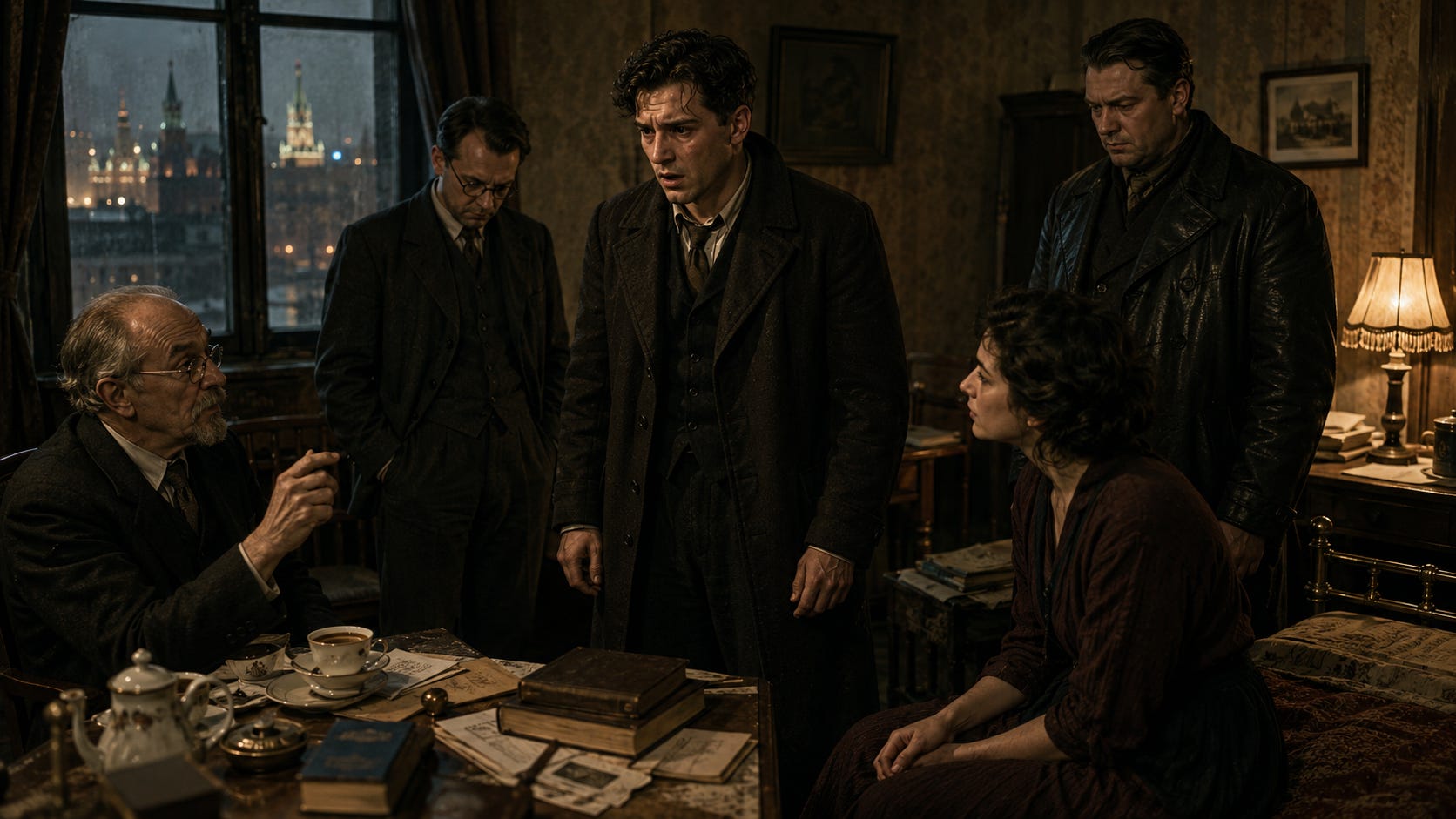
Jona held his head in his hands, trying to block out the mind numbing bickering. The theater was completely dark, remaining blacked out long after the end of the movie. The two forms in the seats directly in front of him were scarcely discernible. He sat in the next row behind them, with Elfieda on one side and Alex on the other. Elfieda clasped his hand, squeezing rhythmically as if trying to massage away Jona’s anxiety.
So far, matters had gone well since arriving in Moscow. At least, so Alex told him. Their train from Leningrad had been delayed on sidings so many times that Jona was not sure whether they finally arrived on a Monday or a Tuesday. When they exited Leningradsky Station, exhausted from lack of proper sleep, they found the barren, brown expanse of Komsomolskaya Square inundated in a cold, torrential rain that quickly soaked through Jona’s coat jacket.
From there they walked for what felt like hours. Goldstein seemed to know his way perfectly, even as dusk fell and the streets turned into dark grey corridors shrouded in drifting fog. Jona began to tremble from both fatigue and cold, and abruptly stopped with a painful paralysis of his left leg. Alex gave a casual glance in his direction, and almost without losing a step scooped Lieb up onto his back and kept striding into the gloom.
They stopped at the gate to an enormous building set well back from the street. It resembled a Veronese palace more than a Moscow apartment building. “Ve are here,” Alex mumbled, pushing open one of the ornate, brass filigree gates. “Volkonsky House.”
Jona could only stare in confusion. “We’re going in there? Looks like the emperor lives there.”
“No emperor in Russia. Tsar. And he’s dead. Used to be nobleman’s house, baron or something. One hunderd, two hunderd rooms. Now communal house. Shared by workers. One family, one room. All are eating in dining room, share everything.” Alex grinned at Jona. “Sometime share girls too. Nice, eh? I told you. Worker’s paradise.”
As they approached the elaborately columned entryway to the building, Jona could see people sitting at open windows, nothing more than obscure silhouettes jutting into empty space. They watched impassively as the two men approached. Jona muttered a warning into Goldstein’s ear as he slid himself back onto the ground. “I think they’ve spotted us.”
Alex let out a snorting bellow. “You joke. I can guarantee you the secret police haff already been notified that two strangers are here. Just keep quiet and follow me. Remember who you are, doctor from U.S., vanting to learn about Party, maybe join. They love that kind of scheitze here, believe me.”
It was a relief to be within dry walls and safe from the pour, but it was actually colder inside than out. Jona could not stop the tremoring and aching of his leg, made worse by an immediate feeling of claustrophobia. It seemed like dozens of men, women and children of all ages filled the corridor, almost obstructing their passage. Most sat on chairs next to open doors, some lounged idly, propped against the walls, and others sat cross legged on the floor, doing nothing, with darting eyes and empty expressions. Everyone was bundled in long coats, scarves, and thick boots, including the women. A few were chattering among themselves, but most were silent, still, and watchful. The stink of unwashed clothing clung to every breath of air, causing Jona the panicked sensation that he might vomit at any moment. Even worse, he was terrified he might be touched by one of the filthy specters crowding the corridors. Goldstein ploughed forward serenely, shifting deftly around the human obstacles in their way.
The very last apartment in the wing to the right was A-19. Alex pounded the door with his fist, then kicked it a few times. A middle aged man with sharply receding hairline and thick, round, wireless glasses opened the door carefully, took one peek at Alex, then threw the door open and embraced him warmly. The two men began to speak rapidly in German, too quickly for Jona to follow. Goldstein pointed in Lieb’s direction two or three times, making rapid-fire guttural noises all the while. After a few moments the man ushered them into his apartment, still smiling broadly.
“I speak English, Herr Doktor,” he said, grasping Jona’s hand with obvious enthusiasm. “I am Helmut Damerius. Wonderful to see you. She said you would come in a day or two, to expect you and Alex, and here you are. Marvelous!”
Jona could not hide his confusion. “She said? Who said?”
“Well, Elfieda, of course. You did know she was here, didn’t you?” Damerius glanced quickly at Alex, arching an eyebrow.
Goldstein broke in, turning towards Jona. “I told you, Jona, she vould be here. Ve vill find her soon. So many Germans in Moscow right now.”
“It won’t be hard. She’s at the hotel with all the other German emigres. They are packed there like sardines.” Damerius thought for a moment. “Hotel Lux.” He waved his arm dramatically. “It’s on Tverskaya boulevard, right in the middle of things, actually in the center of town. Much better lodgings than this pile of hemorrhoids.”
Alex laughed. “You forgive Helmut, Jona. Very theatrical. He here now two, three years, here to make TRAM work, Director, right?”
“Yes,” Damerius sighed. “Not getting much cooperation, though.”
Jona sat, uninvited, on the only chair in the room. His leg felt better instantly. “You came to Russia to work on streetcars?”
“No.” Damerius and Goldstein sat down, side by side on the edge of a tousled bed, virtually the only other piece of furniture in the room. “It’s a youth theater group. Young people express themselves, serve as good examples and models to the masses. Go outside, make street theater. Russians love it. It’s good, but... maybe a little too much of a formulaic production, always the same. We’re based here right now but going back to Berlin soon.”
Alex appeared surprised at the news. “Why? Crazy there.”
Damerius shook his head ruefully. “We’ll talk another time, Alex. Crazy here too.”
“Alex. Tell him.” Jona could not contain himself. “About Marielle.”
Alex laughed and broke out a cigarette. “O.K., Jona, but keep in your pants until ve find her.” He turned to Damerius. “Ve look for a girl. It’s his girl. American, from New York. Verk at the school on Bolzhany, teach English. Helmut, can you help us?”
Jona’s heart raced as he watched the expression on Damerius’ face. After a few moments thought the German rubbed at his balding forehead and nodded his head vigorously.
“Ja, I think so. I know who to ask, anyway. I think you should go see Elfieda first, she is waiting for you. Tomorrow morning I will go to someone who will know, I think. I can’t be sure he will help, though.”
“What about Bloomberg? Could he help?” Alex jabbed his finger randomly in the air as he spoke.
“Bloomberg? That rat? Yes, of course. He knows everyone, doesn’t he? They’re in his pocket or he’s in theirs. Is he here?”
“He’s here alright,” Alex intoned darkly. “I vill dig him out. Rats go vhere there’s cheese, don’t they? He’ll help, or I’ll squeeze his heart out of his chest with my bare hand.”
Damerius smiled as if relishing the thought. “If he will help, you will find her. You will get your girl, Herr Doktor.”
Jona clapped his hands with glee, feeling almost short of breath because of the pounding in his chest. Damerius grinned contentedly as he puffed on a lit cigarette placed deftly in his lips by Alex. Suddenly, a metallic alarm sounded, vibrating through the floor and walls with its intensity.
Goldstein jumped to his feet. “Fire! Get out now!”
“Sit down, you fool.” Damerius took another leisurely puff on his cigarette. “The cafeteria alarm. That’s what they’re all waiting for.” He gestured towards the door. “It’s organized very well. They get to eat right before they leave for their next shift.” Damerius took another long drag on a cigarette that was now almost all darkened ash. “Potato soup tonight. Potato soup. That’s what they’re all waiting for.”
Jona had the sudden urge to tell Elfieda about the train passenger who was hauled away by the Gestapo, the one at the Czech border. It was his third day in Moscow. The three were gathered, Alex, Elfieda and Jona, sitting tightly together on a bench, immortal friends bound together by fate, or whimsy, or circumstance, or just maybe by cosmic decree, but bound in any case by ties they could only feel and not explain. Jona sat between the other two, sensing their touch and wanting to stay, but Elfieda was feeling chilled and tired, and said she wanted to leave. Jona and Alex could stay, she said, and they could all meet back in her room later. That’s when the crazy man in the gray suit jumped into Jona’s mind.
They were sitting outside a Metro station, on the banks of the Moskva right across the river from Gorky Park. Elfieda had picked the spot because it was safe. They couldn’t possibly talk in her hotel room because they would be overheard, and she worried that NKVD agents were prowling the park itself for anyone appearing unusual in any way. Conversation in a foreign tongue would be sure to attract attention.
The bench they shared sat in a sharp circle of light, shining down upon them from electric bulbs suspended high above. The street was also lit, dotted with small circles of light that receded left and right, showing the area to be deserted. The river Moskva flowed with a metallic sheen of silver and red streaks, a shimmering montage of reflections from the bright park lights. The park itself was sharply illuminated, bordered by neatly laid beds of flowers and carefully measured walkways. Jona could see only one group, two adults and two young children, ambling slowly beneath a flower-festooned arbor. The scene, the sky, the city itself was cloaked in an eerie silence. There were no sirens, no coughing engines, no shrill laughter, no distant music. Even the river flowed without a murmur, as if a silent movie was unreeling under the open sky.
“Elfieda, I need to tell you something about a man I met on my trip.” Jona gushed the words out in a loud rush of vehement syllabication.
“Hush, darling, not now.” She stroked the back of his hand patiently.
“It’s so quiet. There’s not a sound.” Jona’s voice quavered as he spoke.
Elfieda clutched his arm more tightly and laid her head on his shoulder. “Is it frightening you, darling?”
“No, not frightening, I think.”
“Silence always make me afraid. Silence always followed by sound. Always. Sometimes sound that is very, very bad.” Alex bent over to assume a Thinker pose, fist set firmly under his chin. “Just vait.”
“Quiet, you big brute. You’re enough to frighten the children, you are.”
Alex chuckled, softly, contentedly. “Jona not my child. Face different. Look like you, though, Elfieda. Maybe yours.”
“You monster!” Elfieda forced a laugh, but Goldstein’s words jarred her, striking like a lightning bolt from a cloudless sky, spinning her in an instant into a sinkhole of remembrance. She had an immediate urge to go to her purse, but Jona was leaning on her arm, pinching it down. Thoughts came.
Maximillian. That was what she named the child at birth, in a vain and pretentious act of authority, at a moment when she had already given up all rights to the little alien that was birthed from her body. It had been so long ago, and she had managed to fog the memory so well. The drugs helped, of course, but it was more than that. Something more had been needed to expunge his face from her mind. Anger, perhaps. Maybe guilt. And indifference. The creature that had grown inside her was an exotic foreigner, an unwanted and unexpected immigrant into her private country, the mysterious and unexplored land of Elfieda.
At first, when she recognized the changes within her, Elfieda felt calm acceptance. She had been with Tyszka. Women had babies, after all, even at seventeen. That was the natural order of things. And she certainly didn’t care that she had no husband to account for the child. After all, her own mother never had a husband. One was never needed.
As a young girl, Elfieda received all the proper education she needed, she was given proper clothing to wear, and she was given proper lessons at the piano. The only thing in her life that was not proper was her mother. Marguerite Brunner claimed to be descended from one of the myriad German princelings whose castles and keeps dotted the countryside around Magdeburg, and she behaved every day of her adult life as if she was not subject to the laws and customs of common people. Having old money helped confirm her in the daily exercise of her deliberately bohemian behavior.
Elfieda’s aunt Bert was always there, through every difficult moment, during mother’s long absences but especially during Marguerite’s often short and brutal visits. Mother’s constant desire was to travel the continent, consorting with the various liberal and progressive factions of European intelligentsia. She was vaguely interested in women’s suffrage, but never gave material aid to the cause. She pitied the poor, but never gave alms in her life. And, for reasons known only to her, she spoke out about the plight of the Romani, though it was doubtful she had ever met or spoken to a gypsy in the course of her travels. She was a woman who positively glowed in the reflected brilliance of others and took pains to ensure that everyone knew how she mingled freely with Avant Garde thinkers within the most enlightened salons of France, Austria, and Germany.
Elfieda could remember the day her mother received a telegram from the writer Wilhelm Raabe announcing the death of the great novelist and poet Theodor Fontane, and asking if she would be coming to the funeral. There was to be a reading of some of his poems, and Marguerite might want to read one. So the telegram read. Oh, how mother strutted around their flat in Berlin that day, waving the telegram in the air for all to see. Wilhelm Raabe telegrammed her! To notify her about Theodor Fontane! My God, to give a reading!
That very evening mother gathered the servants in a circle and insisted that Elfieda read passages from one of Fontane’s novels. It was titled L’Adultera. Her mother demanded that Elfieda read loudly and distinctly, every word, and corrected her sharply when the words were not spoken to her satisfaction. Sex was a mystery that was just beginning to unveil itself to thirteen year old Elfieda; reciting passages from a book that discussed sex freely and openly caused her to feel shame and humiliation, while her mother glowed with pride and the servants rolled their eyes. By the end of the reading Elfieda’s ears had turned a beet red and her cheeks were flushed so deeply she appeared to be coming down with variola.
The next morning Aunt Bert opened her door to find Elfieda sobbing on the doorstep. The young girl lived in her aunt’s home from that day on, together with her uncle Freddie. She never saw her mother afterwards, and received no letters, not even a card at Christmas. Aunt Bertie saw to it that Elfieda studied Latin, history, geography, Lear and Hamlet in English, Flaubert and Hugo in French, and Cervantes in Spanish. Of course, there were many readings from Goethe. This was deemed a very credible education for a young girl of her station. Marguerite, it seemed, was quite content to abandon her daughter to the loving arms of Aunt Bert. This suited Elfieda very well.
A few years later Elfieda learned of her mother’s death. She received a letter from someone in Paris, someone she did not know, informing her that Marguerite died after being struck by an automobile while crossing Rue Lamartine. From that day on, Elfieda always imagined her mother crossing the street oblivious to any traffic, perhaps smoking a cigarette, struck down during a fit of careless laughter. Madame Brunner lived long enough after the accident to dispatch a note in her own hand, written with tremulous strokes, crafted with long tall L’s to seduce and and short squat M’s to coerce. Elfieda had committed it to heart:
My dear, Moliere was so right.
We die only once,
And for such a long time.
Live, live, my darling, and let no memory distract you
That injunction became the only meaningful legacy of Marguerite’s life, a rich endowment that Elfieda willingly accepted. She determined to live a life of conscience and action. Life became an endless blur of daily here and nows, urgent activities, and temporary pleasures. Even with Leon Tyszka, life and love were passed back and forth from day to day, like passing olives and water biscuits on a tray, without thought for the future. So, there could be no time in her life for a mewling infant, and she gladly gave up the little creature, surrendering it to strong hands that plucked it from her body like ripe fruit from the vine. Time had marched on, to the drumbeat of her own passions, and she had tried very hard not to let the baby’s memory distract her. Mostly she had succeeded. He would be thirteen now, but whenever his memory emerged into her awareness, she reminded herself that the cause she believed in and fought for far outweighed the importance of her own happiness.
“Elfieda, I want to explain about the man...” Jona’s voice went up an octave, cutting with a whining rise and fall through the street silence.
“Darling, hush please.” She snuggled her face against Jona’s neck and stroked his hair, patting it as if an unruly lock was out of place. “Let this moment be. The world is so cruel right now.”
Silence descended once again, pervasive, boundless. Jona sensed that Elfieda no longer wanted to leave, and so he hugged her as strongly as he could, straining to keep her pressed tightly against him. Alex put a long arm around both of them, resting his chin on the top of her head. They were quite still, bathed in a sharp circle of light, an evanescent tableau etched like a perfect engraving in the motionless night air.
“Comrades!”
Jona, Elfieda, and Alex startled as one, heads revolving in an instant towards the direction of the sound. Bloomberg emerged from the night shadows on their right into the bright cone of light illuminating the three friends. He wore a long dark woolen coat tailored elegantly to his stocky frame. A broad yellow cravat secured by a gold and diamond pin peeked out between the lapels of his coat, nicely framed by his sharply manicured, newly manufactured beard. A ludicrously large ushanka swallowed his bald head down to his ears. To Jona, the stylish Bloomberg looked like he had just emerged from a high stakes game at the baccarat table.
He stopped a few feet away, and with arms akimbo he scrutinized the trio, still seated arm in arm. He turned his gaze carefully towards Jona. “My friends, you look like you are trying to brave the Siberian winter. Come now, it’s a beautiful spring evening.” He spread his arms wide, as if inviting an embrace.
Alex arose carefully, unwinding himself slowly, and sauntered casually towards Bloomberg. Without warning he clamped his fist like a vise onto the smaller man’s tie, wrenching it up towards his neck. “Nice to see you, Herr Bloomberg. Surprised to see you vithout the usual pond scum you like to play vith. You know. Cops, SIPO, NKVD, informers. That kind.”
“Wait, wait, please! I have nothing to do with that sort any longer. You must believe me.” Bloomberg’s eyes opened wide in panic, revolving back and forth rapidly. In an instant his legs began to shake violently, but oddly in synchrony with one another, making him look like a fat trout being fished out of the water. “Believe me, I’ve gone clean.”
“Relax, Herr Bloomberg. Ve don’t vant you to go clean so fast. Ve vant you to call your friends. Ve need information.” Goldstein explained quickly about Jona’s search for Marielle.
Alex allowed Bloomberg to slip away from his grip. Bloomberg immediately began patting down his shirt and fussing with his necktie, both in considerable disarray. He straightened to his full height. “So, you need my help, after all. Just like the old days, Alex. Why should I? What’s in it for me?”
“You help, you live. You betray us...you know I haff many friends here.”
A long pause followed. Jona watched anxiously as Bloomberg stared vacantly into space, visibly calculating the odds of one course or the other. At last he smiled. “Of course I help! Why not? Especially because it is for the son of my distinguished former associate. Tell me…” He paused both his peroration and his smile. “Who else knows about this?”
“Damerius. Ve see him first. Easy to find.” Goldstein glowered at Bloomberg accusingly.
Bloomberg laughed. “Terrible choice. He is under surveillance. But, of course, we all are.” He glanced at Jona, continuing to preen while adjusting the knot of his tie. “It’s very liberating, Dr. Lieb, isn’t it? We are all the same here, as you can see. You and me, all of us completely the same. Everyone is under the glare of the state apparatus, so that correct behavior is assured for all, and the revolution can go on and on and on.” He laughed again, very coarsely, making Jona feel there was something very unclean about the puffed up little man.
“So, vat is next?”
“We should meet tomorrow. Do you know the Kamerny?”
Elfieda spoke up. “I know it. Kamerny. The theater.”
“Good. Tomorrow at four. Ask for Aleksandra. I’ll see you there.”
“Mr. Bloomberg, please...” Jona surprised himself by speaking up. “Do you think there’s a chance?”
Bloomberg’s face neither hardened nor softened. “Do you remember the Paul Klee I showed you in Berlin?”
“Yes. I think.”
“Did it mean anything to you?”
Jona did not hesitate. “No.”
“That’s a shame, Jona. You need to put something of yourself into it to get anything out of it. Your father liked Klee. Met him through Max Ernst, and then introduced him to me, and I like him too. Has made me some money, and there is nothing wrong with that. Your father diagnosed him as Geisteskranken. Mentally ill. Not really crazy, but painting like he was crazy. That was part of his charm, you see. So, I will answer you. If you mean, is there a chance you will all survive this, then yes. Possibly. If you mean, is there a chance of finding the girl, then no. Frankly, you are acting like you are crazy. Geisteskranken. But I will do what I can.” With that, he turned on his heel and disappeared quickly into the darkness, to their left, beyond the rim of bright light that encircled them.
The Kamerny Theater hardly looked like a theater at all. It stood like a squat, pale, plainfaced structure with a long, undistinguished façade on the street side, gathered up within a perimeter of trees that appeared to be dead or dying. There was no marquee or other outward sign to indicate it was a theater rather than a residence heavily in need of renovations. A single, oblong billboard stood next to the main entrance, featuring a poster covered by pictures of actors with fierce looking faces, most of them holding guns.
It was a short hour’s walk from the hulking Lux Hotel to the unimposing Kamerny at No. 23 Tverskoya Boulevard, but for Jona it turned into a passage of regret and fear.
After their meeting with Bloomberg they had returned to the Lux. Alex and Jona slept on the cramped floor of Elfieda’s room, one on each side of the bed. With the single ceiling light turned off, the room was submerged in utter darkness. Alex seemed to fall asleep immediately and soon filled the room with the sound of sonorous breathing and a low whistling snore. Jona closed his eyes and dozed but could not sleep. He could hear Elfieda’s sheets rustling softly and her body turning restlessly, every sound like the far off edge of a coming thunderstorm. He in turn tossed fitfully, semi drowsed, simultaneously unable to sleep but yet unable to open his eyes and come fully awake.
An electric shock coursed through him when she touched him. His heart first stopped, then erupted violently, rushing so quickly he could barely take breath.
Her hand brushed his forehead as she leaned down over the bed. Her barest whisper seemed to come from somewhere inside him when she spoke. “Jona, darling. Sleep here.”
She tented the sheet up high as Jona came into her bed, slipping in tremulously as if he were entering an ancient, undiscovered tunnel of desire and dread. She enfolded him and they remained embraced, lying face to face through the passage of the night, awake, asleep, found at last and still profoundly lost.
The next morning Alex awakened them with a playful spank. “Come on you two. Sleep all day already.” He lit a cigarette and puffed vigorously over the two prostrate forms, exhaling thick plumes right over their heads.
Elfieda groaned, tossed a pillow at Alex, and elbowed Jona. “Both of you turn away and close your eyes.”
“Do I haff to close my ears too?” Alex managed to chuckle, turn on his heels, and smoke furiously all at the same time.
Jona could not move at first. His head was spinning and his eyes were dimmed as if layered by a thick, dry membrane. Alex shook him gently but insistently. “Come. Be late otherwise. Find out about Marielle.”
Jona grimaced. The word rang through his mind, pealing like a church bell, clamoring like an alarm. Marielle, he thought. Marielle. He repeated the word, but he could think no further than her name. He had dreamed about her during the night. At first, they were together in a familiar scene, a memory from the previous summer, sitting on a park bench in Union Square. The pigeons gathered at their feet, cooing in a continuous monotone of contentment as Marielle cut up small pieces of bread and tossed it to one bird or the other. Jona was feeling lightheaded, perspiring with anxiety. Finally, he screwed up his courage sufficiently, and when he judged the moment was perfect he placed his arm around her shoulder in an awkward, lurching motion. She said nothing, but darted a sideways look at him, both mischievous and enticing. In his dream, her eyes were a dark green, and lingered in their glance, growing larger and larger until he found himself immersed in an ocean of green vapor. Panic set in as Jona found himself directionless, without an up or down or right or left, lost in the cauldron of her sea green eyes, drowning slowly...
“Jona! Get up!” It was Alex, shouting into his ear.
Jona came fully awake, sitting up in bed, but the feeling of frenzied hysteria he felt in his dream remained, overcoming him. He grasped his head with both hands, shaking back and forth. “My God, my God, Alex, everything is so out of control. What am I doing?”
Elfieda sat back on the bed next to him. Alex remained standing, more gigantic than ever as he loomed over Jona. He waited a few moments and was surprisingly gentle when he spoke again. “Vhat is it you dream? And vhat do you dream of doing?”
Jona sobbed and buried his face in his hands, now terrified that he might begin crying. Elfieda began caressing the back of his neck, sending a burning shudder down his spine. He shook his head rapidly as if trying to shake the aftertaste of his dream from his mind, and squared his shoulders resolutely.
“Marielle. I want to find her.”
Alex shrugged his shoulders and spit out a few small shreds of tobacco. “Alright. Let’s go.”
They had some salted crackers, and drank bitter tea perked in an electric pot, then left the hotel at a hurried pace. Striding rapidly was the preferred way to walk in Moscow, according to Elfieda. The NKVD were suspicious of anyone seen loitering. She rushed them north from the hotel, along the left side of the crowded Tverskaya, then abruptly stopped with an air of triumph in front of a storefront covered by an enormous multipaned window.
“This is it!” she cried. “Alex, do you recognize it?”
He stared for a moment with an air of confusion, then nodded his head. “Yes. Different now.”
“It used to be the Yeliseev deli.” She gave an evil grin. “Now it’s called Grocery Shop Number Eight.”
“You remember, Elfieda, we eat good here. What vas that soup I like?”
“Rassolnik. And I liked botvinya.” She paused a moment, then burst into hysterical laughter. “You liked it hot and I liked it cold!”
Alex also let out a loud, howling guffaw, embracing Elfieda warmly. They went on with their riot of laughter, absorbed in the moment they shared long ago. Jona could only watch, feeling lost. He thought he should laugh also, and forced some feeble tittering. Then, stunningly, Alex bent down and kissed Elfieda fully on the lips. Jona almost stumbled in shock, exhaling rapidly with an audible wheeze.
Elfieda turned to take Jona’s hand. “Sorry, darling, we’ve been ignoring you. It’s just that we’ve been here so many times, Alex and I.”
“Yes, always good food. I vill buy some pelmeni for all of us. You’ll see, Jona, taste very good in lips and stomach.” Alex gave a stiff bow, performed a military about face, and marched briskly into the store.
Elfieda laughed again as she watched him leave, then hugged Jona briefly around the neck, kissing him on the cheek. “He won’t get far. His money is worthless in there. He can’t get anything without an official coupon and stamp.”
Jona stared in bewilderment, his head still swimming. He felt a tear brimming up. “Why did you let him go?”
She pulled him a few feet to the next doorway over, a narrow foyer leading to the apartments above. “We have so little time alone, darling.” She placed her hand on his hip, barely touching, and her head on his chest for just a moment, as if listening for his heartbeat. She stood very close.
Jona became acutely aware of the passersby on the street. They all seemed to be staring right at him, some with a mocking lift of the eyebrow, others smirking, or twisting their lips in a taunting curve, or giggling knowingly as they strode by. For a moment he imagined they were pointing at him, craning their necks to get a better look at him, or even dragging their legs and cackling in derision while he cowered.
Jona raised his eyes to hers. “Would you kiss me, too?”
Without a word, she did, then stopped to flutter the briefest of smiles, then kissed him again, then smiled again. “Darling, Alex and I were very close when we lived here. But you and I are very close as well, aren’t we? We’ll have our own jokes one day, and laugh, and kiss, and tell the whole world to go to hell.”
As she spoke her head bobbed up and down, much as a bird perching itself to sing its song, and her straight blond hair rippled and flowed smoothly back and forth over her ivory white forehead like wavelets dancing over a luxuriant pool of oiled and steaming water, and he remembered their first night together in Berlin when she came to him and how her hair that night swayed like a sash, waving to and fro and back and forth and she sighed for him like an apparition from an unknown future, a mistress of magic and delusion, both heavenly goddess and hellish gamine.
“Why did you let him go?”
“I don’t know, Jona, I don’t know why I did anything back then. It was a million years ago and everything was so different from now.”
A small shiver came over Jona. A voice inside told him to stop, that he should stay silent, or walk away, or kiss her again. “And you love him? Still?”
“Of course, of course I do. Jona, I no longer have the heart of a little girl. Don’t judge me as if I were a schooltime sweetheart. I love him, just the same way as I love you. But you know that, don’t you?”
Jona stood, mesmerized, looking into her eyes but seeing nothing, sensing the touch of her hand on his waist but feeling nothing. Do I? he thought. Do I know anything? Am I allowed to know?
“Hullo, you two. I think for minute you leave me!” It was Alex, bounding up to them with three small bundles of wax paper held in his hands. He looked sharply at Elfieda, then at Jona, his face disfigured instantly into a dark scowl. “Something wrong?”
“No darling, nothing at all.” Elfieda gave her brightest smile. She pointed at the packages in his hand. “Pelmeni? How did you get them without food vouchers?”
Now it was Alex’s turn to smile. “Easy. Show German marks to man in front of me on line. He take money, I get little tickets. Presto! Pelmeni! I vait on three lines. One to order, one to give coupons, one to get food. I learn something. Russians, they love queues.”
The three resumed their walk. Elfieda and Alex munched voraciously on the soft, round, spicy dumplings. Jona had no appetite. He still felt dazed and hollowed out, as if his center had been surgically extirpated, leaving only his external husk as the residue. Alex insisted that he try at least one of the flavorful balls, but just two bites resulted in immediate dyspepsia. Instead, he carried the small wax bundle palm up and held at chest level as he walked, much like the votive offering of a penitent pilgrim marching towards the shrine of a patron saint.
At length, Elfieda paused, pointing to a broad avenue angling towards their left. “I think that’s it. Tverskoya.”
Alex stared, uncertain. “Sure? Look different. No churches.”
She pointed in the opposite direction, towards a small, carefully manicured park to their right. “I think that’s Strastnaya Square. The churches must be gone, but that has to be the Strastnaya Monastery’s belfry tower...” Then, with more certainty, pointing emphatically. “Yes. I can see Pushkin’s statue. The arrogant bastard is still standing,” she said with an evil laugh.
Jona was startled. “Pushkin? Is that someone you knew?”
“Knew him? My God, Jona, haven’t you read Pushkin? Stories? Poems?” Elfieda grabbed Jona’s arm so forcefully she almost spun him around.
Lieb’s mind whirled. “Yes, I think so.” He tried to concentrate. Had he? If Pushkin’s writings were important to know, then surely his father would have seen to it. “Possibly.” Then finally, “No, I don’t think so.”
“You cannot understand Russia without reading him, even though he lived a million years ago. We must read him tonight when we get back to my room.”
“Vonderful! Can’t vait!” Alex howled the words, causing them all to break out in laughter once again.
Jona’s feelings of anguish evaporated in an instant as they giggled like schoolchildren. Without a thought, he placed his arm around Elfieda as they turned onto the garden lined boulevard of Tverskoya heading west. Before the view was lost, he craned his neck to look backwards at the bronze statue standing upright at the far end of Strastnaya, towering upwards like the ruler of the world. Yes, Jona thought, he does look like an arrogant bastard.
Though not as wide, and certainly not as busy a street, Tverskoya reminded Jona of Berlin’s Unter den Linden. The long, tree lined pedestrian mall coursing down the middle of the thoroughfare, and the large, stately homes ordered neatly along both sides of the shaded street gave the avenue a vaguely Germanic flavor. Jona found it charming that the street was stone quiet and devoid of pedestrians, giving the scene a postcard-perfect appearance.
They had hardly gone a hundred yards when a young boy emerged, as if unveiled by a stroke of magic, from a narrow alley to their left. Jona was shocked by his appearance. He was wraith thin, the size of a ten year old but with the face of a grizzled miner, deeply dirty and lined with sharp creases radiating from the outer edges of both eyes. The top of his head was studded with numerous small, perfectly rounded bald patches, like white leopard spots, a form of acquired camouflage that gave protection within an exotic urban jungle. He wore an oversized faded red cloth coat buttoned at the throat and hanging like a tent to his ankles, so that his feet could barely be seen as he ran with an easy, athletic alacrity to a spot directly in front of Lieb. Without a word he pointed to the small wax bundle Jona held in his hand.
“Don’t move, Jona.” Alex breathed the words softly as he eased himself a step forward.
A blur of motion caught Jona’s eye. Three more children emerged from the alley. Then three more, then five, then a dozen or more debouched out onto the street, both boys and girls. He shivered involuntarily at their emaciated, ragged and somber appearance. Then, in a moment of horror, he saw they were holding improvised weapons. Some carried short, thick clubs, others carried steel or brass pipes. Two of the larger boys carried knives held indifferently at their sides. These were not schoolchildren on extended recess. Making no sound, their leader withdrew a short axe from beneath his coat, propping it on his shoulder.
Jona stood as if paralyzed, transfixed by what he saw. He had a sudden sensation of breathlessness and pain in his chest. “Alex, what is happening?”
Goldstein said nothing. He carefully removed his wallet and tossed it on the ground. The boy scooped it up and smiled when he identified the stack of German marks inside. He made a move as if to dart away, but stopped abruptly, and deftly snatched the packet of pelmeni from Jona’s open palm. For the briefest moment he grinned at Lieb, while his fingers gripped and regripped the axe on his shoulder, fingering it with the rhythm of an imaginary tune played on an instrument of his own making.
He did not run away. Instead, he sauntered back to the alley, waving to the others as if returning to his clan after a long and successful hunt. In less than the blink of an eye they were all gone, ghostly, ephemeral, unreal. The entire event had taken a minute, no more. Stillness washed over Jona, and he suddenly felt that his left leg was numb. He clutched at Alex to keep from collapsing to the ground. Alex did the simplest thing, lifting him in his arms as if picking up a child.
Elfieda spoke first, touching his arm. “It’s alright, darling, they won’t be back.”
Jona felt his leg trembling spasmodically, causing pain to shoot up his spine. “What was that? What in hell was that?” He could not keep from shrieking.
Alex spoke. “Besprizornye. They’re called Besprizornye. Children left behind after the roundups. Parents taken away, no home, live in different corners of the city. Alone, Jona. They make gangs. Can be very dangerous.”
Jona could only gasp. “Why aren’t they picked up, placed in homes or camps or orphanages, or anything? My God, that one boy was like an animal.”
Alex looked down, appearing dejected. “Not like animal. Trying just to get along. Jona, the revolution is still going. Everything not perfect yet, but the struggle is hard.”
“Yeah, well you can keep your struggle in that case,” Jona snarled.
Elfieda also appeared downcast, but took Jona’s arm as soon as he could stand and they resumed walking, moving now at a hurried, ragged pace. After several minutes she spoke in a subdued voice, looking down as if speaking to the pavement. “Darling, I understand how you feel. But is it any better in Berlin, or New York? Please, give us a chance. Give all of this a chance.” She pulled a small, darkly tinted bottle from her purse and tilted it in Jona’s direction as an offering.
He shook his head, saying nothing as she took a deep swallow. Give a chance, he thought bitterly. That’s all I’ve been hearing. Give a chance. How about someone giving me a chance for a change? A thousand thoughts exploded through his mind, a whirling montage of still pictures, word fragments, gestures, and surges of emotion. Harvard. His boyhood hat. Dr. Norris, Starka, Fleming, Agaghigia, Osler, cigar smoke, ducks, grey suit man, leg massages. His father. Give me a chance. Let me take control. I have to find Marielle. A powerful wave of sadness washed over him, an ache of incomplete accomplishment and unfulfilled longing. He felt tears brimming at the corners of his eyes as his thoughts swirled. Am I allowed to feel hope?
“Jona.” It was Elfieda, tugging on his arm. “You are quiet. What are you thinking?”
He said nothing.
“That’s alright, you don’t have to tell me, I already know.”
“O.K., I’ll bite. What?”
“It’s about your quest. Do not lose heart, darling. You will find her. And we will help.”
“Help?”
“Yes.” She hugged him more tightly. “Sancho at your service.”
Once again, she giggled, a little girl’s giggle that sprung without thought or purpose. The lyric of her laughter made Jona first grin, then chortle softly. Warmth waved over him, over his face and chest, and the pain in his leg washed away. He put his arm around her neck and breathed deeply, taking in the scent of her neck and hair. “Why are you laughing, Sancho?”
At this she let out a loud guffaw and pointed at Alex as tears of mirth coursed down her cheeks. “Because, if I am your Sancho, then he must be Rocinante!”
Elfieda’s childish joy touched Jona. In that moment, something cleaved within him, a crack that he could feel, a split in the dry, encrusted mortar embedding him. He felt as if touched by a birthstone, connecting him to his own beginning. A space deep inside yawned open, a secret crevice, a place that gave him comfort and warmth, somewhere between moaning and sighing, grieving and crying, wanting and trying, somewhere between simple belief and awful deceit, somewhere he had always been and somehow never known, like a blind man living in a golden-gilded room. He smiled.
When they arrived at their destination, they walked around to the theater’s side door, unsure where to go. An ancient crone answered their knock, dressed completely in bedraggled black, with head shrouded by a mourning kerchief. After Alex asked for Alexandra, she gestured them to come in. The old woman ushered them slowly along a curving, murky, darkly lit hallway, walking half bent and shuffling with every step as if about to pitch over on her face at any moment. The hallway ended in what was obviously a backstage area, cluttered with unused scaffolds, planking, and ropes. From there she guided them to the orchestra seats, directing them to the second row. As if in obedience to a vow of silence, she tottered off again without a sound.
As she disappeared the theater lights clicked off, leaving them in darkness. Jona sat in a void, almost completely sightless and senseless, barely aware of Elfieda and Alex on either side of him. Anxiety and expectation, the twin harpies of dread, whirled over him as he waited for what was to come.
A machine whirred and clacked, and a brilliant cone of light suddenly streamed before them. A movie began to play, projected onto a screen set up on the stage. It was a Russian film, with opening credits written in Cyrillic characters that were no more intelligible to Jona than ancient hieroglyphics.
Elfieda leaned over and whispered in his ear. “I make the title out as ‘Diz-ir-ter’ in Russian. I think that means Deserter. I’m not sure though.”
Obscenities screamed through Jona’s mind. Who the hell cares what the name of the movie is? What the hell are we doing here? Anger surged through him, and pangs of fear as well. He thought about Bloomberg, feeling the urge to tear his face off. The bastard betrayed us, Jona thought. This whole setup is a joke. We’ll be sitting ducks when they come to arrest us.
Two forms flitted between Lieb and the projection, one tall and angular, one short and wide, making their entrance like animated silhouhettes acting out their roles on screen. They sat down in the seats directly in front of Jona, wafting competing aromas of perfume, brandy, and dried sweat.
One turned around towards Elfieda. It was a woman, her features only partly illuminated, with pitted cheeks and craggy nose sweeping irregular shadows over her face much like an alien moon at quarter turn. “I only agreed to help because of you, Elfieda.” Her voice trembled with a nasal twang, barely heard over the sounds of the movie. “Do you remember me?”
Jona could not hear Elfieda’s response over the background noise, even though she was sitting right next to him.
The woman went on. “Aleksandra. Aleksandra Ekster. We met at Kudrinskaya square, at the actor’s market. I was looking for work then, doing agitprop theater in the streets, doing anything for bread, everything was up in the air, and you were at MONO. You helped me get a job at the Historical museum on Niglínnaya. Do you remember now?”
Elfieda squealed a response and leaned forward so that the two could share a quick peck on both cheeks. Jona poked at Elfieda with his elbow. The movie dialogue was now so loud and piercing that she had to almost speak into his ear to be heard.
“I worked at the Moscow People’s Education Department, that was the job they gave me in ‘21. Every Sunday morning, unemployed actors gathered at Kudrinskaya. I was able to recruit some workers from there, sometimes also from the Moscow author’s club on Prechístenka. So many talented people, so many gifted artists were starving then. Not like now, Jona. Now everyone has work.”
The stolid form of the man who sat next to Aleksandra did not turn or speak. Jona could see that she was speaking rapidly into his ear, but he remained motionless. Eventually Aleksandra turned again towards Elfieda, jerking her thumb toward her silent companion in irritation. “This is Tairov, the director. Désolé ma cher, il veut être ici.”
Jona could not resist the impulse to speak up, raising his voice to be heard over the movie’s soundtrack. “What are we doing here? What are we waiting for? Where is Bloomberg?”
Aleksandra stared back at him momentarily, her eyes darting back and forth in the flickering light like small silvery fish circling in dark, deep ponds, but she said nothing and turned back towards the screen. Alex leaned into Lieb. “They haff the movie playing so that no one can hear vat ve say. There must be a dozen workers in this place besides the old bag. No one knows who can be trusted. Just wait.”
No one spoke again, Jona sat helpless in his seat, and the movie dragged on. Lieb paid only cursory attention to the film. It was halfway through before he realized that the characters were speaking both German and Russian in rough, choppy dialogue accompanied by a churning kaleidoscope of images flashing in bright sequences. The scenes were dominated by an earnest young man with a sometimes anxious and sometimes saddened demeanor. “Alex, what’s it about?”
Goldstein shifted in his seat several times before answering. He seemed agitated somehow, speaking in mumbled tones that Jona strained to follow over the gutteral din of the film’s dialogue. “Young vorker, German, in shipyards. Vants to go on strike against capitalist bosses vith his friends but then his family vill starve, haff no money. Not sure if it all makes sense. He goes to Russia to find understanding. Now... right now it looks like he goes back to Germany to fight.”
Alex slumped back into his seat, receding completely into darkness. Jona sat on edge, almost squirming. Fight, he thought. That is what I intend to do. For once, I’m going to fight for what I want. But how? How can I possibly fight when I don’t know how to? Without wishing it, a voice whispered to him, out of a deepest past, arising from a silky invisible skein that trailed behind him like an unseen cord. Involuntarily, Jona looked to his left and right, towards Alex and Elfieda. Use them, the voice said. Sometimes you have to use others to get what you need. Use anyone and anything you have to. He squirmed in his seat and shook his head. Thanks for nothing, dad. I’m not an operator like you, and I have...I have…I have a conscience.
The film ended without warning and without fanfare, simply shutting down. The theater remained dark, cavernous, silent. Tairov and Ekster began to spit at each other about the meaning and worthiness of the movie. They bickered on and on about art and culture, the popoli, and the needs of the revolution, two disembodied voices that might have been beamed into the capacious hall from some unknown, alien point of origin.
The two eventually drifted into silence and stillness, until Aleksandra twisted in her seat, this time in Jona’s direction. “You are the doctor searching for a past lover?”
The question sounded strange when asked in that way, but Jona nodded his head in assent. He thought he could see Aleksandra smile.
Tairov turned violently in his seat, placing his forearm firmly on the back of the chair for support. “This is romantic nonsense, sentimentalist, seditious. Crazy, really. C’est une idée loufoque!” He intoned each word furiously.
Aleksandra grabbed at his arm, equally furious. “Monsieur T, surely you must understand what he feels?”
“No, Asya, I must not! And you must start to reject all these bourgeois...bourgeois desiderata. To be true to our art we must free ourselves from the old lies.”
“Love is a lie?”
“Sans déconner! Of course. Even if such a thing exists, it must be held as something private, an individual possession, and there can be no personal possessions or attachments of any kind if the revolution is to mean anything.” Tairov fairly shouted the last words, as if in triumph.
Aleksandra bobbed her head back and forth, staring vainly into the darkened corners of the deserted theater, then cried out “You are right, comrade!” In a lower voice she muttered, “Que tu es emmerdant, Alexei.”
The movie projector churned to life again without warning, and the same film began to play on the screen, “Dizirter.” As the opening credits rolled Jona heard the shuffling of feet immediately to his rear and felt his chair pushed roughly from behind. He whirled in his seat to see two forms seating themselves in the next row back. A face emerged abruptly from the blackness, rounded and white, like a moonlit ghost materializing in the night. It was Bloomberg.
He leaned over Jona, stretching himself to talk towards Ekster and Tairov. “Ça gaze?” He greeted them as casually as if encountering them at his club.
Aleksandra remained mute but Tairov almost jumped out of his seat when he looked backwards at the new arrivals. “Comrad Shumyatski! You honor us and our theater. I did not expect you to accompany Monsieur Bloomberg yourself!”
Jona made a motion to turn and examine the newcomer, but Bloomberg pressed his fingers sharply into both shoulders. “Don’t turn around, Herr Doktor. No need to see our guest. All of you,” he shouted loudly, “please keep your eyes forward.”
Jona winced as he felt hot breath against his ear, but the voice that followed was melodious, modulated, and pleasant, a voice of reason. “I was curious about you, Dr. Lieb, that’s why I came. Your father was someone I knew.”
The words made Jona cringe. What’s next? he thought. Yes, I knew your father well. I helped him smuggle the crown jewels out of Russia for a donkey load of supplies and a hero’s salute.
The voice spoke again, this time into the other ear, harsh now and sibilant, a voice of vengeance. “He was a very stupid man.”
A shiver of fear coursed through Jona like a seismic vibration, freezing him in place. His thoughts reeled as he absorbed Shumyatski’s sneering pronouncement. Earnest Lieb had been the target of many epithets and curses, and the quarry of hateful critics and professional vendettas, but he had never been called a stupid man. He wanted to turn and confront his father’s accuser, but Bloomberg kept a firm hold onto his shoulders.
The voice behind him emerged from the darkness once again, now no more than a murmur vibrating through the air, a subtle distortion of the surrounding atmospherics. “Lieb had the chance to join me and the others, all of us who were true to the spirit of 1918 and believed in the revolution, and in Lenin, and the rule of working men and women everywhere. Instead he pretended only, pretended to be with Trotsky, pretended to spy for Stalin, pretended to go with Bukharin. He pretended to be my friend too. Lieb, the great actor! Lieb, the great liar! If he had stayed, he would have risen to the highest circles, and he would have made a difference. His body would be on display in the walls of the Kremlin right now. And why did he betray us? For a few banquets in London and Paris? So that others could stroke his ass and tell him how wonderful he was? To advance his career? No, no, no. Money. It was all for money.” Shumyatski made a spitting noise.
The movie suddenly flared with the blare of shouting between two men, transitioning quickly to a scene of hundreds of workers marching with determination under a forest of flags. Jona sat stock still, almost in shock, while Elfieda and Alex stared rigidly forward.
“Stop the damn cinema! Stop it!” It was Shumyatski, screaming at the top of his voice. Bloomberg and Tairov also shouted the same demand, just a beat behind, dutiful echoes in the vastness of the empty theater. The projector stopped whirring with an audible click. The silence and darkness that followed was overwhelming, terrifying, beating down any urge to move or speak. Jona could hear rustling behind him as Shumyatski rose to his feet. Bloomberg was breathing sonorously, a high priest waiting for his master’s words to spill into the space that surrounded them.
“Hear me. I believed him. Much more, I believed in him. I introduced him to everyone at Khamsovet, to all the artists and directors and writers, and from there he met others, and then others, and then Lenin himself. And when his lies were found out, who do you think they came after? I live still, but they will never trust me again. All because of him.”
Jona could not bear it any longer, despite the bite of Bloomberg’s nails into his shoulders. “Maybe he changed because he discovered the truth behind your lies!”
“Silence! You are very fortunate I don’t throw you to the NKVD.” Jona felt the man’s cold breath at the nape of his neck, ruffling his hair, as if Shumyatski was bending down to smell a stricken prey. When he spoke again his voice was soft once more, almost friendly. “Right now we must be nice to Roosevelt, we want good relations and to be such friends with the U-S-of-A, so you are safe. And I have some exciting news for you! I know exactly where your whore is.”
Jona heard scraping noises behind him, and felt a jarring push at the back of his seat once again. Shumyatski was sliding down the aisle of chairs to exit the theater. “Wait,” he cried. “Where is she?”
The movement stopped for just a moment. The room was pitch black but Jona felt certain he could make out the outline of the Russian just a few feet away. “You will never find her,” he snarled. “If she is not dead yet she will be soon. Maybe you will wish to follow her. Enjoy your stay in the Soviet Union.”
Jona sprang to his feet, attempting to launch himself at Shumyatski, screaming a garbled imprecation. Strong arms clutched him from behind, arresting him, holding him firmly around the neck, squeezing steadily. As he lost consciousness, Jona realized with mild surprise that it was Alex who held him tightly, embracing him until the world faded gradually away into nothing, nothing, nothing at all.
The walk back to the Lux became a funereal procession of three, lacking only the moan of a dirge to complete the appearance of a solemn cortege. Jona’s legs soon lost feeling, and his spine was wracked by hot, searing javelins of pain. Once again, Alex hoisted him onto his back, toting him like a haversack slung over the shoulder during a stroll down a country lane.
“I so sorry, Jona.” Alex walked with head down, saddened by his friend’s pain. “I had to stop you. If you hit Shumyatski, even a little blow, then he sure to call police, NKVD, and all the rest. So then I haff to kill him. Bloomberg too, of course.” He shrugged. “Maybe others who vatching us, also. This vas best, to stop you. Sorry, my friend.”
“It’s true, Jona. I’ve heard his name. Shumyatski is the head man in the movie industry, very high up and very powerful. I’m... amazed he would show himself to us.”
“Yeah, I get it,” Lieb croaked the words bitterly. “He came to stick it to me. The bastard wanted revenge.”
Jona felt as if he were in a state of shock. His mind was simultaneously racing out of control and in a deep, languorous fog, making normal thinking impossible. The safe harbor within himself, discovered so short a time before, a place where he could anchor himself for comfort and serenity, was lost in the profound torpor that clouded his mind. Marielle’s face, her waist, her hair, her ice white thighs revolved rapidly around him in a carousel of flashing images. Thanks dad, thanks dad, thanks dad played in the background of his mind, a continuous, harsh staccato fugue that finally erupted. “Bastard!” Jona shouted at the top of his lungs, not caring who heard. “Bastard! Bastard!” Then, almost without realizing it, he began to cry.
It was dark outside by the time they pushed open the door to Elfieda’s room. She looked quickly left and right, then gestured to have Jona laid carefully on the bed. He was awake but almost stuporous, staring ahead vacantly.
Alex heated up the left-over morning’s tea while Elfieda sat on the bed next to Jona, taking off his shoes and then stroking his forehead. She leaned over him to whisper into his ear. “Darling, say something. Don’t keep it inside.”
“Inside is where it belongs.” Jona spoke indifferently. “Inside of me, me, where it belongs. It has nothing to do with you.”
“But we’re your...” Elfieda stopped herself.
Jona refused the tea. The three lapsed into silence. Alex sat on the floor and pulled out a cigarette. He offered one to Elfieda, who plucked one gratefully, and then offered the pack to Lieb. Jona stared at the soft blue carton, captured by its bright coloring. On the bottom flap it read Belomorkanal in western letters. A map of Russia was printed on it, appearing huge, relentless, mysterious, its landmass drifting off to an indefinite horizon at the edge of the box. He shook out a cigarette and had Alex light it.
Elfieda and Alex smoked quietly, each lost in their own thoughts. Jona studied the cigarette carton, holding the lit cigarette without taking a puff. “Russia is so enormous,” he sighed. “So vast. You could sink all of humanity into Siberia and still find yourself lost.”
After a moment he propped himself up on an elbow and spoke again, looking towards Elfieda. “He looks like an egotistical bastard, doesn’t he?”
“You mean Shumyatski?”
“No. I mean Pushkin. The way he’s standing, he’s full of himself, isn’t he?”
Elfieda hazarded a small laugh, watching Jona’s face carefully. “Perhaps, darling. Genius can afford to be arrogant, cruel, even vindictive. It is all forgiven later, because it’s all forgotten later. Only the genius remains. But that reminds me, I promised a reading tonight, didn’t I?”
Alex groaned while she rifled through a box next to her bed, and then raised a book triumphantly. “Verses! Russian and English. Goldstein, you cannot escape me.”
She began to recite from the book. Jona paid little attention. Instead, he studied the little map on the carton in his hand, imagining the turbulent roar of the rivers, the deadening gloom of the forests, and the unexplored fastness of the mountain ranges rearing up from the rolling plains below. Elfieda droned on in a sing-song voice, ignored, until Jona heard the wispy tendril of a line of poetry that jerked his attention to her words:
...Waiting, a dinner the old man prepared
But there is she
Through the steppe, alone,
A youth is following her steps;
To the old gypsy he’s unknown
“My father,” the young maiden says
“We have a guest. I’ve found him, missing,
In a desert that mounds behind
And called for our camp for a night
He wants to be like us -the Gypsy...
A gentle knocking came through the door, a rap-tap-tapping that echoed the pervasive melancholy in the room. Alex was the first to hear it. He looked around desperately for a moment, found a wooden coat hanger, then trod to the door rapidly. When he flung it open, Damerius was standing there with an older man by his side.
“Alex,” he blurted out, “let us in quickly.”
“It’s alright, Helmut. There’s no doubt we’ve been seen already.” The older man’s voice was deeply resonant, calm, and in keeping with his tall, thinly shaped form, long face and deep set eyes. He took in the room quickly and came directly to Jona, offering his hand. “You are Dr. Lieb.”
Damerius was a short step behind. “Jona, this is Commissar Lunacharskii.”
Elfieda gasped, looking stunned. Alex gave a half bow. Jona, lost in a silent realm of depression, shook the proffered hand as if weighing a sausage, remote and uncaring. Damerius was sweating profusely, jerking his head nervously in all directions. Lunacharskii smiled benignly at all of them.
“Actually,” he intoned, “I am former Commissar Lunacharskii. I will confess that I enjoyed the position of Commissar of Enlightenment while it was mine. Such a wonderful title, don’t you think?.” He shrugged his shoulders. “The store is under new management. You Americans would say I am being reassigned. Put to pasture would be more accurate. Still, I was able to do a favor for an old friend, here.” He pointed at Damerius. “He thinks coming here is a death sentence for me, but I don’t care, really. They want to send me to Spain as ambassador, or Morocco, or some other place far away from home. I should also say, away from my first love, the theater.” He sat down next to Jona with a sigh. Then, more sharply, “Tell me what happened today.”
Elfieda spoke for them, reviewing the day’s events quickly, including the attack of the Besprizornye, describing the street urchins in detail. Lunacharskii shook his head in dismay at the piteous description of the children. When she spoke of their encounter at the Kamerny, his cheek began twitching in anger. As Elfieda neared the end, he held up his hand imperatively to cease her narrative.
“Stop, please. Shumyatski is nothing but a jackal, the worst kind of apparatchik. No creative ability whatsoever, a fraud. Also, it should be said that he has no way of finding the information you are seeking.” Lunacharskii smiled gravely. “He lied to you.”
“I just knew it couldn’t be true!” Jona struggled to his feet. He felt his body swell with excitement.
The elderly commissar settled himself on the bed. As he did, he discovered the thin volume of poetry lying on the coverlet where Elfieda had tossed it. He cracked the book open, allowing himself a thin smile. “You are a Romantic, Dr. Lieb, a believer in love just like Pushkin, aren’t you?”
Jona stammered, not sure what he should say. “Yes, maybe, I could be, or on the other hand a realist.”
Lunacharskii laughed, enjoying himself thoroughly. “Of course, Pushkin was a fool and got himself shot for his pains. What about you, Doctor? Aren’t you afraid you might be killed during this little experiment?”
“I don’t exactly understand what you mean by experiment.”
“Experiment. You know, trial. Test. Like the human experiment, always trying to achieve something hidden just over there, just around the corner, just beyond the rainbow. For sure, most fail, but when the experiment succeeds it can be glorious. Didn’t your father teach you that? He conducted many experiments, after all.”
“No.” Jona began to feel a familiar sensation spreading from the pit of his stomach.
Lunacharskii’s voice became stern. “Our political theories do not approve of individual experimentation, Doctor. Human capital must further the aims of the state, which in turn benefits everyone, everyone, everyone. No one is left behind, which means that no one can get ahead. That is the meaning of what we’re doing here, understood?”
“I think so. Yes.”
A glimmer of a smile returned. “Of course, in the arts we allow ourselves some maneuver. Themes and stories by the immortals, by Dostoyevsky, Ryshkov, Sardou, Sumbatov, Voltaire, even Shakespeare will never perish, no matter how weighted by history.” His thin grin turned into a cavernous smile, extending completely across his face. “I’m afraid you must begin a new experiment, Doctor Lieb.” He turned towards Damerius, raising an eyebrow.
Damerius shuffled his feet nervously. “The Commissar has gotten the information you requested. Jona...Marielle was arrested a few weeks ago. She was turned in by the local druzhina, that’s the volunteer neighborhood police. It looks like she didn’t have proper papers.”
Jona sprang forward a step. “Well, where is she? We can go get her, get bail, or a lawyer, or whatever it is they do in this country.”
Damerius continued to shuffle his feet and gave Jona a pitying look. “I’m sorry, she was considered an outdated element. Déclassé. Dangerous. They shipped her out to Siberia with a large group of other offenders. She’s gone.”
“Where in Siberia?” Jona’s heart began to pound violently, pulsing wildly within his chest.
“A place called Nazino. It’s an island.”
“Nazino?” Jona swung his head frantically from Damerius to Lunacharskii and back again. “Where is that?”
“In hell.” Lunacharskii’s voice boomed like a cannon. “In hell, Doctor. They call it the Island of Death.”
Chapter 20
J. Edgar Hoover was wary of New York City, especially in the spring. The city seemed perpetually slow in shrugging off the grimy residue of winter, mocking the first feeble probes of warmth as they coursed their cautious way earthward. He missed the broad, sun kissed avenues of his hometown Washington, the bold colors of the Potomac, the roiling waters of Chesapeake Bay, and the rolling countryside of western Maryland. Most of all, he missed the smooth corridors of power buried deep within the edifice of national government, corridors that he patrolled like a gray, predatory, shapeless shadow. Nonetheless, this trip to the City of Sin needed to be made, and only he, with a face-to-face encounter, could conclude the business at hand.
The one saving grace of this necessary ordeal was his hotel. He was sitting pretty in the Presidential Suite of the Carlyle, on the thirty fourth floor, buried in the plush cushions of an enormous couch and looking out over Central Park through a picture window that yawned from floor to ceiling. He could see the burnt brown tree lines of the park blending into the bright green of newly sprouted grassy meadows. The vista resembled a Currier and Ives print, and it was grand. Much as he despised the grimy city itself and its left-leaning, union-loving, progressive political establishment, Hoover could nonetheless appreciate the sweep and beauty of a New York cityscape that stretched out to the far horizon. It was a sight that was pleasing to the eye and a view he very much appreciated, something he would add to the esthetic canvas of his memories. After all, he considered himself to be, by nature, a sensitive soul. Not when it came to enemies of the state, of course. Those he would root out and smite with the hard edge of his authority.
The Carlyle had been chosen because of its exquisite and proven tact in all matters related to delicate encounters, secret assignations, and discreet rendezvous. Even so, he had taken appropriate precautions. His staff had booked his room under the name of ‘John Smith’, and he had entered the hotel through the 77th street service entrance. Even now his agents patrolled the passageways, alert to any unauthorized intrusions. His upcoming meeting must, at all hazards, be kept from the view of inquisitive eyes.
He felt no confusion or ambivalence as he awaited the arrival of his invited guest, and certainly no remorse. The country, his country, was at a dangerous tipping point. Huge numbers of unemployed men wandered the streets without occupation or purpose, easily susceptible to the blandishments of pinkos, anarchists, and agitators of every stripe. Subversive elements were everywhere. People were losing faith in their institutions, farms were going under, and even the existence of God was questioned. The country was on a slippery slope on its way to hell in a handbasket, and it was his duty to ensure that it didn’t happen. It was, incidentally, to his own benefit to see that it didn’t happen. If he could, he would guide events by means of dexterous persuasion and nuance, punching all the right buttons and turning all the right knobs. Subtle influence was sufficient for some. If he had to push to get things done, however, he sure as hell would push, just as he was about to do today. Brutal coercion or skillful persuasion: Hoover was adept in both techniques. He would do whatever it took. Guide or push. One or the other.
The door to the apartment burst open. Franklin Roosevelt was wheeled in by his valet, entering in a whoosh of energy that belied his crippled body. Hoover could not help a snort of disgust at his arrival. For one thing, Roosevelt was flashing the same phony grin he fed the masses, while waving his cigarette in the air. For another, his I-am-here-to-serve-you negro came bouncing in like he was cock o’ the walk as he trundled his master’s wheelchair into the room. They were both repulsive. Hoover checked his watch. They were also late. He had only an hour left before another important engagement.
He stood grudgingly. “Mr. President, we have to....”
“Please do sit, Director, there are no formalities here.”
Hoover became even more irritated. “We need to talk, Mr. President...”
“Sorry to keep you waiting, old fellow. Took forever to get here, you know. I couldn’t meet you at the residence because…you know how people talk”
Roosevelt’s bland condescension was infuriating. Hoover knew it was only a few minutes from Roosevelt’s townhouse on East 65th street to the back door of the hotel. “That’s O.K., Mr. President. I appreciate your willingness to meet privately, away from others. But we need to talk. Alone.” He arched an eyebrow in the valet’s direction.
“What? You mean old Mac? Why, he’s completely trustworthy.” Roosevelt gave a jovial chuckle and twisted his neck backwards ever so slightly. “Are you trustworthy, Mr. Macduffie?” The valet stood silently, discreetly, moving his mouth into a smile while not uttering a sound.
“Very well, Mr. President. I want to talk about the letter you sent. The one for Pickett.”
“What about it?” The President suddenly seemed cold and detached, allowing his eyes to drift towards the ceiling while he sucked absentmindedly on his cigarette holder.
Hoover leaned forward to whisper. “I think it would be best for you to disavow it.”
“My, my, Director! Why on earth would I do that?” There was something very odd about Roosevelt, something disconcerting. His voice was pleasant enough, but his face became a wooden mask, an opaque and impervious cipher.
Hoover very carefully eased himself on to the edge of a coffee table facing the president, like a cat readying to spring. He licked his lips. “The mission has been compromised. My sources inform me that your messenger, Dr. Jona Lieb, has disappeared. Looks like he’s gone to Russia. Moscow, more than likely. Mr. President, he hasn’t been heard from in over a week. It’s pretty apparent that he’s absconded with your personal written appeal.”
“Well, that’s disconcerting to hear. Thank God for your sources, Director. Your information is undeniably helpful. Dear, dear. Disappeared. Imagine that. I’m grateful to you for that information, believe me.” He placed the cigarette holder firmly in his lips and with a jut of his chin extended it in the direction of his valet. “Light me up, won’t you, Mac?”
Hoover, leaned closer to FDR, intensity blazing in his eyes. “OK. The best way to do this is to deny, deny, deny. Deny you wrote such a letter. Deny you sent Lieb. Deny you even know him. We’ll issue a Federal warrant for his arrest on some charge, maybe for espionage. You’ll see, this whole thing will simmer down within a week, and just, just...” He struggled momentarily. “Just fly away like a bird.”
Roosevelt took a comfortable, almost languid, puff of his newly lit cigarette, and tilted his head and jaw upwards to a combative angle. “Director, I’m quite surprised to hear you say such a thing. Fly away? There’ll be no such thing. The mission must be accomplished, and you must help in any way you can. I won’t distress you by asking how you know about this operation in the first place.”
Hoover had long ago learned to tamp down the fires that raged within him, especially when dealing with superiors. This time, he found himself barely able to speak in a civil tone to this pompous, posturing, hypocritical aristocrat. “Sir, if I may say so, it would be tragic for you if news of this letter should leak out to the press, possibly even in some distorted form, in a way that makes you look like a cowardly capitulator!”
Roosevelt gave a soft chuckle, no more than a pleasant gurgle of the throat, while at the same time fixing Hoover with a baleful glare. “You know, Edgar - I hope I can assume the privilege of calling you Edgar - you have been a sterling Director of the Bureau of Investigation. As you very well know, your department is going to be reorganized into a new agency, the Federal Bureau of Investigation. The FBI. That sounds splendid, doesn’t it? FBI. Peachy. I want to see that it gets done soon, for the sake of the country, of course. Edgar, we’ll need strong leadership in that agency. You know, I’ll only be president a few more years at the very most. The Director of the new FBI on the other hand, whoever he may be, might be here for a decade or more. I will have to be very careful in picking the right man. I was hoping you wanted to meet with me to discuss that choice.”
Silence ensued.
Defeat, like victory, comes in many guises. Hoover had become skilled at recognizing every possible form of triumph and disaster, assimilating both, and manipulating either to his own ends. Though he hated Roosevelt, he was not contemptuous of the man. He was never contemptuous of power, and understood that in some ways Roosevelt was a kindred soul in that regard. They both worked well in the seamless underground of silhouette and shadow, of formless threats and unspoken fears. The difference between them, however, was that FDR had to come out in the open from time to time, and lay his hand down, no matter how closely held. In the last analysis, he was nothing but a politician. Hoover was rarely under any obligation to do the same. In any case, perhaps this was a time for nudging, and not for pushing.
“Mr. President, it’s just that I’d hate to see your administration hurt in all this. If Lieb goes rogue and all hell busts out, think how that might affect all your other initiatives, things the country needs right now.”
“I see.” Roosevelt took another contented puff on his cigarette, absorbed in the magnificent vista of a crimson tinged sunset over Manhattan Island. “Tell me,” he asked casually, “What if he doesn’t actually possess such a letter?”
Hoover, for all his discipline, could not stop himself from jumping to his feet. “What do you mean? He’s carrying it, isn’t he?” The alarm of uncertainty was in the air, ringing loud and clear. He glanced involuntarily towards the door to the apartment.
“What if he’s not? I really can’t say one way or the other. You, know, I must confess my memory is not what it once was. But what if he’s not?”
“Then why the rigamarole? It is said that Pickett is expecting it. I think you know that. Wants it, in fact, and everything that follows. Frankly, he needs it to prop himself up.” Too late, Hoover realized he had blurted out too much. He averted his eyes to avoid Roosevelt’s satisfied smirk.
“Have you ever wanted something very badly, Director? A special gift, perhaps, one of great value. What if you told all your friends you were about to get it, and then have the rug pulled out from under you at the last moment. That would be crushing both for you and your friends, I think, human nature being what it is. Your trustworthiness would certainly come into question no doubt.”
“Yes. That would be consequential, Mr. President. A raw deal indeed.” Hoover did not feel chastened. That was not in his nature. He did, however, feel a new measure of respect for the crippled man with the plastic face.
Roosevelt shifted in his wheelchair, twisting backwards toward his valet with remarkable vigor. He gave a toothy grin as he spoke. “Mac, would you call Mr. Moran to come in?”
The Mule entered quickly, with the air of a gladiator entering the colosseum. His gnarled fingers were clenched into compact fists and the lift of his chin offered a pugnacious challenge to anyone who might dare to cross him. He ignored Hoover. He wanted to ignore Roosevelt. At this particular moment he preferred to ignore the whole damn world and crawl into his own personal cave for an extended period of hibernation. Things might be better in a few months, because they surely couldn’t turn any worse right now.
“Mr. Moran, can you brief us on the status of Dr. Lieb’s son. He seems to have strayed from the playing field a bit. Has he become a turncoat?”
Moran hesitated momentarily, eyeing Hoover suspiciously. Roosevelt had a way of asking questions in the most irksome manner. “Jona Lieb, the older Lieb’s son, is in Russia, we believe in Moscow. Sir, we don’t know what’s gotten into him, but I have two crack agents on his tail as we speak. They should be drawing a bead on him any day now. When we catch him, we’ll sure as hell find out what he’s up to.”
Hoover burst in. “With respect, Mr. President, the Service has no idea where he is. He could be half way to Havana for all we know. The next thing we know about him may be from an interview posted in the Richmond Examiner. And that won’t be pretty.”
“Really?” Moran made every effort to snarl. “I don’t suppose the Bureau has a better fix on him? Your agents have been snooping around enough.”
“If you had competent men on the job we wouldn’t have to.”
Moran’s face flushed a fiery crimson. “One of mine are worth ten of yours any day. The difference is that mine work for Uncle Sam and not for Little Adolph like yours do.”
“Gentlemen, gentlemen, please.” FDR continued to gaze intently out the window, supremely unruffled by the turbulence surrounding him. “Look, you’re going to miss this...” He pointed as he puffed lazily. “The sun.”
As he spoke the sun declined to become a dull red glowing rim suspended between the edge of orange sky and purple earth, flanked by tiered clouds of iridescent gold and deep aquamarine. It was sunset, but if the hour were unknown it could just as easily have been dawn. The golden orb might be rising or falling, pointing the direction of time one way or the other. Forward to the new day coming, or backwards to the day just done. One or the other.
“It’s a shame about Lieb.” Without looking in the direction of either Hoover or Moran, Roosevelt spoke softly but distinctly. “Still, if he’s not a friend then he must be an enemy. That needs to be found out. Contact the Russians, Edgar. You have the means, and they are anxious for our friendship right now. If Lieb’s a friend, I want him to complete his mission and get to the South. If he’s not, then he must be stopped.” He waved his cigarette with a jaunty bounce of his hand in the direction of both men, grinning fiercely. “Friend or enemy. One or the other. No burrowing in between, it’s time to declare himself. Isn’t that right, Mr. Hoover?”
Walter Duranty considered himself a proper Brit. He was descended from a long line of proper Brits, more or less middle class, without the medieval hogwash of meaningless titles, but proper, nonetheless. Now, however, he lived his life in the wider world, a world without artificial boundaries, a world bursting with new ideas, realities, and hopes. He had become very comfortable in his post as Moscow bureau chief for the New York Times, and by and large he had come to like what he saw happening in the birthplace of the New Man. There was a fervor in the land, a tumult of ideas and plans, preposterous suppositions, patchwork proposals, beatific visions, and sketchy renderings that would never reach fruition. The process was organized, chaotic, destructive, innovative, but it all bore down with cyclonic force in one direction - the future. The various soviet states had coalesced into a bubbling pot of trial and error, boiling down rapidly into a hard residue that would point towards a remorseless, relentless future for all mankind.
It was a shame, of course, that the whole thing had to be taking place in Russia. He had found the Russians to be poorly mannered, ill tempered, secretive, bombastic, and thorough liars. They did produce some creative thinkers, though, and among those was Joseph Stalin. Duranty was convinced that Stalin was a worthy heir to Lenin. He was not only the most astute politician he had ever encountered, but also a charismatic leader sincerely intent on ushering his people into a better world. He was a good man, maybe even a great man. Many tried to attribute horrible crimes to Stalin, but Duranty did not believe a word of such mendacious rumors. Obviously, the First Secretary could not possibly be responsible for everything that went on in Russia.
Katya, Duranty’s maid, caught his eye as she maneuvered around the dinner table with vodka bottle in one hand and a tray of pickled beets in the other. He could not suppress an involuntary twitch of the mouth as he watched the lithe sway of her waist when she walked by. Katya was one of the perquisites of his post, an uncategorized emolument that helped sooth the drab Moscow nights. And she was not the only one.
His friend Hugh Knickerbocker, sitting next to him at the table, leaned very close to whisper. “Is she as good as she looks?”
“Better.”
“Bastard.”
Duranty slurped down an enormous spoonful of goulash and washed it clean with a thimbleful of vodka. After a dozen years on station, he had progressed in learning the Russian palate, but was still very cautious with his liquor. Drinking was an arena where the Russians reigned supreme, and vodka was the potent totem they most craved. Eugene Lyons, sitting opposite, seemed already quite smashed up after just a few tumblers of vodka. Duranty thought he would have a little fun.
“The Guardian is sending Muggeridge back to report on the Volga situation. Should be arriving any day.”
Lyons straightened up like a shot, but his bleary, reddened eyes seemed unable to focus. “He’s a beasht and musht be shuppreshed!”
Knickerbocker raised both hands in protest. “Eugene, please, give the bloke a chance. Let’s hear him out first.”
Talk around the table stopped abruptly as Lyons struggled to his feet, swaying back and forth as if he were a slow moving pendulum. “I will shever ties with hanyone who takes his shide.”
The gathering erupted in laughter. Knickerbocker laughed the loudest, also standing with a mock stagger. “Gene, how’s the goulash? Looks like you’re the one who’s shtewed!”
Duranty decided to intervene. “Aw, leave the fellow alone. His heart’s in the right place. At least he’s not a Nazi.”
“ Really? You sure? Anyway, Nazi or Bolshie, what’s the difference. They’re pretty chummy right now. Pretty much the same to me.”
A cautious silence fell upon the table for a brief moment. For some reason, Duranty felt himself genuinely annoyed. “Big difference, mate, and you know it. Never had anything like these two bullies in history, not really. Alright, maybe Athens versus Sparta, but not quite. Let me explain. The Nazis believe that if you make the right man, the right man will create the right society. You understand what the ‘right man’ is, don’t you. The one with the right blood. Aryan. The true German. Our Russian friends believe that if you make the right society, the right society will create the right man. And you understand what the ‘right society’ is, of course. Having the same beliefs, the same clothes, the same haircut. Very different ideas, and they both can’t be right.”
“Or shmaybe bot of ‘um are wrongs!” Lyons swayed as he stood, grinning from ear to ear.
Duranty sniggered as Katya helped Lyons regain his seat and refresh his glass. They were all good enough, Lyons and Knickerbocker and all the rest in his crowd. Good enough, but they just weren’t bright enough to understand what was at stake. It might be true that millions were starving somewhere in Ukraine, perhaps even starving to death. Men, women, cattle, swine, children, the sparrows, whatever. Malcom Muggeridge had gone to Kuban, a city in the Volga basin, had seen the devastation himself, and reported on what he saw for his newspaper. So it was true, no question. People like Lyons wanted to deny the truth, claiming that the kulaks of southern Russia were well taken care of. He was therefore a self-professed apologist and an unprofessional fool.
But Muggeridge was also a fool. If the true story were told, it would be used as propaganda, a tool in the hands of those that wanted the Bolsheviks to fail. In good conscience, Duranty could not let that happen. He owed it to humanity, and humanity owed it to itself, to allow the Bolshevik experiment to unfold, whether good, bad, or indifferent. As bureau chief of The Times, fate had placed him in a position to help do just that. Of course, meticulous documentation of every bump in the road, like famine and mass deportation, was essential, down to the most minute detail. One day all these facts would make for a very good book, a book that would explain everything, a book that would be a best seller, and as an added bonus win him the Pulitzer. In the meanwhile, adverse propaganda had to be suppressed or denied. It was his obligation as a good journalist to do just that. Duranty gulped down another shot of vodka at the thought, then gazed around the dinner table, his dinner table, thoughtfully. The goblet he drank from was made of finely cut crystal. The silver candelabras, set on fine, hand embroidered silk cloth, were polished brightly. The caviar heaped before each of his guests was first rate. Life in the new Russia could be very good, very good indeed.
The doorbell rang.
It rang again, somehow sounding louder.
The second ring was clearly heard over the din of the dinner party. Silence dropped like a dense fog over the gathering, smothering the entire room. In Moscow, a ring at the door in the late hours of the day was not a trifling matter.
Katya padded to the door with a rapid pace and opened it in one quick swing. There were three men, one in front and two standing a pace behind. The one in front was dressed as a taxi driver and spoke first, in the coarse, guttural Russian affected by working class Muscovites. “Is Mr. Walter Duranty of the New York Times here?”
Katya shook her head, answering with a low “No.”
The driver checked a small scrap of paper in his hand. “This is 53 Bolshaya Ordinka, right?”
When she didn’t answer right away, one of the men standing in back, a big, rough faced brute with bulging eyes, pushed his way towards the door, placing his foot squarely across the threshold. He crossed his arms, exuding an unspoken menace.
“What is the meaning of all this?” It was Duranty, hobbling to the door, deliberately speaking in English, hoping to intimidate the intruders. He was shocked when the burly man blocking the doorway answered in perfect English. He sounded like an American.
“You Duranty? We’ve spent the whole damn day tracking you down. This cabbie has cost us a fortune.”
Walter Duranty’s first impulse was to tell these uninvited roughnecks to go to hell and slam the door in their faces. But a quick moment’s reflection held him back. The big fellow looked and acted as if he were from New York. Perhaps he was the new reporter from Vanity Fair, making an obligatory first visit to the doyen of Western correspondents in Russia. The other one, standing with ramrod discipline, was even more interesting. He was hatless, wore a crisp, well fitted charcoal gray suit, and seemed somewhat dark tinged. It appeared to Duranty that he might be a mixed race Phillipino, or perhaps a Berber. That would be appealing.
He took a deep breath and spoke as severely as he could. “Well, who are you two, and what do you want?”
The dark one stepped forward and offered a modest smile and barely perceptible bow. “My name is John Andrews. This is Joe Murphy. We are checking up on an old friend and wondering if you could help us.”
As he spoke, he broke into a wide smile that flashed brilliant, perfect white teeth set below sharply cut lips and a razor thin mustache. Duranty liked him immediately, in contrast to his oafish appearing friend. “And who might that be?”
Andrews hesitated briefly, casting a glance at Katya. “Dr. Lieb. Dr. Earnest Lieb.”
“What do you want with a dead man?”
Duranty seated his guests in the small, dimly lit room he used as an office. Andrews piqued his interest, and Katya’s sly smile in the direction of the tall dark man made it clear she was intrigued as well. “You do know he died in March?”
Andrews shifted forward on his seat, furrowed his brows, and extended his hand palm up in a show of earnestness. “Mr. Duranty, let me be frank with you. Mr. Murphy and I are agents of the United States government. We are employed by the Internal Revenue Service, and we are on a mission to find Dr. Lieb’s son, Dr. Jona Lieb. Do you know him?”
“No, not at all.” Duranty gave the two agents a quizzical look. “This sounds daffy, if you don’t mind my saying. Why in blazes are you looking for him? And why here? And why not go to the Russian authorities?” He paused a moment, and his pulse quickened. “Are you here illegally? Is this clandestine?”
“Whoa, whoa, whoa, hold your horses.” Murphy put both hands up as if to ward off a falling boulder. “That’s a lot of curiosity there, Mr. Reporter Man.”
Duranty was immediately confirmed in his opinion that Murphy was the most disagreeable man he had met in some time. A boor, really. “Well, of course, I’m under no obligation to speak to you at all. I don’t engage in conversation with any Tom, Dick or Harry you know.”
“Sir, I apologize for my colleague. We’re both very fatigued from our travel and a bit on edge. I can assure you we are in Soviet Russia with legal authentication. Surely you can understand...” Andrews leaned even further towards Duranty, fixing him with an intense gaze. “It’s not easy for us here. As you know, there are as yet no formal relations between our country and this. We can’t approach the appropriate agencies through normal channels. So, we’re looking for help wherever we can.” He flipped both hands upwards with an exasperated motion.
Duranty leaned back in his chair. He desperately wanted a drink and considered calling Katya to bring vodka but decided against it. He didn’t want to offer spirits to the two Americans; he was certainly not on social terms with them. It was really a shame that Andrews had Murphy in tow, it would have been much more pleasant to deal with him alone. “Why do you want him?”
Murphy started to respond, but Andrews placed a cautionary hand on the older agent’s shoulder. “It’s a delicate situation, and we hope you will show restraint and discretion in the matter. After Earnest Lieb’s death, Jona Lieb cleaned out his father’s accounts, sold all his father’s valuables through questionable methods, and absconded with the cash. They say he just snapped, I suppose from grief. Anyway, he fled the country and the estate defaulted on its tax liabilities, which brings us into the picture. We would prefer to handle this in a way that doesn’t sully the name of Dr. Lieb. Earnest Lieb, that is. We just want to find the young man and reach a reasonable settlement of the matter.” Andrews leaned back on his chair and crossed his legs.
Duranty was an experienced investigative journalist. He could see immediately that Andrews’ little tale had more holes in it than the Titanic. But, he also knew when to keep his suspicions to himself, especially when it looked like there was more fishing to be done. He shook his head in a show of sympathy. “How unfortunate. What the devil makes you think he is here?”
“We’re not sure, of course, but he did make some comments to workmates before he disappeared. Something about meeting old friends of his father’s here in Moscow. Maybe renewing previous ties the old man may have had.” Andrews took a deep breath. “That’s where you come in, Mr. Duranty. Can you steer us to the people Lieb was close to, someone Jona Lieb would have heard about from his father, and known about? Anyone he could come to for help?”
Quick decisions were generally anathema to Walter Duranty, but he made one now. “That’s the most preposterous thing I’ve ever heard. I refuse to listen to this fiction any longer.” He stood up. “You can leave now.”
For a moment it appeared that Murphy was going to spring out of his chair and cuff Duranty, who cringed backwards and raised his arms up to his face involuntarily. Instead, Murphy turned on his partner with a fierce glower. “I told you all this bullshit wouldn’t work. Now tell him the truth.”
Andrews hung his head, giving the newspaper man an imploring look. “OK, but on one condition. Hold the story. It will be your exclusive when the time comes. Give me your word that you’ll hold the story and not publish anything until our mission is over. Otherwise, we walk.”
Duranty sat down in delight. “Agreed. You have my word. But tell me everything.”
So they did. Almost everything. They explained the invitation to Atlanta, the president’s letter, and Jona Lieb’s disappearance in Berlin. Earlier in the evening, when Andrews and Murphy had gone over their plan about how best to deal with Duranty, they decided to avoid any mention of Kohler. Adrews thought that revealing Lieb’s Nazi friend might be troubling to Duranty, who was well known to harbor a hatred for Germans stemming from his time as a front-line reporter during the world war.
At the end, Duranty was left stroking his chin thoughtfully. “Still doesn’t make sense. Leaves Berlin, you surmise with some woman he just met, as if he’d been smitten overnight.”
Andrews pounded his fist into an imaginary palm. “I agree. That’s what makes this so frustrating. That’s why we came to you. We really do believe that anything you can tell us about the old man’s contacts here could give a clue.”
Duranty slumped back in his chair, still stroking his chin. The glare of the overhead light bulb on his glasses obscured his eyes, giving his face the appearance of a thin, brushed up cartoon character with blank oval orbits hovering over a thin line of lips. “That would be the old days, wouldn’t it.” He thought a few moments longer. “Leon Trotsky was his great friend. No one knew he was a monster then.”
“You mean Lieb?”
“No, I mean no one knew that Trotsky was a monster. A lying, cheating monster who would sacrifice his own mother for personal gain. He had so many gifts.” Duranty became more animated as he recollected. “And they were so wonderful together, he and Lieb. Both brilliant, both with reservoirs of deep knowledge, both with intimate insights into politics, culture, art, music, science - you name it, and they could carry on for hours. It was sheer theater to sit and listen to them talk…Katya! Drinks all around!”
As Katya hurried in to serve them from an enormous flagon of vodka, Duranty propped himself at the edge of his seat, his eyes now gleaming through the lenses of his glasses as if peering through a peephole. “They met in Zimmerwald.”
He downed his drink with a surprisingly powerful thrust of his arm, then held his glass out to Katya for another.
“It was 1915. The war’s ferocity had sapped the strength of the international socialists. In almost every country in Europe the parties of the left cleaved to their own national governments, abandoning overnight the rhetoric of a generation.” Duranty forced a laugh. “I might say the dreams of a generation. Right. In one fell swoop the idea that the working masses would never recognize national boundaries, only class boundaries, all that fell by the wayside. The laboring men of Germany, France, Italy, Russia, even Britain, they all marched dutifully and expertly to the front to be massacred. And, very dutifully and expertly, I bore witness as they did so.”
Without warning, and with no change in expression, Duranty gave out a loud sob. Andrews cocked his head quizzically, surprised at the show of emotion. It was not what he expected. “But that was their chance, wasn’t it? What the international movement wanted? A cataclysmic war that destroyed the status quo and opened the door for revolutionists to take over?”
“No!” Duranty roared. “Not all! Most still believed in parliamentary methods. Not Lenin, though. And not Trotsky. The international peace movement organized a conference in Switzerland, at Zimmerwald, to organize anti-war activities, both on the home front and at the trenches. I went because I was curious, not because I believed anything would come of it. At that stage I thought too much blood had been shed to simply turn the war off like a spigot, but I was wrong. It turned out that not enough blood had been spilt as yet, not nearly enough. So I came. And Lieb came also, though why and how was not so clear to me. He had a way of popping up in places, you know.
He was a dynamo, that man. He argued for passive resistance. Understand, please, he wanted masses marching in the streets, speeches in Parliament, and so on. Trotsky laughed at him, saying the Russians had barely finished burying their dead after trying those kinds of tactics. He wanted to storm the citadels. That’s how they met. Arguing daily but somehow becoming closer as they fought. They were both front and center during the course of the meetings. Lenin was shrewd about the whole thing, working behind the scenes. He didn’t tip his hand until long after.”
“Anything else?”
Duranty gently shook his glass before downing it in one abrupt motion, raising his chin up high and spreading his lips wide to swallow, just as if he were a chick with craning neck and open beak, straining to be fed by its mother. “No, not really. The delegates spent the week in discussion, then issued a memorandum...”
Andrews noticed a subtle change in tone and pounced. “What else? What else did you see?”
“It was odd, in a way. We stayed at a lovely hotel, the Beau Sèjour. It was set in a high mountain dale, fields and groves all around, and with spectacular views of the Alps in the distance. The food was marvelous. I could barely afford the three days I stayed there, I assure you. There were sixty or seventy delegates, and they continued on for over a week...I wondered...” Duranty trailed off, leaving Andrews with a look of confusion.
“You wondered how they could afford it.” Murphy’s booming voice broke the silence. “You couldn’t understand how this group of shiftless, unemployed revolutionaries could live so high on the hog. Where did the money come from?” Murphy broke out a cigarette and lit it. “Mr. Newspaper Man, who gave them money?”
Duranty flickered a smile. This Murphy fellow was quite a character. Disagreeable, though. “Good question, and something I’ve not been able to ferret out completely. I do know that Earnest Lieb gave the Bolsheviks one million, U.S.”
Andrews’ legs jerked as if struck by an electric shock. Duranty continued to flash an awkward half smile, but said nothing, turning his head slowly from Andrews to Murphy and back.
“O.K. I get it. What do you want?” Murphy waved his cigarette without taking a puff.
Duranty smiled widely, a genuine smile of victory. “I want the letter. Or a verbatim facsimile. I want your word that you will track down Jona Lieb, get the letter, and send it to me… Gentlemen?”
Andrews hesitated. Murphy did not. He extended his hand. “Good deal. The whole world will find out soon enough, anyway.”
Duranty barely touched Murphy’s hand as he bolted from his chair, veering towards his corner desk. He inserted a key to one of the drawers, rummaged in it for a moment, and retrieved a thick manila envelope. The diminutive newspaperman clutched it to his chest briefly as if it were a holy relic.
Andrews could see Duranty’s hands trembling as he opened the envelope and spread papers of varying shapes, sizes and different colors on the desk. He laid them out carefully, as if sorting out pieces to a jigsaw puzzle. Standing just a few feet away, in a shadowed nook of the room, Katya watched, her dark eyes gleaming with the feral intensity of a tiger taking up the first scent of its prey.
“This story was told to me by Zinoviev. You know who that is, right? Lenin’s close associate from their old days in exile together in France. We were sitting at dinner, and after enough vodka he began to reminisce about the revolution. I think he was quite under the influence, and truthfully, he drank so much that he ended our soireé flat on his back on the floor, snoring as loudly as a locomotive. I wrote his words down as he spoke them, I’m very good with steno. Let me read you some of what he said.” Duranty sat back down, settled a sheaf of papers in his lap, and began to read:
Walter my dear, dearest capitalist friend, it’s too bad you were not here in the beginning, 1917. That was the year when we didn’t know whether we were going to live or die, whether we would wake up decked out as kings or not wake up decked out in a casket. It’s hard even for me to comprehend, really. The empire of the Tsars, can you imagine! In the past, Holy Russia resisted the Tatars, fought the Golden Horde, conquered the Poles, and threw Napoleon and his invincible army back from the streets of Moscow. But we bolsheviks took the country in six months! I can’t take too much credit, but neither can anyone else, not even Vladimir Ilyich. It was a storm that descended, sweeping everything before it, first tearing away our garments to leave us naked in the wind, but whipping back once again to garb us finally in the raiment of power. First, the Tsar was deposed. Then a provisional government was declared, with Kerensky in charge. The burzhui thought they could retain power, a bourgeois belief doomed to collapse. The Kerensky regime was a joke, really, and everyone believed it was doomed to failure. Historical necessity required this outcome, for sure, but as I look back, I laugh sometimes at the fact that money was the instrument of our success, not Marxist predictions. And not just any money. No, no! American and English money! (he laughs here).
Listen, let me tell you something my dear little Englishman, for tonight I love you like a brother, though I may need to strangle you tomorrow. The Americans had bank people in Petrograd when the revolution began, from Guaranty Trust and National City Bank. The British had theirs as well. They came to us in April, days after Lenin and I arrived in Petrograd. They asked us whether we would continue the war if we came to power, and whether we would agree to take loans for armaments. They offered us money, the sons of whores, money to take power, money to buy guns, money to plough more of our boys under the black soil of Russia. At first Vladimir Ilyich thought they were courting us because they were playing both sides to win, just as if they were playing odds with thoroughbreds at the races. But then the American Red Cross Mission arrived in August, and then we understood. They were backing us to emerge victorious.
The committee arrived by train from Vladivostok, coming through Siberia to Petrograd, a journey no person in his right mind would volunteer to take in 1917, or even today for that matter. They were headed by someone named Thompson. William, I think. Yes, Bill. He paid the full expenses for the entire group out of his own pocket. Walter, my cousin, do you know who that Thompson was? Director of the Federal Reserve Bank of New York. Drink some more vodka, Walter, drink until you’re stupid, and only then will you believe that the very heart of Wall Street came all that way, to the very heart of the red revolution.
Trotsky met with them immediately, and the next day introduced me to a remarkable fellow in the group, a man named Lieb, someone he knew already and was willing to vouch for. This was a Nobel laureate, a doctor of world renown. There were other doctors, too, from the best Universities in America. Chicago, Yale, Hopkins. Six medical doctors. Very helpful. Six. But also, sixteen businessmen from Wall Street firms and banks. What a surprise. It was not a Red Cross mission, you see. It was a business trip, and the business was Russia.
But not for Lieb. There was fire in his eyes. Passion. He was a man who was angry every day and showed it too. He had a cause to fight for, but the peculiar thing was that it was not really our cause. I never believed he was a bolshevik, not for a minute, but he was willing to work for us, and with us. And, of course, it turned out he had money.
He went to the worker’s soviets when their meetings were held, dressed in a cherkassa as if born to it. His spoken russian was that of a small child, but he understood our language well enough, and made every effort to sing the ‘Dubinushka’ and other patriotic songs as if he believed them. He liked even more to attend the soldier’s sessions. You know, little friend, that Petrograd was teeming with soldiers, tens of thousands. Some were in organized troop units, most were deserters from the front. Their meetings were the most intense of all the soviets, and sometimes the most radical. When they convened, Lieb got into the habit of attending their sessions regularly.
Alexandra Kollontai told me once that he jumped up on a table during a meeting of one of the soldier’s soviets, pounding on the wall and exhorting them to distrust the provisional government and throw their lot in with the bolsheviks. Kollontai loved that kind of passion. Oh, by the way, my balding comrad, did I mention about Alexandra Kollontai? Take a long drink first. After all, we aren’t monks who have taken the strict and terrible vow of the ‘schema’, are we? No, no. Drink now, while we are still alive, and let’s beckon the gusli players to sing about love, and women, and heartbreak.
You know, I had Lieb to dinner when I heard about him and Kollontai. But he wouldn’t sing with me, or dance to the call of the balalaika while we ate and drank. He ignored the zakuski that were prepared for him, the borscht with cream on top, fish in aspic, even the kvas. He wanted to drink only, as if he wanted to drink himself deep into the ground, become absorbed into the earth, to forget everything. He was a man completely alone. I called him Alyosha, because I wanted to give him a Russian name. Would you believe, he told me he was honored to carry the name of Dostoyevsky’s favorite son, something I did not know. It made him feel like a son of Russia. You see, that was the kind of man he was.
He wanted to have sex with Kollontai. It was not about love by any means, it was about need only, and apparently he had great needs. And why not? She was beautiful, highly intelligent, and very willing. He might have been thirtieth or fortieth in the line of men she invited to her bed, after all. Well, that’s what they say, anyway, but I wouldn’t tell her that if I were you, she’d box your ears for sure. To be short, after a week or so she threw him out for someone new, and he began walking about like death itself was draped over his brow. Very sad. That’s when I invited him to my apartment for a feast that turned into more like a wake.
Vladimir Ilyich came by later that evening without notice, together with Trotsky, both in a hurry. That’s the kind of friends we were back in those days, days of heroes. No one for himself, everyone for all, and all for the revolution. Later, things changed, and the chess pieces began to move all over the board, but that was only after our victory, when some became fat, and after becoming fat became hungry enough to steal out of their neighbor’s plate. Lenin knew all about Lieb and Kollontai, of course. Everyone knew. We were like a family of little rats, in each other’s whiskers all the time. He couldn’t care about such things. He had his own share of women in the past, and look at him, he was a married man. In fact, he rather liked the kind of sexual politics that Alexandra was so avid about, that’s why he appointed her to the Party Central Committee.
But the visit that night was about business, and quite urgent. Walter, my little British friend with the proper mustachio, if you could only feel what we felt in those days, with sudden arrest and a firing squad lurking around every corner. The omens were not good. There were rumors circulating from deserting soldiers that the provisional government was sending troops to the capital. We learned that the miserable cur Kerensky was ordering the Army to send loyal units to Petrograd to restore order and eliminate the bolsheviks. As premier he didn’t have the authority to do that, but the staff officers at Third Corps headquarters were nothing but spineless dogs, and they hated our guts anyway. Mind you, we had the Red Guard, but they were nothing more than armed factory workers, untrained, and would be simple target practice for seasoned troops. As for the soldiers that were milling about in the streets, wandering from corner to corner searching for a dry room and a hot meal, I tell you truly they were nothing but a mob, incapable of organized resistance. So it was over. If the Army came we would have to disperse, Vladimir Ilyich would have to flee through German lines to Sweden, and the rest of us would be stewed with the next day’s cabbage (laughs loudly).
Let me tell you about Lieb. He was heavy over the shoulders, big arms and wide body. Bushy eyebrows, thick beard. He was blond, right? Eyes of amber. When he was angry, which was often, he cursed like an Ismailovsky Guardsman, without regard to who was around within earshot. In Petrograd of that time, not a good trait to have, but he didn’t care. The main thing, he was a demon. When an idea entered his head, he became berserk with energy and would stop at nothing to execute his plan. And so, back to that night. First, have some pryániki, good for digestion.
By the time Trotsky gave his bad news, in the same shrill voice he always used, Lieb was drunk. I would say more than drunk. He appeared to be in an alcoholic coma, collapsed in his chair with head thrown back and spittle at his lips. It amazes me that he was able to hear anything at all, but he heard everything. Before I could say a word, he leaned forward as if resurrected from the dead. Lazarus could look no more terrible. Oh, and his breath smelled like a dead carp, by the way. He grabbed the forearm of Trotsky with an iron grip.
“Let me go to them,” he said, as clearly and calmly as a ship’s captain ordering a course change.
Trotsky could not be more shocked if a gun were pointed at his head. “Go where?”
“I will go to Army Headquarters. I will speak to the commander of Third Corps. I will convince him not to order his men to Petrograd.”
Vladimir Ilyich seemed ready to either cry or laugh out loud. “And how could you possibly do that, comrade?”
In a voice cast from the hardest steel Lieb answered. “I have money.”
Please don’t misunderstand, my imperialist intruder. The Russian soldier was not for sale. The men in uniform had deep love for the mother country. But the front line soldier had suffered four years of brutal battle, where millions of his friends had perished. His bravery and devotion were unrequited by an uncaring government of babbling, shallow idiots, his family back home was starving, and the big shot industrialists were raking in rubles by the millions. It would not take much to bend the troops in the right direction, to make them understand that the whole rotten edifice had to come down and be replaced with something new. The way things were, the gentle touch of a feather might be enough to tip them over, and Lieb had much more than a feather. He had a million American dollars.
Let me say now, loudly and unequivocally to any and all who care to listen, or might be listening right now, that Lenin was a great man, almost as great as Stalin. Great as a theoretician. Great as a political operative. Great as an inspirational leader. But the greatest gift of this great man was in making decisions wisely, surely and decisively. And so he did that night. He endorsed the plan of a wild eyed American, who was intoxicated and might be out of his mind. I suppose you could say, what did we have to lose, and you would be right. But when Vladimir Ilyich said ‘move’, all the gears clicked into place and the engine began to turn very quickly.
We made our plans that very night, with a small modification the next day. Naturally, we tried to persuade Lieb he was crazy. Naturally, we tried to persuade him to give the money to us and let us manage the affair. Naturally, we tried to persuade him to tell us where he kept the money, and where it came from, and from who, and why he brought it with him, and who else knew of the money, and on and on. And naturally he refused to answer anything.
Trotsky, as we dispersed at the end of the evening, told me he thought he knew where the dollars came from. By the way, did I mention about Trotsky and Lieb? When Trotsky was thrown out of Paris - wife, children, all of them - he went to New York. This was January 1917. Why they let him in I can’t imagine. He wrote ideological articles for ‘Novy Mir’ and gave lectures and so made maybe enough money to have a cup of tea once a week. But Lieb took care of him well enough. The family was given an apartment, and Lieb arranged for a car and chauffeur to be at Trotsky’s disposal. One day, when the car arrived in the morning as usual, there was a man sitting in the back seat, waiting. Trotsky told me he was at first hesitant to get in, thinking it was the police. Far from it.
“Lev Davidovitch Bronshtein,” the man said in a voice that rolled down like thunder from Mount Tabor. “I am Jakob Heinrich Schiff.” Heard of him, my bosom little liberal-socialist toady? Director of more Wall Street firms than I have shirts, including National Bank of New York City. I understand they spent the morning together in a pleasant tour of Manhattan, discussing who knows what. I’m sure an incendiary bolshevist revolutionary and the president of Kuhn, Loeb and Company must have a lot in common, don’t you think so? Trotsky never told me more than that, but winked when he declared that Lieb’s treasure came from a very deep pocket that emptied and buttoned up in New York City.
Our dilemmas were many. We didn’t know with certainty how best to approach the government troops. Our spies told us that General Krymov, a drunkard in charge of Third Cavalry Corps, was ordered to secure the city. His headquarters were at Narva, a distance of over 100 kilometers away. He was not the one coming, though. He handed the operation to one of his divisional generals, Dmitry Bagratian, commanding officer of the Savage Division.
Walter, my nearsighted darling, Russia is a rough country, fit only for the toughest, and the strongest. That’s why we have never been conquered. Can you guess why it was called the ‘Savage Division’? Of course. Its men were savages. Certainly, you could say, in a poetic way, that they fought like wild men in battle. But they actually were savages, truly, all volunteers from Azerbaijan, Krzygistan, Ossetia, Dagestan, in fact from every dirty village and collection of primitive huts scattered through the length and breadth of the Caucasus. And virtually all of them Musselmen, each one nurtured since birth with a traditional hatred of Russians. I’m sure the government, and Kerensky in particular, felt smug about unleashing the Savage Division onto the streets of Petrograd and letting them do their worst.
Bagratian was known to be at Krasnoye Selo, twenty five kilometers away, with his division massing along the road leading to Petrograd. Trotsky had a genius for understanding the pulse of the enemy. He was sure that if the troops at Krasnoye Selo could be turned, Third Corps would send no more. So, that was our plan, if you want to call it a plan. Get to Bagratian. Convince him to abort the operation. Convert the troops to our side. Save the revolution. Save the world. Simple, eh? The how’s, when’s, and where’s were conveniently overlooked. Vladimir Ilyich agreed to everything and told Lieb to meet him the next morning. He told me to come too.
We had not moved into our operational base at Smolny as yet, that was later, so we didn’t have formal offices, we generally met in apartments or at sessions of the various Petrograd soviets. Lenin instructed us this time to meet in front of the Mariinsky Theater, which was convenient to all of us. It was early morning when I arrived, maybe seven. I could see that the dance students were gathered outside the theater, waiting for the doors to open. Their dreams, like ours, were very much alive. How many of them, do you think, survived the wars that followed? Lenin was there already, which was not surprising. He was sitting very grandly in the back seat of a Vauxhall, a Grosvenor with closed cab, very formal. Very elegant. Very expensive. Where did it come from? Who owned it before? How did the Bolsheviks get it? All frivolous questions that history would not give a rat’s ass about. So, there he sat, very regal. He already had the look of a Premier.
I made a little joke to lighten the moment “Tovarisch, are we going to war or are we going to the ballet?”
Comrad Lenin did not like my quip, even though it was such a small one. He was serious in that way, almost marble cold. An opaque wall surrounded him at all times. No humor, no familiarity. No one could call him Volodya in public, not even his wife Krupskaya. There was a poem by Mayakovsky that said it well:
There are two in the room:
I
and Lenin -
a photograph
on the whiteness of wall
I loved Mayakovsky, by the way. Not just as a poetic genius, no. So dedicated. So intense. He once gave a report to Stalin itemizing the numerical production of verses in Russia. You understand, like the total number of written stanzas that year, just as if he were running a production report of pig iron or coal. Stalin found the report interesting, and referred it to the appropriate bureau. Of course, the appropriate bureau was Mayakovsky’s!
Lenin spotted me immediately, and gestured me into the back seat with him, very impatiently. You can imagine my surprise when I saw who was up front, driving. Alexandra Kollontai! For a split second I thought Lenin was making his own joke, at Lieb’s expense. Very quickly I learned he was all business. He told me I was not going, that I was too valuable - that’s correct, for any and all who would care to know, and might hear my voice, and are interested in the truth and not vicious stories, Lenin himself said I was TOO VALUABLE to lose. (Shouting - loud) He had made other arrangements. Of course I began to ask many questions, but he held up his hand to silence me. Shortly, Lieb arrived. What sang froid the bastard had! He barely looked at Kollontai even though she gave him a luscious smile. He had with him a white duffel bag, the kind a sailor might carry, and was dressed in a Russian-made long coat, boots, and fur ushanka, maybe raccoon. Expensive. He looked crisp and ready for action, with no hint of a lingering effect from the previous night’s drinking.
Still we did not move. We sat quietly for some time, simmering with our war plans, long enough for the doors to the Mariinsky to open and allow the ballet students to rush in and embrace the day. I envied them. Walter, my friend, let us take a drink together. Eat some pickled beets, have some black bread, and forget today and yesterday, let’s think only about how wonderful tomorrow can be (stands up and staggers around the table once before sitting).
Let me say that our wait was rudely interrupted. This dark bearded fellow abruptly opened the door to the car and seated himself like a king directly across from Lenin, as if the Vauxhall was his personal property. I had never met him before, and I disliked him immediately. Vladimir Ilyich didn’t like him either, I could tell, even though his face remained rigid, with the same impassive face he assumed when playing chess.
I realized with a shock that the man was carrying a rifle over his shoulder, a big one. You know the kind, a Cossack version of the Mosin Nagant. It was an odd feeling. I had been around many armed soldiers in the past, but always with groups or squads, never before with a single armed soldier, and never before in such a tight space. He gave me the shivers.
His name was Said Shamil, a name I still say with dread. Lenin announced that he would be the one going with Lieb to find Bagratian, turn away Third Corps, and save the world for the revolution and humankind. Not in those words, but the intent was the same. And why was he the right one to go? Because he himself was from the Savage Division, an officer who deserted, who still had friends, and who was a Musselman from Dagestan. And by the way, he was a direct descendent of the great Imam Shamil, the one who fought the Russian army of Tsar Alexander to the very last inch, back in the time of our grandfathers.
So, the outlines of the strategy began to emerge to anyone with eyes. Shamil, a twig sprouted from the tree of the great hero of Islam, would return to his division. Now that he was unleashed and free of military order, and with the passion of his hatred for the Russian nation, a nation that had enslaved his people and mercilessly desecrated his home country, he would subvert the troops of Dmitry Bagratian. Also, don’t forget about the American money. Money has a way of translating passion into success.
But what a surly character he was. He smirked continuously as Lenin gave his instructions. I could hear him muttering under his breath all the while, and at one moment I could have sworn I heard him say ‘yob tvoyu mat’. Can you believe it? In the presence of Lenin himself! I almost blurted out, ‘No! You go fuck YOURSELF instead!’ I didn’t only because Vladimir Ilyich was very sensitive about using foul slang in his presence. Shamil was an ugly man, a dangerous man, a useful tool, and a necessary one for that mission only. I was not surprised when a year later he betrayed the revolution and tried to set up an independent Caucusus Republic under his own rule. Well, he payed for that later.
Back to that day, my lovely crippled friend. Did you say once that you injured your foot in a train crash, and you haven’t walked like a man ever since? Fate can be so unforgiving, tovarische, so drink up while you can. The biggest tactical problem was getting to Savage Division’s camps without being intercepted by patrols along the roads right outside Petrograd, or further on by advanced sentry posts. Shamil was confident that once they got inside the camps themselves everything would be alright, that they would be protected by his friends.
He took out a map and traced some lines with his finger for Lenin and Lieb to follow. They would make a great loop around, he explained, first to the southeast and then swing up to the northwest to approach the division lines from the rear. Lieb studied the map carefully and pointed to a spot.
‘You have us going through here,’ he said, ‘but there is first a river and then a lake between the jump off point and the camp. How do we cross?’
Shamil did not bother to look at the map. ‘We swim.’ He said it without blinking an eye, the bastard. ‘Do you know swimming?’
‘Looks like a wide lake.’ Lieb spoke in a way that made it seem he was not afraid.
‘Duderghoffskoye lake. A kilometer wide, maybe one and a half at most. The river is small, not a concern. Any problems?’
Lieb did not hesitate. ‘None,’ he said. ‘Let’s go.’
And then they were off. My young brother Walter, throw that empty bottle on the ground and get it off the table, we don’t want to invite bad luck, and drink a toast with me to Alyosha Lieb, a man much braver than we, I can promise you, a man with balls not of brass or steel, but of uranium. Shamil was returning to his friends, but Lieb was going into the unknown. And for what, and for who? Not for the Bolsheviks, not really. Maybe he went because he believed, really believed, that anything was better than the wicked war, and that Lenin was the only one who would stop it. Or maybe he did it because he wished not to disappoint his friends of the Red Cross Commission and the Wall Street moguls. Or maybe he did it to impress Alexandra Kollontai, and have her spread her legs for him one more time. Who knows? That’s why we must drink not one, not two, but three toasts to the great man who by himself turned away an entire Cavalry Corps. To Alyosha!
You know the rest, don’t you? Or don’t you? Don’t tell me it wasn’t reported in the Sunday Times so people in Birmingham could read about it with their coffee and toast! They drove themselves like madmen. They rode on horseback for three days, then hiked through forest for three days, swam whatever the hell they had to swim over, and made it through to Savage Division’s encampment. Shamil organized the soldiers into soviets, and the committees immediately voted to stay right where they were. The division did not advance. Petrograd was saved. Bagratian was turned, and later became himself a great general of the Red Army. The million dollars was never heard of again.
And Lieb? He didn’t return to Petrograd. Actually, he disappeared after that, and never sent a word back to us. We didn’t see him again until 1924, just before Lenin died. That’s when he broke with Stalin, or pretended to, who can know in this complicated world? They say he left Krasnoye Selo on Bagratian’s horse, rode one hundred fifty kilometers, and crossed over the German lines at Riga. Through wild country, forests, and swamps, mind you. Rosa Luxembourg saw him in Berlin two weeks later. Strange fellow, don’t you agree, but then again history is created by strange fellows, isn’t it?
So one more time, my arrogant little English bulldog puppy, let me sprinkle some anise into our vodka, and let us drink. Let us drink until all the lies are forgotten. Let us drink until all the truths are forgotten. Let us drink until we ourselves are forgotten.
Walter Duranty finished reading with a dramatic flourish, then hugged the leaves of paper he was holding to his chest, just as he would hug old friends he had not seen for many years. “That is some of my best writing,” he sighed.
Andrews shook his head, as if he were awaking from a trance, barely able to wrap his thoughts around the story he had just heard. “This is all true?”
“Every word. I may have edited out some of the foul language, it’s incredible how Russians swear, but otherwise completely true.” Duranty clutched the sheets of manuscript even more tightly. “Of course, I haven’t revealed everything he told me that night, about other matters that have nothing to do with Lieb. You’ll have to wait for my book to read more.”
“So what you’re telling us is that Earnest Lieb, who hated the communists with conviction, is the one who saved their revolution and made it all possible?”
“I’m telling you what actually occurred, told by an eyewitness to the events. I can’t tell you what might have happened if Lieb had not been there. Lenin, Trotsky, Bukharin, Zinoviev, Kollontai, Stalin...they were quite resourceful. Brilliant, really. I always believed they had redundant plans for every contingency.” Duranty hesitated briefly. “I’m very sorry, gentlemen.”
“What do you mean?” Murphy did not hide his irritation. He couldn’t bring himself to believe half of what he had just heard. Most of it sounded like an elaborate fabrication concocted for the little man’s precious book, or even more likely for a movie script destined for Hollywood.
“Well, nothing in this history can be of any possible help in tracking down Lieb the younger.”
Andrews sank into his chair gloomily while Murphy paced back and forth furiously. “Why did he do it? Why did he risk his life for a cause that wasn’t his? What was his game?” Murphy reached for a cigarette, stopped abruptly, and whirled towards Duranty. “You have a theory, don’t you? You must. C’mon, tell me.”
“I have a theory, certainly, but you won’t like it. He was a paid agent, I’m sure of it. A mercenary, nothing more or less. I’m told he was rather fond of money. Probably recruited during the Swiss convention of 1915. With his connections and prestige he was very valuable. Trotsky handled him. Later they had a falling out, and Lieb turned on the whole bunch of them.” Duranty sighed. “No different than leaving The Times for The Telegraph, I suppose.”
“No.” Andrews spoke softly, still slumped in a pose of despair. “Not an agent. A ghost.”
Murphy turned on his younger partner. “What? Are you nuts?”
“That’s right, a ghost, or better yet a phantasm. Don’t waste your time trying to understand him, there is no understanding.”
Duranty coughed down a laugh. “You mean a mirage? He was somehow imaginary?”
“No, not at all. Real enough, just like fingerprints are real. We can find his fingerprints everywhere and anywhere, but we’ll never find him, and who he really was. His story leads to a dead end.”
Murphy growled his disagreement. “Ya know what I think? I think he was an adventurer. A Jack London type, in it for the thrill of the ride. And he liked the dolls, that’s another thing I’ve been thinkin’, and I’m also thinkin’ the apple don’t fall far from the tree.” He pulled out a thin notebook from his jacket pocket and faced the newspaperman. “Do you know a girl named Marielle Hervieux? American?”
Duranty straightened up so quickly that his back cracked audibly. “Not lately!” He threw an agitated glance in the direction of Katya, who lingered in the shadowed corner of the room. Her eyes glowed with a malign, serpentine glare. “I mean no, not really, just barely, not in a while.”
Murphy almost dropped his notebook in shock and disbelief. Could it be, incredibly, so easy? Was it true that this man knew Lieb’s old girlfriend? Was it possible that she was right there in Moscow? Duranty’s quailing response opened an immense vista of opportunity. Of one thing Murphy was sure. If Marielle was here then Jona Lieb must not be far away. “How do you know her?”
“Well, she’s quite well known...you know, around town.”
“Where is she? We need to talk to her.”
“Honestly, gentlemen, I don’t know. I haven’t seen her in some time, many weeks at the least.” He cast an anxious look once again in Katya’s direction. “Maybe months, I really don’t remember.”
Andrews chimed in. “So sorry, sir, for any inconvenience this causes, but we are desperate to find her. Please think. There’s got to be a way to locate her whereabouts.”
Duranty moved in Katya’s direction and motioned as if to embrace her, but she slapped his arms away. He appeared desperate for a moment, arching his eyebrows with a pleading look in his eyes. Then, inexplicably, he began to laugh. At first it was nothing more than a low, staccato rumble, but then his laughter grew, louder and louder, until his jaw vibrated with a breathless, wheezy yowl. “You’re in Russia, comrade Andrews.” He jerked his thumb in Katya’s direction. “Where everyone watches everyone else. Don’t you worry, mate. Ask the right people, and she can be found.” He winked at Murphy, still tittering. “Get me a bottle or two of bourbon, you look like the man to do it, and I can find out tomorrow. Better make it three, I may need one for myself.”
Chapter 21
Sleep. Deep sleep. Sleep without sensation, sleep without mentation. No dreams, none. Existence without awareness, uncaring, unreasoning, unresponsive, primitive, dwelling far from the canyons of perception. Sleep, profound and utter sleep. Sleep without recourse, but far from death. Neuronal transmission, cardiac contraction, gastric propulsion, urinary flow, colonic compaction; all the small, demeaning necessities of the flesh and the automatic accoutrements that mark the passage of life continue. Only consciousness is voided, leaving an unrecorded canvas, blankness, ready to be informed, instructed, and moulded as life seeps downward into sleep. Life is present, but it is life without mind, and so life without will. Life without will and so life without doing. Life without doing, and so life without identity. And so sleep liberates mind and body anew, creating life anew. But only while there is sleep.
“Dr. Kotmeyer, how long will this go on?” Pickett shifted his hat nervously in his hands.
“Difficult to say. Another few days, I should think.” Kotmeyer spoke with an air of supreme confidence. He pointed at Maddy’s body, lying peacefully and unmoving on the hospital gurney as it was rolled down the hall. Her respirations were easy and rhythmic but seemed very shallow. Her face, lips and skin were all profoundly pale, almost translucent. “She is doing very well, I should say. No adverse effects from this last treatment.”
“Will it be difficult to bring her back? It’s been a long time now.”
“Not at all.” Kotmeyer whirled towards Pickett. “Your Excellency, you must really leave all these details to me! Please remember, I have been trained in the greatest institutions of Europe.”
“Alright, doctor. But just remember...” Pickett poked a rigid finger into Kotmeyer’s bony chest. “That’s my only girl lyin’ there, and this here ain’t no Vienna.”
The psychiatrist’s good eye swirled back and forth beneath his glasses, completely disjointed from the steady, passive stare of his other, glass eye. “Rest assured, sir,” was all he could say in response, as the President strode away with his retinue of aides.
“I’ll be back tomorrow.”’ The words drifted back as Pickett disappeared around a corner, words that echoed with a bite of menace.
Madeline was in her sixth day of drug induced sleep, receiving shock treatments at least twice a day. On several occasions she had lapsed into prolonged, clonic seizure activity, which Kotmeyer interpreted as a favorable indicator of progress. There was no real difficulty in keeping her asleep. He was using Somnifen to maintain deep sleep, and after some initial experimentation was able to titrate the dosing to his liking. He was confident that she was in a state of profound narcosis, unfeeling and unaware. The theory of deep sleep therapy predicted that neuro-integration was malleable to a degree, and that during deepest sleep mental healing from schizoid and depressive disorders could slowly take place.
That was the theory. In practice, there were many unknowns, not least the uncertainty about the necessary duration of the healing process. Five days? Ten? Two weeks? Kotmeyer had already decided on ten days based on reports out of asylums that practiced the technique in Switzerland and Romania. The real problem was simply maintaining the patient’s overall health during the sleep treatment.
Satisfying her nutritional requirements was a nightmare. Maddy was being fed through a nasogastric tube, given an emulsion of milk, raw eggs, orange juice and olive oil four times a day. It was Kotmeyer’s own concoction. However, the nasal tubes clogged regularly and needed to be replaced on an almost daily basis. They were made of soft rubber and had to be kept frozen in order to stiffen them sufficiently to be passed down through the nasal chambers and into the throat. Under the best circumstances the procedure was unpleasant and difficult. It was bad luck that this particular patient’s upper passages were narrow and tortuous, making every tube insertion a bloody, arduous ordeal. To make matters worse, Nurse Stuppen, the Administrative Nurse in charge of the sanatorium, and who was also an unfeeling swine, had decreed that difficult procedures of this sort could only be performed by the physician. Nurses were not permitted to attempt the task. Kotmeyer suffered daily humiliation as he struggled to pass the necessary tube with his one good hand, under the guidance of his one good eye. Typically, the insertion required attempt after attempt until good fortune finally prevailed. He could almost feel the frowns and winces of the nurses assisting him as they looked on in dismay. He could almost hear their derisive, mocking laughter once they were out of earshot.
And there were other issues, such as general cleanliness, and the need to keep Maddy turned regularly in order to avoid bed sores. But the one recurring concern he could not abide was the daily report about his young patient’s bowels. It appeared that she had not had a movement since the induction of therapy. Nurse Stuppen, the slippery snake masquerading as Head Nurse, called him at odd hours to inform him of that fact, and to ask for orders. One call was during his evening prayers, and he was sure it was deliberately timed to harass him. It was infuriating that someone of his stature should be bothered by such trifling details. After all, he had not studied at the Deutsche Forshungsanstalt für Psychiatrie under the world-famed Emil Kraepelin in order to deal with difficult excrement! And he would certainly not be browbeaten into ordering an enema while he was in the midst of prayers!
With this, he was absolutely certain Dr. Kraepelin would agree. It had to be said, however, that the august director of the foremost psychiatric hospital in the world had not agreed with Kotmeyer in everything. In his early days at the Institute, young Samuel Kotmeyer was something of a heretic, a self-avowed revolutionary in the field of human behavior. He believed it was possible, actually necessary, to combine the dynamic insights of behavioral psychologists with the rigid, categorical, concrete approach of the research psychiatrists. Blend Vienna and Munich. Freud and Kraepelin. Dream analysis and electroencephalography. Subjective and objective.
Kraepelin told him he was crazy to think that way, that there was neither an all-embracing theory to accommodate both points of view, nor the technology to prove such a theory in any case. Kotmeyer listened very attentively to that advice, just as he listened very attentively to everything the Director said. He felt obligated to harken carefully, and not just because Emil Kraepelin was one of the great minds of the century, the founder of scientific psychiatry, and a renowned teacher. It was because Emil Kraepelin had saved his life. Not in the physical sense, of course, though he arrived in Munich right after the war with his body still broken. Physically, he healed slowly, adapted, and recovered enough function to allow himself to feel useful. The greater devastation was within him.
Emotionally, he was no more than a barren wasteland, wiped clean of any possibility of even momentary joy. The war had sucked him dry and left him an empty shell. He tried drinking, but could not endure the racking nausea and vomiting that inevitably followed alcohol induced stupor. He had already withstood enough pain and wanted no more. A colleague in Vienna whispered to him about trying cocaine, or opium, but that would cost money, and he had no money. None of that would be possible for him, so that by the time he arrived in Munich he was grimly determined to lead his life as it was, living each day as if he were trying to climb out of a dark crater that kept swallowing him deeper and deeper into its depths.
Naturally, it did not take the great master long to diagnose Kotmeyer’s symptoms. He was called into Kraepelin’s office after clinic hours one Friday evening, just a few weeks after his arrival at the Institute. It was January, frigidly cold, and almost pitch black outside. Kotmeyer was planning nothing more than to return to his small apartment to review his notes and study, but was of course honored by the request to come see the Director privately. The office was dimly lit by a single lamp on a surprisingly small desk in the corner, and barely warmed by a smoldering, coal burning fireplace. Kraepelin’s silent form was framed by overarching Gothic windows that loomed high behind him. Frayed books were heaped in tall piles against every wall. On a small table set against a window Kotmeyer could see a series of glass jars. He knew they contained fragments of human brain fixed in formalin. It was a room that spoke of many yesterdays, of endless study, and of highly ordered reflection.
Kraepelin’s face was set in deep shadow, so that when he spoke his words swam out from unseen lips. “Sit Herr Doktor, you seem to need some rest.” He pointed at Kotmeyer’s empty sleeve. “The war?”
“Yes.”
“Does it hurt?”
“No. Thank you.”
“No? Don’t you have pain where your arm was?” The question was asked politely, but with a note of command.
“Well, sometimes right here, where the muscular and bone elements were...excised.”
“No, no, no.” Again the words were soft, but insistent. “Do you feel the arm you no longer have? Do you feel pain, as if you still have that arm?”
Kotmeyer squirmed uncomfortably. With a rapid blur of remembrance, he had a vision of his mangled forearm and wrist, and a small broken bone, one of the tarsals, protruding through the skin at an awkward angle. He relived once again his detached, clinical observation of bright blood pulsing rhythmically to the beat of his heart, spreading everywhere, spreading oh so quickly over his chest, where he held his arm tightly as if clutching a touch-relic, blood that streamed hastily in every direction, in a great hurry to run away and hide with some special secret. “Yes, Herr Professor. I do, but it is more so over my eye.”
“That is very interesting. Pain only, or other phenomena?”
“Visual also. Sometimes stars, sometimes bright flashes or movements.” He hesitated. “Sometimes objects.”
Kraepelin pounced. “People? Do you see people? People who you know?”
The familiar sense of deadness began to return, radiating rapidly, first chest, then body, and head, as if a mirror image or photo negative of once useful blood was infusing through him, now expired and rendered noxious. “Yes. Sometimes my parents. They are dead now.”
“Of course.”
A lengthy silence ensued. Kotmeyer did not want to speak, and felt vaguely embarrassed to talk about his infirmities, but the quiet eventually unnerved him. “I learned the news a year ago. In a letter.”
“Of course, of course. You are from Galicia, is that right?”
“Yes. From Lviv.”
“Your German is excellent.”
“My parents sent me to school in Vienna when I was thirteen. I learned there. I was raised with Russian, and I speak Polish as well.” He couldn’t stop a sarcastic laugh. “In Lviv we don’t know what to speak.”
“And the people you see, your parents, this bothers you?”
“Yes. Yes it does.” Kotmeyer understood that he was being drawn out. As a student in Vienna, before the war, he had been steeped in theories of free association, dream analysis, and Oedipal fixation. He had attended several sessions of the Psychoanalytic Society, with the great Freud himself presiding, and was well aware that Kraepelin was testing the waters, fishing for submerged thoughts, trying to lay out barbs that would ensnare him into revealing his innermost feelings. “Herr Professor, I harbor no ill memories of my father, or of my mother. I grieved for them when I learned they were gone, but I became the way I am right now long before that. The explanation is very simple. It was the war.”
Kraepelin tented his fingers and sat well back into his chair, dissolving into a smoky, poorly lit still life. When he spoke again it was not too quickly, just long enough for a deep breath in and out, merely allowing for a few beats of time to play a drumroll in Kotmeyer’s mind. “Which war?”
“Come Professor, don’t play games with me!” Kotmeyer could not help a surge of anger, and his voice began to rise. He crossed his legs violently. “I did not come here to be trifled with. You see me as I am, dismembered, disfigured, ruined for the remainder of my days. Now you dare to toy with me. I came to the Institute to better myself, to learn at the feet of the master, not to play a fool, or become one of your therapeutic projects. Please, no more of this.” He made a motion as if to stand up.
Kraepelin appeared unperturbed. “Do you know Darwin?”
“Of course! The question is demeaning. Professor, please know I served in a regiment of Dragoons. I have little more than my honor left, and I won’t allow myself to be ridiculed.” Kotmeyer felt a surge of burning pain in his arm, the one no longer there, causing him to embrace his empty sleeve.
“There is a war for survival going on right now Samuel, inside you. A Darwinian war. A war without boundaries or fronts, a war without pity. There are two parts of you, one pitted against the other. Only one will survive, the one that can adapt the best. The battle is real. If you cannot resolve this conflict, you will be too weak to play a useful role in society. You will be used up and cast aside, just another dead-end life lived without meaning. Stronger ones will take your place.” Kraepelin spoke almost casually, steadily, as if offering a prediction on the next day’s weather.
Kotmeyer abruptly felt faint, rooted in his chair as the room commenced a dizzying gyration, twirling and twisting around him. As the spinning increased his vision blurred, and streaks of white lightning and starry showers burned into his eyes. Then, familiar images began to materialize, at first grainy and ghostly, but quickly gaining strength and clarity. They were illusions, he knew that. Phantasmagoric figments. Unreal, complex conceits that were conjured by a willing fantasy. He saw his parents, hand in hand, running through the streets, running frantically down the middle of broad and brightly lit Svobody Prospekt, past the museum and the Opera House, then through Lychakivsky cemetery, dodging ancient tombstones that popped up one after the other like targets at a shooting gallery. Blood soaked both of them, on their chests and arms as they ran, and then he could see the soldiers chasing them, aiming, shooting...For a moment, Kotmeyer thought he was able to see out both eyes, his imaginary eye and his real one, creating a stereoscopic panorama. Side by side he could see Dr. Kraepelin observing him intently, stroking his chin, while right next to him his parents ran through deserted streets lined by burning buildings, fleeing yet another murderous pogrom. Kraepelin stood up, reaching a hand towards Kotmeyer just as his parents rushed over the rough cobblestones of Blacharska Street and into the courtyard of his childhood shule. In his vision, Kotmeyer now saw himself running into the synagogue with his parents, running frantically past Kraepelin, who opened his mouth to speak...
Kraepelin took a step towards Kotmeyer, both arms extended, as if he were emerging into his line of sight from a dark recess in the house of prayer. “Herr Doktor, are you alright?”
Kotmeyer’s inert left eye went dead, extinguishing the vision of his parents, the synagogue, the Jewish quarter of Lviv, everything that had been conjured by his fractured vision. After a few moments the real image of Kraepelin came into focus. “I’m not sure.”
“You have been badly injured, Samuel. You have lost much more than an arm and an eye. And it is plain you have not recovered from all your wounds as yet. That is why you are really here, isn’t it?”
Kotmeyer cast a quick glance at the jars of formalin lining the wall, each containing sections of human brain, each specimen the object of careful dissection and microscopic examination. Psychoses, neurasthenias, debilitating dreams and deep depressions lurked in the depths of each fragment, running, hiding, masquerading, slipping elusively from the investigator’s probe. “Yes, thank you Herr Direktor. It is kind of you to take such interest in my case.”
“Come back to me Monday. You may need Lithium, or tincture of cocaine together with electroshock. In the meantime I advise you to smoke one cigarette every four hours and walk one kilometer every morning. Drink coffee, it may help.”
That night he could not sleep. The false vision of his parents running into the temple kept repeating, over and over in his mind, just as it had for months previously. The synagogue, by tradition the oldest in Lviv, was named the Rezja Zahave. The Golden Rose. As a young boy Kotmeyer had found the name to be evocative, hinting at some deep mystery and unknown provenance. Inside, the cruciform Gothic arch-roofs wove a spell of wonder, and the portal-shaped stone Bimah seemed to float like a cryptic gateway to an inscrutable, ancient past. His parents arranged for lessons with the rabbi, and young Samuel cleaved to his religious studies with great enthusiasm, first out of curiosity and then with increasing belief. Study of the Midrash, Talmud, and of course the Tanakh gave him a feeling of fulfillment, as if he were connecting with a force vastly greater than himself.
At thirteen he was sent to his great-uncle in Vienna, whose only son had emigrated to America. Kotmeyer never saw Lviv again. Great uncle Moshe Avinu was a well-to-do physician who dabbled in many areas, including history, philosophy, music and the arts. He encouraged Samuel to have an open mind about world affairs and study the poetry and art of German and French masters. He also encouraged his great-nephew to stop wasting his time on Judaic studies and devote his energies towards blending in with the Austrian boys at school. At best, uncle Moshe and tante Hannah tolerated the outward forms of religious observance, and even so, just barely.
One year, at Shavuot, uncle Moshe had himself driven in an imposing horse drawn barouche from their home in suburban Heitzing to the great Leopoldstadt temple in the city center. On other occasions he would have had the driver stop several streets away from the great synagogue and walk the remaining distance. This time, he had the driver stop right around the corner from the entrance, and made a point of sitting grandly in the spacious tonneau of the vehicle, resplendent in a pure white suit, taking pains to greet acquaintances as they walked solemnly by on their way to prayer. Most responded with looks of shock and anger as they realized Avinu and his family had taken a carriage to synagogue rather than walk, as the law required. Eventually, they were spied by the chazzan, who later denounced them to the chief rabbi.
That was their last day of temple worship. Moshe Avinu declared he could no longer abide the atavistic practices of the fools who followed the tenets of Hebrew law. He announced that his belief in God had elevated to a higher, more sophisticated level and went on a great harangue about the difference between belief and form. Form, he concluded, was unnecessary. For a while at least, the Shabbat candles were still lit, the challah bread was still made, and Shalom Aleichem was still sung. In observance of Pesach, matzo was served and the Kiddush blessing was recited, but the elaborate ceremony dictated by custom and law was abandoned. Slowly, even those small shows of observance melted away, like the fat on a lamb lost and starving in the desert. Samuel became engrossed in his studies, eventually entering university with his great uncle’s endorsement, ultimately earning a medical degree. Religious practice dissolved into the large reservoir of his past, just as playing with a hoop or ball had done. Uncle Moshe and tante Hannah were placed in kherem by the religious authorities of ancient Vienna, commanded to leave the body of the faithful as surely as Ismael had been banished by Abraham. It did not surprise him when uncle Moshe and tante Hannah converted to the Christian faith a few years later, and it bothered him not a bit to attend the strange and exotic ceremony of confirmation performed at St. Stephen’s cathedral.
When the Great War came, it was his great uncle who suggested - no, insisted - that Samuel enlist as a volunteer. Service in the army would confirm Samuel Kotmeyer as a loyal citizen of the empire, someone beyond reproach, someone who could then seek to enter the highest strata of society without any limitations. His Jewish background would subsequently become irrelevant. Besides, as a medical officer he would be in no real danger, as he could expect to be posted in a hospital situated safely behind the lines. Uncle Moshe proudly presented him with an ornately carved Mannlicher to use as his personal sidearm while at the same time predicting it would never be needed.
Unfortunately, the Italian army was not a party to this understanding.
He was sent to a large field hospital near the village of Doberdò, on the Isonzo front. Although the sound of artillery could be heard crumping in the distance, at times almost continuously, the place seemed safe enough. The hospital grounds were situated on the outskirts of the village, edging an almost sheer escarpment rising mountainously high, at least one hundred meters. The cliffs loomed over an enormous swath of hollowed out valley that stretched fifty kilometers south to the Adriatic Sea and the port of Trieste. The enemy could not possibly come without being seen easily. The enemy did come, though, and came with insane desperation and violence.
His wounds materialized suddenly and anonymously, without the intercession of a guiding hand, the result of a random spread of shrapnel from a shell that burst high above. Shock came on very quickly, and for much of the time that followed there was only darkness. He regained consciousness briefly in Gorizia, the crossroads town which was the true objective of the Italian offensive. The clustered streets of the ancient city were already engulfed in a wall of flames and a rain of bricks and glass as his convoy of horse drawn ambulances wound its way east and north. Kotmeyer’s first real awareness came many days later. Apparently, someone decided he was fit to live despite the severity of his wounds, possibly because of the caduceus prominently displayed on his lapels. As a result, he was transferred to an officer’s sanatorium in the Vienna suburb of Sulz, hidden within the fringes of the densely forested Wienerwald. He was not in delirium, and fortunate never to endure chills or fevers, but as he slowly became aware of his surroundings he found himself dazed and disoriented, struggling to break through a thick fog that had settled into the deep interstices of his mind. They told him later that he remained that way, in a form of coma, for weeks.
As Kotmeyer thought about the evening’s meeting with Kraepelin, he had a flash of remembrance from those first days in Sulz. In the beginning, he was sure he was going to die. Later, he was sure he did not want to live. It was not only the cruelty of pain that had to be endured. Moment by moment, hour by hour he persevered through that ordeal. No, there was more. Kraepelin was correct. He suffered through much more than pain and had lost more than parts of his physical self. He had lost something very vital, some necessary core piece of himself, leaving him in an incoherent wilderness without a roadmap or sign, making life unworthy of his attention. Perhaps it was something he had lost long before, just now making its absence felt, like a missing tie, or belt, or precious piece of jewelry.
Back in his apartment, sleep toyed with him briefly, a fog that stroked his forehead momentarily only to withdraw abruptly, leaving him quite awake, curled up on his side with knees drawn to chest, no more than a mote on the moving edge of time and space. He tried very hard to remember the thoughts he had in the early days of recovery in Sulz, but the memories were elusive, flitting away as a butterfly would when approached too closely. Then something sprang into his mind, like a little bird darting in through an open window, chirping loudly to proclaim itself. It was a word, a single word spiraling slowly upwards from a hazy past. Mitzvot. Commandments. Laws. Order. Order of mind, order of spirit. The word swung open a giant spigot within Kotmeyer, releasing a deluge of other thoughts that cascaded over him, drenching him with memories of his boyhood. The lessons studied so arduously under the supervision of the rabbi. The prayers committed to memory, the homilies of the Midrash, the daily adherence to religious routine, all the threads and stitches that bound his life together in both body and soul. The memories swept back and forth in his mind, like brush strokes repeated over and over, creating a picture of form and texture that made him ache with a yearning pang for the forgotten years of his childhood.
The word recurred. And again, intruding into his thoughts, and again. He could not make it go away. Mitzvot. Instruction. Learning. Mitzvot. Understanding. Obedience. The word tumbled around and around in his brain, the letters stretching from horizon to horizon, becoming a monolith that obliterated everything except its own presence, glowing with an awful power. Then the word began to speak.
The word itself began to speak to him, teaching him, instructing him.
It spoke as a living presence, curling and twisting, murmuring the mysteries of all the unknowns, of past and present and all the things to be, of life and death, and blessing and curse, and of the fragile flower of his life, which would slowly, inevitably turn its face towards its own end of days as it grew closer to that awesome hour.
He finally slept, a deep sleep without dreams, encased within impenetrable walls, then awakened very early, well before the first streamers of sunlight peeked into his room. It was the day of rest. He wasn’t sure where to go, but by asking directions he found his way to Herzog-Max Strasse and the Great Synagogue of Munich. As he passed through the massive arched portals of the temple he heard the words of the Shacharit, the morning prayer, and felt washed with a peace he had not felt since he left Lviv as a young man. Later, after returning to his rooms he recited prayers he thought he had forgotten, drank of the ceremonial wine, and experienced a surge of regret for all the years during which he had abandoned the covenant that was consecrated with his Creator. With the twist of an unseen knot, the bond was forged again.
The following Monday Kotmeyer returned to Kraepelin’s office to describe his experience. The Director listened carefully, with a show of profound interest. At the end, he could barely restrain himself. “Mystical conversion!” He shouted the words as if calling for an assistant to come in. “A most interesting phenomenon! Well described, but poorly understood. Possibly of frontal lobe origin, a remarkable demonstration of altered sensory perception. You certainly look much better.” He gave Kotmeyer a piercing gaze. “Why do you think this happened?”
“Because of you, Herr Professor.”
“How so?”
“The missing part you told me to look for. If not for you, I would never have searched. My war is finally over.”
Kraepelin gave a lengthy sigh. “Darwinist philosophy gives short shrift to religious belief. I myself have none. Does it provide any adaptive advantage?”
Kotmeyer could only smile. “Advantage? As you can see, it saved me. That is advantage enough.”
Looking back, it was easy to see that he truly had been saved from an inexorable decline into a frigid and empty existence. His studies at the Institute flourished. Within a year he met Rosa and fell in love, something he could not have dreamed of before his renewal of faith. After her death he was able to grieve, something he would have been incapable of. He had won his battle, and he had carried on, and become useful to society, just as Dr. Kraepelin had wanted. More importantly he had become useful to himself.
“Oh, Doctor!“
Kotmeyer winced. It was that viper Stuppen. He did not wait to hear her request. “Enema now, soap suds, one hundred twenty milliliters and again in four hours.” He spewed the order tersely in her direction.
As the nurse walked away with just a hint of a grin on her haughty face, Kotmeyer gave a deep sigh. What to do with the President’s daughter. There was no certainty the current treatment plan would work. It was imperative that he develop an alternate strategy to be implemented immediately if Maddy did not respond as planned. His dead eye flashed briefly with a bright white light. Of course, there was always the option of a lobotomy. Very regrettably, however, only about half the patients survived the procedure. He stood quite still in the hallway, thinking, when he remembered a report from a Scottish clinic that was practicing amputation techniques to deal with difficult cases. The therapy seemed to be helpful for a few. The theory was that psychoses segregated to certain body parts that fostered the abnormal mentational processes. Kotmeyer stroked his chin. It was radical, yes, but worth the effort if it could be curative. For just one moment, he had a vision of Maddy with only one arm, or perhaps even only one arm and one eye, smiling happily. Yes, he thought. It might be worth a try…
“It’s a great life if you don’t weaken.”
It was every day of her life that Siobhan Healy reminded herself of what her grandmother used to say. Of course, it was usually said while hacking and coughing up great puddles of the most awful smelling, blood speckled golliers. Well, that was the life of a culchie in the old country. No use in cnawvshawling, and there was no time to be sitting by the fire sighing about a soft auld day in the spring, not when there was still work to be done. Siobhan learned the lessons of hard work at an early age, though she was fortunate in the end to escape the toil and trouble of the dirt farm that lay hard by Glengad. Sure, she had come far from herding sheep up and down the sparsely grassed slopes overlooking the stone houses that fronted Sruwaddacon Bay. Gawd, how mamo warned her every day to be careful climbing Dooncarton mountain! Siobhan had travelled far and wide enough by now to know that Dooncarton mountain was nothing more than a weather-beaten hill, barely tall enough to lay bare all of Kilcommon Parish from its peak.
It was easy enough to reminisce fondly about the old days, now that they were done and over, but Siobhan could remember well how hard it had been to escape. It was her love of music that saved her. That, and Father Daniel, an addled priest with the great misfortune to fall in love with a thirteen year old girl. And not any thirteen year old girl, but one who had the grim determination to kick the slop of Glengad behind her the first chance she could, whether it be a great life there or no. And so it went on from there, and here she was, traipsing the world over from Dublin to New York, and now two days out from Veracruz on a slow boat to Savannah.
She was curious to see the American South. Yes, she had been told much about it, and read much about it, and more recently been lectured sternly about it, as if it were a novel that needed to be digested and understood. Gawd, it was made out to be like something out of Arabian Nights, more exotic than the forests of Zanzibar, more cruel than the Gobi desert, more dangerous than the gorges of the Hindu Kush. So be it, Siobhan Healy would not be unnerved by anything she encountered. She was a fit woman, and educated too, and fully capable of handling the affairs of the modern world, grueling though they might be. Mr. Synge once told her that she reminded him of the fabulous Lady of Gearóid Iarla, and like the wife of the great Earl of ancient memory, she knew no fear.
If that was so, it was a gift given to her by her ma, so her mamo told her. Her mother was a great woman, a woman who gave her life for Ireland without a second’s hesitation, gave her life as freely as a lark might do, singing its song to the very moment the winter’s chill might come, and clasp its heart, and shatter it. So said mamo. Of course, mamo said many another thing as well, tottering around the little mountain hut they called a home. Just remember that all of life, everything you see and touch, is nothing but illusion, she would say, and the pain we feel is Jayzus’ reminder to us all that another day is coming. Father Daniel would utter the same tripe from time to time, along with other gammy blather, but then everyone knew he was off his nut and soft as shite. Even so, people in Kilcommon Parish gave inordinate regard to the little gingernut weed named Siobhan Healy as she grew up, out of respect for her mother. That memory would help her when her own day of judgement came, and all because of singing.
The joy of music was lodged within her breast from the day she first mewled her way into this world of sky and dirt. It percolated inside her, nurtured by the winds blowing off the upper bay, and the ceaseless, throaty churn of deep crested northern waves, and by the gentle sighing of her mamo’s voice crooning the nighttime lullaby. The soothing song words still lived within her, and just like then, the singing of them would settle the manky world with a downy blanket of healing comfort. By the time she was ten she was singing like a springtime mistle thrush to the contentment of anyone who would listen. Her early favorites were Mairie’s Wedding and Johnny I Hardly Knew Ye, and other ballads too, but Father Daniel soon enough announced plans to harness her to the work of the Church.
In later years, after many appearances in serious theater in both Ireland and England, she tried to recapture the secret of singing but could not do so. The voice was just not there, not the melody, the pitch, or the cadence. It seemed as if it had flown away, taken from her as surely as the first fruits of the harvest might be taken by the landlord. She made the mistake of attending mass one morning while in Dublin, in hopes of recapturing the spirit of the thing, but merely stepping into the nave of Christ Church made her feel as if she were coming down with a bad dose and sent her scurrying out. It made her angry to remember about Father Daniel, but it had to be said that one’s life was like a little trickle of water, and it didn’t always flow downhill in a straight line, now did it. In the end it was for the good, but only after the bad.
Mr. Synge asked her one day whether she could sing. It was during the time of rehearsals for Playboy. She was terrified to answer truthfully, and truthfully, she wasn’t sure. Finally she told him she couldn’t sing if Satan himself demanded it, and he let the business lie. In any case, and for various and sundry reasons, he kept her in the cast as Sara, and the little trickle of her life became a rivulet and then a brook and then a stream moving mighty fast. Playboy of the Western World was her introduction to the world of theater, and she never looked back. The plays and parts came thick and fast, and so did the money. Not too long after the money, so did the men.
Siobhan was raised in the Holy Church, and then left it for good reason, but she never lost her sense of decency. However, she decided early on that she would place herself in charge of defining that slithery word, even if this or that Lady Muck would not approve. And sure, Lady Mucks abounded. Well, it was her life, wasn’t it, and her privilege to pleasure herself as she saw fit. Not anyone would do, of course, to be a friend or lover. She approached the subject matter as an artist would, taking good measure of light and pitch, perspective and place, depth, story, and most importantly, the whimsy of the moment. And like an artist, she might throw the whole thing out if she didn’t like it, or pine over it if it turned into a masterpiece.
The only masterpiece in her life so far was Mr. Synge, the very one who of a fine dawning in the spring of her life asked Siobhan if she could sing a tune, while at the same time busying himself at nibbling on the nape of her neck. It couldn’t last with him very long, and she missed him still. Of course, opening night of Playboy would live with her forever, and sure, would be remembered and talked about for as long as actors played parts. The bloody stupid Irish shouted them down that night, shouted down an ingenious play by a genius of an Irishman, all because there was a hint, just a hint mind you, in maybe one or two lines, that Irish women dropped their knickers from time to time! Well, the Irish were already close enough to the saints above as it was. Walked among them, in fact. Lowering them down a peg or two towards the rest of humanity couldn’t hurt much, at least that’s what Mr. Synge said afterwards.
It was not surprising that there were many other disasters to live through, too. For one, the tall African who claimed to be an Ethiopian prince and wore an earring to bed as proof. It turned out he was no prince. And then, the Lord of Breaky Manor, who pronounced himself the most eligible bachelor in Connaught. His wife and children must have been surprised to hear that news. Siobhan gave out to him something fierce when she learned the truth.
The biggest catastrophe of all was Danny Breen, right hand man to Michael Collins himself, or so he claimed. He was quite a bucko, thickly mustachioed and slim around the middle, looking every bit the Keltic hero. Oh, and he was a chancer to boot, which only made him all the more exciting. In the need of the night he was fine enough in the doing of the deed, alright, but he suffered from a terminal illness that prevented him from ever shutting his gob. How he talked and talked, and it was usually the same pot of piss over and over again. Ireland, and Ireland, and justice, and then Ireland, and freedom, and the Tans, and the Auxies, and justice, and Ireland, and God bless the soul of Padraig Pearse, and pray the English rot in hell...after a while he began to sound like quite a holy joe, and Siobhan could take only so much o’that. He pridefully introduced her to all the boys, and sure, they made her feel like family, and they were nice enough, but a fair number were boozers, more interested in a plain pint at the local than blowing up IRC barracks, and O! Glori-o! they would then have one or two more to celebrate old Eire. And Gawd, wasn’t the IRA like the Catholic Church. It could smother a soul, and for anyone joining the cast it was almost impossible to drop out of the production without fear of the morrow.
It was already written into history that Ireland’s soft and tender breast was stuffed cock-a-pile with the souls of poets, saints, and fools, not necessarily in that order. What right did Mr. Breen have to preach to her about freedom? After all, had her mother not already paid the family’s debt to Ireland? Wasn’t it enough that Mary Healy was shot fetching guns to Stillorgan at the behest of none other than Jeremiah O’Donovan Rossa? And why speak to Siobhan about justice? True justice would have been to string up Father Daniel by his knob for what he did, and tell the world about it too, and most especially inform everyone in the village. Doing so on the feast day of the Annunciation would have been utter justice.
There weren’t many young boys to sing choir in Glengan, maybe three or four. The priest had the notion to stand Siobhan next to the choir pews, on the nave side of the rickety prie-dieu. In that way she could join in the singing and chanting without appearing to be part of the choir. She was adept at learning the hymns and prayers of the Latin mass, and over time became the rock that braced the choir. After a year or so there was no longer any pretense, and when her voice was raised to sing the Dies irae there was no murmur of objection to be heard. Father Daniel insisted that she come to Church every Thursday after matins to practice the hymnal. Siobhan learned steadily, but chaffed at the rigid monotony that dictated her every tone and cadence. In turn, Father Daniel took to rapping her knuckles sharply for every deviation, using a short brass wand for the purpose.
No one could rap Siobhan’s knuckles to discipline her again, she could take pride in that for sure, just as she took pride in sweeping the memory of Danny Breen from her lap. One reason to come to Southern America was to get away from it all for a while, meet some new people and forget some old. It was a long and roundabout way to go; Dublin to Brest, Brest to New York, New York to Veracruz on a ‘Confederate Special’, Veracruz to Savannah, then on to Richmond to play Elizabeth in Barretts of Wimpole Street at the Byrd theater. A million miles seemed just about far enough to finally leave everything behind. Of course, she had not really left everything behind, now had she. The necessities of the times required her to bring some letters and packages from the boys of Sinn Fein in Dublin to the boys of Sinn Fein in New York, just a few items to stir the stew somewhat, and they were well appreciated.
And so the boys in New York practically tripped over themselves to show her a good time, and a good time she had indeed, most especially with a bantam rooster named Owney Madden. They were introduced at the Stork Club. He stuck out immediately as a quare bloke, mighty fine in the face and eyes and looking every inch the lost lad. She was pulled to him from the start, even though he was quite bolloxed the night they met, and played the part of a bouzzie with a perpetually unlit fag dripping from his lower lip. In the beginning he seemed more interested in getting into her drawers than anything else, but before long proved himself to be quite the gentleman, despite his reputation as a gangster. How he showed her around New York! The Cotton Club, Toots Shores, Macy’s, and Ebbett’s field were just some of the tasty morsels she was treated to during a frenetic, whirlwind tour of the sleepless city.
Siobhan was not a baby, but she was quite unprepared to believe that the boyo called ‘Killer Madden’ had ever actually killed anyone, at least not in the recent past. And it could not be overlooked that he had a gentle soul. He came to her room before her departure to Veracruz with a saintly smile on his lips and a locked valise in his hand. A very heavy one. He implored her to bring it to Savannah for him. It was to serve the cause of justice, he said, and by the way would help defray some of his expenses. Justice again! Gawd she was sick of it! Well, Owen was a sweet boy and she agreed, but she told him to lay off with any further talk like that. She would take it because they were friends, and for no other reason. He told her that being friends was fine with him and left behind a magnum of champagne.
Of course, being friends with anyone could still lead to a bloody awful day, now couldn’t it. Father Daniel would tell her, oh so many times, that he was her friend and wanted to see her march straight up the winding road of life. Looking back, he was probably a header and couldn’t stop himself, but that still made him the devil’s scum. It was a Thursday evening when it happened, a Thursday when no one else was there to practice from the hymnal. Father Daniel asked her to rehearse the Te Deum in her high clear voice, a triumphal prayer she could sing with her ears shut to the world, she knew it so well. Ordinarily, the prayer was sung standing, until right after the words ‘Te ergo quaesumus,‘ when the choir would kneel. Siobhan Healy decided on the spur of the moment she would not kneel. Like Dicey Reilly she felt an independent air that night, and would not do it, and there was no sense trying to understand why.
Father Daniel stopped her, the brass wand flashing in the dim candlelight. “Sit yourself down on your knees, for the love of Jayzus,” he said.
“No,” she answered simply, with a bounce of her red hair.
“Kneel, or you will get a kneeling you’ll not soon forget.”
Siobhan remembered that the wand waved with a brief, menacing arc, but still she did not obey. Outside, she could hear the drumbeat of a heavy lashing, and could almost feel the dense scatter of raindrops on the clustered lancet windows that lined the walls of the nave left and right. Inside, Christ on His cross loomed over the sanctuary, head lowered and subdued, legs bent in agony, watching silently from His perch up high. Siobhan at the time was a girl of only thirteen, and barely of the age of understanding, but Father Daniel cared naught for that, and laid a heavy hand upon her. When she cried he told her to shush, and that he secretly loved her, and that Jayzus loved her too for the sacrifice of her body.
It was stupid, really. Siobhan Healy had relations, many relations. Close cousins and further cousins and furthermost cousins. A word from her and the priest would be a dead man, to be fished out of the Shannon one day in the spring with his eyes eaten out and his member missing. Of course, her most important relation was mamo. She was a fine woman, mamo was, and with a fine mind cultivated to a knife-sharp edge by living all her life in a small village in Kilcommon Parish. After tending to the child’s immediate needs, she put Siobhan to bed and instructed her to say nothing to anyone.
“But mathair mhor, he hurt me badly, and I must have justice!”
“Hush, darlin’, you’ll have your justice, and the best kind too. Remember the old saying, ‘De reir a cheile a thogtar na caisleain.’ Be patient.”
It might be true that it takes time to build a castle, but in Siobhan’s case, not too long. After two weeks had passed, mamo had cousin Ryan drive her to Castlebar, where it was heard the bishop would be presiding over mass at the Church of the Holy Rosary. Apparently, a few minutes alone with the bishop in the venerable church presbytery resulted in a veritable miracle. The story was told triumphantly over dinner that night. His Grace, having heard news of Siobhan’s angelic voice, had decided to sponsor her for enrollment at the Royal Irish Academy of Music in Dublin! There was some additional news. Poor Father Daniel was to be transferred. Mamo understood it was to be to somewhere far away, to a place called - and here she enunciated the name very carefully, letter by letter - B-O-R-N-E-O. Gawd, it was told to her by Mr. Burke the schoolteacher that there were savages there who ate the flesh of men and refused to see the Christian light of day. Father Daniel was just the one to do the Lord’s work there, sad though it was to lose him.
As Siobhan stood on the promenade deck of the Aquarius, all of that seemed so long ago. Memory faded, though unevenly, like an old picture left too long on the windowsill. Siobhan told herself she could deal with the hurt, and told herself every day that it was a great life she was living. She reminded herself of that very fact as she stood at the boat railing watching the broad estuary of the Savannah River float by. The current was slow and the water muddy brown, just as she expected. The shoreline and surrounding oxbows were choked with rotting logs, wildly exuberant shrubbery, and the eerie forms of cypress trees dripping with Spanish moss, just as she had read about, and mangroves growing right out of the river, by Gawd. A sudden eruption of water near the boat revealed the squat, obtuse form of a manatee that rolled about slowly and contentedly. Siobhan felt far from home, and just a wee bit nostalgic. A brisk breeze sprang up, flirting with her hair and sighing a song, a quiet lullaby of great comfort to her when she was a child. She could hear the words rush forward and fade, like seawater flowing over pebbles, and just for that moment felt the loss of mamo, and gentle green mountain slopes, and John Synge, and deep glades with uncertain edges, and the brilliant smile of a mother she never knew. The words wavered indistinctly:
Over the mountain, over the sea
Back where my heart is longing to be
Oh, let the light that shines on me
Shine on the one I love
Well sure, the one she loved was still to be found, wasn’t he? She was only thirty eight, after all, and looked ten years younger. Siobhan took solace from that, straightened her back, and braced herself for the coming day. She would have a wonderful run at the Byrd Theater, become as famous as Maire O’Neil, then see Texas and some real Indians, and sail back to London rich as Croesus. Or maybe stop in New York on the way and visit with Mr. Madden and laugh at his silly smile. And it would be great. As great, or even greater than her first day at the Dublin Royal Academy of Music, where she was introduced to counterpoint theory, Oscar Wild’s The Ballad of Reading Gaol, and a corner boy named Kevin Mulcahy all on the same day. Ultimately, she grew to love Oscar Wild, grew to avoid Kevin Mulcahy, and grew to dislike counterpoint. Instead, like an abandoned waif drawn to the shelter of an orphanage, she found her way to the Abbey Theater, where she found the nourishment that would sustain her through all the days to come. And, with all petty pride aside, make quite a name for herself.
A steamy heat boiled down upon her as she descended from the ship onto the arrival pier, her first introduction to Southern climate. There were very few passengers, a few white faces here and there immersed in a sea of black workers. Two porters hustled her bags to the Customs booth where a ruddy faced man with whiskers that were much too long waited patiently. To her astonishment, Siobahn saw a gaggle of photographers waiting on the other side of the arrival gate. Her agent must have sent word about her impending tour. He had assured her they were starving for stars of stage and screen in the CSA. The need to fill the back pages was no different there than anywhere else. They jumped into a frenzy of activity, shouting, calling out her name, and snapping photos in rapid sequence. She waved back, giving the biggest smile she could. The Customs officer stood deferentially as she approached, tipped his hat, and quickly stamped her passport.
“Miss Healy, welcome to Georgia. No need for you to open your bags, Miss Healy, your reputation precedes you, ma’am. You’ll find nothing but southern hospitality here. I’m sure someone like yourself has everything in order.” The whiskers on his face didn’t seem so awful after all, as he gave a big, toothy smile that was nonetheless a bit too frothy.
Siobhan stopped briefly with the reporters to answer a few questions and offered a coquettish pose to the delight of the photographers, then breezed past the lot of them and out to the street. A man was waiting for her, as she was told to expect. He was a black man, somewhat older, thin but somehow athletic looking, with a full head of steely white hair. He wore a tan colored suit with a small cross of cloth pinned to the lapel. With calm assurance he opened the back door of a limousine for her.
“Miss Healy,” he announced with a prolonged drawl, as if to entertain her with the pure southreness of the moment, “This is Mr. Steele.”
“Oh good,” she answered, not knowing what else to say. Mr. Steele was the one that Owney Madden told her would be meeting her. He was an odd appearing fellow with jet black eyebrows that looked to be at war with one another under the brim of his hat, cris crossing every which way as if he were amused and angry at the same time.
He did not get out of the automobile as the driver and porters stacked her luggage in the trunk. He merely leaned over to whisper with a harsh and grinding sibilance. “Miss Healy, do you have a special package for me from New York?”
She pointed to the locked valise without a word.
He also did not say a word, but simply sat back in his seat. His eyebrows somehow seemed more content.
“Get in, Miss, if you will. I’ll drive you to your hotel.” It was the driver, smiling benignly as sweat poured from his brow. He appeared fatigued, almost washed out. Siobhan approved of him immediately. Her instincts told her he had to be a very nice person, despite his appalling status. Being a black man in the South of America must be an awful thing, she thought. Quite surprising that they don’t make more of an effort to improve their condition. They should do like the Irish did and stand up. This fellow looks beaten down, now doesn’t he. Even so, I suppose mamo would say it’s a great life nonetheless. Provided you don’t weaken.