


Chapter Four
Summer was a promise soon to be redeemed. The dogwood trees along North Twenty Fifth Street were beginning to bloom, and multi-foliate azaleas were burnished anew by the sun’s strengthened rays. Along the low plateau overlooking the river, stately homes of brick and clapboard lined quiet streets that shimmered in the morning haze. Variegated steeples, turrets and mansard roofs all seemed to reach for the bright blue sky, like morning glories arching upward silently to receive a sip of warmth from the still air. This early in the day there were almost no cars on the roads, and North Twenty Fifth Street nestled quietly in the very womb of the morning. The scene was a magical dreamscape, a myth brought to life by the touch of sunrays slanting down from a sun untouched by care or woe.
Down the street, a team of horses appeared, pulling a large wagon piled high with every conceivable type of dish-ware, lengths of carpet, pots, chairs, brooms and other paraphernalia of human existence in the early twentieth century. The driver, with skin cast in dark cocoa, made a clicking noise with the back of his throat. It was that noise, a gentle disturbance in the early morning atmospherics, that brought out the cooks, servants, and cleaning maids of the neighborhood. North Twenty Fifth Street was lined with small clusters of people, all blended brown and black, awaiting the wagon’s arrival.
Near the corner of Broad Street a small grassy space afforded a natural stopping place. The tinker jumped off the wagon, secured the reins of his horses to a thickset post, and began to place some of his wares on the ground while a small crowd converged on him. The man was graying, short, with a powerful physique and broad chest. He moved quickly and vigorously, whistling to himself as he hauled items off the wagon, arraying them for display. Within a few minutes a horse-drawn cart laden with vegetables arrived, driven by a young boy wearing an impossibly formless felt hat. The older man barked a few instructions to the boy, who parked under a large willow tree. More people congregated. Some were quiet while others greeted acquaintances they met along the way, but any sounds that were made were no more than a murmur that eddied like a gentle puff of wind within that time and place. The quiet bustle was orderly and did not disturb the genteel graciousness of the neighborhood. As purchases were made, the older man carefully noted each transaction in a log book, including the item, its cost, and the households of the purchasers. He knew every household on the street and beyond, perhaps everyone in Church Hill. He could recognize almost everyone who walked up to his wagons, and everyone knew him by his name: James Cox. Mister Cox to most of them. Some of the servants were dressed in fine, crisp uniforms, or well cut suits and dresses. Some conversed in a fine, cultured tone that bespoke a childhood education. These were, after all, house servants. All, slaves. Cox was dressed in overalls, and spoke the rough language of back country life. Even so, everyone who approached him was deferential. No matter how coarsely dressed he was, James Cox already owned the precious commodity that most of his customers that morning could only dream of having. He was a free man.
Even James Cox straightened up and became attentive at the approach of a tall, slightly stooped man with a neatly trimmed, pure white beard. He wore a cream colored linen suit and starched white shirt that contrasted sharply with his dark, smooth textured complexion. A black ribbon was pinned to one jacket lapel and a small cloth cross on the other. As he waded through the knots of people standing around the wagons, there were softly spoken greetings and respectful nods. He acknowledged everyone he passed with a quiet smile but did not stop until he reached the assortment of goods set down on the grass around the wagon.
“Good morning, Cox.” His voice was thin, almost reedy. His eyes darted sharply along the ground and then up to the wagon.
“Morning, Mr. Jones.” Cox smiled broadly, gave an agile jump up into the wagon and retrieved a package wedged in between two large tin cartons. He climbed down, handed over a plain brown-papered package and stepped back with his arms crossed over his chest, appearing very satisfied with himself.
“Where did you get it?” Jones waited for the answer before undoing the string wrapped around the parcel.
Cox grinned again. “It’s awright. I picked it up in N’Awlins coupl’a weeks ago. It probably came from, you know...” He pumped his thumb rapidly upwards several times.
Jones said nothing. It might indeed have come from up North. But if it came from New Orleans, it might have originated from anywhere - North, South, or perhaps Europe. And it may or may not have been shipped legally. Customs officials there were notoriously loose about that sort of thing. He slowly undid the wrapping and took out the small blue volume that was inside. It appeared to be in pristine condition. He carefully examined the binding and then inspected the flyleaf. It was an original edition copy of Alfred E. Zimmern’s ‘The Greek Commonwealth.’ It looked like it would do. He looked directly at Cox. “Well?”
“Twenty dollars.” The traveling merchant raised both hands before him reflexively, palms outward, as if warding off a powerful force. “Now please don’t start with me. That’s fair and that’s what it’s going to be.”
Jones handled the book idly, tilting it back and forth in his hand, letting the sun glint off its polished cover. “Is that so? Now tell me, where else are you going to sell this? You’ll be lucky if I take this off your hands.”
Cox cracked just a bit. “Now you know this is perfect for Mister. This is ‘xactly what you asked me to find. Now I found it and you have to pay.” He paused a moment and then tried his best gambit. “Everyone knows it’s his birthday coming up. You’d better get something you know the man will like.”
Jones pursed his lips and almost scowled. He could probably squeeze a few dollars out of Cox, but with a small crowd around them he could sense that at least a dozen ears were attuned to their every word. It just wouldn’t do to be seen penny pinching with a street merchant. “Very well, Cox. Thank you for thinking of us. Keep your eyes peeled and let me know if you see any other interesting items in your travels.”
At that he handed over a twenty dollar gold coin, and turned to leave. Before he had taken another step, he heard his name called softly. He turned back to find Cox with his hand extended. “I am sorry about your mamma, Mr. Jones.”
Jones took the other’s hand. “Thank you, that’s very kind.” He was not surprised that Cox had heard the news even though the sad event had happened only three days before. Word had spread widely and rapidly. He could also see the measured look of surprise in the other’s eyes. Many had expressed their condolences since the passing of his mother at the astonishing age of one hundred and one, and many had seemed perplexed that Jones gave little indication of grief. They were wrong. Robert Jones was mourning the death of his mother more than words could describe. More than anyone else, she was responsible for baptizing him into the spirit of the Lord and setting him on a path of righteousness. But he did not show grief. It was not a matter of simple stoic acceptance or simple strength of character. It was a simple matter of faith. Jesus Christ was Robert Jones’ lord and master. Jesus had told him, told him personally and without equivocation, that “God is not the God of the dead, but of the living.” Those words had spoken directly to his heart, giving him the courage to carry on with his duties despite his grief. He felt this message so deeply that he planned to make it the subject of his witness that very Sunday.
Jones strode rapidly back towards the big white house fronting a Greek Revival styled façade. Simple Doric columns rose majestically around the entry portico, a prelude to the gracious grandeur to be found inside. The house, the street, all his surroundings were part of his life, known to him these past twenty years as well as he knew his own arms and legs. The gentle rhythm of the seasons resonated within him as naturally as the cycles of birth, life and death. Winter was ended. Spring had come on hard in the past few weeks, casting its verdure everywhere he looked. The sycamores and chestnut trees were budding, sprouting tendrils were reaching for the sun, and leaves were erupting with bright coats of green. The green of spring. The green of new life. Resurrection green. The God of the living was exulting, and Jones breathed in His divine fragrance with every step and with great joy. As he walked, he tossed the book he had just purchased up and down in his hand. Mister liked to collect and read books of many different types. His body servant, Robert Jones, lived his life by only one.
“Daddy, are you up?” Madeline shouted, almost shrieked, as she knocked on the door to the study.
“I am, darlin’. Come on in,” came her father’s prompt response.
Madeline entered the room to find her father in his robe, seated at his massive desk with what appeared to be a mountain of papers stacked before him. He had scooped out some space in the center and was stooped over two books set at an angle left and right, with a pad of yellow foolscap placed between them. The early morning sun poured in on long beams from the window on his left, casting the right part of his face into darkness. He sat facing a solid floor-to-ceiling mass of bookshelves bursting with volumes of every size and thickness. Behind him was an almost bare wall with two candle sconces. Over one was a portrait of his father at maturity, resplendent in full dress military uniform. Over the other was a fading, grainy oil rendering of Abraham Lincoln, holding his chin and brooding silently.
On other days, Madeline enjoyed rummaging through the books in the library, asking her father questions about this one or that. Not on this day, though. On this day her gaze was fixed squarely on her father’s face. His steel gray hair hung in finely curled ringlets, molded neatly despite the early hour. He was visibly tired, with long radiating lines extending from his eyes onto his cheeks. His eyelids seemed to be drooping, giving him an almost drugged appearance. “I’ve been up for a little while now, angel,” he said slowly. He paused to take a sip of coffee from a small, fine china cup. “But what’s gotten you out of bed so early?”
His daughter did not answer immediately. She arched both arms upwards and performed a graceful pirouette as she moved towards his desk.
“Daddy, you told me to have fun this week, didn’t you?” She did not wait for him to respond, but rushed on. “I’ve been invited to a picnic, and I want to go.” She managed to speak, sound breathless, and smile, all at the same time.
Her father put both hands palm down, pressing them firmly against the desktop, and inspected Madeline carefully. Mornings could be very difficult for his only child. He could see that she was still in her long flannel nightgown. She had not yet washed her face and her snow-white hair was undone, hanging loosely almost to her waist. Madeline’s skin was pellucid in the early morning light, and her eyes a pale, washed out gray. They created a startling effect, appearing to shine from an inner light that reflected outward, like the glow of a bonfire beaming a warning from a rocky promontory. For now, her eyes were calm. He knew that at times of anger they could transform in an instant into a translucent aquamarine that flared brilliantly. And dangerously.
Madeline had always hated the luminous look of her eyes. They marked her as different from others, strange and apart, like a feral creature stalking the depths of the forest. As a child her father had told her often that her eyes were beautiful diamonds, and that they flamed brilliantly like the stars above. He would name the brightest points of light in the heavens, telling her she outshone them all. Madeline had memorized the exotic names as her father intoned each one softly: Antares, Sirius, Betelgeuse, Rigel...but childhood had passed. As Madeline grew older her eyes took on a different aspect. They began to mirror an inner affliction that tormented her unpredictably, without apparent cause, like the unexpected eruption of a solar flare. Powerful, impatient, and at times violent outbursts of unreasoning anger could engulf her for hours at a time. Some days were quiet, when the flames simply smoldered silently within. But a searing, flashing fire lay always close to the surface, just within the ambit of her pale gray eyes. When unreasoning fury erupted, her father’s love and compassion were tested to their limits. Her doctors had been unable to help her, and both father and daughter refused the opiates they recommended for sedation during her outbursts.
“May I ask just who is doing the inviting?” he asked in a neutral tone.
She paused just enough for effect. “Alec.”
Her father felt relieved. Alec was a decent fellow. He was the German ambassador’s son, and could be relied on to be a gentleman with discretion. Madeline could be impulsive, and it was never possible to predict when an attack might occur. “Darlin’, a picnic is a wonderful idea. And it looks like it’s going to be the perfect week to have one.”
“Thank you, daddy. You know I’ll need a new dress.” Her pale lips pursed into a smile, and her father rejoiced that she seemed genuinely happy.
“Of course, Maddy. why don’t you go downtown with Lou Ellen. She will help you and I want you to be with somebody. Taking a walk will be good for you. But please...don’t go hog wild.”
At that, Madeline tiptoed up to her father and kissed him on the cheek. As usual, he wasn’t sure how to respond. She was a young woman. He was an elderly father. Without the guiding touch of a wife and mother he felt uncertain about how best to show his love for his daughter. She didn’t wait for him to return her demonstration of affection, but again did a series of twirls and pirouettes as she spun away, then turned and rushed out of the room.
As if on cue, Robert Jones came in the door just as she was leaving. Madeline roared past him like a hurricane, shouting “’Bye, Jonesy” as she disappeared from view.
Jones shook his head as he stared after the fleeing girl. When he looked back into the bedroom her father was also shaking his head. “You see, Jones, that girl is in one big hurry. Persephone fleeing Hades would not run so fast.”
Jones appraised the situation carefully before answering. Mister looked tired this morning but did not appear depressed or angry. There had been no argument with Maddy, no shouting match, no call for help. All was well.
“Yes, sir. Always in a hurry. She stays mighty thin that way.” He paused a moment and pointed at the books and paper strewn on the desk. “Doin’ your hobby?”
“Yeah, a bit.” Mister waved his hands over the books, as if conjuring forward an unseen spirit. “You know how it is, Jones. It helps get my mind off things. I know I’ve got so much real work to do.” He cast a hopeless look in the direction of the mounds of documents heaped before him on different corners of the desk.
“What is it about today?”
In the blink of an eye Mister snatched up the foolscap and waved it in Jones’ direction excitedly. “Parallel passages, I think. Tryin’ to figure it out. I know you can’t understand all this, Jones, its above you, but it’s real interesting. Let me show you.” He held up one sheet of paper, pointing to some lines of strange looking letters, then flipped to another page. Here the letters were familiar, but the words made no sense.
“Sorry, Mister. I don’t get it.”
“Well, this first one is in Greek. The beginning lines from an ancient book. Never mind what it’s about. Listen.” He deepened his voice and enunciated each word with a regular cadence:
ἄνδρα μοι ἔννεπε, μοῦσα, πολύτροπον, ὃς μάλα πολλὰ
πλάγχθη, ἐπεὶ Τροίης ἱερὸν πτολίεθρον ἔπερσεν
“Still sorry. Still don’t get it.”
“Alright, now listen here. This next one is Latin, from a book by another author, an old Roman writer. Listen good.” He spoke the next passage again in a ponderous tone.
Musa, mihi causas memora, quo numine laeso
Quidve dolens regina deum tot volvere casus
“Mister, no one speaks in these tongues anymore, ain’t that right?”
“Only scholars, Jones.”
“Well...” Jones paused. He had been down this road with Mister many times before, never with a good response, but he felt it was his duty to try. “You read those lines like they’re straight from God’s mouth, but those words are from mouths long dead, meant for people who are long dead. See here, but anyone livin’ today can read the word of the Lord. Don’t need to be no scholar to do so. And the Lord is alive, if you would just talk to Him.”
Mister shook his head ruefully. Jones was a good body servant, but a very simple soul without depth, and without insight into the complexities of the human experience. “Now let me read the translations back to back.” He then read the words in an ordinary speaking voice.
Tell me, O Muse, of the man of many devices, who wandered full many ways
After he had sacked the sacred citadel of Troy
Then:
O Muse, assist me and inspire my song
The crimes and the different causes relate
Jones allowed himself to be silent, unwilling to look Mister in the eye.
“Did you hear that, Jones? They both invoke the spirit of the Muse. The Muse helps them tell the story.”
“Who’s is that? The Muse?”
Mister wagged his finger emphatically. “The Muse is the one that tells the story, saying the words through the mouths of the two writers. That’s what it’s all about, finding your Muse, out there somewhere. That’s what I’m trying to do, to make sense out of what all I’ve been through and done. Some of all you’ve been through with me too, side by side, so that’s what you should be doing’ as well.”
“Telling the story or making the story?”
“Don’t be ornery with me, Jones. Truth is, could be either, but either way all the words come out of its mouth, the Muse, and down to us.”
“Whatever this muse may be, it’s a creation of man. Gospel says that in the beginning was the Word, and the Word was with God, and the Word was God. Right there, solid as rock. God, not man.” Jones could see a certain look come over Mister’s face, one he had seen many times before, and understood that he had disappointed him once again. Well, it could not be helped. When the Judgement came, as the scriptures said, by his words he would be justified.
Mister sprang up from his chair abruptly, as if responding to an alarm. “Jones, you know I can’t believe in all that shit. Let me tell you, when the bullets are flying, I’ve learned to believe in many gods, but they’re all .38 caliber and larger. Now, let’s get on with it, we have a big day ahead. I’ll leave the praying to you, Jones. Include me in your mumbo jumbo or not, it’s up to you.”
Uncannily, it was exactly seven thirty as the words boomed out. For over thirty years, seven thirty was time for the morning bath, and in all those years Jones had never needed to give a reminder. The bath water was already drawn, and it was steaming gently, expectantly.
Jones was a skilled servant who knew what his elderly master wanted. The man had to be helped into the bath carefully, and for the first few minutes he simply lay back in the hot water and relaxed. Jones applied wet, warm towels over the face but did not rub. After a while, he used a soft brush soaked in soap water to begin scrubbing vigorously. First over the back and neck, then arms and legs, and then thighs and buttocks. Jones used up and down strokes and applied the brush firmly to the skin. He eased up as he brushed the left shoulder area. A long, jagged deformity scarred most of the shoulder and upper chest. Jones rubbed a washcloth gently over the area, following the scar carefully as it coursed along, a fleshy reminder of a violent past now long gone. The older man relaxed visibly and became limp in the water as he was lathered and then rinsed down one handful of water at a time. Jones then removed the hot towels and carefully shaved the face and neck using ordinary soap and a straight razor. When it was over, the old man seemed to stiffen for a moment, then sighed as he urinated and defecated in the bathwater. Jones helped him stand in the tub and step out. He used an enormous bath towel to carefully wipe the older man dry over his entire body. He left the buttocks and groin areas for last, making sure they were free of any soiling. Mister was known to make a mess there some days. At the end he gave one last inspection and was satisfied that Mister was clean and dry. Using a small face cloth steeped in lilac water Jones then patted him down gently over his upper body, under the arms, and on the face. No ointments or gels were used on the scalp, but it still took several minutes to comb out the naturally curled hair. Finally, Jones helped Mister dress. He had already laid out a well combed seersucker blue pinstripe suit with white shirt and attached starched collar. Mister liked to stand as he was dressed, leaning on the other’s shoulder to pull on his underwear and pants. His servant rolled on both socks and then fitted on and tied up both shoes. Finally, Jones expertly knotted and tied a dark blue bow tie. Mister had remained quiet throughout the entire time. Jones could see that he was lost in his thoughts this morning, and did not intrude where he was not wanted.
When all was finished, Jones held up a large square mirror. The man in the mirror appeared rejuvenated. The careworn lines in his face had receded. When he smiled in the mirror he seemed like a man in his fifties, not seventies. As he turned towards the bathroom door he clapped Jones on the shoulder, gave a jaunty wave of the hand and strolled down the long hallway to the staircase without saying a word. He walked rapidly, with a spring in his step. Although Jones could only see the back of his head, he knew that Mister was grinning his famous grin. Fabulous, ancient, resplendent and indomitable, George Pickett Jr., twelfth President of the Confederate States of America, was ready to conquer another day.
Madeline and Lou Ellen walked arm in arm down a gently descending embankment toward the canal. They had shopped for hours, but could not find a dress that flowed properly over the young woman’s long thin torso and arms. By early afternoon Madeline had grown restless and her attention began to wander. Eventually, they stopped at John Tyler’s Jewelers. The venerable establishment offered a new display of pearls in the window, advertised as river pearls. Madeline rushed in impetuously and immediately picked out a string of irregular pale white pearls that seemed to virtually dissolve onto her skin when she placed them against her neck. Lou Ellen was not pleased. Mister had not approved a necklace, only a dress.
As usual, a pouting glare from Madeline was sufficient to silence any protest from her servant. “That old fool,” she snorted, “he don’t care what I do as long as I don’t embarrass him, God forbid. I don’t really care what any of you say, including you, you old bag. So fuck yourself and stay out of my way.”
With that said, Lou Ellen did not dare do or say anything further that would disturb the welcome tranquility of the day.
After making placing her order Maddy and Lou Ellen walked arm in arm at a leisurely pace through the downtown streets, enjoying the glorious spring day. Madeline was dressed in a sleeveless yellow dress, but began to feel warm nonetheless. The sidewalks were filled with ambling pedestrians. Most were women, including servants. No one seemed hurried, and the air was filled with murmured greetings. A few passersby nodded politely as they crossed paths, but no one stopped to speak to Madeline. Cars and trucks rumbled down the streets slowly, dodging horse drawn carriages and wagons. The streets themselves were spotless. Small groups of street cleaners, all young black men, moved quickly to sweep up any horse droppings. They were hired out by their owners to the municipality to do the work, and were all dressed in neat green work coveralls with a large, ornate “R” scrolled over their breast pockets. A group of Black Scouts dressed in field gray uniforms passed by, parading in unison, proudly carrying their wooden guns at shoulder arms. The boys all seemed to be between eight and ten years old, clean faced and crisp as they marched under the direction of their elderly white officer. Policemen in light gray pants and white tunics stood at every intersection, directing traffic. An aura of calm and orderliness pervaded the walkways and placid citizens of Richmond on this beautiful day in early spring.
The pair swung west to avoid Monument Avenue and Freedom Mall, then entered Canal Walk just below Tredegar. The walkway here was lovely, a place that Madeline liked visiting to experience the serenity of the rapidly flowing river. The James took on a murky blue color, churning as it rushed past the Jefferson Bridge. The river was never the same to Madeline, changing color, or texture, or the rush of its current with each visit. The sounds of crashing water came from the Falls. Belle Island could be seen in the distance as a gentle mound of green arising from the river surface. A modest breeze flared through the treetops, causing a distant rustling in the newly greened boughs. A boy came by selling peanuts, but did not utter a sound, merely holding up a paper bag wordlessly as he passed them. Serenity ruled. As soon as he passed, Madeline opened her purse, took out an amber-colored bottle, unscrewed the cap, and took a quick gulp. Lou Ellen looked quickly around to be sure no one was watching but said nothing.
It was approaching one o’clock and the sun was at its strongest. Both women were fatigued, and stopped to rest when they found a bench thoughtfully set under the umbrella of an enormous, flowing willow tree. The view was pleasant, and they were able to avoid the sun’s direct glare. Madeline appeared content and the older servant was happy to be off her feet. The day seemed to be crawling to a halt and settling down to rest through the heat of the afternoon. After just a few quiet minutes had passed, Madeline abruptly began to feel restless, as if agitated by the heat, and started looking around rapidly in all directions. Lou Ellen watched her with concern. “Maddy, are you feeling well?”
“Yes, I’m fine,” she responded. But her pale gray eyes continued to flick around, almost randomly, as if she were suddenly blinded. The river, the sky, the sun, and her companion all seemed lost to her. “Let’s go,” she said suddenly.
“Go where, child?” Lou Ellen was hoping it was time to return home.
“Let’s go up to see daddy.”
Lou Ellen turned on Madeline firmly. “Out of the question. You know you can’t interrupt your father when he has work to do. He is a very important man and he’s very busy today.”
“Well, I’m going. I’ve got to see him.” Madeline’s voice was faint, barely rising above the noise of the creaking tree branches just over her head. Without another word she began striding briskly towards the Seventeenth Street exit off the Canal walk. Lou Ellen could have stopped her if they were at home but stopping her in a public place would create a scene. That just wouldn’t do. With a sigh she hurried after Madeline and the two then continued arm in arm at a brisk pace.
It took only a few minutes to get back up the hill to Government Center. The graceful portico of the State Capital stood like a brightly lit beacon, overlooking the city from its perch at the summit of the plateau. They took a left on to Clay Street and after a few more minutes saw the Executive Mansion complex ahead. The area was congested with trucks, bulldozers, cranes, and many dozens of laborers working on the site. The fabled old building, the epicenter of the Executive branch of government, was undergoing extensive renovations as part of an ambitious reconstruction of the original Southern White House and surrounding grounds. Congress, after years of wrangling, had finally authorized the first significant alterations to the revered site since the days of Jefferson Davis. Construction workers, some black and some white, scurried about pushing wheelbarrows and carrying planking around the new building site. Discarded chunks of mortar and piles of unused bricks were everywhere. A small group of men in scuffed suits stood next to an enormous scaffold, examining blueprints set on a long wooden table.
Lou Ellen felt Madeline’s arm begin to shake as they approached the building. The young woman again seemed agitated, and Lou Ellen recognized the frantic, panicked look in her eyes. It was a look the elderly servant had come to know well; the first spark of an impending explosive outburst. Madeline was about to have an attack at the worst possible time, in a public place. Lou Ellen herself began to panic at the thought. It just wouldn’t do to have strangers see the President’s daughter having a fit and screaming incoherently.
As if by some magical intercession, Madeline’s eyes blended into a pale, cloudy aqua, and her bare white arms and cheeks flushed a faint candy red. Madeline gripped Lou Ellen’s arm urgently, tightly, tilted her head up, and opened her mouth as if to shout something at the heavens above.
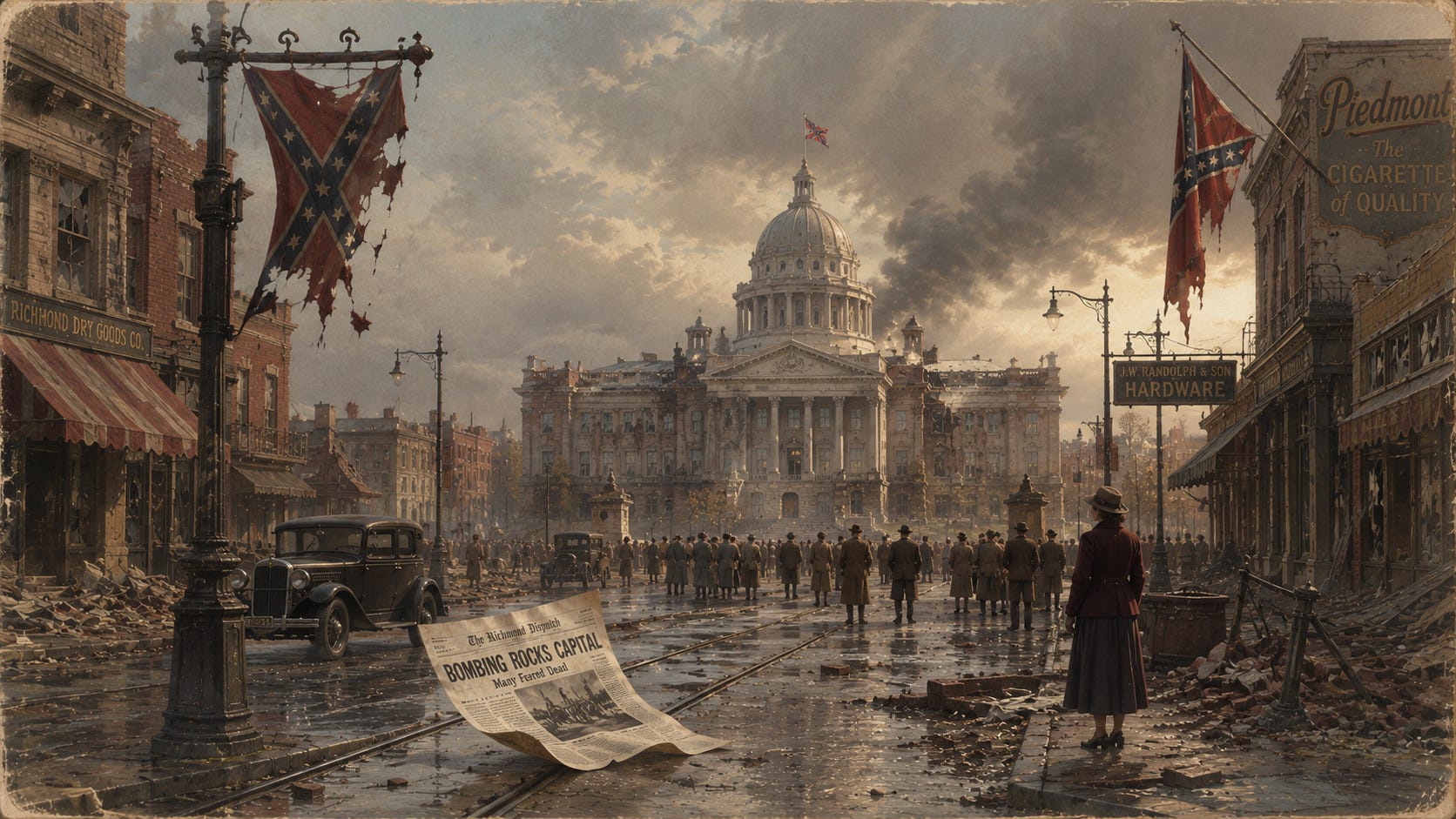
Just as a scream exploded from her lungs a crackling detonation concussed the air around them. The force of the blast swept everything before it, slamming into both women with terrific strength and knocking them onto the ground as if thrown down by an angry, all powerful giant. The west wall of the Executive building crumbled, sending up a huge geyser of smoke and leaving broken bricks and twisted piping on the pavement all around them.
The scene was horrific. As the swirling dust and smoke began to clear, the bodies of construction workers could be seen laying in odd positions on the ground, some still and others rocking back and forth and groaning softly. Agonized screams could be heard coming from under piles of debris. Dense smoke drifted from the scene as shocked bystanders and gray clad police rushed to help the injured.
They found Madeline on her back, alone and unmoving, with arms spread gracefully at her sides. She lay quite straight, almost perfectly in the middle of the street, as pale as a corpse.
Pickett was fretting in a meeting with Hattie Caraway, the wealthy junior senator from Arkansas, when the bomb went off. He was in his office on the second floor, luckily facing away from the windows as the explosion shuddered the building and shattered glass on the lower levels. Hattie Caraway recognized the sound right away and leaped onto the president to protect him. Seconds later, when the Secret Service agents catapulted into the room, they found the rotund senator from Arkansas sprawled on top of the president, pinning him to the ground. To the agents, it appeared that she was attacking him, and they swarmed onto the pile aggressively to restrain Caraway. Within a few moments order was restored, and a terse explanation from Pickett made matters clear. For her part, the widowed Hattie Caraway had no objection to her brief encounter with the president.
Pickett was hustled to a secure room in the sub-basement. The Executive Mansion was quickly surrounded and cordoned off by Secret Service and Virginia Guard troopers. Within minutes the building was a fortress. In addition to the troops on the ground, military aircraft began patrolling the skies over Richmond. By the time members of the cabinet began to arrive it was clear the bombing was an isolated event. There was no evidence of unrest in the city. Telephone calls to Atlanta, New Orleans, Savannah, Houston, Charleston, Memphis, Juarez and other important urban centers indicated that all was quiet. The teletype from Havana was silent. There was no general uprising.
Pickett looked around the bare walled bunker gloomily. The room was congested and the air thick with tobacco smoke. An enormous ventilation fan in the ceiling made a rapid, continuous scraping sound as it turned. The inner circle of the country’s political leadership was present, waiting for him to speak. He wasn’t sure what to tell them. The bombing was undoubtedly the work of the UR - the Underground Railroad - though it might be difficult to prove. There had been a steady increase in bombings, shootings, and bank thefts attributed to the UR over the past year. Most of their actions had been in rural areas, far from any nearby concentration of police or military force. They had never been so bold before, but Pickett had feared it was only a matter of time until they attempted a strike like this in the heart of the capital. The Secret Service and the Division of Investigation had of course begun a preliminary inquiry and a few fragmented reports had begun to come in by courier. The explosive device had been planted under some scaffolding on the new North Wing of the building along a section that was still under construction. North Wing... Pickett wondered if that was meant to make a statement. There were many casualties reported. Two young Black Scouts were killed as their troop marched by on their way to Monument Avenue. At least six more were gravely wounded, among them their commanding officer. Another report indicated many laborers and pedestrian passersby were also injured and at least eight dead. Over the course of the past hours the chaotic scene outside had been brought under control, the injured transported to hospital, and the area completely sealed off. The Executive Mansion and surrounding grounds were now an enormous crime scene.
The newspapers were already in a frenzy. The Enquirer had sent a small busload of reporters to the area. It was said that the journalists outside already outnumbered the security troops. Pickett knew he would have to meet with them soon in order to reassure the country that he was well, and that the government was functioning normally.
“Mr. President, are you sure you suffered no injuries?” It was Vice President Garnes.
“I’m fine,” Pickett snapped. For no particular reason, the question rankled him. Hell, this was nothing compared to combat. He looked around the room at the others, all of whom seemed to be staring at him with varying degrees of shock and apprehension. He used his well known smile to veil an overwhelming anxiety. The country at large was quiet for the moment, unaware of today’s tragedy. But news of the bombing would spread quickly, broadcast high and low, and the consequences could be incalculable. The president could not be sure how ordinary people from Virginia to Texas would react. Among whites there would be indignation, anger, perhaps a cry for vengeance from some, or perhaps a cry of remorse and self-loathing from others. Among blacks, and especially among slaves? Only God could know.
Pickett knew with certainty what few were willing to admit. Slavery was dying. Slavery as it once was, what the Founding Generation had fought to protect, was already dead. In a country of almost eighteen millions of blacks, less than three in five were chattel property, as in the old days. A few million were now legally free of ownership, completely manumitted. Of course, they occupied the lowest strata of society, for the most part, and would never enjoy the privileges of a white person. Many more millions were held to service, but for wages. In some cases, they were paid based on a wage scale determined lawfully by individual states. The pressures of labor shortages in a newly industrializing society had resulted in wholesale “service contracts” with factories that required menial, unskilled labor. This type of service was becoming increasingly popular. Not only could owners contract out slaves to function as workers, but they no longer had responsibility for their care and maintenance. Workers, whether men, women or even children, were kept in cheap, squalid, company owned housing adjacent to the factory plants. Some contracts allowed the workers to have their families with them so that many slave owners had no physical connection at all with their property, just ownership papers - much like stocks and bonds. In Tennessee, North Carolina, and Virginia black children, both free and slave, were eligible for elementary schooling at a rudimentary level in order to produce the more productive workers that were going to be necessary for the ‘New South’. Pickett smiled ruefully. That slogan was an expression of his vision, first proclaimed during the intense presidential campaign of 1930. The idea of a New South, true to its founding principles but modern in outlook, represented his hopes for the future of his country. The campaign slogan resonated with voters and had gotten him elected in a landslide. Of course, his name had not hurt any.
The sweep of change was accelerating, rapidly destroying the face of the Old South. The graceful plantations dotting the coastal plains and river valleys of the southern states were no longer viable and were maintained only by the wealthiest of families. There was still a community of interests among all whites, but there was restless concern about the growth of slave jobs in the industrial sector. Of course, no white man would ever do a nigger’s job, but the global depression had suppressed demand for some of the CSA’s important exports, including tobacco, rice, and cotton. People were hurting, and there had been mass protests over the lack of high paying jobs. Unions were discouraged, but that did not stop agitators from attempting to organize workers. A strike had broken out among Birmingham steel workers that was ultimately suppressed with brutal force during his first year in office. Ten dead. Ominously, there were recent attempts in Atlanta and Richmond to organize black factory workers as well. It was not possible to know what might be bubbling below the surface of these movements.
Pickett rubbed his brow, as if trying to squeeze a solution from his brain. The past and proper relations between master and slave were eroding. They weren’t even called slaves any longer; they were servants, workers, or laborers. They could not be assimilated, and they could not be made to go away. There was no solution, there could only be accommodation. And the best way to achieve accommodation was to restore the Confederate States of America to the community of nations. Even though the country owed its existence to foreign recognition during the old War, it had been treated like a pariah since then by virtually every European nation. Germany was a rare exception, and in recent years had proven to be a close friend. Pickett knew in his gut that the only way to save his country from falling into chaos was to entice European trade and broaden diplomatic partnerships. And the only way to achieve that goal was to conclude a peace treaty with the North and gain recognition of their final, irreparable sovereignty. Ultimately, the North would be their natural trading partner, and warming relations between the two countries would decompress the cauldron that was boiling in the South.
Right now, though, it was necessary to deal with the emerging threat of the Underground Railroad. They were thugs, criminals, and terrorists, but no one could deny that over the past twenty years they were gaining strength steadily. Attacks of sabotage had spiked to new levels, and the increasing efficiency of their methods suggested a higher, more sophisticated level of organization. As these thoughts swirled in his brain, Pickett slumped in his chair, cupping his face with his right hand, the very picture of despair.
An orderly entered the room ushering in two men who Pickett immediately recognized as editors from the Guardian and Enquirer. The president instantly sat straight up, fixed a grin on his face, beckoned both men to sit next to him, and pulled out a cigar. In an instant he was completely transformed, and again radiated confidence. Bacon, from the Enquirer, was an enormously obese man who was sweating profusely as he entered the congested conference chamber and then had difficulty negotiating the cramped space in the small room, squeezing around those who were already seated. He heaved himself into a chair right next to Pickett, scattering droplets of perspiration onto the president’s shirt and pants. He had no sooner secured his bottom onto the seat of the chair than he pulled a silver flask from his jacket pocket.
“Mr. President, would you honor me, sir?” It was more of an announcement than a question as he held the flask out across the table.
Pickett did not miss a beat. “That’s mighty white of you, sir,” he answered expansively, and flashed a smile as he rapidly took the flask to his lips and executed a highly exaggerated swig. “Excellent liquor, Mr. Bacon. Please feel free, gentlemen.” Pickett lit his cigar and watched as Bacon offered a drink to Mason, who was from the Guardian. Mason appeared to be over six feet tall but weighing no more than one hundred forty pounds. He had large, bulbous eyes framed by deep convex glasses. He literally turned his nose up as the flask was offered, exposing a scrawny neck with cord-like muscles.
“Mr. President!” He almost screeched. “There are dead bodies in the streets of our capital! Armed bandits are on the loose! The public safety is in jeopardy! What is the Administration going to do?”
Pickett regarded the other man coolly as he dragged on his cigar. With a determined look he stood to his full height and placed his hand firmly on the tabletop. He drew strength from who he was and what he embodied as the head of state. The president began to speak in a low, even voice. The room hushed, and men who knew well how to appraise and judge cast their eyes upon him.
“I will tell you, sir, what we shall do. We shall turn ourselves to stone, and with hardened heart hunt down every criminal who is hiding with blood on his hands. We shall mobilize every man, woman and child, black or white, free or slave, until every one of these vermin are flushed from their hiding holes. And every one we do find we shall fire with the flames of hell, until every atom of their existence is extinguished for all time. I will speak to the nation, to the very conscience of the nation, and together we shall overcome this moment in history, just as our forefathers did in their time.”
There was silence initially, but someone began to clap, and soon everyone was on their feet clapping rhythmically in the hot, closed room. A few yipped the rebel yell. The president seemed to stand hugely before them, smiling a grim warrior’s smile. They continued to clap as a courier struggled his way into the room and edged along the wall until he reached the president. He whispered something into the president’s ear. The clapping continued as George Pickett first swayed back and forth, as if struck on the head, and then clumsily collapsed onto his chair.
On most days reality lapped at her mind gently, like a spent wave curving along a protected cove. The throbbing ebb and pull of the outside world was incessant, but only dimly felt within the threshold of her awareness. True awareness, true feeling, true vision came only with the tempests that surged out of their secret dwelling places within her. In those moments, the howling of her voice matched the keening of the winds in her mind, blowing through time and space. In those moments, she could hear others calling her name in the gale, their disembodied voices coming from over the horizon. In the crisis of the storm, the seen and the unseen, the known and the unknown, the real and the unreal, the possible and the impossible all collided around her in a kaleidoscope of sight, sound, and feeling. And out of this chaos came.... what? Anger. Always, there was anger. Sometimes mingled with despair, or a deep sense of helplessness. But always anger. Swirling upwards from her heart, her mind, her soul, it was a demonic force that took possession of her. Fury was the first wind to lash at her, and the last to recede.
She knew very well what others thought about her. When she was younger, after the attacks first began, she had tried to explain. No one, not even her Lou Ellen, understood. She knew they pitied her for the way she looked, and for the “troubles” that afflicted her. As a young girl she had been ashamed of her white, white skin and long pale hair. She had been saved from the disparaging taunts of others only because she came from a great and powerful family. But over time she had grown to understand how different she was from everyone else, and that her inner convulsive storms were just part of that difference. She believed she was uniquely gifted, and at times she felt overwhelmed with the power that had been given to her.
Long ago, in her early teenage years, she experienced a recurring dream that played out like a movie show in her mind, composed only of thoughts, unspoken words, and blurred images. In her dreams, a race of giants wandered through the universe during the time of the Creation. They were great creatures of power and wisdom who traveled effortlessly through the byways of place and space. As they journeyed, they left tokens of their passage by planting kernels of primordial energy randomly in different corners of the cosmos. These seeds germinated through eons of time, waiting to exfoliate at preordained moments, and so created heroes, saints, and prophets. Madeline came to believe, and was quite certain, that her mind and soul had flowered from one of those seeds. Like her lifeblood, that power flooded through every nerve of her being, and she believed there was a purpose, a great design, for that power. There had to be. When she found herself in the epicenter of her furious deliriums, this force of light gave her a special sight. Not just the sight of things that were or are, but the sight of things that could be, or might be. Or would be. For moments at a time she could see the dim outlines of an indefinite shore, and comprehend the forms and sounds and motions that animated it. With her second sight she could sense herself and everything around her surging relentlessly toward the unseen borders of what was to come.
But even visions of the future could not calm her rages. Anger burned within her even in her calmer moments. Like the light from the sun, it illuminated every dark space in Madeline’s world. She had told herself many times that it did not matter that she was destined to travel through life alone. She was a pillar of power unto herself, and being apart from others was the necessary exchange for her secret power to see the coming unknown. But even so, she felt the bitterness of this truth. Her bouts of rage did not drive others from her, because there was no one to be pushed away. She had already seen this particular future, echoing repeatedly in her mind’s eye. In all time to come there was no one for her. No gentle arm to lean on, no soft voice to soothe her, no heart to embrace her. She could foretell that the days to come held no tenderness for her, and so she held none for herself.
Maddy...The future called her name, summoning her over the cresting surf. Maddy...The past pulled at her, recalling her to a quiet, sandy spit of sanity. Maddy...the present beckoned her urgently, vehemently, repeatedly to solid ground.
“Maddy! Can you hear me, darling?” She heard the familiar voice as if it were coming from within her.
“Madeline! Speak to us!” She opened her eyes and saw dim shapes moving in an uncertain light. Lou Ellen leaned over her and rubbed her cheek gently. “Maddy,” she murmured.
Madeline began to push herself up onto her elbows, but a gentle hand pressed her back firmly onto the bed. Her eyes began to focus on another form, and she recognized her father standing at the foot of the bed. He stood as if at attention, with his right hand holding his hat over his heart. Once he saw a look of recognition in her eyes he placed his hat briskly on his head and stepped closer to kiss her on the cheek. “How are you feeling, Madeline?” His words came slowly, as if he felt reluctant to speak at all.
Lou Ellen was seated at the bedside and was able to bend over and embrace Madeline in a tight hug. “Don’t fear for me, I know I have been saved for some higher purpose.” The stricken young woman spoke firmly, but she felt very tired.
Pickett gazed at his daughter with relief. Her color was even more pale than usual, but she was coherent and oriented. The doctors had told him that she had suffered a blow to the head and a concussion, but that she should have a complete recovery. For this he was grateful. But others were not so fortunate, and there would be much grieving over the coming days. And with grief there would be demands for vengeance. He looked at Lou Ellen, almost prostrate over the body of his daughter. A deep feeling of anger came over him as the meaning of the day’s events sank in, like a noxious vapor that permeated the air he breathed. There was a cancer in the land, and it had to be found and removed. For those who had died, for his daughter, for his country, he would do whatever was necessary to accomplish just that.
He spoke aloud what he was thinking within. “We’ll find them, Madeline, the ones who did this. We’ll find them and kill every one. I’ll lynch them from the treetops.” Pickett thought he saw his daughter move as he spoke, but it was Lou Ellen turning her head halfway towards him. The old woman looked Pickett in the eyes.
“Well, get on then,” she said quietly, “and get it done with.”
Robert Jones walked confidently down the almost empty streets, immune to the electric sense of fear that flowed around him. There were police barriers and checkpoints at every major intersection. Heavily armed Virginia Guard troopers in their distinctive black leather jackets prowled the side streets in groups of four, rifles at the ready. Jones was surprised to find a tank stationed on the corner of Belvidere Street, its stubby muzzle aiming towards the sliver of moon just arising over the horizon. The tank commander stood in the open top hatch, carefully monitoring the lanky black man strolling briskly towards the deserted intersection. Jones pretended not to notice, but he could see there were other armored vehicles nearby. Soldiers with guns slung over their shoulders huddled quietly in small groups, almost lost within the gloom of the early evening. Jones thought it was strange that the cavalry was not scouring the streets as well. Perhaps they were patrolling the extensive suburban reaches of the capital.
He strode quickly and purposefully, making no attempt to deviate from his course, and keeping to well-lit streets. He was leaving Jackson ward, which was an inevitable focus of investigation as dusk descended on the city. It was a colored neighborhood, made up mostly of second generation freed blacks. It would be easy to imagine that the UR had spread its tentacles into the oldest black section of Richmond. Now that there had been a bombing at Government Center it was understood that blacks - any and all blacks - would be under suspicion. Jones snorted. Nothing new in that, he thought. Just the same old thing. Blame the nigger, now. When something goes wrong, blame someone below you. That was the easiest thing to do. It required no thought, no conscience, no....no nothing. Someone could be as empty in the soul as a dried up well and smear about blame like that. Jones knew the world had not changed much since the times of the Lord’s days on this earth. Pharisees, sinners, tax collectors and the high and mighty were all still here, still in charge. Ordinary people pay for all the world’s needs, he thought, especially the need to be blamed. Slaves, the poor, the downtrodden all paid in this world, but God would see to it that the rich and powerful would also pay in due time. Yessir, pay to the last full measure. What would that look like? The accumulated debt of pain and sorrow gathered up over the years; why, it would have to pile up half way to the moon. No, uh uh, not to the moon. Half way to heaven itself.
Small shops, some restaurants, and a few artisan’s studios dotted Leigh Street. As Jones made his way east from the Ebeneezer Baptist Church he could see that everything was shut down. A few folks, mostly elderly women, sat at their open windows, watching the scene unfold before them. No one dared to walk the streets.
Jones planned to get home by going through old Chimborazo. This part of the city remained undeveloped, retaining pockets of thickets and scrub pine that dated back to the time of the old War, when an extensive field hospital occupied much of the area. It was generally believed that the ghosts of the tormented dead still roamed the valley. Jones had been through this way many times, and had often imagined he could hear the sobs of the long ago departed, as if their voices lived in the nodding trees that lined his route. This way was heavily patrolled, and Jones was stopped a half dozen times. His identity card and transit pass were impeccable. Whenever necessary, he carefully unfolded an endorsement from the President of the Confederate States of America. He had no difficulty at any of the stops and made his way rapidly home through the gloaming.
Church group had been unsatisfying that afternoon. News of the bombing had spread like wildfire, and Reverend Mattoon had decided to dwell on that matter rather than the planned text from 1 Corinthians. Reverend Mattoon was their white pastor. Reverend Jackson, their colored pastor, had sat quietly in a pew all afternoon, head bowed, seemingly in prayer the whole of the time. How disappointed Jones had been. He had studied the passage from Corinthians intensely over the past week, and prepared himself that day with prayer and by taking only bread and water in the morning. He had hoped to reveal passages from Amos, Job and 1 Timothy that would deepen the meaning and scope of the section under study. As he walked through the valley of Chimborazo, he repeated a passage of sacred text to himself in a low voice: “For I delivered unto you first of all that which I also received ...” Jones shook his head slowly, overwhelmed by the beauty and solemnity of the words written by Paul. Yes, Lord! Robert Jones had been shaken to his very soul when he first read that passage. In those few words he had seen an image of what his life should be. What could be greater than giving to his brethren from the gifts that he had been given? Jones had been blessed with a quick mind, an education, and a trusted position. Like the apostolic writer, it was his duty to transmit the fruit of these gifts to others. First of all... Not as an afterthought, or as a half remembered errand, but first. Like the great apostle, Jones prayed that his gift giving would open the hearts of others to the glory of the King. For this, he would give everything and endure anything.
As he approached the turn onto his own street, Jones could see several police cars, their headlamps dimmed to a dull orange. Richmond uniformed police performed a careful inspection of his documents. Jones, of course, removed his hat respectfully as he was interrogated. This was no time to provoke or antagonize a cop, no matter what documents he carried. He could see that Virginia Guard troopers were also present, lurking a dozen yards from the checkpoint, weapons at the ready. Security around the president’s home could not be tighter. A police sergeant told Jones to lean over a car, and frisked him carefully. “You o.k., boy, now go ahead and run home,” he said. He seemed to be smirking. “Wouldn’t want old man Pickett to have to change his own drawers.” His partner chuckled but said nothing.
The house was quiet as Jones approached, but he saw the kitchen lights were on as he swung around the back. Someone, maybe Lou Ellen, would be there to share a sandwich with him. It was almost completely dark now, but Jones knew every brick in the walkway, and had no difficulty maneuvering around beds of giant begonias as he made his way to the rear of the house. The entire neighborhood was very still, but Jones could see there were lights on in the adjacent houses, including Senator Robinson’s behind them. It looked like the senior Senator from Alabama was entertaining dinner guests. A low current of music could be heard drifting from his dinner party. The soft creaking of cicadas could also be heard, and as Jones ambled around the back of the house he breathed in the sweet scents from the lilac bushes nearby. Jones began to feel an enormous sense of relief. It seemed that despite the trauma of the day, life was still on its orderly and quiet course.
The servant’s entrance was right next to the kitchen, raised by three steps off the graveled pathway. Jones never made it to the first step.
“Freeze!” a harsh voice hissed from somewhere ahead. “Put your hands up where I can see them.” At the same moment a blinding light illuminated his face, causing Jones to squint and cover his eyes with his right hand.
Strong, anonymous hands grabbed him roughly, and threw him face down to the ground. Jones felt a moment of terror as his face was pushed hard into the turf, crushing his mouth and nose and smothering him. His arms were twisted behind him and steel cuffs placed on his wrists. Just as he felt he was going to lose consciousness the hand holding down his head let up its pressure, allowing him to turn his face and take a deep, gasping inspiration. The pungent, chlorophyll laden smell of grass filled his nose and throat, causing him to cough and choke as he was pulled to his feet. Jones could sense men on both sides of him holding him by each arm and a third behind him holding him by the collar of his jacket. Wordlessly, they ran him, as if running a dog, to a car parked at the side of the house.
Just as he was thrown into the back seat of the car, Jones felt a sharp, brief sting in his upper arm. Other bodies piled into the car seat on either side of him. Jones tried desperately to right himself and sit straight up, but suddenly felt weak and very dizzy. He collapsed backward, his head falling onto the shoulder of the man to his right. A deep vortex of blackness engulfed him rapidly, rendering him senseless as the car sped silently into the dark hum of night.
Chapter 5
“Adaptation is the key, gentlemen.” A bout of staccato coughing interrupted the speaker for a moment as his words boomed out over the audience.
“Explaining the emergence of adaptation and antibiotic resistance, when and why they occur, is crucial to our understanding of bacterial biology. Perhaps to our understanding of human biology as well. The understanding of adaptation requires that we understand all the possible mechanisms of change. Change is everything. Adaptation requires self-awareness, identity, uniqueness, plasticity. Yes, even desire, in a way. The desire to survive. Indeed, to thrive. We all share some of that, don’t we, complex though we may be.” Stanhope Bayne-Jones paused for effect, scanning his audience regally from the lectern. Standing tall in the diffused light of the amphitheater styled lecture hall, dressed in a dark blue coat and tight fitting vest, he appeared every inch the Great Professor. “And,” he said in a tone of magisterial authority, “adaptation lends understanding to the basic biological instinct of resistance. We evolve in order to remain what we are, yes, to keep our identity.”
Jona shifted in his chair uncomfortably. The auditorium was crowded that morning due to the eminence of the speaker. It was unusual for Bayne-Jones to speak to a group of generalist physicians rather than to his cohorts in the field of microbiology. He was well known in his discipline, and the audience was eager to learn the newest information in an area of medicine that had exploded over the past several years. Apparently, the Yale professor had decided not to pare down or simplify his presentation for his New York audience. On the contrary, his lecture was filled with complex data culled from recent research on bacterial replication. The presentation was tedious, detailed, and lengthy, making it difficult for Jonah to follow carefully.
Jona also found it hard to concentrate because he felt on edge in the crowded hall. He sat in the gallery, where the audience was compressed into an uneasy, uneven, restless mass of tapping feet and crossed legs. The chairs were pushed very close to one another, and he could sense every breath, snort, and cough from those sitting around him. In particular, he was able to hear every mucousy, congested sniffle from a diminutive man with an enormous walrus mustache sitting right behind him. Jona did not recognize him, and concluded he might be a neighborhood physician not on the Bellevue staff. By all rights, the intruder shouldn’t have been allowed admittance into the lecture hall, and Lieb felt a righteous sense of resentment that the stranger was here at all. This kind of information was not appropriate for everyone, after all. At one point during the presentation Jona had stolen a quick peek backwards at the little fellow and was repelled by the appearance of a stringy purulent discharge on the upper edges of the man’s hairy facial appendage.
“I am convinced,” Bayne-Jones continued, “that the development of resistance is an adaptive response that is inherent in the genetic endowment of bacteria. In the broadest sense, this entails the ability of these organisms, or any organisms, to differentiate their internal from their external milieu. Or, if you prefer, to distinguish ‘self’ from ‘non-self’. Each living entity can in some way understand its own unique existence and can respond to external threat by attempting to protect itself. Not always well or successfully, perhaps. The broader, the more robust and more responsive its capacity to mutate and change, the greater its chances of survival. Survival, of course, may mean the evolution of an organism into something that is very different from the original. It is not known, not yet, how genetic information of this type is transmitted through successive replications, from generation to generation. We believe that this line of research will reveal the secrets of the genetic code within bacteria, and eventually, if I may say so, within humans.”
As the audience burst into sustained applause, the professor’s words triggered Jona’s mind backwards to a conversation he once had with his father. The elder Lieb rarely talked about his research with Jona, and when he did it was usually to voice a complaint about bureaucratic incompetence at the laboratory or university. More rarely, he would talk about general trends in the field or speculate about future developments.
Just a few months before, they were alone for a rare breakfast together. The elder Lieb had taken the train down to New York to meet privately with John Rockefeller about an endowment. Times were difficult, and the Rockefellers were already immersed in the uptown construction of the ultramodern complex that was slated to become the New York Medical Center. Endowment funds were cut short until the medical center was to be finished, still more than two years distant. However, Earnest Lieb could be very persuasive, and his meeting had gone well. He had arranged to meet Jona the next morning at a small restaurant on Eleventh Avenue. The place was owned by a former Serbian army officer befriended by Lieb during the old days, when he and Jona still resided in the city. Jona had noticed that his father appeared tired and asked him about it.
“I’m exhausted, but I feel exhilarated at the same time, Jona. Our research data are really exploding. We’re finding that some bacteria seem to be able to confer patterns of antibiotic resistance rapidly to one another. The information spreads through any given colony of these organisms with amazing speed. Mutation. Change. That’s the mechanism, I’m sure of it. But we don’t know how. We don’t know what triggers the process, and how the mutation spreads among individual bacteria. We don’t even know if it’s orderly, by design, or just a random series of events. I can’t believe it’s random, though. There is a how and why to change. And that’s what beggars the imagination. Why do they want to live? How do they know they want to survive? Is there some recognition of life in these tiny organisms? Do they want survival only for themselves individually, or for their entire colony? We will develop our theories and test them systematically. It’s time consuming, but that’s science.” As he discoursed he sipped at a Turkish coffee, a renowned specialty of the Serbian owner. It was always taken as strong and hot as possible, with no sugar, and it’s deep, aromatic smell permeated the air. Jona was drinking tea with light cream.
As usual when he was about to challenge someone, Earnest Lieb tilted his head to the right and thrust his jaw out. His dark brown eyes gleamed radiantly, matching the coffee’s intensity. “And how are you, Jona? You appear well rested. Recovered from all that nonsense of last year, I hope. How is your research going?”
In one swoop his father had bored in on the two open wounds in Jona’s life. The reference to Marielle caused a searing pain in the pit of his stomach, moving him to momentarily wrap his arms over his abdomen. Jona dreaded questions like that from his father. He hated to discuss his own failures with the great man of science, particularly his research failures. Even the few successes he had enjoyed in the Neurology research laboratory were trivial in comparison to the scientific advances achieved by Earnest Lieb. Jona said nothing, bowing his head over his teacup.
After a few awkward moments of silence, the elder Lieb settled back into his chair, giving the impression of examining the restaurant’s gritty plaster ceiling carefully. Dim noises of clinking cutlery came from an adjacent table, but the small dining room was otherwise quiet. “Do you know what my field of interest was, back in the beginning, when I first got started?” He asked the question as if he were looking for something at the back of a medicine cabinet.
Of course, Jona knew. “Syphilis,” he answered promptly. “Spread, prevention, especially treatment.” Earnest Lieb had made several seminal discoveries regarding one of humankind’s most mysterious ailments, giving him scientific renown when still in his early thirties.
“That’s right. But do you know why?”
Jona felt vaguely uncomfortable. “No, not really. I assumed you were put on the chase for a cure by Professor Collins back in Atlanta.” Jona had a vague memory of Dr. Collins as a short, fat man who wore a monocle implanted in his right orbit.
“Partly true.” Earnest Lieb eyed his son with a tremor of tension at the corner of his mouth but said nothing further.
Jona felt a void stretching out before them as the quiet deepened. He sensed that his father wanted to speak about the past, but was searching for an opening, like a blind man seeking a doorway. As they sat quite still, he could feel an inaudible metronome ticking down in a cadence that would end in silence. If he did not strike the right note in the next few moments there would be nothing left for either of them to say.
“Was it because of the Negroes? Did you want to do something to help them?” As a young investigator Earnest Lieb had found that up to a quarter of male slaves in the South had syphilis by age thirty. Lieb had often referred to syphilis as one of the many “diseases of oppression,” occurring disproportionately in slaves and poor free blacks, male and female. Much later, he had discovered that roughly the same incidence rates for venereal diseases were found in Northern black men inducted into the army. For years he had urged the development of systematic health services for the poor, and particularly enjoyed shocking anyone who would listen by proposing the free distribution of prophylactic rubbers to men. And to women.
“No, Jona, I was no social worker, especially back in the beginning. I simply wanted to succeed in my research and get ahead in my career.” Lieb looked at his son sharply, and took a sip of coffee. “But I was angry, too...” His voice faded off and he seemed distracted, playing with a spoon.
“Why, dad?” Jona did not want him to stop talking.
“Listen. You can’t understand what things were like back then in that place. Thirty years ago, but it seems like yesterday. My God, blacks were possessions! Still are. Honest people, friends, good solid men with dignity would have their underwear washed by slaves. Blacks were somehow human but not full human beings, just pieces you could move here and there as you pleased, as you might move a lamp from one corner to another. It was awful. It’s still awful. It’s a goddamn crime, really. A crime without penance. You’ve heard me say all this. A crime before all humanity.”
Jona was shocked to hear his father use profanity. He could remember that, as a child, his father would occasionally swear, particularly during dark moments of anger and often when drinking. But from the time they moved north, and with his recognition as a prominent international figure, his father’s control of language remained scrupulously proper. It was part of his persona. Jona also did not allow himself to utter any improper words, even in the most trying of circumstances. He knew his father would never approve. It was a rule he could not even imagine breaking.
Lieb finished his coffee and abruptly turned the cup over upside down onto its small dish. A small trickle of brownish fluid and coffee grounds appeared leaking around the rim. He observed the drainage briefly, and then continued speaking slowly, in a soft monotone. “There was a very rich woman from Savannah. A big-time landowner, had a huge plantation. More than a thousand acres, had cotton, rice, cattle, you name it. She came to see Collins about some of her female servants, and he directed her to me with instructions to help in any way possible. So they came in. There were three young women, all reasonably healthy appearing but all clearly infected with syphilis. All three were quite pregnant. One was very young, maybe fifteen. They told me, at least the young one did, that the plantation overseer had raped them. All we had available at the time was a drug called salvarsan. We knew even back then that treatment with salvarsan was ineffective for the fetus, and possibly dangerous for the mother. But salvarsan was all we had; it was either that or nothing. After making the diagnosis I recommended that all three pregnancies be aborted, and that the women be treated promptly thereafter.” Lieb paused a moment and shook the inverted coffee cup on the saucer very gently. He took out a package of Lucky Strikes, removed a cigarette, and placed it in his lips. Almost instantaneously the restaurant owner appeared from nowhere, as if from an adjacent universe, and lit the cigarette.
“Thank you, Vlade,” murmured Lieb. Vlade was quick to extricate a cigarette from the pack for himself and light up as well. Jona noticed he was missing the fourth and fifth digits of his left hand, which appeared contracted and deformed. A long scar extended down his wrist, disappearing under his shirt cuff. The nail on his middle finger protruded at least an inch, much like a knife-like rapier ready to be deployed in an instant. The Serb pointed to the pack of cigarettes and gazed at Jona questioningly, but Jona shook his head.
His father inhaled deeply, then continued. “Of course, abortion was ruled out of the question. It was illegal, naturally, which I didn’t mind. I could have gotten around that. That wasn’t the problem. You should have heard the owner, though, when I gave her my recommendation. The old bag screamed as if she were struck by lightning. ‘I am a soldier of the Lord!’, she shouted at me as if it was Sunday morning in some backwoods low hollow church. ‘I will not allow the Devil’s work to be done in my household.’ What a joke.” At this Lieb laughed a full throated, rumbling laugh as he tossed his head backwards. Almost simultaneously Vlade did the same, slapping himself on the knee, although Jona had the impression that the Serb did not understand a word his father was saying.
“I didn’t realize the truth of the matter right away, but eventually it dawned on me. Of course she wanted the babies. Little black babies, when weaned and toilet trained can eventually be quite valuable. Even with syphilis, which would be a minor distraction in the workaday world of the blast furnace, or coal mine, or tobacco plantation. Have you ever seen congenital syphilis, Jona?”
“Certainly. Mental retardation, poor vision, heart and liver disease...The spirochetes of syphilis can infect almost any organ. It’s a horrible condition.”
“Not so horrible, my boy, if you can make a few bucks out of it. That’s what our dear lady from Savannah had in mind. One of the girls, the young one, delivered prematurely while they were still with us. I saw the baby before it died the next day. I didn’t want to acknowledge it as human, Jona, it was so deformed. The worst example of congenital syphilis I ever saw. Its head was no larger than a small orange. But even so I knew it would one day be put to some mindless labor or maybe left to slowly starve to death. It made me angry...I wanted to kill it, smother it, remove it from my sight, destroy the goddamn thing...” Lieb trailed off, staring vacantly at the breakfast dishes in front of him on the table. The Serb watched him intently, his dark brown eyes unwavering, the clipped mustache on his upper lip twitching slightly. A clock on the wall ticked softly, the minute hand moving smoothly over the dial. Jona’s heart beat quickly. He had never heard this story before. For an instant, he remembered the quick flashes of anger in his father that he had seen as a boy. The clank of a fork on a plate coming from a nearby table shook Earnest Lieb from his reverie, and he looked rapidly around the room, as if afraid that his words had been overheard.
“I did not, of course, though I had every opportunity to do so if I wished. I’m sure the old lady would have been happy if I had discarded the little bundle for her. Even better, had I popped it into the crematorium. This particular specimen would be unsuited for any kind of work whatsoever. Providence saved me from any further torment when the infant finally died of internal hemorrhage within a day or so. I think the young mother was relieved as well, though she cried all night over the little thing. There was absolutely nothing I could do. I couldn’t help it. I felt terribly guilty about it all.”
Jona felt a hot flush of anger at what he was hearing. “There was nothing for you to be guilty about. That’s absurd. Why would you feel guilt?”
Earnest Lieb smiled widely. He looked over his shoulder for his friend. “I don’t know. Where does guilt come from? Eh, Vlade?”
The Serb had moved silently, like a shadow, to the rear of the room and was just walking back with two plain glass flasks in his right hand, both without labels. He placed them on the table in front of his friend and pointed to them in turn, saying simply “Starka“ and “Raki” as he identified each one. The elder Lieb nodded towards the Starka. He had spent a summer in Poland investigating a cholera outbreak and had acquired a taste for the rough burning sensation of Starka taken straight. It took him only a second to drain an ornate shot glass. He placed the glass sharply on the table and tapped the rim with his forefinger. It was promptly replenished by Vlade, who then wrinkled his brow in Jona’s direction. Jona was already dizzy from the cigarette smoke swirling around him and shook his head rapidly.
Lieb threw back his head and finished off the second shot, grunting softly and then gritting his teeth. “Well, Jona, where does guilt come from, tell me?” His voice was louder, insistent, belligerent.
Jona wasn’t sure how to answer. Did his father really even want an answer? He groped for a response, sifting mentally through philosophical treatises he had read. “Kant would say from within,” he answered haltingly, “from the deepest core of our humanity.”
Earnest Lieb literally sneered. “Kant said that? From our deepest core? Do you mean from our cells? Or even deeper, our chromosomes, our genes? Does guilt come from our genes, Jona? Does hate? Desire? Faith? Do our genes determine whether we have compassion?”
Jona was stunned by the depth of his father’s intensity. He sat helpless, head bowed, unable to answer back, unable even to look up.
The older man took another deep drag on his cigarette. An acrid blue haze hovered over the table. His voice lowered and he leaned forward over the table, crouching like a prowling carnivore as he continued. “When I was much younger than you are now, I read everything I could about the great giants of science. I studied their accomplishments. I dreamed about them. In my mind, I pretended to perform their experiments. I learned about Friedrich Miescher and his discovery of nucleic acids. He isolated nucleic acids in pus draining from wounds, can you believe it! I imagined in my mind’s eye Muller’s experiments using x-rays to cause gene mutations. While my friends at school read Tolstoy and Thackery I memorized Edmund Wilson’s drawings of chromosomes cleaving during cell division. I devoured Morgan’s experiments with gene transmission in fruit flies. What a mind he had! Remarkable science! I believed at that time that all the answers I needed could be found in those experiments. I thought everything could be explained by science. If not in biology, then fine, the solutions would be in other fields. So I studied physics, astronomy, chemistry. Becqerel and Curie, Roentgen, Rutherford, von Baeyern, Maxwell, Boltzmann, Laplace, Courvoisier...” His father’s voice drifted off and he seemed to slump in his chair. Vlade silently filled their glasses once again. Earnest Lieb drank his down without hesitation.
Jona wanted to say something but was unsure what his father might want to hear at that moment. The Serb pulled over a chair and sat at the table with them, making an exaggerated smirk and appearing bored as he smoked. Very casually, he inserted his long fingernail into his ear and probed vigorously, retrieving a glob of brownish material.
“Jona, do you know where the highest concentrations of syphilis organisms are typically found?” Ernest Lieb pursed his lips, assuming a professorial tone, but with head bent, looking downwards.
Jona thought for a moment, culling his memory for the answer. He felt like a young schoolboy at the feet of the master. “No,” he admitted. He imagined that the Serb threw him a glance of contempt, as Vlade continued to draw on a cigarette that was now more ash than tobacco.
“In newborns. The fetus is the ideal medium for the growth of the spirochetes of syphilis. I performed an autopsy after that baby from Savannah died, Jona, and I harvested the brain, heart, and liver. I cursed the unfeeling God that allowed the birth of a monster and the death of an innocent baby, but I was able to begin my first transmission experiments with that tissue. So you see, it was my anger and guilt over the birth and death of that miserable creature that pushed me down the road of my research.” Lieb smiled at Jona, but it was a hard smile, and his eyes seemed to narrow into slits.
“It was a worthy road, dad. It was a road that led to great things.” Jona felt momentarily transported back to his boyhood, when it had been easy to speak intimately with his father.
“Anger and guilt,” Lieb mused, as if he had not heard a word that Jona had said. “The reverse side of two other sins, hatred and pride. I gave up everything ... almost everything. Years and years devoted to nothing else. I walked a road to hell to satisfy those sins. No, I crawled that road on my hands and knees. And as the years went by, after all my research and study of syphilis, salmonella, cholera, and every other stinking, godawful microscopic killer of humans I could identify, I learned something.” At this point he turned completely in his chair to look at his son.
Jona later remembered the moment vividly. His father’s dark green eyes flitted back and forth, searching, as if unable to focus across the hazy space that separated them. A broad forehead was wrinkled in crisp relief against a sparse crop of steel grey hair. A sharp nose cast an unyielding shadow over the mid part of his face. His cheeks and chin appeared leathered and weighted down, obedient to the laws of nature.
“I learned that bacteria have chromosomes, and they have membranes,” he said softly. “But they have no guilt. They live all their days without the slightest sense of guilt. That, and pride, and hatred, and hope belong to us alone. They come from deep within us. They come from the deepest core of our humanity.”
After a moment he turned back to the table, picked up the inverted cup from its saucer and carefully examined the brown stained coffee grounds that remained within it. He grimaced and pushed the cup over to the Serb who also scrutinized the blot of brown material.
Vlade shook his head slowly, patted the professor on the shoulder, and poured another shot of liquor for both of them. He stood up and held his glass up in the air theatrically, gesturing in a toast to Earnest Lieb, intoning sonorously “Per me si va nella citta dolente,” before they both poured the burning fluid down their throats.
After the lecture, Jona walked outside into a dreary, drizzly day. He hurried along Twenty First Street clutching a small piece of paper in his hand. Joe Murphy had left a message for him at the ME’s office that morning. The note instructed him to come to an address on 59th street, in the old San Juan Hill area, a seedy and depressed part of Manhattan hard by the river. The meeting was set for noon, giving Jona just enough time to walk to his destination and avoid the expense of a cab. Jona hoped the misty rain would not flare into a heavier downpour before he got there.
The streets were tough here, and pedestrians in this part of town were sparse. At one dirty, littered corner Jona could see a group of people huddled around a small pile of furniture. As he approached, he realized it was a family of four that had been put out on the street. He pretended to study a poster on the building behind them as he passed, advertising Charlie Barnet’s band appearing together with Kitty Kallen at a club in East Harlem. Without wanting to, he could see a little girl, ashen faced, sitting on what looked like a grimy horsehair sofa. Tears were streaming soundlessly down her face, as she held up a piece of cardboard with some scrawled writing: need $12 rent for April. The mother seemed to be sleeping on a blanket folded on the pavement, snoring loudly. Two little boys who looked like twins gazed at Jona apathetically. Twelve dollars, he thought, that’s not very much.
A group of four black men in long shabby coats loitered further down the block in front of a tenement building, singing. The words were easy to make out, even at a distance. Jona could hear them trilling “Let’s all sing like the birdies sing” in strong, melodious voices. Clustered tightly, they faced one another and sang à capella to no one but themselves, moving their arms expressively as if inviting the whole world to listen. They managed to give the song a percussive, syncopated beat with every ‘tweet, tweet’. The words vibrated up and down the nearly empty street. Jona wanted to get closer but was afraid to appear too interested in their performance. He loved the song, as he loved music in general, but the clustered men seemed rather ragged and soiled, and all of them were grimly thin. He feared that if he passed too nearby, they might try to speak to him, or ask for money. Involuntarily, he clutched at his wallet as he walked hurriedly beyond them.
The address he had been given was a nondescript brownstone building with a storefront office advertising “Mehl and Mehl Law Firm”. As he stepped through the door Jona wondered idly why the Secret Service had chosen a Jew law office for their meeting. Of course, he was not bothered by it. The hallway was poorly lit and filthy. Jona flinched when he spotted several roaches scuttling along the walls as he walked towards the office door.
It had been four weeks since his father’s death, and Jona had become resigned to his impending mission, and though he didn’t want to say so aloud, even a bit excited by the prospect. He had mentioned the idea of a memorial lecture in Atlanta to his colleagues at the city morgue, all of whom expressed support for honoring his father. Most importantly, Dr. Bellevue had seemed exceptionally solicitous of Jona, to the point of urging him to take as much time as he needed before returning to his duties. That was quite unlike Dr. Bellevue. It certainly seemed as if his supervisor had undergone a pleasant and welcome change in demeanor. All in all, the idea of visiting the CSA had begun to appeal to him, and he no longer dreaded the summons from Murphy he had received that morning.
Of course, the two musclemen assigned to accompany him were certainly not going to control what he did or said in Dear Old Dixieland. He would meet his father’s old colleagues, give a lecture In Memorium of Earnest Lieb’s scientific accomplishments, and deliver Roosevelt’s letter to the appropriate authorities. Very simple. Jona had no political axes to grind and intended to avoid any inflammatory comments or provocative discussions. He had decided, completely on his own, to recommend the publication of a festschrift in honor of his father’s accomplishments. He was very proud of himself for coming up with that idea. Furthermore, as far as he was concerned, anything resembling a social agenda was taboo. In essence, his trip would be strictly academic in nature. Yes indeed, he would lay down the law to these two jokers, Andrews and Murphy, and make it clear that he, Jona Lieb, would be in charge.
As he entered the offices of Mehl and Mehl, Jona reassured himself that the whole venture would be a breeze, and probably quite entertaining. He would enjoy seeing the land of his boyhood and he would certainly enjoy being treated like a distinguished visitor. That would be a novel experience. And, if he played a pivotal role in improving the international climate, so much the better. Any honors that followed would be well deserved.
A young woman in yellow was sitting at a desk in the middle of the room. Jona was momentarily distracted by the console radio in the corner of the room. It was a beat-up looking Philco with the top panel removed, exposing the internal wiring and glowing vacuum tubes. Jona stared at it for a moment. The scientific marvel of radio transmission still amazed him, but it seemed a somewhat trivial accomplishment. Nothing very important was ever broadcast over the airways. Grainy sounding music, possibly an opera, was emanating from the speaker. The accompanying hissing and buzzing made it impossible to recognize the music with any certainty.
Jona walked up to the receptionist diffidently, conscious of his awkward limp. “Hello. I’m Dr. Lieb. I have an appointment with Mr. Murphy.”
The woman gave Jona a radiant smile, revealing perfectly formed teeth. “Mr. Murphy is expecting you, Doctor. He called to say he would be a little late. Can you have a seat?”
Lieb smiled and nodded. His heart raced when she smiled at him again. Her blond hair was bobbed in a somewhat old fashioned manner, her skin had a lustrous, pearly appearance, and her eyes were bright blue. She was quite lovely, and her gaze seemed to linger on him just a moment longer than necessary. Jona turned away. As he sat down he began to rehearse what he would have to say to Mr. Murphy and Mr. Andrews.
Joe Murphy was seething with anger. He was sitting in the crowded lobby of the Biltmore Hotel waiting for Andrews to finish his phone call. Fifteen minutes ago they were ready to leave the hotel for their meeting with Lieb. As they exited the elevator a bellhop informed Andrews he had a call waiting on one of the lobby phones. Murphy had been sitting ever since, impatiently waiting for his younger partner to finish. He could see Andrews clearly from where he sat. What annoyed him most was the junior agent’s pervasively passive appearance. He never looked excited, or angry, or happy for that matter. As he watched Andrews talk inside the phone booth it was impossible to discern any clue about the nature of his conversation. The man was a machine.
When Andrews finally strode out Murphy could not hide his annoyance. “Who the hell were you talking to?” he demanded.
Andrews did not answer immediately. Rather than responding he began to adjust the knot on his tie. This simply infuriated Murphy. “Look, Andrews, you answer my question or I make a phone call of my own, to Moran. Now who were you talking to?”
Andrews looked casually at his senior partner and kept moving towards the double revolving doors at the east entry into the hotel. “The Bureau,” he said simply.
Murphy grabbed him by the coat sleeve, almost jerking him backward. “Why the hell were you talking to them?”
“To find out more about our dear little friend. He has quite a dossier with them.”
Joe Murphy was in his fifteenth year with the Secret Service. He had joined the elite cadre of agents right after discharge from the Marine Corps. Over that time he had developed a grudging admiration for the Bureau, especially since it had been reconstituted as the Federal Bureau of Investigation a decade earlier. They were certainly thorough in everything they did and any information from them was very likely to be reliable. On the other hand, he was not convinced the Bureau was trustworthy. The Director, a rat faced, smug looking fellow named Hoover, had already shown himself to be a vicious infighter in the highest circles of political power. The fact that the Secret Service was interested in Jona Lieb was sure to find its way to Hoover’s desk. Who knew what he would do with that information? If the Director began snooping into the matter the secrecy of their mission would surely be compromised.
As if reading his mind, Andrews clapped Murphy on the shoulder. “Don’t worry, I spoke to a guy who’s an old college buddy of mine. Princeton man, if you know what I mean.” Andrews seemed to smirk for an instant. “Strictly on the QT.”
“Yeah?” Murphy snarled. “Well next time how about you clear things with me first?”
The younger man said nothing in response. They were in their car within a few minutes. Andrews was the driver, and he concentrated on weaving in and out of light early afternoon traffic. When they stopped at a red light he turned to his partner and spoke slowly and distinctly. “Don’t you want to know what he told me?”
He got a guttural grunt in reply. Murphy appeared to be fastidiously studying some undressed manikins in a nearby clothing store window.
“Our wonderboy, Dr. Jona Lieb, was in with quite a bunch of Reds. It turns out he knew them all. You name them - Clifford Odets, Erskine Caldwell, Lester Cole, Elia Kazan, Alvah Bessie. Mostly the artistic types. A Who’s Who of the Communist Party.”
“We already knew this stuff, didn’t we? The boss spelled it out for us and for him also. Scared the crap out of him.”
Andrews gave Murphy a poised look. “He met with Jim Cannon at least once, right after the guy came back from his trip to Moscow.”
Murphy shook his head vigorously. Jim Cannon had been the first President of the American Communist Party. He had gone to Moscow in 1928 to attend the Sixth Congress of the Comintern, apparently at the invitation of Joe Stalin himself. If Jona Lieb had been given access to the leader of the CPA it meant a real possibility that he was a true believer. If that were the case, their mission was blown sky high. “But he was never a member, right?”
“Jona? No. But Earnest Lieb was.”
“The father?” Murphy was dumbfounded. “But he spoke out against the Commies. I read that he once debated a Commie academic type from NYU who kept calling Communism the wave of the future, and the Red Dawn, and shit like that. Lieb renamed the ‘Red Dawn’ the ‘Red Lie.’ “ Murphy did not read much, unlike his younger partner, but what he did read, he remembered. He prided himself on a near photographic memory, and could remember verbatim statements and conversations faithfully.
“Quite true, boss. He was actually a member of the Communist Socialist Party before it broke up and became part of the CPA.” In the whirlwind of social and political upheaval during the 1920’s the various communist and extreme left socialist factions had fought viciously among themselves for political primacy. A kaleidoscope of parties, labor movements, and political associations had merged and diverged, melded and reformed during a period of continuous internecine skirmishing. The Communist Party of America, or CPA, had emerged victorious from the fray, though weakened considerably by important defections. Apparently, defections like that of the august Ernest Lieb. Nonetheless, the U.S. Government considered the CPA a formidable threat to national security. It was said that Hoover worried insanely about the communist infiltration of labor unions, academic institutions, and the motion picture industry. No wonder that the Bureau of Investigation monitored its activities intensively.
“It seems the old man broke with the Party right after Cannon’s return from Russia,” Andrews continued. “It was from that time on that he denounced the Party, the Comintern, Lenin, Trotsky, the whole bunch. His best ammo was reserved for Joe Stalin.”
Murphy felt confused. “But he continued his associations with a bunch of them afterwards. Does that make sense to you?”
“Not only that, but he introduced his son to several of them, and encouraged him to continue in their company. Bureau agents are pretty sure about that.” Andrews shifted his gaze from the road to glance at his partner, who seemed absorbed in thought. “And young Jona was happy to comply.”
“Is that so? He doesn’t give me the impression of being too happy about anything.”
“The reports indicate he hung around with this bunch socially. He dated lots of girls casually until he met Hervieux. One of the Bureau’s undercover agents met her at one of the Saturday night dances the Party used to put on down on East 10th street, what they called vetcherinkas. She liked to call herself an anarchist, but she was a CPA member from 1929 on. True believer, a soldier. Little Lieb fell hard for her, evidently. Not sure what happened there.”
“That’s someone we should talk to, find out a little more about our friend.”
“No can do. She’s gone from the scene, about six months now at least. She wasn’t very important in the big scheme of things, and the boys at the Bureau didn’t bother tracking her. Don’t know where she is, but they think she’s in Europe now. Maybe Paris.”
Murphy said nothing, frowning hard. He wanted to slow down the pace of the conversation. Andrews was coming out with too much too fast. “But why would old man Lieb want his son in that company? Maybe I could understand that he didn’t want to abandon old friendships of his own. But why involve his son?”
The younger agent shrugged, his face remaining impassive. “Maybe he planted Jona with them as, you know, a seksot.”
“What the hell is a seksot?” Murphy growled.
Andrews smiled wryly, enjoying the moment. It felt good to see Murphy squirm. “I’m told it’s a slang word they use in Moscow, ever since the revolution. That’s what they call a spy.”
Murphy had the feeling that Jona Lieb had bonded with Andrews. One good reason for that, he surmised, was because they were both oddballs. And, he thought ruefully, because both were quite wrapped up with themselves. There was something about Andrews that made it easy to think he was a friend. Murphy had never seen anyone be so two-faced so easily. With some ambivalence, the senior agent decided that the younger agent would be the point man when it came to dealing with Jona.
John Andrews, on the other hand, was not so certain that he had forged a connection with Lieb. He sensed something about Jona that he couldn’t put precisely into words, but he did not believe Jona Lieb could feel attachment to anybody. It was not just that Lieb seemed aloof; it was that he seemed uncaring. Also, for someone bright enough to be a doctor, he didn’t ask many questions. Andrews could think of dozens of questions that should have been asked about this whole affair by any reasonably bright person. But not from Jona. Is he some kind of a passive personality type? Andrews thought, Or just damaged goods? Has he been too beaten down to trust?
Murphy wanted Andrews to confront Lieb with the information from the Bureau and demand an explanation about his past activities. Andrews argued that any attempt to corner their already skittish charge would simply result in losing him completely. They needed Jona to be fully cooperative, as once they got down South they would be totally dependent on his good behavior to accomplish their mission successfully. There was no need to antagonize him needlessly, particularly since his past history was probably irrelevant to the task at hand. Jona Lieb and his father had strayed into a crowd of Bolsheviki, but Jona appeared as conservative as Calvin Coolidge. Murphy was clearly not happy but had ultimately relented. There would be no confrontation with Lieb.
Andrews felt very satisfied with his morning’s work. He had taken the initiative and gotten a briefing on both Liebs from the only agency in the government that could provide that kind of background. He grimaced at the thought of his senior partner’s performance. Joe Murphy liked to play by the script. Once he encountered anything out of the ordinary his usual response was to retract into his shell as if he were crawling into an entrenchment, and shout orders out to others. After their disagreement, Andrews was very surprised and pleased that Murphy had not kicked the whole thing upstairs to Moran for further instructions.
For that reason alone, Andrews was able to flash a genuine smile when he and Murphy met Jona in the law firm’s waiting room. Jona looked smaller and somewhat more frail than at the time of their last meeting. Additionally, he was limping more than previously, with a tortuous gait that suggested pain at every step. He seemed happy to sit down as they entered a small conference room in the rear of the office suite.
“Gentlemen,” Lieb said tersely by way of greeting.
Andrews responded promptly. “Dr Lieb. We’ve asked you here to discuss some of the details of our upcoming trip. Please listen carefully, since you will not be given anything in writing from us until after we’ve left the country.”
“O.K., but you listen first. Here are the rules. I want to be clear that I won’t be sneaking around in a trench coat and sunglasses. I intend to travel openly under my own identity. I will use my own passport, and my own name at hotels.” Jona lifted his chin defiantly as he spoke. Now they know I won’t be pushed around, he thought. And I do mean business.
Murphy said nothing, but promptly felt confirmed in his belief that Lieb was nothing more than shit toast and could not be trusted. Andrews also remained impassive but shifted his gaze directly into Jona’s eyes. As he spoke he made his voice assume a soft, steady, reassuring cadence. “Doctor, I will repeat what I just said. Please listen carefully to these instructions. We will be leaving two weeks from today on the Franconia. That is the morning of the twenty first. They tell me it’s a wonderful boat. It leaves from the 48th street pier, be there by ten in the morning, your billets are all taken care of. Again, the twenty first, 10 am. We will meet you promptly once you’re on board. We arrive in Southampton on the twenty fifth, then to London. We’ll spend just under a week there, and on the second we take the overnight steamer to France via Dunkirk, and then the train directly to Berlin. You will be asked to give a short talk at the Kaiser Wilhelm Institute, as a commemorative lecture in honor of your father. No doubt they will wine and dine you while you are there. On the twenty sixth we leave Bremen direct to Caracas, then on to New Orleans, arriving on the eighth. Into Atlanta on June tenth, attend the Colloquium on the seventeenth, and then to Richmond on the twentieth. We expect you will be given an interview with their president at that point, but that could change. You complete your mission by delivering President Roosevelt’s personal letter. You, of course, don’t know what’s contained in the letter. We don’t either. We’re all just delivery boys when it comes to that. We depart for Bermuda on the tenth, then on to New York on the twelfth. That gives a full month in good old Dixieland. Arrive home on the fourteenth of July. It’s going to be one crazy, exciting trip.” Andrews gave a broad grin in hopes of lightening the moment but he could see Jona pursing his lips.
“Why are we going to London? I can understand spending some time in Berlin. My father still has many friends there. But why detour through England?”
“Because that’s the way the Chief wants it to be, and that’s the way the plans have been made,” Andrews answered slowly.
Murphy jumped in, as if unable to restrain himself any longer. “Look, Doc, if you don’t want this trip to be for biscuits, you can’t always question every little thing during this wonderful vacation fling we’re going to take. A lot is riding on the success of this mission and quite a few smart brains have put a lot of thought into the plan. The brass doesn’t want you to hide. They want your name front and center in the papers right before you get to the CSA. That way, you’ll make a bigger splash when you get there. You’re going to meet some science big shots in England, make the newsreels and the papers both there and here. It’s all in the plans. The point is, you can’t be fighting us on every detail, or we’ll never make it.” At that Murphy folded his arms as if challenging Jona to say anything further.
Jona did not speak for a moment, as if he was giving due consideration to everything that had just been said. He wanted desperately to show them that he was in command of this venture and that he would be directing their moves. He wanted to be his own man. But he really couldn’t afford to stir up any trouble, either. He had a brief, flashing mental glimpse of Dr. Bellevue’s frowning face. Now that his father’s protective aura was gone, Jona entertained the sickening possibility that he could be dismissed from the ME’s office without a moment’s hesitation if he didn’t play ball with these two slugs. Their presence was surely the reason Bellevue had been so pleasant recently. Slowly, he nodded his head, as if agreeing with Murphy. “That’s fine. I want to keep this as aboveboard as possible, I think. I don’t mind it if we get the press involved, as long as I can focus on the academic aspects without interference. I’ll do what you want me to. Just don’t try to make me into something I’m not.”
Andrews and Murphy exchanged glances, and Andrews walked around the long mahogany table to clasp Jona on the shoulder. “That’s great, Dr. Lieb. That’s just what we need to hear from you. We’re all on the same team now. Why don’t you rest up the next few days, make any purchases you need to make, and blow off some steam between now and our departure.”
Jona nodded to both of them, and got up to leave. As he reached for the door he turned back abruptly. “Are we traveling first class?”
Andrews smiled, a broad, genuine smile that revealed short white teeth and crinkled his clipped moustache. “Yes, Doctor, you will be. Even though we’re just the hired help, we will be in first class also. It will be grand.”
As Jona left he nodded weakly to the blonde, but felt somewhat nauseated and made no attempt to speak to her. She kept smiling until he disappeared from view.
François Minsch sat at his desk praying for the end of the day to come quickly. In reality, if not for his wristwatch he had no way of knowing whether it was day or night. Not a drop of natural light entered his subterranean office. The harsh overhead light bulbs were wreathed in circular tin collars that reflected energy in very specific ways according to very specific physical laws. Enough energy, he imagined, to hasten a photon on its never ending path, or move an electron to pity, or swell an orchestra of celestial subatomic strings. Minsch had studied physics in Lyceum and considered himself somewhat of an expert on the matter of light waves. However, even though his enormous bulk was properly illuminated, no vibrancy whatsoever seemed to reach François Minsch. If any corpuscles of energy did reach him, his vast, overflowing body remained singularly resistant to their effects.
There is a certain class of humanity who have come to live in a manner that satisfies the minimal requirements of maximum entropy. Persons with bloated, corpulent bodies of flabby flesh surrounding frames of thinning bone and minuscule muscle mass. Individuals whose fat laden, indolent nerves discharge their impulses only intermittently, resulting in no appreciable bodily responses except for the barest necessary movements needed for satiation and excretion. People who allow the universe to flow by them like a torpid dream and seem incapable of spontaneous motion without vitalizing injections. François Minsch was such an individual, but without the vitalizing injections.
Of course, it had not always been this way. There was a time...Well, there were times for everything, but his time had slipped away, taking ambition, and hope and earnest desire for success with it, without declarations or announcements of any sort. A picture of his daughter Clara, long gone to Brazil, looking young and vivacious in a long white dress and straw hat, sat on his desk facing him, as if urging him to go on, though it be for only one more day. He knew he should try to carry on, even if all he had left inside was the energy emanating from the lamps overhead.
His job at the Ministry had changed sharply in the past few months. For many years it had been very quiet in the warren of offices at 22 Schlierstrasse. Over this time Minsch had allowed his once sharp mind to succumb to the dumbing, numbing effect of repetitive, meaningless work. Now, however, there were abundant numbers of newly arrived, keen eyed men in long leather coats who hurried through the corridors every day, shouting orders and making demands. On some days, it was possible for someone that he didn’t know and had never seen before to charge into his little room and order him to prepare an immediate report on this or that matter. Everywhere and everyday were heard shouts of Bisschen dalli! Weitermachen! Schnauze! Hurry, hurry, hurry! François noted that these people invariably wore colorful armbands displaying a hakenkreuze on the sleeves of their jackets and small black lapel pins almost as a form of rank.
Long ago, during the Great War, Minsch had been rewarded several times for his work. His supervisor then, General Hauser, had praised him for his careful eye to detail and his thoughtful analysis of often confusing information. It was not easy in those days. The fate of the nation was in peril, and their adversaries were clever. Everyone, Minsch included, had to do their utmost to fulfill their duty to the Fatherland. It took careful attention to every nuance of information, long hours, intuition, and mental agility to decipher the enemy’s plans. General Ludendorff himself had sent a congratulatory telegram to the entire staff after the great victory at the Masurian Lakes.
But that was then. Things had changed, and a new breed was in charge. The current crowd didn’t even adhere to the usual niceties and courtesies of office life. No greetings in the morning, no offers of lunch, no sense of collegiality. So, Minsch ploughed on in anonymity. He went through dozens of reports a day that were often no more than short notes, and prepared a daily summary briefing for his new boss, Fughler, who was a real Nazi. Most of the analysts were not Party members, but Fughler made it abundantly clear that he was, strutting around with a Nazi armband on his coat sleeve like an arrogant peacock.
The work was excruciatingly boring. Minsch was at least self aware enough to recognize that he was just going through the motions, like a rat trained by Dr. Pavlov to push a ball with its nose. The thought of a rat instantly conjured up an image of thick Stilton cheese, his favorite. He had to concentrate hard to remove the image of the cheese from his mind, and focus on the papers organized in haphazard piles on his stainless steel Government Issue desk. Perhaps it was this retreat from the cheese that caused him to take note of a short memorandum in front of him. The report had come in at four a.m. Berlin time, sent by one of their agents in the United States, in Boston. It was a detailed itinerary for a North American doctor, someone who would be coming through Germany and then travel to the Southern American nation. Someone named Lieb. Minsch remembered that name from a lengthy report he had received from Professor Kohler a few weeks previously. He always remembered Kohler’s reports because they were usually written beautifully. Additionally, they often included an interesting literary notation. Minsch prided himself on his ability to identify them. Kohler had mentioned this same Lieb as well.
After considerable shuffling of papers Minsch decided he would incorporate the information about Lieb in his report, cross-referencing Kohler’s citation. It was odd that this doctor fellow was going to the C.S.A. It was quite illegal after all, based on U.S.A. law. There was no way to get proper visas for a trip like that. Someone would have to arrange that, someone high up. Why come to Germany? Who was he? Why was this information even sent by their Boston agent? And how reliable was the agent? He was a very mysterious fellow, wasn’t he. The code system used in his messages was a joke, easily decipherable by any serious cryptographer, so that it was abundantly clear this couldn’t be a terribly important source. Minsch understood there was a great deal he did not know, but his supervisors might know much more from other sources and other reports. Perhaps he could satisfy Fuhgler’s sense of the dramatic for at least one day more with this information.
Minsch knew he needed to curry favor with his boss, or he would be fired soon. Actually, he didn’t have much hope of salvaging his position and making it to retirement, now just two years away. He worked at a sensitive desk, and he suspected that his name, bestowed by his Francophile father, worked against him. He sighed. He had never liked the name François, and often pretended that his name was actually Friedrich. But these people knew, of course. They knew everything.
And there was another matter. A different kind of problem with his bosses might also develop, based on some of the rumors and vicious gossip he had heard recently. In fact, Fughler, the Nazi, had just asked him about it a few days earlier, demanding clarification and confirmation. He wanted to know if François Minsch was a Jew.
There was a liquor outlet on the corner of Twenty Second street and Third Avenue. There were no liquor bottles in plain view, of course, but Jona had been told reliably that the small produce store nestled on the corner also doubled as a market for more expensive grades of whiskey. He had been in the store only once before, to buy apples, and so the place was barely known to him. He hesitated in the murky drizzle outside before determining to go in.
The sign on the storefront announced the premises of Vincent Vitelli and Sons. Lenny at the morgue had told him to ask for Lefty and take out a five dollar bill. “That’ll open all the doors you need, Doc. A onetime payment, sorta to show you’re on the up and up and not some mug off the street,” he had said, laughing. Jona proceeded as instructed. There was a boy at the counter, sitting idly as Jona walked up to him. When he asked for Lefty the boy scrambled quickly to the back of the store. Jona was surprised by the appearance of an old woman, perhaps in her early seventies, who shambled up to him wearing an ancient woolen overcoat and blue kerchief. He offered the five dollars and she promptly snatched it from his hand, waving silently for him to follow her.
At the rear of the store Jona could see a large, framed watercolor of Jesus Christ hanging somewhat crookedly, on a wooden door leading to a back room. The figure seemed to frown in disapproval. The woman opened the door, revealing a small room with shelf after shelf of whiskeys, gins, and bourbons. “What kind you want?” she demanded in a frog-like voice. Jona could smell an odor of rotting onions coming from somewhere, perhaps from the old woman. He glanced at her quickly, noting a large glandular swelling protruding from the front of her neck like a small orange. Lieb pointed vaguely towards a fifth of Seagrams and backed out of the little room quickly. At the counter he paid out four dollars for the bottle, which was placed carefully in a brown paper bag. The woman said nothing further as he left the store.
Jona had never done anything like this before. He had felt unsettled and disoriented all afternoon, as if everything around him was spinning. The gloomy day somehow worked to make him feel drunk, and so he decided to truly get drunk. Drinking alcohol was usually an unpleasant social necessity. He never looked forward to it, and he certainly never drank alone. Somehow, a grim lever had slipped into place deep inside, driving him to buy the illicit booze. Maybe it was his meeting with Andrews and Murphy earlier that afternoon, or maybe just anxiety about the upcoming trip, but in any case he felt a sense of tension. As he walked home, Jona had the sudden realization that it was Tuesday, and there would be no letter from his father this day, or any other day ever again. Forever.
The apartment was cold when he arrived, and quite dark. Very little of the bleak evening light filtered in through the windows. No noise was heard coming from the street. The ice box was warm, and empty. It let off a musty smell. Jona could not remember the last time ice had been delivered. He was not hungry, and felt jittery as he opened the whiskey bottle and poured a large splash of liquor into a water glass. He wanted music, and made his way cautiously into his small parlor, first peeking in carefully to make sure the room was empty. Cole Porter’s “Night and Day” was already on the turntable of his gramophone. After a few cranks of the motor he placed the playing arm carefully on the record disc, then settled into his armchair. The music had a dreamy effect on him. Almost without realizing it he took several deep gulps of whiskey and began singing softly with the recording.
Night and day, you are the one
only you beneath the moon and under the sun.
Whether near to me or far, it’s no matter,
where you are.
I think of you
His father’s diary was on the end table next to him, still in its brown paper wrapping, unopened since it was given to him weeks ago. He picked it up, and immediately dropped it on the floor. Jona poured another drink for himself and quickly drained it before picking up the package again. He undid the string, and a thin leather-bound volume was revealed. Along the spine,“1909” was embossed in gilt letters.
Jona had been drunk a few times in his life, but never alone. Others had done the singing and the dancing, made the silly gaffes or shouted the wicked jokes that were forgotten by the next day. Now he was alone, and the room and music were beginning to swirl around him as if he were in a vacuum. He took a swig directly from the bottle, as he had seen done in the movies. The caustic fluid seared his throat, but did not cause the choking or gagging sensation that he had feared.
He opened the book randomly, and it fell to February 27, 1909. In scrupulously neat handwriting his father spent two paragraphs critically reviewing the recent crisis between France and Germany over Morocco. The two countries had almost come to blows over some stupid matter of protocol. At the end of his analysis Earnest Lieb had confidently predicted that a general European war ‘that will be horrific’ would break out within two years. “Well, dad,” Jona muttered. “Wrong on that one. It was five years.”
Jona flipped through the pages aimlessly, watching the days and months of the year fly by as he continued to hum slowly under his breath. The words of the song played dreamily in the background, as if coming from a different room, a different apartment, or a different time that he was just now remembering.
Day and night.
Night and day.
April 26. The handwriting was still neat, but strayed upwards, as if the words were written in an awkward position. ‘I haven’t got the courage to approach Evelyn any longer. I know she is dying, and there is nothing I can do. The servants are with her around the clock. I want her last days to be composed and calm, and of course I feel an obligation to be with her, but every moment away from Amelia is torture. Things at the lab are a mess. I don’t know what to do. I am so lonely.’
Jona felt a buzzing in his ears, and bright, sharp lights began to flash before his eyes. It sounded as if the music playing on the gramophone suddenly increased in volume. The words to the song, once so familiar, now seemed distant and strange.
April 28. ‘Is it possible for a human being to be more miserable than I am? This morning I touched heaven, and no universe was too great to conquer. Amelia told me she felt the same way. Oh, the sweetness of her smell as we parted ways! I did not want that moment to end. This evening I am in hell. Evelyn is surely near death. Coughing is worse, always bloody. Pain is worse. Respirations are labored. She asked me where I had been all day and begged me not to leave her side again. I can’t stand it when she looks into my eyes that way. So selfish of her.’
The humming noises in Jona’s head increased. His head began to sway. He stared at the page before him as if he were blind.
Who was Amelia?
The music was very loud, reverberating off the walls, the ceiling, and directly into his brain. He took another drink from the bottle, allowing the burn to sink down the middle of his chest, then turned in the direction of the gramophone. A crackling voice emanated from the whirling disc.
That this longing for you
follows wherever I go.
April 30. ‘Amelia stopped me in the laboratory today. She was upset about something, but wouldn’t say about what, and we couldn’t get alone. She gave me a run up of our latest data, which were marvelous. I’ll get a complete picture when I get to the farm. I think I know what she’s upset about, but I didn’t have time to talk to her about it. No privacy. I think the whole thing is wearing her down. She won’t go to the farm with me though it would be perfect if she did. We’ll have time together when I get back. Received a letter from Erlich today. Was very kind and encouraging. He again invited me to come to Frankfurt and visit him at the Institute. Asked what I was up to. Wrote a quick note back telling him to expect some big news from us very soon.’
May 2. (evening) ‘Evelyn closed her eyes for the last time at 1835 h and expired at 2110 h. Called Dr. Elliott, who attended. Her last words were unclear but sounded like “don’t leave me”. I feel a bit alone and down right now, and exhausted, but I trust in a happier future now that she is out of the way. Amelia does not know yet, but news will reach her surely before I can tell her myself. Will cancel the farm until after the funeral. I will weep for Evelyn, I’m sure, but I feel like a stone has been lifted. Everything will be easier now. She may be going to heaven or hell, or nowhere at all, but at least she’s gone.’
Jona felt his eyes stinging, and a warm droplet fell from his face onto the open book page. The room felt hot and oppressive. He lurched to the window and pushed it open. Immediately, a blast of cold air seized him, drying his face. The raucous noises from the street below drowned out the music playing in his apartment. A policeman was walking his beat right underneath him. Jona leaned out of the window and defiantly took a long drink from the whiskey bottle. “Hey, you!” he shrieked, “Look at me!” He waved the bottle outwards, as if offering a drink. The policeman ambled on, oblivious to Jona’s shouting. A few pedestrians looked up absently, but no one stopped. For a brief instant he considered standing up on the window ledge. Surely, people would then notice. Surely, people would then stop and pay attention. Surely, people would then ask why, why, why? As Jona wobbled back and forth to counter his own unsteadiness, he found the idea suddenly too frightening and he quickly relented.
After a long, empty stare into vacant space Jona turned back into the parlor, and closed the window completely. The music had stopped playing. As carefully as he could, Jona placed the playing arm on the first grooves of the record. It took several tries, but he was finally successful. He was thoroughly dizzy now, and almost fell back onto the couch as the music started.
In the roaring traffic’s boom
In the silence of my lonely room
I think of you
Jona’s vision was blurred. He held the diary close to his eyes, but even with straining it was hard to focus on the small, carefully crafted words. He thumbed forward to the next page to resume the narrative.
May 3. ‘It is over. For her sake I hope there is a God, since she spent her whole life trusting in the belief she would one day be exalted. No need to argue about that anymore. The funeral was not well attended. No one from the lab came. Can’t blame them, been a little rough on them lately. Amelia did come, but kept a distance. I imagine that was for the best. Now that she is gone, I will not attach any blame to Evelyn. Her infidelities are forgiven, though she never asked for forgiveness, and never concerned herself with the consequences of her actions. All the consequences. Every one. Everything that went wrong was my fault, I suppose, though it couldn’t be helped. I’m not sure that I didn’t hurt her at the end, but I couldn’t stand her clinginess, and that’s the truth. Don’t really have time to deal with all that. I can’t be controlled like that. Amelia spoke a few words to me. Leave for the farm tomorrow.’
May 6. ‘Results beyond any expectations. Spencer reviewed the tabular data with me, and he is quite satisfied that we can end now. We have surpassed all our own predictions. I don’t know how to feel. I have been an agent in helping to advance the progress of mankind. How odd to think that my name will be associated with this momentous landmark. Collins will be very happy when he gets this. Will want to have this published immediately, I’m sure. I will have to discuss this whole thing very closely with Collins, particularly the protocol. Study cohort, etc. Would not want to upset our European friends. I have written him about this, but he hasn’t responded as yet. The paper should be titled: “Successful Treatment of Treponema Pallidum Infection Using a Novel Antimicrobial Agent.” I want the outline of the Introduction, Materials and Methods, and Results to go as follows:’
The writing ended near the bottom of the page. When Jona turned the leaf over, he found the succesive three pages had been neatly cut out. The next journal entry was May 12, which seemed to be devoted to a dry discussion of human skull sizes and racial identity. Jona’s mind was drifting in and out of comprehension, but he forced himself to concentrate as he skimmed forward quickly over the dates of the next several weeks. He found no further mention of the project. The project, of course, was his father’s groundbreaking study on the treatment of syphilis. It had made Earnest Lieb famous and was still referenced in medical texts more than a quarter century later. It had been the first step on the way to the Nobel Prize.
Jona turned back to the missing pages. They had been cut very close to the binding, at first glance with a very sharp scissors. As he thumbed the edges, Jona realized that they were more likely cut with a scalpel, all three together in one precise, continuous stroke. Like removing a cancerous tumor at autopsy, Jona thought. They were the only pages missing from the diary. They might have contained details about the syphilis study. Perhaps they contained details that Earnest Lieb didn’t want others to ever see. A quick image of his other’s silhouette flashed through his mind. Maybe something about infidelities.
Or there may have been more about Amelia.
Jona was beginning to feel sick. Bile came into his throat, choking him as he swallowed it back down with difficulty. He placed the journal and the bottle on the floor, and sank back into the couch, disappearing in the dark shadows of his own thoughts. His mind was ebbing, like a slow tide. But as he receded into unconsciousness, he dragged up small bits and pieces of memory, almost like hauling up debris from a litter-strewn lakebed. He could remember the night of his mother’s death, hiding in his bed as his father and the visiting doctor talked in urgent whispers right outside his door. He remembered sadness then, the same sadness he found himself feeling once again. His father had been very careful to write down the time and manner of his wife’s passing, the doctor’s name, and all the other detailed fragments that were so important to record, the final deed to a house of memories that had long ago begun to crumble into nothingness. But nowhere in his personal journal did he mention a nine year old boy trembling in fear at the mystery of death. Trembling in fear at the loss of his mother. Trembling in fear, perhaps, for himself as well.
The music sounded mournful as the recording came to an end, lulling Jona to the very boundary of oblivion. He mouthed the words, but made no sound as he imagined a summer’s evening very long ago.
I think of you
Day and night
Night and day
Chapter 6
Listen. Listen closely. Listen to the sounds of the trees. Each tree has its own voice. Each plays to its own key, whether murmuring or humming, singsong or keening. Each has its own words, spoken in its own rhythm and pitch. Some squeak like happy children, with bright tones fluttering rapidly at the top of the register. Others, like a ponderous mill-wheel turning slowly, rustle cautiously while carefully seeking just the right note.
Robert Jones cocked his head to the left, trying very hard to listen. He was being attentive to the words of branches and twigs and limbs and trunks. Actually, he wanted to talk back, perhaps responding to some query or remark made by the placid walnut tree, or aggressive willow, or shy magnolia. But he did not talk back. He knew it was insane to speak to trees, and he was not insane. So, he contented himself with merely listening. The trees would do all the talking. He lay on his side in the darkness of a subterranean, windowless room, and thought of all kinds of trees. Cherry, chestnut, sycamore, birch, maple... But most often he thought of the mustard tree. He knew of it, of course, from the Bible, where it was mentioned prominently. But he had no idea what it was. Was it found only in the Holy Land? He tried to imagine it, what it might look like, how big it might be, the color of its leaves. Most importantly, what it might say. Surely, its demeanor would be pious and its words would be precious. So he listened carefully, hoping to hear its voice.
Robert Jones had completely lost his sense of time, making no attempt from the beginning of his incarceration to keep track of the passing days. He imagined it had been a few weeks since he was arrested. He remembered walking past the giant chestnut trees at the back of the house on that Tuesday evening, and nothing further. But the chestnut trees had witnessed everything, and he was sure that one day they would reveal the truth to him. Jones had awakened in this cell, with only the murkiest memory of how he was apprehended, or by whom. He had no remembrance of how he had been brought to the place he was in now.
From the beginning, he was beaten in a haphazard manner. There was no particular pattern or rhythm to it. Each time, Jones was brought to a brightly lit room with a large window. A view of green, rolling hills carpeted with loblolly pines lay beyond. He would first be strapped onto a thick metal stool bolted onto the floor before his interrogators went on methodically with their business. He was typically beaten on and off for a number of minutes at a time, it seemed to him, with carefully chosen blows upon the chest, back and abdomen, usually with a stubby black billy club made of ash. Jones, of course, could have no real idea how long the ordeal lasted. It was not unusual for him to faint for a few moments at a time as a result of the horrific pain inflicted on him. Then, of course, all notion of time was lost. The murmuring of the trees would always bring him back, though, reviving him to a slow awakening as if infusing him with the word of God.
It was Jimmy’s job to do the beating. He seemed to be proud of his work, as he made a point of introducing himself by name before starting in. Apparently, he considered it the proper and correct thing to do. “Hey, I’m Jimmy,” he would say, or “You remember me from the other day, don’t you? It’s me, Jimmy.” Jimmy was very wide of frame, with large rough hands and a very thick neck supporting an exceptional head. He was smooth cheeked, with close cropped red hair and a downy goatee. The gray pinstriped suit he wore like a uniform was kept buttoned and stretched tightly across his chest and arms. Although he recognized the somber nature of his work, he never appeared ill natured. Jimmy scrupulously followed the directions of the man he called ‘boss’, a balding man who preferred to sit in a swivel chair in the corner of the room. Jones could see him tapping at his knee with a pocket watch as the rhythmic punching or clubbing went on. The boss never seemed particularly angry or upset. He merely seemed intent on supervising the corporal punishment that was delivered, as if according to a schedule.
He did earnestly advise Jones to speak up at their first encounter. “Come on, now,” he said. “You betta con-fess. You betta talk now or we gonna just slap it outta you. Look...” at this point his voice had gotten low and serious, as if to emphasize the peril of Jones’ situation. “We’ve had a quite a bit a practice beatin’ the shit outta niggas. We not gonna fail with you. Hell, I hadda never failed. My score is purrrrfect, about one thousan’ ta zero.” He laughed at that.
They had started by asking him about who he knew, the questions beginning on his first day there. They questioned him about everyone in the neighborhood he knew, even if only through the most casual encounter. They wanted names of everyone he knew at the church, and in turn who they knew. They wanted most of all to know about the Underground Railroad. The UR. The Underground. Over and over, they asked the same questions. “Who do you know in the Underground?” “Who recruited you into the Underground?” “Who is your contact in the godamn Underground?” Every so often, almost casually, they asked what he knew about the bombing in Richmond. They inquired where he had been and at what times, who he had talked to, and when. Sometimes, it was the boss asking the questions. Most of the time other men, two or three of them, entered the room at intervals, sat at a small desk, and conducted the interrogation. They never attempted to cajole or threaten, and only one fellow appeared to enjoy the painful spectacle played out before him as Jimmy went to work. The questions from his interrogators were often punctuated by staccato blows to the ribs, or chest, or groin. Sometimes, there was a blow, and then a trailing question. Sometimes, a question followed almost immediately by a blow. At times it seemed as if Jimmy was unsure about what to do next, pausing until the boss gave further instructions. As his exertions increased, Jimmy’s tie would become loosened and askew, and flutter around outside the confines of his jacket. His inquisitors told Jones repeatedly to give up and talk; they would break him eventually, he was just postponing the inevitable.
But they had failed. Robert Jones was fast approaching sixty years in age, but his strength and stamina were still considerable. Even more formidable was the strength of his prayer. He began offering up prayers from the moment he was brought into the torture room. Often it was no more than “Dear Lord,” or “Oh, Lord,” or “Dear Jesus.” His constant invocations seemed to affect Jimmy, who occasionally paused to allow Jones to finish a prayerful entreaty aloud. This did not sit well with the boss, who merely needed to murmur “Jim-my...” to begin the mauling once again. Jones could see that Jimmy was irked by the reminders. Sometimes, he deliberately withheld his blows an extra count longer as a show of defiance to the boss. Once, Jones was knocked off his stool after being clubbed on his upper back. The pain seared into his eyeballs, turning everything around him black. He screamed in agony and then heaved out a passage long burned into his heart: “When they arrest you and deliver you up, do not worry beforehand.” Even through his pain, Jones could hear Jimmy softly say “Praise Jesus, amen,” before striking him again with the club.
The boss would provide careful instruction, such as “Three to the underbelly” or “Club him twice on the spine.” Jimmy never struck him over the head or face, however. Jones had wondered about that, but only in the beginning. When the little bald man stopped shouting instructions the day’s torture was over, and Jones would be brought back, or carried back, to his cell. He did not curse or condemn his tormentors. He never confessed to any crime. He never proclaimed his innocence.
He told them nothing.
He wanted to, though. He wanted to tell them there was no Underground, that it was a fantasy, a nightmare conjured up whenever there was a bombing or a shooting. He wanted to tell them there was no enormous subterranean network of terrorists waiting to strike. He wanted to tell them that every act of defiance was the work of a single man or woman, coming forward to raise a hand against a system that had to die. Once, when he was alone back in his cell, he laughed aloud at the incredible stupidity of his inquisitors, and everything they stood for. They were searching for a vast labyrinth of conspirators who acted in concert, as if by some grand design. Didn’t they know that even the greatest forest was made up of single trees, each seeking out the sun in its own way? Didn’t they know the scriptural message ‘that the trees of the forest will sing for joy before the Lord, for He comes to judge the earth?’ Jones nodded grimly to himself. And His judgement would be mighty.
One day, after what seemed like weeks had passed with the same daily, unyielding routine, Jones was brought to a different room at the end of a tangle of hallways. Although Jimmy and the boss were there, everything else was different. The room was small and dark, with two large bright lamps focused on a single metal chair in the middle of the room. A hospital gurney was parked a few feet from the metal chair. The boss sat very close to Jones after he was strapped down onto the chair, and began whispering into his ear. “You’re gonna be hurt real bad today, son,” he said, almost as if talking to a friend. “Today’s the day you pay your dues. Tell me what you know, and I’ll let you off easy.” He paused, thinking the words would sink in. “You don’t even have to tell me everything. Just give me something. Like where ya’ll meet. Give me something, now, and this don’t have to happen.”
At that he signaled Jimmy, who began clubbing Jones over the shoulders carefully and with great power. He did not introduce himself this time, or pause to hear Jones pray. He took his time, looking like a man chopping wood very precisely. The blows went to the chest and then the abdomen. The pain surged from one bone to another. At one moment Jones was struck a blow over the forehead, between the eyes. That had never happened before, and the effect was like a volcanic eruption within his head. Jones began to hallucinate as blood poured over his eyes, blinding him. His legs thrashed violently, trying to get traction, the sound lost in a high pitched shriek of pain. His mind took leave of his body, wandering off like a lost soul moaning for relief, trying to shut out the horror of pain lancing through his skull. Through the buzzing in his ears he thought he heard the soft friction of wind against bough, and the gentle rubbing of broad green leaves. They were speaking to Jones. They were saying something just out of reach of his hearing, out of sync with his awareness. He could hear voices at a distance, shouting at him, entreating him, threatening him, demanding something from him.
Jones became narcotized, insensate to the agony induced by every blow of the club on his body. Jimmy put the club down and carefully punched Jones in the solar plexus. The blow sent a shock through the sternum and into his chest. He coughed up a small amount of blood and felt a tingling numbness up and down his spine. He wanted to vomit. He was struck again, in virtually the same spot. His chest seemed to be crushed, and he felt for a long instant as if he were unable to breathe. Amidst the coughing and choking, and with his own blood staining his clothing, Jones cried out to let his Lord know that he was ready to cross over, if he would only be taken. He prayed fervently for release. As if in answer to his prayers, a chaotic fog of forgotten images from a long-ago childhood came swirling before his eyes. His vision narrowed as his awareness broadened.
He was on the Vance ranch outside Pensacola, and from halfway up a scrub pine at the far edge of the plantation he was able to make out the ocean, extending deep and blue to the very limits of his sight. What a wondrous scene! Jones was able to see through his boyhood eyes once more, and feel again the wonder of that view. His hands seemed to touch again the rough, resinous wood of the pine. He could hear his aunt Marion, calling to him to come down out of the tree. “Robbie, get down here now,” she cried, “Get over here with the rest of us.” Little Robbie scampered quickly to the ground. His younger cousin, also named Robert E. Lee Jones, was lying on his side on the ground, playing with the long stalk of a dandelion wedged in his teeth. Other children were there, and Old Man Misery, and Miss Vance, wearing a long cotton dress and a checkered apron that hung to the ground. Big horse flies were buzzing all around them, their sounds waxing and waning, sounding urgent as they flew by very close. Veering into the soft swirls of ocean breezes playing through the tall grass, they seemed to be saying something. Something. Saying something, but what? Old Man Misery recited a prayer in a deep, quavering voice. Everyone murmured “amen.” Aunt Marion then began to sing, in a high, clear, vibrant voice, a voice that carried through the generations, maybe even through all time itself:
If you don’t believe I’ve been redeemed
God’s gonna trouble the water
Jimmy drove a terrific blow into the lower abdomen, causing Jones to exhale a groan that left him without breath. For a split second he wavered between past and present, between his memory of before and the searing agony of the present moment. A spinning sound twined around him, penetrating deep into his brain. Give me something, it said. The voice was shrill, demanding, familiar. Something.
Then all became black again, dissolving into a warm, clear, late summer afternoon. An ocean breeze rustled through the treetops, and the heavy scents of muddy swamp water and wild honeysuckle filled the air. Two clouds floated without moving against a perfect indigo sky. All the people in the little clearing were from the same household, and were gathered to pray, with Mister Vance’s approval. In Pensacola County, they could do nothing without Mister Vance’s approval. Mister Vance preferred an outdoor location, enveloped by the glory of nature, rather than taking his household to a regular church. Sometimes, Mister Vance himself would accompany them out to a suitable place on the fringes of his three thousand acres, between the creek and the bluff, a small clearing where they could all hush to the word of God, and he would lead them in prayer. On those occasions he would usually tell them a story from the scriptures. Jones remembered Mister Vance telling them the story of Onesimus, the trusted Greek slave who served God’s ministry on earth. Saint Paul had used Onesimus as a messenger, carrying the Good News from city to city. Mister Vance told them that Onesimus was Paul’s slave, and was appointed to do the Lord’s work at the direction of his master, Paul. That was little Robbie’s favorite story. Oh, to one day be like Onesimus, and serve the Master of all!
When Mister Vance didn’t come himself, he sometimes sent Isaiah out with them. He was one of the two nigger drivers on the Vance farm, and his terrible cruelty was legendary in Pensacola County. Isaiah would circle them from a little distance on his narrow hipped gray mare, always watching. His dark face was perpetually shadowed by a wide-brimmed felt hat, and his right hand was never far from the whip coiled on his saddle. He never joined them in prayer, and everyone understood that he was already consigned to hell. But on this day, this particular day, the group was alone. They all kneeled in a circle, almost lost in tall maiden grass, except for Old Man Misery. He stood alone among them, head bent down and hands outstretched to the heavens. Aunt Marion was singing, and one by one the others joined in:
I want you to follow him on down to Jordan stream
My God’s gonna trouble the water
A carefully aimed punch into his groin shocked Jones into the here and now. As he looked down at himself through uncomprehending eyes, he saw his lap was soaked in blood. Or perhaps it was urine; he couldn’t see clearly. He wanted to die at that moment, and tried to picture the Master embracing him. His vision was blurred and darkened, and he really believed that he was about to cross over, cross over to the side of the Lord. He would cross, rinse in the cool waters and rest under the shade of the trees that were shushing in the distance. The body would be shed, shaken off like a cocoon, and his spirit would be free. Jones imagined himself resting under the heavenly trees, and could hear they were speaking to him, singing the Word to him joyously. He could hear them saying, as if from a great distance: Give something. Jones understood immediately. In order to cross over, something had to be given. That’s what Old Man Misery had told him many years ago, in between puffs of his pipe.
“In this life,” he had drawled, “You have to pay your dues. The master will make you pay, the master here and the Master upstairs. You can’t even check out without paying your dues.” Robbie had pretended to understand, but at the time he didn’t know what the word ‘dues’ meant. He thought it was another word for prayer. So, in that bush meeting of long ago, kneeling with Aunt Marion and Miss Vance, Robbie Jones also joined in the singing, thinking that he was paying his dues. Forehead dripping with sweat, he raised his voice in song:
You know chilly water is dark and cold
God’s gonna trouble the water
You know it chills my body but not my soul...
Jones was trembling and shaking uncontrollably, as if he were freezing. He felt immersed in the cold... The blackness around him receded slowly. His vision was still blurred, but he was able to make out the walls of his cell. He did not know how he had gotten there or how long he had been back. He was still in agony from the blow to his testicles, and his breath came in short, sharp gasps. He had to breathe through his mouth because his nose was filled with clotted blood. Any movement of his right arm caused excruciating pain in his shoulder. Something in there was badly hurt. It was hard to even think, but at that moment he knew that the Redeemer had stretched out His hand and saved Jones, for some reason, from death.
That had been the last beating.
Now, one or two or three days later, he lay on his side, in the dark, imagining the murmured sounds coming from outside the walls that imprisoned him. He still had no idea where he was, or what his captors intended to do with him. He wasn’t always able to think clearly, but he understood that he had been left alive and with spirit unbroken.
He knew well that there were ways a confession could be extracted from any man. Bones could be broken. Eyes could be scoured out. Teeth smashed, private parts ripped, viscera extruded, nails torn, muscles disjointed. The litany of human cruelty was lengthy. If his keepers wanted information Jones knew there were ways to make him say anything. And if they wanted him to die, there were experts in that matter as well. Why they were torturing him in this manner was known only to God, but Jones felt he was meant to take this passage for a reason.
Food was left for him two times a day, generally leek or potato soup with bread. It was tasteless, but they were not starving him. The electric light recessed high into the ceiling was turned on for a few hours a day, revealing stark gray walls and a solid stainless steel door with a diminutive peekhole. The prison guards did not speak to him, and he did not attempt to speak to them. Jones eventually began marking a line on the floor next to his cot with blood from the open, draining wound on his forehead. He made the mark with every alternate meal he was given, judging that to be twenty four hours. It was hard to establish a routine, but he tried to get down on his knees to pray four or five times a day. Sometimes he could not get on his knees because of the pain in his back. Sometimes he could not get up after kneeling, and simply collapsed on his side. Sometimes, he began to cry and could not pray. It seemed lately that he had to urinate frequently, so he decided to pray after each time he passed urine into the open latrine in the corner of the room. Each prayer ended with the same exhortation, said in a lowing, mournful voice: “Lord, if it is Your will, take me to Your side right now!”
And so it seemed to Jones that he was coming closer to his God every day. His mind became filled with visions of holy places, and the sounds of sacred trees whispering their secrets to him. Even though his body was pierced with pain, he felt a certain sense of justice as well. He comprehended that he was going to die very soon, perhaps in agony, but he believed his spirit would live on in ecstasy. His abusers would stay on in this life, at least for now, but their spirits would one day be consumed in fiery torment. The inexorable symmetry of his universe helped him endure, even overcome, his torture.
Shortly after daubing the third bloody line marking the days since his last beating, Jones adjusted himself painfully on his knees. He wanted to pray, or sing, but his mind was fuzzy, and he felt faint. He believed he was truly in a valley of death. In my dark hour, O Lord, he thought, I pray to You. His head throbbed with pain radiating from crown to jaw as he bent his neck to quietly recite the twenty third Psalm. He had committed the verse to memory as a boy and recited it frequently. Just now, the words leapt into his mind without prompting. Just as he mouthed the words “Surely goodness and mercy shall follow me ...” Jones heard the sound of keys turning in the lock of his cell door, and the overhead light suddenly turned on, spilling white light directly on him. With eyes still blurred by darkness, he saw four men enter his room like phantoms and stride silently and rapidly towards him. All four appeared to be hard men with pockmarked faces and lean bodies. Three were black, the first black men Jones had seen since coming into the prison, dressed in gray flannel uniforms and high boots. The fourth, thin necked and blond, gave crisp orders with quick gestures of arms and hands. Swiftly, they grabbed Jones by his shirt and legs and without a word began carrying him out of his cell. He screamed in pain as his arm was wrenched behind him. He felt dazed and uncomprehending, like an animal succumbing to the fatal embrace of a foaming predator. At that moment Robert Jones did not know that he was being dragged directly into an indescribable hell. These men had come to subject him to a new universe of pain.
The beatings had ended.
The carving and cutting was about to begin.
“Mr. President, we believe we’ve broken their backbone.” Larson Lehr looked around the room and shuffled some sheets of paper that lay before him. Before continuing he looked for approval towards the man to his immediate right. “To this point we have made thirty seven arrests. We have eleven whom we’ve turned. They have given us a wealth of information, leading to one hundred and five additional individuals who are under surveillance right now. There are two safehouses, one in Lynchburg and one in Petersburg that we have identified with certainty. We’re watching every move they make, marking every contact they have. We expect to round up even more in the coming few weeks.” He looked around the room smiling smugly at the others.
President Pickett felt irritated by the rail thin man sitting opposite him. He had never liked Lehr, and sensed the feeling was mutual. The Director of Secret Intelligence was a perfect example of the type of long service bureaucrat that was stifling initiative at the highest levels of government. After thirty years in the Service, Lehr had almost no memory of his brief career in the field. His expertise was in analysis. Pickett grunted. More like paralysis. The president allowed his gaze to stray briefly over to the burly form sitting next to Lehr. That man was a different matter. “Tell me, have you yourself interviewed any of the officers who sent those reports?”
Lehr shuffled through some papers. “No, Mr. President, but I have their written reports right here, if you would like to see them.”
“No, I don’t want to look at any more papers!” Pickett made an effort to control himself. “I want to know what those men really believe, what their gut tells them. We go through this same damn business every few years. We get a ‘breakthrough’ with a witness, or crash a safehouse and round up a bunch of this scum. I can’t tell you how many times I’ve been told that they’ve been broken, infiltrated, dispersed. But they keep coming back, don’t they?”
Lehr almost jumped out of his seat, as if he had been struck. “I can assure you, Mr. President, that this information is accurate!”
Pickett brought his palm down heavily on the table, creating a sharp cracking noise. He did so deliberately, for effect. Everyone in the room instantly straightened themselves to attention, except for the thickset man dressed in field gray sitting next to Lehr. He remained hunched over the table, leaning over it as if ready to spring into the air. Pickett surveyed the men around the table, then devoted his attention to the Chief of Secret Intelligence. “No, sir, no you can’t,” he said very softly. “You can’t assure us of that at all. The only thing you can be sure of is that your men tortured a sufficient number of these bastards to get some kind of information out of them. We have no idea whether any of it is true or accurate.” Pickett paused a moment, contemplating Lehr carefully. “As in the case of Robert Jones, for example.” He waited a few drumbeats before continuing. “You did torture him, didn’t you?”
Lehr opened his mouth and motioned as if to gasp but dared make no sound. His Adams apple bobbed up and down several times as if he were trying to swallow something noxious. He could not believe that the president would bring up his former body servant during a cabinet meeting. There were rumors percolating everywhere around the country that someone from the president’s own household had been gathered up in the sweep that followed the Richmond bombing. To this point, the media had agreed not to pursue the story until the investigation into the terror plot was concluded. It would be in the best interests of everyone in the Pickett Administration, including the President himself, if Robert Jones would simply disappear into some dark hole and never be heard from again.
Pickett was insistent. “You tortured Jones, is that right?”
“Sir, all interrogations are conducted as forcefully as the law allows. Anyway, he’s a...you know, a...negro.” Lehr almost expectorated the word.
Pickett savored the irony of Lehr’s legal claim. The law did not deal with the interrogation of slaves accused of terrorist or guerrilla activities. Of course, slaves were indeed persons. The Supreme Court had ruled on that decisively in a series of cases. For example, it was held that slaves had immortal souls, just as whites, and could not be denied last sacraments without just cause. However, they were property and had none of the rights of a citizen. That seemed pretty clear. As such they were granted minimum standards of humane treatment in any prison environment. Any slave engaged in insurrectionary activities, however, was entitled to nothing. The thought of a slave uprising evoked the most primitive fears in whites all over the country. It was the stuff of nightmarish stories told to children at bedtime, as if old Nat Turner were skulking in a corner, ready to jump out of the shadows at any moment. No one would lift a finger to help a negro accused of such rebellion. In any case, Pickett doubted there were any lawyers in the hellholes run by Lehr’s department.
“Did he admit to anything?”
Lehr peered at a page of notes through narrow, wire framed glasses. As he bent over a cow lick stood straight up from his scalp at a ridiculous angle. “No. He denied everything. However...” At this point Lehr looked across the table directly at the president. “We have not exhausted all our efforts with him as yet.”
“I see.” The president seemed thoughtful. “Tell me, just how was it that you came to round up Jones?”
Lehr was not expecting that question and began to visibly flush. “Mr. President, we have our networks and our informants. The day of the bombing we got a call implicating your man from a source we consider reliable. It didn’t take us long to establish that his whereabouts were unaccounted for during several hours that morning. He refused to tell us where he’d been and what he was doing that day from the moment he left your home. Anyone can read between the lines and figure something isn’t right.”
Pickett felt his anger mounting. He knew in his bones that the whole matter with Jones was a setup, designed to embarrass him and his administration. He could imagine the tabloid banners: ‘Terror leader bathed and dressed President hours before bombing.’ He readily admitted to himself that he would do a great deal to avoid headlines like those. No, it was a setup from the get-go. Jones was no more guilty of a terrorist plot than his daughter was. His servant had been framed, and Pickett had a strong idea who was behind it. The only man in Richmond unscrupulous enough, ambitious enough, conniving enough, and powerful enough to conceive and carry out a scheme like that. Lehr’s immediate superior, the same burly, glowering, immaculately dressed man sitting across the table. The General in Chief of the Army of the Confederate States of America, George S. Patton.
A knock at the door interrupted Pickett from continuing. An aide in military uniform marched into the room briskly and handed Lehr a note. Lehr reviewed it quickly then looked up and scanned the group, but avoided eye contact with the president. He handed the message to Patton who read it slowly, then pushed it across the table. Pickett knew instinctively the message would contain bad news and had to will himself to pick it up and read it. It was worse than he imagined. Within the past two hours there had been near simultaneous bombings in Jackson and Little Rock, both at the state capitol buildings. At least eleven were dead, with dozens wounded. Mercifully, the governors of Mississippi and Arkansas were unharmed. Like the Richmond bombing, there were no messages or acknowledgements of responsibility. The malefactors were unknown and presumably long gone. It had to be the Underground. Pickett’s vision turned red momentarily as he absorbed the news. He then read the message aloud in a clear and distinct voice.
“Courage, Mr. President.” It was the gravelly voice of George Patton. “We’ll find these SOB’s if we have to turn out every nigger loving bastard between here and the Rio Grande. And when we do find them, every mother’s son of them will be sorry he was ever born.”
Pickett ignored the remark, sweeping his eyes around the room at each cabinet member individually. “We will overcome,” he said quietly, and then in a much louder voice, “We will overcome this blow, just as we have overcome every blow since the founding of our nation. I want everyone here to return to their posts. Summon all your energy, use all your manpower, do whatever is in your means to tighten the net around these murderers, and bring them to justice. I will call on Congress for an emergency appropriation to cover the cost of this dragnet. In addition, I intend to call a Governor’s Council to coordinate our efforts with the States.” He looked at Lehr briefly. “We have not broken them yet gentlemen, but I intend to see to it that we do.” The president rose from the table and swept rapidly out of the Cabinet Room, followed by a small coterie of his personal staff.
The group began to disperse, several members rushing out of the room holding briefcases clenched tightly. A few lingered, talking quietly in practiced tones of authority. Most of them were completely impotent and knew it. A few, a very few, were truly ready to seize the day and everything it might bring.
George Patton dismissed Lehr brusquely with a gesture of his hand. He considered the Director of Secret Intelligence to be nothing more than a bureaucratic functionary and had no use for his opinions. Lehr’s Chief of Staff, James Knox, stood aside discreetly as the Director left the room. Knox was a short, stoutly built man with a full beard. His eyes gave the startling appearance of constantly shifting back and forth, left and right, and he had the peculiar habit of never looking directly at anyone as he spoke. Most often he gazed earnestly right over the head of the person he was talking to. Patton beckoned him into a corner of the room where they could be alone. “Well, what did you think?”
Knox did not hesitate. “I think that’s a man who has lost control, sir. He gave no real direction because he doesn’t know what needs to be done. I don’t believe he can generate and hold the confidence of the people.”
“Jim, I think you’re correct. It’s very unfortunate for the nation that we are facing this emergency with that man as president. Sad to say, he’s just too old and too ignorant. His fire burnt out a long time ago. He was never nothin’ but a cowboy, anyway.”
The junior man did not miss a beat. “Sir, we must do everything we can to save our country, even if that means taking extraordinary measures.” He drawled out the word ‘extraordinary’, giving it added emphasis.
Patton smiled grimly and wrapped his arm around the other’s shoulder. His breath was hot as he leaned close to speak. “Don’t worry, Jim. Our country will be saved from this crisis, whatever it takes. And we will be the ones to save it. You may be called upon to play a part. Be ready.”
Knox seemed to stiffen, as if snapping to attention. “Sir, my family was born and bred from the soil of Alabama. Our bones are scattered from Huntsville to Opelika. My grandfather fell at Malvern Hill. We Knox’s are always ready and eager to serve.” Then, more quietly, he added “You just need to give the word.”
Patton could not restrain himself. He leaned over and kissed the younger man on the forehead. “God bless you,” he whispered.
The Special Edition Hansom Six sped through the streets of Richmond, surrounded by howling police and Secret Service cars. The motorcade wound its way past the spectacle of the Monuments, but Pickett paid no attention to the heroic statuary lining Freedom Square. He was so lost in thought that he remained oblivious to his surroundings. The elaborate and fastidiously manicured green lawns of Liberty Mall swept by as the President considered his options. The CSA, unlike the North, did not have a centralized internal security service. The Department of Secret Intelligence was a small, woefully underfunded and poorly led division of the War Department. It’s primary purpose was to collate intelligence from other countries, most importantly the United States. There was simply no equivalent to the northern Federal Bureau of Investigation. On the contrary, each state zealously guarded the privilege of investigating and prosecuting any criminal activity within its own jurisdiction. The only major exception to this rule was the Escaped Servant Registry maintained by the Department of Justice and enforced by CSA marshals. Any truly nationwide crisis like the one facing the government right now had to be managed in one of two ways. Pickett could turn to the state governors and urge them to coordinate a counterterrorism campaign extending from the local level across state lines. He had already taken this step after the Richmond bombing. Or, as President, he could turn to the only authentic national institution, the one that transcended everything; the individual states, the governors, the local courts, everything. The Army.
The Army of the Confederate States of America. The very words sent a tingling sensation down Pickett’s back and caused his heart to thump just a little faster. Involuntarily, the old names came tumbling into his mind, stirring up echoes of past glories. Jackson, Longstreet, Hill, Stuart, Hood, Forrest. His own father, George Pickett. And, of course, the immortal Robert E. Lee. He had learned of their exploits as a little boy, firing his youthful fantasies of glorious battles and decisive campaigns. The great Confederate captains of warfare were as illustrious as any in history. Even now, as an old man, Pickett could still imagine them mingling in the company of Alexander and Caesar, Genghis and Napoleon. It was because of their dedication, valor, and military skill that a new nation erupted onto the world stage just seventy years earlier. In turn, it was because of their inspiration that his own life had followed a tangled course of danger and adventure, defeat and accomplishment. He had fought for his country, from the deserts of Mexico to the swamps of Nicaragua, always imbued with the ideal that the Southern way of life was righteous and true, and the cause of the Confederacy was just. His nation was not free of blemish, but was incomparably better than any other on the planet. Certainly better than the one across the northern border. So he believed.
The modern day Confederate Army included the flower of the nation’s youth. For most boys, military training began at age twelve in a local Scouts unit. Although not compulsory, participation in a Scout infantry or naval unit was virtually universal. Societal pressures to become a part of the formidable Southern military machine were pervasive, firmly woven into the fabric of community life. Wearing a Scouts uniform was a mark of manhood that no boy would willingly forego. Formal military service was compulsory for all able-bodied males at age eighteen. Not everyone could get into national service, however. Only those young men with exceptional physique, muscular coordination, strength, and an appropriate level of education were allowed to enter the ranks of the Confederate Army or Navy. Of course, scions of illustrious First Families were exempt from those restrictions and were able to enter the national service arm of their choice. The remainder were enrolled in county militia elements or State Guards units, under the direct control of their respective governors. Traditionally, these units were used in the settings of natural calamity or unforeseen disaster.
In contrast, the Confederate States Armed Forces were an instrument of national authority, under the orders of the President and his immediate subordinate, the General in Chief. Pickett had the authority to order Army, Navy, and Air units into the search for the elusive guerrillas of the Underground if he wished. Unless their intelligence apparatus was able to ferret out more specific information about the identity of UR operatives, however, their efforts would be doomed to fail.
Pickett rubbed his temples as if he were experiencing an excruciating headache. He glanced reflectively over to Alben W. Barkley, the Secretary of the Interior. Barkley was a close personal friend from Pickett’s youth. Three decades earlier, as young bucks on leave from the army, they had been filibusteros together in Nicaragua. They had dodged death more than once, and by the narrowest of margins. Looking back, it was easy for both to laugh at their youthful adventures. At the time, though, it was deadly serious business, and had almost triggered another war with the North.
Also seated in the back seat of the limousine was the president’s Chief of Staff, Edward Mosby. He too was a trusted friend. Pickett shook his head in exasperation. These might be the only two friends he had left. If things didn’t go well with the Underground, he was quite sure they would drift away too.
“George, I can see this is making you sick.” It was Barkley, trying to sound a solicitous note.
“No, Pudge, not sick. Angry. Angry this is happening. Even more angry that I feel almost powerless to do something about it. I feel like I’m not worth a lick. Right now, it’s the governors of Virginia, Arkansas and Mississippi that are in charge of tracking down these murdering hyenas. We have a few dozen Secret Intelligence agents that we can assign to help, and that’s it.”
Barkley stared at the floor before answering. “I understand how you feel. Just trust the system, George. A lot of minds much smarter than ours spent a great deal of time figuring out how this government is supposed to function. This is the way they thought it would be best. Let things work out the way they’re supposed to. If the governors want help, they’ll let you know. Don’t fret, they’ll holler rather than face political suicide themselves.”
Pickett looked out the window of the speeding limousine. The car cast a sharp black shadow on the road as it moved. “These are different times, though. Different problems. “ He hesitated just a tick. “Could call out the Army.”
“God, no!” Barkley shouted as he inched forward to the edge of his seat. “That’s the last thing you should do!”
“Well, well, well, Alben,” Pickett managed to chuckle. “That was pretty sharp. I wonder why.”
“You know why. Firstly, ordinary folks will see it as a panic move. It’ll shake confidence in their state governments. Secondly, we don’t need the Bald Eagle involved in this. Give him an opening and he’ll take charge of the whole show. Hell, give him a chance and he’ll take charge of flushing the toilets around here!” Barkley moved his massive torso to the right in order to look directly at his friend.
Pickett laughed out loud, a clear, almost singing laugh that made him sound much younger, flashing pearly white teeth at the same time. ‘Bald Eagle’ was their private code word for George Patton, though ‘Chrome Dome’ was sometimes used as well. “You’re right about that,” he said softly, drawling the words out indistinctly. “He is trying to make hay, no doubt about it. I don’t understand why, though. I’m about halfway through my term, and the field will be clear for him after that. Just a few more years and it will all be his for the taking.”
Barkley seemed to be breathing heavily, obviously excited by the discussion. His heavy jowls quivered with dismay. “No need to wonder, friend. Power. Plain and simple. The son of a bitch craves power, and he’ll do anything to get it.” He looked quickly at Moseby, then continued in a quiet voice. “I sincerely worry about him, George. He’s into everything and everybody and plays by his own rules. He’s capable of anything, I believe.”
“Like, for example, framing my body servant in order to embarrass and undermine me?”
“I could believe he probably did just that. And that situation is an example of something else that you need to know. He needed a real good organization to do that. And not military. People outside of the military were involved with that arrest.” Allben Barkley wheezed as he patted his ample abdomen, proud of his assessment.
Pickett conjured up an image of Jones stretched out on a long table, being tortured, screaming in agony. And Patton standing over him, laughing fiendishly. The whole thing was so dirty and so nauseating it made him feel like calling out Patton to settle the matter man to man. He made an abrupt decision. “Moseby, take a note, please. Address it to the Chief of the DSI. I want my property, Robert Jones, released from detention forthwith. He’s mine, I own him, and I want him back. Law is clear. All his personal items are my belongings, too. Had a small bible he carried around. Want that back also.”
Moseby took out a pad and small pencil and dutifully began scribbling furiously. He had delicate, long fingers that worked very quickly. As he wrote he arched one eyebrow and asked in a slow, deliberate manner “Is that a good idea, Mr. President? I mean, releasing him with charges against him unresolved? What if this gets out?”
Barkley waited just a beat and then chimed in. “He’s right, George. I’m sorry, but you can’t just release him like that. You’d just be adding fuel to the fire.” He paused and murmured under his breath, “Lord knows we have plenty of fires right now.”
Pickett sensed some of the old fire leaping up, like a hot breath on the back of his neck. He felt himself flushing over his face and ears, a warning that he was ready to erupt in a torrent of anger. It took a few moments to compose himself before answering, but his blood was up. “Well, what in hell am I supposed to do, just wait for a false confession to be twisted out of him? You know they’ll get what they want eventually. Everyone sooner or later signs what’s put in front of them. Who knows what they will make him admit to. Maybe even personal things. About me.” He hesitated a split second, staggering his words. “Or Maddy. They could make him say anything.”
Allben Barkley knew his friend well, and instinctively understood what he was trying to say. He knew that Maddy’s circumstances weighed heavily on Pickett’s mind. “I have an idea. It would not be very hard to do. Why not send him down to the Georgia farm?”
“Farm?” Pickett stared at Barkley with a vacant look. “What farm? What are you talking about?”
“You know...the farm. The one outside Atlanta. My department runs the place. No one will approach him there, no one can interrogate him there. He’ll be out of Lehr’s clutches, and the best part is that Patton won’t be able to question it.”
Pickett understood immediately. He stared at his friend pensively. The other two men stayed silent. No one dared intrude into the President’s thoughts. “Will he be alright there?” He asked the question in a hushed tone, as if in a confessional.
“I can see to it. Much as possible.”
The President again stared out the window at the car’s contorted, jet black shadow on the ground outside, stretching absurdly far from the limousine as they sped through empty streets. He responded very softly, as if greeting an old friend at an intimate dinner party. “Well then, let it be so.”
Madeline stared morosely at her feet, daydreaming aimlessly. Thoughts, forms, images and memories flitted in and out of her mind in no order at all, without conscious effort. Painful sensations from her legs and head competed with fleeting glimpses of fall foliage and the smell of melting chocolate, inhaled within the feathery warmth of her favorite duvet. Her memories both drew her away from the world outside and grounded her to it. Madeline believed she possessed a continuous recollection of her life back to her earliest childhood years. When she was depressed or lonely she opened the vaults in her mind and let the spirits of the past roam freely, visiting with them like an old friend. At times she could be in the past, reliving a bee sting, or a cold autumn rain. When the Fury came upon her, the past, present and future sometimes melded into one great orgy of indistinguishable emotions and sensations.
“Madeline, get up, baby!” The voice struck her sharply, bringing her back into focus. “Get on your feet, honey.” It was Lou Ellen, standing just a few feet away.
“I don’t want to.” Madeline turned her wheelchair so that she was facing away from her servant. Light poured in straight, parallel beams through an ornate Palladian window that stretched from ceiling almost to the floor. A pair of light gray wood pigeons were sitting on an ornate birdbath in the small courtyard outside the windows. They made low cooing noises as they jerked their necks rapidly up and down, their curiosity unrequited. The sky above was azure and cloudless. Madeline was in her room, surrounded by the things that usually gave her comfort and reassurance. On this day she felt moody and uneasy but didn’t know why. She did not feel the early tugs of a crisis. There were no warning voices in her head, no sudden premonitions or visions. She felt tired, almost dead, and wanted nothing further to do with feeling alive.
“Get on your feet and do your walking like Doctor wants. Now!” Lou Ellen barked the command like a drill instructor. She was boiling over with anger. During the past weeks she had lost all patience with the young mistress. It was true that over the years, Maddy had grown more and more difficult, but she had now withdrawn completely behind a hard shell of uncaring recalcitrance. The doctors had confidently diagnosed Madeline to have suffered a concussion and emotional shock as a result of the bomb explosion. However, there were no serious physical injuries. Her arms and legs were fine, with the exception of some minor bumps and bruises. They had recommended a regimen of gentle massage, moderate exercise and daily swimming to help speed her recovery. Madeline responded like a sullen, oppositional child, refusing to follow the daily routines outlined by her doctor. Her mood, always unpredictable, settled into a pattern of withdrawal and depression alternating with periods of irritability. She barely touched her meals and appeared thinner to Lou Ellen, though others had not yet noticed. Mister seemed completely oblivious to the change that had come over his daughter. He visited every day but acted as if Madeline was convalescing from chickenpox or a broken leg and well into recovery. Lou Ellen sensed that the young woman was suffering from something deep inside, far beyond the reach of any scalpel or syringe.
Madeline knew that the elderly servant was upset with her behavior and didn’t care. She seemed to enjoy it. She abruptly swung the wheelchair around again.
“Help me,” she commanded sharply. Lou Ellen threw a glance at the door, hoping for someone or something to come in and save her, and almost moaned. Without another word, she reached around the younger woman and assisted her to a standing position. Madeline began to shuffle towards a leather upholstered settee in the corner of the room, half bent at the waist. Lou Ellen walked alongside, her arm around the other’s midsection, but barely providing any support. As they neared the sofa Madeline seemed to stumble or trip. She instinctively grabbed onto Lou Ellen, causing both of them to lose balance and tumble onto the couch.
Madeline first groaned, then screamed “Hold on to me, you old bitch! Can’t you do anything right? Now hand me the bottle. The pain is unbearable. I have it under that little cushion in the corner.”
Holding her hand over her heart, Lou Ellen shook her head but said nothing as she reached for the brocaded pillow.
Both women were startled by a loud knock on the door. A brief pause was followed by another knock, and a hoarse voice shouted, “Is Miss Madeline in there?” It was Charles, the new man. Neither one of them liked Charles. Partly, it was because he was completely new to the household and seemed nervous and confused most of the time. Partly, it was because he was acquired from a ranch owner in Waco, Texas, and had bad manners, bad breath, and bad teeth. But mostly, it was because he was trying to fill the shoes of Robert Jones. From her first encounter with Charles, Madeline was determined that he would never take Jonesy’s place.
The two women pushed each other to sit upright, shimmying and smoothing out their dresses. Lou Ellen gave Madeline a sly smile and yelled back, “What do you want here, anyway? Go away before I call the exterminator, you varmint.”
“Sorry, miss Lou. I don’t mean to make t-t-t-rouble b-b-bu-b-but the pu-pu-p-pu-p-p-puresident is coming t-to-to-t-to see Miss Madeline right now, and they want her t-t-t-to stay p-p-pu-p-pu-p-p-pu-put!”
As the last agonizing stammer ended, both women exploded in laughter. Madeline laughed like a little girl, simultaneously giggling and snorting at the expense of the unfortunate Charles. In a few moments there was another knock, softer than the first. “Come in, d-d-d-daddy,” she shouted, and again burst into laughter.
Pickett opened the door cautiously and poked his head inside. As usual he immediately studied Madeline’s face in order to gauge her state of mind. Satisfied with what he saw, he entered the room with a broad smile. “Hello, darlin’.”
Madeline sat on the settee, her smile turning into a frown almost instantaneously. “Daddy, I’m so miserable I want to die!” She appeared ready to burst into tears.
Pickett rushed to her side, feeling helpless. His mind was racing as his heart was breaking. How could a young woman go through so many changes so quickly? And how could a man who had gone through three wives not know the answer? He placed his arms around her just as she began to sob loudly. “Sweetheart, what’s wrong?”
He no sooner finished the question than Madeline broke into a heavy, heaving cry. “I don’t know what’s wrong. I’m just so unhappy, daddy! Do something! Help me feel better!”
Pickett gave Sue Ellen a questioning look, but she merely shrugged her shoulders, unable to explain Madeline’s mood swings. He squeezed his daughter tightly around her shoulders. “Darlin’, give me an idea at least. Is it your head or your legs?”
She answered with a wail and shake of her head, crying uncontrollably. “No, I’m just miserable.”
Her father was hopelessly lost. He stroked her swan white hair tenderly, feeling its soft, silken touch. She cupped her face in her hands, sobbing.
“But about what? Did somebody bother you today?”
“No. Nothing. I don’t know why I’m so blue.”
George Pickett Jr. could be patient, but not very often and not for long. Action was preferable to waiting, whether tracking rebel Mexicans on the desert prairie or attacking political opponents in the halls of Congress. The sight of his daughter in such anguish triggered his decision to act. He squeezed her shoulders again.
“It’s OK, honey, it’ll be alright. Look, it’s past time we got you some more help. Now we will. We’re going to get things done for you, I promise.”
Lou Ellen also grasped Madeline by the shoulders and looked at Mister directly. She looked frail after many years of difficult service, but her dark brown eyes flashed an unquenchable challenge. “Mister, what do you mean?”
Pickett straightened up, suddenly energized. “I’m sending you to see a doctor they say is the best in the country. No, the best this side of the Atlantic. German, I think. I’m told he’s helped many like you, Madeline.”
His daughter stopped heaving long enough to sputter a question. “Where is this doctor?”
“In Atlanta, darlin’, at the University, I believe. Don’t worry, I’ll have you stay with the Otley’s while you’re there. They’ll take good care of you, and I’ll be coming down there myself in some weeks for an event at the University. You’ll be just fine.”
Madeline nodded wordlessly, almost numbly, still pouring tears down her cheeks.
Lou Ellen did not appear completely content, though. She cleared her throat loudly to get Pickett’s attention. “Mister, just one thing...what kind of doctor is this supposed to be?”
Pickett frowned at the question, as if giving it thought. “He’s an alienist”
“A what?” Lou Ellen seemed horrified. “Mister, what is a alienist?”
Pickett frowned again, more severely this time. He turned and started to leave the room. “I’ll arrange for telegrams to be sent to the necessary people. Later on, I can get Otley on the telephone. Don’t worry darlin’, everything will be taken care of.” He stopped at the door and gave Madeline a wide grin, showing perfect teeth. “You’ll be feeling better in no time at all. Why, by the next time I see you in Atlanta you’ll be a different girl.”
Madeline said nothing, nodding her head in silent assent. She kept her face averted, staring at the floor, not wishing to look at her father or Sue Ellen. A feeling of calm settled over the moment, and the strangest sensation overcame her. She felt something within her leap, as if trying to come out, a feeling of hope she barely recognized.
Night fumes wafted up slowly from the dark and wet cobblestoned streets. Shadows played in irregular jagged lines on the walls of decaying houses. Wilhelm Kohler cast his own shadow as he walked, his cane tapping loudly on the pavement before him. All else seemed silent, but Kohler knew there was a whole world hidden behind the solid doors and shuttered windows of this seedy district. From time to time he glimpsed others hurrying across an intersection, appearing and disappearing like fleeting wraiths, or the occasional dimmed headlights of a car swerving down a side street. No one approached him. Nonetheless, he knew he was not alone.
He had been here before, but not in years. It was a low rent district in Schwabing, just off Studentenstadt, far from the sparkling fountains and broad boulevards of Maximilianstrasse and Ludwigstrasse. It was equally far from the University, where he had enjoyed the best years of his life. Far from the Lichtsall, where he had walked happily with friends, fellow students, shouting lines of poetry from Faust. Far from the Aula, or Great Hall, where countless hours of lectures had passed like a dream.
The old neighborhood seemed superficially unchanged, but he felt that everything was different. He had felt that way ever since arriving back in Germany. After disembarking in Bremen he had rushed by train straight to Berlin to check with his staff at the museum. There were mounds of correspondence and administrative details to catch up with. After a three month absence he had much to do.
On his first full day back he was summoned by courier to report to his nominal superior at the Ministry of Culture, Bernhard Rust. As his car made its way through traffic towards the Wilhelmstrasse he was shocked to see a group of ten or twelve men dressed in brown shirts and pants literally dragging a man and a woman down the street, holding the woman by her long blond hair. They both appeared to be barely conscious as they were hustled along.
As Kohler stared his driver spoke up. “SA,” he said tersely. “Rounding up Red Front scum.”
Kohler shook his head in confusion. The SA constituted the paramilitary arm of the Nazi party. They were an essential, brutal formation composed of thugs, thieves, and disenchanted former soldiers who had helped pave the road to Nazi supremacy. Their bullying street tactics were meant to intimidate ordinary citizens and subvert governmental and institutional authority. Most importantly they were used to crush Communist factions wherever they might be found. But now that Hitler was in power, there was no longer a reason for the SA to exist. The Nazi party no longer needed the brownshirts to subvert the government. They were the government. Kohler had assumed they would be disbanded once the Nazi Party was in control of the security apparatus. Their continued presence on the streets made no sense, leaving him deeply apprehensive.
“What about the police?” he shouted. “Aren’t they in charge of these arrests?”
The driver turned his head briefly to look at Kohler with a wry smile. “Who knows who’s in charge. SA, police, SS, SD... there are so many. There’s a new bunch now, as well, Geheimes Staatspolizeiamt. We call them Gestapo, it’s easier. Who’s running the show?” he snorted. “For all I know you are, boss.” Kohler exhaled deeply, causing the driver to look back at him again. “You’ve been gone awhile, haven’t you?”
“Where are they taking them?” Kohler felt very old at that moment.
The driver pointed with a long, bony finger. “They have an interrogation house right down there on General Pape-Strasse. They have others, too. Many. Kantstrasse, for one, right around the corner from my apartment.” He laughed loudly, a ‘Ha-Ha’ laugh, enunciating every ‘Ha‘ distinctly. “It might make others nervous, but not me. I welcome it. I am a good German, after all.”
Since that day Kohler had heard the same phrase repeated over and over amidst the chaos of events in the capital city. ‘I have nothing to fear, I am a loyal German’ was the mantra of the Berliners that he encountered. Taking a stroll alone one evening in his Potsdam neighborhood he was stopped for identification by three different groups of men: a squad of SA, two local police, and two men who said they were from a branch of Abteilung, the secret police. Kohler’s Party papers made short work of each interruption, but the experience created an oppressive aura of fear. Kohler came to realize that the Nazi party, praised before its ascension to power for its iron discipline and strict obedience to the fuehrer, Adolf Hitler, was actually led by a collection of competing warlords. Hitler’s henchmen - Himmler, Ribbentrop, Göring, Röhm - were all promoting their own fiefdoms in an effort to consolidate power. Secret torture houses sprang up all over the country, some said more than fifty in Berlin alone, operated by any one of a half dozen different agencies. Interrogation centers were quickly filled with people from all walks of life. Anyone who expressed democratic, socialist, or communist beliefs was just as likely to be dragged off in the middle of the afternoon as the middle of the night. People who saw their neighbors taken away assured themselves that it couldn’t happen to a good German.
But it could. It did. Kohler learned of acquaintances and even some colleagues who were beaten on the streets, or arrested, or taken off and not heard from again. For some, it seemed as if their only offense was to be an artist, whatever their political views. Especially if they were Jews. News percolated through the museum staff that performers from several of central Berlin’s nightclubs had been arrested. It was rumored that they were Jews. People whispered that they were taken to a detention camp built by the SS near a small suburb of Munich. It was called Dachau.
Jews everywhere were packing bags and buying tickets to anywhere. Kohler found that to be somewhat regrettable, but perhaps necessary under the circumstances. Inevitable, really, under the circumstances. It was too bad. True, in other days some might have been his friends, but the world had changed in a way that made any friendships with people of a lower cultural order impossible. The times had hardened. The demands of German kultur required the purity of the German race to be preserved. He had believed all this for years. It was too late to go back now, despite the unfortunate emergence of SA, Gestapo, and all the rest. Jews simply did not belong in the new Germany.
Of course, he wanted nothing untoward to happen to these unfortunates. He did not really believe in the assorted conspiracy theories that were broadcast by the authorities, accusing Jews of every malfeasance that could be imagined. Like many other intellectuals, he wanted Jews to be shipped to a homeland of their own, and peacefully removed from Europe in a humane manner. To Madagascar, perhaps, or Central America. El Salvador would be nice. The stories that were heard of rampant beatings and arrests of Jews, possibly even murders, were unsettling, but he repressed any feelings of alarm.
And, there were whispers that the state’s tentacles would soon ensnare others. Others who were malformed. Others who were insane. Others who were homosexual.
And so, Wilhelm Kohler began to feel the sweetness of victory turn to ashes in his mouth. He had cleaved to the Nazi movement more than a decade earlier, after Germany’s defeat in the Great War, in the belief that ironclad discipline and national pride were necessary to prevent the spread of chaos. After mountains of effort had been expended and oceans of faith had been consumed by the movement, the New Germany had come. But the New Germany was now run by a collection of sociopathic misfits who had begun to reveal themselves clearly to anyone who had eyes to see. Kohler felt his spirit being crushed as he learned more and more gruesome details of life under the new regime. He had worked for years to see the German spirit renewed, arising like a phoenix from the ashes. He had hoped to see Germanic genius, in the tradition of Wagner, Beethoven, Goethe, Schiller, and Schopenhauer once again express itself in the soul of the nation. But the great crusade was on the cusp of floundering. He was coming to believe that his hopes were nothing more than illusory fantasies, and that the short, dark man with the powerful voice and charismatic gestures who was now their leader was sweeping all of them towards an unknown catastrophe.
And then had come an invitation to Munich. The telegram took Kohler by surprise when it arrived one morning during breakfast. It was from an old friend, a comrade from the old days, the pure days. It was somewhat unexpected to be summoned back to Munich, since the center of power was now shifted to Berlin, but Kohler knew that his friend loved Munich. There they had shared their dreams together, hoped together, schemed together for the sake of the movement. Everything was different then, even his friend. Charming, energetic, heroic, charismatic, fluent in French, Italian and Swedish, a bon vivant, he was then the embodiment of Germanic vigor. They met regularly at the Café Heck to discuss everything imaginable in hushed, excited tones, like two schoolgirls prattling about a handsome young Hussar. Everything was new then, and everything was about politics, history, music, and art.
In those days Kohler the professor had not hesitated to inform secretly on his colleagues and contacts among the intimate tangle of artists and writers flourishing in post war Munich. Now, Kohler the bureaucrat was sunk in such a vortex of depression that he seriously considered ignoring the message. For days he had fantasized about putting an end to everything with one quick and final action. He felt chronically tired, drained of all energy. On the day he received the cable from his old comrade, fatigue overwhelmed him and he collapsed into his armchair to take a rest. Sleep came willingly.
It was filled with short, vivid dreams, but he was able to remember only one. He was with very old friends and intimates. On one side of him was Goethe and on the other was Beethoven. Or Schiller, or Liebniz, or Heine, or Bach; they were all old friends, morphing one into the other randomly. Together, they were standing in front of the main altar of Saint Peter’s church in Hamburg. Kohler’s heart filled with joy as he saw again, in every detail, the wondrous Grabow Alterpiece, the centerpiece of the church’s medieval shrine. He allowed the rich, deep wooden colors to flow around and through him as his eyes traveled across the four painted panels of the polyptych, each illustrating scenes from the Scriptures. His gaze fell to the right lower corner section, depicting the ‘Rest on the Flight into Egypt.‘ He knew the piece intimately. As a young man he had written a dissertation on the genesis of the work, explaining how Bertram, Master of Mynden, then a young man himself, had conceived and created it. It was a seminal experience in Kohler’s life, his first serious descent into the glory of medieval art.
The infant Jesus was shown as fat and healthy, with the Virgin Mary’s left nipple securely in his mouth as he sucked contentedly. Bertram was a master at depicting humble, ordinary activities. He had Joseph, to Mary’s right, sipping from a long tube connected to a wooden flask. How delicious! Young infant and elderly husband both receiving nourishment at the same time. Even the donkey to Joseph’s right was feeding. The Virgin, however, seemed disinterested and aloof, lost in her own thoughts as she fed her very human appearing child. She held her left breast, round as the earthly globe, delicately with her right hand, as carefully as she held her baby. Her eyes rested on a distant, unknown scene. How deeply resonant was the rendering! He who would nourish the universe was Himself being nourished! Even so, in obedience to God’s command the holy three had fled their home, still subject to the laws of human nature, feeling both fatigue and thirst. The poetic interplay between the four figures was exquisite.
At that moment in his dream, Kohler heard the measured tramp of thousands of boots. Far off, he heard hoarse singing, a chorus which became steadily louder. Goethe grabbed his shoulder in alarm, and Beethoven crouched in a shadowy corner, trying to hide from the intruders. Men in uniform entered the church, marching into the nave in squads of four. As they approached the altar down one aisle, their singing became cacophonous, filling the air with scattered words and phrases. Through the din Kohler heard a verse he recognized immediately:
Arise you damned of the earth,
You prisoners of starvation!
The Internationale! The song’s words made his skin crawl, and in his dream the marching men were suddenly transmuted into grotesque, deformed gremlins, wicked gargoyles with evil leers. As they came closer, they lost order completely and swarmed forward like all-consuming locusts, ready to invade the altar space itself.
Just then, Kohler heard from a different direction the dim outline of a refrain that sounded familiar, like a distant bugle, and growing stronger by the moment. As he heard it he could feel the hard beat of his heart within his chest.
Flag high, ranks closed,
The SA marches with silent solid steps
New men appeared, arrayed in straight solid lines, all order and strength. They stood tall, blond and handsome, all with the hakenkreuze sewn over their breast pockets. They marched down the aisle towards the alter from the opposite side of the church as a solid phalanx exuding power.
Why were they all marching? Where were they going? The two groups converged, their singing drowned out by the tread of thousands of feet on the aged flagstone floor. Goethe began yanking at him, yelling, begging Koehler to stop the mayhem that was about to ensue. Beethoven was lost in the converging maelstrom, but his voice could be heard, thundering a plea to save the altarpiece. Just as the two masses were about to collide, Kohler awakened, fear mixing with exultation. In his last memory from the dream, he was looking back over his shoulder at the Virgin Mary, who, peering off into the far horizon, seemed oblivious to the clashing armies at her feet.
The next day he took the morning train for Munich.
As he walked deeper into the night, Kohler recognized some old landmarks from days gone by. He passed familiar, low lying doorways with small signs and darkened windows. The Kitty Kat, the Kleist-Kasino, the Silhouette, all floated by as if emerging from a long lost dream. Kohler imagined that the Bürgerbräukeller, site of Hitler’s plotting before the failed Munich putsch in 1923, was not far different from these clubs; secretive, subterranean, and choking in tobacco smoke. There were a few men seen here and there, scooting by quickly, flitting in or out of one of the nightclub entryways. It must have been the same at the Bürgerbräukeller, but those men were not interested in a few hours of release and oblivion. They were men filled with demonic dreams that would one day be translated into the awful reality of the present world.
At last, he arrived at a massive stone-framed doorway that receded into the ground, reached by walking down three granite steps. Kohler felt a slight shiver as he descended, not knowing what he would find when he opened the doors, feeling touched for just an instant by the smoky remnant of a youthful burning.
The Bratwurstglöckle. Entering it was like venturing into a grotto dug into the side of a mountain. It was cool inside, and dark. The rank smell of stale beer and cigarettes was everywhere, and low murmured laughter filled the air. Kohler stopped, breathing heavily. He had started off from National Socialist Party Headquarters at 45 Briennerstrasse, a three kilometer walk from the club. His old friend had not been at headquarters. That was a disappointment. He was instructed instead to go to the Bratwurstglöckle, where further instructions would be given to him. The distance should not have been excessive, and he thought he would enjoy a vigorous walk, but the aging museum director was in poor physical shape and felt an uncomfortable tightness in his chest.
“Herr Kohler.”
The voice came from behind him, in a shouted whisper. He turned to see a young appearing man with fair hair, a long gray jacket, a white shirt with short black tie, and knee-high brown leather hosen. His smile was half grin and half grimace. They walked silently together to the rear of the club, where they found an empty table. The younger man gestured to a seat, and Kohler heaved himself down gratefully.
“You must be Heinrich,” Kohler offered, unsure what to say or do next. “They told me you would be the one meeting me.” An image of a work by Boecklin flashed through Koehler’s mind. He had seen it on display earlier in the day, at the Schack gallery downtown. It depicted a dragon emerging with sinewy power out of a narrow mountain pass, appearing ready to terrorize the countryside. Herr Heinrich looked very much like that dragon.
The other ignored him as he quickly lit a cigarette and took a deep drag. Kohler had the urge to take out his pipe but resisted, leaving his fingers buried in his coat pocket. He was distracted by two men walking by, arm in arm. The room seemed to close in on him, forcing him to breathe more deeply as small trickles of perspiration emerged on his forehead and under his arms.
“Please begin,” he said. “I’m not feeling well.” The words wheezed out of him.
Heinrich observed the older man for another moment, enjoying his cigarette enormously. When he spoke, his words had a sing song quality that blended softly with the rustle of sounds around them, like gossamer leaves in a feathery breeze. “Are you a lonely man, Professor?”
Kohler was startled by the question. “Of course not. I have my work, my colleagues, seminars, and so forth...Why?”
“I think you are lonely. You should consider making new friends. Travel might be just the thing for you.” Heinrich gave a wide smile, as if he were inviting Kohler to vacation on the Côte d’Azure.
“I have just returned from an extended trip abroad. Three months! You must know that!” Kohler was exasperated. “I have too much work here to take more time off. And anyway...I don’t know about any of this anymore. I’m getting old.” He decided to bring out his pipe after all. A good smoke would calm him.
Heinrich slowly undid his jacket, draping it over the chair next to him. He said nothing, stubbing out his smoke and leaning back in his chair. The dim light caught him at an angle, making him seem very pale, almost ghostlike. He beckoned the waiter by crooking one finger, and whispered something in his ear. Then he turned back to Kohler, eying him directly. “We were very interested in the report of your stay in America. It was excellent. The young, crippled man you met, Lieb’s son, is going to the Southern United States. He is traveling with two US federal agents and is bringing a letter from the President of the United States addressed to the Southern President. They are meeting in Atlanta, but he will be stopping in Berlin first. For a few days, it appears. We want you to be there when he arrives. Meet Lieb. Find out what is in the letter. If necessary, travel with him on his journey. Report back. It’s all very straightforward.”
“I told you...I can’t do this any longer. Please...” Kohler felt his chest tighten even further, and brought up a shallow cough. “Why me? Someone else can go.”
“You’ve already met. He knows you. He may even like you.” Heinrich paused briefly. “Anyway, Herr Goering has already decided. You are to go.” For Heinrich the matter seemed quite settled. The Reichsmarschall, Koehler’s old comrade in arms, who was now thick with the thugs and thieves had decreed it so. It appeared he had become a thug and thief himself.
“Look, I’m an old man now. No more adventures, no more excitement for me. I just want quiet.” He fumbled with his pipe unsuccessfully, almost dropping it.
Heinrich smiled again as he lit another cigarette and inhaled very deeply, letting plumes of smoke stream from his nostrils. As they sat in silence two figures approached their table. Heinrich waved them over. “Herr Professor, may I introduce Monsieur Kluge, the owner of this wonderful establishment.”
Kluge bowed stiffly. Next to him stood a very young man, more like a boy in his teens, with smooth cheeks and an awkward stance. He tapped the youth on the shoulder. “And this is Konrad.”
The youth smirked and sat down.
The muscles in Kohler’s arms began to contract spasmodically, and he felt his heart beating as if it were about to crush his chest. Heinrich seemed to enjoy the moment thoroughly, and asked the proprietor for a round of peach schnapps. He caught Kluge’s arm as he turned to leave and asked in a whisper loud enough for Kohler to hear, “Where did you find him?”
“The local high school. We get quite a few from there. The pay is good.”
Heinrich shifted back to Kohler. His eyes seemed made of dark, smoky glass as they bored into the older man. “Are you really too old, Professor? No more adventures?” He laughed and snorted tobacco smoke from his mouth and nose simultaneously. “Maybe just one more?” His laughing turned to tittering.
Wilhelm Kohler was almost overcome by a deep wave of tremulous warmth, his ears and face burning brightly. His head seemed to expand enormously, and he imagined that his appearance must be quite grotesque. The room began to swim around him, twisting him somehow onto a horribly contorted, narrowed road that led to some unexplored and unknown place. An awful place. He felt as if he were stretched out between heaven and hell, his body breaking in the middle. But still, for just this one moment he suddenly felt alive again, and he wanted that feeling to last forever.

Coming Next Week in Searching Jona…
A coded message arrives from Washington.
An unexpected invitation in London opens the door to secrets from Earnest Lieb’s past that Jona never knew existed.
Questions surrounding Russia, revolution, and powerful figures from a vanished era begin to surface, forcing Jona to wonder how much of his father’s life was hidden from him.
Meanwhile, Robert Jones continues his journey through a South that is both familiar and unsettling, confronting memories that have shaped the man he has become.
As old loyalties are tested and new directions emerge, the shadow of a rising movement in Germany grows harder to ignore.
The past is beginning to reveal itself.
Whether Jona is ready for the truth is another matter entirely.