


Book 1. “Wishing”
Come on people, gather around
And listen to my story
About a man so vain and proud
Who thirsted after glory
Chapter 1.
“Come. Come out. Come out, come out, wherever you are.” Jona leaned up close against the table and carefully inserted his finger into the man’s chest through a smooth round hole over the left nipple. The wound was very small, barely allowing the entry of first his pinky and then, with some cautious stretching, his index finger. As Jona stooped over the body and probed carefully, intense light from the overhead lamps spilled over the back of his head and neck, casting a sinewy river of black flowing over the victim’s white skin. The other overhead lamps in the room were off, creating a sharply outlined island of brilliant illumination surrounding the table where the body lay. All around, slopes of light alternated with swales of indefinite darkness in every recess of the chamber. Metallic clashes rang from stainless steel bowls, scalpels and probes as Jona handled the instruments. An attendant stood at the foot of the table, his head tilted attentively, barely catching the flow of light over his forehead, nose and cheek. He hummed what sounded like “Harvest Moon” in a rough, high-pitched tone while he extended his right hand, holding a scalpel.
Dr. Jona Lieb shifted onto his right leg, feeling the usual sting of pain shooting up along his hip and spine. He tried to ignore the spreading numbness in his left foot and leg as he probed carefully into the chest wound. After a few moments, he stood somewhat straighter, grunted, and scooped an oval plug of metal out of the small hole with his examining finger. A quick squirt of brownish red fluid streamed out as the finger was withdrawn.
“Well, Lenny, I just hit the jackpot,” Jona muttered.
Lenny said nothing. While still humming he placed the scalpel down and handed over a small brown envelope. Dr. Lieb carefully placed the bullet into the envelope, sealed it, and made an entry on the back using a worn, blood-stained pencil.
Lieb turned back to the table, grasped the number 15 scalpel he preferred to use for his autopsies, and made a typical “Y” incision extending from the neck to the groin. Lenny assisted as the ribs were cut, exposing the chest cavity. Lieb used both the sharp blade and the blunt end of the scalpel to expose the tissues of the lung and then the heart. After several minutes of dissection, he stood back and pointed into the chest. The sight was incredible. The small, neat, circular wound that could be seen on the chest externally was transmogrified into a mass of clots, ripped tissues, and exposed, raw muscle internally. A gaping hole could be seen along the upper surface of the heart, filled with congealed blood. Hemorrhage could be seen almost everywhere in the exposed chest cavity. Lenny gave a low whistle. Lieb stepped back from the autopsy table, taking in the whole scene. “Life is precious,” he murmured.
Lenny paused a moment, wondering if he should say anything. His usual rule was to avoid unnecessary talk with Medical Examiners. Especially Lieb, who was not the friendliest fellow. “Yeah, doc, but this ain’t nothing I ain’t seen before. Nor you neither.”
Lieb went back to work, taking careful notes with a pencil every few minutes as he completed his dissection. The body lay on a long, flat, shallow gray porcelain sink that gradually accumulated old blood, small pieces of miscellaneous flesh, and vile smelling fluid contents from the thorax and abdomen. When the small and large bowel were sliced open the stench became overwhelming, causing the assistant to put on a cloth mask. The pathologist continued working stoically, seeming unaffected by the sights and smells of the autopsy. No mask was necessary for Jona Lieb. He hated noxious odors, but he had learned to accept the smell of death, and rigidly refused to succumb to any personal weakness. In turn, this allowed him to complete the job at hand. That was how he was trained, after all; carrying out his assigned tasks was meant to be a duty, not a pleasure. From time to time his hands, especially his left, tremored with a dull ache, causing him to pause briefly. This was nothing more than a necessary renewal, an obligatory concession to his own limitations.
As he worked, he remained acutely aware of every anatomical nuance of his dissection, but at the same time his imagination darted in and out of his consciousness, causing him to pause involuntarily from time to time. Nothing was known of the victim. He had been found naked in a back alley behind a row of tenement buildings in Hell’s Kitchen. The man appeared to be in his fourth decade of life, pale in complexion, and almost hairless over his trunk and extremities. There were no distinguishing marks. He was someone with close cropped brown hair and neatly trimmed nails; the man could have been a banker, or an actor. His stomach was filled with undigested spaghetti; he might be an Italian. Or a restaurant owner. Perhaps a politician. The abdominal muscles were tight and well developed. He was a hiker, a mountain climber, a tight rope artist. A sculptor. A physicist. He might have been mentally impaired, or drunk, and simply walked into the line of fire during a gunfight, completely unaware he was about to die. For some reason, Lieb liked that idea, and had a quick mental image of a smiling, bumbling fool casually walking between two men shooting at each other in an alleyway. It was interesting to him to imagine the dead as they might have been before they were struck down, their life features fixed in one last cameo appearance.
One by one, the lungs, heart, liver, spleen, kidneys, thyroid, testes, pancreas - all the human organs - all were removed, examined, weighed and catalogued. The brain, the center of all life, was no exception. The scalp overlying the occiput was slit across the width of the skull and then pulled and folded forward over the eyes, the skull was sawn off, and the brain adroitly scooped out by Lenny after it was severed from the brainstem. Everything that had sustained life was exposed, dissected and revealed. Lieb thought of the human body as an intricate mechanism controlled by sensitive endocrine and neurologic levers that drove every movement and controlled every thought. And these levers in turn were amenable to study, and description, and understanding. Despite all the inspection and probing, however, the man who had lived within this bundle of skin, nerve and bone remained hidden from view. His future would never be accomplished. All that he could have been, all that he could have done was now lost. Happy or sad, astute or simple, composed or enraged - all unknown.
He stepped away from the dissecting table for a moment. How odd, he thought. Death should end all possibilities, but for this anonymous corpse death has opened every possibility that could be imagined. Every possibility known to man.
Notes were written, findings documented, pictures taken, and the autopsy was over. Cause of death: a small piece of metal where it did not belong, causing the man’s life blood to flow into places where it was not meant to be. Jona experienced no sadness, no sympathy or solicitude for the dead as he concluded his work. He did feel a sense of accomplishment that he had done his work well, scoring another checkmark that validated his expertise as a forensic pathologist.
Jona Lieb removed his leather apron and rubber gloves, washed his hands and wiped his face. With meticulous care, he packed his notes into his briefcase; a big leather satchel bound with straps, imposing enough to declare the importance of its contents to anyone who cared to notice. Lenny undertook to suture up the body and prepare it for delivery to the mortuary. The attendant moved at his own pace, performing his tasks by rote. Since it was Saturday, Lieb was free to leave once he completed his paperwork and documentation. He wrote his formal report quickly, in a clumsy, imprecise hand that was shakily ragged. Once he finished, the report was placed in a dossier embossed with the seal of the Medical Examiner of the City of New York. The cover already had the case number written on the front. Dr Lieb carefully signed his name below the number, and then the date:
March 23, 1933.
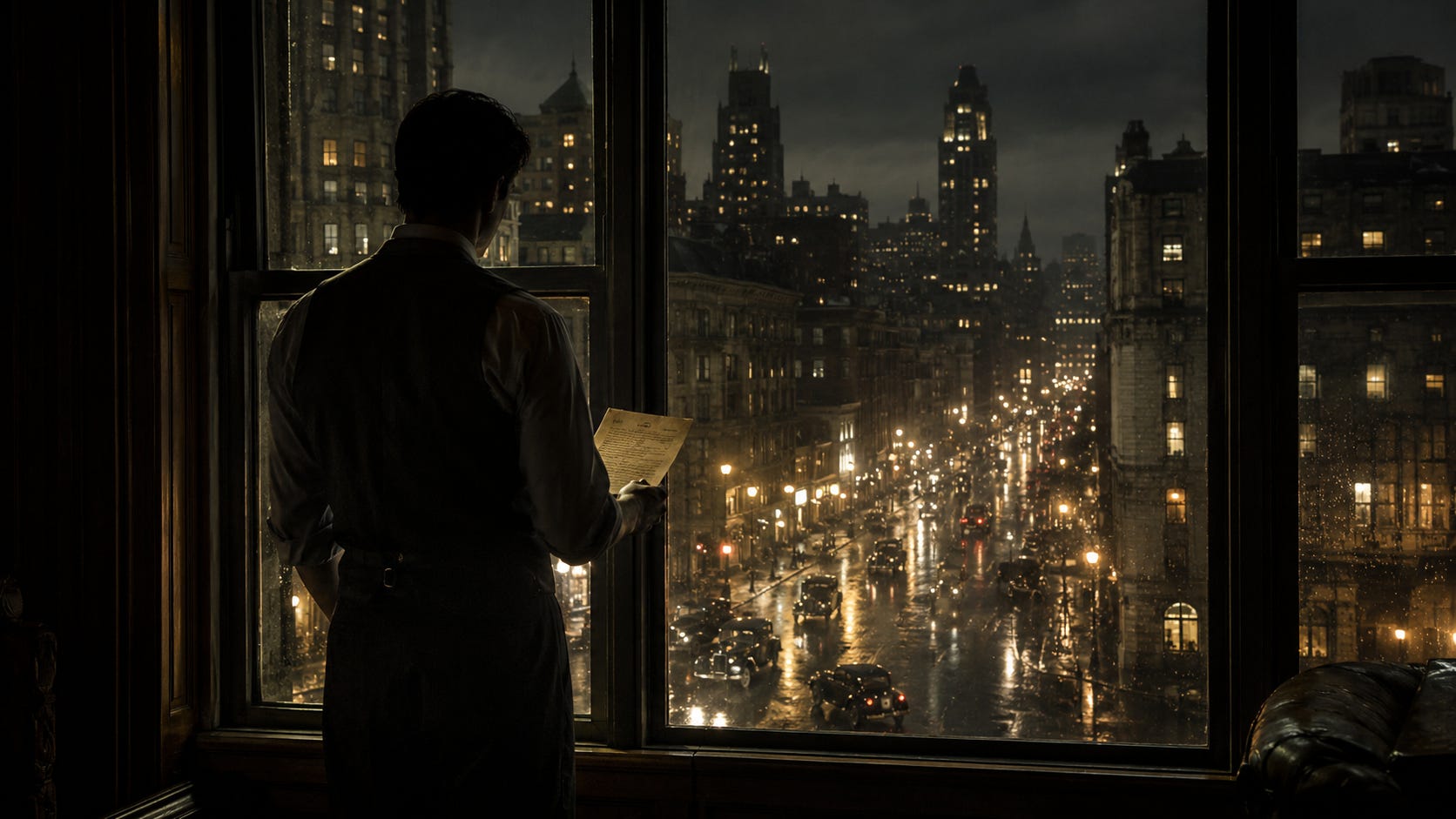
The East River wind whipped into his overcoat as Jona turned onto 25th street. It was just three o’clock in the afternoon, but already turning into a grim twilight. Patches of ice, now almost black, were fading into the dark gray concrete of the pavement as the light slowly failed. There were not many people on the street, but there was a small group of men clustered at a newsstand near the subway entrance. Lieb hesitated, but did stop to scan the newspaper headlines, standing as far apart from the others as he could manage. He did not see anything that was really new or important. There was something about Germany and the League of Nations. Roosevelt was moving quickly to submit a Banking bill and some kind of Retirement Insurance bill to Congress. More troops were being sent to the Ohio river. Jona did not care to follow politics, and in the absence of any obvious catastrophes he concluded that not much was going on in the world. Nothing of importance, anyway, and nothing he could do anything about. He limped past the familiar small shops that lined the north side of the street as he approached Lexington Avenue, craning to see whether the Horn and Hardart, the self-serve delicatessen on the corner, looked crowded. It was.
Lieb did not like crowds and preferred to eat his meals alone. He turned around and walked back a few minutes to Sherman’s Deli. Although the owner was a Jew, he kept his shop open on Saturday. There had been a soup kitchen set up in a vacant storefront right next to Sherman’s, but that had closed down a few months ago, in the dead of winter. Lieb sometimes wondered where the long line of ashen, stubbled, vacant faces had gone. Fairly regularly, one of them would be brought into his own place of business. It was usually the same story; exposure, poor nutrition, often pneumonia. Each had died in typical, pathetic squalor. They were sometimes without identity, nameless and unknown, but they were never formless. Their bodies remained behind as a testament to their deaths, a necessary exclamation point defining the terminus of life, examined and documented in intimate detail by Lieb or one of the other Medical Examiners. Lieb had an excellent memory. He could remember almost every detail of every autopsy performed by him, and certainly every unusual finding. The dissections of the unfortunate wretches brought in from the streets and parks were invariably bland, however. Almost never anything exciting with that bunch, he thought. No challenge. No stimulation.
There was truly little that stimulated Jona Lieb these days. His career had hit a wall. He could never hope to become Chief Medical Examiner himself one day because of Dr. Norris, the current chief, who despised him for no apparent reason. He was mired in the rank of Assistant Professor at the medical school, with minimal teaching assignments. Furthermore, his research projects in nerve function had failed, one after the other, to achieve meaningful results.
All this did not bother him terribly much. A certain amount of failure was to be expected. Not everyone could have a brilliant career. It seemed to bother his few acquaintances quite a bit more, perhaps because of his father’s legacy. Or, perhaps, because his so-called friends were themselves all utterly ambitious. Just like his father. Jona grimaced involuntarily as pain shot up from his left hip to his spine. His father, the great Earnest Lieb: professor, physician, researcher extraordinaire, advisor to presidents and kings.
Dr. Earnest Lieb continued to cast a shadow over anyone who was associated with him, including his son. For the past thirty years he had thrust himself to the very cutting edge of research into human microbial infection, ruthlessly ploughing through anything and anyone who stood in his way. Colleagues, research institutions, even governments had been tossed aside if they stood in the way of a solution to a problem he might be studying. Over the years the elder Lieb had abandoned almost everything other than his scientific work. Friends and co-workers alike were indiscriminately thrown overboard into the wake of his furious intellectual energy.
Jona did not remember his mother very well and had only a vague recollection of the succession of nannies that raised him through his childhood. Looming over everything in his memory was his father. Questioning, demanding, instructing, berating. Without doubt, Jona had been groomed to follow in the great man’s footsteps.
Lieb sidled towards the counter inside Sherman’s, careful not to jostle any of the other customers, and waited his turn to order. The interior of the delicatessen was dim. The ceiling was made of pressed, patterned tin, painted a dull green. Two naked light bulbs hung over the deli counter, casting sharp shadows over the meats in the display windows. Salami, roast beef, hams and chicken parts all stood out in sharp relief against the soiled white doilies arranged on the produce shelves. Other patrons also pressed near the counter, which made Lieb feel uncomfortable. He thought of leaving, but he was hungry, and his left leg ached. And there was something else. The smell. The rich, pungent smells of spiced meats hung in the air everywhere around him, making his stomach warm. He decided to stay.
“Hi, doc.” It was old man Sherman’s son, Walter, at the counter. He was a good fellow, always helpful. Lieb waved hello but said nothing.
“What’ll it be?”
Lieb hesitated. He had the feeling that everyone around him was staring at him, listening. That was one reason he didn’t like crowds and public places. He detested being too close to others. His father, on the other hand, loved being in the public eye. Giving a formal lecture to a group of scientists, sitting at a club with a group of admirers, or chatting with wealthy donors was all the same to him. It seemed he had an inexhaustible reservoir of anecdotes and jokes, tall stories and true tales that kept him at the center of attention in any setting.
He asked for roast beef on a roll and handed over thirty-five cents. Carefully, Jona looked around as he waited for his food, trying to appear remote. Right next to him stood a woman he judged to be in her sixth decade, with iron gray hair squeezed under a small, flowered hat. He noted that her cheeks were ruddy, with several small but prominent veins coursing over them. She made a low whistling sound as she breathed, and she smelled awful. Her breath surrounded her like a cloud, filling the space between them with a foul aroma that he found nauseating. She was sick in some way, that was obvious, but Jona’s only concern was to move away from her. He could not step very far because a man stood inches from him on the other side. When the brown paper bag was handed over the counter, he grabbed it quickly and lowered his shoulder to move past the people surrounding him.
It was darker now outside, and the street-lamps were just coming on. A vagrant dressed in an old, soiled military overcoat stood on the street corner, standing silently and holding out his hat. He looked emaciated, with a salt and pepper beard that overwhelmed his thin chest. The avenue was crowded with people who only seemed interested in hurrying somewhere. Lieb also hurried now, heading for his apartment on 29th street, anxious for quiet and isolation. The great city surrounding him hummed in all its power. In the near distance sirens were wailing, and farther away a bell was clanging gently, perhaps on a boat in the river. Great plumes of exhaust streamed out from cars stopped at a red light as he waited to cross the street. Sounds and smells swirled around him with a fleeting, familiar, kaleidoscopic evanescence.
Jona, like his father, loved New York. When they first arrived in the United States, Jona was only a boy of ten. He remembered bits and pieces of their previous life, but New York was the only home he really knew. In the beginning, Saturdays were usually spent together with his father, often including a walking trip to the lake in Central Park. They would sit on the benches, even in cold weather, eating peanuts and watching the ducks swim their orderly zig zag courses.
Although he was young, Jona was allowed to accompany his father during his many excursions to the small bistros and cafes around Canal Street, or 8th Avenue, or the more trendy spots in midtown. The talk then was almost always about politics, and almost always about the old War. Everyone of course knew Dr. Lieb’s story, and he was invariably the center of discussion. People wanted to know his opinion about great matters and small, and not just in the local cafes. The great Dr. Lieb was sought after by Congressmen, mayors, business tycoons, women’s groups, academics - they all wanted some of his time, and he delighted in pontificating to all of them. In one way or another they were buying his opinions, and he had plenty to sell.
Over time, his father changed, and everyday life seemed to change as well. The elder Lieb’s incessant drive kept him in his laboratory for unending hours, leaving his son in the care of a series of nannies, none of whom performed up to his father’s expectations. There were times when he didn’t come home for a few days consecutively, preferring to sleep on a cot near his research benches. As Jona got older, he saw less and less of his father. Then, in his twelfth year, his world changed forever.
His apartment was on the second floor of an eight story building on 29th street just off the corner of Lexington Avenue. It had a dark brick exterior and seemed to squat securely on a street of low-rise brownstones, solid and restrained, without any show of extravagance. The doorman stood just inside the large glass entryway, near the foot of the staircase.
“Good evening, Dr. Lieb. It’s going to be a cold one.” William had been a doorman at this building for two years now and had yet to accept the fact that Lieb did not like idle chatter. Without a word Jona stepped carefully onto the first marble step of the broad staircase and slowly made his way to the second landing. He had to lean heavily on the banister to keep pressure off his left leg, but tried hard not to show any sign of discomfort until he was out of view of the doorman.
Polio had come as a wrenching surprise to both Jona and his father. There had been no known community outbreak at the time, and he became afflicted in October, right after his birthday, an unusual season for the dreaded disorder to strike. Perhaps that helped explain the relatively benign course of the infection. The lower extremities began to respond within six weeks of the onset of paralysis. By twelve weeks he was able to do some walking, first with crutches, then with thick metal braces, and eventually, after many months, on his own. But never normally. He had lived with the residue of crippled nerves and muscles every day since then. He would never recover full strength in his legs. His upper extremities were involved only moderately and returned to almost normal function. He was quite fortunate that some minor weakness of the hands persisted as the only enduring deficit. Of course, as a result, he could never become a surgeon.
His father had been by his side almost constantly throughout the ordeal. Through the haze of pain and anguish in the early stages of the illness Jona could remember his father’s comforting words, affectionate embraces, and manic demands that the medical staff do everything possible to speed recovery. When the pain became unendurable his father was there to supervise the administration of opiates. As Jona grew stronger, Dr. Lieb orchestrated the physical rehabilitation and exercise sessions, cheering every new milestone of accomplishment. By the time he was able to take his first steps again, Jona felt an immense sense of bonding and love for his father. They spent so much time together that Jona grew to sense what his father would say before any words were spoken.
Eight weeks into his illness he was discharged from the hospital. The doctors recommended that he go to an asylum, perhaps in the Berkshires. Dr. Lieb insisted that Jona be sent home to continue recovering under his own direct and personal supervision. No one dared argue with the great Earnest Lieb. A special room in their apartment was prepared and a nursing schedule was arranged. Dr. Lieb was a man of means and no expense was spared. Not too long after that, the days became bittersweet for the young patient.
As Jona recuperated and his powers began to return, his father found it possible to leave him in the care of the small staff he had gathered at their residence. At first it was only for a few hours at a time, then an entire afternoon or evening. Before long he had resumed his frenetic pace of activity at the laboratory, leaving Jona alone with his nurses and therapists.
Jona Lieb checked around his apartment briefly. He was quite alone, but he could not help looking into every room to be sure there were no intruders. He particularly examined his closets to be sure no one was there. In these times one could not be too careful. Just the day before he had heard a creak coming from the bathroom. Without hesitation he had scurried to lock himself in his bedroom and only emerged hours later, when he thought it was finally safe. He convinced himself he was not afraid, just cautious.
He fastidiously straightened the pillows on the sofa, propping them at the correct angle before settling down on his oversize leather armchair. The brown paper bag with his sandwich was still clutched securely in his right hand, but hunger had left him. The white cloth drapes were drawn, and though the windows were securely shut he could see and hear the street below. Outside, the evening had progressed to complete darkness, relieved sharply by the bright lights that adorned the city. The cars on the street below were stacked ten deep at the corner, awaiting the turn of the traffic light. Their tail-lights created a river of somber red embers flowing towards the brighter haze of the avenue. From the apartment right below him he could hear the radio playing loudly. Heard through the floor, the music was reduced to its basic elements; drums and brass wafted in and out of tune, competing with the sounds of honking horns coming from outside. Lieb let himself fall into a reflective reverie listening to the music.
Music first entered his life in a meaningful way as he lay in bed recuperating from polio. His father had bought a gramophone for his room, the kind that rotated a little drum imprinted with music. His nurses were instructed to wind it up and play it regularly in the afternoons. Dr. Lieb believed that music was therapeutic and essential for good healing and a full recovery. Tunes from Sousa and arias from La Boheme had thrilled Jona equally. Over time he fantasized that he might become a great tenor or pianist, or even better a great conductor. He became inspired with the hope that he could soon take music lessons and one day lead a great orchestra.
As the first warm days of 1913 arrived it was clear that Jona had stopped progressing. His father gave him what sounded more like a verdict than a prognosis: further recovery of muscular function was impossible, particularly in his left leg. Jona would have to adapt to life with the impediment of a limp due to diminished strength and flexibility in his left leg. To some lesser extent, fine motor control of both hands would be impaired. His dreams of musical accomplishment were nothing more than a silly, childish absurdity. That night was the last time Jona remembered crying himself to sleep. Afterward, he vowed that he would never cry again, but it was a vow he would break many times.
The next morning, during breakfast, his father summarily informed him that he would be going away for two months, perhaps longer, leaving Jona in the care of his nurses and therapists. He explained that he was leaving on a very important and distant business trip. He would be going to Stockholm, in Sweden, to a place called the Karolinska Institute. He had been awarded the Nobel Prize.
Saturday night in New York City could be a fantasy come true for any young man, especially a young man with a few dollars in his pocket. Anything one could want could be found in abundance. Girls, Big Bands, dancing, and illegal liquor of any sort were all plentiful. Darker vices and sinister pleasures were easily satisfied as well. All it took to have a good time was to walk down the street to the nearest nightclub, dancehall, cabaret, or speakeasy. Jona Lieb was not immune to the allure of such delights. He was not a recluse, not really, not by the strict definition, and enjoyed having a good time now and then, as long as there were no entanglements. Jona wanted no more entanglements in his life, no more commitments, no more passions, and no more extremes of joy or sadness.
Most often, he simply wanted to be alone, particularly when he was liable to be called for an urgent autopsy. It was his responsibility to be ready at a moment’s notice when he was the duty ME. It seemed that every Saturday there was at least one homicide and a few miscellaneous deaths that had to be cleared by the ME’s office. There were beatings, shootings, and the occasional suicide. The worst cases were infanticides. In the five years since he began performing autopsies the incidence of infant abandonment had increased sharply, probably because of the worsening economic depression. Horrible things happened when people felt hopeless. In the past few months Jona had encountered a dozen such cases. Most were newborns, but a few were older. Although he had learned to steel himself against any horror he might encounter in the morgue, dissecting an infant made Lieb feel modestly uncomfortable. Never tentative in the performance of duty, however. In any case, when he served as Medical Officer on duty he made a point of staying at home in order to be easily available. His father had drummed that sense of responsibility into him during childhood, and he felt some pleasure in adhering to his obligations, parties be damned. By now, it was nothing more than second nature.
After Stockholm, Dr. Lieb accepted an offer of professorship from Harvard, and Jona was enrolled at Deerfield Academy, a private school a few hours’ drive from Boston. From that time on, Jona saw his father at irregular intervals, and it was rare for them to be alone together for very long. Jona accepted the fact that his world-renowned father was a very busy and very important man. As he matured, he began to appreciate his father’s monumental achievements. Jona did not consciously pattern himself after the older man, but he knew from the other’s example that iron discipline and hard work were the keys to success.
Academic accomplishment came easily to Jona. He had a retentive memory and a quick mind. However, life was not lived in the classroom alone. His classmates were miserable to him. While he excelled in math and science, they literally ran rings around him on the playing fields. Some were more cruel than others, and began to harass him by snatching his scarf or hat, knowing he could never catch them. Often, the stolen item would never reappear. On a few occasions Jona made the mistake of chasing after some of the boys who taunted him. His halting, limping attempts to run in pursuit of his persecutors only increased their derisive laughter as they easily escaped him.
There came times when Jona was driven to despondency as he realized there was no end to their cruelty. He knew intuitively that going to the headmaster would be disastrous, and that he had to deal with his tormentors himself. Writing his father about it was out of the question. That would only unleash a storm of criticism directed at the school, or at him, or both. In any case the outcome for Jona would be humiliation in one form or another.
Lieb involuntarily shifted in his armchair as the unwanted schoolboy memories bubbled up into his mind. Music continued to seep up from the apartment below along with the clatter of dishes. With some effort he could make out the voice of Ethel Waters singing “Stormy Weather”. He liked the song, and he found the throaty texture of the songstress’ voice to be mesmerizing.
He listened attentively, with a sense of forbidden pleasure. Ethel Waters was a black singer. He knew his father would disapprove, but Jona could not turn away from the lustrous, deeply set rhythmic tones. He had bought one of her recordings, ‘Am I Blue?’, for his collection. He thought of his father whenever he played it. Once, Jona had gone to Harlem, alone, to see Ethel Waters perform at the Lafayette Theater. It was an evening of guilty gratification for Jona, and one that he never shared with his father. The elder Lieb could not stomach what he called Sambo music because he considered blacks an inferior, licentious race. Yes, the great man of science and ethics who preached that all humans were imbued with the same kindred spirit could never bring himself to believe that the Negro could be his equal. Or the Chinese, or the Egyptian, or the Indian, for that matter.
In that respect Earnest Lieb remained a son of the South, even though he had made the irrevocable judgment to leave his home state of Georgia behind. Making judgments was not difficult for professor Lieb. When his son was just sixteen he made the judgment that Jona would take his undergraduate studies at Harvard. Jona had of course accepted that decision and made it his own and applied his own will to the mastery of his schoolboy subjects. He endured the torture of the older boys and found that he could at least diminish some of their abuse by helping the worst of them with their schoolwork.
In the fall of his third year at Deerfield, Dr. Lieb took Jona to interview with Dr. Abbott Lawrence Lowell, the president of Harvard University. After a few minutes of small talk Dr. Lowell congratulated Jona on his admission to Harvard the next academic year and wished him good luck in Latin. No examinations were needed. At that point in his life Jona had little understanding of the power of privilege. He accepted the offer, of course, assuming his admission to be a natural evolution in the scheme of life.
Everything seemed to simply fall into line from that point on. Academic activities became regular, routine, systematic. Jona found a small, quiet niche, both physical and emotional, within that spectrum of everyday life that allowed him the seclusion he needed. At college there were no more boyish pranks or cruel reminders of his physical limitations. Jona learned to live with daily pain. In return, he was given the gift of insulation from the wants or desires of others. Before long, he felt that he at last had control over the course of his own affairs, which Jona considered the true and lasting accomplishment of an educated man. He had heard his father say so many times. He graduated from Harvard Summa cum Laude and promptly matriculated into the School of Medicine, where the elder Lieb served on the faculty.
Once enrolled in the medical curriculum, Jona hoped that he would have more time with his father, but that was not to be. They traveled very different paths, and rarely had time even on weekends to see one another. Jona did very well with his studies, and despite his handicaps graduated near the top of his class. He received, and still cherished, a congratulatory letter from his father complimenting him on his accomplishment.
Graduation day came at its appointed time. It should have been the happiest day of his life, a day he was anticipating eagerly, but on that same morning he was stricken with excruciating pain radiating down his legs and almost locking up his left hip. It had been ten years since his convalescence from polio, and he had not experienced agony so severe since that initial attack. Jona struggled to the graduation ceremony, where he searched for his father. Dr. Lieb should have been on the dais with the rest of the faculty, sitting proudly as his son was awarded the prestigious degree of Medical Doctor, but he was nowhere to be seen. When his name was called, Jona tried to rise and walk, but was not able to continue and collapsed back onto his chair. He had to remain seated throughout the remainder of the convocation, with tears streaming down his cheeks. Only later did he learn that his father had been caught up in a breakthrough at the laboratory and had not been seen for days before, or after, the graduation ceremony.
Jona was startled from his reverie as the audible strength of the music coming from the apartment below suddenly increased. An acoustical phenomenon of some sort, it seemed. The last few bars of Stormy Weather were playing, and he could just make out a few of the words as they flowed into his awareness. He knew them well:
“…Life is bare
Gloom and misery everywhere
Stormy weather…”
Lieb got up and walked into the kitchen, taking his sandwich with him. The apartment was cold, and his desire to eat was cold by this time as well. Life was not bare, but it was not full, not for many months now. He didn’t feel that he had compromised in anything he had done to this point so far his life, at least in his professional life. He had already achieved a great deal by some measure, yet somehow he felt that there was more to do. Unfortunately, he had no idea what it should be. He turned his head to better hear the music from downstairs. It suited his mood perfectly.
“…Heavy-hearted and sad
Night comes around
And I’m still feeling bad…”
His father always seemed to know exactly what to do and continued to advise him by means of a weekly letter that was posted, like a bulletin, every Saturday with arrival every Tuesday morning. In his most recent letter he recommended that Jona abandon his work on nerve conduction, and go to Germany to study brain cell growth and development with Julius Hallervorden at the Kaiser Wilhelm Institute in Berlin. The Institute was the world’s premier center for research in the biological sciences. Hallevorden was an old friend of his father’s, and undoubtedly in line to win the Nobel Prize for his own research in nerve function. Lieb sighed. Maybe that was a good idea after all. A new start in a new place might be perfect for him. New colleagues, new acquaintances, new research. New, new, new. That would be interesting, maybe even exciting. Leave everything behind, he thought, start a new life, and control the course of my own future. On the other hand, beginning all over would be quite difficult, and fraught with uncertainty. New city, new Director, new lab. And, his German was very rusty. It was probably too risky, maybe. Perhaps. He might lose control of his destiny in a new environment where he would have to prove himself all over. Or maybe not. He needed a goal, something tangible he could achieve, but it all seemed so unclear
The sandwich was excellent, but somehow not satisfying. After a few bites he wrapped the food carefully and neatly before he put it away, then wandered to the window. Jona gazed vacantly at the pedestrians hurrying down the dimly lit street below. He remained lost in a mindless stare until the doorbell rang, abruptly jarring him from his trance. Anxiety seized him as he approached the door, but he could see through the peephole that it was a young, slender boy in a uniform. It was a Western Union messenger. Jona signed for the telegram, brought it into the kitchen, and sat down to open it directly under the glare of a large overhanging lamp. The light cut a sharp shadow across the table as he unfolded the message, almost severing the note in half. He saw that it was from Dr. Michaels, a friend of his father’s at Massachusetts General Hospital. The text was short:
Regret to inform you STOP Dr. Lieb died today of massive stroke STOP Call or cable this address.
Michaels.
Chapter 2.
Logic has an intrinsic beauty. Ordered and sequential, it leads to inexorable conclusions. There can be no guilt with logic, no pain, no remorse, no regret. Like fate, logic moves in its own way, without reference to the human observer. Like gamma rays, logic operates according to its own laws, immutable and constant. Like death, logic provides the ultimate endpoint of all natural function.
Life is random. Life leads to death. Therefore, death is random. Dr. Earnest Lieb would have appreciated this simple and elegant statement of logic, although he would not have agreed with the premise. For him, life was never a random process. His own life had been dedicated to grasping hold of events, molding them, changing them, and most importantly controlling them... It was quite true, though, that at one moment his brain was functioning very normally. At another moment his brain stopped functioning completely, shut down by a cessation of circulating blood and oxygen. Thus, death came. It was all very logical. Jona was quite sure his father would have analyzed the matter in that way, and for that reason he accepted the analysis as his own.
The next four days were a blur of activity for Jona. Harvard staff arranged the details of the remembrance service to be held at the newly completed Memorial Church. Dr. Charles Kuhn, a close friend and curator of the Germanic Museum at Harvard was the executor of Earnest Lieb’s estate. He met with Jona before the funeral and explained that Jona would receive the entire value of the estate with the exception of all scientific materials, which would become sole property of the university. Lieb’s papers would be properly indexed and preserved, like dried seeds or exotic insects, to await the inevitable biographers of the great man’s life.
Jona was genuinely unprepared for the outpouring of condolences he received. Telegrams came from all over the world including England, where Earnest Lieb had spent a year at King’s College, and Berlin, where Gerhard Domagk had first sheltered him and Otto Warburg had allowed him to share laboratory space. Both universities extended invitations to the younger Lieb for a collegial visit at his convenience. Jona read each of the hundreds of messages that came in, keeping careful notes about each and earmarking ones that required an immediate reply. The work kept him busy and helped divert him from the upcoming funeral, which filled him with dread.
He was astonished by a personal telegram from Franklin D. Roosevelt, offering his condolences, and asking Jona to come see the President at the White House “next time you are in town.” His father had indeed been an immense figure, and well deserved the messages of praise and remembrance from the great and powerful around the world.
On the morning before the funeral, he received a telegram brought to him directly by courier. Jona was both fatigued and despondent, and his first inclination was to put the message aside for a later moment. However, something caught his eye as he glanced at the envelope, and he took a more careful look. It had been sent from Venezuela, but its point of origin was from the University of Georgia in Atlanta, his father’s first academic home from so long ago. He ripped open the envelope and read quickly. The text conveyed condolences and acknowledged Dr. Lieb as “one of the great scientists of the current era, a groundbreaking giant who will be sorely missed“. Jona read on, fascinated. The Regents invited Jona to come visit the Faculty of Medicine and proposed that he inaugurate a lecture series to be named in honor of his father, sometime in the coming few months.
Jona did not share his father’s visceral hatred of their years in Atlanta, and, for that matter, of all things Southern. His own memories of Atlanta were few, but some were vivid. He could recall the heat. As a boy he would run back and forth from the shade of a tree into the sunlight and play with his own shadow. He could still hear the exotic sounds of the nighttime; the buzz of cicadas and the lonely calls of pond frogs remained vivid in his memory. His bedroom was on the second floor; a screech owl lived in the tree right next to his window. He could remember pretending to talk with the screech owl at nighttime, speaking to him in a special language that no one else could understand.
His mother was alive then. He could not recall her face, not exactly, but he could remember her presence. He could remember her low pitched, almost gruff laughter, and he could remember her hair piled high and tight into a beehive above her head, like some impossible church belfry reaching towards the sky. Mostly, though, he could remember her coughing. Coughing went on day and night, often awakening him in the hours before dawn, jarring him from sleep. At times the coughing sounded like it came from far away, but sometimes it seemed his mother might be lying right next to him, right next to his head, her wet, forceful, guttural, tussive exclamations sounding right into his ears. At those times he thought she was trying to tell him something, something he could not decipher. As time went on, he didn’t want to, allowing her coughing course to dissipate into nothingness. He could remember the fear he felt when her coughing spasms turned into gasps, often followed by a tortuous silence that dragged on for an eternity before the coughing resumed.
He could also remember the fear he felt in the presence of his father. In those days his father was very different from the Earnest Lieb the world later came to know. He often erupted without any apparent provocation, his belt appearing in his hands almost instantaneously. At those unfortunate times the blows struck Jona purposefully, leaving bruise marks that persisted for weeks at a time. Jona learned to be very wary at certain moments, like the times his father settled himself on the veranda with a tall glass of bourbon. Once, he was beaten severely because he playfully ran away with the glass of liquor while his father was distracted. He remembered hoping that his father might chase him around, and they would have fun rough housing together. After his father caught up with him, the drink was first carefully retrieved, and then Jona was struck hard, in the face. There was no fun that day.
He did not recall that his mother ever intervened to stop a beating. However, he could remember that on one occasion, when he ran to her after a “belting”, she tried to comfort him by showing him an angry welt on her own arm. This only made Jona cry all the more. It was odd, but Jona could not bring to mind any words that his mother ever said. He remembered that from time to time she would hold him in a tight hug. He could still sense the warmth of her embrace, and the faint fragrance of rosewater that always seemed to linger around her. He grew to love the smell of rosewater as well. Jona remembered her funeral only vaguely; he was barely nine at the time. Soon afterwards he and his father left Georgia forever.
Earnest Lieb was many things, but he was not a forgiving man. Jona never understood why his father had come to despise the South and everything southern. There were clearly many things to dislike about custom and culture in Georgia, but in the case of Earnest Lieb it seemed as if something deep within him radiated with a wave of hatred at anything having to do with his prior life. The great irony was, of course, that he was descended from a long line of southern aristocracy. Jona had thought about this often, and believed this explained why his father’s attitudes on racial matters were a mass of complexities and contradictions. Publicly he preached freedom and equality for all. Privately he harbored prejudice towards all blacks and felt uncomfortable in the presence of Jews and Orientals. Jona felt proud that he was not burdened by prejudice in the same way. Most definitely, he was free of all that, and proud to be his own man.
The young Earnest Lieb had begun his research into antimicrobial drugs in Atlanta, on the campus of the University of Georgia. He was an acknowledged genius by the time he was in his early thirty’s, the author of dozens of original papers in the field. Most of the work leading to his Nobel Prize had been accomplished long before he arrived in New York, but as time went on his perseverance and drive to succeed actually increased. Up to the moment of his death he held in his hands the threads of several research projects going on simultaneously. Dozens of colleagues from cities all over the world corresponded with him regularly to keep abreast of his work.
Some admirers concluded that Earnest Lieb had to leave the South because he could not live in a culture that fostered inequality, exploitation, and tribalism, but Jona believed that was only a part of it. He had always believed that it had something to do with his mother’s illness, her tuberculosis, or whatever it was that had killed her. On a few occasions as a youngster he had asked his father why they left Georgia. He received the same response on each occasion: living there was unhealthy, unhealthy for the body and unhealthy for the mind.
In 1909 arrangements were made to go to Germany in order to make a circuit of Lieb’s colleagues there in the small universe of microbiology research. There were plans to give several lectures over a period of a few months. As it turned out, they never returned to Georgia. Lieb went on to become world famous not only because of his research, but because of his outspoken views on human rights. He became a spokesman for those who espoused the freedom and dignity of all human beings and was invited to attend humanitarian conferences all over the world, from Ottowa to Paris. Because he also despised Bolshevism and communism in all its forms, he became the darling of capitalists and progressives alike. His stature as a Nobel Laureate gave him a platform that allowed him to speak out on issues of social justice, and in that regard, he had given countless speeches and interviews.
But he had done more than just make speeches. Wherever there was an outbreak of disease, a pandemic, or an unusual cluster of rare infections, he was summoned to help. He had journeyed to every cesspool of disease on the planet to render an opinion, to teach, to investigate, to treat. He had blazed a trail through the Middle East, Africa, the Orient.
Now he was dead.
Jona looked at the telegram in his hands with near disbelief. There could be no doubt that the professors, researchers and administrators left behind in Atlanta almost twenty five years ago would have developed a reciprocal sense of loathing toward their former colleague. Jona knew that at times the elder Lieb had singled out individuals from his old school for specific criticism or indictment, or to illustrate an example of dehumanizing, racializing behavior. That type of public humiliation could never be forgotten or forgiven by any Southerner, even an academic. They must have considered Earnest Lieb to be the devil incarnate. And yet they had sent a message of sympathy and condolence to the devil’s son. Jona shook his head, bemused and uncomprehending. He retrieved the envelope he had dropped on the floor to check the return address, just to be sure the note was not a hoax. As he read it over, everything appeared to be quite genuine and real:
Office of the President
University of Georgia
Atlanta, Georgia
Confederate States
Of America
The predawn morning was cold, coupled with a wet drizzle that saturated the first hours after moonset. Jona awakened at his usual time, about 5:30 a.m., true to his habit of routine punctuality. It was dark outside, and very still. He felt most free in the early morning, while the world around him was still at rest. Living in New York, he had gotten accustomed to the culture of early morning life. The streets were quiet at that hour, breathing with a soft dull hum as though conserving strength in preparation for the day to come. The faces he saw on his early morning walks were often familiar. These were people on their way to start up the ovens at the bakery, or to prepare the subway cars at the marshaling yards, or to take on the early morning shift at the hospital. The crew at the all-night diner on 27th street knew Jona by face if not by name. It was a wonderful feeling to sit in a booth by the window, drinking his coffee and watching the town outside begin to stir.
The change from night dark to dawn light happened very quickly, as if following the tempo of a fast moving script. Children on their way to school, street cleaners with their brooms, tired cops - all would emerge from the depths of the city and would pass by on the other side of the glass pane as Jona watched, a mixture of choreographed theater and random activity. On clear mornings the shadows were cast sharply against the concrete as the sun assumed its course across the sky, and the progress of the day could be tracked by the slow recession of shade across the pavement. But Jona most loved the mornings that were drained reluctantly from the night, when great plumes of mist rose from sewer vents, and the semidark scenes surrounding barely seen buildings appeared vague and blurred. On deep mornings like that, it seemed as if the whole city was uncertain, rousing itself within shifting shades of leaden gray. On hidden mornings like that, each step on the cement street might erupt like the booming of the Second Coming, only to be muffled quickly into silence by wisps of smoke from cellar shafts. City lights made shapes appear and then submerge back into formless swirls of mist as if emerging in and out of time itself. An occasional cat might hiss in the dark, snarling at the unknown, but the great beauty of those mornings was the silence that suffocated every nascent sound before it could be fully born. On forgiving mornings like that, the day to come lay formless, as if coalescing in a vale of dreams, still unknown, still innocent.
Such a morning arose on the day of the funeral. After awakening, Jona went to the window and looked out at the hazy streak of dull orange that marked the eastern sky. He breathed in deeply. The busy swirl of preparation for the funeral was now over, and it was time to confront his father’s burial day.
He was generally a deep sleeper and would normally wake up feeling fresh and ready to do his best work. On this day, though, Jona awakened feeling exhausted. He had stayed up late in an effort to finish reading Gertrude Stein’s The Autobiography of Alice B. Toklas. The reading was a slog, and he was not done by 1:30 in the morning, when he drifted off to sleep. Reading every night was a discipline instilled by his father, who insisted that Jona not only read the great novels, but also works by new, even edgy writers. It was common for Earnest Lieb to send collections of short stories, essays, poetry, and scientific reviews for Jona to read. It was only in this way that a good mind could become a great mind, taught the elder Lieb. Jona prided himself on his book collection, which numbered in the hundreds, and made it a point to stay current with his reading. He completed one work at a time, never mixed readings, and as soon as he finished a book he picked up the next, even if the time was deep into the night. 1919, a new novel by Dos Passos, was in his bag, next in line to be read. His breadth of knowledge gave him a sense of enrichment and power. Dostoevsky, Schiller, Plato, Goethe, Moliere, Wordsworth, Freud - he felt genuinely connected to all the great thinkers whose words had stirred his mind and soul. Everything he needed to know about life was right there, within the scope of their written words, and he turned to them in time of need as one would turn to a wise uncle. They were his best friends.
By the time he washed and dressed it was almost 7 a.m. Dr. Kuhn had arranged to pick him up at eight, so that Jona had time to breakfast. The small hotel dining room was almost empty when he arrived, making it easy to get a window table. Coffee helped refresh him, and Jona began to deflate into a sense of ease. He forced himself to concentrate, willing himself to take control of the day.
He did not allow himself feelings of dread or grief. He understood, of course, that this would be an awful day, but he refused to succumb to sadness. Every once in a while, he lingered with a remembrance of his father, either sad or sweet. He allowed himself to bring up memories but then concentrated on containing them. Mentally, he quarantined them where they could not harm him, like isolating a patient with meningitis. Or polio. Each recollection provided its own image of his father, but curiously his face remained unchanging with each vision, like an immutable, pharaonic mask that remained rigid and unbending through the years.
“Dr. Lieb?”
Jona was startled by a tall, dark appearing man looming over him. He did not generally do well with abrupt encounters, especially with people he did not know, and fumbled with his water glass as he began to rise from the table. He couldn’t help blurting “Who are you?”
“Please don’t get up, doctor.” The man sat down briskly and smiled. “My name is John Andrews. I know this is a terrible time for you, doctor, so please pardon my incursion into your privacy. My condolences on the passing of your father.”
Jona found the man’s solicitude and demeanor reassuring, but he nonetheless felt irked by the sudden intrusion. “Thank you, Mr. Andrews, but...Who are you? What is your business with me?”
Andrews smiled again but did not answer right away. Lieb examined him more carefully. The man was in his early thirties, thin, of above average height, wearing a severe, tightly fitted black suit. Youthful appearing facial features were clear of any blemish, with a razor thin clipped mustache along the upper lip. His hair was jet black and also closely trimmed, mostly hidden under a sharply pressed dark gray hat. He appeared to have a dark complexion, prompting Jona to wonder whether he was a foreigner, or perhaps a hill person. “Sir, your business with me?” Lieb was somewhat more confident now, more in control.
Andrews seemed to take a deep breath before speaking. “Dr. Lieb, I am Special Agent Andrews from the Treasury Department. I have been asked by my superiors to contact you on a matter of foremost importance. We realize the timing is terrible, but it is urgent that we speak to you about this matter as soon as possible, preferably today.” With a smooth and seamless motion he withdrew a silver badge from an inner pocket, exposed the face, and placed it back.
“That’s impossible. My God, I’m burying my father today!” Lieb again started to feel flustered. His ears began to flush warmly as he lost composure.
“Of course, doctor. We were hoping to meet with you after the funeral.”
Lieb examined Andrews again. Maybe the man was a mulatto, or a strange Indian mix. His lips were thin, arching gently under a sharply edged nose. His chin also gave the impression of sharp, regular angles. The man’s eyes were blank.
“Hey, what’s this about? Does this have to do with my father’s estate? I can assure you I have no knowledge of his financial dealings. And may I also say that it’s somewhat crude of the Treasury Department to come after his assets on the same day he’s supposed to be put to rest, and I believe I resent it! Yes, I believe I do!” Jona felt a tentative surge of outrage and made a show of rising up from the table once again.
“Dr. Lieb, please, this has nothing to do with your father’s estate. This is a not a financial matter.”
“What do you mean,” Jona demanded as he got to his feet. “You said you’re from Treasury”.
“Yes sir, I am. I am an agent of the Secret Service. I work for the President of the United States.”
Dr. Charles Louis Kuhn was not a trusting man. He approached everything and everyone as if a terrible mistake was on the very verge of a catastrophic explosion. His staff at the Germanic Museum certainly knew this with vivid clarity. No explanation or demonstration was sufficient to allay the man’s anxiety about even the simplest undertaking. This week’s preparations for the Lieb funeral had thus been a nightmare for everyone involved. Kuhn had given various employees at the museum specific tasks in preparation for the event, and no day had ended without an intensive interrogation of each staff member regarding every step in the process.
Now everything was ready, from the selection of flowers to the printing of place cards for the invited guests. Kuhn felt not relief, but a sense of euphoria or even exaltation. He responded that way at the successful conclusion of any project. Years of intensive academic life had not been financially rewarding. Not until recently, anyway. However, the rich sense of accomplishment he experienced when he achieved something exceptional was adequate compensation for his efforts. His feeling of achievement was reinforced when others noticed his efforts as well, particularly his superiors.
It had not been easy for him over the past few years. The founding curator of the museum, Kuno Francke, had treated him like dirt, as if he were some vulgar, common artisan hired off the streets. He had worked under the old man for years without the courtesy of a single acknowledgement or compliment for all his efforts. Once Francke was out of the way and Kuhn was named as Director, he still faced the formidable challenge of bringing the museum at last into the twentieth century. He had inherited a museum of pitiful plaster cast reproductions and minor middle European works, and in a few short years had begun to create a showcase of original German and northern European artwork. The museum was already a marvel, poised to outstrip the Semitic Museum in numbers of visitors. And, more importantly, in numbers of patrons. Crucial to the turnaround was a surge of new funding by private donors. Kuhn had to keep the origins of much of his new financing confidential, but surely no one was hurt by his private arrangements with the largest benefactors. The University, the Department of Fine Arts, and, of course, Dr. Kuhn all reaped the benefits of the increasing flow of funds into the museum’s coffers. Ultimately, he simply wanted to create a world class museum, and was willing to do anything to accomplish his goal. And, if he could help those who helped him, all the better. It had been Earnest Lieb who had befriended him years ago and quietly explained the wisdom of seeking help from powerful sponsors, even when they preferred to remain in the background. It was Lieb himself who had arranged the necessary referrals as a show of support.
Kuhn had arranged to pick up the younger Lieb from his hotel and drive him to the memorial service. He had only one small task to complete before leaving his faculty house on Irving Terrace, the one small thing that one of his most important patrons requested of him.
He retrieved the newspaper from his front door and opened it to the next to last page. In the upper left corner was the day’s new crossword puzzle, and more importantly the solution to the previous day’s puzzle. That puzzle would provide the template for his coded message. The code he used was simple to apply but would be difficult to break without knowing that the crossword was the key. He didn’t know anything about cryptography but felt that this encoding system was undoubtedly very sophisticated, in keeping with the importance of his messages.
The crossword puzzle itself was constructed with “twenty” boxes across and “twenty” down. There were a total of thirty nine squares along any two continuous sides of the puzzle. In any given puzzle five or six squares along the sides would be blacked out as stops between words, but that left enough lettered boxes to serve as a key for the code. The outside lettered boxes along the top and right sides of the completed, prior day’s puzzle were correspondingly assigned the letters of the alphabet. Kuhn scrutinized the solution to “1 across”, the word “pinafore”. Thus, “p” would be used for “a”, “i” for “b” and “n” for “c”. The word “cab” would be encoded as “npi” using this day’s template. Every letter of the alphabet was thus identified by its correspondence to one of the lettered boxes. Every third or fourth word that he entered was a nonsense word that the decoder could throw out. Kuhn enjoyed the nonsense words and chose them with much relish. After some thought, he chose to encrypt the words skupt, rart and ploac randomly into the sequence of legitimate words.
Working deliberately, Dr. Kuhn worked out his message. He had done this many times before, and so the encryption went smoothly. He had been told to include anything of interest, particularly about university research activities. He therefore included a notation about a new government grant to the physics department. Something about x-rays. A large group of American and foreign researchers in the department of Bacteriology were working on the vector of the viral agent causing typhus. That would be Dr. Zimmerman’s bunch. Dr. Earnest Lieb’s death would certainly shut down his laboratory, at least temporarily. After some thought, Kuhn decided to include something that the younger Lieb had told him by telephone the night before. The University of Georgia would be initiating a new scientific lecture series in memory of the Nobel laureate, and Jona Lieb had been invited to be one of the inaugural speakers.
After completing his message, Kuhn folded it carefully and placed it in a yellow manila envelope. He would leave it at the designated drop off spot, in a trash can outside a bookstore just off Harvard Square. He had no idea when or by whom it would be retrieved. They had told him that transmission of his information was remarkably fast, in keeping with its importance. His message should be received and decoded in Berlin by nine o’clock that evening, Boston time.
Jona waited in the hotel lobby, trying to compose himself and focus on the day ahead. His encounter with Special Agent Andrews had been brief but it had stunned him. There had been no explanations, just a request that a meeting be held in his hotel room later that evening. Jona had agreed, but now felt a mixture of anxiety, regret, and curiosity.
Kuhn arrived on time. He was not alone. A tall, angular man walked next to Kuhn. He wore a heavy, dour appearing black homburg hat that contrasted sharply with a shock of white, carelessly trimmed hair flaring in jagged edges below the brim. He wore a full beard that was equally white but meticulously groomed. Jona noted quickly that the older man strode forward at a vigorous pace using a polished walking stick in his left hand. It was mildly disappointing to realize that the stranger walked without a limp.
Kuhn spoke very briskly. “Dr. Lieb, this is Professor Wilhelm Kohler. Dr. Kohler is this year’s Francke Visiting Professor, from Germany. Spending a few weeks with us at Fine Arts. He knew your father well.”
Jona thought for a moment, then brightened with recognition. “I remember you, professor. I remember you from Germany. You were in Berlin.”
“You have an excellent memory young man. You and your father stayed at my house in Potsdam, for a few days only. You were a mere boy at the time. Time has not changed you too much, however. So sorry about your father.” Koehler bowed slightly as he spoke.
Jona nodded his acknowledgement as they walked to the car. Kuhn owned a blue late model LaSalle that exuded luxury and expense. Jona knew he could never afford a car like that. The stylish vehicle had to cost upwards of two thousand dollars, in a range that only the well-to-do could manage. He wondered how Kuhn was able to purchase it. Jona had been struck previously by Kuhn’s elegant wardrobe and expensive appearing shoes. He seemed to be just a few years older than Jona and held what had to be a poorly paid academic position. Nonetheless, it certainly appeared that he was financially well endowed.
Both Jona and Kohler got into the back seat, giving the unfortunate impression that Kuhn was their driver. Jona chuckled inwardly at the arrangement. Kohler seemed completely impassive and maintained silence. Once they drove off Kuhn announced that he needed to stop at the museum for a moment. The memorial service was not to begin for over two hours, leaving plenty of time.
As they maneuvered through downtown Boston on their way to Cambridge Jona stared aimlessly out the car window. He saw large groups of men standing idly on street corners, seeming at times to cluster together in small herds. They passed an enormous storefront soup kitchen servicing a line of people, including many children, that snaked down the entire length of a city block and continued to wind around the corner out of view. Although the day was warming up most seemed to be dressed in winter gear, particularly the children, who appeared to be bundled up as if for arctic weather. These people looked no different from the ones Lieb commonly saw back home, but there were many more of them. Gaunt, helpless and hopeless, they stood or sat in place quietly. They were poor, they were dirty, they were frightening. The streets also seemed grimy and were littered with refuse. Empty cans, newspapers, and piles of rotting vegetable and fruit peelings mixed with broken eggshells were everywhere. The stink filled the interior of the car as Kuhn attempted to speed up through the area. As Jona watched, it dawned on him that economic devastation was worse here than in New York. And there were many places in the country that were hit much harder still.
Kuhn shook his head as he drove and muttered “Something has to be done” in a barely audible voice.
As they approached Harvard Square, traffic first slowed down to a maddening stop-and-go and then came to a virtual halt. A long line of cars stretched before them, creeping silently in unison, following the serpentine contour of the road. The string of bumper-to-bumper vehicles took on the look of an enormous armored centipede with nowhere to go. Abruptly, like a tornado ripping out of glowering clouds, a rush of dozens of men came running toward them. They surged by in the street and on the sidewalks, darting in and out between cars, pounding on the hoods. Some appeared anxious, peering inside every car that they passed, others grim and determined. Most were shouting, but their words could not be heard distinctly from within the car. Almost all of them held something in their hands - sledgehammers, chains, picks or shovels. A few held large red flags that they stopped to wave every ten or fifteen yards. Jona could see the hammer and sickle emblazoned on the flags, and his skin crawled. A stocky fellow with a rough stubbled beard and a broad red scarf hanging around his neck stopped right next to Kuhn, took a hammer thrower’s swing, and smashed a pipe wrench into the car window. The glass shattered.
Kuhn screamed as if shot through the heart, then ducked down and covered his head with his hands. With the window broken, the universe of sound and smell outside the car reached in and engulfed them. Jona could hear men shouting, cursing wildly, and chanting in unison. Without realizing it, he began to shout incoherently as well. Within seconds, more activity erupted into view. The men were being chased by many police, and by other men who were dressed in plain clothes and wore wide brown armbands. Jona could hear and almost feel the crash of clubs on flesh and bone as the groups of men collided, fought desperately, and separated.
The police caught one poor fellow who appeared to be no more than a teenager, and after knocking him to the pavement began beating him mercilessly with their batons. The large red haired man who had broken the car window walked up behind one of the policemen, and in plain view, very carefully took a batter’s swing and struck him on the head with his wrench. The sound was like the crack of a ball caroming off the solid part of a bat. As the police officer crumpled to the pavement, Jona was quite sure he had just witnessed a homicide. Immediately, another policemen standing no more than three feet away pulled out his gun and swung it in the direction of the assailant. The two grappled, falling to the ground in their struggle. Almost at the same moment a man in a blue corduroy suit, wearing a prominently displayed brown armband walked up to the two men struggling on the pavement. In one fluid motion he leaned over, calmly shot the civilian in the neck with a tarnished, antique appearing revolver, and quickly moved on. Jona never saw his face. The smell of gunpowder filled the air, and the wail of a police siren could be heard from straight ahead. The blue suited man seemed to disappear into thin air, lost in the wisps of gun smoke still curling over the two forms lying inert on the ground. The whole of the human flood, police and armed men alike, moved on, receding down the street away from them. Like a spent tidal wave, the mob left detritus strewn in its wake the length of the roadway. Steel tools, red banners, and human bodies lay all about. Jona was in shock, unable to comprehend what had happened. The storm of violence had come and gone in what seemed like seconds, leaving him curled up and numb in the back seat of the car.
“Dr. Lieb?” It was the deep, almost resonant voice of Kohler piercing the vacuum of silence within the car. “Dr. Lieb,” the voice was insistent. “Shouldn’t you go out there?”
Jona shook himself. “Go out there?”
“Doctor, there are injured people on the ground. Surely, you should attend to them.” Kohler’s eyes fixed on Lieb, pale and unmoving.
Jona felt a sense of dread come over him. The scene outside the automobile was chaotic. Some cars were attempting to leave the area by driving onto the sidewalks. A police van drove up, disgorging a half dozen uniformed officers. An ambulance pulled up right behind, engulfed within the long screaming keen of its siren. The car in front of them was trailing smoke from its engine. Jona glanced rapidly at Kohler and then Kuhn. Both of them seemed to be staring at him. Jona felt they were both judging him. Perhaps comparing him to his father. What would Earnest Lieb do? There was no doubt that he would already be out on the street ministering to the injured and organizing medical triage.
Lieb stepped out of the car as if in a trance and trudged slowly but directly to the two bodies lying no more than ten feet from his door. The policeman lay still, curled up on his side. The red haired protester was sprawled right next to him, flat on his back with arms outspread. Clangorous sounds and acrid smells permeated the air but were attenuated, as if coming from far away. The incessant honking of car horns created a cacophony of squalling reverberations that overwhelmed the moans coming from a half dozen men strewn up and down the roadway. A woman’s scream wailed faintly, blending with the sound of sirens. A cluster of policeman surrounded the two still forms lying on the coal colored street. As Jona approached the group, one of them whirled around, gun in hand.
“That’s far enough, Mac!” he shouted.
Jona held his right arm up. “I’m a doctor” he responded. “Let me help.”
The group parted immediately, leaving an open space around the two bodies. The policeman was dead. Jona had seen this type of head injury many times: a crush injury to the base of the skull. The skull itself was caved in and blood and brain tissue were seeping from the wound and through matted blond hair onto the cement sidewalk. The vital neurological centers controlling respiratory and heart function were destroyed by the blow of the wrench, leading to almost instantaneous death. The man looked very young, perhaps mid-third decade of life.
The other fellow was still alive, but barely. The red scarf around his neck was saturated with his own blood, and bloody, frothy saliva dripped steadily from the corner of his mouth. His breathing was irregular, a pattern of shallow breaths alternating with abrupt gasps, punctuated from time to time by low gurgling noises. The left carotid artery was undoubtedly disrupted, leading to massive hemorrhage. The man’s eyes were open, with pupils widely dilated, and they seemed to turn and follow Jona as he approached. Lieb could see he was a broad man with a robust physique. He had a heavy growth of sandy red colored hair showing a few flecks of gray. He looked to be in his early forties. Within moments of Lieb’s arrival the man’s breathing became agonal. He seemed unresponsive and unaware as Jona loosened the red scarf to examine the wound, then expired abruptly with a stertorous gasp. Jona noted the time carefully and half turned to the police sergeant standing next to him. As he checked his wristwatch his left hand started to shake. “Well, that’s it. Nine twenty two. They’re both dead.”
The sergeant stared at him suspiciously, anger flaring from his eyes. “That’s it? You didn’t do nothin’!” He hissed the words in disgust as he pointed to the dead police officer.
Jona felt his chest tightening. His head suddenly ached and his left leg shivered with a paroxysm of pain. The two bodies at his feet were a testament to his impotence. How typical, he thought, that all he could do to help was identify the cause of death. He looked up sadly. “Officer, I witnessed the whole thing. I saw this man with the red scarf kill the first victim,” he said, pointing. “Then I saw the man who shot the red scarf fellow.” Jona went on to give a description of the man with the blue corduroy suit.
The police sergeant listened briefly, then asked “Was he wearing a brown armband?”
“Yes he was, on his left arm.”
The officer seemed to nod vacantly and then turned and faced the two dead men on the ground. The crew from the ambulance was placing them both on gurneys. Jona knew the drill from there. They would be taken to the city morgue where a tired and overworked Medical Examiner would toil the next several hours to confirm a cause of death that was obvious with just a brief and cursory inspection.
“Officer, what happened here? What was this all about?”
The police sergeant seemed to be fading away, completely disinterested in anything Jona had to say. As the bodies were trundled into the ambulance, he turned one last time and looked Jona directly in the eye with a look of grim determination. “Strikers,” he said. “Union laundry strikers were fighting scabs. This is what happens when they pull this kinda shit. Now they’ve killed a cop, and the bastards are going to pay.” With that he strode off down the street in the direction of the paddy wagon. A uniformed officer asked Jona some further questions and jotted down some notes. The double homicide had been witnessed by a dozen bystanders including several police. No one knew where the man in the blue suit had gone, but no one really seemed to be searching for him.
Jona felt exhausted, his throat felt constricted as if he couldn’t swallow, and his leg was causing a suffocating pain. He limped back to the car and with difficulty lowered himself into the back seat. Both Kuhn and Kohler remained essentially as he had left them, unmoving, still staring at him. He noticed that Kuhn was holding a small club in his hands. It looked like a foreshortened baseball bat, not more than a foot long but quite thick at the head and held by leather straps looped through the handle.
“What’s that for?”
Kuhn looked down at the club reflexively. He seemed both nervous and defiant. “You see what is going on around here every day? A decent man doesn’t know what can happen from one moment to the next. This was nothing. This was less than nothing. These laundry workers are just part of an organized plan. They’re just puppets, if you know what I mean. The strings are being pulled elsewhere.” Kuhn placed the billy club back on the seat next to him, muttering softly “This is not enough. I need something more.”
Jona ignored his last comment. “How did you know they were laundry workers?”
“Everyone knows who they are. They’ve been striking for two weeks now. At our last faculty meeting we agreed we wouldn’t give in to their demands. It was pure extortion. They are trying to rip the money from our pockets.”
Jona thought for a moment as Kuhn started up the automobile and prepared to pull away. A light breeze drifted in through the shattered window, cooling Jona across his brows. Kuhn wasn’t making any sense. “Faculty meeting? What does the faculty have to do with all this?”’
Kuhn gave a little snort. “My dear fellow, the Harvard Laundry Workers Union is on strike. We’re fighting them tooth and nail. I believe that dead fellow is Ryan, one of the ringleaders. I know him. Knew him. I think he recognized me too. Breaking my window was a perverse and deliberate act of aggression, believe me.” Kuhn carefully checked his mirror before pulling out onto the road. “This is horrible. We’ve lost a good thirty minutes,” he mumbled to himself.
As they drove, Jona continued to feel a sense of pressure in his chest. A sob welled up repeatedly, a teary gulp that he was able to suppress only with great difficulty. Perhaps it was due to a sense of lingering shock over what had just happened. He had seen death innumerable times and in many different forms. Never, though, as the event happened, never enacted right before him. Not live. Very much unlike his father, who once had a picture taken of himself while ministering to a row of dying cholera victims, all lying on stretchers that were laid out in seemingly endless, orderly rows. The grainy, slightly blurred picture had hung proudly in Earnest Lieb’s lab, serving as an inspiration to his entire team. Jona quietly repeated the private mantra taught to him by his father: Life is precious.
The other two in the car were quiet, lost in their own thoughts. Kuhn was driving very carefully. No one seemed interested in talking, but Kuhn seemed to be muttering under his breath, saying something repeatedly in a garbled, guttural tone. It sounded something like “not now, not now.” Jona examined the back of Kuhn’s neck. Thin, no fat pad. Hair whorls normal, without a hint of baldness. A straight scalp line. Normally formed ears. No distinguishing marks. Altogether unremarkable. Jona didn’t know anything about this man. He wondered how Kuhn had become connected to his father. They must have become very close, since Kuhn had been named executor of his father’s estate, but Jona had never heard his father speak about him or mention his name. How could a man so ordinary be associated so closely with a lion of the modern world? He suddenly wanted to know much more about Charles Louis Kuhn, but wasn’t sure how to ask.
“Are you both alright?” It was Kohler, his voice sounding Olympian in the silence. Kuhn answered right away, “Quite fine, professor.” Lieb merely nodded his head.
Kohler went on. “These kinds of things are happening everywhere, I’m afraid. I have witnessed similar scenes a few times in my own country. This is a necessary process every industrialized society must go through. Workers and bourgeoisie, capitalists and proletariat, government and anarchists; their struggles are irreconcilable. But I am sure you, here in the great United States, will overcome it, just as we did.” He waved his hand airily, as if discussing a minor inconvenience.
“The German way will surely prevail,” Kuhn almost shouted.
Kohler nodded slowly. “Perhaps, perhaps. The circumstances seem proper.”
“There are some concerns about National Socialism in this country, professor.” Jona could recall his father listing the good and bad of the Nazi system, but couldn’t recall any details.
“Why should that be? There are many aspects of National Socialism that fit well with the aesthetics of your country. Surely, you want your industries to become reconstituted? You want your military to become strong and respected both here and throughout the world? You want your youth to grow up with a love of country? You must agree these are worthy goals.”
Kohler spoke very confidently, as if he’d expressed these thoughts many times before. “And there are other things. Why shouldn’t the fruits of our social system benefit those who are most deserving? Your cousins in the South have already proven that a society functions best when the lowest elements are put in their place. You are a trained scientist, doctor. Why should a primitive negroid, or a Jew, or someone with no brain and twelve fingers reap the same rewards as you?”
Since his youth Jona had heard his father rebut arguments like these with verve and intellectual vigor. But Jona simply didn’t have the energy and conviction to debate effectively about these matters. When he tried, he usually found himself quoting Hume or Rousseau, something like “no man has authority over another”, or something like that. Even so, he never seemed to find a citation that precisely fit the point he was arguing. In any case, at the moment he felt almost drugged and unable to think coherently. He shook his head. “It’s hard to disagree with you. But we’re different here.”
“Not so different, perhaps.” Kohler’s eyes seemed to harden slightly. “We’re all just human, after all, and not so exciting, really. I agree with Goethe; the human race is a monotonous affair. “
Jona shifted in his seat. “Tell me, how do you like Mr. Hitler?”
“He’s alright. He comes ‘from the people’ as you might say in your country. ‘Carried on the shields of the people’ as they might say in Germany. I believe he’s busy trying to make himself a permanent dictator right now.”
“That’s not likely to happen, I imagine.”
“Oh, I imagine it will, and very soon at that.” Kohler did not appear too distressed. “Some in the artistic establishment are heaving with orgasmic doom at the possibility.”
“Dr. Kohler is an expert on that subject.” interrupted Kuhn. “He has already taken care of some of that trash. You know, the artistic trash that has been destroying Germany.”
“Well, not trash, perhaps. But it is true that some in our field are confusing everyday politics and art. Look at poor Otto Dix. Someone I’ve known for years. I supported him when he put his last exhibit on display, and deservedly. He is a talented artist. But, for some reason, he’s lost his bearings. He recently produced an anti-war poster that was utter propaganda, absolute political propaganda. A terrible thing. We wasted no time ripping it down wherever we found it. Of course, we had to release him from his position at the Dresden Academy. Art, after all, does not occur in a vacuum. The creation of art is a moral act, no? We cannot allow moral decline in the arts any more than we can allow it in our citizens, in our schools, or in our government.”
Kohler leaned over towards Jona as if to speak confidentially. “That is why I am organizing an exhibit we will call ‘Reflections of Degeneracy’. It will be shown in the Dresden Museum, and perhaps go on tour throughout Germany. Who knows, maybe elsewhere, maybe one day in New York! The subject is, after all, of universal concern. The point is to demonstrate some examples of artwork that diminish the strength and vitality of our culture, or any culture. That very work I mentioned, by Dix will be one of the highlights of the show. It diminishes our brave soldiers of the last war. People will see for themselves how seditious that kind of so-called art can be. Here is one place where we agree with the Bolsheviks; art must help organize the masses. And guide them. Push them, if necessary.” Kohler seemed quite energized and was clearly eager to continue the discussion.
Jona had read something of recent trends in German art and cinema, but he was out of his element and chose to stay silent.
Kohler continued. “Our esteemed colleague Dr. Kuhn has chosen to display some recent works from the Bauhaus, and something from the artists of Die Brücke. Erich Hechel, I believe. One reason for my visit to the museum was to view these interesting and controversial works.”
“It’s really a very small display,” said Kuhn. He sounded hoarse. “And I believe we’ve presented them in such a way as to suggest appropriate interpretations.” His eyes darted to the rearview mirror, as if straining to see Kohler’s face. “After all, the German Museum must have German artwork on display,” he croaked. After a pause, he continued almost in a muttered plea, “Even if we don’t always approve of it.”
They pulled up to the museum. Kuhn invited them to come in but Lieb and Kohler both declined. They waited in the LaSalle while Kuhn rushed past the statue of the roaring lion out front, and into the building. Jona watched him enter through a high arched doorway. There was an inscription over the entry that he struggled to read, craning his head backward:
Du Kannst
Denn Du Sollst
“That is, of course, from Kant.” It was Kohler. “Just another German, eh?” He seemed to be examining Jona as he pursed his lips in a thin smile.
“Yes, I thought so...it looked familiar. Dr. Kohler...” Jona hesitated then stopped.
“Please go ahead, my dear Lieb. Ask anything.”
“I remember the Brücke artists. I believe my father took me to Dresden once to view a showing. I met one of them...Kirchner, I believe.” He turned to look directly at Kohler. “My father explained what they were trying to do... Die Brücke...which means The Bridge in English. There were several artists living and working together. Communally. He was very enthusiastic about their work. I remember one that he showed me...it was some bathers at a lake...”
“Bathers at Moritzburg. An early work. Did you like it?” Kohler had taken out a pipe and began tamping some tobacco into the bowel.
“Yes, I think so, I believe maybe, and so did my father. He did not view it as degenerate art. At least he never said so.” Jona hesitated only slightly. For the briefest moment, an image of the dead policeman flickered through his mind. He looked at Kohler, took a deep breath, and reassured himself that he was correct about the artists of Die Brucke. He was quite certainly on firm intellectual ground.
Kohler lit the pipe and took a few deep draws, still watching Jona. “Forgive me Dr. Lieb, but may I say how much you look like your father at the same age? We will miss him terribly. He was a wonderful man, a great man.”
Jona breathed in the aromatic smoke and allowed himself to relax. The old German academic leaned back very comfortably in his seat, absorbed in his pipe. His brows knitted slightly together, as if he was contemplating an important philosophical issue. He gave no outward sign that he had seen two men die almost at his feet just a short while ago.
Jona felt seduced by the older man’s appearance of thoughtful wisdom. “Explain to me, Dr Kohler. Explain how my father was a great man.”
Kohler smiled and then gave a low, deep, melodious laugh. “Explain? Why do I need to explain to you? Didn’t you know him?” He took a few more puffs, and then said gently, “He changed the world.”
The professor removed his hat, placing it carefully on the seat next to him, and cranked open the window to let some of the smoke out. His full white hair stood out in irregular waves, spilling over his ears and forehead. His eyes were a deep hazel with small mounds of tissue under each one, giving him a somewhat turtlish look, an appearance of high intelligence. Jona had an instantaneous image of him as he must have looked years ago; a healthy, handsome young man, a romantic.
“You don’t know what it was like, back in the time.” Kohler seemed content with only an occasional puff now. “Death was... everywhere. Absolutely everywhere. People who would greet you one day would be sick and dying the next day. Your own children might embrace you one morning and be dead by the following sunrise. Lung infections, skin infections, brain infections, birth infections. It was everywhere, and every day could be a terror, especially if there was an outbreak of some disease in the neighborhood. And, there was nothing one could do about it. Leeches, maybe, or blood letting, nothing but superstition! Just think, doctor, that a sick patient might come to you for help and you could do nothing. Nothing! That feeling is probably unknown to you, I imagine. In fact, the best you might do was to predict the hour of death! Oh, that became a black art of its own. Can you believe it? Listen, it used to be that sick people flocked to a certain physician in Frankfurt who was reputed to be able to fix their time of death to within fifteen minutes more or less. A Jew, by the way. And the more skilled in this art, the more expensive the fee.” Kohler laughed softly, but his eyes hardened. “Can you imagine! ‘Well, Mr. Müller, you will be dying this evening between 5:10 and 5:25 pm. Don’t worry, it won’t be too painful. That will be 1,000 marks!’ And, of course, they would pay and say ‘Thank you, doctor.’ There might even be enough time to brag to the neighbors that the best possible medical opinion was obtained.”
Kohler quieted for a moment, lowering his head before continuing. “I remember a time during an outbreak of brain fever in Brussels ....encephalitis, I believe they called it....walking down the street one evening after leaving a gallery exhibit. I could hear lamentations from at least one house on every block. On one particular street, from three houses, one right next to the other. At one corner a woman, obviously a distraught mother, came running out onto the road, screaming. She didn’t make any sense, really. I have often thought that when Edvard Munch painted “The Scream” he used a parent who had lost a child to illness as a model.”
Jona visualized the well known wraith-like figure in the painting, mouth open in horror and hands over ears in disbelief.
Kohler continued. “Ah, the grieving! High and low, rich and poor. The wealthy wail even louder. They cannot believe that fate could be so cruel to them. Like the dumb brutes of the fields, the poor are more accepting of their loss. To show you this is not just theory, doctor, not just some abstract history, may I tell you that my own dear sister died of pleurisy when she was seventeen. We cried for weeks. Your father’s discovery could have saved her, if it were just a little bit sooner.”
Jona stared at the older man respectfully. “Sadly, sir, we have antimicrobial medications for only a few infections.”
Kohler smiled and shook his head. “You still don’t understand, do you. For once, we could have hope. More than hope. At last, we had some control over our destiny. No more pathetic acceptance. No more wretched praying. We were released to struggle, to demand, to fight. It was like using fire for the first time eons ago, a great gift to humanity. Lieb, your father gave that to us. It was historic, heroic. One day, an enormous painting showing the moment of discovery will hang in one of the great museums in your country. That canvas, showing his gift of hope being passed to all of us has not been created as yet, my young friend. A great artist will be needed for that. But it will be done, and one day soon.”
The pipe was out, and Kohler seemed content to simply hold it in his hand, tamping down the tobacco with his thumb. Jona could still smell the pungent aroma of the tobacco, and breathed it in tentatively, unsure about its possible adverse effects. He felt relaxed, almost drugged. The events of the past hour were receding, and the events of the coming hour were not yet upon him.
Everything Kohler had said matched his father so well. Struggle and demand were the bywords of the man’s life. Earnest Lieb had never willingly succumbed to mere random fortune. He had hated what he called the uncertainty of everyday life. Jona was instructed repeatedly that there was an essential order to the cosmos, and that mankind’s destiny was to define that order, and then wield that power to create a greater good. In a degenerate world, even one man’s struggle could make a difference. Jona nodded his head. The great man had played his part. Surely, others would carry on. Maybe, he thought, maybe one day I will have a part...
Kuhn reappeared after more than ten minutes had gone by. The memorial service was scheduled to start in just a short while, but Jona felt no sense of haste. He was deflated, almost soporific. He gave his own clinical self-analysis: he was in a moderate state of acute post traumatic depression, almost certainly as a result of witnessing two murders. Ryan’s face floated back into his awareness, a steady stream of bright red blood flowing from both corners of his mouth.
He hardly reacted when Kuhn leaned into the car and offered him a package. It was a small cardboard box tied with thin hemp rope.
“Dr. Lieb, we feel this should be in your possession. It was found yesterday among your father’s papers at the laboratory. I examined it briefly last night and realized it is clearly a personal item. It belongs to you.”
Jona accepted it hesitantly. “What is it?”
Kuhn got behind the wheel after swiping some broken glass off the car seat. “It appears to be a diary,” he said casually, “In Dr. Lieb’s own hand.”
Jona was dumbfounded. He had never known his father to keep a diary. Jona had gone through all his father’s personal papers at the house in Cambridge and had found no journals. There were many letters. Earnest Lieb had corresponded with some of the great men and women of the age. Jona had found letters from Charles Lindberg, Earnest Rutherford, Theodore Dreiser, Neils Bohr, Ramsey Macdonald, Margaret Sanger, Toscanini...the breadth and width of his correspondence was astonishing. But no diaries. He touched the knot made by the rough hemp string lightly but made no motion to open the box. “Is it in good shape?”
“Oh, excellent condition, just a bit water stained. It looks like it’s for 1909.”
Jona heard him as though a fog. 1909. The year they left Atlanta. The year they went to Germany. The year his mother died.
The memorial service and funeral that followed were blurs of sound and color, a blend of major and minor undulations of time and motion. It became very warm inside the church, causing Jona to perspire heavily. His leg sent sudden surges of pain shooting to his back, making it difficult to stand or even sit comfortably. Familiar faces with great names came swimming past him. At one point a vigorous appearing steel-haired man stepped up to Lieb. His face looked familiar, but Jona could not recall his identity.
“Hello, Jona. My heartfelt condolences. Earnest will be missed.” He waited a moment and realized Jona did not know him. “I am Harvey Cushing. I treated you during your illness.”
Cushing was the foremost neurobiologist in the country. Jona was impressed that he had come on such short notice. “I’m sorry, Dr. Cushing, my memories of that time are sketchy.”
The great man was very gracious about it and introduced Jona to several other dignitaries. Other members of the Harvard faculty were present. Percy Bridgeman of the Physics department and Harlow Shapely, director of the Harvard Observatory made a point of stopping to offer condolences. Jona was staggered by the range of disciplines represented by the men who had come to say goodbye to his father. Somehow, he had touched all of them. Knowing his father, it must not have always been in a gentle manner. Homilies were orated by David Edsall, Dean of the Medical School, and James Bryant Conan, President of Harvard “...Great man...Enormous contributions... Massive figure...For the ages...” were some of the expressions that resonated in the still air of the church, but all seemed somehow disconnected from the moment. James Michael Curley, the ambitious, politically aggressive mayor of Boston also spoke, invited for reasons having nothing to with his father. They were all accomplished men, all with great egos to satisfy, and all vying for some of the luster dripping from the name of Earnest Lieb. By the time it all ended, Jona could remember barely a word of what they said.
The trip to the cemetery was brief. A few forgotten words were said by an obscure minister, chosen for the task by someone unknown, possibly Kuhn, and the casket was then lowered into the hard early spring ground. There were still licks of dark ice scattered over the brown grass, adding to the somber mood. Jona found himself sitting on a hard folding chair at the graveside, receiving guests as they walked by one by one, a lengthy line of outstretched hands and stiff white cuffs, an assemblage of serious men in somber hats.
And then it was done. It was midafternoon and the sun had already spent its strength. Clouds were gathering in heavy ruffled ranks of light blue and dark gray. The wind gusted through the few bare trees, bending branches and causing groaning sounds. Occasional high pitched keening noises were heard as the wind blew at just the right velocity over a bough positioned at just the right angle of deflection.
Jona was getting cold and feeling hungry. He wanted to believe that Earnest Lieb’s spirit was finally unconfined, filling the eternal spaces of the universe with its restless energy. He wanted to believe that his vast intellect was even now fertilizing some kind of cosmic spirit. Jona wanted to believe all this, but upon reflection could not persuade himself that it was true. He was convinced that the unique constellation of molecules that constituted his father’s body had already begun to dissociate and dissolve, to distill into a timeless, unknown ether filled with purposeless, randomly vibrating carbon atoms, never to resume their previous form. And for this, he cried bitter tears.
Chapter 3.
William. H. Moran was paid to worry, and worry hard. He had acquired the nickname “Mule” during his college years, an apparent tribute to a considerable streak of stubbornness. Since becoming director of the Secret Service, though, he was renamed “Nanny” by acclimation, and by now the name had stuck. Nanny Moran was not entirely unhappy with it, since it underlined what he felt was the primary virtue of any Secret Service Special Agent: the ability and obligation to obsess about every detail. Thus, from dawn to dusk he had the stamina and fortitude to worry about almost anything. That was on a good day. On a bad day anxiety bored into him like leaden nails, leaving his head aching and his nerves stretched taut as a tripwire.
This day was a truly bad day.
He had been very unhappy with the present undertaking from the moment the president had given him this assignment. He hardly knew Franklin Roosevelt, who had been sworn in as president of the United States just a few weeks earlier. He certainly did not like Franklin Roosevelt. But that did not matter. What mattered was the need to complete his mission quietly, quickly, successfully, and get the hell back to Washington where he belonged. At this moment he was like a caged gorilla who was very annoyed, and he wanted to be sure all the other animals in the cage knew it. Consequently, it had been a miserable afternoon for Special Agents John Andrews and his partner Joseph Murphy. For Andrews particularly, it had been necessary to maintain his composure as Moran grilled him repeatedly about his encounter with Lieb that morning, sometimes asking the same question two or three times consecutively. And Moran simply did not know how to ask nicely.
Both Andrews and Murphy had trailed Lieb after the initial morning’s contact. They were able to report the day’s events in detail and were also able to provide a synopsis of the labor dispute that led to the violent free-for-all and double homicide near Harvard Yard. Murphy had gotten basic background information about Kuhn, but little was known about the German professor, Kohler, who accompanied them. University records described him as a “Medievalist”. The term was completely unfamiliar to Nanny, but somehow sounded suspicious, and possibly very nefarious.
Moran had heard these reports with ill-disguised agitation. It was incredibly unlucky that Lieb had been exposed to a horrific crime just before his father’s funeral. The day had undoubtedly been very traumatic for Lieb, and there was a good chance he would try to back out of meeting them as scheduled. That would certainly push back their timetable; perhaps even wreck the plan completely. It might have been a mistake to attempt to recruit him on the day of the old man’s burial. The Director of the Secret Service knew that if he could not deliver Lieb to the president it would mark an inauspicious start to their working relationship. In fact, it might mark the end of their working relationship completely - in other words, the end of his job.
The new president was obviously different from his predecessor. Herbert Hoover had been quiet, humble, and undemanding. A simple man. He was bright, but not clever; capable, but not ambitious. Franklin Roosevelt, in contrast, was the most complex man that Nanny had ever met. He was vocal, intrusive, self-confident, and quite demanding. All those qualities were on display three days ago when Moran received a call from Rex Tugman and told to come to the White House immediately.
Tugman was one of Roosevelt’s close political and economic strategists and seemed to be spending his first days at the White House strutting around like a rooster in a barnyard. One of the problems associated with the advent of any first-time administration was identifying and sorting out all the new players on the team. With Roosevelt and his current cadre of assistants it was worse than usual. There were a staggering number of new names and faces to identify, from the foppish academics of his “brain trust” to old time political operatives. The press had already dubbed them the “kitchen cabinet”. Each of them seemed to genuinely believe that the president wanted to consult with them twenty-four hours a day, and that their input was necessary for the salvation of the republic. As a result, there were often a dozen or more of them milling around in the East Wing reception area, waiting to be called into the presence of the newly anointed president. Keeping track of them was proving to be a nightmare for the Special Agents on duty. Joe Murphy, who was head of the Washington Detail, had been forwarding almost daily reports complaining of inadequate numbers of both uniformed and plain clothes agents.
The president had greeted Moran genially enough upon his arrival at the White House. He was in the Private Quarters alone with Tugman and Harry Hopkins. Falla, the president’s dog, raced up to Moran to sniff disdainfully at the intruder, but returned quickly to the president’s wheelchair. Hopkins stood in the background quietly. He was an enigmatic figure with vaguely defined duties, since he had no specific portfolio in the new government. It was abundantly clear, however, that no one was closer to the seat of power than he was, not even Mrs. Roosevelt.
It was near dinner time when Nanny arrived. FDR was holding a cocktail glass in one hand and an unlit cigarette lodged at the end of a smooth ivory cigarette holder in the other. He was smiling broadly, exuding an almost impish charm. “Please come in, Mr. Moran. Have a seat. I assume you are on duty, so I won’t offer you a drink. Tell me, is this thing legal?” He brandished his glass and seemed ready to laugh out loud.
Nanny shook his head ruefully. For the time being, alcohol was still illegal. There was no doubt that Prohibition would be repealed, but the necessary, newly fashioned Twenty First Amendment had just been proposed to the various state legislatures in February. Legal liquor was still months away. “I hope you’re enjoying your seltzer water, Mr. President. Thank you, I’m not thirsty.”
Roosevelt did laugh, a loud, almost cackling laughter that seemed to come from his throat and nose. “Excellent, Mr. Moran, excellent! What a splendid sport!” The president paused and seemed to study Moran. It was said that Roosevelt was like a chameleon, changing mood and tone instantaneously to suit the circumstances. The amused, beguiling appearance of a moment ago abruptly melted into an impassive, impenetrable mask, rigid with authority. When he spoke, it was with the clipped, precise tones of a well bred aristocrat.
“Now Mr. Moran, these two gentlemen have something they would like to discuss with you. I’m not sure what it is, and I have no desire to know the details, but I am certain it is quite important, maybe vital to our nation’s wellbeing, and I am quite confident you will do your best to help them.” A sudden thrust of the jaw and hard stare made it very clear to Moran that he was about to be given orders that came directly from the president of the United States, by way of his two henchmen. “I hope that’s clear, Mr. Moran,” he murmured quietly.
As if on cue, a servant entered the room and announced dinner. Roosevelt nodded majestically as he was wheeled through a broad doorway into the private dining room. Rexford Tugman whispered briefly into the president’s ear and then turned back in the direction of Moran. He nodded towards Hopkins, who almost jumped out of his chair and walked up close to the Secret Service agent.
Nanny Moran had seen Hopkins’ type before, many times. A former Social Worker, he was street smart and tough, direct and confrontational, and he was the president’s man first and last. Unlike Roosevelt, Harry Hopkins had only one speed and direction: fast forward. He stopped squarely in front of the Secret Service agent, arms akimbo. “Do you know who Earnest Lieb is?” he asked in a cracked voice that had finally succumbed to chronic cigar smoking.
“Sure, everyone knows. Used to be a CSA scientist, a doctor of some kind, who won the Nobel Prize. He gave a speech about making abortion legal, didn’t he? That’s all I know about him. And, he hates everything about the CSA.”
“Hated. He died yesterday. An aneurysm or heart attack, something like that. Did you know he’s got a son?”
Moran thought a moment. “Actually, I do. He’s in the ME’s office in New York. His name is Jona Lieb.”
“You know him?” Hopkins asked excitedly.
“Not at all,” Moran explained. “I bumped into Charles Bellevue at a forensics conference in New York a year ago. He told me Lieb was on his staff. Didn’t seem to think much of him, I don’t believe.” Charles Norris Bellevue had served as New York City’s first Medical Examiner since his appointment right after the World War and was an iconic figure in the field of criminal forensics.
Hopkins grunted. “We’ve just gotten some interesting information from Richmond, Mr. Moran. It seems that their government has made a decision at the highest levels to invite young Dr. Lieb to give a commemorative lecture in honor of his father. Georgia University, Atlanta, sometime in May or June. Believe me when I tell you this.”
Moran stood attentively but made no attempt to hide his confusion. “Why are you telling me this?”
Apparently, it was time for a cigar, as Hopkins took one out with a nervous, jerky tug on his jacket. He prepared and lit it, taking a few puffs before answering with another question. “Do you have any idea what this could mean?”
“Not really. Look, Mr. Hopkins, I’m going to ask you again what this is all about.” And more importantly, thought Moran, what he was expected to do. Nanny was not a baby when it came to these matters; he could smell a large pile of heavy duty manure heading his way.
Blue cigar smoke curled to the ceiling as Hopkins took another puff and sat down in a narrow rocker with an emphatic humph. Tugwell watched them both intently but said nothing. The room was quiet. No sounds could be heard from the direction of the private dining room a few doors down the hallway. “Mr. Moran, do you know the United States is at war, and that you are a soldier in that war?”
Nanny was increasingly annoyed by the pretentious questions being asked. “Of course I know we’re technically still at war with the CSA, since an armistice was never signed. We have a truce of some kind. Every school kid knows that.”
Hopkins seemed to jump on the answer. “For seventy years we have remained at war for the simple reason that our politicians have refused to recognize that the CSA is an independent country. We’ve lived with the myth that a temporary ceasefire was imposed, but that one day all will be made right and the two countries will be reunited. In the meantime, we patrol our borders across a mutual No Man’s Land, refuse passage of commerce across our lines, boycott each other’s goods, and, what’s worse, our boys take occasional pot shots at each other. And believe me when that happens it’s sure to make the headlines, on both sides of the border. So this war goes on and on, with no resolution in sight.”
“Mr. Hopkins, may I flatter you by saying that you are a highly intelligent man. The fact that you haven’t answered my question must be taken as a deliberate omission. Now I’ll ask again, real nice. What’s this all about?”
Tugwell smiled at this, but Hopkins seemed unfazed. He became even louder and more strident. Moran thought he sounded like a backwoods preacher attempting to persuade a bunch of Baptists about the positive benefits of going to hell. He almost appeared to dance on the balls of his feet as he surged on. “The war is political poison. No politician in his right mind will deviate from the sacred catechism of denial we’re in. The two governments have nothing to do with one another except for the occasional exchange of captured spies. We have to transmit guarded, secret messages to each other through third parties. Telegrams have to be routed through Mexico or South America. Anyone caught with the other guy’s money faces felony charges in Federal Court. Well, this has got to end!” Hopkins made a chopping motion with both hands to emphasize his point. “The war is over, it ended seventy years ago. We are two different countries now. We certainly aren’t going to conquer them any time in the future. Hell, we couldn’t do it the last time around, and no one is pretending that we are going to raise an army to march on Richmond again. They have no intention of coming back either, and are very happy with their system, no matter what we may think of it. Pretending otherwise is a joke. No, it’s stupidity incarnate. Moran, the president has decided that it is time to make an opening to the South.” Hopkins said the last few words in staccato fashion, emphasizing every syllable individually.
The Director of the Secret Service, in a very deliberate manner, looked vaguely up towards the large chandelier that hung in the center of the room, as if looking for a misplaced file. He was afraid to hear more, but couldn’t just walk out on Tugwell and Hopkins. He was a government employee and was bound by all applicable Federal laws. He could not stray far from the legal constraints of his employment. However, he also felt viscerally that he worked for the President in a manner that was uniquely personal. He sensed that the limits of his duty were about to be tested. In reality, he had no choice about following the Chief Executive’s instructions, even if it led to disaster. Besides, at this point in his career his pension was secure. After a moment he responded, “What are your orders?”
Roosevelt’s two advisors exhaled simultaneously, as if relieved of some hidden burden. At this point Tugwell spoke up. His demeanor was somewhat different from his colleague. He appeared calmer, more thoughtful, somehow more cerebral than the frenetic Hopkins.
Rexford Tugwell was an educator, an economist, and a banking expert. He was very comfortable with the fact that he was considered a whiz kid, and indeed his identity as a man of genius provided a comfortable backdrop to his more mundane activities, such as explaining basic Keynesian economic theory to politicians. Not that he was averse to instructing the president and his inner circle of advisors. He genuinely liked FDR and found him both charming and capable. Intelligent, yes. Intellectual, no. Cunning might be a better characterization of Roosevelt’s persona. In any case, Tugwell was satisfied that the country was calling upon him to reconstruct the abysmal financial system that was plaguing the markets. It was past time to suppress the insatiable appetite of the moneyed classes and redistribute some of their ill-gotten gains to those who were both needy and more deserving; his policies defined Progressivism at its best. Once that was done, in perhaps six to twelve months, he would be able to resume his academic endeavors and all would be well again. One day, a statue might be nice, perhaps fronting the Federal Reserve in New York.
“We believe that the invitation to young Dr. Lieb offers us an opportunity to build a bridge to the South. An opening that can be exploited to one day resume normal relations. We also believe that they would not be making this offer to Lieb’s son, of all people for Chrissake, unless they felt the same way. This could be a crucial first step in healing a chronic wound that is afflicting both sides. We want you to meet with Lieb and ask him to accept the invitation. Urge him to accept, if necessary. You know what I mean. When he does go, we would like him to bring a personal letter from the president. Hopefully, he will be given the opportunity to present it to their president. We expect so, actually.”
Nanny Moran was not raised to be stupid, and he correctly suspected that Tugwell believed he was speaking to a lower order of intelligence. “Are you saying that Lieb doesn’t know about this?”
“That is correct. He will be informed of it in a letter or telegram of condolence, within the next twenty-four hours. We have that on very good authority.”
“Why do you need me? Anyone could handle this. One of you could meet him.” Like a missed pulse, the palpable silence that followed made Moran feel queasy.
It was Hopkins who answered, after first taking a long draw on his cigar. “A few reasons. First, someone like you would suitably impress Dr. Lieb about the importance that we attach to the mission. Also, you, as a Secret Service agent, are imposing enough to provide, let’s say, some positive reinforcement towards a favorable decision. But there is another thing...” At this point Hopkins paused to look at Tugwell. “We would like you to send an agent to accompany Dr. Lieb on his trip. We would like someone in your department to go with him, keep an eye open and make sure everything goes as it should.”
Nanny Moran then did something he had never done before in his professional career. He momentarily lost his composure and uttered the first words that came into his mind: “Aw, shit!“
That had been three days ago. Moran had picked his team by the next morning, and they had hurried to arrive the day before Lieb’s funeral. He had Andrews make the first contact in the morning, but only after they were given confirmation that Jona Lieb had received a condolence cable from the University of Georgia the previous afternoon.
Andrews had given Lieb no substantial information during their morning interview, simply urging Jona to meet with them in the evening. The agent reported that Lieb had appeared very apprehensive, but had agreed to an appointment at seven p.m. They would meet at the hotel dining room, right where they had encountered each other earlier that morning.
The plan was to have Andrews there at seven, with Murphy waiting in a car outside. If everything went well, Andrews and Murphy would bring Lieb to their suite at the Metropolitan Hotel. Moran would take over at that point.
Nanny had been cautious in his briefing to the junior agents. On the one hand they needed a fairly good idea of what they were trying to accomplish, and why. On the other hand, he didn’t want them to have knowledge of any details that might be potentially embarrassing. Not yet at least. Most importantly, he stressed the primacy of maintaining secrecy about the mission. The president’s political handlers had emphasized that point repeatedly to him. Any premature revelations regarding the possibility of official contacts with the Richmond government would set off a political firestorm. That in turn might cripple Roosevelt before he could fairly get started with his ambitious economic reform program.
Moran really didn’t care about how many balls Roosevelt had to juggle simultaneously. At this moment, he was most concerned about Lieb. There was no way to control him completely. They would have to rely on his good sense to keep quiet about the undertaking. Moran had considered an appeal to the man’s patriotism, but after some thought rejected that approach. Nanny knew very little about Lieb, which he found enormously frustrating. The past forty-eight hours had been spent gathering all the information possible about both father and son. Almost all of it, of course, concerned the elder Lieb. Earnest Lieb appeared to be an internationalist, not really an American at heart. To begin with, he was born in the CSA, not the USA. And, he had spent long, sustained periods of time abroad, supposedly doing research. While in foreign lands, he had undoubtedly associated with...well, foreigners. And who knew about the son? At bottom, Moran harbored some suspicion about which “side” Jona Lieb was on. Could he be trusted at all?
As the appointed hour approached, Nanny Moran began to feel nauseated. He wanted to light up a cigarette but couldn’t do so in front of his two subordinates. His own policy guidelines forbade any smoking by agents while on duty. Once again, he reviewed with Andrews what he could disclose to Lieb, and what he could not. The younger man seemed quite self-possessed and confident, giving the appearance of being more annoyed than apprehensive. Moran knew Andrews well, and had already, once before, seen him behave calmly and intelligently in a crisis.
A little over a month earlier, both Murphy and Andrews had reacted swiftly after an insane anarchist named Giuseppe Zangara had pumped five shots in the direction of Franklin Roosevelt. The then President-elect had just gotten into a car with the governor of Pennsylvania after arriving in Philadelphia by private yacht. The would-be assassin was only yards away from FDR when he took aim and fired, emptying his gun in mere seconds. Fortunately, three shots had gone astray. Of the rest, one grazed the scalp of the governor, and one struck a bystander in the abdomen, causing a serious but not mortal injury.
Both Murphy and Andrews launched themselves into action promptly. Murphy, as the senior agent, had whisked the president-elect off to the safety of the Astor residence, where it had been planned that he would stay while in the City of Brotherly Love. He protected his charge like a lioness watching over her cubs for the next two days, converting the private home into a fortress guarded by Secret Service and Bureau of Investigation agents. When it became clear that Zangara was safely incarcerated and was nothing more than an isolated and somewhat demented revolutionary, Roosevelt had summoned Joe Murphy and personally thanked him for his service. At that point, his elevation to the posting of Chief of the Washington Detail became inevitable. Moran knew what Murphy was capable of on the job. A complete professional. Off the job, however.... As long as he performed his work properly there would be no problem.
Andrews was another story. He had plunged into the chaotic crowd at the scene and had personally helped subdue Zangara. The agent was tall and wiry, with unusual strength in his upper body. The diminutive Italian immigrant had been no match physically and was rapidly hustled off to the closest police precinct. In Moran’s opinion, it was at that point that Andrews really performed exceptionally. He had rapidly orchestrated close coordination with the local law enforcement authorities, ensured that appropriate legal services were arranged for Zangara, and initiated a stream of telegrams to Moran and Director Hoover at the Bureau of Investigation providing detailed information about the day’s events. Less than an hour from the shooting he had the presence of mind to cable a reassuring message to President Hoover.
Later that day he was part of the interrogation team that quickly determined that the hapless culprit was very likely acting alone. Two days of solid detective work and background checks confirmed that Zangara had an anarchist history but had no discernible active connection with other groups or individuals. Andrews had then written a masterful preliminary summary of his findings that had subsequently proven to be correct in every detail. At the end of the report he had included some recommendations for tactical and operational changes that could be implemented to help deter any similar attacks in the future. In summary, Andrews had behaved and performed magnificently.
Moran had been impressed with his young agent and had marked him out for early advancement. His Princeton background didn’t hurt, either. The world was changing, and the Secret Service was obliged to change with it. The brute strength and military background of the likes of Joe Murphy were no longer adequate qualifications. Agents like young Andrews were the future. Bright, well educated, adaptive.
There was one obvious problem with Andrews, though. His color. He seemed dark. Not dark as if tanned, just...dark. But he didn’t look like a Negro, either. It was odd. His skin color was like a cup of cocoa with heavy cream, but he otherwise appeared and acted like a white. In any case, he didn’t look like he quite fit in, and sometimes he behaved like he didn’t quite fit in. Moran had never questioned Andrews about it and wasn’t sure how he would even raise such an issue. His file listed him as Caucasian, and his mother as white. Who knew, maybe he was descended from Polynesians, or Arabs, or something like that. He had once read that Hungarians were dark complexioned. Gypsies, too. Just maybe, there was some promiscuous pirate blood in that family tree. Regardless, as far as Moran was concerned, John Andrews was deserving of his full confidence, and was one hell of an agent. When Tugwell and Hopkins had instructed him to send an agent to accompany Lieb, he immediately thought of Andrews. A successful performance by him on this mission would ensure that he would get the recognition and advancement he deserved. Of course, a successful mission would also ensure that Nanny Moran would receive the just dues he deserved as well.
With that in mind, as soon as his agents departed, he stretched out on the sofa, propped his legs up, lit a cigarette, and waited for their return.
Joe Murphy drove through the tortuous downtown Boston streets warily. It was dark, and lighting on the roadways was poor. After what they had witnessed earlier in the day, he was ready for anything that might happen during their brief ride over to Lieb’s hotel. The Agency had issued them a cheap looking, beaten up ‘31 Ford model A. The boxy automobile was sturdy enough, but acceleration was miserable no matter how adroitly Murphy manipulated the gears. To make things worse, a pouring rain began as they drove, limiting visibility to scarcely a few feet in front of them. The murky view mirrored his mood.
He stole a sideways glance at Andrews, who seemed calm, staring straight ahead stolidly. He didn’t particularly like his younger fellow agent. Andrews was a cold fish. No one really knew him well on the job, and off the job he did not share any part of his personal life with the rest of the fellows. Fate had thrown them together in Philadelphia, and now it looked as if they were stuck in the same boat once again. To every outward appearance Andrews was an excellent agent, that much Murphy could not deny. He was diligent in his work, punctual, neat, and dressed sharply. That was another thing that bothered Murphy. Where did he get the money to buy his clothes? It seemed he owned at least a dozen suits, all of them fashionably tailored to accent his tall frame. Murphy had once made a fool of himself by approaching Nanny about his concerns. He wondered whether Andrews was somehow on the take. Moran had laughed at him and told him to relax. Of course, Nanny had full access to Andrews’ dossier, and knew everything there was to know about him. Including whether he was a darkie. All the boys wondered about it, but no one really knew. Most thought that he had some blackie blood somewhere in his family tree, but not everyone agreed. Andy Criggler thought it was more likely he might be from the south of France, or maybe Sicily. That would explain the dark skin and the straight Roman nose.
Murphy glanced over at Andrews more deliberately. “Hell of a crazy idea, huh?” he grunted.
Andrews barely turned, quickly answering “Quite.”
That was another problem with Andrews. He talked differently than everyone else. Murphy knew that Andrews had graduated with honors from Princeton. He was obviously a smart guy, but it was more than that. He used big words, or oddball expressions like “quite“, and sometimes spoke in long, complicated sentences. He acted different, he spoke different, and he looked different. And, it didn’t seem that he really cared what the others thought of him. Murphy unconsciously rubbed the scar that ran along the right side of his neck. He had learned the importance of unit cohesion and team play at Belleau Wood. Andrews was definitely not a team player. Well, fuck him, he thought. Murphy’s mind raced, suddenly conjuring images of leaden skies, brambles choked with dead leaves, and bodies in brown uniforms lying still on the ground. He shook his head, trying to concentrate on the roadway. Memories like that came to him frequently, uncontrollably, and invariably left an aftertaste of mild agitation. Just fuck him, he thought grimly. He’s a loner. He wouldn’t last two minutes in my old outfit.
They pulled up to the hotel. The Buckminster. Not exactly run down, but it had seen better days. Murphy stayed in the car, keeping the engine running. There was only one entrance to the hotel, facing a dark, litter strewn street. Surprisingly, there was no doorman, and the cramped lobby appeared empty. Andrews disappeared through the revolving doors, leaving Murphy alone with his reflections.
He knew that this mission was a plum being thrown in Andrews’ lap. A successful outcome would push the younger agent upward on the career ladder, possibly passing Murphy. Moran seemed to have a sweet spot for Andrews. A nice little reward for our darkie agent, he thought angrily. He gets a bite of the apple if we win and I get a taste of turd if we lose. And there was Lieb. He just couldn’t understand what the angle was regarding Lieb. What was the point of the whole thing?
The goal of the mission itself sounded both insane and impossible to achieve. The country just was not ready to agree to a permanent parting of the ways with its Southern half. It was something they used to talk about all the time in the army. The fiction that one day in the future the two halves might reunite continued to nurture the national psyche. Joe Murphy was cynical by nature, and he suspected that FDR was setting up a ploy that could be put into play if his economic policies failed. Nothing like a massive distraction to fool the voters in four years. The president was a shrewdly calculating politician, of that he was sure. Cleverly leaked news that an attempt to reach out to the southern states was rebuffed would result in a backlash against the CSA. That would strengthen his hand in any future dealings with the South and mobilize public opinion in support of his domestic policies. Hell, maybe Roosevelt was really gunning for another war and a chance to become a genu-ine red, white and blue hero. Sure, mow down a million men and the unemployment lines would get an awful lot shorter. Murphy shook his head slowly. He couldn’t know what was best for the country. But he did know that a good outcome for Andrews could be a bad outcome for him. This is what I get for saving FDR’s ass, he thought. I should be on the Presidential detail right now, in charge. Instead, I’m given this pile of shit to deal with. Things go well and little Andrews gets the golden ring. Things go kaboom and I get fucked just ‘cause I’m the senior agent. Looking at it realistically, there were several different ways the mission could turn into something he would consider a catastrophe. For just a moment, his right hand strayed towards his jacket pocket and played with the outline of the small flask of whisky he kept there. With a quiet sigh, Murphy withdrew his hand and placed it back on the wheel. “Naw,” he thought. “I’m still on duty. I’ll wait until I get rid of this bastard later on.”
Andrews arrived ten minutes early and chose a booth near the restaurant entrance. There was a large standing sign in the entryway advertising the low alcohol beer that was now legal. He was able to sit in a corner of the booth so that the placard partially obscured him.
After ordering a lemonade he settled back into his seat patiently. He felt neither anxiety nor distress as the minutes lengthened and Lieb did not appear. His assignment to this detail by Nanny Moran had not pleased him. He didn’t know all the pertinent facts of the mission but understood clearly that it required secrecy. Secrecy was precisely what no one could guarantee, especially with a civilian like Lieb involved. Andrews did not fully trust Lieb. He had seemed very nervous when they first met in the morning, as if hiding something. Lieb made almost no eye contact during their conversation, and occasionally seemed belligerent. It was true that the man was on the way to his father’s funeral and was visibly upset, but Andrews was left with an uneasy feeling about Jona Lieb. At times he had caught Lieb staring at him with a quizzical, searching look. Andrews had seen that look before many times, and understood what it meant. As far as he was concerned, it would be just as well if Lieb did not show, and the whole scheme came to a crashing halt. There were too many unknowns entangling this mission, and too many ways to fail. Andrews had plans for himself and his future and didn’t need any disasters suddenly blocking his way. In any event, if their pigeon did show, he was prepared to do or say whatever might be necessary to first engage Lieb and then convince him to cooperate.
Andrews spotted Jona as soon as he appeared hesitantly at the doorway. He was alone and responded promptly to the agent’s hand wave. “Good evening, Doctor.” Andrews tried to inject some enthusiasm into his greeting but found to his own surprise that it was difficult to pretend any warmth for Lieb.
Jona gave every indication of being exhausted. Dark circles extended around puffy eyes, and a fine brown stubble coated his lower cheeks and chin. A dark, badly wrinkled red regimental tie hung loosely down from an open collar. He stared at Andrews for a moment, and then slumped into a chair.
“This is insane. I don’t know what I’m doing here.”
“I’m happy you chose to respond positively to our earlier conversation, Dr. Lieb. You will not regret your decision, I trust. We want to invite you to do something very important for your country.”
“What country?”
“Why...” Andrews made his face impassive. “You’re very perceptive, doctor. Not just your country. Something important for the world.”
“I’m all ears. Not really. Look, I have to tell you that I’m not my father. I have no political agenda, and no political contacts. In fact, I hardly know who’s in government now except for the president. I didn’t vote for him, or anybody else, by the way. If you’re expecting me to pick up my father’s mantle and give speeches all over the place, about this or that progressive issue, that’s just not going to happen. Also, I have an important job to do at the ME’s office. There’s a schedule I must keep. And, I might be called in the evenings for emergencies. I’m afraid I won’t be able to offer you much help.”
Andrews listened carefully. It was part of his brief to assess Lieb’s willingness to help before bringing him back to their hotel to meet Moran. If all went well, Nanny would then lay out the plan in detail. Dr. Lieb did not sound willing to help.
“Doctor, I appreciate everything you just said. Only... I didn’t know your father, but I do know some of the principles he believed in. I heard him give a lecture a few years ago, at Princeton. It changed my life. It was a conference on colonialism. He spoke on the topic of imperialism. Ethnic and racial subjugation. England, the European nations, that sort of thing. He talked about India, mostly, and some about Africa. And he spoke a bit of his life in the South, as well.”
“I remember that conference very well. It made all the headlines. I was there.”
“As a speaker also?”
“Of course not.” Lieb appeared irritated, and Andrews could sense that he was losing interest.
“I remember him saying something very profound in that speech, that democratic practices in any country were not sufficient to end exploitation, subjugation, and the abuses of power. There also had to be a healthy population at peace. With health and peace, the most onerous practices of oppression would gradually erode. Peace especially. Peace is everything, he said. Those were his words. Your father was a man of science who chose to serve the cause of peace. He said so many times, you must know that. Do you follow your father’s beliefs, doctor?”
Lieb seemed to almost sway in his chair from fatigue. He thought back to the Princeton speech. Truth, he thought. That was the other part his father preached. This fellow was forgetting that piece. Societies had to be open and truthful. Truth, health, peace. The holy trilogy of progress. That was the way, the Lieb way. “Of course. Most, anyway. He was a great man, everybody knows that. Now, please tell me what this is about.”
“What if you had the opportunity to spread a message of peace and reconciliation, would that interest you?”
“No. Yes. No. I mean maybe. I’m not sure, but I need to know what exactly you would expect me to do. I can tell you right now that I won’t go to Russia. As far as I’m concerned, the fact that people are starving there is the fault of the communists. Let them stew in their own juice.” The famine in the Soviet Union was in its third year, with rumors that many millions had died of starvation. Most of the victims were in the Ukraine, prompting dark rumors that the authorities in Moscow were perfectly willing to see a few million ethnic Ukrainians die in order to salvage their new world order. Earnest Lieb had spoken out about the tragedy repeatedly over the last few years, adopting it as one of his main talking points. Jona felt on sound ground on this matter, and spoke with firmness.
Andrews took a sip from his drink, fixing Jona with an unwavering stare. Nice guy, he thought. “Doctor, I can assure you it has nothing to do with Russia. For security reasons I cannot tell you much more until you agree to assist your government in this worthy endeavor.”
Lieb still looked tired, but a new level of alertness appeared in his eyes. Curiosity, perhaps. “Is there anything I would be afraid of? You know...dangerous?”
The question took Andrews by surprise. Not because he didn’t think Lieb could be a coward. On the contrary, his initial impression was that Dr. Jona Lieb was nothing more than a fearful mouse that would cut and run at the first sniff of danger. No, he was surprised because he didn’t think that Lieb would condescend to admit he could be afraid.
“Absolutely not. There is no danger attached to this mission. If there were, we certainly wouldn’t involve a private citizen in the matter.” Andrews paused a moment. He hoped what he just said was true. “Look, Dr. Lieb, I realize how difficult this must be for you, especially on this particular day. But when you think about it...How appropriate that an opportunity like this arises at this time. It is a chance for you to do something big, something important, something that your father surely would approve of. Something...he would do himself if he were still with us. Agree to come with me and meet my boss. He’ll explain everything.”
Lieb shifted in his seat and averted his eyes, keeping his thoughts to himself. There was a small band in the dining hall that started up abruptly, playing a raucous tune with more enthusiasm than talent. The alto sax could be heard clashing with the clanging sounds of knives and forks and the low murmur of voices, virtually drowning out the other instruments. Andrews recognized the music being played, a melody he hadn’t heard since he was a boy. The singer, who was in blackface, began grating out the words in a harsh parody of the gentle, harmonious song he remembered from his youth. The refrain came to a hoarse climax: “Honey, don’t cry if they don’t play with you...” Andrews momentarily began to lose his concentration as he heard the caricature continued.
The music brought him back more than a decade, to his sister’s house in Baltimore, at a time when he felt alone in the world. It was “My Sugar-coated Chocolate Boy,” a popular song of the time. His sister often crooned the song softly to her new baby as she lulled the infant to sleep. Andrews was in his mid-teens at the time, living with his sister, and new in that part of town. He remembered sitting in the parlor room alone, working on his schoolwork. He could hear her high vibrating voice coming from the bedroom upstairs. “My honey brush your tears away...” He would listen as she sang, feeling a deep well of both sadness and contentment as his sister’s soft trilling soothed the baby to sleep. It was a time that seemed an eternity away.
Andrews quickly regained control of himself, pushing back his memories and forcing himself to focus completely on the here and now. He did not really care for music in any case. He noticed that Lieb was also listening to the band, almost mesmerized despite the grotesque performance. “Dr. Lieb... Do you think you can give me an answer?”
Lieb looked back at Andrews, took a deep breath, nodded his head, and said “You’re right about what my father would want. Probably, I guess. Let’s do it, I think, or maybe, I’m not sure. But yes, alright. Take me to your leader, Andrews. Then take me home. I need some sleep.”
Joe Murphy was startled when Andrews tapped on the car window before opening the door. Andrews was barely visible, a dim wraith appearing abruptly out of the darkness. Rain was coming down in cold sheets, giving the entire street scene a hazed, disembodied appearance. There was a club across from the hotel, its strident neon signs competing with the gentler glow of the dim streetlamps. The word “Vortex” flashed with an eerie yellow rhythm through the gloom. Murphy had been fixated on two young women who were standing outside the nightclub entrance. They were protecting themselves from the rain by standing under a large, tented awning extending out from the club doors. Both of them were showing a lot of leg under low cut coats.
Andrews had emerged from the gloom with Lieb behind him, both figures hurrying through the torrent of rain pouring down on them. Lieb did not have a coat on and appeared soaked. As the two men got into the car Murphy introduced himself before Andrews could say a word. He noticed immediately that Lieb was limping heavily and had considerable difficulty climbing into the back seat. “Are you OK, doc? Need any help?”
“No, I’m fine.” But Lieb didn’t look fine. He had an expression of pain and fatigue that gave him a distracted appearance. Murphy had seen that look before in the service. The man was exhausted. Andrews got into the passenger seat in front.
Just as Murphy began to pull away from the curb, he heard Lieb give a choking gasp, and almost a screech, “Look!”
Both agents whirled around to face Lieb as the car ground to an abrupt halt. Lieb was pointing out the car window. The two women across the street were being pawed by three men who had come out of the club. One of the women seemed to be trying to pull away, slapping at a tall man in a yellow slicker and broad brimmed hat. Murphy shouted “Doc, what’s the matter?”
Lieb was still pointing “Those women are being attacked! We’ve got to help them! You’re both agents. We can’t have another thing like what happened today once again. Too horrible. Do something! Quickly!”
Murphy looked across the street at the group in front of the club door. The neon sign flashing over the front entrance gave added illumination to the scene. The agent looked back at Lieb in the back seat. “Doc, it’s OK. They’re just having some fun. Nothing’s going on.”
Lieb shook his head. “No, that man is pulling on that woman’s skirt. This kind of thing can’t be allowed! Do something! Aren’t you armed?” He was still shouting.
Murphy looked over at Andrews, who maintained his rigid, impassive demeanor. Murphy twisted himself to face the back seat. “You’ve got to be kidding me, right? Don’t you see what’s going on? Look, Doc, those ladies are hookers. The blockheads with them are called Johns. They’re having a professional encounter, O.K.?”
Lieb appeared dubious. “How can you be sure?” But even as he spoke the small group of men and women began to link arms and start laughing. One woman’s high pitched voice was able to pierce the drumming of raindrops on the window pane and car roof, and Lieb could hear her say “You know it honey! If you play you pay!”
At that moment Andrews abruptly opened his door and jumped out of the car. He strode quickly and purposefully to the cluster of men and women grouped under the awning, ignoring the soaking downpour. Lieb took in the tableaux through the car window. Andrews stood before them and said a few words, then showed his badge. What they said could not be heard, but the three men turned abruptly and as a group hurried off down the rain spattered sidewalks. The two women loitered a few moments more, and then they sauntered off in the opposite direction. As Andrews hurried back to the car, Murphy looked at Lieb through the small rear-view mirror and muttered “Jeeze, you don’t get around much, do you?”
Andrews swung his lanky frame into the Ford and immediately faced Lieb. “Dr. Lieb, you were quite correct. Both ladies were in some distress and were appreciative of our intervention. Thank you, sir, for bringing the situation to our attention. I’m glad you were able to stop another crime from occurring today.”
Lieb nodded back, feeling both ridiculous and relieved. Murphy wanted to say something, offer an apology or anything else that would put Lieb at ease, but refrained. As he turned the wheel and put the engine into gear, he looked quickly into his side view mirror at the retreating forms of the two women now disappearing into the night. Shit, he thought, this guy is a moron. He looked back once more, hoping to see a flash of leg. God, I really need to get laid.
“Yes, sir, I will certainly keep that in mind.” Moran’s voice was raspy, and the cigarette smoke curling around his nostrils ensured that it would only become even harsher as the evening wore on.
“The president wants no screw-ups with this, Moran. If you cannot reel him in, just let him go.” It was Hopkins on the telephone, and he sounded testy. At this point it was Nanny who wanted to be let go.
“Yes, sir, I will definitely keep that in mind,” he repeated. Thankfully, Hopkins broke their connection at that point without any further admonishments. Moran took out his personal notebook and wrote a quick, shorthand summary of his conversation with Hopkins, carefully noting the time. He stubbed out the cigarette, cracked the window to let some air in despite the rain, and sat down to wait, completely impatient with everything.
It was an old hotel with peeling plaster on the ceiling and wallpaper that was grimy along the corners. The room was nothing much, just a bed in one corner and a sink in the other. The lavatory was down the hall. But it did have two overstuffed Queen Anne chairs, placed facing one another, which would suit his needs very nicely. The walls were thin and the door poorly fitted, making it easy to hear the shuffle and squeak of footsteps in the hallway a few moments before his team arrived with their mark in tow.
Moran’s first view of Lieb as he entered the room was approximately as he expected. A man of slight build, short dirty blonde hair that was full on top, thin neck, and striking hazel eyes. He was dressed in a heavy worsted woolen coat jacket that was open, revealing a blue pinstripe shirt and a tie that hung from his neck so loosely that it appeared to be an afterthought. Altogether, the deliberate look of a young academic. And, of course, he limped. Moran noted immediately that he did not wear braces, which was a surprise. The President, who had partially recovered from an attack of polio years before, could not move on his own without braces. Most times he was either wheeled around or propped up by an assistant. Lieb’s polio must have been a mild case.
“Doctor, please sit down. Can I offer you a drink?” Moran offered an open silver flask to Lieb. The smoky smell of the illicit whiskey immediately permeated the space around them. A glance of repugnance was sufficient response, and Moran quickly put away the flask and waved Lieb to one of the armchairs.
Lieb sat down clumsily and heavily. His nerves were frayed, he was exhausted and he felt himself to be depressed. The day’s events were registering more strongly now, sapping him of strength. The room was small, and he was uncomfortably close to the other three men present. The broad chested, balding man who had offered him a drink smelled strongly of tobacco smoke, causing a vague sense of nausea. He wanted desperately to gain control of the situation, to take command of this meeting. It was obvious that the man who greeted him was accustomed to hard and direct authority over others. Without any thought, Jona blurted out “Who are you?”
“My name is Senior Agent Moran, Doctor. I know you’ve had a real long day. Thanks for taking the time to come here tonight. Sorry about your dad.” Moran began to smile at Jona, but at the last moment decided it wouldn’t be the right thing to do, and instead pursed his lips together. This, together with the day’s growth of salt and pepper beard and his naturally creased brow created a grim effect. Moran stood balanced on the balls of his feet, chin thrust forward, and with right hand on his hip, inches away from a revolver protruding just over his belt.
The impact on Lieb was subliminal, but profound. He experienced a surge of fear and found himself edging out of his seat. He understood that his fright was irrational, but the entire scene was unnerving, and he made a spontaneous decision to leave. “Look, I really can’t stay here. I don’t know what I was thinking. I need time to myself, maybe a few weeks just to recover from everything. Why don’t you look me up in New York then... Could you please take me back to my hotel?” Jona stood up straight, to emphasize his demand.
“It’s all right, Doctor. There’s nothing to be afraid of. Remember why you came...Together we can do much good.” It was Andrews, whose voice had an immediate soothing effect on Lieb.
Jona quickly scanned the others in the room. They were staring at him, but there was no sense of hostility among them.
“Alright, I will sit down, I guess, just for a few minutes. But I need some answers right now.” He turned directly to Moran. “You seem to be the head man. Tell me what you want me to do. If it’s decent, and legal, and within my power, I’ll try to help. As long as it doesn’t interfere with my work of course. Otherwise, we’ll say goodbye. As I’ve already told Andrews I won’t go on any speaking tours, for the president or for anyone. Won’t go to Russia, absolutely. I won’t go to China, either. Probably not India or Africa. Way too dangerous over there. Come to think of it, someone told me Mexico is awful. Canada would be alright, I think. It would have to be a quick trip, though. And I won’t bend any laws, never mind break any.” Lieb ended with a defiant note in his voice, then sank down heavily into the heavily cushioned chair with the satisfied sigh of one in command.
Both Andrews and Murphy sat on the bed, while Moran strode rapidly to the chair opposite Lieb and sat on the armrest, lifting his foot up onto the seat cushion to balance himself. He looked somewhat contorted but gave every indication of being perched like a bird of prey.
“Rest assured, Dr. Lieb, I will respond to all your questions. But first, I have a few of my own, if you don’t mind. Just some routine stuff, the kind of things we always ask.”
Lieb nodded his head in assent. He had no doubt that the three agents in the room knew that he would walk out summarily if the interview did not proceed to his liking. Ultimately, he had the power to stop the entire process in its tracks at his own discretion. He felt that he had indeed gained some control over the whole matter, a very satisfying feeling. He settled into his seat.
Moran took a small leather bound notebook, similar to a small steno pad, out of his jacket pocket and flipped through some pages. He seemed very casual, almost bored, as he ran his index finger down one page slowly, as if looking for a specific line. When he spoke his voice was calm, almost sing-song, the words coming out in an ascending scale.
“Tell me, Dr. Lieb, do you know a Marielle Hervieux?”
Jona’s spine stiffened involuntarily, causing his neck to snap back and his head to bob upwards. He looked into Moran’s eyes, which seemed to be gleaming inside orbits that were unusually large and wide set. Lieb’s composure began to dissipate rapidly. He felt his heart begin to beat heavily and his face and ears flush with a burning sensation. Like a stroke victim, he opened his mouth but could say nothing.
Moran turned over a page in his pad and studied it closely. He let a few moments pass by and then he spoke again, his voice lower and raspier. “Doctor? Do you know her, Marielle? How about James Cannon? Do you know him? Elizabeth Gurley Flynn? Emma Goldman? Alexander Berkman? Alvah Bessie?” Each name reverberated inside Jona’s head like a cannon shot. “How about William Z. Foster? He just ran for president, you know, as a Commie. How about it, Dr. Lieb? These are people you met with? Did you read a magazine called New Masses at one time? Subscription, addressed to your apartment? You know, I think that’s a Bolshevik rag.” Moran stopped, put his notebook in his lap, and studied Lieb. He could see the man was falling apart, and literally shaking.
Jona could barely respond. He felt lightheaded, and his mouth was completely dry. “How do you know about Marielle? How did you learn about any of this? What’s in that notebook?”
“Whoa, doctor, whoa. That’s a lot of questions. Why don’t you answer some of mine first. Tell me about the club you used to go to on East Seventh Street in Manhattan, the International Brigades? They had dances every Friday night, didn’t they? Hey doc, you like dancing? That’s kinda an odd thing. No offense, but...I mean, how do you do it?”
“Do what?” Jona responded numbly.
“You know...dance?” Moran snickered openly, evidently enjoying his own joke. “Tell me, do you remember any of the speeches you heard? Did you make any speeches yourself?”
There was a long silence. Moran contented himself with waiting, observing Lieb carefully. Murphy and Andrews seemed cut from stone, not moving from the bed where they sat. Jona was thoroughly nauseated, and began to feel an urge to urinate. Through the walls of the hotel room the crying of an infant could be heard, wailing in distress. Outside, the rain was gusting against the windowpane. He started to shift his weight forward on the chair. “I’m getting out of here,” he breathed.
“Doctor, these people are all communists, including that little cutie Marielle that you were dating. Did your father know you were in with this bunch?”
Jona gritted his teeth and stood up, trying to avoid putting any weight on his left leg. “I’m getting out of here”, he repeated, his voice hoarse.
“Really? I think you should stay. We should talk about this, Dr. Lieb. I certainly don’t mean any harm by bringing up all this stuff. Believe me, I am fully aware that folks sometimes get involved in situations they don’t really understand. For your own sake we should clear this whole thing up. Just think, what if this kind of distorted information should get out to the press. You being your father’s son and all. Or worse, what would Dr. Bellevue at the ME’s office say if he got wind of all this? Why, I bet it would be difficult to stay in your position there. Your university posting would of course be out of the question. Taxpayer funded. The Provost would have no choice but to let you go. The best thing is to sort this out thoroughly now and come up with a story we can tell people, a story that will be safe. You know, plausible. Plausible stories are very important in life, generally speaking.” Nanny Moran felt he was being gentle and cajoling. In reality his face assumed the appearance of an iron mask disfigured by a fixed smile set in concrete. His grin revealed small stubby teeth that were browned with tobacco stains.
Lieb stared at the foreshortened nose marked by a sharply bent bridge, and wondered how many nasal fractures were in Moran’s history. He noted the gnarled knuckles of the right hand. There had been quite a bit of trauma there as well. The forehead was broad and lined with irregular furrows overlying cavernous eye sockets. His shirt collar was neat and clean, but the shirt itself was wrinkled, with a small brown smudge just under the left shirt pocket. Moran looked intimidating, overbearing, and overwhelming. Jona felt a sensation of fear that was new to him, a sense that some terrible force had taken direction of his life.
“That’s a bald faced threat. I won’t have it.” Jona tried to speak forcefully, but his words sounded cracked and almost garbled, as if spoken in an incoherent dream. He continued to stand, but after a few more moments he slumped abjectly back into the folds of the armchair.
Moran made an elaborate show of putting his notebook back in his jacket pocket, then swung his leg up with a circular, athletic swing around the arc of the chair’s width, and sat down. At the same time Joe Murphy walked over to a small desk in the corner and pulled out some loose sheets of paper and a pen. He sat poised, looking like a counterman waiting for a luncheon order. Andrews walked up behind Lieb and squeezed his shoulder in a show of support. All three men acted as though their movements were choreographed, moving synchronously and ending almost in unison.
“So, Dr. Lieb...say, since we’re going to be working together can I call you Jona? Feel free to call me Moran.” Nanny put on his best smile, now appearing more genuine. “We should really be friends, since we’re both on the same side and what not.”
Jona nodded his head. “I knew all those people at one time. I haven’t had any dealings with them in a year or so. Except for Marielle. It’s true...” Jona waved his hand dismissively “I was in a bad crowd for a while, I guess. But I didn’t really think about it the way you put it. For most of the time it was just social stuff.”
Murphy could not keep himself quiet and snorted out “Yeah, socialist stuff alright!” He was writing furiously on hotel stationary, attempting to take verbatim notes.
“Why don’t you leave him alone!” It was Andrews, standing right over Lieb’s shoulder. Jona looked up and shot Andrews a look of gratitude. “Dr Lieb has had a brutal day. Let’s let him get some rest and pick up again tomorrow.”
“Stand down, Andrews. Jona can answer just a few questions, then we can all rest.” Moran gave Andrews a sharp look and then turned back to Lieb. “How did you meet Marielle Hervieux?”
Jona took a deep breath and forced himself to concentrate. He had tried not to think about Marielle for months. He had never wanted to think about her again. “We met through Miss Flynn. She introduced us. It was at a play.”
“What play?”
“Paul Green’s play, ‘House of Connelly’, right after it opened, a few years ago. He was someone my father knew...I wanted to see it because my father wanted me to, because it was...you know, about the South and how things really are down there. It was one of the intermissions between acts. Miss Flynn was there; she saw me and then introduced us.”
“This was in 1931, right? September? You already knew Flynn?”
“Yes, from a few years before. From right after the Crash. I heard her give a speech in a coffee house somewhere, it was in the Bowery. I was there with my father.” Jona paused. As if a door had opened, that day came rushing back to him, complete with vivid sound and color. Even the aromatic smells of mulled wine and flavored coffees came welling up into his senses, wafting through a mix of subdued talk and quiet laughter.
His father had made a quick weekend visit to New York and invited Jona to meet him. After lunch the two walked slowly down Sixth Avenue before turning west. It was a crisp-cold day in November, threatening a premature snowfall. The Hudson River oozed slowly past, like molten lead flowing down a frozen sluice, and cotton vapor trails of condensed breath smoked from both of them as they spoke, adding to the feeling of chill in the air. At first it seemed as if they were walking aimlessly. Jona talked hurriedly about his research, his friends, his new apartment. He had just started at the ME’s office, and the whole world breathed with the fresh scent of the new and unknown. His father was quiet that day, but attentive as Jona spoke. Eventually, they wandered across a coffee house that Jona could dimly remember from years before, and Earnest Lieb loudly proclaimed it was just the place he was looking for. When they entered there were no available seats. The tables were filled, and dozens of people were standing in the back and leaning along the walls. A middle aged woman was perched on a low bench at one end of the room, shouting out in short, strident bursts of speech. Jona recalled being astonished, not by what she was saying, but by her passion. That woman was angry. Her words, her demeanor, her gestures and her facial expression were all angry. Even her hair stuck out at angry angles from underneath an oversized hat.
Jona was insensible to what she was saying. He had long ago become immune to the political rantings heard among his father’s coterie of friends. After what seemed like an hour of vigorous belligerence the woman stopped and surrendered her place to a young man with an enormous beard, rimless glasses, and long, unkempt hair. She then walked directly over to Earnest Lieb, smiled as she took his hand, and directed him to a small alcove piled with coats. Jona watched as they exchanged a few words, and he was then beckoned by his father. The introduction was very short: “This is Elizabeth Flynn, Jona, a very old friend.” Her response was equally brief: “Welcome, Jona. We’ve been waiting to meet you.”
After a while others came and joined them. Everyone seemed animated and eager to talk. Mostly, they talked to his father about his recent trip to East Africa. Jona recognized the old time rhetoric erupting once more, with the same phrases he remembered from his boyhood. “Imperialists,” “Capitalists,” “The masses,” and “Proletariat” were all bandied about with great verve. Jona and his father were given seats together with Flynn, and the afternoon was spent discussing a flurry of topics beating down like rain on a tin roof. Colonialism, labor, abortion, fascism, the New Man, the New Woman, democracy, the Great War, and, of course, the old War each had their turn as the throbbing subject of the moment. The conversation whirled so rapidly that Jona could barely swivel his head back and forth fast enough to keep up.
As they walked home at the end of the day, his father asked Jona if he had liked meeting his friends. That was a most unusual question coming from Earnest Lieb. Ordinarily he wouldn’t care what Jona thought about friends and acquaintances. When Jona responded that he had enjoyed himself very much his father seemed quite pleased. “Why don’t you visit there again? They have weekly socials, dances, lectures. A good way to meet people.”
And his father had been right. He began to frequent the club, which was a manageable walk from his apartment, even with his impediment. Jona met an extraordinary group of people there. Artists, writers, actors and activists all congregated at the ‘Brigade’. There were dances, often with bands that played illicit jazz music. Playwrights read from their most recent works. Academics theorized about economics, history, even physics. At times Jona would be drawn into discussions about advances in medical science with people who might have been artisans, architects, or anarchists. Since he was typically the only patron who was a doctor, it was not unusual for people he didn’t know to approach him for medical advice about a variety of problems. In the beginning it was not easy for Jona to interact with complete strangers. Over time he began to feel comfortable and accepted in the overcrowded, noisy nidus of radical New York politics.
And there were women. Many women, all of whom were friendly. Of course, some were Jews. And Poles, and Romanians, and Russians, and two or three blacks. All out of the question for him. However, there were many others to choose from. This experience was completely new for Jona. It was very pleasant for him to pass from one girl to another without any sense of entrapment or obligation. Nothing serious, of course. No intimacy was permitted at any time. That was out of bounds as far as he was concerned. Coy teases and mildly amorous repartee was as much as he would permit with any of the girls. Jona allowed himself to settle into the social web of the self-styled revolutionary movement during those years but refused to get involved with their passionate babble of political agitation. He did not share in the endless arguments about the proper role of the Socialists, or labor unions, or the Communist International. He simply didn’t care about politics, or the drift of human affairs, as he liked to think. He remained the way he had always been. Contained. Content. Correct. And then he met Marielle.
“Dr. Lieb?” Jona felt his shoulder being shaken. It was Andrews. “Are you alright? You drifted off for a moment.”
“I guess...I’m so tired.” Jona slumped back, almost shrinking into the confines of the large chair.
“Chief, we need to get Dr. Lieb some rest. He’s in no condition to go on with further questions tonight.” Jona detected a new, harder edge to Andrew’s voice.
Moran pursed his mouth again, the lower lip protruding over his chin like an overhanging glacier. “Sure, I can see that. You need some sleep, right, Jona? We’ll continue another time, maybe tomorrow at breakfast. I just need one thing from you before we break.”
Jona looked up dully. When he spoke his voice was almost slurred. “What is that?”
A short silence ensued. Moran crossed his legs and settled back in his chair comfortably. “Jona, we’re asking you to do something which could be very important for your country, and for peace in the world. Your part would be very simple, provided you perform your task in good faith. Will you agree to help?”
Lieb knew it was pointless to ask again what they wanted him to do. They wanted him to make a commitment, he understood that. It would be something that would promote peace. It was not dangerous. His father would certainly approve, so they said. “Alright, I guess. I’ll help, I suppose. Tell me what you want me to do, and I’ll try.”
Nanny Moran smiled. A genuine, ear to ear smile that crinkled his cheeks. “Alright then. We want you to carry a letter.”
“Carry a letter where?”
“To the President of the Confederate States of America.” Moran absorbed the confusion and shock on Jona’s face. “Don’t worry, you’ll have help.”
“Help from who?” asked Jona.
Moran’s smile somehow got even broader as he nodded at Murphy and Andrews. “These two. They’ll both be going with you. They’ll be there by your side every step of the way.”
The raindrops beating on the slate roof played in the background of Kohler’s mind, like a faint symphonic movement swelling in and out of his awareness. His mood was already dark, and the gloom of the night made it darker still. The patter and pitch of sounds brought to mind Mahler’s ‘Kindertotenlieder’. Kohler sighed. ‘Songs of the deaths of children’. Ah, Mahler, he thought. So dramatically, so romantically Germanic. How typical for a German, a German Jew graced by infatuation with the morbid.
Koehler was alone, writing notes in a large cloth bound volume. For almost fifty years, since his schoolboy days, Dr. Koehler had ended virtually every day of his life by putting down descriptions, inscriptions, transcriptions, and interpretations on any subject at hand, a feuilleton encompassing any observations that came to mind. He had variously written in his own words, or had taken verbatim from Schiller, or Shakespeare, or Aeschylus, or any author, or poet, or dramatist. He borrowed widely from literature, art and music in order to supplement his musings, and he prided himself in believing that some of his writings had great intellectual insight.
The discipline involved was incredible but was inculcated into his daily behavior by decades of repetition. He had amassed an enormous volume of material, all stored away carefully in a sub-basement at his museum in Berlin, all his life’s work neatly wrapped and boxed. From time to time he enjoyed having an old volume pulled at random and would read a passage that might be thirty or forty years old. For that very reason he wrote carefully and laboriously, to ensure that he could read his thoughts again in another thirty or forty years, as if he were some future scholar researching the past. Possibly, one day in the future, someone else might wish to read them, too...
There were no literary revelations on this night, however. He scrupulously enumerated the day’s events and expressed some observations about Kuhn. The flashy dressing curator was a make-work little fool. He had no culture, no original ideas, and no courage. Koehler was certain that the pompous, diminutive agent sent nothing but tripe in his messages to Berlin, and was quite sure his secret reports were used for kindling by the intelligence officers at Sicherheitsdienst headquarters. Koehler had almost gagged at Kuhn’s vulgar and overbearing conceit when the little puppet described the importance of his “mission” for the Reich.
He spent more time on Lieb. Young Jona Lieb was an intriguing individual. He was certainly not in the class of his father, but he was reasonably bright. He might become useful over time if he were approached properly. He needed only a little push, or perhaps some enticement. Lieb was of that class of young people who were common in these times. He was the product of acquired privilege but had no fixed principles himself. He believed he did, and at times he behaved as if he did, but he was unmoored and could drift as the tide pushed him. No. No convictions, no fire, no mileposts. Koehler smiled. This was a man who lived his life by looking carefully in the mirror to make sure his tie was knotted properly but would overlook a child begging in the street. That was why the son could never reach the station of the father. Such a man could be turned with the right encouragement. Or subtle threat. Koehler, whose own fires had burnt out long ago, finished his notes, closed the volume and secured it with leather ties.
The rain continued its irregular pounding, and occasionally a gust of wind would propel the raindrops forcibly against the window. He was in Kuhn’s guest bedroom. The interior of the house seemed trapped in a trance, immersed in a deep silence. He imagined that the arrogant little mouse who owned the house had already gone to bed. Kohler was tired but fought against sleep. The sounds of the tempest outside were relaxing to him, and he relished the time alone. What irony, he thought, that someone like himself, so completely isolated, was almost never left alone. He was daily surrounded by whirlwinds of energy and the shape- shifting ephemera of meaningless words and sterile actions. Almost all of it was futile, of course. He was entangled in ideas, plans, proposals and people, and yet had no one and nothing to turn to in time of need. Except perhaps for deep sleep, which he felt was finally beginning to embrace him.
Alone, and with no one. No living family, no friend, no loved one. Not even a protégé. It had not always been that way, but life had slowly drifted away from him, just as consciousness was drifting away from him now. From far off, as he succumbed to the probing fingers of unresponsiveness, a string of words came drifting into his mind:
Ich bin, ach! kaume alleine.
The words, memorized so long ago, gently rocked him back to his youth, to a time that was more gentle and honest. He could remember the day he first read that verse, a deep winter day of crystalline beauty. As a boy and young man it was glorious to immerse himself in poetry, music, and, greatest of all, art.
Ich wein’, Ich wein’, Ich wein.
Now, as an old man, he confronted a new world of jagged edges and harsh sounds. The modern world of mankind’s current century; a time of disbelief, of cynicism, of unreasoning hatred. A coarse time filled with empty thoughts and thoughtless acts. He wanted only peace in this contemporary world, but he had discovered for himself, with much sorrow, that the long winding passage to the serenity he desired was numb and unfeeling. And so, he fended off this new and awful network of modernity as carefully as he could. He enclosed himself within the protective callus of transitory, everyday life while listening to his secret, inner poetry. Wars, pestilence and famine were nothing more than interesting pockmarks on his scarred soul.
And yet, like a backwards looking Cassandra, he could feel the past descending all around him, like the mist drifting down with the rain which was now drumming outside his window. Relentlessly, every day, he picked at the scabs afflicting his soul and tried to ignore the horror that lay underneath each one. Very nimbly, he was able to navigate through the awful past of his own lifetime. By plumbing the past he could see what was sure to happen again: slaughter, execrations, summary executions. Better to ignore what was to come. No, much better to immerse oneself completely in an inner, private life of beauty, and to hell with the outside world. It was going to hell anyway.
Life for Koehler had changed dramatically in the past year. He was no longer his own man, and certainly no longer in charge of his own destiny. Along with the dawning of a new era in his homeland came new kings and princes, and a new array of arrogant magistrates directing his every step. With each passing day, his present masters applied the whip indiscriminately until every nerve was raw, until insanity could be the only sane recourse. Some were once his friends. Some were boors. Some were monsters. None of the newly anointed had any sense of grace or esthetics. Still, he stayed on. Still, it was easier to stay and be a good German, like Goethe, Beethoven, Kant, Liebniz, and so many others whose genius had fertilized the planet. It was his duty to obey the rulers of the new epoch.
Das Herz zerbricht in mir.
It was past time for him to go back home. Back to Germany, back to Frankfurt where he could repose in the Paulskirch and listen to its ancient organ swelling with beautiful, resonant chords. Back to Cologne where he could stretch out on the gently sloping banks of the Rhine and admire the spires of the great Cathedral soaring high above. Back to Berlin where he could sit in the Tiergarten and drink the summer’s dark brown beer. He was leaving for New York the next day and would then depart on the Belgenland, bound for Bremen, the following day. He would go home and report on everything he had seen and heard in the great United States of America, land of the unwashed masses. He would report on this little puppy Kuhn. And he would report on the somewhat damaged piece of clay named Jona Lieb.
Sleep and fatigue began to overcome Koehler, and he reluctantly prepared himself for bed. Before lying down, he again imagined himself as a little boy in his parents’ home and began to smile. He remembered dreaming that there was a whole universe of passion, and adventure, and love lying ahead of him. Was there still? Abruptly, he arose out of his bed and walked back to his desk. Even though he had already undressed for sleep, he sat down, retrieved his writing book, unbound it, and carefully wrote down in English the words spinning into his head from so many years before:
Alone, and oh! unsleeping
I’m weeping, weeping, weeping,
The heart within me breaks
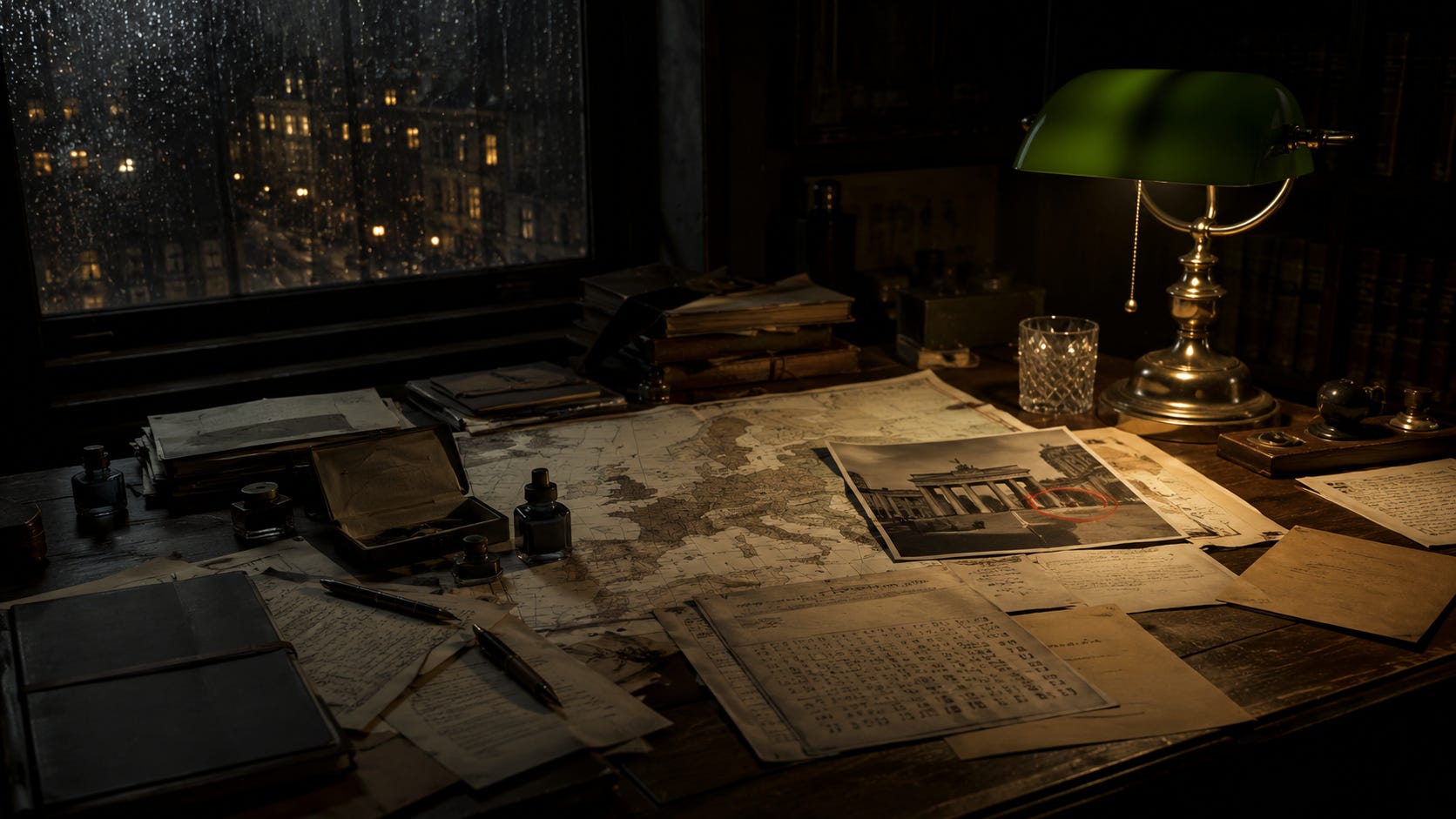
this has such a great cinematic vibe to it. the pacing is tight and you hit that perfect sweet spot of classic sci-fi intrigue without getting bogged down in too much exposition. looking forward to seeing where this project goes