



Chapter 16
She was walking through the desert, ankle deep in burning sand. Not aimlessly, though, and not fleeing or following. Her feet were set on a straight line, with purpose, directed by an internal compass. On the far horizon a horizontal demi-moon was either setting or rising, its two horns describing a parabola that arced down to embrace the entire earth from pole to pole, creating a great blank space within its curve. Her eyes could see its ashen, bloodless form. Her tongue could taste the sandy grit penetrating through her lips and into her mouth. Her lungs could breathe in the deep, unremitting heat that radiated from every pore in the ground, burning her nose and throat. Her legs could barely endure aching fatigue as she forced herself forward, trudging over one scalloped dune after another. Her skin could feel the wetness on her neck and over her breasts and sense the warm rivulets of perspiration touching the small of her spine. Her ears could hear the whispering sounds of sand grains whisking by, driven by shallow gusts of rising warmth, singing to her in their native tongue.
In her mind’s eye she could imagine her journey’s end. Crowds would gather then around her, hailing her by name, congratulating her, wanting to greet her and touch her and hold her. And she, with the soft desert winds still rustling within her, would murmur tender words of remembrance to them, and touch their hands, and hold them in return. And they would love her, and she would love them also. And with each greeting and with each shout and murmur she would thrill with the zest of life, and feel the swell of life, and the flowing tug of life, and life would be gathered up from an uncaring world and given to her anew. All she had to do was intersect with the ending that belonged to her, that was coming towards her just as surely as she was moving towards it. She could see the scene so clearly, more clearly than any vision of the future could possibly be. It would all be there for her, all at the end of the journey.
Then, unwelcome rain began to fall. Violent rain, unremitting rain, rain enough to smother her, and make her gag, and cough, and choke, as if a soaking wet rag was being held down firmly on her face. Panic set in, and she began to scream. Not because she couldn’t breathe. No. Breathing was not that important in the order of things. It was because the journey was coming to a halt too soon, long before she could reach its end, and find those who were waiting for her, her loved ones. In the blink of an eye her dreams were about to dry up and die in a soaking rain, leaving behind the remnants of a god-forsaken life that was strewn like useless rubble on an unused road.
Madeleine startled into wakefulness. She was lying supine on a bed. Her body was completely exposed, as if awaiting the meticulous inspection of a coroner. A nurse leaned over Maddy, administering a thorough sponge bath, working down from the eyes and the bridge of the nose to the cheeks and chin and then to the neck and upper chest. The nurse scrubbed vigorously, rubbing, prodding and scouring, so that Maddy was forced to stay awake. It had been this way on and off for what seemed like eons now. Whenever Maddy attempted to complete her trek through the desert stillness, she would be called away from her passage, back to the little room she lay in, away from everything she hoped for. At times the interruptions occurred with a dizzying frequency, leaving her feeling dazed and disoriented, unable to discern dream from reality.
When the nurse saw that her patient had awakened, she scurried out of the room. In brief time, she returned with a doctor clad in a short white jacket. He looked very young, his youthful appearance only partially obscured by a patchy beard sprouting over his chin. He gazed at Maddy’s naked form deliberately, saying nothing at first, then sat on the edge of the bed next to her. Maddy made no attempt to cover herself, completely indifferent to the other’s presence.
“Miss Pickett?” His voice resonated with the timbre of a studied sonorousness. “How are you today?”
She said nothing in response. She turned to stare at the wall, and for the first time, realized the room was tiled completely in white, empty of all color. Sterile. Dead. This must be a dream, she thought. She held up her hand, matching it against the chalk-white wall. I should wake up from it and go back to the desert. My loved ones are waiting for me.
The nurse visibly twitched when Madeline turned her back to the doctor, then lurched to the bedside to cover her with a sheet. As she expertly tucked in the edges, she leaned forward near Maddy’s ear and whispered fiercely, “Answer the doctor!”
“That’s alright, nurse. Don’t you mind, Miss Pickett.” The doctor smiled amiably. “I know you’re still experiencing a great deal of pain. Emotional pain, that is. You are under no obligation to talk to me, of course. I would like to help you in any way I can, though.”
“Get out!” Madeleine hissed the words. “That’s how you can help me. Get out, go straight to hell, asshole, and take this she-wolf bitch with you! I can’t stand any of you!”
The doctor paused for the tirade to end, as if waiting for the reverberations of a mountain call to echo down before he continued. “Suit yourself,” he said with a shrug of his eyebrows. “In that case I’ll give Dr. Kotmeyer a call. He asked to be notified when you woke up. By the way, Captain Bledsoe is asking to come in. He’s been waiting to talk to you for some time now.”
Madeline shrugged in response as if it made no difference to her, even though she really wanted to bellow an imprecation in protest. Kotmeyer was bad enough, but Captain Bledsoe was without question the sorriest man she had ever seen, a big fat man with brown greasy hair hanging down to his shoulders, a nose like a turnip and a mouth that belonged on an oversized carp. To make matters worse he emitted a foul odor that waffled across the air as soon as he entered the room, reminding Maddy of a rotting pile of vegetables.
For his part, Captain Dwayne Bledsoe of the Georgia State Guard took a dim view of all politicians and anything attached to them. That included their families, who inevitably needed to be handled with kid gloves, and very especially this particular family member. The Chief Executive’s daughter was a willful, sallow, spoiled brat, a hellion with weirdly white hair, a surly attitude, a mouth like a sewer, and a coiled-spring temper. For all he could see, she was crazy to boot. But, he had been given the lead job of investigating the case of the mysteriously disappearing and reappearing presidential daughter, and the events that duly transpired immediately thereafter, so he was determined to unravel the truth.
Thus far, he had gotten nothing useful out of the young victim. Their half dozen interviews had been short, punctuated by a variety of moans, threats, jeers, curses, and sobs. In each instance Madeline had thrown him out of her room with protests that she was too weak, or too sad, or too anxious to continue. The Captain was no stranger to the varied and sundry techniques of evasion, and it was quite clear to him that Madeline was attempting to avoid his questions. This time would be different, though. He had already been given the high-sign by the doctor, a signal that it would be alright to begin his interrogation of this very charming and pleasant young lady. And Dwayne Bledsoe, Captain of the Georgia Guard, was chomping at the bit to do so. Just to prove the point, he carefully inserted a wad of chaw into the crevice between his gums and cheek and began to move his jaw up and down vigorously. An appropriate amount of drool began to form almost immediately around the margins of his lips. His determination thus fortified, he strode confidently into Madeleine Pickett’s sick room.
Captain Bledsoe was a big man. Naturally big since childhood, but made even bigger over the past few years by a regrettable degree of dietary excess. Time and weight had transformed him into a bulky, lumpy shadow of the muscular, athletic and lithe lieutenant who had entered the Guard a quarter century earlier. It was no surprise, therefore, that he failed to dodge the bedpan thrown at his head the moment he entered the room. Fortunately, he was able to get his arms up just in time to protect his face from being struck. The metal pan twanged harmlessly to the floor at his feet.
“Get out of my room and go stick your finger up your ass, you long haired skunk!” Maddy was sitting up in her bed, her face a waxen mask of anger. Her pale eyes tremored back and forth rapidly, as if seeking to acquire her target again for another attack.
Bledsoe straightened himself up, shook his hair away from his face, and carefully spewed a stream of tobacco juice into the fallen bedpan. “Thanks for the spit toilet, Miss Maddy.” He gave her a broad grin, baring an irregular set of brown teeth. “It’s only out of respect to your daddy that I don’t catch you up by that pretty hair of yours and swing you around the room a time or two, you sweet talking little lady.”
“Don’t mention my father! I hate the bastard, and I hate you too. Why can’t you all just leave me be?” Maddy’s voice, like an engine powering up, surged with a rumbling whine. She felt the familiar trembling of rage begin to build inside, tapping with a frantic urgency within her. At moments like this Dr. Kotmeyer had taught her to imagine something soothing, such as a quiet day at the lakeshore, bathing in the cool water and lolling on a picnic blanket while surrounded by friends. If they would only release me from my confinement in this so-called convalescent home I would be free to do just that, she thought. I could be on my own, without the Bledsoes and Kotmeyers of the world analyzing everything I say and do.
One of the nurses had informed her that she had been admitted into the sanatorium just over a week before, but she had no memory of it. Her razor edged recollections ended on the Saturday she decided to run away from Buckhead. Everything after that was erratic, or blurry, or turned backwards on itself.
She remembered Bobo. Bobo Fitzimmons was his name. And Cletis, and Wally, and the other one, the chubby one with the drooping mustache. At least she could remember his face. And the club, The Embassy, it was called. Oh yes, she remembered that, and she remembered they had such a very gay time together. Maddy allowed herself a smile. Are they still waiting at the club? she wondered. I hope they are. There is still time to meet them, and I don’t want to be late.
Escaping the Buckhead estate had been absurdly easy. The train station stood almost at the front gate of the plantation, and was meant for the exclusive use of the Ottleys and their guests and servants. Madeleine simply strolled onto the train, threw a two dollar bill at the conductor, and haughtily told him to keep the change. She got off at the end of the line, at Atlanta Center. She had no real plan. She simply wanted to walk alone, to be finally on her own, to explore without chaperone or guide. She had hardly stepped off the train when she met Bobo.
She was struck by the flash of earnest blue eyes, closely shorn red hair, and an engaging smile framed by dimpled cheeks. He wore the blue uniform of a porter, and without hesitation he approached closely to make himself heard over the clamorous hub bub that engulfed the station. Even so, his words were muffled and indistinct, something about helping with her bags.
Maddy had answered in a carefree, breezy manner. “Why, I’m free as a butterfly,” she had said, “And with just as much baggage.”
“Mighty surprised to see a beautiful young lady as yourself all alone,” was his response, or words very close to that.
Maddy was sure he had used the word ‘beautiful’ with a mischievous twinkle in his eye. From there one thing led to another. Bobo introduced himself, and offered to show her the best sites around town personally, if she were only to wait an hour or two. And if she would, would she mind to pass the time in the company of some sweet tea at a drug store across the street from the station, and they would meet there. She did just that, and by and by he was there, with faded plaid shirt, smelling of mint and tobacco.
And then came magic, the kind of magic it was said that could only be found in fairy tales and dreams. They walked and walked, and they laughed and laughed, and in the middle of the afternoon they sat under an arbor and shared an ice cream soda together, and sucked in the rich syrupy chocolate as if it were the very nectar of life, the vital nourishment that would keep them young forever.
Looking back, Maddy thought she could remember him asking who she was and where she came from, but she only laughed and waved her straw hat like a fan, and told him butterflies did not have names, and generally came from nowhere on their way to somewhere else.
Later, she was introduced to Cletis, and funny looking Wally. Later still, the chubby fellow with the drooping mustache picked them all up in a grand appearing blue Mercedes with an open top, and drove them to the Embassy. Madeleine could close her eyes and still hear the music playing. They called it jazz, a funny sounding name for the uptempo, raucous sounds generated by the four black men on the stage. One of them, the big bellied piano player, was sweating profusely and stopped frequently to swab his brow with a bright white handkerchief, but the music never stopped.
The chubby man with the drooping mustache ordered champagne for everyone, and asked Madeleine to dance a foxtrot. Everyone laughed when the intoxicating mixture of dance and drink left her unsteady on her feet. Following that, there were some long, voided spaces in her memory, punctuated by the remembrance of fleeting smiles and clever jokes, wonderful stories, and raised glasses. As Madeleine thought back to that night, she felt herself squinting at isolated memories that jutted up above the surface of her mind like icebergs, shining just like tinsel flashing in the sunlight.
One of them, maybe Cletis, proposed that they should go to the graveyard and kick over some headstones for fun, and bring the champagne with them. Maddy, surprising herself, said she would not go, that she was afraid of ghosts.
Bobo asked her, she remembered, “Why?”
She could not answer. Maybe because ghosts were both of the days before and of the days to come, and she wanted neither past nor future intruding into her day. She wanted no visions, no furies, no glimpses of a distant shore, and none of the inevitable tomorrows that were decreed long ago in times of yore. She wanted to live only in the moment that surrounded her, sitting in the Embassy Club, floating like a tiny mote within a brilliant beam of light, in perfect equilibrium with everything surrounding her.
It was Bobo who whispered words into her ear as he poured champagne into her glass. Graveyards at night were places of enchantment, he said, where the moon and stars run their silky fingers through the grass in uneven furrows of dappled light and dark, and where the groaning earth becomes at long last at peace with itself, and the seeds of wonderment and contentment could be found like jewels strewn in a pirate’s cave. And so she agreed, and so they went, parking in a little grove of gnarled cypress trees that bore witness to the splendor of the unlighted night.
And then, she remembered, they made love under the velvet canopy of darkened heaven, into the creaking small hours of earliest dawn. First with Bobo, then with angular Cletis and funny Wally. And perhaps with the other one, the one with the drooping moustache. On and on, under the thin and devilish smile of a reddish moon that rose at last above the nodding trees, as if the night would never end. And as she was touched, so she touched in return, clutching, embracing, unbreathing, senseless.
That was all. That was all, all until confusion and forgetfulness overwhelmed her, and she was exiled to some distant desert, to begin her endless tramp back home. That was all, all until the moment the ambulance opened its doors and she was lifted up into its belly like a burdensome beast.
She had refused to tell her story to anyone, especially the dreadful Georgia Captain who pestered her repeatedly. He continued to ask her questions as if he were too stupid to understand that it was none of his business, and that he could never understand any of it anyhow, and that magic and memory do not mix. He loomed over her now, tapping a notebook against his thigh, a moronic smirk on his face, a dull look in his eye.
“Well, Miss Maddy, do you want to tell me what happened during your little vacation in Atlanta?” He asked the question as if he couldn’t care less about the answer. “I got all day, y’know. Doc said it was alright for me to pester you some.” The smirk became an arrogant, irregular grin.
Maddy abruptly raised herself bolt upright, allowing the sheet to slide off her shoulders, falling dimpled to her waist. “Are you sure you want to stay?” She purred the words softly.
“Oh, yes, I’m sure.” Bledsoe answered without hesitation. His eyes did not waver from her face. “Now, s’ppose you tell me a thing or two about that night.”
“Since you insist, it was awful.”
“Awful in what way, ma’m?”
“First give me a cigarette. Even better, a drink. Bourbon would be nice.” Madeleine stretched out her hand imperiously.
Bledsoe shook his head, resigned to all the absurdities of human behavior that police work unveiled. He retrieved a small leather flask from his jacket, offered it in the direction of Maddy, then snatched it away just as she reached for it. “No, no. No, m’am. First talk, then drink.”
“You are not a gentleman.”
Bledsoe said nothing, merely folding his arms.
“You must not be angry with me, Captain, I’ve been through a terrible ordeal. And I am now quite alone, abandoned by everyone, including my own father.” Maddy paused, but saw no response. She lowered her head in contrition. “I hope our conversation will be closely held. You understand, confidential.”
“Yes, Miss Maddy, to the extent the law allows.” He handed over the flask. It was cherry brandy, and it seemed to do just fine. Madeleine took one long swallow, then another.
As she continued, she raised the sheet back over her shoulders. “I just wanted some time alone, that’s all. And it was so boring out in the country. I thought a day in the city would be fun, is all.”
“Did you meet anyone?”
“Oh yes, I did, a real charmer, what my father would call a scallywag. His name was Mr. Fitzimmons. Robert. A common porter at the train station.”
“And?” The Captain was writing furiously in his notebook.
“He seemed like a nice enough gentleman at first, although a bit below my class, and he offered to show me around town. Introduced me to his friends, Wally and Cletis. And another fellow, real quiet, with a drooping mustache.”
“And?” Bledsoe then observed something he had seen many times before. Madeline’s demeanor changed in a subtle way. Her face softened, her jaw dropped slightly, and she began to look directly at him. It was the look people gave when they were ready to speak the truth. He was able to sense it. It was a talent he had. He just knew it.
“He seemed nice, so I allowed him to escort me. Later on we went to a club, where he said I would enjoy the music. There was a band there, they said from West Texas. I was expecting some good negro music, you know, like blues. But they were playing something different, something scandalous. Mr. Fitzimmons said it was called Boogie music, and asked me to dance. Once I saw what the so called dancing was like, of course I refused. After a while I became very uncomfortable. The dancing seemed very...well, carnal, if you know what I mean. Wild and uncontrolled. Shocking, really.”
“This was the Embassy Club?”
“I think so...how did you know?”
“Plenty of people saw you there and identified you. You kinda stick out from the crowd, Miss Maddy, if you know what I mean.” Bledsoe curled his lip into a half smile, half sneer, enjoying the moment.
A long silence followed, uncomfortable to neither one of them. Madeleine lay back down in the bed, curled up on her side, and covered her head completely under the sheet. When she spoke again, it was a thin, tired voice that oozed out from the bedding. “We weren’t long there.”
“Anything unusual happen?”
“Not really.” The sheet did not move.
“Well, that surprises me some. Y’see, m’am, there was quite a little ruckus there that night. Thought you might have seen some of it.”
“What ruckus?”
“Some of the boys, you know, patrons, got quite a bit worked up it appears. Real agitated. The story I’m told is that there was a piano player there, a fine looking mulatto boy of twenty, twenty one. Owner is a gentleman from Louisiana who is specially partial to this boy, seeing as he’s a really talented piano player and so forth. The boy, a real heavy set boy, was sweating up a storm as he played, using his kerchief to wipe down the sweat so much the kerchief became no more than a wet rag. Now, it appears that he called out to the other boys in the band for a fresh kerchief. Called on the other boys, mind you. His kind. Then the most peculiar thing happened.”
Captain Bledsoe paused, unsure how his witness might respond. Human behavior was an oddity that could not be readily explained or predicted. Some people remained silent at all times, regardless of circumstances, facts, or station. Others wanted to talk, on and on, regardless of truth or accuracy. Still others hoped to mumble and stumble their way stupidly through any situation.
The form under the sheet did not move, but a voice again wandered out, almost lazily. “What?”
“Well don’t you know… A lady in the crowd came up to the stage and handed the boy her handkerchief. A white lady, that is. As I said before, quite a fuss broke out. The white gentlemen in the club did not take kindly to a nigger piano player taking a personal item like that, an intimate item, from a white lady. Of course, she shouldn’t have handed it to him. Almost seemed like she provoked the whole thing. Some people said it was you, m’am. You were the lady who started the fight.”
From the depths of her cocoon, Maddy let out a hoarse groan. “It was not me. Now please, leave me alone.”
“Come now, Miss Maddy, you must admit to some responsibility in this egregious matter. A riot broke out after that little exchange. You know what happened to that poor boy? They dragged him outside and hung him from a lamppost, right there in front of the Embassy. Hung him dead, and they messed with his body some, too. The whole city was thrown into the eye of a storm for four days after. Niggers didn’t take it quiet. Went rampaging all over town, several dozen killed, number of white folk also. Guard was called out of course, everything shut down. Buildings burned all over downtown, you can still smell the smoke. The money loss was appalling, looks like quite a few millions. To top it all, you were found lying on the ground unconscious, in an alley, not ten feet from a dead negro. Male, in his thirty’s. He was beaten up bad, skull crushed. Now, tell me true, weren’t you the one who began it all? Weren’t you the lady with the handkerchief?”
“No” Maddy answered with a barely audible whimper.
Bledsoe exploded in anger. “Weren’t you? Weren’t you the reason my city blew up, you stupid, privileged little bitch?”
The form lying in the bed suddenly began to twist and turn with a paroxysmal convulsion of movement, as if a contortionist was struggling to escape a set of hidden iron shackles. Madeleine abruptly sat up ramrod straight, emerging from the sheet as suddenly as an apparition raised from the grave. Her face was a colorless mask, set as rigidly as the whitest carved ivory. Her eyes nodded back and forth in a painful struggle to focus on the Captain. She stood up fully to face him, unclothed and uncaring. Her words were calm, spoken with a deep huskiness in her throat.
“No, I was not the one, because I was not there at the time. You see, Captain Bledsoe, I was escorted out of there much earlier by Mr. Fitzimmons and his friends. They were all so fine to me, so nice. I was taken to a deserted place where they said we would have some fun. A cemetery, I think. And then I was raped. Over and over, by all of them, all through the night, until I was dead. And then I was dumped in some back alley street until y’all found me, and brought me back to life. I suppose you were home sleeping while I was raped, Mr. Bledsoe, nice and warm with Mrs. Bledsoe. No police around at all while I screamed my lungs out, in fact. No, I was not your mystery lady, Captain. I was not the lady with the handkerchief. I was the lady weeping for help in the back seat of a Mercedes.”
Bledsoe felt almost paralyzed, made inert by Maddy’s revelation. There was nothing in the medical reports about a rape. He wasn’t sure she had even been checked for possible rape. His mind was struggling with her recollected words when a sliding, shuffling sound coming from behind caused him to whirl completely around.
“I think that’s enough for one day, Captain. Why don’t you leave my patient alone for now.” Dr. Kotmeyer stood a few feet away, looking forward with his one good eye, pointing resolutely to the doorway with his one good arm.
Pain. Pain unyielding. Pain searing. Pain unceasing. Pain over her arms, and chest, and head. Pain exploding in every sinew. Pain erupting over every muscle. Pain lancing through her eyes, causing her to see bright evanescent spots and billowing lines of light coursing towards her like combers at the shoreline. Eventually the pain subsided, leaving in its wake a harsh throb that pulsed with each beat of her heart. An hour went by, perhaps two, maybe longer. She was awake, but kept her eyes tightly shut to better see the shining display of stars winking on and off, or turning into streaking waves of incandescence. She almost felt that she should name them one by one...Orion, Venus, Haley...but they flickered alive and died too rapidly to be identified individually. Slowly, a thought burned into her awareness.
“Dr. Kotmeyer, why do I see wavy lines?” Maddy opened her eyes.
He was sitting by her side, not a foot away. “They are not real, Madeleine. They are figments, nothing more than exuberant surges of electrical activity emanating from the neural cells within your brain. They will resolve in a while.”
He had told her this before, after her other treatments. This was her fourth one. Electroshock therapy it was called, and each one had been excruciating. But somehow, after each one she had experienced a prolonged feeling of great calm.
“But, doctor, where do they come from?” The answer to that question was suddenly very important to Madeline.
“They come from nowhere. The neurons in your visual cortex begin to discharge, that’s all.” Kotmeyer answered with supreme equanimity, not in the least appearing disturbed by Maddy’s odd query. The thoughts she expressed probably reflected derivative manifestations of an internal conflict. She was, after all, very ill.
He doesn’t understand, she thought. That’s where everything comes from. My attacks. My memories. They come from wherever it is that the flashes and dots come from. She fondled a wire connected to one of the electrodes attached to her head. She did not want to give up quite yet.
“But I’ve never seen these wavy lines before, before the treatments. Never in the past.”
“And so?”
“How can my brain discharge something I’ve never seen?”
Poise and composure were critical to Kotmeyer’s therapeutic method. Nonetheless, he found his patient to be particularly annoying today. The empty sleeve of his jacket began to tremble ever so slightly, a spontaneous response of the injured muscles and nerves in his mangled arm that he could not control during moments of distress. “Please, Madeleine, do not concern yourself with such things. Think of it as imagination, nothing more or less. Pure imagination.”
The pain in her body was by now subsided into a dull soreness, mirroring the aching exhaustion in her mind. She could sense that the shock regimen was somehow helpful to her. All the bad feelings, the utter desolation, enveloping darkness, and absolute devastation were now pushed back, enclosed and walled off, but only momentarily. Soon enough they would seep back, oozing from below or dripping from above, drop by drop. In the end, darkness was the only natural condition, and any attempts to eliminate it were sure to fail.
“What if I described it to you?” She asked tentatively, not sure that she would get an answer.
“Described what, my dear?”
“How they look. The wavy lines, I mean. Would you understand? Would you be able to imagine them too? Could your imagination discharge the same way my imagination does? Aren’t your nerves different?”
Kotmeyer suddenly found himself agitated almost beyond endurance. Why was the patient asking questions, especially these kinds of questions? She ought to be in a twilight state of somnolence. His one functioning eye bored into Maddy, peering as if trying to see through her.
“Well, if it’s all imaginary, I don’t have to see what you see, do I? We can both imagine we see the same thing and move on. Hopefully, to a place where you can at last experience a feeling of calm and repose.”
“So if I see one thing and you see another thing we can just say we see the same thing?”
“We would call it the same thing, yes.”
“But you told me that whatever we see has to be attached to something to make it real, like a thing, like a carpet or a cloud or a comb. That’s why my visions aren’t real, you said”
Kotmeyer rubbed his brow in exasperation. “Well, you see, you can see whatever you want to see, and I can see it and we can say we see the same thing even though we don’t really know for sure. We can see the same thing differently. Now you should really rest.”
“But the wavy lines are real?”
“Yes. Real in your imagination.”
Maddy turned on her side to face Kotmeyer. She did in fact feel very calm, very much as if drugged and about to fall asleep. She closed her eyes, preparing to return to her journey across the desert sands. “I’m the one,” she murmured.
“Miss Pickett, honestly, I’m concerned you will need another treatment very shortly. You’re not making sense.” The psychiatrist felt a sudden thrill of anxiety. If this particular client did poorly his reputation would be in tatters.
“I’m the one they’re looking for. The lady with the handkerchief. The one who started the riots.” She opened one eye to see Kotmeyer’s expression before continuing. The world looked different when she looked through only one eye, as if seeing things that way made all the difference. He began to tug at the short shred of tallis that hung, exposed, from his shirtwaist. She had never seen him do that before.
“I was the one who handed the piano player my kerchief. He was so hot, and he was playing so well. I didn’t want it to end. Something told me not to do it, but it just happened in a second, really. I just wanted the music to go on. A man got up to shout at me, I think he was drunk, then others, and women began screaming. They were all very drunk, I’m quite sure. They charged up to the piano player and grabbed him by his head and shoulders and threw him down and began kicking him. I was so frightened, I ran away from there as fast as I could, out of the club, and kept running until I was completely lost. I think I sat down to cry, or maybe I fainted, I can’t remember. I was afraid to admit what happened. I told Captain Bledsoe that I was with some men I met, and a man named Bobo, and that they were my escorts, but that’s not true. I was alone. Completely alone.” Madeline let out a throaty sob. “I still am.”
The store’s front windows had all been broken and were now boarded over. Management had resorted to daubing the temporary wooden panels with small, mimeographed flyers, allowing the smeared, thin blue type to announce the various sales going on inside.
“Come in!” one urged. “Never has bedding been so easy to buy!” Evidently even that was not enough, as another proclaimed that “No respectable offer will be refused! You can sleep in easy luxury tonight!”
Despite the urging of the accumulated mass of advertisements plastering the display cases of the Samuels Brothers Department Store, no passersby were tempted to enter its spacious interior. There were no passersby to be tempted. All of Myrtle Street remained deserted as far as the eye could carry. The bank building just a few yards away, First Bank of Georgia, was still exuding a foul smelling smoky plume that trailed into the smoggy Atlanta sky. Other buildings along the street gave evidence of the recent three day downtown battle. Cartridges and brass shell fragments still littered the gutters, shiny debris baking in the broil of mid morning heat. And all was quiet, as quiet as if the last human had just picked up and moved on.
Promise Stone took it all in with a lackadaisical air, for all the world appearing indifferent to his surroundings. He veered towards the Samuels Brothers department store obliquely from across the street, and made his way along a side alley until he reached the loading dock at the rear of the store. Two black laborers were preparing to lift and carry a refrigerator into the store, one of a long line of refrigerators, ovens, sinks and stoves waiting to be moved. A middle aged white gentleman dressed in faded overalls sat in a rocking chair nearby, holding a clipboard in one hand and a Coca Cola in the other hand. Sweat was pouring hard from all of them.
Stone approached slowly, stopping deferentially ten feet away. The man in the rocker startled, as if he had been dozing, and took a few hard swallows before coughing and gagging up a sizable clump of filthy looking sputum that he spit out on the cement dock.
Stone did not give the man a chance to speak. “Hullo, suh. Excuse me, I’m lookin’ for Mr. Orkhum.”
The other stopped still to squint at the massive form of Promise Stone for a second or two before he resumed his rocking again. “Who the hell are you?”
“Sorry, suh. Name is Jethro Spratt. Major Levy told me to come here and that I was to be workin’ here. Didn’t say at what. Here is my papers.” He pulled out a crumpled envelope from his back pocket and offered it in the other’s direction.
Mr. Jones had given him the papers the night before, assuring him they looked genuine and would pass the closest inspection. Stone had been heavily drilled about his new identity, and was confident he could pull the whole business off. And if he couldn’t, and if he were to be found out, that didn’t bother him very much either. He wouldn’t go down alone.
Cassius Orkhum was unhappy about having his quiet morning interrupted. Old man Samuels had spoken to him earlier in the morning, and told him that a boy was coming over from a Major Levy, and that he was to be put to work on the loading dock for three dollars a day. Said that the Major was new in town, and might be joining the Samuels’ congregation, or temple, or whatever they called the old man’s strange looking house of worship. Said the Major had called him last night, and would be sending his boy around in the morning. Cassius wasn’t sure he wanted any more bodies around, though, and wasn’t at all pleased with the notion of breaking in a new hand.
He scrutinized the blue work forms handed over by Promise. “Major Levy is your owner?”
“He’s my owner, thassright.”
“Where you from?”
“We comin’ from Cuba.”
“No. You. Where you from? I wanna know about you.“
“They says I was born in Alabama. Birmingham. But hard to say. Suh.” Promise struggled to control himself. He was bothered by the man’s personal question. What did he care about Promise and where he came from? He was lying if he did say he cared.
Orkhum took an immediate dislike to the black man standing in front of him. Too big, and too powerful. Couldn’t be trusted, especially nowadays. “Where is your owner right now?”
“Dunno. Gave me directions to come here. Said he’d be staying at the ho-tel, and that I was to be your boy now.”
“Well...” The loading dock supervisor for Samuels Brothers department store was unsure how to proceed. Maybe there was a way to get rid of this big, unwelcome buck. “Tell you what. I’ll keep you if you can show me that you can do the work.”
“Yassir.”
“See those refrigerator units? They all need to go up to the second floor. Staircase is to your right.”
Promise glanced over at the two dockworkers, who were struggling to move one of the appliances with great effort, pushing it slowly into the building on a cart. About ten or twelve units remained. Without another word Promise jumped onto the dock, secured a length of rope, and wrapped it around the nearest refrigerator. With a quick tug, he used the rope to help hoist it onto his back and made his way steadily into the doorway.
As he disappeared into the building, Orkhum shouted after him, “Alright, you’re on. Three bucks a day, you pay for your own meals. Sleep in the warehouse, the other two will show you.” Godalmighty, he thought. He’s a find. I just hope he doesn’t tear us all apart one day.
In the early afternoon, Promise had a chance to rest from the bone breaking work of heavy lifting for a few minutes, while Orkhum wandered into the bowels of the giant store. This was apparently his normal routine at about this hour, as Tom and Tim, the two loading dock laborers, promptly knocked off work. They were twins, almost identical in facial appearance, but very different in form. Tim was tall, broad across the chest and shoulders, and with thick, strong forearms. Tom was no more than five feet tall, with a wiry frame and thin, angular arms. His left arm didn’t seem to work too well, and a perpetual, stupid appearing grin was pasted to his face.
The two brothers were sitting on the ground in the shade, huddled in a corner of the loading dock, laying out a meal of cold corn dodgers and fried fatback as Stone returned from making the last refrigerator haul. A bucket of water was perched on a stool nearby.
Promise felt a stab of hunger gnawing inside, made even stronger by the intense heat of the day. The smell of pork grease began to overwhelm him. It seemed like an easy opportunity to see about some food. He could hear the two men talking together as he approached, but what they were saying made no sense. They continued speaking gibberish, oblivious to Stone, who stopped just a few feet away.
He picked up fragments of their conversation, hearing words that sounded as if they should be familiar but were somehow unintelligible. To his complete astonishment, the two men finished serving out their food neatly on some well worn napkins, brushed a few crumbs from their laps, and got on their knees. Very deliberately, they clasped their hands and began to pray:
De Lawd, ‘E duh my sheppud
Uh een gwoi’ want
E meck fuh lay down een dem gween passuh
E Kha me deh side dah stagnant wahtuh
E sto’ muh soul -
With a powerful kick into the small of the back Promise sent the nearest one, the small one, sprawling with a yelp.
“What the hell are you two sayin’?” He growled out the words menacingly.
“That’s how we talk, you son of satan.” The other one, Tim, clambered onto to his feet, balancing himself carefully in a semi croutch. He was bigger than average, and thickly set, but did not measure up to Stone’s sheer mass. “Geetchee. But that’s just for us. We talk your way too. Why did you kick my brother?”
Promise ignored the question, glared at both men, then reached down and snatched a piece of pork fat. “Was you prayin?”
Tom staggered to a stand, holding his back in pain. “Yes, we prays. We prays against the evils of the world....” He hesitated. “Like you.” The grin had not left his face.
The fried pork was pleasantly tender but had a mildly rancid taste. Stone hunched down to sample a corn dodger as well. He had no interest in striking up a friendship with the two brothers, but they were odd enough, and intrigued him. “Why?” He grinned at Tom. “Why pray? Ain’t no one gonna listen. Where you two from?”
“Beaufort County. You know Port Royal?”
“Shit no.” He regarded them both carefully as he chewed a crunchy corn dodger. “You rented or contract?”
“Rented, I guess.”
“So you got no money of your own?”
“No, why should we?” Tom cut into the conversation aggressively. “The Lord had no money. Money is the root of all evil.” He hesitated the barest moment then pushed his chest out. “Money fertilizes the work of the devil, that’s what.”
Stone chuckled. “That what they taught you in Beaufort County? Dumb trash like you is what’s keeping us all down. Let me tell you somethin’. Money is the root of a full stomach, that’s what, and decent clothes, and boots with no holes in ‘em. Money’s not evil. It’s the ones that got the money that’s evil. And you already know who they are.”
Tim shot a glance at his brother and mouthed something. The other shrugged and whispered back “twis’up unmanussuble buckrahnigga”.
Stone shot to his feet, clenching the paw of his right hand into an enormous fist. “What did you say? If you’re talkin’ about me I’ll lay you both out.”
“Calm down, brother.” Tim put both arms out in a gesture of appeasement. “We’re just sayin’ that you’ve been beaten down some. You need to get right with the Lord, pull yourself back up, let yourself be free.”
Stone stood to his full height, reared his head back and bellowed out an enormous laughing cackle. Finally, he knew who these two were. He had met them before, many times in his travels. Turn the other cheek. The Day o’ Jubilee is comin’. Jesus will save you. The wheat will be thrashed on the Day o’ Judgement. Stone understood what they were all about. These were dead people talkin’. Dead to the world around them. Dead to the crimes committed against them. Dead to Promise Stone. He stopped laughing just long enough to shake his head, half in wonderment and half in anger. Dead and they didn’t know it.
At one end of the loading dock Stone caught site of a narrow, recessed metal door. He ambled over leisurely and tried the knob gingerly, shaking it slightly.
“Hey, leave that alone. You can’t be touchin’ that.” It was Tom, looking slightly stooped over but still grinning.
“What is it?”
“Door to upstairs. That’s WSB. Radio station. We’re not allowed up there.”
“Okay.” Promise decided to grin in return, happy to move onto another subject, giving only the briefest look at the locked metal door. “Okay. When you ready let’s get back on the job. You know, my brothe’s, idle hands make for devil’s work.”
“Amen,” Tom answered, grinning amiably.
Chapter 17
Energy. Charge. Velocity.
Guilt. Remorse. Redemption.
Mass. Dimension. Inertia.
Thought. Wisdom. Divinity.
They are interwoven, these all, all interchangeable and all necessary. They converge through different strands of perception, entangled beyond any meaning made possible by the ritual of words. From these, the world around emerges, ill formed, ill seen, ill felt, all image, all real.
But is it all?
Come down. Go back across the valley. Retrace every step. Command a baton of light to sweep over an infinite compass, seeking backwards until it encounters a random past. Shadows form, congeal, and fold into the being of a young mother nursing an infant in the shade of an ancient palm tree.
She is there, perfect in form, intact down to the last atom of her existence. The muscles around her mouth quiver upwards into a tentative smile as her pupils constrict into focus on the babe at her breast. Her heart beats, her lungs breathe. Everything about her, every movement, every chemical reaction, every molecular arrangement, is perfectly restored. But is the adoration she once bore also there? Can love be made to reappear, as if it floats like a senseless, pervasive vapor, ready to be breathed gently into an empty shell of form and substance? Or has love evaporated, spun off like an atom in decay, dismissed from the chorus of time and now merely dissolved, like a mud print in a fretful rain? Can love be measured or is it illusory? Does it matter?
Crossing from Germany into Czechoslovakia became a nightmare.
Osler had met with Jona and Alex in a safehouse apartment in the middle hours of the night before they fled Berlin. His sources had given reassurances that the Sipo and Gestapo might have no knowledge of Jona’s presence at Bloomberg’s house the night of the shooting. However, there could be no certainty. Wittenauer might have somehow tipped them off beforehand, or there might yet be another mole in their group, someone as yet unknown. So, it was best to travel with what Osler called ‘improved papers’. He handed over a well-thumbed American passport with the picture of a sandy haired man who wore thick glasses and a neatly trimmed beard. It looked perfect, quite authentic down to the border stamps from Denmark and Belgium.
“You are Doctor Harrold Teig from Spokane, Washington. Don’t worry about the beard, you are fine as you are. They may ask some questions at the border. For example, they may ask you the name of your favorite restaurant or theater in Spokane. Don’t be alarmed, it’s just to shake you. Say anything reasonable but remember what you say. Once you cross into Czechoslovakia you can go wherever you like. I suggest the USA Embassy. Get home as soon as you can.” Osler put his outstretched hand on Jona’s forehead, as if to give absolution. “My dear Dr. Lieb, you can take your chances here by remaining, or you can flee. It is your choice, but I recommend you flee. Your country and Germany are not on good terms right now, and will never be as long as Nazis are in power. If you are apprehended, the gorillas that run the asylum might choose to make an example of you. However, your new identity is very thin. If they should stop you on the train, or at the border begin to confront you, or especially lead you off the train for any reason, any reason at all, even the most plausible, in that case say nothing. Nothing at all. I will do what I can for you.” Osler’s thin smile was cold comfort.
Alex was to travel as Hemmerich Czwizckowinik, an architect from Graz. They travelled on the same train, but in different cars. Jona could not understand the logic of this precaution. Surely, if one of them were apprehended, then the other would be found out. He did not like the idea of taking the most dangerous journey of his life alone, possibly cut off from Alex at a crucial moment.
The train was impeccably clean and the ride was smooth. However, Jona was on edge, unable to calm himself. He forced himself to sit quietly and stare out the window, which revealed nothing other than blackness. He closed his eyes and soon had a terrible vision; Marielle lay stretched out on a bed, dying. She called out his name as he checked her in a frenzy. ‘I’m sorry, madame, but you have only two hours and fifteen minutes to live. That will be twenty dollars, thank you.’ He found himself saying this with complete confidence and without emotion. The vision terrified him. Could it possibly be true, a foretaste of what was to come? He opened his eyes in a sweat. He forced himself to remember her as she was, vibrant with life and exuding the lure of enchantment.
Drenched in dread and sweat, Jona sat motionless. Abruptly, it occurred to him that he had never finished his letter to Churchill. I’m glad I didn’t post that nonsense to him, he thought. I understand his worry. Now I know enough to tell the real truth. The cabin car offered several generic postcards extolling the beauty of the Fatherland. With shaking fingers, he withdrew a pen from his jacket and began to write:
Churchill:
I am on a train escaping Germany. I am escaping insanity wrapped in hatred immersed in ignorance. Above all, I am escaping a vortex that I fear will engulf the world soon enough, as soon as the monsters in charge have forged the power to bend everyone to their will. The people I have met are beyond reason. They have all been infected with a powerful pathogen that has destroyed their humanity. When we met you were concerned about Hitler and his apparatus. It’s not just him, however. Almost everyone here, with the exception of a few heroes, has been touched by this affliction, and there is no going back for them, for their country, for the world. As for me, I don’t give a shit. Actually, I do: I’m going to find my girl in Moscow and then get as far away as possible. Good luck.
Lieb
Jona held up the postcard and grimly re-read what he had written, then flipped it over. The face was divided in four parts, each with a picture depicting a different part of the German countryside, from deep forests to towering alps to gentle sloping farms to serenely flowing rivers. In his eyes, the harmonious images blended into a landscape of terror and agony. Without further thought he stuffed the postcard into an inner coat pocket.
Between Dresden and the final stop at the border crossing into Czechoslovakia, Lieb became increasingly anxious. Even though he had been told to stay strictly in his own compartment and do nothing to attract attention to himself, Jona found himself wandering through the club and dining cars in hopes of spotting Alex.
Just as he started to feel foolish about seeking out Goldstein against explicit instructions, Jona glimpsed a man who was staring at him. At first he could not be certain, but after sneaking a quick look twice more while pretending to search for the lavatory, it was clear that the portly man in the gray tweed coat sitting in a corner table of the club car was observing his every move. Instantly, Jona’s heart began to pound in his chest like a sledgehammer, making him feel that his head was about to explode. A searing, numbing pain shot up the back of his leg, causing him to jerk and stumble backwards spasmodically, and in a flash he fell clumsily to the floor.
Briefly, everything turned gray. A woman’s short, shrill cry pierced his awareness, and Jona felt hands under his shoulders, helping to lift him. As he regained focus, Lieb found himself being supported by the portly man who had been observing him. Jona gave a feeble attempt at extricating himself by pushing away and turning towards the car door. He muttered a rough sounding “Thank you,” as he moved towards the exit.
The small crowd that gathered drifted away, but the portly man remained at Jona’s side. “Sind sie Amerikaner? You are American?” His accent was thick and nasal.
“Yes. No. I mean, yes.”
The other grabbed him by the lapel and would not relinquish his hold on Jona. “You are American. Listen, please. Fuck Hitler, yes?” He hissed the words with a deep exhalation.
“No! No!” Jona felt a surge of panic begin to overwhelm him, and despite the radiating pain in his leg and back he began to backpedal rapidly, breaking the man’s grip. Lieb opened the door to the next wagon and slammed it shut as he passed through, hurrying as if his life depended on it. The portly man in the tweed suit stayed where he was, pressing his face to the window in a crazed manner. He seemed to be mouthing the words “Listen, please. Fuck Hitler,” over and over.
Hours later, halted at the Czech frontier, Jona had still not regained his composure. He felt almost paralyzed, both physically and emotionally, cursing himself repeatedly for his stupidity. It seemed obvious that the man who accosted him was a planted spy, someone who ensnared unwitting passengers with provocative, treasonous talk. Something about Lieb had attracted the man’s attention, a fact which could only imply terrifying consequences. When two German border agents came by to collect Jona’s passport, he pretended to be half asleep in order to avoid any conversation with them. Osler had been correct. It was best not to talk to anyone unless absolutely necessary.
Jona allowed the predawn darkness to settle over him, quieting him, allowing him to prepare for the next stage in his journey. This was the time of day he usually loved most. It was a time of softness before the hardness of the day to come, a time to indulge in useless thoughts and deep yearnings. As he peered out his window he could see nothing through the unlit gloom of the railroad siding. All was quiet. No clash of boots, no shouted alarms. All was well. He began to dream of Marielle and her milky white legs. Finally, he began to relax.
A scream quavered through the silence. Another. In the corridor outside his compartment Lieb heard the sounds of scuffling and groaning. Without thinking, he quickly opened the door. Three uniformed police were dragging a man down the aisle. He was struggling, trying to dig his feet into the floor, gasping for breath. A thin trickle of blood coursed down his forehead.
It was the portly man in the gray suit. Other passengers had opened their doors as well, and all were staring, their heads protruding into the corridor like so many overripe melons hanging on a vine.
As the man was hauled onwards, he sighted Jona.
“Amerikaner!” he shrieked, “Help! Help! Bitte!”
Three other men were trailing the struggling group. Two were the border agents from earlier in the night. The third was dressed in a short brown suede jacket, bare of any insignia. He seemed very young. Without hesitation he approached Jona, extending his hand upwards peremptorily, indicating that Jona should not move. He snapped his fingers, and the border guard standing a step behind immediately produced the passport of Dr. Harrold Teig.
The portly man’s cries for help receded as he was taken off the train, then dissipated into a deadly silence. Blood buzzed through Jona’s temples so loudly that he could barely keep his head upright. With a supreme effort he kept his eyes fixed on the man in suede.
“So, Doctor Teig, you are leaving Germany so soon?”
Jona struggled to remember the date on his entry stamp. Three days earlier. “Yes, yes, I have to be on my way, on my way.”
The young man gave a pleasant smile. “Where are you going? Your final destination?”
Without hesitation, Jona blurted out, “To Moscow.”
“Really? An unusual destination, Herr Doctor. Are you perhaps a Bolshevik? Ha-ha, forgive my joke.” The plainclothes agent began to stroke the passport up and down with an alternating motion of his hand, as if it were a blade on a leather strop. He was not smiling. “Are you?”
Lieb cursed himself for his blunder. He should have said Budapest. His mind was unsettled, fuzzy, jumping from one thought to another. “No, no, not a Communist at all. Just a visitor. I want to inspect their medical system...it is far behind the U.S. And Germany. Even France. I want to see how they are coping with their primitive methods.” He struggled to keep his voice steady.
The agent’s voice hardened suddenly, and he thrust his chin out aggressively. “Why did that man speak to you just now? How do you know him?”
“I don’t. He approached me in the dining car last night. He spoke to me, quite uninvited. I think he’s crazy.”
“What did he say?”
Jona did not hesitate. “He said ‘Fuck Hitler, yes?’ at least twice.”
The agent settled back on his heels and motioned to the uniformed border officer, who began to write furiously on yellow foolscap.
“He seemed very angry,” Jona offered. “I think he wanted to see if I was...you know, with him. Crazy fellow, really.”
Without prelude, the official launched into a rapid, heated rant in German that Jona could not understand. As he shouted, he began to stroke the lapel of Jona’s jacket. He paused a moment, then continued in English. “That is fine wool, so smooth. Expensive, I’m sure, but of course you are a doctor.”
The man’s fingers strayed inside the lapel, almost stroking the pocket containing the postcard. Lieb staggered, panicked that he would be asked to produce the card for inspection. He felt his throat tighten, almost obstructing his breath. “I can, if you wish…” He began to stammer. “If you…you, you wish, I can open my bag for you. I have nothing to hide.”
The agent seemed satisfied with Lieb’s response, withdrew his hand, and began to return the passport. At the last second he snatched it back. “By coincidence, Dr. Teig, I know Spokane Washington quite well. I’ve been there. My uncle lives there, you see. Tell me, what is your favorite motion picture theater there?”
Jona managed to laugh softly, feeling a gush of relief. “Why, the Palisades Theater, of course. Best popcorn in the state.”
The man clicked his heels together and gave a half bow at the waist as he extended his hand with the passport, and in a heartbeat the agents were gone, leaving behind only the strident echoes of boot heels striking hardwood.
Later, when they had crossed the border into Czechoslovakia, Jona wondered what happened to the portly fellow in the gray tweed suit who was dragged away. The man was obviously insane for talking the way he did and was undoubtedly taken directly to a sanatorium. For the briefest moment, Osler’s warnings of Nazi plans for mass euthanasia flashed back to him. With eyes closed, Jona had a vision of the man’s face, flushed and plethoric, his body swinging from a gibbet even as he continued to mouth ‘Fuck Hitler’ over and over.
Their agreement had been to leave Hlavni Nadrazi station separately upon arrival in Prague, and meet at a restaurant on the corner of Rimská and Italská streets. As Jona’s taxi approached the intersection, he quickly spotted Goldstein’s massive form slouched against a lamp post in front of a dirty, decrepit looking storefront, smoking indifferently. Jona could not contain his joy and relief. Alex had arrived safely. Soon they would be together and on their way, and Marielle would be the prize waiting for him at the end of their quest.
Alex did not appear as happy to see Jona, however. His first words were a shock. “You should not go to Russia. Time to go home, Jona.”
“What do you mean?” Lieb could not hide his confusion. “We’re safe now. Out of Germany and away from the Sipo. We can go to Moscow.”
“Moscow not safe. Not to go there. Not to visit, bad schweinerei there right now. Scheize, you understand?”
“I don’t give a damn about visiting Moscow. I want to go to Marielle, and that’s where she happens to be.” Jona eyed Alex carefully. As usual, he could discern nothing in his new friend’s demeanor that gave any indication of alarm. “Why do you say it’s not safe?”
Alex shrugged his shoulders. “I learn. Come vit me.”
They entered the restaurant, deserted with the exception of an octogenarian sitting at a window table, smoking a drooping, antique calabash pipe and drinking beer from a pewter mug. The man’s hair was sheet white under a wide brimmed hat, but his flaring mustache retained streaks of fiery red and brown. He wore enormous, startlingly black sunglasses. His face was hard to discern because of his oversized hat and forbidding glasses, but seemed dark and had the lines and texture of beaten parchment, reminding Jona of a faded map.
Without hesitation, Alex sat at the man’s table and jerked his thumb towards Lieb. “This is him. Talk vit him in English,” he muttered.
The other paused in his puffing long enough to study Jona carefully from head to toe, as if inspecting a marble figurine or antique relic he was assessing for a bid at auction.
“Alex tells me you are a friend.” His spoken English was almost flawless.
“Yes. Alex is my friend.” Jona answered confidently.
“Then you should listen to him. Go home. Russia is dangerous right now.” The old man gave a thin smile when Jona did not respond. “You are going for a girl?”
“Yes. Not any girl. A girl I’m in love with.”
“Sometimes, men seek the love of a woman to forget her, not to remember her. Is that you?”
“No, definitely no. It cannot be otherwise.”
The man seemed to smile through the opaque lenses of his sunglasses. “Beware. They do this, the Russians. Every few years they kill some people. A hundred, sometimes. A thousand. A million. It makes them feel good, like they are making progress in the world.” The old man nodded contentedly and stroked his mustache. “Right now, they are killing people once again. Quite a few this time.”
Jona could feel Alex staring at him, waiting. “I don’t care about danger.” He blurted out the words without really thinking. “I’m going.”
The old man said something unintelligible to Alex in a low, purring voice. Then he turned to Jona. “That’s what Mr. Goldstein predicted, Doctor. But you will need papers. It’s not like the old days, when you could just go. You will need a letter of invitation from some official, or at least a vid.“
“What’s a vid?”
“Papers. For identification. If you stay very long you will also need residence papers, what they call propiska, and register with the local MVD. You know, the police. Goldstein, you can get these, yes? From our friend up north?”
Alex nodded quietly and got up from the table. Jona arose with him. Before leaving, though, he extended his hand. “Thank you for your help. I know you mean well, and I thank you for that. May I ask your name?”
The old man removed the pipe from his lips and began a giggling laugh as he shook Jona’s hand. “Do you read books, Doctor?”
“Yes, of course.”
The old man gave Jona a look of amusement. “Then call me Ishmael,” he intoned dramatically, and continued with his quiet, tittering laugh.
Out on the street, Alex launched ahead at a vigorous pace, striding along as if he were alone. Jona struggled but caught up with him at the corner crossing as they waited for traffic to clear.
Jona grasped his friend’s arm. “Hey, wait for me.”
Alex squinted forward, then gave a casual look all around and behind them, as if interested in the wood and brick buildings that made up the neighborhood. “Du understand, everything he said, true.”
“I understand. Who was that man, anyway?”
Alex managed to both smirk and grunt at the same time. “Father’s friend, vhat else. He know effryone, effryone know him.”
“But how? What kind of friend?”
“Vy you always want to know this things? Friend, that is all.” Alex could see that Jona was about to burst with more questions. “A writer. From Argentina. I think he’s crazy, but your father like him, help him vith money, and so he writes more crazy things. He is getting much vorse since starting to go blind. Everything vith him is a mystery, vorld is a mystery. If he write two sentences can mean five different things. Life, love, hate; all a mystery with no answers. And crazy.”
“Well isn’t it? Crazy?” Jona surprised himself by his sudden surge of anger. He clasped Alex’ arm tightly to keep from stumbling.
“Listen to me…” Alex whirled, grasping Jona by the shoulders to steady him. “I like you maybe, but you haff not suffered enough to be bitter. Me, yes. You, no. That man, also yes. If he say danger, you must listen.”
Ok, I’m not allowed to feel bitterness, I get it, Jona thought angrily. How much more do I need to bear. Tell me. A quick stumble and a helping arm by Alex allowed him a moment to compose himself. “He’s old. All old people are afraid.”
“Not old. Young. Wears disguise.” Goldman shot a quick glance at Jona out of the corner of his eye, a look a wolf might give before deciding on dinner. “Told you. Crazy.”
“Alright, I understand. But if it can be done, I want to do it. Now that my father’s dead, Marielle is the only thing left that matters to me. I should never have let her go, and now that I know where she is I have to find her. If it can be done, it’s something I must do.” Jona waited a long heartbeat. “Can it be done?”
Alex said nothing as they walked together, with Jona still clutching at his arm. When they reached the next corner, they stopped for an enormous lorry that crept by laboriously, coughing out a cloud of noxious, irritant fumes as it passed. Goldstein squatted down, ignoring the curious looks of other pedestrians, and pulled Lieb with him.
“The gas vill rise up. Less danger.”
When they stood up, Alex faced Jona squarely. “In the Var, and after, too, I learned some things about men. Most are cowverds, just like me. But I saw many men afraid who ver first to go up and over, and first to die.”
Jona had a flash of understanding. He hung his head, trying desperately to guess the right thing to say, but his mind was cluttered with Marielle’s face, and the sound of her sighs, and the softness of her neck. “I just want to see her, Alex. I won’t be at peace until I do.”
Goldstein laughed hugely, clapped Jona on the shoulder, and took off briskly. “OK, OK. Life is shit, anyway. You are crazy, but come, we go.”
Jona also laughed as he struggled to keep pace. “Hey, where are we going?”
Alex did not stop, keeping his head down as if imitating the bow of a ship surging through churning waters. “To Reval. Then Finland. Then Moscow. Then maybe hell.”
Emerald blue splashed with foam green filled a vast tableau that blurred into the horizon. Bright yellow-white light, channeled in narrow beams, poured through turbulent clouds of charcoal. Above, seagulls screeched their incessant cries of hunger, greeting, and warning. Jona was exhausted and exhilarated at the same time. He had never felt so alive, glorying in the feel of cold ocean spray spitting at his face. The whole world, his world, had never seemed so clear before.
Ravel receded into the distance, now nothing more than a smudge of memory as the tired ferry struggled slowly into the Gulf of Finland. Actually, the small medieval city on the coast was now called Tallinn. Alex had discovered the name change, much to his astonishment, shortly after their arrival.
“Do you see dis?” He grumbled the words and pointed at the fresh placards that had been glued over every station sign. “They change a good German vord like Reval into Tallinn. Everything change after the var, everything from here to China different now.”
Goldstein’s words had triggered something inside Jona, a charge that touched him with an electric sense of wonder. Now, as the day descended into a late dusk, the words came back. Everything was different. Some unexplained sleight of hand had transformed him into an actor playing a new and unexpected role, spinning him in a direction he could never have imagined. He could have left Germany and gone home to New York. Somehow, the die had been cast in a different direction. He was on a boat bound for Helsinki instead. Who could imagine the chances of that? There was no magic here, and no logic either. Chance, improbable chance was setting his course in a world that was now unrecognizable.
Alex had warned him that the days would be long here, and the nights short. As Jona leaned out over the boat railing and stared, the sun dipped below an endless bank of clouds and then lingered motionless a finger’s breadth above the edge of the world. Only, Jona knew that nothing was motionless. The earth was spinning at a thousand miles an hour, and the stars were hurtling on their cosmic courses, and the little ferry was crawling towards its destination, and everything around him was moving towards some final, unknown ending. He felt his skin prickling at the thought of Marielle somewhere out there, on her own ferry, also moving inexorably closer and closer to the moment they would meet. It was destiny, after all.
Destiny was a word that came to mind frequently now. Perhaps it was because of Kohler, who had a way of phasing in and out of Jona’s memory. The old professor had told him that everything of importance in life was destiny. Art, music, love, death. Everything, he said…
It was back in Berlin, while they were both strolling over the University grounds. A thin looking fellow with narrow spectacles, an enormously wide brimmed leather hat and a furrowed brow sloped up to them as they walked. Kohler introduced them quickly, but Jona could not make out the name. It might have been something like Struderger, or possibly Schrubing, a physicist at the University. It was obvious that Kohler and Strudenter were not especially pleased to see each other.
Kohler was excited about attending the opera that evening and angled the conversation onto the subject of artistic genius, directing his comments at Struderger more than Lieb. He began with Bach, and in frenetic succession went on to Leonardo, and Sappho, and Shakespeare, and others who were much lesser. In an excited voice raised slightly too loud and pitched slightly too high he waxed on about the unknown artists who created a medieval work called the Bamburg Apocalypse, very smug in the knowledge that neither Lieb nor Schrubing knew what he was talking about.
“Everything is destined, Jona. It is sometimes said that great artists fulfill their destiny. It is almost as if the magnificent libretto or exquisite canvas already exists, simply waiting to be unveiled and embodied by the artist. You might call it transmutation. That’s what genius is. A cosmic, innate ability to receive the gift of art, and only a few are destined to do so.”
“That is too bold, professor. We have no proof such circumstances prevail. In the model you suggest the artist is devoured from without by some type of creative energy. We have no evidence such a force exists.” Strudinger spoke in a quick, nervous voice.
Kohler visibly hesitated, almost halting in his steps. “This gentleman, Dr. Lieb, has a unique perspective on the universe. It is all...” he snapped his finger, “but an act of chance. Correct, Herr Professor?”
Refracted by the thick lenses he wore, Struder’s eyes stretched enormously, engulfing his face and leaving almost no room for lips and nose. “One could see it that way, I suppose, but that way is false. A better way to see it is that any outcome can only be a probability. Measurable observation is needed to confirm any occurrence, after all.”
“Come now, I have heard you say that the physical world operates like a spin of the roulette wheel.”
Schtruder rolled his eyes in response. “You have once again broached a discussion just to provoke me, professor.” He turned to Jona. “The professor misquotes me, as usual. In ordinary language, the outcome of an event cannot be known with certainty if we must first make assumptions about the conditions preceding the event.”
To Jona, that sounded quite logical. It occurred to him that it was something his father would say.
“Really? Tell him about your so-called thought experiment, mein Herr.” Kohler gave signs of losing his temper, showing a streak of irritibility that Jona had never seen previously, breaking through the old professor’s wall of dignified equipoise.
Stroder squinted thoughtfully at Lieb. “Are you an art person also?”
“No, I am a physician.”
“Good, then you have scientific training. Have you heard of quantum physics? You know, the theory that allows us to explain atomic and subatomic phenomena.”
Jona blushed and dropped his jaw, thinking furiously. “No, I think I have not, I guess.”
Schruder paused a brief moment to stare at Jona, then continued on. “Well, you’ve heard the old conundrum about the tree falling in the forest, haven’t you?”
“Yes!” Lieb almost shouted his enthusiastic response. “Yes, I have! If a tree falls in the forest and no one is there to hear it, then did it really fall?”
“Excellent. In quantum terms, the problem can be stated somewhat differently. There may be a probability the tree will fall. There may be a probability the tree will stand. While the dual probability exists, the tree is both standing and falling! Only when we observe the tree do we know which has occurred and register the event one way or the other. Only then is the event finalized.” The physicist stopped, grinning with satisfaction.
For several moments there was complete silence. Jona offered a weak response. “You mean it is standing or falling and we don’t know which until we observe the tree?”
“No! Completely incorrect. The tree is doing both simultaneously. The atoms and electrons composing the tree act along mathematical lines that define both possibilities. When we make an observation, we degrade one of the possibilities, leaving the other intact. Only then are the outcomes of the mathematical functions resolved. What do you think Herr Professor?”
Kohler raised his chin haughtily. “I think your science is insane. Michelangelo did not both create and uncreate the Pietá.”
“You may be right about that. But in creating his masterpiece he expended many thousands of muscular movements. And in turn that required millions of neural transmissions, and in turn billions of chemical releases. Ultimately, the science of atoms governed each of those events. Who knows, the Pietá might have looked like a dwarf embracing a dog if just a few of those chemical events had gone differently.”
Schtruder laughed at his own joke, while Kohler remained sullenly silent. After a moment Jona joined the physicist with a forced chuckle. Something occurred to him. “But that doesn’t really follow. Trees are composed of many billions of atoms. Like a gas administered by an anesthesiologist, let’s say. Even if individual atoms behaved in different ways, wouldn’t their preponderant activity make the tree stand or fall?”
Struderer gave Jona a sidelong glance. “True, I suppose, unless the effect of one electron, or proton, or photon for that matter, resulted in an irrevocable event. One particle that in some way decrees the fate of many. I haven’t quite come up with the right example to illustrate this as yet, but I will. I assure you, even one atom spinning in space one way or the other can change the course of the universe!”
“If it does,” Kohler intoned with gravity “Then it was destined to do so.”
“Alex?”
“Don’t bother now. Sleeping.”
“Who was the man we met in Prague, really?”
“Fuck yourself. Sleeping.”
The countryside was a dreary brown, surrounded by a thick matting of ancient looking trees clotted together in dense copses along the line of railroad tracks. The sky was no more than a ribbon of muddy gray above. The train taking them to Moscow was practically empty, adding to the feeling of disorientation that had plagued Jona since they entered Russia. A tired appearing provodnik in a tight fitting jacket had come by to collect their tickets, almost the only interaction Jona experienced with a Russian since they crossed the border from Finland. She had stopped to stare at Jona’s shoes suspiciously, but eventually punched his ticket and moved on without a word. Alex seemed different as well, withdrawing as if he had recoiled somewhere deep inside himself. He had been curt, almost churlish, when Jona peppered him with questions about where exactly they were going in Moscow, and how they were going to find Marielle.
Jona shook Alex with his elbow. “C’mon, talk to me.”
One eye opened and circled slowly, looking very much like the eye of a whale, perusing with an indifferent look. “What wrong? Little boy afraid?”
The train blacked out as they entered a tunnel, giving Jona a few seconds to answer. The dull light bulb in their cabin appeared brilliant in the darkness. “Alex, I know why I’m here. Why are you?”
Goldstein shifted upright and answered with a half grin. “First time I hear you say someting like almost you can look past your own nose.”
Jona said nothing, not sure whether he should grin or frown.
Alex settled back against the window, looking out blankly. “I am thinking of Elfieda. I am thinking of you. I am thinking of Moscow.” He smiled more broadly now, showing stained teeth set off against a rough black stubble of beard. “Look and see, my friend. Not all Germans so tough, so hard, eh?” He pulled out a cigarette for himself, not bothering to offer one to Jona.
“Who was the man in Prague?”
“Someone from long ago. Once a friend. Now acquaintance.” He paused. “Your fadder’s friend, I told you.”
Jona’s cheeks suddenly burned as if slapped. His father.... Was he dead? Jona had not thought about him in an eternity, as if a line had been crossed that walled off past from present. Memories came flooding back, all unasked for, some unwanted.
“You want to know, right?” Alex continued on evenly, staring out the window. “Don’t know real name, call him Bill. Or sometimes Ernesto. Real crazy man, sometime anarchist, sometime communist, sometime Catholic. After var was actor, also pick pocket. As organizer was for shit. Trouble with police every day. Then began to write. Your fadder liked him, gave him money to write, told him to leave Germany and go back to Argentina. He probably take heroine. And a queer, also.” Alex snapped a quick sidelong glance at Jona. “They lived together in Switzerland for a few months. Don’t think... nothing happen. You know, with your fadder and him, but I don’t know. But I think that is why he never was in army. Began to write books, make some money, meet some people. But he comes back here and there, stay in touch with Osler. Take money and things, bring money and things. Wear disguise because he’s crazy, thinks Nazis after him, or maybe the Reds. Or maybe the Pope, could be. He’s not the only one like that. Now days, many are crazy. Anything else you want?”
No, Jona thought, and then without thinking, why doesn’t he just go away? I’m sick of it all. What was he doing with this guy in Switzerland? Living together.
For a moment, he felt shaky and slightly disoriented. As the train rocked and vibrated, shuddering and screeching as it passed over an irregular or poorly laid rail, Jona felt himself more at ease. “No, don’t need to know anything else about any of that. Putting it behind me and don’t care. Just want to know what we do when we get to Moscow.”
Goldstein closed his eyes again, determined to sleep. “First, we find Elfieda. Then, we find Bloomberg.”
Jona sat straight up. “Bloomberg? The art dealer?”
“Yes. That is funny, Jona. Art dealer. You mean art stealer.”
Even with his eyes closed Alex managed to arch his eyebrows. “The little prick will be there somevwhere, I think I know vere. Osler tell me about that before we leave Berlin. He will be there in two, three days, and ve will find him. He vill help us.”
“Help us do what?”
Alex opened one eye again, sharply. The whale eye appeared annoyed. “I am back to sleep now.”
Goldstein’s last words were drowned out by the prolonged blast of a whistle as the train tugged its way under a canopy of dark boughs, pushing ever deeper into the vast Eurasian hinterland.
God, I need a lay. No one around I can ask.
Murphy took a sip of Seagrams from a small porcelain cup. The bottle was at his feet, now hovering at the half empty mark. Andrews was slumped on the wooden bench opposite him, eyes closed, chest moving almost imperceptibly up and down. Murphy studied him briefly. Fucking guy doesn’t even snore, he thought. He’s like a goddamn hibernating squirrel, or rabbit.
The two men were completely alone, two small fixtures in the silent fastness of Vainikkala Station. Murphy carefully set the cup between his knees. It was time to concoct a curse. No, that would not be enough. He set his mind to constructing a string of curses, a powerful stream of godawful imprecations, a cascade of blasphemous execrations, anathemas and maledictions, all directed at the miserable asshole who had instructed them to come to Russia by train. They could have gone by boat from Danzig or Oslo, or through Istanbul. No, no. They were assured by the Consul General in Warsaw that Danzig to Helsinki by ferry and then by train to goddamn Moscow was the easiest way to go. Now they were in cold storage, locked inside a dilapidated shithole of a station just outside the Russian frontier for the second consecutive day, hungry and sleepless, waiting for the fucking Finns to let them through.
And if they were allowed to cross the border, what then? The Heinies had told them confidently that Lieb was on his way to Moscow. That’s what their snitch told them. But Murphy was in no mood to believe anyone’s assurances any longer. As he poured another double finger breadth of whiskey into his cup, he quickly sized up the chances of finding Jona Lieb in the People’s Paradise as.... nil. From what he understood, even to try to find him they would have to enlist the aid of the secret police, an outfit called NKVD, or some shit like that, maybe VD for short. And the chances of that were... nil.
Murphy glanced at Andrews once again. He had decided not to despise his younger partner any longer. He couldn’t help that he was an arrogant, scheming, self-serving, manipulative prick. At this point it didn’t make any difference anyway. Just like drinking made no difference anymore. In fact, nothing made any difference anymore. He could shit in his pants and wail like the day he was born, and it wouldn’t matter. Both men were screwed, whether they found the fine, trustworthy young Dr. Lieb or not. For all Murphy knew, it might be Leavenworth for both him and Andrews, thrown in jail together as punishment for their negligence. It was almost too much to hope that Lieb would return with them even if they did manage to track him down. Murphy shook his head, still in shocked disbelief about Jona. It turned out he had been a closet Commie after all. And I didn’t think he could believe in any kinda shit for real, he thought ruefully. He pounded a fist into his leg absentmindedly. Now that I know, I hope I get just one more shot at him. Get to say hello and goodbye my way.
Maybe because of the alcohol, maybe because of fatigue, Maggie’s body flashed into his mind. And then, unbidden, little Lukie’s face appeared before him. These were images he would not allow himself to harbor under ordinary circumstances, but he had never been able to completely cast out those particular demons. Like thieves lurking in the middle night, they probed at him in his unguarded moments, most easily when he was in the depths of drink.
Getting drunk did not open Murphy’s mind and memory. Instead, his thoughts narrowed, constrained into erratic, herky jerky corridors of past experience and emotion. He never actually dreamed about Lukie and Maggie. They came to him only as random images, as if he were rummaging through a stack of photos, nothing more than still and silent caricatures of two beings from a previous life, black and white tones bereft of any solidity. They were less even than wraiths or spirits, appearing more like abstract pencil tracings without content, something a primitive artist might scribble.
“Don’t you believe in love, Joey?” Maggie would say that a thousand times, sometimes pleading, sometimes demanding. He had never lied to her. He had married her because he didn’t want his son to be a bastard. He had married her because her brother had threatened to shoot him dead. He had married her because of the fifteen dollars a week she brought home from the shop. But not because he loved her, no matter how often she swore that she loved him. Anyway, he knew she didn’t love him the way she said. She needed him for some crazy, obscure, random reason. He was something she imagined, something invented, a fantasy derived from her own private world of dreams and desires.
She was peculiar in another way. He could not abide her constant exhortations about sin, and heaven, and hell. She regularly took confession just in order to recite novenas that would clear the decks for more sinning. And one thing about Maggie that everyone knew: she was no stranger to sinning. The church was like a complicated but well oiled machine, churning out entertainment and salvation on a mass scale for any sucker that put a nickel in the designated slot, and Maggie dutifully inserted her nickel over and over, Sunday after Sunday.
There was no way that Murphy would go to Mass with her, no matter how earnestly she made her plea. Mass was something unreal and notional, unconnected to the everyday struggle of the real world. Father Caroll’s had cured him of any further interest in sitting still for an hour of mumbo jumbo so that he could save his soul. If Maggie’s religion gave her some kind of satisfaction, then good for her - as long as he did not have to hear a word about it. Murphy had no particular argument for or against God. He had been through those arguments at Father Caroll’s. There might be a heaven, there might be a hell, but he would deal with either one when the time came, and he arrived at either one. Assuming, of course, that he didn’t just go pfft when the end came. In the meantime, he could not stand her preaching.
His brief married life with Maggie had driven him insane, transforming him into a heartless, unfeeling creature who cared only about himself. He scuttled around the confines of what he called a life like a dung beetle, with emphasis on the word dung. He believed he could drink himself sober, and tried to do so as often as he could. Even little Luke’s birth did nothing to bind him to a familial commitment. There was no love. No sin. No salvation. There was always, and only, tonight.
And so there was never any guilt about going out for a few drinks at Leroy’s, or prowling South End alleys after a Saturday binge just to see what the night might bring. His life belonged to him alone, and he was intent on living out the final act on his own terms and in his own way. His friends thought he was nuts. He certainly acted like he was crazy, most times. Drink, sex, and delirium tumbled each into the other, one day after the next, and he lived as if the good times would have no end. And if they did have an end, it wouldn’t matter anyhow, because for him that would be the end.
The end for Maggie and little Lukie was not his fault. The cops told him that to his face, even though they said it as if he were a small wad of dirt, no more than a speck of scum taking up unnecessary space on a smear of shit. It was determined that the fire that killed them began in the basement boiler room. The flames spread rapidly through the ancient tenement building, engulfing six or seven victims, including Murphy’s wife and son.
Murphy himself somehow managed to escape. He had come home drunk, stopping in the alley beside the apartment building just long enough to vomit up most of that night’s beer and whiskey. He had gotten into a fight earlier, a vicious street brawl with two drunk Micks outside of Corcoran’s. One wielded a heavy chain, leaving Murphy with a long, red-blue welt along the side of his face. He had no memory of staggering up to his bed before collapsing. When the flames began to lap the walls of his bedroom he was somehow able to sense the heat and make his escape, mostly because the wound on his cheek awakened him with a burning sensation. The firemen found Luke and Maggie crumpled in a corner, their bodies smoking.
The fire chief was alright with Murphy, offering what little comfort he could. The police detective was not so forgiving. He wanted to know why a father and a husband had made no effort to save a child and a wife. Also, he was particularly interested in the angry wound on Murphy’s forehead and cheek. It seemed that someone had been found in the gutter outside a bar called Corcoran’s, dead of a stab wound. A weighty, forged steel chain was found under his body, with links about as wide as the roadmap that was raised on Murphy’s face. Murphy, for his part, could remember almost nothing after leaving Corcoran’s, except for the part about vomiting in the alley. Fortunately, he had many friends. Eyewitnesses placed him at a grimy little neighborhood bar called Leroy’s that night, just as surely as the Pope could be placed in Rome.
Maggie’s brother was still out there, though, and that would be a big headache, maybe a permanent headache. Getting out of town somehow, someway, seemed wise. By the next afternoon, after a cup of coffee and two aspirin, enlisting in the military began to shape up like a very good idea to Murphy. He didn’t want to wait around for the funeral two days later, figuring that attending his wife and son’s burial might lead very shortly to his own.
The Marine and Navy recruiters shared a small office in downtown Chicago, a storefront right on Ohio. He approached the Navy recruiter first, who stared him up and down, took note of the chain imprint on his face, and asked whether his parents were married. When Murphy answered honestly that he didn’t think so, the Warrant Officer jerked his thumb towards the thickset Marine sergeant at the next desk.
“Go to them,” he said, “They’ll take anybody.”
And so they did. Murphy enlisted at nineteen, feeling somewhat older but acting somewhat younger. He adapted to life as a grunt quickly and easily, even through boot camp. Once he learned how to square his rack, when to say ‘Aye sir!’ and when to say ‘Yes sir!’ and how to break down his ’03 while blindfolded, life eased up for him. The next seven years seemed like the best of his life, despite the coming of the war. Still the best, he thought, as he took another hard swallow of whiskey. Maggie and baby Lukie were left behind him, nothing more than two empty husks scattered by the winds of time and distance.
But never too far.
Murphy began to sense the first warning signs of disorientation. He found himself blinking hard to maintain his focus, and his thoughts began to circle each other over and over, careening through a foggy soup of memories. He didn’t see any point in trying to keep a grip, though. No need for that any longer. No, Maggie, I don’t believe in love, he whispered.
A loud clacking noise startled Murphy. Looking over his shoulder he saw a tall thin man in blue uniform approaching them over the stone and concrete floor of the cavernous departure hall. He carried a manila folder at his waist with one hand, and rested his other hand on the grip of his sidearm. As he briskly approached the American agents it was not clear which hand he was preparing to deploy.
The agent did not speak English, but did speak French. Murphy kicked Andrews awake and observed as his partner entered into a smart dialogue with the Finn. They spoke rapidly, but the word “Non” said over and over could be discerned without difficulty, uttered by both men with varying degrees of emphasis.
“O.K.” Andrews broke off with the agent to speak to Murphy. “They are willing to play ball. And wait till I tell you this...” Andrews broke into a wide smile. “Two days ago an American came through here. A doctor. His description matches Jona perfectly. Only his name was not Lieb, it was a Dr. Harold Teig. From Spokane Washington.”
“He’s sure?”
Andrews pointed to the document held by the border agent. “They copied the information onto their day ledger directly from his passport.”
Something tugged at Murphy, but his mind was too clouded to focus. “Will they let us through?”
“More like they’re kicking us out. We are being shipped over the border, and we can’t come back. Ever.”
For the first time in days Murphy felt a spark of optimism. If they could just get to Moscow they would at least have a fighting chance at finding Lieb. “Don’t mind if I never do. When does the train leave?”
“Don’t know, I’ll ask -”
Both men shifted at the same moment towards the border agent, and both men froze.
The Finn had stepped back quietly, removed his gun from its holster, and had it leveled steadily at the two Americans. “Venez, messieurs,” he purred, gesturing towards an exit with a jerk of the pistol. “Venez avec moi.”
The frontier crossing was not far, less than a half kilometer away. Andrews and Murphy trudged along the railroad bed, following the burnished steel lines of the tracks. Their guard followed several paces behind them, arm extended and gun pointed as if he were at a shooting range. A chill wind snapped by, adding to their misery.
The border separating Russia from Finland ran along a broad stream spanned by an ancient, rusting iron bridge that appeared ready to collapse with the merest vibration. The border agent stopped and waved them onto the bridge, then incongruously saluted them as they passed on, his gun still at the ready. The Russian border post could be seen a few hundred yards away, screened by a splash of trees.
Murphy felt himself ready to explode with fury. The sum of every errant step they had taken since the start of the mission and the enormity of their failure began to overwhelm him. He tightened his jacket at the throat, trying to protect himself from the sudden freeze that enveloped him even as he felt himself boiling with anger. It’s freezing in May. I am really losing my marbles, he thought, as a final sense of ruin sank in. Without realizing it he began to mutter to himself, exhaling a rythmic mantra of virulence from deep within his throat. Son of a bitch, son of a bitch, son of a bitch...
“Hey, what’s that?” Andrews looked quizzically up at the bluegray cloud ceiling that hovered over them.
“What’s what?” Murphy refused to look up, preferring to stare at the ground as he walked. Something wet stung his cheek. And again.
“Look.” Andrews stopped.
Murphy looked up.
It was snowing. The wind was swirling heavy white snowflakes around his head. For an instant he felt paralyzed, but then he spread his arms wide and began to twirl himself around, faster and faster as the westerly wind spewed snow over him in quick short gusts.
“Son of a bitch!” he shouted at the billowing edge of clouds above his head, seemingly just beyond his reach. “Son of a bitch! It’s snowing and it’s May!” He began to twirl himself ever faster, snapping his fingers and holding his arms straight up as if he were dancing a jig.
Andrews stared for a long second. Just what he had feared was playing out right before him. Murphy was either going insane or descending into a drunken fit. “O.K., Murphy, just calm down. You’re losing it.”
“What’s the matter, smart boy? Afraid?”
Andrews could not keep the anger out of his voice. “Yeah, I’m afraid alright. I’m afraid you’ve gone insane.”
“Son of a bitch, Andrews! Snow in May! Son of a bitch!” He began to laugh, a twittering, screeching laugh that blended with the pounding of his feet. Now he was spinning so fast that it almost seemed as if he were trying to corkscrew himself into the ground, laughing like a chimp and snapping his fingers with each twirl of his head.
Abruptly, he stopped. Breathing heavily and with body motionless he slowly raised his index finger straight up to the sky. He gave a wild look in Andrews’ direction, turning his head but with his eyes still fixed upwards. It was a look that refracted in a thousand directions, as if he were about to implore the multitudes to repent of all their sins.
“It’s snowing in May,” he shouted. The words gushed out with a stentorian bellow. He stretched his finger further, trying to touch the low lying mantle of clouds above them, as if a billowing wisp of cloud was reaching for him as well, and spun himself around to every point in the compass with a glare of messianic rage. “Snowing! So tell me, Andrews. You tell me. Now who’s fucking crazy?”
Chapter 18
Inbetweenity. That was just about the right word to describe the ambigorous frame of mind that Carver Tweever was fixin’ to resolve. Inbetweenity. He could not decide ‘twix one and t ‘udder, and there was nothing more discomfortable.
Yes he loved pretty Anna. Loved her hair, her eyes, her dimpled cheeks, and all that. But he also loved Delilah. The sensurious curl of her lip and the way she splashed one foot before the other as she swished and swayed did something to his magination. Actually, it did a lot to his maginating. He loved the way she swaggled when she walked, and the way when she talked she slurred y’aaaall... She made it sound all breathless and hushed, as if she was speakin’ in a church, or on a bus.
Anna, she was a nice girl, and any-all would say kinda praddy in her own way. But Delilah, she was straight up be-utamous. In fact, she was the most be-utamous girl that Carver Tweever had ever seen. Her be-utamity was widely known and a topic of sober conversation among anxious young men from DeKalb to Peachtree, each hoping to get a touch. And, Carver knew, she was willing to give a touch from time to time, and that was a fact. Anyway, getting some was not against the law anyhow, and that was also a fact.
On the other hand, Anna knew all the rules about how to behave in proper company, something she was taught at a place called ettican’t school. That was a school for learning the French way of doing things, what anyone can and especially can’t do, and required her to know French, which she was still learnin’ by the way.
Her father had seen to it that she learned the ettican’t way of life. Insisted ‘pon it. People said it was cause he was a Frank-O-Pile and loved to do all things Frankly. People also said the good doctor had put aside a sizable sum for Anna as well, maybe five thousand dollars, maybe even more for the right beau that might come along. That alone made her loveable. Also, she had the generous hip line that his brother Clovis was always talking about, something that would be important in their marriage bed, so he said. Well, she certainly had hips galore, there was no problem in that dimension, she was sure a broad bottomed lady. Between the money and the hips, she definitely had the approval of Clovis.
Unfortunately, Carver did not have the approval of Anna’s father. Carver kinda suspected how come, though he he could not agree with the reason. After all, he was no lunkhead, no matter what others might say. He didn’t have much schoolin’, meb’ four or five years, but he had done his time in the Guard without a hitch. Yassir, served in the infrantry perched right on to the Tennessee River for three months. The infrantry there was so thick a hare couldn’t hop by without a signed and sealed official pass. Of course, it wasn’t the same as regular Army, but if the Georgia Guard said he was good enough to do the job, then that ought to be the end of it. He could distinctly remember Lieutenant Harworth saying over and over to anyone that would give a hey that Private Carver Tweever was smart enough, was in fact walking smart. That was Lieutenant Harworth. ‘Nuff said.
But anyway, that didn’t count for much with Anna’s father, who whispered loud enough for anyone in spittin’ distance to hear that his daughter could do a lot better than lamebrained Tweever. He don’t even have a row to hoe, her father had been heard to say. A small part of Carver really didn’t care, though, as his thoughts fairly frequently swayed back to Delilah. Her hips were very different from Anna’s. As he considered the contrasts between the two girls, a familiar tingling feeling crept up his leg. The recollection of Delilah’s hips moving slowly back and forth fairly swatted him on his head, a smack coming down upon him from above as if from the heavens themselves. The thought of that girl set firmly in his brain as a consequence, and no amount of contentation could wipe it away. Oh Delilah! Carver had to confess in that moment that he was not in a situation of inbetweenity after all. One day soon, mebbe next week, he would go out to the street corner where she often passed, and wait for her, and say hey. She had smiled at him once and might do so again.
It was rough having so many irons in the fire. The whole business was enough to keep him up at night, sleeping poorly, and leaving him with a touch of headache every morning. Carver found himself at times unable to focalize on his work, something that would never do. His job at the station meant everything to him. More than Anna. More than Delilah. In fact, more than his well meaning brother Clovis. Or, down at the farm, his father Otis, or his mother Lois, or uncle Honus, or cousin Lomas, or anyone else of his close knit kin. The radio station was everything to him. He drew life from his work just as surely as any piglet sucked milk from a sow.
The dang thang of it was that Carver loved gizmos, especially any kind of electriconic gizmos. He could forego Sunday afternoon cakewalks, Friday’s down at the Pigeon and Bugle, pokeberry wine with Clovis, and Monday night Bible study. None of that was needed as long as he was bathed in the hum of vacuum tubes, the buzz of transformers, and the silent strength radiating from the ilectrocal power panel. Relays charged him up. Circuit breakers sparked his curiosity. Transformers consumed him.
He had studied long and hard, under the supervision of his boss Mr. Welch, to understand the secrets of electricacy. Although he didn’t understand everything yet, Mr. Welch told him every day to keep at it. Mr. Welch was his boss surenuff, but he was also the kindest, most generosterous man in Atlanta, and for that, Carver was very grateful. Lord Jeez alive, he was grateful just to have a bed in the back room to sleep in and store his clothes, and a working toilet with running water just down the hall. Life right now for Carver Tweever was honeysuckle sweet, vampy sweet, never mind what might happen with Anna or Delilah.
It was four in the morning when Carver yawned himself awake. Just time enough to get to his studies if he moved likkedy splikkedy. The station began broadcasting every day at six AM on the dime. By five, five-fifteen the engineers began to arrive, and Mr. Welch generally came in about a half hour after that. Learnin’ was on Carver’s own time, before punching in at four thirty to start the daily chores of mopping, wiping, scrubbing, dusting and polishing. A radio station could get purty dirty in no time if the cleanin’ wasn’t attended to.
While chewing on a dry biscuit, Carver settled down over the piece of paper given to him by Mr. Welch the last Christmas, and began to write:
Ahmzlawr. E=IR.
He wrote it again and again, painstakingly copying the words in a neat, single file down the length of the page. It was a formalar, and he had memorized it by heart.
E=IR
As he wrote, he whispered to himself, drawing out each syllable and analyzing what he saw written on the page. Ahmzlawr. This lawr was the basic buildin’ block, kinda like the cellar, the foundationer of the entire heaven and earth, all the sky and water, maybe even of the entire time of all time. Everything he seen and touched, everywhere he’d been and done, whatever he would do tomorrow - everything, everything was ordered by this lawr. Carver breathed over the word, over and over. Ahmzlawr, Ahmzlawr, Ahmzlawr...
He didn’t clearly understand it yet, but that could be forgave. There were people sittin’ in colleges who really didn’t understand things proper, and they were very smart. He knew one thing for sure, that E was the cymbal and banjo for power. For now, it was enough to know just that. Power, like the power that lit up the city, or drove an aeroplane, or moved a tractor, maybe the power that would slingshot Delilah into his bed one day, all came from this formalar. So the formalar itself had power, storing the power inside it’s odd looking words, just like a capacitator. And a capacitater was something to be respectful of. He had learned that the hard way, and wouldn’t touch one again without due respect.
Say it like you prayin’, thought Carver. Probaly it was Moses, or sweet Jesus on high who first said to pray it. E=IR. Reverend Shipley had told him once, with a twitch of his neck and a grab on the arm, that Ahmzlawr had nothing to do with Jesus or God, but Carver would not believe it. That kind of power could only pour down like sweet water from the gates of heaven.
After a few minutes Carver stopped concentrating on the formalar and felt himself getting fidgety. Problem was, he didn’t do so well with readin’, or writin’, or prayin’, or even crappin’ too long a spell in one place. That was one reason he was still studyin’ on Ahmzlawr after six months of it’s being set on his table. As anyways, he was too interested about things in general to just set around.
He was curious cause it was kinda set in his marrow, and so he wanted very much to understand what was going on around him. He was specially curious about anything going on at the station, like the new tube, the one that had came in the day before, all the way from England, with a side trip through Nawrleans. They called it a crystal, a special crystal. It was the talk of the station because of how strong it was. It had power, heaping power. They said it had a strength of 50,000 what nots, and could broadcast seventy or eighty miles in every direction. Seventy miles! That was a lot of muscle, almost far enough to be heard down on the farm. The tube they had right now was only 10,000 strong, and it was still good enough to be heard all over the city.
Carver reverently approached the open wooden shipping crate where the tube was stored. It lay right on the top, nestled into a little harbor of straw, no different than a newborn lamb delivered in the back of a barn. It looked more fragile than bone china, giving no hint of its might, but Carver knew that it would soon hold dominion over a million people, or ten million people, or more. Ordinary folks would hurry home, and time their day work so they could sit on their sofas just to hear the transitmissions from this little glass tube. They would lissen, then talk about it the next day, then lissen some more, then before long the radio’s druthers were their druthers. The signals from the tube would make them sway first one way then t’other, and soon they would like or not like, believe or not believe, go or not go and buy or not buy what the crystal told them. No one would yet again ever be in a state of inbetweenity once more about nuthin’ or anythin’.
He gripped the glass cylinder firmly and raised it up to eye level with both hands. For anyone who didn’t know the truth, it made no sense at all. How could this frail glass ornament be so powerful? But Carver already knew the truth.
E=IR
Ahmzlawr.
With great care he placed the tube back in its nest. As he did, his eye caught a sheaf of paper on the desk. It was copy for the news broadcast, either from the night before or to be read that morning. He read the typed lines carefully, tracing each word with his index finger as if trying to probe into the paper itself.
The first was about someone named Commagen, arrested by Atlanta police. The paper said he was a spy for the UR. Carver studied the man’s picture carefully. He was some kinda uggla, bald, white trash lookin’ fella. Talk was that most UR corroborators were drunks, pumped up with spirituous liquors that made them crazy. That’s what Clovis said, anyways. Carver couldn’t figure the UR, and especially UR corroborators. Why not just leave well enough alone? It was hard to understand, but he figured that somehow they were just lookin’ for their own Delilah, and got stuck in their own inbetweenity.
His hand strayed over the pile of remaining bulletins on the desk, struggling arduously to scan each one quickly. The very last one was printed in bold, large type. Carver squinted as he read, making out the letters one by one, spread as thick as manure in a pigsty.
It was about the Pres-dent. It was an announcement that the Pres-dent was coming to Atlanta next month. No, not just that. The Pres-dent was coming right there, right to the radio station! He was going to give a broadcastin’ speech, right there at good ole’ WSB! Gonna talk to the country that was about somethin’ impotent. Carver suddenly felt as if he were struck by a lightning bolt. He looked earnestly at the paper in his hand, then lifted his gaze to the crystal tube cradled inside its crate.
The most powerful man in the country was coming, coming right to where the sleepin’ power was berthed. Carver felt himself swelling with an immense feeling of pride. He understood, understood completely, and the knowledge confalidated him. It was nothing more than the lawr come to life, the power proving itself right before his eyes. Even the Pres-dent had to obey the lawr, yazzir. He had to come himself, make what they called a piglamidge right to the very place where power lived, in order to touch the power himself. Carver rushed back to his room and picked up the notepaper he had worked on so laboriously that morning. There was the lawr written down, line after line down the lenth of the page, and on the page below from the day before, and on the page below that. Line after line was the lawr written in exactly the same way, page after page, day after day, just as sure as Ezekiel followed Isaiah. Maybbe, just maybbe, the Lawr was written exact the same way up in heaven, under the direct tuletage of sweet Jesus. He mumbled the words aloud, slowly, as amazed as the day he was born:
E=IR.
Ahmzla
Sometimes, his mind strayed into dark corners.
It was a dream he’d had many times before. He stood naked at the threshold of a door, uncaring and unbound, as if nothing was sacred anymore. Beyond was but a great space with no walls or floor, an unformed room devoid of sound or sight or smell. Somewhere in there was the beginning. Somewhere in there was the end. In his dream, he wanted desperately to pass through the doorway, to take a step of faith, knowing it would be alright. He felt that somehow he was a key, forged by the Creator for this one purpose. If he could only insert himself into the blank emptiness that lay just beyond his feet, then paradise, true paradise, would be unlocked, and become revealed as if birthed just for him. Time waited for him, prompting him, but in his dream he could not move. He stopped because he could hear words being spoken in his head. It was the Serpent that spoke to him, coiling at his ear, soothing him, coaxing him to choose the well known hell of his current life over the unspoken grace of the next.
Robert Jones bent his head, allowing his chin to set deeply upon his chest, and gripped both hands tightly on the thick volume he held in his lap. As he emerged from sleep his dream fled into a hidden recess of memory, sucked away swiftly like a silent wraith inhaled into the maw of the underworld. He kept his eyes shut even though he was now awakened, wanting to live just a few moments longer within the scope of his mind, letting his thoughts play out, away from the intrusions of the sad, sinful world around him.
Was he truly redeemed? That was all that mattered now. The flow of life meandered for most, but not for him. His had streamed, straight as an arrow, to this very hour. There were no mileposts along the way, no markings to tell him he was following a righteous path, but he believed the Lord God was directing his every step. True, he could hear the hiss of the Deceiver flicking out of the shadows, calling his name, licking at him with a dry, fleshy tongue. The demon’s whispers chimed softly, like finely cut crystal, vibrating with the same question over and over: Would he take that next step, the step into nothingness, the one that would place him at the feet of the Master? Jones had never allowed himself to answer. To answer would be to acknowledge the possibility of failure.
He had long ago stopped asking why. Why? Why was it necessary to drink from this grim chalice of struggle and pain? Why were his people in bondage? Why did God test him repeatedly? Such questions were meaningless. He was a soldier of God, a man under discipline more strict than any ordinary soldier could endure. He wanted only to know how. How? How would he redeem his faith, and his people, and himself?
The room he was in was overstuffed and comfortable, like the rocker he sat in. A wall shelf crowded with toy trains and trucks, wooden boats, teddy bears and a tin giraffe loomed over his shoulder. On the opposite wall hung a very old appearing quilt, the multi colored patches torn in spots and beginning to fade. A narrow platform, once an infant’s changing table, was wedged into a corner, its cracked veneer puckering up with age. A baby had once been birthed here, and grown here, and very possibly died here. A rotting smell exhaled from the planked flooring, which seemed vaguely damp. The room, the small cabin perched at the edge of a bayou, even the leaning trees hovering outside the window, all bespoke of old times now gone by. Jones was content with that thought. He was old, everything he knew was old, and it would all end soon enough.
For some reason, the image of George Pickett swam into his thoughts. Not as he was now, though, but as he was when Jones first knocked on his door at VMI so many years before. Pickett was Commandant at the time, living in a modest house on the campus. Jones was delivered to be his slave, sold quickly after the Reverend Nebuchadnezzar’s death.
Because he was sold across state lines, the law required that Jones should be escorted by a CSA Marshal, just as when he had been delivered to the farm in Arkansas. The Marshal was a balding, scarred, dour faced man who had nearly died of smallpox a few months before, a fact that he relived with Jones repeatedly during their two days together.
Jones had dreaded his first encounter with the older Pickett, but found himself received by a vibrant man who was fully alive, with a youthful energy that belied the deep creases tracking his face. And his hair! Jones had never seen a white man with hair like Pickett’s. It was long, reddish brown without any gray, hanging gracefully in curls well past the nape of his neck, and gave off a lavender smell, just like a little girl’s purse. All the white men Jones knew had short beards and short hair, and back in Arkansas many of them smelled like mule shit.
Pickett didn’t bother with the papers presented to him by the Marshal. He gave Jones a searching look. “I hear you are handy with household books.” His voice was smooth, direct, and travelled one way only, from his lips to the ear of the listener, whether slave or sergeant.
“Yes, sir.”
Pickett looked him up and down. “Let me hear you talk some more. Say some more things.”
Jones didn’t bother to be confused by the request. “As you wish. I had a wonderful trip here, praise God. First class all the way, in the Negro cars of course. Very restful. I want to thank you for that, sir.”
“You talks good.”
“Thank you sir. Study of the Scriptures can only elevate a man.”
Pickett gave a wide mouthed smile, revealing perfect teeth, and clapped the Marshal on the back. “Not too elevated, mind you. Boy.” He chuckled at his little joke while the Marshal grinned. “Come on in, Jones. You’ll be my man.”
So Pickett said and so Jones became.
Pickett was already something of a legend by then, his military exploits embellished by a national press that was starving for new heroes to replace the generation of founders that was slowly fading away. To Jones however, in the beginning, George Pickett was nothing more than Pharaoh come alive. The Biblical portrayal of arrogant pride and power was perfectly demonstrated by Pickett’s everyday behavior. He was cruel to the cadets, insulting to anyone who was not an officer, and coveted every woman within artillery range of the school. Even as he was groomed to play the role of body servant, Jones came to detest his new owner.
It also became apparent that Pickett was peculiar in many other ways. He had no interest in God or religion. The Book of Scriptures was never opened at his dinner table. He had drinking companions aplenty but almost no close friends. Despite his notoriety he was a secluded man. He spent inordinate hours of time, when he wasn’t drunk, at his desk reading Greek and Latin, two obscure languages that Jones understood to belong only to the dead of long ago. On balance, Jones sized him up to be no more than a dented, rusted, shallow tin cup that was now nearly empty. Pickett was a man who was dried up and used up, trying to escape some terrible history that pursued him relentlessly. All the drink he consumed and the women he conquered could not save him from his own past.
Then came Nicaragua.
Pickett made the announcement briskly one morning as Jones was running the bath water. “Jones, what do you think of mosquitos? Get along O.K.?”
Jones did nothing more than check the water temperature with his finger.
“Well, get ready for plenty of ‘em. These will not be of the local variety, either. These ‘uns will be vicious. Where we’re going they come in three sizes; large, larger still, and ex-wife. All three sizes bite but the last one also snatches your wallet. Or your nuts.” As he often did, he laughed at his own joke, thinking himself hilarious.
Jones did not find any of it funny and kept his head down. The humor sounded like a wisecrack Pickett might have heard from one of his drinking companions the night before, and the notion of going anywhere far from the Institute probably originated from an even more dubious source. He could not refrain from asking about it though. “So, we really leavin’?”
There was no immediate answer. Pickett slipped into the steaming bath water and let out a long, ecstatic sigh. “Man, you do this better than anyone I’ve ever had.” He gave an appreciative look in Jones’ direction. “Won’t be having a bath like this again in some time. Leavin’ tomorrow morning, first thing. Headed for New Orleans first. We’ll get our gear there. You just pack my personal items. Three pair underwear, no more. Medium socks. No jackets or ties needed, I assure you. And no uniforms.”
“But Mister,” Jones spoke slowly, feeling his way along carefully. “You’re still Commandant. What about the Institute?”
“Don’t worry about that, the school is paying me while I’m gone. Taking some of the kaydets with me, sort of like field maneuvers. All volunteers, of course.” Pickett laughed yet again, this time more harshly. “Don’t know as they’ll all make it back, though.”
Four days later New Orleans burst into view with a blur of sight and sound, rancid smells and constant motion. The wharves were teeming with boxes, cartons, sacks and crates of every size. There were more Negroes here than Jones had ever seen before. They came in all shapes and looks. He saw stevedores who were muted brown, sleek black, chestnut, and chocolate. To Jones they were a matter of curiosity, no more, prompting no sense of kinship or association. He was a personal servant to the Colonel, and as such had the luxury of lounging on the pier, watching as the dockworkers loaded their ship. He could only feel relief that he was not one of them, a mere menial laborer worked to exhaustion just for the privilege of drawing food rations for one more day. He heard Pickett joke that dockworkers had a shorter life span than the rats that ran under the rotting piers beneath their feet.
Thirty one men gathered on the fandeck of the Costa Rican flagged vessel “Nataniel“ as it slid down the Mississippi the night they left New Orleans. In the time to come, Jones grew to know them, but never trusted a one of them. Most were roughnecks of no particular account, men who knew Pickett from the Army and were willing to sell their prowess with a gun to the right bidder. These were dangerous individuals, unshackled from any serious concern for right or wrong. Jones understood intuitively that these were men to be avoided at all hazards. There were also the VMI students, three of them, neat whiskered young men who were anxious to fight and willing to die in a noble cause. One of the bravos brought along his body servant Blue, who sat meekly on the deck as the group gathered. Pickett’s old friend Major Barkley was there, seven sheets to the wind even before they sailed. Amazingly, he fell asleep standing, snoring loudly while propped against the ship’s railing.
The same night was the first time Jones set eyes on Rufus Dirk. Later, after they arrived in Nicaragua, Dirk claimed to be Creole, and then another time Mestizo, but that first night on the boat he told Jones he was Ocale. Dirk’s skin blended into the black furrows of water curling down the muddy river, and was criss crossed by a thousand thin creases and shallow folds, as if he had been hung out to desiccate under a hot dry sun for a month or more. There was great power in his shoulders and arms, but he stood on spindly legs that seemed to barely endure the massive bulk of his torso. A thick, long-curved knife, a machete that looked more like a broad sword, dangled on one hip and a revolver on the other, and yet another, smaller pistol was jammed behind his belt buckle.
Jones sidled near him, curious. In his young life, Dirk was the first black man he had ever seen to be so heavily armed, lounging informally with the others as if they were all equals. There had never been anything like him to be seen back in Arkansas or Pensacola. Dirk retrieved a straight briar pipe from his pocket, made a great show of lighting it, and vigorously puffed up plumes of poisonous smelling smoke.
“You keep your distance, boy.” He spoke casually and kept his eyes fixed on the shoreline, as if addressing the cypress and magnolia trees that crowded the riverbank. “I’m not one of you’uns and you not one of us. It’s simple. Besides, I’m a free man. Now go back to where you belong, just like him.” He jerked his head in the direction of Blue, sitting quietly at the feet of his master like a faithful dog.
Jones felt a sudden surge of anger. “Yeah, well I’m not like him. I want to be like you.”
Rufus Dirk gave a curious look out of the corner of his eye, then let out a loud exhalation, like the cough of an engine that misfired. “Git.”
This last was clear enough, and Jones backed away just as Pickett stepped up on a coil of hawser ropes to address the group.
Jones later regretted that he didn’t pay close heed to Pickett’s preaching. The band of adventurers stood on the deck surrounding him, posed in varying degrees of attentiveness. The speech rambled on too long for Jones to concentrate, but some words broke through.
Nicaragua was suffering under intolerable dictatorship...The native Indians were being persecuted by the government and their lands under threat...Their country was invaded and their president in hiding... The British were leaving the area, abrogating their promise of protection to the natives... abandoning the populace to their fate ... Yankees were at the root of this evil as they desired to control Nicaragua in order to build a transoceanic canal...It was the duty of all good men and strong to help the natives restore their kingdom and make the Caribbean safe for democracy...
It went on and on in that manner. At the end, the VMI students shouted three hurrahs, while the rest of the band broke up quietly and went their separate ways. Blue stayed seated silently, even after the assembly had dispersed, as if screwed to the deck with invisible bolts.
And so, Jones learned, for the glory of the Southern cause and to strike a blow for human freedom, they were headed for Nicaragua, to a place called the Mosquito Coast.
The Nataniel stopped at Coxen Hole on Roatán to take on provisions. Pickett allowed everyone shore leave while the resupply was underway, though there was really nothing to see on shore other than an aimless assortment of thatched and wooden houses scattered among the mangrove trees. Coxen Hole was more a disorganized outpost than a town.
Jones was surprised when Dirk sprang aboard the ship’s dinghy and sat down next to him for the short row to the beach. He carried a rifle that he placed carefully between his legs before grasping his oar.
Jones was determined not to speak to him. He concentrated on the rhythmic pull of his oar, enjoying the spray of cool salt water that flicked onto his face and forearms. He was surprised once again when Dirk spoke first.
“You been long with him?”
“A few months. Three, maybe.”
“You know anything about him?”
Jones was young, but old enough to weigh his answer carefully. He didn’t know much about Rufus Dirk and what kind of background he had with Pickett. “Dunno. Some kinda war hero, I hear.”
Dirk was sitting on the windward side of the boat. His leathered face was rapidly flecked over with sea scum and foam, making him look as if he were an old, tarnished bronze statue resuscitated from the ocean depths and dripping with briny sweat. Jones noticed with a start that the whites of his eyes were a mustard yellow.
“Yeah, war hero. Brave as they come. Doesn’t give a good goddamn about himself or anyone around him, especially the likes of you. Me, included, for all I know. Remember that.”
“How do you know him?”
“Met in Texas a long time ago. Saved my ass then, from some Tonkawa brothers who were way too interested in my liver. And maybe the rest of my guts too. Then Cuba. We attacked a hill, there was a hot fight, and that gave me a chance to rescue his ass from the frying pan. Now I stand by him, and he stands by me. It’s simple.”
“But you’re...” Jones abruptly decided to leave the rest unsaid.
Nothing more was spoken until they reached shore. As Dirk swung his legs over the prow to disembark he hoisted his rifle in the air, as if it were a trophy held up in triumph. “Jones, you know what this is?”
Jones nodded his head, feeling exasperated. “You don’t need to make a show. I’m not stupid. I know it’s a rifle.”
“Mauser, model 98. German. The best damn weapon in the world. Anything within a half mile of me in any direction is inside the range of my power to kill it, for sure.”
“Sure, but that toy of yours can be taken away. I’ve seen it happen.”
“That’s why you have to use it. Use it and keep using it and no one will have the balls to try takin’ it away. It’s simple.” Dirk strode away down the sandy beach purposefully, as if he were assaulting an enemy position. His head was tightly bound in a red bandana, he was without shirt and was bare chested. Jones imagined that he looked a bit like Abraham leading his tribe through the desert, onwards to a land that God had promised.
Their landfall was a low lying spit of jungle that jutted out beyond the Coco Rio River. It looked solid enough in the early dawning gloom when examined through glasses from the safety of their ship. But it was not really land. Instead, Pickett’s troop encountered a marshy soup of foul smelling tall grass and twisted, half submerged tree trunks that were home to curious pelicans. Unloading the boats, securing them, and hiding them among the bull rushes and scattered palms proved to be a nightmare of pain and effort. Pickett stood up on a stump to give a few words of quiet encouragement, calling them his glorious band of filibusteros, but the men all appeared miserable in the swampy terrain. To worsen matters, just as the sun broke above the tree line, enormous gray clouds billowed over them and shortly began to pour rain.
This was unlike any shower or storm that Jones had experienced, even as a boy in Pensacola. The rain came on in an instant, building to a continuous deluge of thick pelting droplets that sprayed upon them with the force of a waterfall. He had a quick flash of recollection, of his mother from a few years before, running out into a downpour that streamed in just the same way over her hair and face. He’d never seen her do anything like that before. She laughed and laughed, shouting out that Jesus Himself was crying over her and anointing her with his miraculous tears. “When these waters wash away there will come upon us a new DAY.” she had cried. He remembered that she began to sing, in an unnaturally deep voice, words that came from the depths of her throat, words that young Jones had never heard before but were now etched in his soul:
Wash these waters Lord
Wash these waters from my mind
Memories are all I have
But they haven’t all been kind
So wash these waters Lord
Wash these waters ‘way from me
and set me free
Wash these waters Lord
Wash these waters from my soul
No one knows the pain I feel
That time cannot console
So wash these waters Lord
Wash these waters ‘way from me
and set me free
He thought at the time her face was serene, confident in the coming of the Redeemer. Looking back, he wondered whether she already knew it was to be their last day together for untold years to come. The next morning they told Robby Jones he was sold, going to a new home far away, to a place called Arkansas, and leaving behind the family and the plantation he had known forever. His mother’s pleas and laments were of no avail, and in any case not really heard by anyone of importance. Barely comprehending, Jones was trundled off to the train station and the start of his new life.
For a few heartbeats, different moments in his past shimmered indistinctly as Jones stared blindly out the window of the cabin in the woods, safe within the cage of the here and now. Memories swept through him rapidly, like the pages of a flicker book flipping by at great speed. The past whispered to him, calling him by name, chiding him for being afraid and with indistinct murmurs called for him to come back. Jones glanced at the ancient quilt hanging on the wall, then closed his eyes tightly, feeling himself at the doorway to a great mystery. It was the same doorway as in his dream, and he was anxious now to take the next step into the unknown vastness. He caused his eyes to open, and surrendered to the past, finding himself surrounded once again by the darkness of forest and rain as his memories continued to flow…
Rufus Dirk took the lead, his machete in hand. Pickett followed several paces behind, rifle at the ready, and Jones took his place right behind them both. The troop followed in single file. Pickett had given Jones a long canvas duffel bag and told him to guard it carefully. The bag was heavy, and bulky, and Jones found himself barely able to keep up with the older man as they struggled through the difficult terrain.
After no more than a half hour the rain subsided. As it did the temperature began to rise and perspiration oozed out from every pore on his body, soaking his shirt beneath his rainproof and saturating the lining of his hat. Something else was fretting Jones, gnawing deep inside, creating its own cavern of dread and causing beads of sweat to break out around his eyes and to trickle along the small narrow space between his shoulder blades.
Robert Jones felt fear. He felt fear because of the jungle, and the darkness that seemed ready to devour him. He felt fear because of the riot of screeches, squawks, chirps, hisses, hoots and a thousand other unknown sounds that engulfed him. He felt fear because he was surrounded by heavily armed white men, unscrupled adventurers all, with guns at the ready. He felt fear because the expedition might end in catastrophe, and he would die an insignificant death with no one left behind to mourn or remember. Despite his fear, or maybe because of it, he did not utter a word in prayer. At that point in his life, although Jones had felt the pull of the cord, he had not yet been bound to his faith. His own baptism in the Truth was yet to come.
As the company pushed forward, the ground transitioned from wetland and became dry and surprisingly even, with nothing more than a low undergrowth of purple bahia grass sprouting up through layers of wet leaves. Within a few hundred yards of the shore Jones found himself walking through a towering green and gold archway of thickly columned trees made grotesque and contorted by a myriad of entangled vines and lianas. A disorienting, varicolored stream of vegetation crowded the highest tree branches, descending towards the earth in reverse of natural order, cascading in a thick, rope-like spider’s web that obscured their passage. High above were small tree-swept piebald patches of blue and gray sky. Here and there, beams of light reflected ephemerally from compacted leaves and tree trunks. Pickett seemed enthralled by all of it as he helped Dirk cut their way into the dense heart of the forest, grinning ferociously all the while.
As the rain receded, the cascading chirps and tweets of kiskadees, grackles, jays, and parakeets reached a new crescendo of intensity. The thrumming sounds of cicadas permeated the entire periphery of their hearing, continuous and unwavering. Other sounds played on Jones’ imagination. He thought he heard the low growl of creatures hidden among the palisaded trunks of hardwoods and banyans. He had overheard the men talking about the dangers of panthers and jaguars, animals that skulked in the darkness of the forest waiting to pounce on unsuspecting prey. Jones became obsessed with the thought that at any moment he might feel the slash of sharp claws raking his back, or hot fangs tearing at his throat.
Suddenly, off to his right he saw movement within a cluster of ferns, and a low furry form that streaked behind a tree. Jones screamed loudly, pointing. “Jaguar!”
Dirk and Pickett were at his side in a flash. Dirk moved towards the tree cautiously, taking out his revolver as he placed one foot gingerly before the other. One of the men further back in line began to move in a diagonal direction towards the sighting, while the rest of the company hunkered down. In a split second Dirk’s gun barked, and he rushed forward, disappearing as he ran nimbly around a clutter of congested vines.
Within moments he returned at a leisurely pace. Pickett began laughing as Dirk held up an inert form in his right hand. It looked like an enormous cat with a white nose. Several of the other men broke out in laughter as well.
Rufus Dirk seemed to revel in the moment. “Here’s your jaguar!” he shouted, as he tossed the furry carcass at Jones’ feet. “I saw a whole family of these pizotes back there. I think this one is the mama.”
Pickett kicked at it with the tip of his boot. “Scared my boy, here, sure ‘nuff. Scared him shitless, I would say.”
“Well, you know, Colonel, country coloreds scare easy,” Dirk said with both a laugh and a sneer.
Maybe it was the heat, or his exhaustion, or relief that he was safe, or the fear that still boiled within him. Maybe it was something about Rufus Dirk. Maybe it was something that could never be understood. Even afterwards, Jones could not explain why he snapped. They were only a stride apart, he and Dirk, and he was on the bigger man before the other could react, flailing and clawing at his face, screaming in incoherent rage. He never saw the blow that laid him low.
When he regained his senses Pickett was right next to him, squatting at his side with his hat held over his heart. He gave a solicitous shake of his head and a half smile in Jones’ direction. “You concern me, boy.”
Robert Jones knew he was woozy, but he didn’t feel the pain in his jaw until he sat up. “Sorry, Mister. Lost my head.”
“I reckon so, but what you don’t know is that you really did almost lose your head. Next time, don’t show no fear like you did. It will make you a marked man for sure. People like old Rufus don’t respect fear.”
Jones was still dazed, or he might not have spoken back. “Easy for y’all when y’all got guns galore for protection.”
Pickett, to Jones’ astonishment, didn’t hesitate a moment. He unslung his own rifle and held it muzzle up. “Come on, then. Teach you how to use it.”
It was a Krag Jorgensen .30-40, pretty easy to learn. In twenty minutes Jones was shown the rudiments of its operation, and was able to take a half dozen aimed shots at an Ironwood tree that stood a measured fifty paces away. He had no idea whether he hit the tree or not, but Pickett clapped him on the back with great vigor and pronounced him ready.
“Now you keep that rifle on your person at all times, and you will bond with it. That’s an order. Woe to you if I catch you without it.”
Jones vacillated between feeling ecstatic and feeling even more terrified now that he had a weapon in his hands. Every time Dirk came near, though, he made sure to heft his rifle and keep his chin high.
By late afternoon they reached their destination. It was the Coco river once again, six miles upstream from where they landed. The river here was broad and brown, barely moving, and with wide flat sandy banks on either side. The men made camp near the treeline, and soon the smell of coffee and bacon filled the air.
Jones busied himself with cooking and serving Pickett, then cleaning up. By the time he was done he fell to the ground in a state of exhaustion. It seemed as if all the men had gathered together around a large bonfire at the water’s edge, even Blue. Pickett was talking to them, his clear white teeth flashing in the glare of the flames, but his words were drowned out by the buzz of mosquitos and the rhythmic, to and fro plainsong of cicadas. Jones fell asleep, oblivious of Pickett, the moonlit river, the fires of their camp, and the softly edged haze of the Milky Way that soon swelled its borders above him.
A thick mist engulfed the camp the next morning, creating an eerie feeling of isolation and abandonment. Just as disorienting, Jones found his face, arms and legs massively swollen from insect bites, giving him the odd feeling he was inhabiting someone else’s body. Light was just breaking. Jones thought he was the first one up; Pickett was unmoving, cached completely under his rubber sleeping bag. The only sounds heard were the tentative warbles and screeches of unseen birds from high above. After stoking the campfire Jones trod cautiously towards the river’s edge. Remembering Pickett’s injunction, he was careful to sling his rifle over his shoulder first.
Rufus Dirk materialized out of the fog as if contrived into being by wispy river wraiths. He was seated cross legged on the sandy riverbank, staring intently at the hazy edge of the waterline, with rifle at the ready in his arms. He gave Jones an amused glare. When he spoke he was hardly audible.
“Boy.”
“Go to hell.”
Dirk chuckled. “That’s not a very Christian thing to say.”
Jones squatted at the water’s edge and washed his face, rubbing hard over his swollen eyes. “Aren’t you one?” He darted a quick look at the cross of cloth hanging from Dirk’s neck. “A Christian?”
Dirk clasped the cross with two fingers and squinted intensely into the mists hovering over the river. “Naw. Naw, I’m not. This is kinda a memento, a kinda keepsake. It’s simple. Got no time to be Christian, or Musselman, or stargazer of any stripe.” He stood up, arching his back. “Why you here?”
“To wash myself. You know, wake myself up.”
“No time for washin’ or wakin’. You should be here to lissen.”
Jones also stood. “Listen for what?”
The other shook his finger as a warning, then placed it over his lips. He whispered, and pointed. “For that.”
Men appeared. Magic men. They were many, gliding over the water effortlessly, heads and torsos quietly emerging and dissolving again, as if propelled through the dense river mists by an unseen, supernatural power. It was not until they were almost upon him that Jones could see they were standing on broad canoes, using poles to push slowly downstream.
Rufus Dirk cupped his hands and shouted at the lead boat. “Allo! Ki moun ki la?”
A canoe ground to a halt right in front of them. A bow-backed, nut brown man with a shock of white hair stepped out cautiously. He examined Dirk carefully, then looked around, up and down the shoreline. Jones realized with a start that they were not alone; a half dozen of Pickett’s troops were gathered on the riverbank, rifles cleared and at the ready.
As more of the canoes pulled up, the old man reached out his hand towards Dirk. “Ki moun isit ki pal angle?”
“I do. I speak English. Are you Robert?”
“That I am.”
Dirk gave an audible sigh of relief. “Then come with me, sir. The Colonel is anxious to meet you.”
“No need. I’m right here.” Pickett emerged from the fog at a brisk pace. He stopped to salute Robert smartly, then shook his hand. “Everyone!” he thundered, “Gather around!”
Jones would never forget the electric feeling of that moment. Pickett’s troop, disheveled and ragged looking, clustered closely around their leader. Just as they did, beams of sunlight broke through the mists surrounding them, touching Pickett’s face with a radiant glow. He seemed to stand out gigantically among them, as if touched by a living flame. As he spoke, his words danced in a slow, measured cadence, inspiring each man to believe that each utterance was intended for him alone.
“It is my high honor to introduce to you His Excellency, the President of the new Republic of Miskito. For many years he has been the Whita Tara, the Grand Judge, of all the Miskito. Now he has been elected by his people, through the elder councils, to this new and sacred office. It is our solemn duty to help secure the newly created country he is sworn to serve. This new nation is born pure, by revolutionary secession, undertaken to preserve the rights, the customs and the institutions of the Miskito people. And, boys, who knows more about secession for the cause of liberty than we, the sons of the South? Do we not all share in our hearts this one eternal truth?” He paused and spread his arms wide. “That nothing, nothing is more dear than freedom!”
The men began to cheer wildly. Rufus Dirk cheered. Jones found himself cheering. Even Blue cheered, in his own subdued fashion. Soon, the high pitched ululations of the rebel cry pierced the air, echoing and re-echoing into the impenetrable jungle that encompassed them.
It was two full, back breaking days to Waspàn. The current was fortunately sluggish all the way, at times barely noticeable as they paddled upstream. Jones and Pickett joined Robert in the largest pitpan, crewed by four of Robert’s men, while the rest of the troop dispersed among the remaining dugouts. A few dories carrying supplies, personal effects, and camp gear were towed along at the rear of the small flotilla. However, Pickett directed Jones to keep the large duffel bag at his side at all times.
Jones was curious about Robert. The old man had donned a shallow panned steel helmet, the kind worn by the British during the World War, and strapped it tightly under his chin. Fluffy white hair spilled out below the brim, as if he were wearing a cap lined with sheep’s wool. The appearance would have been ludicrous, but for his grave and sober mien and soft spoken speech.
He and Pickett talked freely within easy earshot of everyone on the boat, so that Jones gradually came to understand the scope of the campaign being planned to win sovereignty for the Miskito nation. Pickett spoke quickly and aggressively towards Robert, with frequent jabs of his finger for emphasis. His staccato tone made it seem as if he were issuing instructions to a subordinate, appearing very much like an imperious general snapping orders to a comical appearing private wearing a tin hat.
Jones learned that the village of Waspàn was an ideal staging post for the coming fight. It was situated deep in the interior of the country on the south bank of the Coco, which divided Nicaragua from Honduras. It was too remote for government forces to attack in strength, Pickett said. Rebels could be recruited to Waspàn safely and trained with impunity in the dense jungles all around, or if need be, across the river in Honduras. In two months they would be ready enough to strike south, through the jungle. Their first objective would be Bilwi, a small town in the interior that was already a hotbed of resistance. A band of revolutionaries would be waiting for them there. Ultimately, they would move on to the great prize, the city of Bluefields on the southern coast. The capture of Bluefields would give them a port. It would give them a capital. It would give them independence. The Miskito people would surely rise in support of the offensive every step of the way. The whole affair would be over in less than six months. As he absorbed the plan of campaign, Jones again felt a great foreboding about the venture. He could not shake off the sense of fear that gnawed at him.
At the end of Pickett’s analysis, Robert nodded his head in agreement and satisfaction. “God be praised.”
Jones found it odd to hear the old man say those words. He found himself staring at Robert, who locked eyes with Jones briefly before turning back to Pickett.
The old man seemed quite calm and at peace with himself as he regarded the Confederate. “Tell me, Colonel, you do think God is on our side, don’t you?”
Pickett chuckled grimly. “God is on the side with the most battalions. And, usually, the side with the most food. What about you, Mr. President?”
Robert did not answer right away. He appeared absorbed by something beyond the boat, perhaps the congested line of trees arching over the water’s edge, or perhaps the slow slap of oars in the muddy water. He sighed again, a deep exhale tinged with pain and sadness. “I believe God is on the side of our country. Look.” He pointed at the jungle drifting slowly by. “This, it is my country. This, where I am. This, what I am. Look, there is a quebracho tree, stained black. And the rosita.” He paused momentarily and pointed again. “A bribri. And there, beyond, see the tall supa. I could find for you ripe plantains, krabo, wild mangroves, and also ibina, and the small mahklala that runs like the wind, and take you to a valley where the King Jankro fly. There are villages where we eat eskabaycheh and play the gombeh, and dance the kunjai when we want, and pray in our own tongue that God gave to us, and not some other.”
A small splash in the water nearby interrupted him. Jones almost jumped with fear at the sound. Pickett reached for his gun but Robert stopped him. “Just a caimán. A crocodillo. Like many of God’s creatures, they live all along this river. So I aks you, Colonel. Wouldn’t you fight for all this? Wouldn’t you offer your life to protect your people from conquerors and their evil ways?”
Pickett said something in response, but Jones had stopped listening. The sound of the crocodile thrashing in the water seized his attention, bringing his mind to bear on the scene before him. He became mesmerized by the moment, with past and future and present blended into a single mote of time extending simultaneously towards him, away from him, and around him. The river stretched ahead in a perfectly straight line almost as far as the eye could see, narrowing in the far horizon to a line-thin vortex of jet blue sky, brown water, and overwhelming jungle. The sun’s heat beat down upon his forehead, causing large pearls of perspiration to roll down over his eyes. His vision dulled into a blurred swim, and he felt himself disconnected, as if spinning into a fall down a deep, dark shaft. A voice came to him faintly, from somewhere, speaking directly to him, explaining to him, telling him that everything he could do in life and everything he could become would first have to pass down this narrow channel of water, woods and sky. It was a journey created just for him.
Then a woman appeared on the shore. Jones could see her clearly. She emerged from a barricade of fallen trees at the river’s edge with a sudden flurry of form and motion and came to a stop beneath a slender silver palm tree. She was young, and even from a distance her beauty was luminous. For an instant Jones felt a powerful surge of desire and imagined himself lying with her at the water’s edge. Then he looked more closely. Was she wraith or real? The contour of her naked body blended into the surrounding vegetation, and her head sat unevenly on her neck. At first she was squatted down, her bare breasts just discernible above a spreading fan of papta. Then she stood to her full height, slowly, gracefully, uncaring, and extended both arms straight out, palms upwards, and with eyes uplifted, a high priestess of the One Whose Name is Great. She began to move her mouth. The sounds inside Jones’ head grew louder. He realized it was the woman talking to him. She started to shimmer, like pure gold reflecting in a tropical sun, while the sounds she made grew ever more distinct, reverberating in his ears through an unseen megaphone. The words were distantly familiar, and abruptly Jones recognized them, and knew them by heart. He spoke them to himself, and then spoke them to the woman, who was now somehow standing next to him:
Trust in the Lord with all your heart
And lean not on your own understanding
In all ways submit to Him
And He will make your paths straight
Jones stretched a hand tentatively toward the woman, wanting to touch her, to feel her as she was, but her flesh had dissolved into insubstantial threads of shadow and light, nothing more, and in a heartbeat she was gone completely.
Trust in the Lord with all your heart. Jones had studied that text, and knew it well. But he had never felt the electric power of the message in the same way. His senses flooded back so rapidly that he truly felt as if he had been blind, and now could see, deaf and now could hear. He absorbed his surroundings all again; Pickett, Robert, the suffocating heat, and the deep brown water flowing by his boat. The angel was gone. Was she a vision, or was she a dream? He could not tell whether she had sprung from the jungle or from his fevered mind, but her soothing words remained, etched forever into his heart and mind. Robert Jones, for the first time in his life, had felt the awesome power of his Lord. He felt himself balancing in a teetering equilibrium, rooted in this life but connected somehow to the next. Fear drained from him as if a dyke had let loose, spilling his life blood with all its accumulated store of passion, fret, pride and anger onto the ground carelessly. For the first time, but not the last, he found himself bereft of everything in the world that made sense, standing before a great portal leading to nothing and to everything, to his final destination and to a thousand possible tomorrows. For the first time, but not the last, Robert Jones dared to imagine the face of his Maker.
Waspàn was no more than a collection of thatched huts tossed randomly, like so many dice, along the banks of the river. The ramshackle dwellings stood on narrow stilts or pilings of wood, leaving a crawlspace between the floor of the house and the ground below, and those small spaces appeared to be the breeding grounds of the chickens that roamed freely over the two dirt roads that ran through the village.
The villagers gave the impression of being more curious than friendly. They gathered in small groups to stare and point at the odd looking strangers from the north. Jones heard them laughing among themselves. Somehow, that gave him a feeling of annoyance. He couldn’t help thinking that the men of Pickett’s troop should be doing the laughing. The natives were uniformly dirty and unkempt, apparently satisfied to be smeared with brown mud and dirt. Many were thinly nourished. The children in particular appeared boney, with protuberant bellies and gaping spaces between their ribs.
Despite the obvious poverty of his people, Robert announced that the village would celebrate that night with a feast in honor of what he called “Pickett’s Liberators.” It did not seem possible to Jones that the Miskito had the wherewithal to provide even bread enough for all of them, much less a feast.
Nonetheless, the village was transformed into a beehive of preparation. A dozen or so long, roughhewn tables were placed at the riverside, and through the course of the late afternoon were stacked with fish platters of various sizes, baskets of fruit and nuts, long leafy vegetables, chicken parts, and dried strips of meat. A fire pit was dug in the sand, lined with stone, and filled to capacity with a gutted pig.
Jones decided to explore the grounds, and was soon befriended by a young boy, looking ten or eleven, who trailed behind for a few minutes before presenting himself boldly and extending his right hand. He introduced himself as Simpson and commenced to narrate the proceedings as they unfolded. He spoke in passable English, and Jones could see that the boy could hardly restrain himself with delight in anticipation of the coming feast.
“You see the woman carrying the straw pataki?” He pointed at an old woman shuffling slowly with a basket under her arm. “She is bringing bami. Bread. Eat together with the chimoaleh. Soup. Over here, look...” he caught Jones by the hand and guided him to a table. “Kwamu! What you say is turkey. And over here. Panaades. And this is tahpam, big fish cut in small pieces. And look, sir! Garnache with beanz an rise. And this is rompopo, so good to drink!” Simpson was so excited he began to dance a little jig.
“Think you’ll eat well tonight, eh?”
The young boy rubbed his swollen belly and grinned. “Ah yer so.”
There was something engaging about young Simpson, something familiar and resonant about his youthful joy and playfulness.
He grasped Jones by the hand again. “Hey, sir, come wit me! You like sweemming? Let’s go sweemming!” He pointed excitedly at the river. “Come on!”
Jones grinned, and gripped the boy’s hand tightly. Sure. Why not? he thought. Let’s go swim in the river!
Just then Blue emerged from the crowd, ambling slowly up to Jones. He jerked a thumb over his shoulder. “Colonel want you now.”
Jones shook himself free of Simpson. “Well, boy, maybe another time. Sure would like to, though.”
The boy understood in a flash and sprinted away, laughing loudly in the uncaring way that children do, free as a bird.
The feasting lasted well into the night, accompanied by the percussive rhythm of drums and sticks, shouts, catcalls, laughter, hoots and derisive joking. There were many declamations of valorous faith in the cause of independence, including one by Pickett that was largely drowned out by the surrounding hubbub.
Although a home brewed beer was served, it was in small quantities only, and consumed quickly. There was no drunkenness, but as the evening wore on many of the villagers began to smoke small, crudely shaped cigars that exuded a pungent, peculiar acrid smell. Soon, a thick cloud of fumes settled like a pall over the revelers. Here and there, a head fell onto a table, asleep, or someone dropped to the ground snoring loudly. Some of Pickett’s troop also fell victim to the powerful haze of smoke being inhaled repeatedly in rounds of merriment.
Jones had heard stories of certain plants that could be made into powerful drugs by either smoking them or burning them like incense and inhaling. Falling flat on his face in a stupor did not seem like an enjoyable prospect to him. Pickett was engaged in earnest conversation with Robert, with no need for Jones. The food was tolerable, and so he piled up a small basket for himself and made his way towards the water’s edge, away from the others. His rifle hung heavily on his back, and the gun strap chaffed at his shoulder, making him hurry. Since Pickett was preoccupied, it would be an easy thing to disobey orders, and to leave the weapon behind. Jones would not disobey. Besides, carrying a weapon gave him a sense of importance, especially in the presence of the villagers.
The night was moonless and dark, lit up only by a large bonfire that cast rippling shadows over the slow flowing waters. Dense jungle stretched interminably away in every direction, a great giant sleeping fitfully under a tropical sky, pricked by the plaintive calls of nightbirds and the strumming of cicadas. The river itself was soundless, sensed but not seen.
He nestled himself onto the sandy riverbank, and after finishing his food Jones lay down, propping himself on an elbow, and allowed the sounds of revelry to gradually fade. The night sky revolved past him slowly, filled by a million stars it seemed, each following its own track, as they had done from the time God first tossed them across the heavens. The awesome panorama prompted him to say a prayer, but he felt restless, bothered by a disturbance deep inside, an inconvenient flutter in a forgotten corner of his mind. He ached to be as free as the stars, but he knew they were not free. They were tasked to their unyielding duty just as surely as he was. How easy it would be, how natural, to turn his head and walk into the depths of the forest, pretending to be free, and trust in the Lord to protect him. He knew somehow, and believed, that other plans had been prepared for him and that a great task lay before him. The memory of the angel praying by the river came to him, and he felt the heavy weight of his fate press down, like a fever upon his brow. Soon, soon, surely, surely, he would be shown the way.
Jones heard a ripple and splash in the water. Caimàn, he thought. Then another, louder splash. A few more. They were active this night. A thought tugged at him, a thin whisper, just a thread. Did crocodiles come out in groups? At night?
The attack came from the north, from across the river directly opposite the village. Later, it was learned that most of the attackers were Garofundu, a neighboring tribe with a long history of enmity towards the Miskito. Their mutual hatred was sufficiently deep to justify spasmodic bouts of warfare, going on now for many generations. There were also Nicaraguan officers, and, it was said, some Salvadorans. Some swore there was a North American among them, issuing orders. It was never learned who betrayed Pickett’s troop, or why, or when, for the enemy’s ambush had been carefully laid long beforehand.
The crash of gunfire shook the night with the power of an earthquake. Jones jumped to his feet, confused and uncomprehending. The screams and hoarse shouts that rent the air unveiled the power and savagery of the attack quickly enough. He retrieved his rifle and lurched toward the sound of shooting coming from the direction of the banquet.
He never made it there. As he lumbered forward, rifle at the ready, a heavy fusillade erupted a few yards ahead. The shooters were screened by dense thickets of underbrush and grass choking the shoreline, but he could easily hear the clack-clack of magazines being slammed into place and the snap-click of firing bolts rammed into position. Much of the screaming had turned to agonized moaning. Jones stopped and tried desperately to think. Anyone in the killing zone must be dead by now. His best hope was to make it back to the troop’s campground just south of the village. He reasoned that it would be a natural rallying point for Pickett’s men, and its location in a small clearing carved out of a banyan grove would provide some protection.
As he immersed himself in the cover of the forest the dark became even blacker, causing him to stumble repeatedly. No more than twenty yards in, he heard a hissing sound that froze him in place. The sound came again, raising the hairs on his neck. He heard the sound again, and then again, soughing in an up and down rhythm. It was not hissing. It was sighing. Gripping his gun tightly, Jones made his way carefully towards the sound.
He found an oddly slumped form cradled in a tangle of cascading liana, like a great spider lying expectantly in its web, waiting silently. Jones approached, afraid of what he would find, and brought his face close to the other’s, struggling to see any detail in the darkness.
It was Blue. Jones touched his face, feeling the warmth of fresh blood. The wound seemed to be in the neck, extending wider than a palm’s width. Blue said nothing, but raised a single finger, pointing towards his right. The sighing stopped. Blue died as quietly as he had lived, nothing more than a small flame that flickered briefly in the immensity of time, snuffed out without a trace. A body lay inert a few feet away, barely visible on a hummock of broken shrubbery and spider plants. Jones couldn’t be sure at first, but a glimmer of starlight revealed the high cheekbones and downy beard of Blue’s owner, the young VMI cadet they called Pluto. Jones could see that Blue’s finger was still extended, pointing at Pluto as if in silent acknowledgement of something that could no longer be expressed in words. How strange, Jones thought. Blue was never far from his owner in life, and Pluto never far from Blue. Now Blue and Pluto would remain together, dead, to the ages of ages.
The firing had not stopped but did not seem to be getting any closer. Jones made his way to the filibustero tents as silently as he could, certain that his thrashing would attract the unseen enemy. As he got closer he could see light flickering vividly from the encampment, a bright beacon that guided Jones but would equally guide their attackers. It seemed like a foolish breach of common sense.
To his astonishment, Jones found Pickett in the center of the camp, revolver in one hand while using the other to steadily feed small pieces of paper into a leaping fire. He wore a stone mask of concentration as he shoveled papers into the flames, barely glancing at Jones.
“Help me with this,” he snarled. “The bastards have sold us down the river.”
Jones stopped dead in his tracks. Pickett was emptying out the contents of the duffel bag he had been assigned to carry. There were papers, sealed envelopes, and folders. There was also money. Newly printed USA dollars, Northern dollars, were bundled together in different denominations stacked within the depths of the bag.
Jones was aghast. “Mister! It’s money!”
Pickett grinned wickedly. “It’s just money, Jones. Don’t want the other side to get it, though. Our Yankee cousins would be howlin’ mad to see us spending their money this way. Making a new country don’t come cheap, for sure.”
Jones made a halfhearted stab at the contents of the bag, but stopped himself again. “How much is there?”
“Cut the shit and get moving, Jones. There’s a million give or take. Kept ten thousand, we may need it. Burn the rest.”
Jones thought he knew Pickett well. Even so, it was a revelation to see not a trace of fear in the older man. His rigid features radiated fury, not fright. This is the kind of man people will follow, thought Jones. No fear. No regret.
He bent over to begin scooping up bundles of cash as Pickett ordered. As he crouched, Jones felt the brush of something whirring, buzzing with the heat of a rocket just over his head. He looked up with a start, just in time to see Pickett whirl in an awkward pirouette and fall heavily to the ground. A dark stain appeared over his shoulder, spreading quickly.
Click-clack.
Diving flat onto the ground, overwhelmed by a feeling of nausea, Jones saw a man run up to within a few feet away. He was short, dark, and hyperexcited as he fumbled to chamber a round into his smoking rifle. Jones struggled to unsling his own gun as he raised himself to a standing position. It was a race won very quickly. The Jorgenson felt as if it were ten feet long and weighed a ton as Jones labored to unravel it. Before he could raise his weapon, the enemy soldier had his own rifle at his shoulder. The muzzle wavered briefly before coming to rest on a direct line to Robert Jones’ head. It was over.
In that instant a vision of the river angel came over Jones, embracing him, enveloping him with an overwhelming feeling of serenity. She guided him by hand to the edge of the great gateway that awaited him. Beyond was an infinite forest of virgin green trees, swaying to and fro in prayer. In the fraction of an instant before death, Jones mumbled the first words that came to mind:
Our Father who art...
The soldier’s head exploded violently, as if it were a ripe melon struck by an unseen sledgehammer. Blood rained over Jones, pelting his face with bright red droplets that streamed like ruby colored tears down his cheeks. For some reason, his ears rang with a deafening whine.
Rufus Dirk strode into view purposefully, checking his rifle’s mechanism with brisk, practiced movements. Major Barkley came puffing up right behind him. He kicked the dead soldier’s body as he trotted by.
Dirk knelt down at Pickett’s side, examined the wound briefly, and gave a half grin, half grimace. “Boss, you don’t look so good. The bullet is gone through and through, though.” He shook out a handkerchief and pressed it against the wound.
Pickett groaned and raised his revolver. “Prop me up. I’ll sell out dear while you get away.”
Barkley gasped. “Colonel, no!”
Pickett groaned again, more softly, and clutched at his shoulder. “Acta est fabula...plaudite.”
Dirk stood up, snorted, and took a quick survey of the clearing. “Keep that shit to yourself, I’ve heard it all before. You’re like a broken record. We’re movin’ out. All of us.” He bent down to whisper into Jones’ ear. “I need my hands clear and Barkley is useless. You’ll have to carry the Colonel.”
Without another word he sidled in a crouched stance to the fringe of the tree line, rifle at the ready. Pickett gave out a loud, prolonged moan as Jones hoisted him up over his shoulder, shuddered once or twice, then lost consciousness as the small band of survivors lost itself rapidly within the unseen channels of uncharted jungle.
Dirk drove them at least a mile before he allowed a pause. They dressed Pickett’s wound as well as they could, but blood leaked steadily around the edges of the hastily created bandaging. Jones surrendered his shirt to be cut into cloth strips. He was relieved not to have to give up his trousers for the same purpose. After what seemed like an eternity, Pickett opened his eyes and was able to drink some water. His gaze fixed on Dirk.
“Hey, pard.”
“Don’t have time for no molasses, boss. It’s simple. We need to keep movin’.”
Pickett passed out once again, even though Jones raised him as gently as he could. By folding the limp body over both shoulders the load was made more bearable, but fatigue set in quickly as they moved on. The ground was even, but strewn with low lying vines, thickly entrenched bushes and fallen branches that made the trek a nightmare of effort.
And the night was full of life. The cicadas had quieted down, but nightbirds quailed their throaty songs from high above them and the croaking of a thousand frogs was scattered around them, each sound spattered around the near distance surrounding them. In the dark of night, every frond and leaf took on the feel of flesh, each protruding twig became a bony finger, and each swish of bough became a breathless whisper. And surely, Jones thought, somewhere nearby, surveilling them intently and breathing slowly, a denizen of the dark waited, hungry, measuring time and distance with an inscrutable calculus.
Without prelude or warning, a man called out softly in an unknown language, somewhere off to the left. Jones threw himself to the ground, losing his grip on Pickett, who thankfully remained unconscious as he tumbled into a flowering Sacuanjoche bush. The voice called out again, more loudly. Someone to their right responded in a high, piercing voice that exuded menace and threat. Jones lay prone, terrified, certain he was to be shot within the next seconds. Dirk, still upright, rushed to Pickett’s side, performed a quick inventory, then turned savagely on Jones.
“ What in the name of fuck is wrong with you…you could have killed the colonel. What happened ? You tripped?”
“No, no…” Jones felt a sense of disorientation. “Didn’t you hear? There are men out there, tracking us. Get down!”
Rufus Dirk’s face remained unseen even as he arose to his full height, waving his rifle ominously in Jones’ direction. “You stupid shit. They’s not people. They’s napes. Parrots. They talk like humans but they’s not human. Just like you, nigga. You talk like a human, but you’re not. Not as I can see, anyway. Never will be. Now pick up the colonel real careful and not another word. It’s simple.”
They hiked again without a break until the first dull gray streamers crossed the sky. Jones had started shaking with fatigue and felt on the verge of collapse when Dirk mercifully called a halt.
“We can stop now. We’ll be OK.”
Barkley was wheezing from exhaustion and sank gratefully to the ground. “How do you know we’ll be alright here?”
Dirk squatted down, his eyes alert. “They’re not following us, that’s how. Either they don’t know we got away, or they don’t care. Maybe all’s they wanted was the old man.”
“Robert?”
“Yeah. Got it in the first volley. It was quick.”
Jones lay Pickett down with great care. The dressing had dried up considerably. Pickett appeared tranquil, but Jones realized his own heart was pounding, and fine tremors were coursing through both arms. He lay down on his back, struggling to calm down, and focused on the sky above. A few stars were still discernible, following their celestial course directly into the oblivion of dawn.
“Dirk, what are we gonna do? Got no food, not much water. Got him.” He jerked a thumb in the direction of Pickett’s prostrate form.
“What we gonna do? We live to fight another day. We find food. We get water. We carry him.” Dirk spat the words out.
“But where we goin’? We gonna travel the wilderness like the Lost Tribes?”
“You shut your goddamn mouth and keep your place. Don’t need to explain nothin’ to you. But if you want to know, we’re goin’ to Bilwi.”
“Corporal, how far is Bilwi?” Barkley had barely enough breath to ask the question.
Dirk removed a small brass compass from his pocket, studied it a moment, and waved vaguely towards the south. “Not too far. About fifty-sixty miles as the eagle flies. Already gone about four. About six, seven days, maybe eight, dependin’. Could be nine. We’ll live off the land, Major. We’ll be fine. It’s simple.”
Looking back, Jones could only remember isolated events, blurring into days and nights, blurring into heat and rain, blurring into burning thirst and stabbing hunger. He could remember Dirk scraping out plantains and mashing wild yams to make a paste that Jones applied to Pickett’s wound. He could remember a family of spider monkeys pelting him with their feces as he lay sleeping one morning, yakking and screeching with hilarious joy all the while. He could remember awakening once to find his exposed chest covered with leeches, and he remembered the intense and painful itch of lice in his groin, and the incessant buzz and sting of mosquitos as large as the butterflies that floated by. If it was not hell, it was not far removed.
On the second night, or third, or maybe the fourth, Pickett spiked a high fever just after they made camp. His face became deeply ruddy, as if touched by flames licking at him from out of the small campfire they had made. He had briefly regained full awareness during their flight from Waspàn, but that night he lapsed into a confused state. He shook with rigors and raved with a howl that silenced the hoohyoo birds and triggered the growling purr of a jaguarundi that lurked not far off.
Dirk examined Pickett’s gunshot wound carefully. He whispered a few words to Barkley, then placed the tip of a thin knife into the fire. It was Jones’ job to hold Pickett down as still as possible while Dirk placed the burning hot blade squarely in the wound, searing the edges with a circular motion. Mercifully, Pickett struggled only briefly before again becoming insensible.
The next morning Dirk informed them they could not move Pickett. “He’s either gonna live or die today,” he pronounced. “Fever been goin’ up and down. Either way, we go on tomorrow. Lay low.”
Jones spent most of that day sitting next to Pickett, using a tree fern to swipe at flies and mosquitos as they hovered back and forth. Toucans griped loudly right above his head, and a flaming red quetzel flew back and forth like a demon, cawing for its mate. Dirk left the camp to forage. He returned carrying a knapsack filled with ripe yellow craboo, some short thin brown plants he called fever grass, and a live lizard that looked like an engorged iguana.
The iguana was lunch, very much appreciated by Barkley and Jones, as they were both disgusted by the rancid, rotten-sweet taste of craboo. Jones had hoped for some coconut, but there were no palm trees in the primordial, compressed wilderness that surrounded them. Rufus Dirk seemed not to care what he ate, concentrating instead on thoroughly chewing everything he consumed. Their water was brown, but potable once it was boiled. Bigger flecks of vegetation were easily removed after boiling, and the small ones didn’t matter. Somehow, Barkley had gotten into some bad water, giving him the urgent shits for three days in a row and rendering him useless for any meaningful work.
After their meal, Barkley lay down with his head beneath a dead yama bush and fell into a deep, exhausted sleep, a mirror image to Pickett’s unmoving form.
Dirk perked the fever grass into a yellow tea, brought a cup to Pickett’s lips, and tried to coax him into a few sips. He kept at it repeatedly, without a word, stopping only when it was clear that the man was unresponsive. Dirk’s shoulders slumped, revealing both sorrow and fatigue.
Jones wanted to say something comforting. “It’ll be alright. He’ll pull out. Mister’s strong.”
A long silence followed.
“Why do you call him Mister?” Dirk gave an abrupt, peremptory glance at Jones. When there was no immediate response he snarled the question a second time, louder. “Why do you call him Mister?”
Jones flushed with a surge of anger. Something about Dirk kept him perpetually on edge. “I don’t know. Think I said it one day and he let it be. Just stuck.”
“Bullshit. That’s bullshit, you lying son of a bitch.” Dirk stood up, towering over Jones. The creases on his face darkened, creating the effect of a fractured black mask penetrated only by his yellowed eyes. His right hand twitched convulsively, as if it were struggling to find a weapon. “Tell me why you call him Mister, or I’ll shove this machete up your ass.”
Speechless, terrified, engorged with hatred, Jones sat motionless. Blood pounded through his temples, his ears roared, and his vision dimmed as if dusk had suddenly fallen. He wanted to stand, to fight, to beat down his tormentor. At the same time, he knew that if they fought, he would die at the hands of the bigger, stronger Dirk. As he teetered on the edge of a violent eruption, heedless of the probable outcome, a miracle happened. He felt the graze of soft fingers stroking his brow tenderly, no more than the barest touch of the gentlest breeze. It was the river angel, appearing to him again, unbeckoned. She descended like gossamer down, dulling him, encasing him within herself, moderating the murderous urge he felt to strike a knife into Dirk’s chest. Jones’ heart slowed and his breathing eased. He could hear the angel talk again, and once again her words were mumbles at first, distilling slowly into concrete form. The words were said with authority.
Thy shalt not hate thy brother in thine heart
The words were not a command. They simply showed the way, a path that was now opened to him, a narrow channel, a slowly flowing river that would carry him to his next destination.
Like a predator in the wild, Dirk sensed that his victim was not going to fight. He stretched his hand well behind his head and in a sweeping arc swung it around to slap Jones across the face. “Why do you call him Mister?”
Jones bowed his head and said nothing.
Dirk struck again, almost knocking Jones over with the force of his blow and leaving a bloody gash over the cheekbone. “Why do you call him Mister?”
Jones’ body began to tremble with pain. He turned his cheek slightly.
Almost incoherent with rage, Dirk clenched his fist and pressed it against the wound, grinding it into the flesh. “Why do you call him Mister? Why don’t you call him what he really be? Tell me, goddamn Christian man. Why?”
Pickett groaned.
Dirk lurched forward to be at his side, placing his palm on Pickett’s forehead.
Pickett’s eyes fluttered briefly, then opened fully. He gave a small sigh. “Hey, old dog,” he said in a whisper, and gave a glance at Jones. “Take care o’ ma boy.”
Dirk forced some fever grass tea past Pickett’s lips, and later was able to feed him a pulpy mash of plantains mixed with craboo. By the next day Pickett was able to walk with his good arm slung over Jones’ neck. Not a word more was said between Dirk and Jones. Both men carried on as if nothing had happened between them, though Jones would feel the pain in his cheek for weeks.
They travelled on, one day merging into night, night merging into day, and then another night, and then another day. Torrential rain fell every morning, heat steamed from their bodies, and step by step they evaporated into their surroundings, blending human and jungle. Sounds and smells became their living companions, and without ever realizing when and how, fear transformed itself into wary vigilance. Rufus Dirk was perpetually in the lead, their guide and their chief, machete in one hand and compass in the other.
They reached a shallow river. It was carved out of the jungle as if with a paring knife, a winding narrow ribbon of sluggish dark green water with a rocky bottom. The sun was just setting, casting a reddish hue across the eddies and wavelets edging the stony shore.
Dirk sat down heavily on a fallen tree trunk, checked his compass, and pointed with his left hand towards the east. He seemed to waver for a moment.
“Bilbi. Other side of the river. Two, three miles. It’s simple.” Then, inexplicably, he tipped over, collapsing on the ground.
In later times, even with the benefit of hindsight, Jones could not recall any clues that foretold what was to happen. Dirk had been strong, the strongest of them all, had never faltered, and seemed impermeable to the effects of fear and fatigue. But he was only human in the end.
When they knelt by Dirk’s side, his breathing was labored and his face was lathered in thick sweat droplets flowing down from his forehead. Though his eyelids were closed, both eyes could be seen darting rapidly back and forth towards the right. Abruptly, his right arm and leg began to twitch spasmodically, becoming more violent every moment. After a long minute the seizure stopped.
Barkley spread open Dirk’s eyelids. The pupils were enormous, round coal black holes staring blindly at the sky directly overhead. His eyeballs were a brilliant, fluorescent green with chaotic streaks of red at the corners.
“He’s burning, boss. I think it’s his malaria. Gotta be.” Barkley rocked back on his heels, his face a blend of fear and sorrow.
Pickett at first said nothing. He propped himself up near the stricken man, but did not attempt to lean over. Slowly, with some effort, he formed his mouth to speak. “I knew from yestady, saw the signs. Gonna have to leave him. Come back for him later.” He straightened himself, staring at Barkley defiantly. “Have to get to Bilwi and report to Richmond. We need orders.”
Jones could scarce believe his ears. “But Mist -” He stopped himself so abruptly that he bit his tongue.
“But me no buts. We’ll leave him water and his sidearm but grab the compass. Take my arm, Jones. Bilwi. The man said It’s two, three miles, other side of the river.”
But Jones did not move right away. He bent closely over the stricken man’s head and held it in both hands. Another convulsion followed, shorter this time.
“Come on, Jones, that’s an order,” Pickett growled. He reached into his knapsack, drew out a crumpled roll of bills, and placed the money in one of Dirk’s pockets. Then, more softly, “Come on. He’s a tough nigger. He’s been through worse shit before.”
Dirk was breathing, respirations raising his chest regularly, but he appeared comatose. Jones sobbed involuntarily. He yanked the cross of cloth from Dirk’s neck, then arose and took his place next to Pickett. The small group trudged on, crossing the river with care. Jones looked back repeatedly, cloth cross in hand, until Dirk’s massive form dissipated into the vastness of the rainforest.
Jones leaned back in his rocker, gazing thoughtfully towards the brown edge of shallow bayou swamp barely visible beyond the cabin window. An enormous cypress tree draped thickly with hanging moss swayed gracefully in the wind, arching over the cabin protectively. Its boughs scraped back and forth on the cedar shingled roof, scratching out a secret message for anyone interested enough to decipher it. Thoughts of Pickett and Dirk and Robert and the little boy in Waspàn tumbled through his mind. It was all so far in the past, and yet so near in his heart, within his heart, buried in his heart. Trust in the Lord with all your heart, the angel had said. He had, and he did, and he would for all the days that remained to him. Sometimes, he felt he was nearing the end. Other times, like today, he felt he had barely moved on from the day they left Dirk at the river’s edge. Of one thing he was sure. Even though he had learned much in the intervening years, there was still so much unknown remaining.
The door to the room opened abruptly. A man entered. Jones knew him as Marchand. He was late, but he made no apology. As usual, he entered with a scowl accentuated by perpetually contorted eyebrows. The left rose high as if in shocked disbelief while the right, suspicious, dipped low onto the bridge of his nose. He looked like a man of many possibilities.
Jones barely lifted himself from his seat in greeting. “Marchand.”
“I’m not particular interested in having a conversation with you today. I’m here only because I have to be.”
Jones settled back in his rocker. He glanced out the window. Two helmeted soldiers wearing the distinctive blue, white and gold pelican patch of the Louisiana Guard had taken station right outside, rifles slung over their shoulders casually. One of them was peering inside as Jones was looking out.
“Well, alright then Marchand, what is your message?”
Marchand launched himself clumsily onto a wicker chair in the corner of the room. He didn’t answer right away, first dislodging an ornate silver flask from a back pants pocket and taking a quick hard swallow. A small trickle dripped from his lip. His pink cheeks turned faintly red. He then reached into his jacket pocket, retrieved a long white envelope, and offered it in Jones’ direction.
“For you. Papers. Some money. The word is to go ahead.”
Jones inspected the contents and nodded his head. “Chauffeur’s license, that’s good. Need someone to drive around though.”
Marchand smiled, his right eyebrow arching even higher and his left squinting even lower. “That’d be me. Be back next week. Leave then.” He paused. “Boss wants me to keep an eye on things. Keep an eye on you.” He patted himself over his left chest ostentatiously, puffing himself up to reveal the large bulge under his jacket more clearly.
Jones nestled himself even further into the rocking chair, tapping his foot quietly as he mulled over the plan he had been deliberating over the past weeks. “One more blow. One more shock, and I think it will all come tumbling down. The temple will collapse all around our heads, Marchand.”
“Yeah, well don’t you worry none about Lou’siana. Go ahead and worry about Virginia and Alabama and all the rest if you want. We’ll be just fine, thank you. Better than fine, ol’ Kingfish will see to that, and we’ll be standin’ tall in the end. He knows what he’s doin’. Too bad about everyone else, but if that’s what it takes,” he shrugged, “that’s what it takes. Need to take care of ourselves right here, do whatever needs be, no matter.”
Jones sat thoughtfully for another moment, then gave a deep and honest sigh. “Know what you mean. It’s a situation been suffered through by many a country, it’s as old as mankind, really. The bible tells us how to pray about it.”
“Yeah?”
“Genesis 32.”
An uncomfortable silence followed. Finally, Marchand blurted out “Well, what does it say? Genesis 32?”
Jones closed his eyes, wanting to retreat once more to the ancient sanctuary of the forest. He whispered the words, not really caring if Marchand could hear, or understand. “Lord, deliver me I pray thee from the hand of my brother.” It was true back then, and it was still true now.
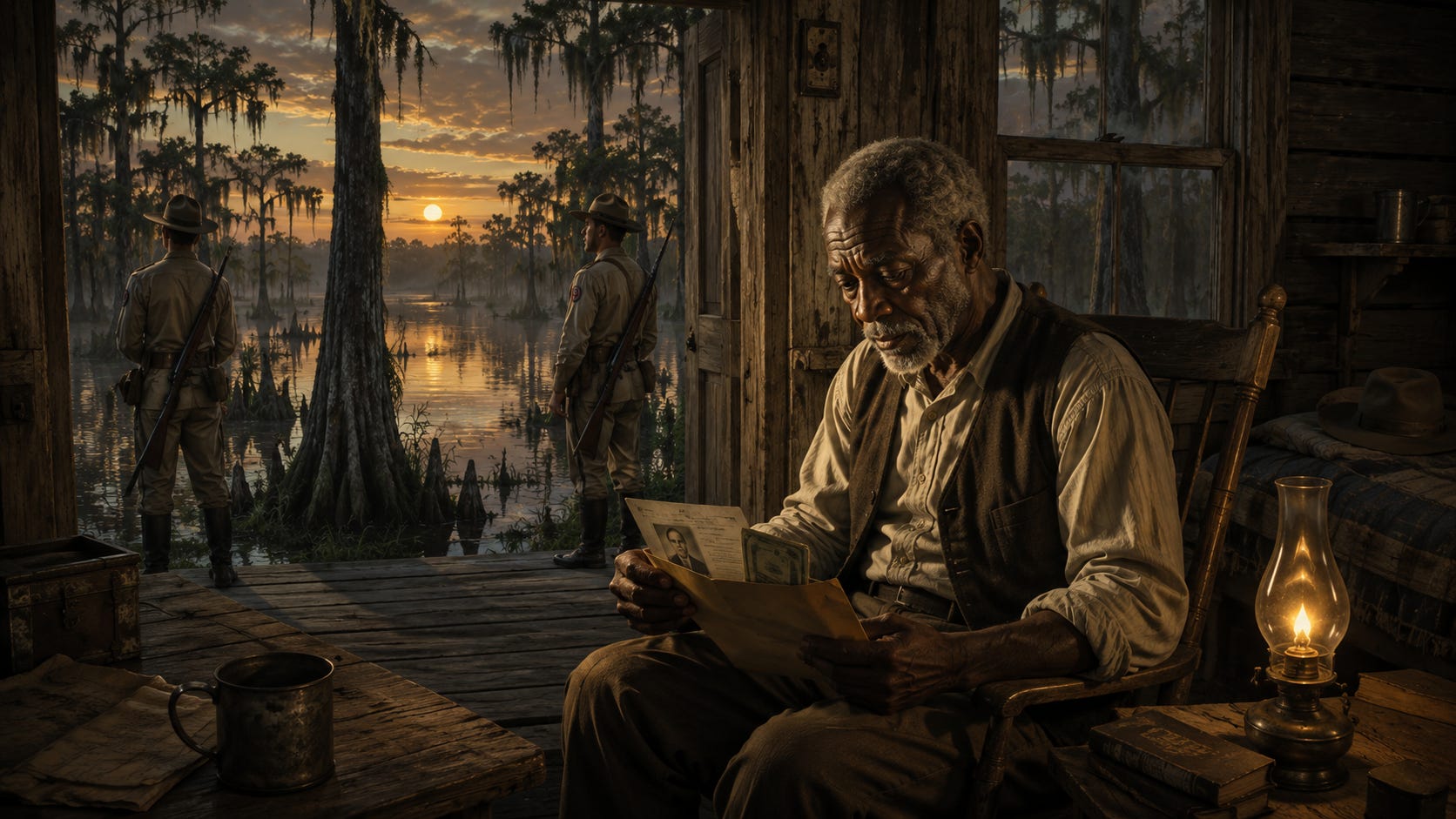
Subscribe to continue the journey. The biggest revelations in Searching Jona are still to come.