
Chapter 13
Sunday morning came flivverin’ in, sneaky at first, like a dirt-poor yard and field boy trying to slip past the padderollers on his way to town, not caring about the whipping that was sure to follow, easing his way eagerly, expectantly into the noisiest, liveliest, bawdiest barrelhouse around. It seemed like the morning star was of a similar mind, riding upwards in the sky as it dodged dark, grim columns of clouds prowling intently in the opposite direction. The moon, on the other hand, looked tired, dry, and weak. Fed whiskey enough, and sated with the trill shrieks, groans, cries and calls of the nighttime, it slumped down low on the horizon, exhausted and ready for sleep.
Sleep was far from Ollie Griffin’s thoughts as he trudged along the early morning streets. Sleep might be sweet later in the day, to be taken while tucked away in a shady bed and far from the muddy heat of the afternoon. But right now he was mindful of only one thing, the one thing that drove him almost every day: Money. Money for his pocket. Money for his honey lady’s pocket. Money for Captain Grace’s pocket. In one way or another money was the necessary ingredient in his everyday affairs. Without money old Captain Grace would pull him off the streets and send him off to who knows where. Without money Florence might start looking in other directions, especially during the long nights he was away from her. Without money his cherished dream of being free would never be accomplished.
Last night had started off well enough at the “81”. The old theater on Decatur was swamped, just like any Saturday night, and the place was jumpin’. All the boys were there, and they all took their turns with a set. The Mississippi Sheiks, The Memphis Jug Band, Peg Leg Howell and his Gang, and The Baxters all played their gigs. Ollie went in with the Howell Gang. Played steel guitar, twelve string, even banjo, whatever Howell wanted. Howell’s owner and manager, Old Man Weaver, was always with the band, and he sometimes picked out songs he wanted done. He liked some of the old standards from the days of Buford Threlkeld’s coon shows, like Warm Wipe Stomp, and other ditties like it that just weren’t popular anymore. As the evening wore on, the band began to play whatever they wanted. When they got around to Too Tight Blues Ollie really got into it with Jimmy Hemingway at piano. Fat Jimmy shimmied his 325 pounds like a sugary bowl of jelly while Ollie hopped up and down as he played. Peg Leg Howell really liked that, and at the end pointed at Ollie to take a bow. Old Man Weaver also applauded, clapping his hands so hard his jowls began to shake up’n down like he was churnin’ butter.
He made three dollar for the show, and Mr. Stone gave him a four bit tip. Mr. Stone was the TOBA man. TOBA was some kind of agency that handled bookings for all the owners, but everyone knew the word actually stood for “Tough On Black Asses.” Well, Mr. Stone congratulated Ollie on a good performance, and promised him a gig at Garver Hall one day. Garver Hall! That’s where whites went to dance, and would mean bigtime money.
That’s what Ollie was hoping for. Bigtime money. He could finish buying himself out from Captain Grace, and buy out Florence also. Be free. Get North somehow. Take the Underground Railroad, maybe. He laughed just a bit. Who knew whether the UR was even real? It might be just a story, something told at bedtime in a whisper, something made up to give folks a little hope for the coming day. But the Illinois Central Railroad, well, that was no made-up story. That was real enough. Get on it somehow, and the ride ended up in Chicago, where people said that anyone with a live guitar could get a job at the best blues clubs in the country. The northern country, that is.
The thing about Ollie was, he liked to work, but he didn’t put on just to get ahead. He was no loose jointed, awkward, aw-shucks-suh smiling jive talker ready to break into a buck ‘n wing whenever he crossed over to the white part of town. He’d been beaten in his day, just a few times, maybe, but never broken. He never kowtowed, not even to Captain Grace. He stayed true to himself, within reason, and most important, true to the music he loved to play.
Playing the guitar had saved him, sustained him, and one day would free him. He had first been taught to play as a small boned boy on the Yazoo, underneath the ancient cypress trees that lived low and slow along the banks of the deep running river. Since then he had learned to play just about anything. Ballads, over-and-overs, devil songs, ditties, stomps, slow low down gut struts, spirituals, schottisches, scats, slow drags, field hollers, breakdowns, jazz, work songs, lullabies, folk rags. Blues, of course. Any one of a hundred different music calls that could touch the spirit and lift a body up, and give joyful release from this mean, mean world, if only for a few minutes. All for a dime a song.
So three-fifty was not bad for a set at the “81”, but not enough. Ollie aimed to make five dollar every day. Three dollar, just as they agreed, for Captain Grace, fifty cent for Florence, fifty cent for him, and one dollar put away for his coming day of independence. He still owed five hundred and five to gain his release. One year, four months and twenty days at one dollar a day. Then seven hundred fitty for Florence. It didn’t seem from time to time that she was worth that much, but he wasn’t complainin’. Shoot, he’d still be a young man of twenty eight when it was all done.
Then the world would hear about Ollie Griffin. He’d go to N’awlns, or Birmingham, or he could stay right here in Atlanta. Start by playing live on WSB during the evening listening hour. Then, record some wax cuts and maybe have one or two local rumbles. And then, finally, sign up with a big label like Okeh Records. When he did make the bigtime, he would walk around looking mighty fine every day, just like Blind Lemon Jefferson. Wear box backed suits, hats with three-colored bands, and on Sundays, shoes with five dollar gold coins in the tips.
So, he hitched a ride to Five Points after the show at the “81”, and was fixin’ to walk back towards Auburn, or maybe all the way to Ponce, and just take his chances, strumming and hollering wherever the pickings looked good. People were funny. Sometimes they’d chase him away, or worse, call the cops. Ollie was no stranger to police boots and night sticks. The caved-in hollow of his right cheek was a grim reminder that sometimes he strayed too far and stayed too long in white neighborhoods.
Other times, he’d be welcomed like a prince. People would come out of their little clapboards and crowd around, clapping and calling, moving their feet and shuffling in the dust of the street and swaying to the timbrous, plaintive, clamorous, plangent twang of bent guitar strings. Then the coins would start falling at his feet, falling like sweet rain, falling like a stream of gold flowing from the mouth of Gabriel himself.
As he headed north he passed the massive Piedmont Hotel lying on its haunches on the corner of Luckie and Peachtree. One day once, it constituted the very cream of luxury lodging in the city center, now fallen on hard times. It was said a room could be had there for two dollar a night, including privileges, and for four dollar, a room with its own private bath and toilet. That would surely be sweet, but would never be in the cards for Ollie. He had gone to the back door of the hotel once, to ask if he could play in the lounge, and he was thrown right out the same back door again. They kicked him as he lay on the ground, and said that a no-account like him would never be allowed in the Piedmont Hotel, ever. There were three big white kitchen boys, and they called him nigger over and over. One of them wanted to stick a cigar up his ass and light it. He was chewing on a burnt out stogie that looked like it was good for nothing else. Ollie held his breath when he heard that, because it would take only one more of them to agree and make it happen, but the other two finally said no, and they let him be.
His friend Early, when he heard the story told, wanted to organize a group to go back to the Piedmont, around to the back, and protest, or better yet burn them out, but Ollie wouldn’t have any of it. Nowadays there were lots of people like that, who wanted to fight. In fact, looking for a fight. People like this cat Nathan Early, who kept talking about some black bigass named Garvey, and about the struggle, and organizing, and going back to mother Africa. Early swore that if anything ever happened to Ollie, he’d blow the town up. He was a hard case.
Ollie asked him once, what was up his ass, anyway? “Hey, Early, why you lookin’ fo trouble like that? Get folks hurt?”
“Folks already been hurt, man. We been trapped here, what? Two hunderd, three hunderd, maybe five hunderd years. It don’t matter, even just one year against our will. Thousands died, maybe millions. It don’t matter, even one killed, and you know that’s true, you seen it yoself. All that can’t be just wrote off. Someone gotta pay. Not takin’ no mo shit, that’s what I’m sayin’.”
The way Early and his friends talked, though, it made Ollie feel like it wasn’t his fight, at least not one he wanted. Furthermore, Ollie didn’t care to go to Africa. He wanted to go to Chicago. So, as far as he was concerned, Early could go have a cigar shoved up his ass if he wanted, but from that time on the Piedmont Hotel was stricken off Ollie’s itinerary on an indefinite basis.
It wasn’t as if he didn’t have a whole lot of hurt, and a certain hardness in his heart, a callus where he’d been struck over and over. It made him angry to think about that day at the Piedmont, angry to think he could never bring Florence up there, to melt like cool ice cream in a room with its own toilet, and sink, and bathtub, all right there to be used any time of day or night. Hell, he’d get out of bed to take a bath at three in the morning just to say he did it. But Ollie was never one to stay down for long, even though he sang the blues. Maybe it was because he sang the blues. Anyway, he was raised to understand that things were just the way they were, and everyone had to get along in their own way, Nathan Early in his and Ollie in his.
And so, like most everyone else, he held his head erect most of the time, doffed his hat when passing a policeman, and kept his mouth subdued. Nathan Early said he refused to be humiliated like that, but he was just crazy, that’s all, crazy and looking for an early check out. It had to be that way, as long as white people were in charge. They were by and large pretty frightening, white people, and they were crazy, too. Some walked around thumping their chests, proclaiming their great goodness before God Almighty, but very few were baptized in the blood, they just talked a lot about it. Plenty more were vicious, and would take a man for every cent his poor body was worth. They liked doing that especially, even to one another. A scattering, it appeared, were somewhere in between. It seemed to Ollie that few of them really cared whether they were one way or the other. They just lived each day as they saw fit, always busy, always important, always about themselves, and if a black man got in the way, well, that was just too bad. It was as if they lived two lives, one just about themselves and a completely different one around others, particularly colored folk.
Despite what he’d seen and gone through in his life, Ollie could not stay angry at white people for very long. They were folks who’d taken a bad turn and headed for a bad ending, it was true, but he couldn’t hate them, at least not hate them all. He ustacoulda, but no longer. His music had saved him from that. Even so, one had to be careful. Look, if he were surrounded by a hunderd snakes, at least ten would be good ones. But ninety would be evil as hell and so all of them needed to be avoided, just to be safe. Every time he was around them, he felt the fear, the unease, the separation. He couldn’t really put it into words, he didn’t know how, and he couldn’t help it, it just happened, somekindaways.
As he walked toward the rising sun, the gray began to dissolve into the opalescent blue of first morning. A few early risers were strolling the streets, and an occasional car was seen slowly droning by. There were no police to be had. Ollie stopped on the intersection of Marietta and Peachtree near Jacob’s Pharmacy. He could see the pharmacy delivery boys mounting their shiny new motorcycles, imported from far away, and roaring off, carrying their precious cargoes, their paths radiating out over the city. He wanted to stop on that corner, it was a good corner, and he had done well there in the past, once. Just as he slung his guitar around his neck, he heard a low, gutteral voice directly behind him.
“Boy, watchou doin’ here?”
Ollie spun around to see a white, short, bald, middle aged man dressed from neck to knees in a white apron, standing in the doorway of the pharmacy, coming out of the blackness inside. He looked angry for no observable reason. Ollie had lived this kind of encounter all his life, knew it well, understood it, felt it as purely as he felt any song. It was as automatic as taking a piss. An opaque caul dropped between the two men as suddenly as a spring storm, sequestering them both into small flailing sacs from which there could be no escape.
He bowed his head and removed his cap. “Yessuh. Just playing my guitar, suh.”
Without turning his head the man called over his shoulder. “Eddie, come out here!” In a heartbeat or two or three Eddie came out, a big boy brandishing a baseball bat. The bald man looked Ollie up and down before rendering his verdict. “Beat the shit out of that black son of a bitch, woudja? Teach him a lesson he’ll never forget. I don’t ever want to see this trash around here ever again. Not in front of my store”
Without hesitation, Ollie began to run.
Now, for a black man to run fearfully through the streets of downtown Atlanta on a warm Sunday morning was no casual thing. He would be a marked man, immediately guilty of every known and unknown, imagined and unimaginable criminal act. By running, the entire police blotter of DeKalb County became embodied in his person, with Decatur’s thrown in for good measure. The mere act of escape could swell up a mob in moments. Ollie knew he faced the risk of brutal punishment if he were caught. If he were grabbed, tripped, or tackled in a crowd it might trigger a frenzy of savage beating, or worse.
Fortunately, the streets were almost empty as Ollie sprinted across Marietta. One pedestrian, an elderly black lady, merely gaped as he went by. Looking over his shoulder he saw Eddie hop on one of the motorcycles parked in front of the pharmacy and roar the engine to life. Ollie knew all about that motorcycle, it was one of the new bikes written up in the newspapers. Supposedly, the Jacobs family intended to enter them into the big bike races in Savannah and Durham. They were said to be the fastest bikes in the South, goin’ faster than 100 miles per hour. No matter, though. Ollie lost him within a few moments by tearing through a warren of back alleys, small vegetable gardens and junk filled lots.
When the deep, menacing growl of the motorcycle could no longer be heard ripping through the still of the dawn, he slowed to a walk, took a breath and checked his guitar. Then he smiled. Everything had turned out fine, it was just another day in Hotlanta. It occurred to him that it was probably time to go see Captain Grace and settle up, but he resisted. There was still money to be made before his day ended. He decided to go on, just a bit further.
Down Fort Street, past Houston, across Irwin and on to Auburn. Past Big Bethel Church, on beyond the ball fields and further north to Ponce de Leon. Ollie took it all in as the city slowly stretched itself awake, just like a lady in lace yawning politely upon arising. He passed small peeling frame homes, crumbling Italianate brick-front slums, ramshackle Revival mansions, and decaying Georgians arrayed in orderless profusion along street fronts that began to glow with the first licks of the sun’s rays.
This was his neighborhood, his place, his part of town. The black part of town. Some slaves lived here, contracted by arrangement with their owners, but here were mostly the freed poor. He felt at home here, comfortable, safe. His people were here. Whites didn’t come up to this area much, unless they were headed to the Pig’N Whistle on a Friday to have barbecue and listen to Blind Willie McTell. Well, often enough, to collect rents as well.
Ollie meandered into a dirty, littered courtyard framed by tenements on the verge of collapse, mostly trinities. This was a good place to stop. He unslung his guitar and adjusted it on his shoulder so that it lay up against his chest. It felt tight against him, comfortable, part of him. He carefully tuned it down, way down to D7. Sure, when he played Dixieland on the banjo he might do high C’s, maybe ten or twelve in a row sometimes, or flat fives, but when he was solo he liked to play low on the register, it suited his voice. He remembered what his old teacher Cecil had told him long ago, while he strummed on a riverbank strewn with the broken limbs of oak and pine. Ya just plays eleven measures like I showed you, use your thumb for the base line, and sing like you callin’ yo mule, thass all ya needs to do. Ollie followed those rules most times. Sometimes, though, he plucked the lowest string unfretted while he fingerpicked the other strings, just to give more depth and resonance to his play, more soulfulness. And then, without fuss, he began to sing:
Wake up mamma, don’t you sleep so sound
Wake up mamma, don’t you sleep so sound
These old blues walking all over your yard
Blues grabbed me at midnight, didn’t turn me loose today
Blues grabbed me at midnight, didn’t turn me loose today
I didn’t have no mamma to drive these blues away
People began to emerge from their apartments. Tentatively at first, then more and more briskly and in greater numbers, smiles wide, eyes crinkled with joyous expectation. There were mostly women and children, with a few older men. The young men were at work early, even though it was a Sunday. They stood silent for a while, and then began to clap their hands rhythmically, and sway from side to side as Ollie continued singing. Voices rang out as he played, loud voices, soft voices, tremorous voices, voices that sparked with life and some voices that sounded about dead. “That’s right!”, they cried, and “That’s how I feel, baby!” and “You know that’s true!” Little by little their voices became part of the song he was singing, and then it was almost as if they were singing and he was doing the hollerin’. And then the coins began to fly at Ollie’s feet, flowing like a joyful river. Nickles, dimes and cents, each coin a message, each coin a prayer, each coin imploring, beseeching, entreating: Don’t go. Stay with us. Play your music. Make your magic.
He stood before them and played with all that he had within him. He felt rooted to the ground, but somehow his soul soared, rising high and embracing everything around him. The courtyard, the people gathered around, his neighborhood, his past and his present, everything that made up the flesh and heart of Ollie.
After a half hour he felt drenched in sweat and stopped. The heat of a Georgia morning had descended upon them all. The clapping subsided, the voices stopped, and the small crowd drifted away as Ollie gathered up his money. One dollar and eight cent. That was good, that was real good, from just one stop. But not enough. He would not rest until he made five dollar each and every one of his God given days.
He decided to skirt the ballparks and head back to the general vicinity of Irwin. He knew a shortcut he could take, through a back alley behind the train tracks. He trudged off, keeping his guitar on his chest and at the ready in case he bumped across a good looking crowd. He entered a narrow alleyway from the street side and had only gone a few feet when a flash of white caught his eye.
If Ollie had been in a bad mood, or doing poorly, he surely would have turned around and just kept right on walking. But he was in a fine mood despite his earlier brush with Eddy, and the world was good because of the money he was making, and so he allowed curiosity to altogether jump upon him, and grab him, and move him towards the sliver of white that lay unmoving behind a low stack of firewood.
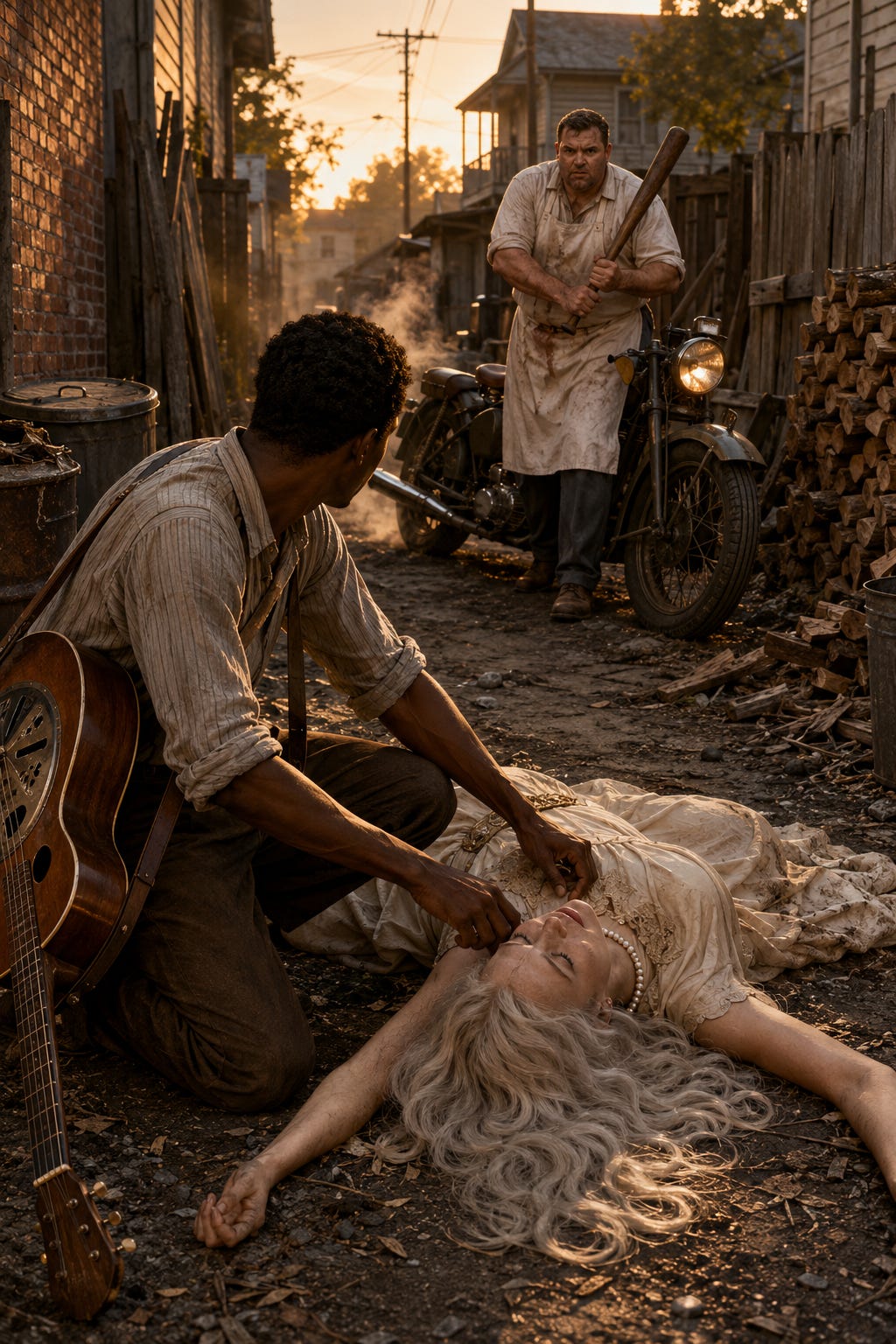
As he approached, he saw that it was a leg. It was a woman’s leg, shapely, exposed to mid thigh, lying in stark relief against the blackened dirt and cobblestone. Ollie rushed to her and knelt down by her side. Her dress was in disarray and stained, and she was lying on her left hip curled up like a baby. He could see that she was breathing regularly, but real shallow. She made an occasional gurgling moan. He saw no blood on the ground around her, and when he turned her head saw no bruises on her young appearing face. Her clear skin was exceptionally pale, and her hair almost pure white, with no color at all, streaming down to the small of her back. She was the whitest white girl he had ever seen. As if in torment, her eyes were gyrating rapidly beneath closed eyelids. Ollie was torn. Here was trouble, maybe fatal trouble if he were caught anywhere near this woman. But, she dearly needed help. Furthermore, it did flash through his mind that grateful white people were often known to give rewards after being rescued from some difficulty. Judging from the way she was dressed, from pearl necklace to fancy shoes, she had money. And if she had money, she had station. She did not appear injured, and she had not been robbed. She had to be sick somehow.
Absorbed in contemplation, Ollie reached over to touch the woman’s neck, feeling for her pulse. The hard smooth coolness of pearls brushed against his fingertips, somehow making him think of the Piedmont hotel, and then of all the desperate moments in the past that had touched him without pity. Very quickly his mind raced from images of broad river mud flats and black bottom corn rows to bright white stage lights blurred by sweat pouring from his brow.
Ollie was so lost in thought that he did not at first hear a peculiar, cyclic, rapidly rhythmic whirring sound coming from directly behind him. When suddenly he became aware of it, he lifted his hand from the woman’s neck and spun quickly around. He turned just in time to see Eddy climbing off his idling motorcycle a few feet away, his face set as grimly as hard concrete, his bat firmly in hand.
Nox, fera nox, vere nox noxia, turbida, tristis, insidiosa, ferox...Pickett sat slumped over a notebook in his lap, leaning against the airplane window, passing the time glumly and aimlessly, writing a passage that suited his mood, translating without much enthusiasm. O night, cruel night! night truly noxious! troublous, sorrowful, gloomy, sanguinary night! He stopped with an audible hmmph. The lines were about a war fought very long ago, from a time of hand to hand combat under the open glare of the sun, and of hard and sorrowful prayer blessed by the healing caress of night. Human warfare was very old, as old as humans themselves, but the nature of war had changed since the days of mythical heroes, gods and goddesses. Then was the kind of war fought with weapons and armor. Now was the kind of war fought with words, falsehoods and deceptions, the truth be damned. God, how he wished he had lived back then! The thought made his leg begin to twitch.
George Pickett was not a man who could sit for very long at any one time. That fact had proven to be one of the many unanticipated problems he encountered during his presidency, and one he had tried very hard to overcome. Nothing in his prior experience had prepared him for the repetitive grind of sitting at a desk and pushing paperwork for four, six, or eight hours a day. In fact, the day he first entered the Executive Mansion was the first day in his life that he undertook any administrative responsibilities more important than preparing a regimental payroll report.
From the early spring morning of his graduation out of the Virginia Military Institute, he had distinguished himself as a man of action. He had fought gallantly in the second Mexican War, and during Cuba’s war of independence he had immortalized himself in the hearts of his countrymen by storming San Juan Hill at the head of his brigade. During his years of military service George Pickett had seen many men die, some at his own hands, and had, from his earliest experiences, become inured to the horrors of combat. War became like an exotic dance for Pickett, something that required thorough training, careful preparation and strenuous effort, but something in turn that resulted in a rush of exhilaration unmatched by any other human endeavor. He had trained for war. He had made war. He missed war.
Of course, he had been raised to it. His childhood years were immersed in stories of martial grandeur, heroic deeds, and gallant sacrifice. Tales of the great men of the War, spoken in hushed tones, were his nightly lullabies. It was his mother who invariably whispered the sagas of yesteryear, as if recounting the chronicles of a race of mythic warriors. From time to time, offered like a delicate plum, his own father’s epic legacy would be intoned, almost as in prayer. Unfortunately, the elder Pickett was seldom around to steer his son as he was growing up, or to care for his family’s affairs. In the end, rumor and scandal accompanied him to the grave. By the time the Confederate war hero was buried at Hollywood Cemetery in Richmond, George would remember his father only as the young general shown in pictures, clothed in the majesty of his country’s uniform. He was the George E. Pickett of legend, the man who helped found his fledgling country’s freedom. The later years of decline, dissipation and despair were forgotten, lost as thoroughly as if once written on a wax tablet that was later scrubbed clean of its ancient writings. His mother suffered much as the family fell into insolvency, but even in the depths of poverty she spoke of her husband proudly, intent that the myth and not the man should survive.
Despite their financial straits, LaSalle Pickett was determined that her only son be educated in a manner in keeping with his family’s standing. Unfortunately, little George was a very poor student. He bounced from school to school until finally enrolled in the Fishburne Academy in Waynesboro’. It was a small gentleman’s school that happily ushered him through his studies, partly because of his name, and partly because of his dazzling smile and commanding personality. He quickly demonstrated that he was a natural leader. There was not a boy in his class who did not want to be on his team when they chose up nines after school, each vying for the privilege of being called George’s chum. As a young man, Pickett learned to give those around him what they wanted: a small slice of himself. An encouraging smile at the right moment, a wisecrack to lighten the mood, a soft squeeze of the shoulder to demonstrate sympathy or solidarity; all were gestures he learned to use as naturally and spontaneously as the moment reqquired.
As a result, there was no shortage of schoolmates ready to help with his lessons whenever he needed assistance, and he needed assistance often. Inexplicably, the one subject that enchanted him was ancient history. He avidly lapped up the alphabet soup of archaic names and places, bygone battles and legendary exploits. Stories of kings, heroes, emperors and champions from Gilgamesh to Genghis mesmerized him, flitting through his thoughts from moment to moment. In a haze of daydreams, his mind’s eye would carry him from the open deserts flowing past the sluggish Nile to the primeval forests crowding the fiercely coursing Rhine. Especially, though, as time went on, his fantasies were drawn to the vales and mountains of ancient Hellas.
The mythological wraiths of Mount Olympus, the lesser gods and goddesses, the satyrs, nymphs, centaurs, cyclops, Furies, Amazons, and all the Muses became a complex cast of creatures that seemed real to him, exciting his imagination and whetting his appetite for adventure. He fantasized about Perseus, Heracles, Achilles, and Theseus, thrilling to their exploits while fantasizing he marched by their side. Although he performed miserably in his math studies, he possessed a quick aptitude for Latin and, incredibly, Greek.
Even before he matriculated at VMI he was well on his way to reading Homer, Aeschylus, Plato, and Sophocles with fluency. The shoe was then on the other foot, and fellow cadets came to him for help in reading the classics. He gloried in the elegance of his tight coatee and cadet dyke, but unkempt nightly vigils with the classics became his passion. By the time of graduation Pickett had earned a reputation as a scholar of Hellene and Roman antiquity, a recognition that he bore as proudly as any campaign medal. He delighted in his cadet years to read the Odyssey and Ovid to his friends in ther original form, out loud and with heavy cadence, something that delighted him still.
Graduation from the Virginia Military Institute carried with it a junior officer’s commission in the army. Pickett enjoyed the army, even during peacetime, and entered service with the intention of spending the whole of his active life there. Without apology, he had the conscious and deliberate thought that he would redeem the disgrace of his father’s later years through distinguished military service. Most importantly, he would make his mother proud by raising the family name on high once more. There was satisfaction to be found in the boredom of barracks life, filled with the daily minutiae of checklists, inspections, and harsh punishments for trivial infractions. He enjoyed the comradeship of his fellow officers, enjoyed the grudging admiration of his men, and enjoyed the adulation of women for a man in uniform.
And women enjoyed him. Pickett’s winning smile, cleft chin and curly hair were a fatal combination for both the belles of high society in Richmond and Charleston, as well as the country girls of Brownsville and Fort Smith. As he was reassigned from post to post along the vast frontiers of the Southern nation he left a trail of happy dreams, broken hearts, and at least two brown-eyed brats that he denied were his. He had no qualms, as he often boasted, about ‘spreading the wealth.’
Until he met Martha. She was regal, imperious, and intelligent, a woman of distinction at the dinner table and a wildcat under the stars. Looking back, it was clear that she chose the young captain and not the other way around. At the time, though, it took an eternity of effort and trial before Pickett could rouse more than a casual smile from the most beautiful woman he had ever met. Her father, who owned an enormous plantation on the Red River, had a very different view of the matter. He had not sent his only daughter to Mrs. Pritchard’s School in Savannah just to have her plucked up by a notorious Army ne’er do well. At a hastily arranged encounter with the two lovers he announced his unshakeable opposition to any marriage. Many years later George Pickett could still laugh inwardly while remembering the look on Harold Oliphant’s face when he learned they had wed the night before his grand pronouncement.
Pickett loved Martha with all his being, no more or less than she loved him. From the first, she was every last thing to him. Together they tapped every mysterious vein of intimacy, romance, unfettered elation, and bodily ecstasy. Her easy smile was an open portal into the soaring joy of life, but her death ushered him into the unutterable despair of dark shadows and devastation. She died in childbirth, along with their stillborn daughter, after two days of fevered agony and a botched attempt to surgically retrieve the infant. It was four years after they were married, almost to the day.
As he sat fidgeting in his seat, Pickett tried to block out any thoughts of Martha. Even after more than forty years, his eyes welled up with burning pain whenever her face formed in his mind. He suppressed the vision with all his strength, though he wanted desperately to go back, to return and feel the tightness of her arms around his neck and her breath falling like a gentle blossom on his breast. More than anything, George Pickett wished he could return, and start his life anew with his cherished bride, and watch their child grow into the woman she should have become. But, it was a mindless wish. He was a man held to service, and it was his stern duty to deal with the here and now.
He looked out the airplane’s small window, down at the countryside rolling below, concentrating on the thin ribbons of back roads snaking up densely wooded hills, or disappearing into dark-lit hollows. Occasionally, the roads passed through open fields and intersected small clusters of buildings. Pickett strained to see, fascinated. Sometimes, he could make out a village square, surrounded by the outlines of large houses, the outlines becoming smaller in size as the village or town petered out a quarter mile or so from its center. Then, down the road somewhat further, there might be seen a dense clutch of small framed buildings, closely packed, many of them reflecting the sun off corrugated tin roofs with momentary flashes of blinding light. Pickett mulled over what he saw. Collections of small shacks like these were scattered all over the landscape, small sores defiling the natural beauty of the countryside. They might be poor whites, maybe tenant farmers, or sharecroppers. Or maybe free blacks, living in vestigial slave quarters. Or maybe slaves. Someone’s servants. He shook his head grimly. “Too many,” he thought, “No matter who they are. Too many.” He realized, with a sinking feeling, that the larger homes that looked so grand from the air were probably just peeling, decomposing remnants of once elegant dwellings. He felt once again the familiar sensation of nausea overcoming him.
What was to be done? He felt as if he and everyone around him were all caught in a cruel timeslip, trapped in a dead-end warp of history without hope of escape. In the Cuban campaign he had known what to do. Outmanned and outgunned, with no retreat possible, his choice had been easy. Find the enemy, charge forward. Live or die, charge forward. Sublime heroism or hopeless hell, charge forward. But here, there was nowhere to charge. There was no enemy to find. He needed to finish out the remainder of his term to turn the corner, and getting right with the North was the key.
“Worried about Madeline?” It was his secretary, Edward Mosby, sitting across the aisle from him. The young man hated to fly under the best of circumstances, but the German made Ju 52/3m had been bouncing up and down frightfully ever since they left Richmond, causing Mosby’s face to turn a sallow yellow color. He clutched a small bible against his chest and winced with each precipitous dip of the plane.
Pickett appreciated his friend’s concern. “Yeah, I am, and you know why. God, man, if she has one of her fits while she’s out in public, and she’s unattended...”
“I know, Mr. President. Everyone is doing their darndest, I’m sure.”
“That’s not the only thing. I’m flat out worried about everything.” He gave his secretary a sharp look. “How’s the family? How are your little girls?”
“They’re both fine.” Mosby laughed softly. “Haven’t seen much of them lately, with all that’s been happening.”
“Eddy, tell me. Where do you see your girls in twenty years?”
Edward Mosby was a sober, God fearing, contemplative man. Anything he said or did reflected that temperament. He knitted his brows in thought before answering. “Married, I hope. Happy. Families of their own.”
“No, I mean what kind of country do you see them in?”
“Why, this one, of course.”
“Exactly as it is? Do you think by that time they will need to deal with...whatever...”
There was a pause as Mosby took on a look of ferocious consideration, kneading his forehead and staring into space. “Property? Funny, my grandpappy asked me the same question when I was a boy at his knee. I’m no closer to an answer today than I was then, and I try to get at it almost every day. Any thinking person would. I do know this. If we are wrong, if the whole system is wrong, then we have a blood guilt on our hands that can never be paid but with blood in return, God help us. Maybe by us...” He seemed to clutch his bible even closer as he paused. “Maybe by our children.”
“That would be justice, right?”
The younger man nodded, unable to respond in words.
Pickett stared out the window for a moment, absorbing his thoughts. When he did speak, it was with a deeply emotional, almost cracking voice. “It’s got to end, Eddy. The whole thing is splintering and has to come down, we need to start over. And I’m the one to do it. We’re going to open up things with the North, set up trade, let people go back and forth freely, let their newspapers and magazines come down here, and their radio shows, and their movie shows, and you’ll see. Change will come, guaranteed. People will see what’s outside, and it will change them, and their kids, and their kids’ kids. The whole house will cave in on itself.”
“What makes you think Roosevelt will play along?”
“He will. He needs us as much as we need him. Our people there tell us he’s ready. This is confidential, Eddy, but he’s sending a personal letter with Ernest Lieb’s son. The scientist’s son, Jona Lieb. You remember I had you fit him into my schedule. Giving some kind of lecture at the University in Atlanta, a colloquium to honor his father. We already have the complete text of the letter...Let’s just say we have a source at the top. Impeccable. I received confirmation of this late last night. The president is going to offer an opening, and we’re going to take it. The letter, of course will somehow make its way into the papers, a grave breach of propriety, and then everyone will know. I expect that people will go wild when they hear about it. We’ve been waiting for this a long time.”
Mosby hesitated, partly because the plane took a sudden drop that left his heart floating in midair. “What about the army? Does General Patton know?”
Pickett grinned. “No, he don’t, and he ain’t findin’ out until it’s too late. Let that genie out of the bottle and it’s long gone! And besides,” he continued, “Ain’t I still the president, and ain’t I still George Pickett?”
They both laughed at that, a deep malicious laugh made more sweet by Pickett’s pantomime of Patton’s contorted facial expressions. As they settled down, a stewardess rushed down the aisle with a paper she held extended towards the president. He read it quickly and seemed to sag in his seat.
Mosby half rose in alarm. “Mr. President! Is everything alright?”
“Just fine, Eddy, just fine.” Pickett sighed with evident relief. “They found Madeline. She’s safe at the hospital with some scratches, that’s all. Georgia Guard are there.”
“Thank God. What exactly happened?”
“Don’t know.”
They both lapsed into quiet. Pickett felt deflated, as if a great, noxious tumor had been removed from his chest. All was well now. His long night of agony was over. He would stay with Maddy a day or two, arrange for Secret Service guards to stay with her, and return to Richmond to prepare the groundwork for the dawning of a new day in his country. A New Day Dawning. It sounded good. It sounded real, real good.
He looked around for the stewardess. The cabin was empty with the exception of the Presidential entourage. Johnson Airlines had been courteous enough to divert an airplane for the President’s urgent flight to Atlanta. After boarding earlier that morning Pickett was told that Adolph Hitler had a similar airplane, sixteen passenger size, for his exclusive use, employing it to fly in frenetic fashion all over Germany. Newsreels of Hitler’s appearances at Nazi rallies had made a deep impression on Pickett. Hitler had transformed his country brilliantly, creating a German renaissance that could only be admired. There was a bit of rough stuff going on there, but who could complain? Pickett made an immediate decision to ask Congress to fund an airplane for his use as well. He could use a long range passenger plane to stump the country promoting his new policies. If the Chancellor of Germany could have one, then the President of the CSA could certainly have one. If necessary, Picket could also learn to perform some of Hitler’s antics at the podium. Anything to make change happen.
He beckoned the young flight attendant, who was at his side in an instant. “Can you tell me how much longer until we land?”
“I’ll find out, Mr. President.”
She was back in a few moments with the pilot, a tall, burly looking man with a florid face. He leaned over and spoke loudly to be heard over the throb of the engines.
“Right now our indicated ground speed is only 198, Mr. President. Head winds, I’m afraid. Another hour and ten until we land.”
“O.K. Let me know when we’re thirty minutes out.”
The pilot leaned down even closer. “One more thing, though. We won’t be landing at Hartsfield in Atlanta. Diverting to Marietta. Your car will be waiting for you there.”
Pickett stared at the man, incredulous. “What the hell do you mean? Why aren’t we landing in Atlanta?”
The pilot retrieved a small piece of paper with what looked like some scribbles on it out of his pocket. “Just got this message, sir. It seems that some rioting has broken out in Atlanta. There is gunfire everywhere, including at the airport. At this time, it says the riots are out of control and it would be dangerous to attempt a landing. The message says Atlanta is burning.”
Setting up the circuitry needed for secure wire communication had been a nightmare. Patton was told that the cables were hidden in sewage pipes emptying into the Potomac downstream from Alexandria. Where the lines originated was unknown, even to Larson Lehr, the Director of the Department of Secret Intelligence. Their contact, whose code name was MENTOR, had never divulged any details of his identity. He had been a low grade naval officer years before, and maybe he still was. Indeed, it was not certain that he actually had a specific government posting of any kind. One theory popular in the DSI was that MENTOR was a political handler in Washington, someone like Roosevelt’s Jim Farley, who had access to a wide array of operatives within the Federal government.
Whoever he was, MENTOR was the crown jewel of the DSI’s espionage network. For the past three years he had been a gold mine of information, providing a wealth of detail about both military and political developments in the northern country. In the beginning, they communicated with him using a Vernam-Mauborgne ‘one time’ cipher system. The technique and necessary equipment had been helpfully provided by the Germans. They had modified and refined the procedure that was first devised, ironically, in the USA. The system had proven essentially impossible to decrypt without possession of the corresponding key to each transmission. The DSI and Patton had been quite content with that method of communication. It was easy, safe, and difficult to trace back in either direction. A year ago, however, their contact insisted on setting up a secure cable from Washington to Richmond, to be used for urgent messages. This had been accomplished with extraordinary difficulty, costing the life of a CSA marine diver in the process.
It was deemed desirable to exclude the president and his cabinet from any knowledge of MENTOR for reasons of national security. After all, Pickett had never achieved a rank beyond colonel, and was now just another politician. Patton, however, in his role as head of the army, was privy to all the intelligence data gathered by the DSI. He had long ago inserted himself into a primary role in posting questions to their spy in Washington. He thrilled to the cloak and dagger aura surrounding the agent’s espionage activities, and more than once mentioned he would like to meet their secretive ally. This idea was rejected out of hand by Lehr. Even James Knox, who served as MENTOR’s handler, cautioned that it was not advisable to attempt to change the nature of their relationship by crowding or pushing their informant.
Sometimes, MENTOR refused a request for information. When he did, he never explained why. Most of the intelligence he transmitted helped to validate data obtained through other means. On a few occasions, though, MENTOR had provided specific information that was unique and unsupported but ultimately proven to be correct in every detail. For example, he had warned two years earlier that the U.S. Navy was secretly floating a contract for a new naval aviation fighter/bomber. The specifications demanded a speed in excess of 200 mph and an altitude ceiling of at least 20,000 feet. That information could not be confirmed by any other source at the time. Patton himself did not believe the technology existed to manufacture a naval aircraft with those flight characteristics. An airplane like that would be too heavy for carrier operations. When the Grumman FF-1 was rolled out for its first test flights in just the past month, matching or exceeding the Navy’s specifications, MENTOR’s stock soared. He was now unquestionably the South’s most valuable secret asset in Washington. Naturally, when he messaged that he wanted to speak by their secure telephone link directly to General Patton, his request was taken quite seriously and rapidly passed up the chain of command. For his part, the General in Chief was thrilled to come at the appointed hour to the DSI offices housed in the basement of the Treasury Building.
His protégé Knox was waiting for him in a room that looked and smelled like a utility closet, and he did not appear happy.
“I don’t like this one bit.” Knox was agitated as he gestured Patton towards a chair placed in front of a single telephone, situated on an otherwise bare table. A mass of electrical recording equipment loomed in back of the table, extending into the corner of the small, narrow, poorly lit room. The dim clacking of teletype machines could be heard emanating from an adjacent room. The only disturbance on the blank, restrictive box of walls enclosing the room was a prominent NO SMOKING sign facing the table, hanging as if suspended in thin air.
Patton opened a monogrammed gold case he kept in his pocket and carefully withdrew and lit a thin cigarette. Shortly, wispy tendrils of gray smoke began to weave a tortuous path towards an indefinite ceiling. He understood the Deputy’s concern. Asking to speak to anyone other than his usual controller was a huge departure from normal protocol for MENTOR. It could mean any number of things, almost all of them unpleasant. For one, it could mean their agent was compromised, and that he was calling under the control of Federal agents. Almost as worrisome, it could mean that MENTOR had somehow become unhinged and had lost all sense of appropriate procedure. That was Knox’s guess, and he loudly hissed his belief that J. Edgar Hoover’s men from the Bureau of Investigation would be swooping in on their man at any moment, alerted by aberrant behavior.
Patton thought differently. He wondered whether the man wanted to come over. Things might be getting dicey on the other side. Perhaps he was feeling cornered, or anxious, or just feeling that time was running out for him. That was all understandable. Now was a good time to come over. Under martial law, the South was as safe as it had ever been. The North, on the other hand, looked like it was simply imploding based on the intelligence reports available to him. Hell, it was all in the daily newspapers. Unemployment was at all-time highs, exceeding 20 percent. Industries were shut down by strikes in almost every sector of production. Criminal violence was exploding exponentially in every major city. The North was a train wreck happening right before their eyes. Patton sat back in his chair contentedly. There was no doubt about which country had the social structure necessary to withstand the blows of the worldwide Depression. The whole problem of the UR was no more than a transitory hiccup in the nation’s progress. Surely, their immoral and indiscriminate attacks would make them pariahs, even in the eyes of more sensible blacks. Contemplation of the matter made him proud to be a Southerner.
The phone rang. Knox answered immediately, mumbled some barely audible coded words into it, then handed it over to Patton. “It’s him.”
George Patton knew himself well. He was not necessarily a smart man. But he was a clever man. With hard work and by the application of will power he had made himself into a force that few could withstand, even the smartest. And as a clever man, he had learned that honesty was a joke, that honor was a phantom, and integrity was an imaginary construction of the human mind. People said and did anything, anything to save themselves, advance themselves, and, if possible, give themselves the slightest advantage against others. Whenever he first met another, he began with the assumption that the other person was lying to him. Right now it seemed to him that this assumption was sensible, particularly as he prepared to speak to a spy whom no one really knew. He was surprised, though, when he took the telephone.
“Hello, is this the General?” It was a man’s voice, but soft and genteel, almost effeminate.
“Yes”
“Pleasure to talk to you, General.”
“Heah now, this is not a personal conversation, is it? You indicated this was important. What’s this about?” Patton spoke gruffly, impatiently.
“Oh dear, I didn’t mean anything by that. It’s just that I’m glad to finally talk to the person in charge.”
Patton thought quickly before answering. “We have a command structure here, just as you do there. President, Vice President, and so forth. I’m hardly the one in charge.”
“I follow the newspapers, General, and the radio broadcasts. It’s no secret what you’ve done, and let me tell you, it’s wonderful. I was beginning to lose faith in your president. Didn’t seem to have the belly for this fight. But you do.”
“Alright, let’s say I do, what of it?”
“Well, it would be a shame if anything came along to interfere with what you’re trying to accomplish.” The speaker gave a low chuckle, one that conveyed an inappropriate intimacy.
Patton squirmed in his seat, unsure what to say. Here it comes, he thought, this is what it’s all about, what he wants to tell me. “How’s that?”
MENTOR’s tone of voice underwent considerable change, slowing and deepening, as if probing forward into a dark crevice. “You know about Ernest Lieb’s son?”
“And what about him?”
“You know, he’s bringing a personal correspondence from Roosevelt, for your president. This letter could be very damaging to your cause.”
The last words were allowed to die, drifting off into the silence of the tiny communications room. Knox, listening in the corner with an immense set of earphones on his head, waved his hand frantically at Patton to say nothing.
The voice coming over the telephone changed texture again, now becoming hard and brittle. “You must know that Pickett has a transcript of the letter, but he doesn’t have the letter, and he doesn’t have Lieb. Without them he can’t concoct the big show he wants, the big reveal. Without young master Lieb none of this happens. You’ve been told that Lieb has disappeared from view, gone off the reservation so to speak. He’s not dead, but he’s not in Berlin, either. He’s just run off somewhere, looks like he wants some time alone. But he’ll be back, I assure you. Carrying that letter. It would be useful if that delivery could be stopped.”
There was another long pause as Patton’s mind raced furiously. “What does it say exactly?”
“Don’t know, but your president does. Can’t tell you who sent it to him, it’s a secret. Someone high up. Maybe someone like me.” A laugh boomed over the telephone. “Once it’s formally delivered and accepted, the whole world will know its contents pretty quickly. The story will rock the world, I assure you. That would be a big win for Pickett, don’t you think?”
“Why are you telling me this?”
A soft chuckle came over the phone, very delicate. “Just want the right side to win.” A prominent click ended the conversation.
The phone felt slick in Patton’s hand, and he realized his palms were sweating. Why had MENTOR gone to such great lengths to deliver that message? Why deliver it to him? Why not go through normal channels? He took in Knox, staring at him expectantly. He had been a good man so far, but he was also an ambitious popinjay. MENTOR certainly wanted to be sure he communicated directly with the top dog. Didn’t he trust his own handler?
Knox broke the silence. “Sir, whatever did you think of that?”
Patton paused for the briefest moment before growling, “I think we’d better stop that letter from being delivered.”
One hundred sixty miles away, MENTOR carefully cradled the telephone and looked towards his boss. They were sitting in a corner office, high above a noiseless street. The blinds were partially closed, allowing slats of sharp sunlight to radiate across the room. The effect made it seem that his superior was trapped behind diagonal bars. Legal sized papers were stacked on his desk, big white rectangles that reflected onto the lenses of his glasses and obscured his eyes. When he spoke he leaned forward, with both hands on the desk.
“You did well.”
“Thank you sir. I’m not sure how he took it. He’s a cagey fellow.”
“It’s just a seed. Give it time to grow.”
“Yes, sir.”
“Now, let’s send that cable to Moscow as we planned.”
“Yes, sir.”
Chapter 14
There was nothing for Jona to read. He was raised to read every night, ending each day with the cleansing ritual of study. He was conditioned to pore over the small, structured symbols spread across white paper pages, word upon word, sentence upon sentence, stacked fastidiously one on top of the other, like stone altars dedicated to a powerful demiurge. Reading revived him, renewed him, and released him. Words, like incense, drifted up from each page, enveloping him while he read, carrying with them the luxuriant, intoxicating, revitalizing scent of language. And with language, memory. And with memory, permanence. And possibilities. So many possibilities. He could remember one particular book he had opened reluctantly, only to be seduced immediately by its opening lines. He had memorized them as a message to himself:
“I had the story, bit by bit, from various people, and, as generally happens in such cases, each time it was a different story.”
On this night, however, the possibilities were obscured by darkness as Jona waited, alone and apprehensive, waiting to see what was to come.
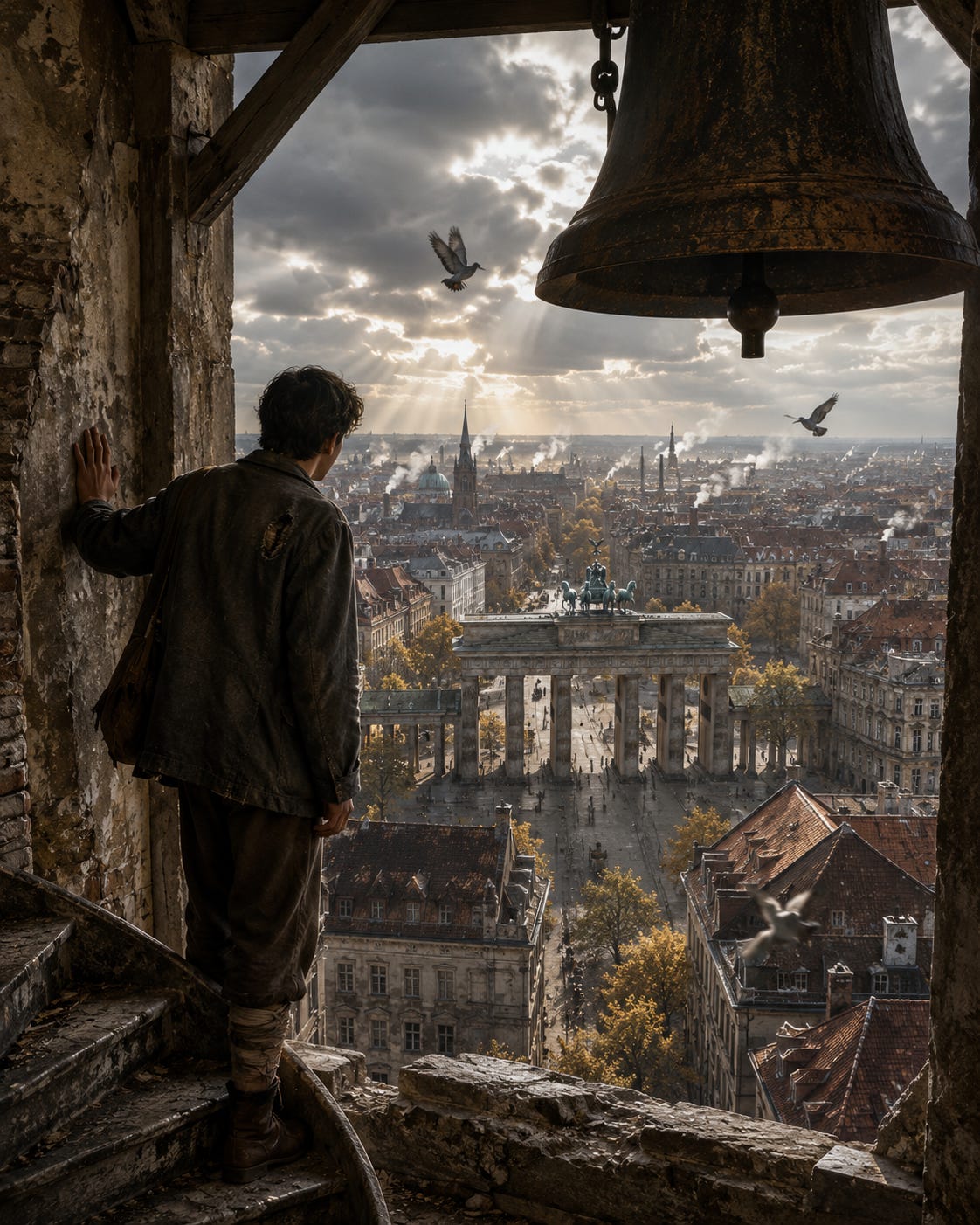
The ground shuddered every few minutes. Trains entered and left the massive domed cylinder of the nearby Banhof Friedrichstrasse regularly, their timing exquisite. It was said that some of the best minds in Germany were put to work setting the railroad schedules, so that a train ride from Berlin to Prague would reliably take six hours and eight minutes, just as scheduled, each time and every time. Jona hoped the trains were running on time this night, for Elfieida’s sake, and prayed that she was already safely across the border into Czechoslovakia.
From his second floor room he was able to stand and look out a small, grimy window onto the street below. A seedy appearing kneipe across from his building had it’s doors flung widely open. He could see patrons leaning up against the bar, holding beers and swaying to the music playing from within the recesses of the tavern. He could also see Alex, standing just inside the door, smoking with frenetic energy. When Alex gave the signal, Jona would go down to him, and they would leave together.
Alex Goldstein was the first one of the group that Jona met the morning he and Elfieda strolled casually out of the Adlon, turning right on to Pariser Platz. Jona was happy to leave his hotel room and eager to start a new day, even more eager to put the previous night behind, even though he felt almost drugged from lack of sleep. He felt the urgent need to locate Andrews and Murphy, but had succumbed to Elfieda’s entreaties to meet with her friends. She was very mysterious about it, and it was that mystery that somehow appealed to him, despite his anxiety about the fate of the two agents. The capacious square fronting the Brandenburg Gate was beginning to crowd with pedestrians rushing to work at that early hour. As they entered the plaza, Jona could see, on its north side, the imposing façade of the Blucher Palace, which housed several embassies including the embassy of the CSA. It occurred to him he should go in at some point to confirm the details of the last leg of his trip to Atlanta. They might appreciate meeting him. Elfieda felt Jona hesitate, and urged him, whispering through clenched teeth, to walk at a normal, leisurely pace so as not to attract attention. He had to remind her, as softly as possible, that it was not possible for him to walk normally. His left leg felt as if needles of burning ice were being injected into every nerve.
Jona followed Elfieda as she hopped onto a tram just as it huffed into motion. His left knee momentarily buckled as he jumped onto the first step of the moving vehicle, but she helped to pull him aboard. The trolley gathered speed as it rolled towards the Wilhelmstrasse, the north-south street at the center of the city, encompassing the administrative heart of the Third Reich.
Jona could feel the tension exuding from his companion. She twisted and turned in her seat repeatedly, staring for long stretches of time at the back of the tram or out onto the street, particularly when they stopped to load and unload passengers. When they reached their stop, she jumped out of her seat like a cat, grabbing Jona by the wrist as she pushed by him. They disembarked in front of a building that vaguely resembled a Florentine palazzo. A street sign indicated they were at number 74 Wilhelmstrasse.
“That is the Interior Ministry Building.” Elfieda took Jona by the arm and began walking him south on the broad boulevard. “We’re not going in there. Believe me, it’s a place to be avoided. The old Chancellory is right next door, and who knows, we might see Hitler whizzing by in his Mercedes at any moment, surrounded by cherubim and angels.”
She laughed a wicked laugh, and twisted herself towards Jona so that she could clutch his arm firmly with both hands. Her checkered coat flounced around her legs as she did so, and a strand of blond hair strayed out from underneath her hat to stand straight up in the morning breeze. At that moment she appeared very beautiful to Jona.
“Where are we going?” he asked.
She said nothing, embraced him more tightly, and quickened her pace. The avenue was gaily festooned with potted flowers and a long colonnade of flagpoles on both sides of the street, flying fluttering crimson Nazi Party flags. An enormous velarium was suspended high over a length of the roadway, extolling the new Thousand Year Reich. It began to seem to Jona that they were walking a rather long time. He found himself forced to lean more heavily on Elfieda.
At last, they arrived at a glum, grey, institutional appearing building of brick and granite, Number 85 Wilhelmstrasse, enfolded by two enormous Nazi flags hanging vertically from the roof and reaching almost to the ground. They were blood red, creating an electric effect. Elfieda nudged Jona towards the entrance. Chiseled over the massive doorways were the words Arbeiter Gericht, which Jona translated roughly as Labor Law.
He stopped before entering and turned on his companion in a confrontational stance.
“Look, I’m not going any further until I know where we are, where we’re going and what we’re doing.” Jona tried to suppress a wave of panic that suddenly washed over him. The current situation was completely out of his control, and it struck him that he knew virtually nothing about this so-called writer and state informant who was herding him towards an unknown destination. The precipitous, madcap exodus and flight from the hotel suddenly seemed insane. He should have been standing at the door of the American ambassador’s office as it opened in the morning, to recruit as much help as possible in finding his companions. Instead, he was with a woman he’d met only hours before, and who was sucking him into some kind of encounter that seemed, at the least, ill advised. It dawned on him with some urgency that whatever chase she was on might be illicit, and possibly dangerous.
Elfieda paused as if to gather strength. “Please, Jona, please meet my friends. One of them should be here any moment. It is necessary for the world to know what is going on here.”
“What are you talking about? What do I have to do with what the world needs to know? Wait…You were lying about being a spy for the Nazis, weren’t you. It’s the other way around, isn’t it?” Jona’s agitation and anxiety deepened, and he felt cold fingers of fear begin to dig into his gut. “Listen, just because we were sort of together last night doesn’t mean...”
Elfieda quickly placed two fingers over his lips, stopping him. “Don’t say another word, I beg you. This is not about last night...Jona, I can see into your soul. I believe you are a good man. I want you to hear everything, understand everything, believe everything that we have to tell you. When you depart from Germany and all of this is behind you, I want you to bear witness to whatever you have seen. Please, Jona, we don’t want to be forgotten.” She removed her fingers from his lips and placed them on his chest, pressing hard, as if trying to feel the beating of his heart.
Looking back, it might have all ended right there. Very possibly, Jona might have turned around at that moment and simply walked away, scuttling quickly towards a safe haven either back at the hotel, or at the embassy, feeding his fear with indignation at the way he was being maneuvered. But it was at that moment when Alex Goldstein first appeared, a huge form emerging abruptly out of the crowd, appearing directly in front of them like a meteor exploding out of the heavens. When Alex spotted them, an initial look of surprise turned quickly into a look of concern. He walked very deliberately up to them and interposed himself between Elfieda and Jona, facing Lieb squarely.
Alex was a very large man who dwarfed Jona, with deep, coal black eyes that probed over Lieb explicitly, as if undertaking an X-ray examination of a cancer patient. A knee length black leather coat could not conceal a massive torso and thick shoulders, making him appear as wide as he was tall. His slightly pitted face was drawn tightly over jutting cheekbones and jaw. He projected a sense of brute power, and something else, something difficult to define; hostility, and anger, and violence, and distrust in varying proportions. Jona immediately found him frightening.
“Alex!” Elfieda spoke in English. “This is my friend Jona. The American I told you I was planning to meet. Kohler introduced us. You remember what I told you.”
The examination did not end right away. Alex continued to stare at Jona with the air of someone who would only be content with his own diagnosis. Long after the moment became uncomfortable, Alex spoke. His voice was a deep base, his words were thick and nasal. He looked directly at Lieb. “I know about you already. We haff acquaintance, somevone you shouldt meet. Talk to.”
Jona did not want to hear any more discussion about meeting Elfieda’s cabal of friends. He wanted only to extricate himself from the situation and began to babble almost anything that came to mind in a rapid flutter of words. “I really don’t want any trouble, I assure you. If it’s not too much of a bother, I’ll just go back to my hotel now, I’m feeling quite tired. I don’t care to meet anyone, thank you. Another day, maybe. Possibly.”
The other did not blink, repeating doggedly. “You talk vith him.”
When Jona made a move to step away, Alex grabbed him by the lapel of his jacket in a grip that allowed no argument. He didn’t seem to care that passersby were stopping to stare. “You talk vith him. We go now.”
Jona felt himself falling into a black pit of anguish. He began to pant, finding it suddenly hard to breathe, and could only speak in a gasp. “No I won’t. Why? Why do I have to go?”
The giant who clasped him by his coat did not waver. “Because. He say he vant to meet you, and you vill vant to meet him. He know your father.”
They headed towards the western periphery of the city by tram, into Dahlem, far from the condensed frenzy of the center. Jona fell asleep, exhausted, as the vehicle began its gentle rocking and rumbling. He had not slept well the night before and was now overcome, as if medicated by an opiate, and dropped his head onto Elfieda’s shoulder almost as soon as they sat down. While he slept, he dreamt vividly. As was often in his dreams, there were no sounds, only images. His mother was there, sitting next to him and grasping his arm. She was smoking, spouting long plumes of dense haze, and ordered a black servant to fetch cigars and champagne. They both spoke words Jona could not hear, tittering together, but her presence was comforting nonetheless. As they sat, she gestured at a nearby window, then extended her arm and pointed repeatedly until Jona went to see. They were in Atlanta, and also in New York. Parts of London could be seen in the background as well. As he looked, he could see a wraith walking in the distance. It was his father. Wherever he passed, buildings collapsed on themselves in great walls of thick dust, leaving gutted, grotesque ruins behind. Seamlessly, the scene outside changed. It was Berlin he was now gazing upon, Hitler’s great Reichshauptstadt. In the blink of an eye, it was reduced to a smoking rubble for as far as the eye could see, to a horizon line broken only by the ragged fragments of canted cathedral spires. People were sitting or lying in the streets, coughing soundlessly. Some were scavenging for food and water amongst the fallen mortar and brick. Everyone was bundled in ragged winter wear, with long trailing overcoats and heavy hats. A sick looking family was eating from the carcass of a horse, sitting politely in a circle surrounding the body, doilies set before them with a knife and fork at hand. At the end of the dream, his father turned, waved from far away and gave a cavernous, toothy smile, his face fleshed out with a rosy, almost feverish gleam. In his hand he grasped an enormous, oval pill that he held up high as if it were a torch. He motioned, as if he wanted Jona to follow. Then he disappeared.
Jona awakened.
He could feel the streetcar shaking and hear the squeaking shrieks of the wheels beneath him, but he did not move and did not open his eyes. As he came out of his slumber he struggled to organize his racing thoughts. Against his better judgment he had agreed to go along with Elfieda and Alex, but now he regretted his decision. He felt angry at himself, but it was anger diluted with fear. His two new escorts were taking him far from the familiar landmarks of the city’s midtown, far from Murphy and Andrews, far from Kohler. More worrisome, however, was that Elfieda continued to behave nervously, jerking around to look behind at frequent intervals, as if she were afraid of being followed. Something was going on here, something outside the boundaries of the law. Jona felt a growing sense of curiosity, even excitement, but was terrified by the possibilities. This is crazy, he thought. They are both some kind of criminals, probably part of some kind of terrorist group. This woman is not worth it. I should flag down the cops. He determined to dodge both of them at the first opportunity and take a cab back to the Adlon.
He opened his eyes and sat up as the trolley sighed to a stop. As if on cue, all the remaining passengers got up from their seats and began to exit. It was the end of the line. Alex sat apart, a few rows away, appearing impassive and bored, as if he were on his way to a mindless job he had determined to quit a dozen times already. As he got up to leave he lit a cigarette and began to jostle his way down the aisle. When he reached Jona and Elfieda he whispered “KaDaWe,” before making his way out.
Elfieda grasped Jona’s hand, contriving to linger until they were the last ones off. She hurried him down a congested street without looking behind her until she darted into a cavernous department store. Lieb had trouble keeping up with her, but she kept her hand firmly clasped in his and did not let up her pace.
Just inside the glass paned doors he pulled her to a stop. People milled and streamed their way past them, like a river dividing against an island. Several of them pushed Jona roughly as they passed. He stood his ground. “Tell me what we’re doing,” he demanded.
“Please, Jona, just a little bit farther.”
“No, tell me now, or I’m leaving. What did your friend mean when he said KaDaWe?”
Elfieda tried a feeble yank, but Jona didn’t budge. She looked suddenly both tired and agitated, and it seemed to Jona that her hand, still grasped in his, was tremorous. “It is the name we use for this department store. Kaufhaus des Westens. We use this place sometimes....to get lost.”
“Lost from who?” Jona eyed her suspiciously. “Who is this other fellow? A friend, or an accomplice? Why did he leave us?”
“He didn’t. He’s behind us. Please don’t look.”
Despite her injunction Jona whirled around. He saw Alex just a dozen feet away, examining a rack of ties. Without looking in their direction he tugged at his ear. Elfieda’s hand jerked spasmodically.
“Oh my God!” she breathed. “We’re being followed. That’s the sign, pulling on his ear. Someone is following us. Come on, we’ve got to go.”
Suddenly reinvigorated, she bulled her way past a knot of shoppers, pulling Jona with her. They skirted past bins of socks, tables piled with shirts, and stacks of sweaters as they scurried away. The next fifteen minutes were a blur of constant motion. The two took the elevator to the third floor, and from there Elfieda navigated expertly from section to section through the length of the stupendously sized store, varying her gait from a brisk pace to a slow amble. They walked past women’s hats, through lingerie, circled the shoe section, and plied through a vast hall of housewares. It seemed as if the entire catalog of human manufacture could be found in the store, dwarfing anything Jona had ever seen before. Elfieda never peered backwards, but in her twisting and turning she managed to maintain a good view in every direction around them. Outwardly, she appeared calm. Jona could sense her anxiety, however, by the way she nervously clutched her purse, alternately grasping it tightly first in one hand then the other.
Mercifully, Jona’s leg pain had eased up despite the tramping. Finally, he objected to descending a deserted back stairway after meandering around the fourth floor, but Elfieda proved to be surprisingly gentle and patient with him, assisting him by holding on to his waist as he painfully and laboriously climbed his way down several flights of stairs. At the bottom she threw open a heavy metal door, and they were suddenly outside. Throngs of people were passing back and forth, and the stink of car exhaust and gasoline permeated the air. Jona felt himself bombarded by the fretting throb of city noise.
“Don’t worry, we’re alright now, there’s no one behind us.” She searched up and down the street, then looked at Jona earnestly, extending her arm behind her. “Maybe I overreacted, Jona. Maybe no one was following us after all, I can’t be sure. I’ve been feeling a little nervous myself, so I know how upset you must feel. Please don’t hate me, I can’t take any chances. If you still want to come, our assembly point is just down the street. But I won’t force you. Come if you want to, I won’t try to force you, but I hope you do. Please.”
As if obeying an imperative command, Jona took a few hesitant steps in the direction she was pointing, and in turn Elfieda placed her arm around his waist, guiding him. Jona hardly noticed her touch. He felt himself immersed in a deep fog, without landmarks and without a compass, completely lost in a netherworld of chaos and uncertainty. Elfieda. Alex. They were both involved in something dangerous and illicit, some kind of resistance to the government. Then there was an unknown friend of theirs. Somehow, he had known Jona’s father. Like a chameleon morphing from one shape to another, it seemed that Ernest Lieb’s identity kept changing from moment to moment. Whether as a babbling brook or a raging river, the power of his personality varied with every landscape. Jona knew he wanted to know more, to learn everything that could be known. He grasped Elfieda’s hand, holding it as tightly as if grasping the secret string that would guide him through the labyrinthine confusion he was feeling.
In a few minutes they reached a massive Romanesque-styled church standing astride the avenue. Its steeples towered over the street traffic, suggesting a promontory overlooking a storm swept sea. It looked familiar somehow.
“What is this place?”
“Gedächtniskirche. Built by the old Kaiser. It’s an awful eyesore, really.” Elfieda sniffed dismissively. Her hand, resting on the small of his back, again seemed shaky.
As soon as they entered the subdued interior of the enormous edifice Jona knew he had been there before, standing on that very spot. He stared upward at the intricate network of carved beams and joists girding the church’s vaulting apse. He remembered that as a boy he had lost himself in studied wonderment at the complexity of the supporting arches, curved raking trusses and ornate spandrels. His father had been there with him, explaining the geometry of the architecture and the physics of the forces intersecting at the point of contact between joists and supporting tie beams, arches and piers, arcades and atriums. Later, Jona had dutifully drawn a rendering of the church as carefully and precisely as he could, though he mistakenly embellished the drawing with an additional, nonexistent steeple. His father had ripped it to shreds with a violent outburst, berating him about improper angles and poor perspective. “You are seeing what you want to see,” was his admonishment. “You must learn to observe and reproduce what is actually before you, only what is real, not what you imagine. Not the aspirational. Not the symbolic.” It was a lesson he had never forgotten.
There were other people in the church, strolling slowly up and down the aisles, or admiring the brightly illuminated stained glass windows and massive wall mosaics. Only a few candles were lit near the altar, rendering the entire interior with a mystical aura. A man was seated in a middle row, head down, apparently deep in prayer. Elfieda headed directly there, sliding in next to him. They sat in silence in the duskiness of the nave with nothing but the sound of shuffling shoes surrounding them.
Finally, the man raised his head and spoke in a voice just loud enough to be heard.
“Come.”
He slid out from the row of pews and without waiting headed towards the left hand side of the chancel. Elfieda and Jona followed behind as the man held open a thick wooden door that led to a dimly lit stairway. They descended two levels before emerging into a dank, whitewashed brick hallway. The man held open another door, and they entered.
Jona was shocked by what he encountered, causing him to flinch reflexively. Inside the room were two men. One was a rotund, mustachioed man with an enormous head that was completely bald. The other was a German officer in dress uniform. Tall and regal appearing, he wore a monacle in his right eye as if it were a fixed part of his anatomy. He stood casually, appearing quite bored, holding a cigarette in one hand with thumb and forefinger, and a pistol in the other. The muzzle was leveled directly at Jona.
Jona kept his eyes fixed on Alex, who had not moved from the same position in front of the bar across the street. A gentle rain began to fall, transforming the street scene outside into a murky haze of streaky white and red lights mixed with deep purple tones that receded far into the city night. The rain began to beat with a staccato pulse, but the rhythm of movement below Jona’s window did not change. Women walked the pavement up and down, repeatedly, in groups of two or three or four. They were straßenmädchen. Young men, mostly alone, were doing the same thing, trolling for customers. Lustknaben, they were called. Jona had learned the words from Elfieda’s friend Alex, the only member of the dissident group who had stayed behind with Lieb. Alex seemed to relish the look on Jona’s face as he explained the words in detail. He had taught Jona quite a bit in their short time together.
Lieb shook his head ruefully as he recalled the small drama played out in the basement of the Kaiser Wilhelm Church. The tableaux was a terrifying one. The sight of a German officer aiming a gun in the direction of his chest had completely unnerved him. Jona had humiliated himself by falling to his knees and pleading his innocence, claiming he had been abducted and dragged there against his will.
Then Elfieda spoke a few words rapidly in German, the officer smiled and holstered his pistol, and the bald man sitting in the corner clapped his hands in delight. The man who had guided them down to the subterranean room also seemed amused. Jona was left nauseated and in agony, and so weak he had to be helped to a chair. Once again, Elfieda was solicitous of his needs and offered him a drink from a small flask she kept in her purse. Jona placed it to his lips and took two long gulps before gagging at the taste of peppermint schnapps. He felt as if a flaming sword had been thrust down his throat. It was enough, though, to revive him and place him back in focus. He promptly cursed himself for not abandoning Elfieda when he had the chance.
The blurr of introductions that followed meant little to him. The officer was named Osler. Colonel Hans Osler. The man they met in the church was called Wittenauer. The bald man was Murat Bloomberg. Their names were irrelevant to Lieb. The only matter of importance was getting out of there and back to a place of safety. It was Bloomberg, squinting at Lieb through thick, steel rimmed glasses, who first spoke.
“You somewhat like your father looked, just barely perhaps, at least on the outside. Do you look like him on the inside?”
Jona stared back dumbly, uncomprehending.
Bloomberg waited patiently, then tried again. “Do you have the stomach, I might say the courage to spread a warning of danger, Dr. Lieb?”
As if coming out of a trance Jona turned towards Bloomberg. “How do you know what my father looked like?”
Bloomberg rubbed his bald head, as if attempting to conjure up a genie. “I knew him well. He was my business partner.”
The abrupt onset of a febrile delirium could not have been more disorienting for Jona. The room began to whirl like a gigantic, spinning carousel, twisting him around and around, turning him so completely that he felt that he was doubling around on himself, bending his torso in a great arc as if going back in time at a fantastic velocity. Jona sensed his body collapsing as he began to lose awareness. Just as the threads of consciousness reached their snapping point, he glimpsed an apparition, snarling as it rushed across the image of a ruined, indefinite landscape.
He phased back into awareness to the sound of piano music coming from somewhere nearby. Jona’s ear caught a pattern of oddly stressed minor chords mixing with the steady pulse of natural notes. It sounded like a kind of jazz beat playing steadily, repetitively. Then he heard a woman’s voice begin to sing, in a cadence of rythmic talking. He couldn’t quite make out the words, but he knew it was Elfieda.
He opened his eyes, and startled. He was in a strange and wonderful place. Muted, late day sunlight shone indistinctly through two open windows across from the outsized bed he was lying on. Outside, he could see a lake on the near horizon and a dense growth of trees. It made him think of the Grunewald, the great forest lapping the western edge of the city. Inside the room, he was surrounded by phantasmagorical sights. Garish reds were splashed on beds of yellow, mauve and blue. Elsewhere sharp violet colors blended with sea green shapes. Distorted faces leered promiscuously down at him from the walls all about, and disjointed bodies seemed to float over an anguished, other worldly terrain. It was magical. Jona sprang out of his bed to examine the florabundance of art displayed in the room. It was artwork of every type, filling every space on the four walls that encompassed him. Soft pastel pointilles competed with misshapen Dadaist landscapes. A Cubist representation was displayed next to what appeared to be a purely Expressionist canvas. In the corner of the room was a bronze sculpture, a man wearing a pharaonic helmet, his head perched on the neck of a cobra.
Lieb’s heart raced as he took it all in. It was stunning. He stopped in front of a work that defied any explanation. He saw a parti colored orb, a face with irregular eyes transected by cubes of color.
“That is a Paul Klee. Do you know him?” It was Bloomberg, standing in the doorway right behind Jona.
Jona exhaled involuntarily at the unexpected intrusion. “Oh, no...” He fumbled for words. “It’s...challenging.”
“Really? Your father knew him, from Bauhause days.” The heavy set, bald headed man heaved himself close.
Lieb noticed that he walked with a pronounced sway in his gait, and had a modest degree of spinal curvature, rendering him hump backed. Unconsciously, Jona began to itemize the list of medical disorders associated with kyphosis. There were many he could think of, but for some reason could not get the possibility of malignancy out of his mind.
Bloomberg regarded Jona with a hint of a smile beneath his shaggy mustache. “I hope you’re feeling better. You were quite fatigued. We were able to get you into my automobile and bring you to my modest accommodations. You slept soundly enough through the whole thing.”
“Did I? Thanks. Sorry about all that, I had no sleep at all last night. May I tell you this collection is astounding?”
The other chuckled. “Yes you may. So, what do you think of it?” He gestured at the Klee.
“I don’t really know what to think. I haven’t really read anything about this artist.”
“Do you like it? Is it good? Color? Symmetry? Balance? Symbolism? Perspective? Geometry? Light? Context? Good, eh?” Bloomberg spit out the words with a machine gun staccato.
“Oh, yes, definitely, almost certainly. I think most people seeing this, or at least many people, would say that it’s probably very good art. Quite adequate art, really, I think.”
“Well, in that case I shall want to charge more for it.” Bloomberg chuckled again and clapped Jona on the back. He pointed to another frame nearby. “What about that one?”
Jona examined it with intensity. It seemed like nothing more than a collage of newspaper clippings, pictures, poster cut-outs and cartoons arranged in irregular patterns.
“This is deliberately childlike. No... I think I understand. This is an abstract concept in some way. A parody of modern life, perhaps allegorical. Yes, yes, now I see it. A very interesting and important work, I think. The artist should be congratulated.”
“Is that so? I can tell you that the artist who created this couldn’t care less what you think. In fact, she despises you, and everything you represent. Anyone seeing this would understand her rejection of everything we call normal. I won’t get more than one hundred marks for it.”
“That doesn’t make any sense. Whoever it is cannot possibly know me, and for me at least, this is an amazing work of art.” Jona hesitated briefly before continuing. “There is a certain beauty in it. It should be viewed as a study in modern expression.” He said the last with great gusto and satisfaction.
“Perhaps a thing in itself. Ding an sich, perhaps?”
Jona screwed his eyes shut tightly, trying to remember where he had heard that expression. “Yes! Yes, yes, yes! I remember now. Of course it is. I read this somewhere. Art for its own sake.”
Bloomberg clapped his hands together gleefully, almost like a child. “Dr. Lieb, your notions are so quaint, so innocent. You did not take art lessons from your father, did you? Too bad. You’d better forget all the old claptrap you learned in school about beauty in music, and poetry, and art. Things are not as they were in the past, things such as idealism, reality, beauty. There is no such thing as beauty, in any case, it’s a figment. In this world, anyway. Art is a thorn, jabbing you in the side to keep you awake and hopefully in pain. In our modern era, art is incoherent, almost repulsive. That’s how it attracts, creating its own conditions of existence in its own space. Those are the new rules.”
Lieb screwed up his courage. “I must disagree, Herr...”
“Bloomberg.”
“Herr Bloomberg. Art, of course, is the outer expression of inner struggle. We all agree to that, I’m sure. There are many essays written on this subject, as you undoubtedly know. As such, there are no rules, really. There is a place for beauty, form, order, and so forth. Just as there is for obscurity, symbolism, and uncertainty.” Jona was confident he was on solid ground. After all, he had not long ago read Roger Fry’s critique of Cezanne. All of it. Not wanting to appear too pompous or overbearing, he waived his hand idly in the air to portray a casual affect. He felt quite proud to hold his own with Bloomberg, who was obviously a major collector.
“Dear doctor, that’s a lot of nonsense. Of course there are rules governing art. Rules about why it’s made, who created it, how it’s framed, how it’s displayed and in what gallery. Rules are what separate art from a carpet stained by dog urine. Of course, the rules can change at any time. Do you know why?”
Jona felt somewhat deflated. “To keep artistic spirit and innovation alive?”
“Of course not, that’s a stupid notion. To keep the customers interested, and most importantly, to keep them buying, that’s why. Cubists, Fauvists, Impressionists, Constructionists, Futurists, Dadaists, everyone has their own label, their own share of the market. Chaos makes money.” Bloomberg really seemed to enjoy clapping his hands together.
As they spoke Lieb heard the piano start playing again. It sounded as if it were coming from the very next room. A man was singing this time, and this time the words were audible. Jona was able to make most of them out, but they made no sense. He really wanted to respond to Bloomberg’s cynical analysis, but he stopped talking to listen to the music more carefully:
An ‘nem schönen blauen Sonntag
Liegt ein toter mann am strand
Und ein mensch geht um die Ecke
Den man Mackie Messer nennt
Jona shook his head in bemusement as the adjacent room erupted into hoots and loud applause. He turned to Bloomberg. “What was that song? Something about a clever Mackie Messer?”
“That is a musical piece from The Three Penny Opera. By Bert Brecht. Do you like it? I can see you don’t know it. It’s quite a famous musical show around Germany these days. Like a manifesto. A statement.”
“Of what?”
For the first time, Bloomberg appeared uncomfortable. “Well, you know how Brecht is, if you know him at all. He’s going through a phase of anti-bourgeois sentiment right now, it can’t be helped. The lead character is called Mack the Knife. He is a thief, pimp, murderer, and much worse. Everything society loathes. Naturally, in the world of Brecht he has a heart of gold and he is the hero of the story. The bourgeois shopkeepers, the police, the solid, everyday town folk are the real villains. I think that includes art dealers. The poor, the oppressed, the dispossessed, anyone who lives at the edges, these represent the true heart of humanity...” Bloomberg’s voice trailed off, leaving a pained expression on his face.
Jona wanted to respond. He had read about this point of view. The ancient Greeks had written about this kind of thing thousands of years earlier, in the form of plays that ridiculed the self-righteous propriety of the powerful. They had covered all that at Harvard as part of a comprehensive education. He was really quite knowledgeable on the subject, after all. Thank God for Harvard, he was taught properly there. Just as he was about to speak up he could hear Elfieda begin to sing once again, distracting him from Bloomberg. She had a thick, somewhat velvety voice, and she put power into her phrasing. He tried to translate as he heard the words. It was something about a ship entering a harbor. The raucous noises from the next room quieted down as she sang, allowing the words to pour into the air like water trickling from a pure spring.
And hundreds will come ashore at noon and will step into the shadows.
Jona forced himself to turn back to his host. “And what about you, Herr Bloomberg, don’t you share his views?”
“I did once. I was a devoteé of Party doctrine in the old days when I was young, a dedicated Marxist. My mother was a widow. I was raised in poverty, and my hatred of almost everything ran deep. I wanted to smash the rich and the powerful. This was before I began my current professional activities, of course. No more, though. Now I am a Practicalist. Come, let’s go into the parlor and join the others.”
And will catch anyone in any door and lay him in chains and bring him before me.
“But why did you change?”
And ask which one should we kill?
“It was exciting in the beginning. The secret associations, the clandestine meetings, even the daily fear of being caught. And I despised the class system. I despised being abused, and seeing my mother, and my brothers, and my neighbors being abused. And ridiculed. Ridicule is the worst infamy. It was worth anything to fight the pompous shits who ran this country with ‘Butterbrot und Peitsche‘. You know, ‘Butterbread and Whip’ was the common saying, as if we were dogs to be trained at the leash. Then the war came, and crashed to an end, and we were suddenly free of the pretentious pile of excrement lording over us. We decided to forge a new government, from the bottom up. Worker’s councils popped up everywhere, and the revolution began.” He paused to take a deep breath and slow himself down. “The war ended and a new world was coming. All the old rules were abolished, and there was freedom in the air.” Bloomberg laughed but did not rub his hands. “Then, would you believe it, suddenly there were new rules, people’s rules. Progressive, of course. How to behave, who to believe, where to be. Even a rule about the right kind of haircut. Very short at the nape of the neck. My current grooming preference arose in response to that one. There was the right way, and the wrong way, just like before, but different. Merely another road to conformity, really. It all became so boring, you couldn’t pass gas from your ass decently without violating a diktat. I decided the best thing to do was to leave all that for the true believers and go into business for myself. Successfully, as you can see. Your father came to Berlin and we met. It was much later, and by then the city’s spirit was broken.”
And at that midday it will be quiet at the harbor.
They entered a large salon. An opulent chandelier illuminated a room dominated by a grand piano at one end. Jona was surprised to see Alex in the group standing around Elfieda as she sang. There were several others he didn’t recognize, perhaps a dozen altogether. Colonel Osler was seated at the piano, playing with long, delicate appearing fingers.
Jona spoke into Bloomberg’s ear so that only he could hear. “But now you are against the new order, right? The Nazis, I mean.”
Bloomberg grasped Jona’s forearm in a surprisingly tight grip. “I have promised everything, everything in this cause. Everything you see around you.” He paused a moment, gesturing towards an ornately carved table. “You see this? A Biedermeier, and I would give it up in a second. Everything but my life. That is one thing, alas, I cannot spare. You understand, I am sure. For the first time in many years I have found something to fight for. Sorry, I mean against. The monster of Hitlerism must be stopped before it devours the whole world. It is easy to believe they don’t really mean it, about how they claim to be Ubermenschen, yes? That everyone else is inferior, destined to be nothing more than slaves to the master race. Jews, Poles, Chinese. Everyone. Easy to believe it’s just propaganda, something to feed the willing masses. But it’s more than just words, Herr Doktor. Not words from a two penny novel, but words that have meaning, and action will follow the words. They are planning to kill every Jew in the world, including my mother.” He searched Jona’s eyes earnestly and spread his arms wide, encompassing the entire room. “Go back to the New World, Dr. Lieb. Tell them, please.” He gave a meaningful pause to his urgent flow of words, continuing his intense gaze, then tapped Jona on the arm familiarly. “By the way, I have no agents in New York right now. Perhaps we can do some business together once you get back. As you Americans say, one hand feeds the other, yes?”
Jona said nothing in response. It sounded like his host was prone to considerable exaggeration. A vision of the intense, earnest young men and women at the bonfire rally flashed before him. It didn’t seem to him as if they were planning to destroy the world. Not at all. To the contrary, they seemed to want to save the world.
The group was very quiet as Elfieda continued with her slow, sad, longing-sounding song. Jona felt the subdued intensity in the room as she went on, apparently nearing the end. Her eyes expressed a deep sense of sadness as she finished:
When they ask me who has to die. And they’ll hear me say: ....
All.
When she stopped there were a few quiet, congratulatory murmurs offered in her direction, but Elfieda ignored them and went directly to Jona.
“Sleep well, darling?” She gave him a dazzling smile, and bent her head down towards him. For a thrilling instant Jona thought she was going to kiss him, but she merely brushed her cheek against his.
He smiled in return. “That was wonderful. It’s from the Brecht opera, I suppose, isn’t it?”
“Yes, this song was Pirate Jenny.” Elfieda took Jona’s hand. “Come, we were waiting for you before starting.”
The group began to coalesce around some chairs and a sofa at the far end of the room. As he moved in that direction, Jona’s eye was caught by a striking silver clad icon set in a glass case near the piano. He jerked Elfieda to a halt, mesmerized by the devotional artifact. It depicted a scene from hell. Winged monsters hovered over a terrified mass of humanity struggling to climb out of the Pit. Some appeared horribly disfigured, others were grinning fiendishly, while still others screamed with open mouths as demons flogged them. The corners of the icon were edged with weathered silver that was studded with a myriad of precious appearing stones. It looked very old.
Jona turned in the direction of Bloomberg, who was standing right next to them. “This is different. I must say, it is striking.”
“You have a very good eye, Dr. Lieb. That is mid fifteenth century. Kievan Russian. Considered to be very holy.” Bloomberg went on in a matter of fact way. “And very valuable. Look here.” He waived his palm and fingers over the icon, like a necromancer anointing the dead. “Here you see topaz for humility, chalcedony for faith, beryl for purity, sapphire for the angelic host, and here chrysolite, and carnelian, and onyx, and jasper, and blessed sapphire, and jacinth, amethyst, agate, ruby, sard, and here...” He tapped the glass case gently, “Most holy emerald. You might say, the entire universe of gems encompassed in this one artifact of faith.”
Jona gulped several times, unable to respond right away. Finally, he choked out the first thought that came into his mind. “I can’t fathom the amount of time and expense it took to craft this. It projects enormous power, the power of all those involved in its creation. A great deal of belief was invested in this, by a great many people.”
Bloomberg gave an amused twitch of the lips in response. “Well, we all have faith in something, don’t we. Right now, a great deal of greed is invested in it. Your father smuggled it out of Kharkiv for me.”
A thousand questions leapt to Jona’s tongue. Who are you? flashed through his mind. What were your dealings with my father? You have some gall saying he smuggled anything out of anywhere. He was about to speak his thoughts, but at that moment Colonel Osler clapped his hands together and demanded quiet. He spoke in a clipped, precise manner, standing with ramrod rigidity before them.
“We have little time to waste. Friends, Himmler is determined to be ruthless. Very shortly anyone who is a Jew will be barred from state service. That means anyone. Anyone who is a teacher, engineer, professor, policeman. Anyone. Even the great Einstein will not be exempt. I can tell you in confidence that he is leaving Germany before he can be touched by this humiliation. Also, in a few weeks at the most, the new Hygiene laws will be issued. Defectives, morons, the malformed, the insane, all will be disposed of. They divert too many state resources from the Wehrmacht. Without them, surely one day in the future we will be able to push out two or three more tanks, a dozen machine guns, or a fresh squad of sappers to the Polish and Russian fronts to assure the salvation of the Fatherland.” Osler paused to stretch his lips into a thin sneer.
“My sister is in an asylum with schizophrenia. What will happen to her?” It was someone Jona didn’t know, a woman who spoke in a horrified, sobbing voice.
Osler reached over to pat her shoulder sympathetically, but he spoke tersely. “Probably an injection, Lena. Something quick.”
Jona could not believe what he was hearing. Without meaning to, he blurted out loudly. “You don’t mean they will be euthanized! That’s not credible, and I refuse to believe it. That would be on a mass scale. Thousands of people. It’s unheard of. How many of the...the impaired are you talking about?”
Hans Osler was a tall man, but he managed to stiffen himself to an even greater height, and adjusted the monacle over his eye more firmly. He gave the impression of examining Jona, as if trying to magnify him ten or twentyfold, tensing his jaw muscles on and off continuously. For a moment it appeared that he wasn’t going to respond at all, but he then exhaled an answer with one quick, almost guttural breath.
“All.”
The small gathering in the room seemed stunned by the announcement. Someone shouted in anger that he was ready to fight to the death. Jona did not believe a bit of it. How could Osler possibly know any of this? He spoke as if he had some inside knowledge of the government’s plans. It sounded more like a kind of edgy, hysterical rumor-mongering. Anti-Nazi histrionic propaganda, that’s all it was. He looked to Elfieda for support, almost shouting at her. “Tell me you don’t believe this is true. They’re not killing ordinary citizens! That’s crazy talk! Tell me!”
She shook her head up and down in a maniacal parody of a puppet fluttering loosely at the end of a string. “Don’t you understand, it’s already happening!”
Jona opened his mouth for a response when a door at the far end of the room flung open with a loud bang. A young girl came streaking in, tawny hair flying behind her. She appeared to be eleven or twelve, still a child. She took no more than two steps before crying out in near hysteria.
“The Sipo are here! Two autos full of them are coming up the driveway! They have big guns!” The girl ran to Elfieda’s side and grabbed her hand, gasping in terror.
To Jona, her words seemed to reverberate as if bouncing slowly within some vast echo chamber. The Sipo. The Sicherheitspolizei. The Reich’s secret police were here, pulling up to enter this house and arrest these people. And he was right in the middle of the whole mob.
An inarticulate roar arose from the group as people sprang to their feet. Osler shouted them down. “Everyone! Quietly! Down the back staircase to the basement and the underground garage. Outside there will be a safe path through the forest. Quickly! Goldstein will lead you. Bloomberg and I will deal with these thugs.”
Jona looked around frantically, in a frenzy to find Elfieda. She and the girl had somehow vanished from view. He could feel his heart racing and his head throbbing. Even though he willed himself to move, his legs were numb and unresponsive. The bore of his vision narrowed to the small sliver of sight that was Alex, standing steadily and raising his hand to signal the others to follow him. Wittenauer, the man from the church, was standing behind Alex, between him and the open door. Suddenly, in the blink of an eye, Wittenauer took a long step away from the others, almost a hop, and in one smooth motion raised his arm straight out. By some miraculous intervention, a gun materialized in his hand, traversing slowly back and forth.
“Everyone freeze where you are!” His voice rang out like a cannon shot. “No one is leaving!” His hand remained rock steady as he swiveled slowly left and right, training the weapon at no one and at everyone simultaneously.
“So, you are the traitor!” Osler spit out the words in Wittenauer’s direction. “I’ve suspected there was an informant in our midst, but I had no hints about the identity. The Sipo have been very secretive. Now we know you for the scum that you are.”
“You’re the scum,” Wittenauer snarled, pointing his gun directly at the Colonel. “And soon you’ll all be dead scum. Especially you, Osler.”
Jona pushed himself back against the wall opposite Wittenauer, watching, terrified, wanting to scream out for help, knowing there was no one who could help. Everything around him became suddenly very faded, all sounds abated, and time lagged to the pace of a slow, slow exhalation. He watched the next events unfold as if looking through the blurred lens of a primitive kinetoscope. He saw a wave of people recede from Wittenauer in the herky jerky manner of actors in an old silent film, and paste themselves noiselessly against the wall next to him, pressed close together in mutual terror. Then, called to action by some unseen director, Elfielda emerged slowly from an alcove behind the gunman. She had her hand in her purse, and while stepping forward she withdrew a glossy black pistol, raised it, and aimed it. A flash of smoke flared from the muzzle, suspended without sound in midair for just an instant before blossoming into an explosive clap. The pungent smell of gunpowder instantly filled the room.
As Wittenauer crumpled to the floor, a scream erupted, followed by the deep grunting roar of the maddened herd of conspirators that now lurched towards the exit. Jona stared, mesmerized, as Osler strode quickly to Elfieda, taking the gun from her hand and with the same motion twirling her around and launching her towards the open doorway at the end of the room. Goldberg shouted something unintelligible, as the pack continued its stampede towards the door, almost trampling Wittenauer’s body where it lay. Lieb stayed pressed against the wall, dazed, with no intention of going anywhere. Alex strode up to him purposefully, grasped him roughly by the arm, and pulled forcefully. There was no resistance.
Jona expected to be hustled to the staircase beyond the doorway, but Alex stopped him as they reached Wittenauer’s prostrate form lying on the floor. He pointed down and asked, “Vhat do you think?”
Wittenauer lay motionless but still alive, body prone but with face twisted to one side awkwardly, gasping with an irregular, low, sucking sound. A small round rent in the back of his coat was soaked in blood, but there was no other external evidence of trauma. Jona knew from the position of the entry wound that the man’s left lung was surely collapsed, causing a catastrophic pneumothorax that prohibited normal respiration. Wittenauer was at the same time both bleeding internally and unable to get enough oxygen into his system, a fatal combination. Without thinking, Lieb kneeled down to see and listen more closely. His hand moved automatically towards the bullet wound, and for a flitting moment he imagined himself performing heroic surgery with a kitchen knife to save the man’s life.
“Will he live?” It was Osler, his voice booming coldly in the silence of the vacated room.
Jona had a sudden, momentary flashback to the red bearded man lying on the street in Cambridge. “No. Impossible. Not without immediate surgery by a first class thoracic specialist.”
“Of course. We can get one if necessary, we have the best surgeons in the world. This is Germany, after all....” Osler murmured vaguely, and then he nodded sharply to Alex, pointing to the inert body lying at their feet. Without hesitation the quiet giant placed the heel of his shoe on Wittenauer’s neck, shifting his weight forward to maximize the effect. The sucking sounds stopped.
Jona watched in horror but made no move to intervene. He wanted to shout a warning, to tell Alex that the coroner would easily detect the man’s crushed larynx at autopsy, and that murder was a felony, and that this was an act of brutality, but he said nothing. He felt immersed in a vacuum suctioning out all energy and leaving him mute and still. The only sound to be heard was the thump of hard boots running up wooden steps, growing louder every moment. Jona could barely respond as Alex leaned over, picked him up, and lifted him over a broad shoulder in one deft motion. Everything then turned black as they entered the dark descent of the stairway.
A car emerged from the gloom, going slowly, its headlights casting parallel cones of luminescence through the hazy drizzle. A chrome eagle with flaring wings glinted on the hood. The automobile was an Adler Standard Six, the model he was told to expect. Jona held his breath as it seemed to slow down almost to a crawl when it reached Goldstein’s position in front of the bar. It stopped. There were two men in the front of the boxy cab, looking around with jerky twists of their heads. Abruptly, the engine roared and the car slid away, disappearing as if it had never been. Alex shrugged up the collar of his long leather coat to keep out the damp, and continued to smoke.
Looking back, Jona could not remember how he got out of the Bloomberg mansion, or how long they tramped among the dark trees of the Grunewald. Or rather, how long Alex struggled through the deep recesses of the forest, picking his way nimbly, silently, while Jona clung to his back like a frightened cub holding onto its mother. Finally, they emerged onto a small knoll covered with thickly sprouting pines. Below them, not three hundred yards away, the great city, Hitler’s weltstadt, swelled abruptly out of the ground, taking the form of a steel limbed giant emerging from a primitive night. The distinct rumble of the U-Bahn could be heard, vibrating through the carpet of pine needles beneath their feet. The tremor shook only briefly, like the first ominous sign of an impending storm roiling just over the horizon.
It was Jona who spoke first. “I want to go home. Please.”
Goldberg eyed him without expression. He squatted on the ground, crouching in the form of an impassive griffin, giving no outward sign of response or recognition. The reverberations from the underground faded completely away before he answered. “Vhere is home?”
Jona felt an abrupt surge of rage, an intense spark of anger that began to shake him uncontrollably, bringing the taste of bile into his mouth. “Fuck you!” he screamed, “Just fuck you! And fuck all of you! All of you! I’ve seen all of you before, you’re all the same, just like the Great Earnest Lieb, holy warriors in the fight against shit and evil. Save the world, you say? No, let the world fuck itself! Leave the fucking world alone and it will leave you alone. Don’t you get it? You’ll wind up on a slab one day and they’ll find your stomach full of sausage and no one will know who you are or how you got there, or give a damn.” As suddenly as the eruption exploded, it began to subside. Jona momentarily felt as if he were outside himself, shocked by the vitriol that flared from his lips. He sank to the ground, exhausted. He realized dumbly that his leg was numb.
Alex watched him quietly, unmoving and unmoved. He took out a green pack of Woodbines from his coat pocket and lit up quickly without bothering to offer one to Lieb. Acrid smoke twirled through the air, reaching towards Jona with smoky, vaporous hands. They both kept quiet as the sound of deep puffing perforated the air. Finally, almost mumbling to himself, Goldstein spoke.
“That’s OK. Sometimes I am thinking the same. The vorld is for shit. But,” he took a long drag, “Elfieda, she convince me ve haff to try.”
The night had cooled considerably, sending a shiver through Jona. “Elfieda said that? She is some kind of woman, isn’t she.” He paused, wondering if it was safe to continue. “How did you two meet?”
Without hesitation, Alex answered. “December 6, 1918. The Chaussee Strasse massacre. Ve marched. Ve demanded food and freedom, and the bastards began shooting us down like dogs. I saw Elfieda standing like a statue. In the street. Just a young girl then. Bullets everywhere. I knock her down and carry her away. Then ve talked. She was Spartakusbund, so I became also. You know. Red. I thought why not.”
“You were a Red?”
“Yes. Still. Still a Kozie.” He laughed derisively as he said the words.
“And Elfieda? Still?”
Alex gave Jona a searching look, squinting as if trying to read a difficult text. “She is. But not like before. The fire is gone now, just anger that is left. In the beginning she vas vith all the leaders. Luxemburg, Liebnecht, Leo Jogiches, the heads of the workers councils. And Leon Tyszka. She vas vith him every moment.”
The wind curled around Jona’s neck, stabbing him with an uncaring cold that caused him to shake. A flood of images and sounds swept through his mind. “They were together?”
Alex took one last drag from his cigarette, then flicked the butt away, propelling it in a glowing arc through the darkness. “They vere together, yes.”
Another subterranean rumble began to vibrate underneath them. Jona hunched his jacket tighter around himself. He wanted to leave. He wanted to vomit. He wanted to hear more. “What happened?”
Alex shrugged. “All things go quick, like the storm. The last day of 1918, the last day of the most terrible year vas the great day of our Party Congress. Rosa Luxemburg gave speech...so vonderful, so powerful. In such hurry to change everything. Right now, she said. The time vas come, she said. Ve change the vorld, she said, and ve change it right now. Tyszka and Elfieda vere there. Ve all clapped. Ve all cheered. Who could know that two weeks later Luxemburg vould be dead, Liebnecht vould be dead. Tyszka vould run away, like rabbit.” Without a pause, he tapped out another cigarette, struck a match, and cupped the flame in his hand in one continuous motion.
“We vent to the barricades. The city vas ours, then. My posting vas on the top of the Brandenburg Gate. Machine gun unit. Ve ver soldiers then, in a new army. Discipline like iron. From there I could see everything. From Templehof to the Dom. I felt like king. But the end vas fast, too. The new year began and our vorld ended...”
The rumble of the subway train faded as Alex trailed his last words in the air. Jona could not bear the brief silence that ensued. “And Elfieda?”
“She go after Tyszka. Never find him. Go to Paris first, I think. Go to Vienna. Go to Warsaw. Kronigsberg. Go to Moscow.”
“She went to Moscow?”
“Sure. That’s vere ve meet again. In 1924. Vorld Congress. Different by then, like she is now. Nervous. Not happy. That’s vhere she began the drugs, to keep her calm.”
Jona’s head snapped up. “What drugs?”
Goldstein shrugged indifferently. “Different ones. Some not legal. Some legal, from doctor friends, like now. Long name. Pheeno-something.”
“Phenobarbitone? A barbiturate! That is addictive.” Jona spoke more loudly and sharply than he intended to.
“Yes. So? Only addictive if you live long enough.” He shrugged again. “Cheaper than cocaine. More reliable. She takes some every day, helps her. Puts it in beer or schnapps, calms better.” Alex cast Lieb a sharp look.
It did not take long for the meaning to dawn on Jona. “Wait...She gave me something to drink at the church...Was that...”
Alex broke into a soft laugh, nodding his head up and down. “She vas very determined you come vith us. Determined you hear the truth. Gave you drink. Made nice fuss to you. You collapse, like broken doll in coma. Carry to car. Drive to Bloomberg. Put to bed.” He seemed to delight in detailing the story.
Jona was stung by a sudden pain over his midsection, just as if punched in the solar plexus. “You fools! Barbiturates and alcohol combined! She has probably habituated to double or triple the normal dose. I could have died! She had no right! None of you had any right!” He struggled to his feet, only to find his left leg completely numb and useless. “I want out of here! I’m getting a cab and going to my hotel. She had no right use me like that and risk my life.”
Alex laughed again, slowly and more softly, with lips downturned and nostrils flaring. “OK, you can go. Today, you hear our story. Go tell others. Go, though you will regret. There is at least one more snitch in the group tonight. You will be identified to Sipo, and they will get you. Not nice people. No Adlon for you. But you are right about this one thing. You did almost die today...”
Jona froze.
Alex continued to smoke, blowing out fumes that billowed into the night sky. The tip of the cigarette burned like a red hot star glowing in the the firmament, spewing tiny comets from its fiery core. “From when I first saw you I did not like you. I did not trust you. And you are American. You vere dangerous to Elfieda. To all of us. So I should kill you.”
Jona struggled to sit back down and finally slumped to the ground, falling closer to Goldstein. He followed the arc of the cigarette migrating in a random pattern through the near darkness. “And why didn’t you?”
“I saw Elfieda. I watched. She smiled at you. I thought, if you can make her smile, you should live. Her last smile vas in Moscow. I vant she should smile.”
The deep gloom of middle night settled over both of them. They sat in a shallow depression, a small hollow on the side of a modest hilltop at the very edge of the forest. The dome of sky arching overhead was moonless, momentarily ruffled only by the sound of rustling leaves and swaying boughs bending randomly in strict response to brief puffs of wind. A peculiar feeling came over Jona. Not depression and not despair. Not resignation, not remorse, not relief. Not fear. It was a kind of numbness, or uncaring. A feeling that nothing mattered. Everything that just a short while ago had been important - getting back to his hotel, finding Andrews and Murphy, giving his lecture at the University, even the basic mission to deliver Roosevelt’s letter - everything now seemed somehow remote and unnecessary. He motioned for a cigarette.
“You vill smoke these? Sure? They are English. Expensive.” Alex tossed over the pack and a box of matches.
Jona was not sure what made him want to smoke. He inhaled very gingerly, barely allowing the acrid vapor to enter his mouth before expelling it. It was caustic and pungent, but he was able to suppress the cough that tickled in his throat. “Why do you smoke these? Like you said, English and expensive.”
“From the time of the var. The trenches. Had all I could take from dead Tommies. Ten. Twenty. Hunderd. Splendid of them to smoke good tobacco. Now used to them.” Alex spoke matter-of-factly.
“Is it hard to...you know, kill someone? Like tonight, was it hard?”
“In the beginning, not hard. Easy then. Always a reason, good reason to kill. Maybe so I can not die. Or my friend. Or someone in next town, or in my club. After time, becomes harder. Reasons not so important. Like tonight.”
“But surely you don’t want to die at the hands of someone else, do you? I know I don’t. That’s very basic, I think.” Jona twirled the cigarette between his fingers, unsure what to do next.
“Live like this? Fear every day? Maybe better to die.”
“You have to live. You have to live, or you can’t make things better. That’s what my father would say. Make a difference.”
Alex gave a low, guttural chuckle, much as would a marksman with his target in sight. “Be careful. You may end up on a slab, vit no one to know who you are.”
Threads of smoke trailed into Jona’s nostrils. He breathed in deeply and deliberately, and promptly experienced a throbbing in his head. He closed his eyes, and immediately felt completely exposed, naked to Goldstein’s cold, implacable examination. He was desperate to hear more. “So what’s your story? What happened after the uprising?”
“Not too much. They find me easy. Beat me. In Plötzensee for six months. Hellhole in day. Pisshole in night. I kill a man, they leave me alone.”
“What about Moscow?”
“I go in ‘24, again in ‘26 and in ‘29 I go for good. I vant to stay, but Elfieda make me come back to organize workers for elections. Duty, she said. All good Germans should return to Germany. So I came back, vith many others, maybe dozen. Ve came. Ve fight. Ve lose. Now ve die.” He spoke casually, but Jona could hear the bitterness in his words.
“What about Bloomberg? Osler?”
Alex reacted angrily, tossing his cigarette aside. “Bloomberg thinks he is a klugscheisse, smarter than us. He is a pig. I shall gut him myself one day, the day his usefulness is over. He thinks ve are the same because ve are both Jews. First, he is not a Jew. He pretends only. Vorships money, not God.”
Jona waited a moment, giving Alex a chance to continue. “What about second?”
“Vat do you mean?”
“You said, ‘First, he is not a Jew.’ So, what is second?”
A new, red hot orb appeared in the empty space between them, accompanied by the sound of a match strike. Jona watched as it flared briefly into a white sear, only to subside into simmering crimson. He could hear Alex drawing breath, as if struggling to speak, until finally the words came tumbling out. “A few months ago they pick me up again. Put me in Kislau. Just got out last veek. You know Kislau? A KZ. Concentration zone. For Reds and queers. Double points if you’re a Jew. They make exercises during the day outside in the yard. Very nice, organized. Take pictures and movies for Goebbels to show people, to show how vonderful to be there, not to worry. At night, inside, they beat you very bad. I had this one guard, nice Silesian boy. Catholic. Thin, strong. Uses rope around the neck. Chokes until you pass out, make you think you die now. And vas always the same thing, saying, “Die, you fucking Bolshie Jew.”
Alex leaned close to Jona, his face emerging abruptly from the gloaming like a shadowy spirit from a haunted forest, his head mounted on a pedestal of darkness. “So, Herr Doktor, here am I. A Bolshie. A Jew. That is me. Everything. Nothing else to know. Bloomberg is lentil soup, make any stew, fill any bowl. He became head of one of the biggest Vingereine. Do you know what is Vingereine? Criminal gangs. Organized. All over city. Own everything, also mayor and polize. Bloomberg became big shot. Hired me for getting rid of enemies. You know, disposing here and there. He vas vith your father one, two years. Gave your father money to buy supplies for his medicine trips. Your father vas bringing him back things to sell. Egypt. China. Russia. Some place in Africa. Good deal for both. Bloomberg become rich, Earnest Lieb become famous.”
The cigarette made a sighing sound as it burnt itself to extinction. Jona sucked on it once or twice, spewing smoke back out into a little cloud over his head. That’s what he had to do, he thought. It was for the greater good. It was to help people, right? That’s who he was.
“And you?” Goldstein’s voice snapped Jona out of his reverie with jarring force. “What about you?”
“What about me?”
“That’s right. What about you.” Alex waited just a beat and then continued. “You are a Jew?”
“No! No! Goddamn no! Why would you ask me such a thing?”
“I guess only, but you could be. Lieb. Could be short for Lieberman, Liebling... Liebnecht. Who could know.” Alex laughed, this time a deep, genuine laugh. “You’re sure you’re not? You could be the vandering Jew, like from the story. Funny. Like Ahasver, only lost in Nazi Germany. We could ask Osler, he could find out.”
“Why Osler?” Jona shifted forward, intent on every word.
“He is Abwher. Military Intelligence. Serves mit the Chief, Admiral Canaris. They say even Hitler cannot touch Canaris. Probably, he knows shit about Adolph. Der Fürher vas probably a cheap night tripper in Munich, a lustknaben vith his balls shot off during the Great Var, that’s vat I think. Canaris and Osler have it all in a dossier hidden somever. Swiss vault maybe. Hitler knows it.”
“And so Osler operates with impunity? He operates a resistance group while he’s in Intelligence? The whole thing is preposterous.”
More deep laughter erupted from Alex, blending with the rumbling of another subway train passing nearby. “Not preposterous. The Sipo will say some nasty things, Osler the same. They vill ask for names and addresses, then he vill ask for their names and addresses. Then they exchange cigarette. Velcome to Germany, Lieb. No, even better, let’s fuck Germany. I am going back to Russia. Nothing here for me. They kill me soon. Elfieda vill haff to leave, too. She is blown.”
The wind picked up again, coursing out of the north and right through Jona’s flimsy cotton jacket, piercing him to the core. He began to shiver. “Good luck, then. I won’t forget you. Any of you.”
Goldstein stood up, shaking pine needles off his pants and coat. “Lieb, vhy don’t you come vit me? See Russia. See the new vorld that is making there. Become a new man, then return to your country. You vill have amazing stories to tell. Germany. Russia. Could not be more different.”
Jona also struggled to his feet. “Me? No thanks, friend. Have my own duty, you know.”
“No. You don’t have duty. Only pretending, like Bloomberg.”
Jona began to shiver violently, and at the same time felt a flush of shame come over him. He blurted out the first thing that came to mind. “I can’t. I don’t even speak any Russian.”
“No bother. Learn there. That’s vhere I learn English. They teach you free. Proletariate is entitled to teaching.”
Alex saw that Jona was trembling with cold. He placed an arm around him, pulling him close for warmth. “I vill tell you one thing more, Lieb. The girls there are the best. Make love under the moon, in the hallways, anywhere. All kinds girls. Americans there, too. My teacher of English vas from America. Young girl, pretty but tough. I look but not touch. From New York, she said. I am going to find her vhen I get back. She had beautiful name, I remember it always. Her name vas Marielle.”
Chapter 15
Regret was not a word to be found in John Andrews’ lexicon. Wistful looks backward and idle wishes about what might have been were a waste of time. No one had taught him that rule. Like most things in life, it was a lesson he learned himself, sternly and without qualms. Yesterday was a long corridor that led to nowhere. Today was a door that opened into tomorrow. And the only important thing was tomorrow. And the next day, and the day after that. For Andrews, the future beckoned him with the promise of fulfillment. He could reach out his hand and touch it. He was willing to kiss yesterday’s foul-ups and bad luck goodbye, since tomorrow was sure to be flooded with success, money, classy women, fine clothing, and the envy of the pretentious, snickering fools that surrounded him. Most importantly, tomorrow would be free of assholes like Joe Murphy.
What really galled Andrews was the senior agent’s arrogance. From the moment they met outside the prison gate following their release, Murphy acted as if nothing had happened the night before. Not a word about the fight. Not a word about the arrest. Not a word about a night spent in jail.
Jail! A trip to hell could not be worse than a night spent in the putrid, stinking, filthy, antiseptic, whitewashed pile of sterile manure called Tegal prison. Yet Murphy had simply given a smirking grin, grabbed Andrews by the arm, and steered them both towards the man in the long brown gabardine coat and blue beret who waited for them outside the mustard colored prison walls.
A short and silent ride in a squeaky Packard brought them to the squatly seated American embassy on Bendlerstrasse. After a quick bite to eat, Andrews fell into a dead sleep. Eighteen hours later he was sitting calmly in the anteroom to the ambassador’s office, completely composed, watching Murphy pick at his nails with a small pocketknife. Neither man acknowledged the presence of the other, but both walked in grim lockstep when they were summoned in to see Ambassador Sackett.
Mosely Sackett was a florid faced bear of a man who preferred to speak in clear, plain and blunt English vernacular. Some said that the state of his desk reflected the state of his mind; both were cluttered and disorganized. However, on this occasion the only thing to be seen on his desk was a leather briefcase wrapped in thick, sturdy straps with metal clasps. As Murphy and Andrews entered, the ambassador’s demeanor told both men everything they needed to know about the true state of his mind.
“Damn both of you!” The growl of a tree-crouching leopard would have been less intimidating. “Do you know what the hell you’ve done?”
Murphy spoke up promptly, almost shouting in return. “All my fault, sir. I accept the blame.”
“You’re Murphy, right? Blow it out your ear, Murphy. And don’t worry, I’ll be happy to see to it that you’re the fall guy. And what about you?” He glared at Andrews with a look of disdain.
Andrews had anticipated the question and thought out his answer carefully. “In retrospect, I should have been more persuasive in restraining agent Murphy, sir.”
The glare did not end, boring into both men as Sackett went on. “Do you realize that the Chief of Criminal Police placed a call to me at four thirty in the morning about the two of you and your little slumber party? Woke me up from a sound sleep, I thought a gol-darn war was started. And do you know where he called me from?”
Both men remained impassive.
“From police headquarters at Alexanderplatz, that’s where. That means he had to haul his rear end halfway across Berlin from his home to his office, in the middle of the night, get briefed on what happened, and then get me on the line. He was not a happy little Nazi. Hell of a time for this. They don’t like us and we don’t like them much.”
Neither agent responded, which exasperated Sackett even further. “Let me ask you both. Any idea where your charge might be?”
Andrews spoke up confidently. “Undoubtedly at his hotel, sir. His lecture at the University is scheduled for tomorrow. If I know Dr. Lieb, I’m sure he’s preparing for it.”
Sackett turned towards Murphy. “You?”
“Not so sure. He’s been hanging out with this Perfessor Kohler guy, who’s really stringing Lieb along, mouthing a lot of Party line stuff. He might be with Kohler. A day at the museum and a night at the theater would be right up the Perfessor’s alley. I think wherever Kohler might be, our boy will be there.”
Sackett drummed his fingers on the desktop with a hard, irregular beat as he bunched up his massive brows into a contorted frown. Finally, he rapped his knuckles down with a sigh. “Hell, you’re both wrong. He’s gone. Long gone, in fact. The people at the hotel last saw him yesterday morning. Left the place with a big busty blond on his arm, a regular Valkyrie.”
A small trickle of sweat swelled onto Andrews’ forehead. He resisted the impulse to wipe it away but could not stop himself from rocking where he stood. He felt the weight of his carefully constructed plans begin to crash down on him. Jona is gone? he wondered. The Elfieda woman? That’s impossible. He’s a frightened little chick. He wouldn’t budge without having someone there to watch over him every moment.
“Find Kohler.” Murphy balanced himself on the balls of his feet, fists clenched at his sides. “Kohler will either have his little buddy in tow with him or know where he is.”
“No!” Sackett stood up for emphasis. “I have a better idea. You find Lieb. You two are supposed to be his bodyguards, right? That’s your story, right? Then it makes sense for you to search for him. If it were up to me, you would both be on your way back to Washington with my boot up your ass and your hands in cuffs. But, The Powers That Be, whoever they are, want you to stay on this. That’s straight from the Secretary’s office. Cabled instructions to me this morning. See here, I know who the two of you really are, and I know who he is, I just don’t get what you’re all doing together. I can infer that it’s best I don’t know. Lieb is supposed to be on a private trip, a tour that lands him in a gol-durn location he shouldn’t be going to, as far as I’m concerned. So, we don’t want to use any of our people to help or draw attention to our interest in Lieb. Have to pretend it’s strictly a police matter. I can give you some money, that’s all. The police chief I spoke to, Arthur Nebe, offered to help.”
“With due respect, sir.” Andrews took a deep breath before continuing. He shot a quick sideways glance at Murphy. It was a make or break moment, but he decided to take the plunge. “Is it wise to have both of us continue this mission?”
His words echoed in the room, shimmering like heavy sleet falling on a dark afternoon. The ambassador gave a tired sigh and sank back into his chair. He pointed to the leather briefcase sitting on his desk. “Do you know what that is?” He surveyed both men. “That is a diplomatic pouch. Supposed to go to Lieb. Supposed to secure it to his wrist when he leaves here. He is supposed to give the contents to somebody, don’t know who and don’t want to know. I have been in the Diplomatic Corps for thirty five years, serving in every capacity. I am the gol-durned ambassador to gol-durned Germany for Chrissakes. Even so, I have not been entrusted with knowledge of the contents of this pouch. I have no idea what is in it, or why it’s going to Lieb, which tells me that whatever it is must either be pretty damned important or a load of doo-doo. I’m betting on important.”
Sackett stood again and circled the desk, holding onto its corner as if lumbering cautiously in the dark, only to sit on its front edge facing both men. He swept back the wisp of white hair that fell over his forehead and managed a smile that looked very close to a sneer. “So, gentlemen. There’s not a whole lot of shit I want to hear from either one of you right now. I don’t care if you two cuddle in the bathtub every night or go at each other’s throats. Just bring me back Jona Lieb!”
As they tramped out of the ambassador’s office, Andrews could see Murphy beaming with a grotesque grin. The junior agent suddenly felt something he never thought he would ever feel again. It was a luxury he had foresworn long ago, a sensation that had no place on the straight road to his future, a terrible distraction from the rigid pathway to success. It was about Murphy. It wasn’t simply that he disliked Murphy. Dislike was acceptable, manageable, perfectly understandable. It was something else that he felt, something that bubbled with intense ferocity and unlimited resources, something without boundaries and outside his control. No, it wasn’t that he disliked Murphy. It was that he hated Murphy.
They talked briefly as they descended to the embassy’s administrative wing on the second floor. They were both famished, and made their way to the small staff cafeteria at the far end of the building. Murphy was suddenly all business, barking out commands as if he were still an NCO in the Marine Corps.
“I’ll take the Adlon. Interview staff, anyone who may have seen Jona leave the hotel. Get a description of the broad, make sure it was the same one we met the other night, the Brunny-something dame. Check his room for a note or any messages. All that. I want you to go to police headquarters. Meet this Nebe guy, get his angle and find out what he knows.” He paused to take a breath. “And while you’re there thank him for the hospitality of putting us up last night. Christ, I don’t want to deal with another one of these Nazi slugs ever again.”
“That’s agreeable.” By this time Andrews was willing to do anything to get away from his partner.
They followed the aroma of coffee and sizzling bacon down the long hallway to the dining room. The passageways left and right bustled with early morning activity and the helter skelter of an overworked staff. Passers-by seemed intent on their own tasks, but Andrews had the feeling they were staring at him. I’ll never dodge that, he thought. They’ll always look at me and wonder, as if I’m a museum object on display. It had been that way for as long as he could remember. Ever since boyhood, he had lived with the knowledge of being different and a feeling of isolation from others. Andrews did not regret that at all. Being separate had made him strong.
A sudden pang brought back a vivid memory of his sister Myra. The only meaningful family life he ever knew was during his stay with her, harbored safely inside the small house on Pierce Street. Myra’s baby, her only child, died of brain fever during their first winter together. Andrews remembered his sister’s grief, her expressions of desolation, and felt some of the emptiness she must have felt. She never spoke of O’Banyon after his death and little John never revealed that he witnessed the demise of that dreadful man. As she recovered from her grief, she became even more of a surrogate parent, prodding John, pushing him, exhorting him to excel in his studies. Serious study blended easily with his serious mien, and serious study demanded strict discipline, which young John Andrews adopted with the fervor of a monk. His closet of a room became a cloister, a suitable habitat for his daily routines. The rigorous study of books did not fill Andrews with specious, silly daydreams of adventure and discovery. He did not read for enjoyment of the written word, and his imagination remained tightly compressed into the rigid sphere of concentration needed to master the subject at hand. His daily lessons provided for nothing more than the preparation for the next day’s lessons, and the lessons after that, and again after that. Like building a long, towering wall, he laid down one block of study at a time, one on top of the other. He had no time or inclination for friendships, and made none. Myra was his only friend and companion. She was always there, the steady rock to which he could lay anchor. And it was through her that Mr. Knolles came into his life.
In the beginning, Andrews could not know whether Mr. Knolles was using his sister, or whether she was using him. He did know, though, that his sister’s new boss was a miracle worker. Once Myra was hired on as his office maid, all manner of good things began to appear in their home. Bedspreads, towels, socks and soap materialized as if by magic. An icebox arrived. And food. Lots of food. Fruit, cheese, meats, and even candy spilled across their kitchen table, all the food that John Andrews could want.
Myra repeatedly admonished her younger brother to be respectful whenever Mr. Knolles came around. It became commonplace to hear tapping at the front door in the early evening hours, and he would appear, a bag of gifts in hand and a narrow smile on his broad and lightly creased face, always on his way to or from some other place. It seemed to Andrews that he was typically dressed in the same thick dark woolen suit and broad cravat nestled under a tight stretched vest, creating an appearance that suggested a plethoric, slightly overstuffed sausage. He wore no jewelry other than a plain gold band on his ring finger. He did not look or act like a rich man, but he was. The Knolles business interests ranged widely, from banking in Chicago to coal mining in Pennsylvania, but Mr. Knolles spent most of his time in Baltimore operating his shipping firm.
He was not a gregarious man by any means. When he came into the house he typically sat quietly in the only armchair in their parlor. Myra usually sat on the couch opposite him. Andrews could remember them both very vividly, sitting mutely across from one another for long, lingering stretches of time, staring vacantly at the floor, or sightlessly at some scene on the horizon. No spark of animation, no casual laughter, no intimate banter passed between them. An occasional, muffled word about the weather might be heard, no more. Andrews thought they looked like two deflated bookends propping up nothing but dead air between them. But still he came.
As weeks and months went by Mr. Knolles became more comfortable with John and made a point of asking how his studies were progressing. Every so often he would ask a question in a teasing manner, sometimes with a modest laugh, as if probing the limits of the young man’s knowledge. Andrews could still remember some of them.
“Who was Cicero?”
“What is Zeno’s Paradox?”
“When did the Ottomans capture Constantinople?”
“Where is Timbuktoo?”
“What is the momentum of inertia?”
Andrews smiled to himself as he played the queries back in his mind. He could remember that his responses were quick and certain, all the queries well within the arc of his intellectual stride. Mr. Knolles gave every evidence of being impressed, and in turn seemed very satisfied with his young acquaintance.
It was understandable that Myra would often leave young John alone in the evening while she worked late at the office of Mr. Knolles. Andrews did not particularly care. If there was a sprout of suspicion in his mind about what might be going on while they were together, it was deliberately left uncultivated. The only matter of importance was that he was lifted out of his former state of penury, away from a deadened life that was barely sustained at a subsistence level. New prospects of opportunity opened up. Young John was ready to seize the promise of tomorrow, and Mr. Knolles seemed ready to open the door for him.
The day that changed the course of his life began as a drizzly Saturday in the early fall. The weather was gray and wet, leaving Andrews without any inducements to abandon his studies. Myra knocked on his door with a soft, familiar knock. Since the death of the baby, she came frequently to John’s room. Partly out of loneliness, and partly out of curiosity, she assumed the habit of standing over his shoulder and watching as her younger brother wrote an essay, or practiced math problems, or simply read. John did not mind as she hovered nearby.
A steady rap at the front door announced the arrival of Mr. Knolles. Andrews thought nothing of it when his sister hastened away. He remained oblivious to the outside world as he thumbed through a worn copy of Caesar’s Commentaries, struggling to find the passage of required reading that he was assigned. Finally, frustrated, he decided to take a break and get an apple from the kitchen.
Most often, remembrance swerves through time as if bent by the lodestar of fate. Memory, always looking backwards, paints the course of events like the blossoming of spring flowers. Each one blooms with exquisite precision, flowering from a central stem in a certain, predictable, and inevitable way, like a day lilly nodding skyward when licked by the sun. Life can plod forward dully, or bend, or even break in an instant, and still appear to be following a plan of inexorable fulfillment. John Andrews did not have the temperament to wonder about what might have been had he stayed in his room that day, absorbed in his studies. Whether he was submitting to an ordained script or was subject to the random rattling of chance was not important to him. He went looking for an apple, and as he passed the staircase, he heard low groans coming from the upper floor.
The house was small, and old, and infirm. Noises, in the form of hushed wheezings and soft squeaks, commonly emanated from basement and attic as nothing more than the tired emissions of advanced age. But the sounds he heard this time were different, freezing him for just a moment before he followed their faint scent up the stairs. Andrews was then a tall and slim seventeen. He had lived among the broken windows and gutted slums of south Baltimore a good part of his life, and he knew what he would see before he opened the door to his only sister’s room. He should have walked away, just turning his head and retreating down the stairs. But in that moment, in a luminous instant, the future whispered to him, like an unseen goddess murmuring a faint promise of what might come to be. And so he opened the door to see.
He saw white flesh blending into brown creases, swaying with a slow quiver. Mr. Knolles was thrust upon Myra, the pink domes of his buttocks exposed to view, his heavy trousers girdling his ankles. The couplers were completely unaware of the young man’s entrance into the room. Andrews watched for a few moments, quietly, and then raised his voice.
“Get up!” he commanded.
Mr. Knolles responded at first by brushing back a hand, as if swatting away a fly. Then, abruptly, as realization that there was an intruder sank in, he jumped up, struggling to shrug up his pants. Myra curled herself up without a word and gave the impression of receding from sight, becoming nothing more than a faint tendril of heat deffervescing upon the bed.
Andrews pointed to Mr. Knolles’ left hand. “You’re a married man.”
Mr. Knolles’ face flashed through a series of rapid contortions and colorations, from anger to disbelief, from pallor to violent red. “You dare to come in here and speak to me like that, you goddamn little monkey? Get the hell out!”
Andrews stood his ground and pointed again at the ring. He spoke in an even monophone, very much like greeting someone walking their dog. “I’ll get out, Mr. Knolles, but it’s not right. Mrs. Knolles will be pretty angry if she hears about this. Our neighbor Mr. Staunton works at The Sun. If he found out, it might also get into the paper. That would be too bad, you being an important man.”
Mr. Knolles did not make his money by acting stupidly. As he quickly buckled his belt and buttoned up his vest, he cast a shrewd look at the gangly young man standing before him. “You’ve got guts, I’ll give you that, kid. You know, I can have three or four boys from the docks over here in an hour. Give you a licking within an inch of your life.”
Andrews shrugged. The threat meant nothing to him. Getting whipped was a chance he took almost every day just walking down the street.
Without looking directly at the young man, Mr. Knolles sat on the bed to put on his shoes. As he struggled with one and then the other, he began to smile. It was the broad, vapid smile of a fairground huckster. “Whaddya want?”
Andrews did not hesitate. “I want to work for you.”
“That’s it?”
“But first, I have to go to college.”
As if moving to the sinuous tune of a magic flute, Myra’s bare leg snaked across the bed. Her naked toe touched Mr. Knolles along his lower spine, stroking silently as it pushed gently against his back. He looked back at her, with a long, earnest gaze. Then he turned back towards Andrews, the smile now gone.
“You’re a clever kid. I know your sister loves you, loves you a lot. Why not? I know you’re smart. I’ll help you. I’ll send you to my old school. College will make a man of you, I warrant. I’ll send you, but you promise to join the firm when you’re graduated. Study accounting, that’s what I need. From now on you’ll be my man. That’s our deal. I win. You win. Fair?”
“And Myra?”
Mr. Knolles made a motion of bending backwards and jerking his head. “Don’t worry about her. Myra will be well cared for, I’ll see to that.”
So he said, and so it became.
Andrews did not learn until later that Mr. Knolles’ “old school” was Princeton. The machinery of application and matriculation were lubricated by a substantial, superficially anonymous donation. Official letters of congratulation were duly received, leaving Myra in tears. Shortly before his scheduled departure an expensive looking leather trunk arrived at the old house on Pierce Street. Inside were three jackets, two suits, pants, shirts and shoes. Nowhere did Mr. Knolles’ name appear, though it was surely from him. A typed note was attached to the garment on top. It read, mysteriously, “DON’T BOTHER TO BICKER.”
The meaning became clear almost as soon as he arrived on campus. John Andrews knew what he was and where he came from. His sister had told him the whole truth about their past long before, and he remembered quite a bit in any case. All the same, he had always believed that he could pass for what he wasn’t. That notion came crashing down around him in his first days at the pure-bred Ivy League school. He was assigned a room alone, which he at first accepted as a stroke of good luck. He realized very quickly that most students avoided him, and every so often he could hear chortles of mockery, half whispered from around dark corners and back row seats. Few, very few, consented to sit with him or be seen walking by his side.
He understood why. His response was carefully thought out and orchestrated. He would become his own man. Andrews began to groom himself meticulously every day and make good use of the wardrobe gifted to him by Mr. Knolles. He affected a clipped mustache and a white straw hat, a very wide brimmed boater, and accustomed himself to walk with a flowing, disdainful gait. Very quickly, he learned to smile with an arrogant air at everyone he met.
Despite his sponsor’s admonition, Andrews decided to apply for entry into the top tier of so-called eating clubs, a ritual called bickering. Rejection after rejection from the more exclusive clubs did not deter him. He applied to others, and eventually was accepted into the less selective Terrace Club. Even then it seemed as if most of the members shunned him, but Andrews behaved as if oblivious to the sibilant murmurs that surrounded him. He strode around the campus, up and down Prospect Street, in and out of Nassau and Alexander Hall like an owner, not a supplicant.
Eventually, he blended into a small coterie of acquaintances. It was a varied assortment of young men, all intent on success and all willing to blind themselves to their respective differences. Among them there were no rounds of rehearsed anger, no savaging of contemporary society or culture, and no pledges to remake the world. Instead, they pored over examination questions, shared answers, and argued over who would be the first to make a million. They never became close friends, and rarely did anything outside the club together. The group was all that Andrews could want, no more and no less.
The study of finance and accounting proved to be an excellent match for Andrews. Rows of numbers in perfect, ranked order, governed by iron clad rules of behavior were the embodiment of a perfect discipline. It looked like a field that offered a safe haven for a poor boy from Baltimore. As his studies progressed his future seemed more definite, and some of his possible tomorrows necessarily folded in on themselves, condensing into a more constricted corridor, and he knew that the path he followed would ultimately debouch into a corporate office that would overlook a busy harbor. The elegant universe of mathematical symbols lit the way forward, like so many signal flares lining a dark tunnel, each one perfect, predictable, reproducible. Life was flowing forward, carrying Andrews in its rapid current.
There was a caller at his door one clear September evening, someone calling with a knocking on his door, someone knocking just as the first brisk autumn winds began to blow. The time was almost exactly four years from the day he had burst into his sister’s room to find her with Mr. Knolles. It was a police detective, an older man, alone, his wispy charcoal hair fluttering in the briskness of the season when he removed his hat. He seemed genuinely sad as he gave Andrews the news about his sister and Mr. Knolles. It was an act of infatuation and mania, he said, a lover’s passion play that ended as so many do. The bodies had been found lying together side by side, unclothed, he explained, one lying in pristine and calm repose, the other smeared by immersion in a thick pool of blood. Myra left a note in her own hand, a few confused words that made no sense to Andrews, a few words that described a hopeless love and a life not worth living in a hateful world. Mr. Knolles also left a last goodbye sealed by a bloody thumbprint, a long rant blaming mankind, blaming God, blaming himself, his wife, his church, his country, blaming all the evil that swirled through the wicked ether separating heaven from earth. At the end of the message, just below his signature, were some lines that looked like poetry. The detective read them aloud from some scribbles jotted in his notepad:
The sleepers are very beautiful as they lie unclothed,
They flow hand in hand over the whole earth from east to west as they lie unclothed
“Do you know it? Do you know what it means?” The officer asked the question in a low, urgent voice. He spoke with evident emotion, as if the answer was the key to everything, the key to understanding murder, and love, and suicide, and all the fractious puzzles that remain unexplained in the borderland just beyond reason and awareness. “Do you know it?” he repeated, earnest, insistent.
“No,” Andrews answered, shaking his head and putting out his palm, trying to push back a door that opened into a world of danger and dark pain. “No, I don’t know it at all.”
Months later, long after graduation, he visited the gravesites. He had received a generous check from the executors of the Knolles will, but he didn’t go because of any sense of debt, or of gratitude. He was curious, no more than that, and he knew his sister was beyond caring. Pursuant to Mr. Knolles’ request, the two were buried side by side, just as they were found at the end. They lay on the edge of a dingle, in a remote corner of the cemetery, bordered by hardened oak and beech trees. The small headstones were very plain and already weathered, bleached and fading in the glare of unfiltered sunlight.
As he stood there, and as anger swelled up within him, Andrews could not understand how he had missed it all. How could he not have seen the secret life that had played itself out between the two dead lovers? He had never felt the heat that so abruptly exhausted itself upon their flesh. He had never looked at the dance they danced, each inside the other’s circle, each caught within a brilliant orbit burning more intensely than the flames of any earthly sun. They had never shown any of it as they groped awkwardly from one day to the next, sitting apart and yet somehow bound together. No light leaked from behind the door they kept closed to the outside world. No one else could know. They alone knew, just those two, the ones who now lay dead side by side. Perhaps they themselves could not know, and could not dream of it, until the last, extinguishing, blinding instant.
When he turned away from their dual tombs on that afternoon five years ago, there was no need for any extravagant vows or earnest resolutions. It was simply understood. He would do better. He would accomplish more. He would prevail.
As he parted ways with Murphy in the Embassy’s somewhat cramped vestibule, Andrews shook away all thoughts of Myra, and Mr. Knolles, and Princeton, and all his past. All of that was old news. What he needed was tomorrow’s headline. He pushed open the door to the street, enlivened by the bustle and noise of the passersby, and determined to make the most of whatever the day might bring. To hell with Murphy and to hell with all of them, he thought. It’s my time now.
The Alexanderplatz address revealed a squat structure that receded from the street’s curb, giving the appearance of an immense, secretive creature crouching in the shadows cast by adjacent buildings. The platz itself encompassed an enormous ellipse, humming with pedestrians, trams and automobiles. A single, unadorned U-bahn entrance erupted out of the grassy central mall, belying the complex warren of tiled tunnels and tracks that arborized below.
Immediately upon entry into the building’s reception lobby, Andrews was confronted by a swarm of black clad, helmeted guards in white gloves. They each wore a brassard of bright, blood red colored cloth on their left arms, with the odd Nazi swastika symbol displayed in black on a white field. He was directed to a young looking officer sitting at an elaborately carved desk. A strong aroma of cologne wafted up from his hair. After a moment of introduction, Andrews waited until another, somewhat older officer materialized. This one spoke English, and quickly ushered the American past the guards. He acknowledged that he was expecting the agent’s arrival.
“First floor, down the left hand hallway. Last doorway.” The officer clicked his heels, shot his right hand upward in formal salute, and offered to accompany the American.
The corridors were cool, and wood paneled. The floor was also of wood, uncarpeted, and creaky. Andrews sniffed at something in the air. It smelled like boiled cabbage that had somehow turned sour. He had been told that the Kriminalpolizei headquarters building also housed a small prison in the basement, but as he was guided to Nebe’s office he heard none of the typical prison noise he was familiar with. No shouting, no jeering or cheering, no clanking, and none of the private, muffled sounds of human incarceration could be heard. Other than the sound of squeaky floorboards the building was hushed.
Nebe’s office turned out not to be Nebe’s office. Instead, it was a small, nondescript room occupied by a detective sergeant who introduced himself as Herr Gröh as he jerked up from his desk. Gröh was a small, angular, thin man with a beaked nose and darting brown eyes. He rubbed his hands continuously, as if crumpling up a sheet of cellophane, and a mechanical smile twitched at his lips. The diminutive German was in plain clothes. There was no armband in view, but a small pin with the Nazi emblem pierced the lapel of his jacket.
“Toot-toot-tootsie, hello! Scooby-doo, kiddo! Welcome to my digs.” He enunciated his words with great care, forming his lips distinctly with every utterance he made. The way he spoke prompted the image of a puppet controlled by a ventriloquist screened from view.
Andrews merely nodded in greeting.
“Come on, Joe, I know why you’re here. Let’s scram this do-se-do and get down to hard boiled eggs.”
“Name is Andrews. Do you mean brass tacks?”
“Brass tacks?” Gröh appeared flustered momentarily. “Sure. Joe is just an expression, buddy. You know, just among us pals. I knows who you are, Johnny Reb. I knows a heap ‘cause this place is the nerve center of the German fuckerland. Get it?” Gröh screeched a laugh. “Don’t fuck with us or you get fucked! No need to beat that drum, Mr. Secret Service. Princeton Tigers, class of ‘28. Dr. Lieb’s nanny, along with your macho older friend Mr. Murphy. That was quite a hoo-ha the other night. How about that, pardner!” Gröh gave a big grin, pleased with himself.
Andrews regarded the detective sergeant thoughtfully for a moment, taking in the whole scene, then broke into a broad smile himself. “Sure was. Quite a hoo-ha. Say, we’re trying to corral Dr. Lieb. Any chance you you can help us smell him out?”
“Welcome to the rodeo!” Groh clapped the American on the shoulder, enjoying himself immensely. “We’re trying to lasso him also. Come with me, pops. Shake a leg.”
He guided Andrews out into the hallway and down two flights of stairs at a brisk pace. As they descended the smell of cabbage became ever stronger. On the second landing a small, barred window looked out over an empty, enclosed courtyard. Gröh pointed straight out as they passed the window.
“Exercise yard. Fifteen by forty yards. This is where the buzzards come home to roost, and that ain’t no jive!”
“There’s no one out there.”
“Are you a nutter? We don’t let anyone enter the exercise area! This is not the Yankee Stadium, you dig? This is where we line ‘em up and let it rip, you savvy my lingo?”
“O.K....pal o’mine. Where are you taking me?”
The other gave a frenetic grin as he forged forward. “There’s a Ginzo I want you to meet. One of my favorite cats. No, no, no. Sorry, bub, I mean rats.”
Andrews gave a quizzical look, causing Gröh to chuckle. “Ginzo. You know. Wop. Guinea. Itie. He’s a narker, spends as much time in here as he does out on the street. He has something to blab.”
“An Italian?”
“We caught him in ‘29. Tried to smuggle in some schmeck. We’ve been playing him ever since. He sees things that are helpful, and he plays ball with us, so we play ball with him. Doesn’t want to go back to Taranto because the mob will rub him out.” Groh snorted. “Wops are all scum. Ugly bastards, too. Wait till you see the schnozzle on this one. Looks like a Jew.”
The prisoner was waiting for them in an oblong, blue walled room. He was seated, with his head down on the table, resting on his arms. He seemed to be sleeping. A uniformed policeman leaning in the corner sprang to attention holding a short, thick wooden truncheon at his side.
As Gröh entered, he in turn stopped abruptly, clicked his heels smartly, and raised his right arm in the direction of the guard.
“Heil Hitler!” he cried out.
The policeman responded instantly, his eyes glued to a spot on the wall above Andrews’ head.
Gröh then gestured towards the prisoner. “Agent Andrews, this is Enrico! My bosom friend!”
As if bored with life itself, Enrico slowly lifted up his head and rolled his eyes casually, in a way that could only be described as simultaneously a leer and a smirk. True to Gröh’s description, he had a nose that seemed to take wing, overspreading his upper lip by a generous margin.
Gröh motioned Andrews to wait by the door and then approached Enrico with a smile fixed in place. The detective leaned very close over the prisoner, whispering softly, as if talking to an elderly relative lying in a sickbed.
They spoke so quietly that Andrews could not be sure what language they were using, until he heard Enrico mumble a long, rolling “Ba’ffancul!”
The effect on Gröh was immediate. He straightened up and waved the uniformed cop over. Gröh held the Italian’s head up by the hair while the other readied his club. Andrews could now see that the prisoner’s hands and forearms were bound onto the table with leather straps. Enrico could only scream as the cudgel came thudding onto his left hand. Gröh was in his ear again, whispering intensely as the club came down again.
“Ba’ffancul! ‘Ba’ffancul! ‘Ba’ffancul!” Enrico howled in pain and terror, first lifting his head with mouth wide open in a primordial gesture of defiance and then collapsing on the table once again.
Andrews watched with fascination, soaking everything in, knowing he might never see anything like it again. It was very interesting indeed. During his training he had been taught that the physical abuse of any prisoner was generally counterproductive. Usually better to be friendly, he had been told. However, it was quite apparent that Enrico was visibly giving up. He began to talk very quickly, gasping in pain every few moments. Clearly, there was something to be said for torture after all.
“Non me caga nienti!” It was Gröh’s turn to shriek directly into the prisoner’s ear. Andrews wondered if he was making an attempt to talk street-tough slang in Italian. Hopefully, he would have better success with that than his laughable efforts at lingo in English.
Enrico continued talking, blurting in short, staccato sentences, in a tone more suited to the confessional than the interrogation room. After a few moments the police guard took out a cigarette, lit it, then stuffed it between the prisoner’s lips. Plumes of exhaled smoke spilled from Enrico’s mouth as he spoke faster and faster.
Eventually, Gröh turned back to face Andrews with a look of smug satisfaction. “This little piggy’s done,” he laughed, and motioned the American to exit the room with him. As they left, the German began rubbing his hands together in a rolling, continuous motion once again, unable to control his excitement. “Everything is jake with this creeper, Joe. Gave us good info again, just like what he told us last night. I asked him to tell me Samoa, Noah, but he had no new hops for pops. It all checks out.”
“Can you believe him?” Andrews began to feel uneasy.
“Yeah. He knows I will stick his nose up his heinie if he’s not square with me. Besides, he don’t get no poontang from us unless it’s all on the up and up.”
Andrews decided to play along. “You mean you supply him with bang?”
The detective nodded, giggling with delight and appreciation. “Yes. Bang. That’s right. I like that. Bang. The stuff we give him is much better than the shit he tried to smuggle in.”
“What did he say about my man?”
Gröh cleared his throat, noisily swallowing his own phlegm. “His friend saw your bird last night. He has definitely flown the cuckoo’s nest.”
Andrews grabbed the frail appearing detective by the sleeve, spinning him around. “What do you mean? Flown where? When? How?”
Gröh chortled derisively. “Looks like you’re in a pile of puke, pal. He jumped the blinds. Scrammed. We won’t be able to help you with your boss at the Embassy, but don’t worry. The Reichsminister will keep this out of the blats. At least you Americans will not be humiliated publicly.”
“Where is he?” Andrews threw the German against the wall, struggling to keep himself from closing his fingers around the man’s throat.
Gröh’s eyes opened wide in shock. “Be cool, cat,” he croaked. “Your little friend has more moxie than you thought, and there’s nothing we can do about it.”
“Where is he?” Andrews shouted in a guttural voice. “Tell me where he is!”
“Gone, man, gone! Left town with a Mocky in tow. Don’t know if he was swanked or someone fed him a Micky Finn, but he was on the choo-choo to Prague last night.”
Andrews staggered as his thoughts whirled. “Stop the train!”
“Too late, mate. The train has left the Fuckerland. Crossed the Czech border early this morning.” The German gave the American agent a contemptuous look. “Face the music, Mr. Shine. He’s been spooked. Jeepers creepers, your crummy doctor friend is halfway to Moscow by now.”