


Chapter 10
Light brown legs swayed before the mirror, swinging back and forth beneath the swirl of a bright yellow camisole. Frederica danced, casting a moving, graceful silhouette against the torn and tumbledown wallpaper.
She stopped momentarily to stare at her reflection before the large oval mirror set in the middle of the room. Almond shaped, dark green eyes set under thin, arching, jet black brows stared back at her. She frowned and made a bahbin, pursing together generous, smoothly upturned lips that were quite accustomed to pouting.
After just a momentary pause to absorb the lines of her face, she took a quick look out the large, open window placed near the door at the very end of the room. It was just past noon. Heat poured in from the outside, pulsing with thick, humid vibrations through the small, closed room. No sounds could be heard. She could see a narrow expanse of deep green lawn set back from the graveled, lazy wander of a back country road. A bright blue sky arched to a cloudless infinity. There was no one in sight.
Frederica began to dance even more intensely than before. As she spun around the room she closed her eyes and imagined herself en Ville, back home on a sultry Saturday night, exhausting herself at dances with the other girls. And with boys, sometimes, as long as they were the right boys. Dances that went on all night. Dances that were forbidden to the gentlemen and genteel ladies of New Orleans. Dances that were insatiable, fueled by a fire that would not be extinguished.
The young black people of the town, those who were free, would come to the Place Congo on Saturday nights, drawn by a mysterious, magnetic action. Finished with their week at hard labor they came, flushed out of the narrow lanes and back alleys of the old city by the promise of the dance and the erotic, exotic excitement of the night. The occasional white citizen, riding by whether in a simple carriage or imposing barouche might slow down to watch, but not to linger. The nocturnal ladies of the town strolled up and down the dirty cobblestoned piazza, spinning their parasols, pausing briefly from time to time, sometimes to laugh easily and take a cigarette from anyone who might offer. For them, the ardor steaming in the night air gave promise of passion, and coin, to come. The fiddlers and accordion players would set up chairs in the middle of the square with their money jar and not get up again until the first tongues of light would set upon the scene.
It was in the Place Congo that she learned the steps to all the dances of the day: the Babouille, the Quadrille, the Calinda, the Valse, the Cunjaille, and the most expressive of all, the Fandango. As she spun around in the heat of her little room, Frederica pretended that she was dancing before a crowd that clapped and whistled with loud excitement, just as in past days. She held an imaginary mantilla, a large Madras kerchief, by its tips and moved her feet to the seductive rhythm of the Fandango once again. With a sudden, lithe swirl she changed to the Calinda. And, as she danced, she began to sing:
Mo te ain negress
Pli belle que Mètresse
Mo té vole belle-belle
Dans l’armoire, Mamzelle
Dansé Calinda, boudoum, boudoum
Dansé Calinda, boudoum, boudoum
A thin sheen of sweat began to gather on her forehead, and stream down the small of her back, but Frederica did not mind. Dancing was more than an escape; it made her feel supremely alive. More than anything else, it gave her a reason to reach for another day, even when the one just past was filled with heartache and pain. She paused once more to gaze at herself in the mirror. Her skin was the color of a light, aromatic cocoa, accented by a cluster of fading cocodinde along either side of a short, straight nose. Long, black, shimmering tight curls flowed down over her forehead. Frederica was no couyon. She knew that she owed everything she had to the allure of her light skin and long, long legs.
Monsieur Fabry had told her once that in Paris she could easily pass for white, perhaps even for one of the dreamy ladies of the night that she had heard talked about. She could not possibly believe that to be true, but she had known even before she transformed into a woman that her face and form were pleasing to men, making them feel the sudden grasp of quick desires and unknown possibilities. It was long ago that she became accustomed to the casual touch of hands upon her body and the quick, unspoken query that flickered deep within admiring, luminous eyes.
When she was seven or eight she came down with la picote, along with several other children in the Fabry home. Monsieur Fabry’s son, T Poot, was the first to get sick, and very quickly the servant children broke out in waves of the pox as well. In those days the house servants had rooms attached to the back of the house. Frederica was whisked from her normal quarters and quickly isolated in the basement. She was bedded down next to sewing tables, ancient looms, and spinning wheels, watched over by Old Janine the seamstress. She came down with the pox anyway. Monsieur Fabry rushed to see her when he heard the news, and came daily for several days, stroking her face and asking about her health.
Even as a little girl Frederica was wise to the ways of the world. She asked Old Jane one day why the master kept coming by.
“Mais, ma piti’ momzel,” she answered, “He want your face to see. He ‘fraid the pox will leave un’ cicatrice! C’est trop dommage if even one mouchon makes on that pretty skin!” Luckily, the chickenpox left her without a blemish. Frederica often wondered what might have happened to her, and where fate might have taken her had she remained scarred after her illness.
They told her she was born in Terrebonne Parrish, in Chauvin Township, just north of Cocodrie, in the fin-fi-fond of backwater bayou country. It was commonly known that master Breaux was her father, but Frederica had no memory of either the elderly master or her mother. At the age of six she was sold to Monsieur Fabry and brought to New Orleans.
Like a delicate flower grown in an exotic arboretum, she was carefully cultivated during her years at the Fabry mansion. She was given good shoes and good food. When other slaves were given simple pain perdu, she was served pain maise and gumbo, dining together with a few of the house servants, just like the master. Gingham dresses were exchanged for silks and satins when she turned thirteen, and Monsieur insisted that she learn correct French and good English. The Fandango was replaced by the Quatre Danse and Valse, and proper manners at mealtimes were the rule. She was reminded constantly to have no doings with boys. Monsieur Fabry lectured her often that it was her Christian obligation to remain pure until she was allowed to marry.
Finally, on her sixteenth birthday, she was deemed ready for resale by the honorable Monsieur Fabry. It appeared he did not have marriage in mind for her, after all. Frederica was presented at a discreet auction held in an ancient manse just off the Place d’Armes. She was purchased by a proctor for her current master on the spot, and brought by steamer to the strange, cold city of Richmond.
Later, they told her that her final purchase price was five thousand dollars, more than three times the usual cost of a healthy female. At first, Frederica was filled with pride at the exorbitant price paid by her new owner. She learned that he was an older man of great wealth and power. But, over time, pride turned to humiliation and ultimately to anger at her debasement.
It was more than a month before she met her new owner. It was many months before she accommodated to her new master’s straightforward advances. To his credit, he never attempted to force himself upon her, though he was well within his legal right to do so. After all, who could intervene between master and slave? Time and loneliness had their effect upon her, however. She was kept segregated in a room to herself, with hardly a care given by the elderly negro couple who were the only custodians of the house. There were a half dozen field hands who rarely came up to the main house, and anyone who did seemed resentful of her. She was instructed by the overseer, Mister Billy, to perform only minor housework, and to do nothing that might injure her hands. This was master’s country home, just outside the city, and it seemed to Frederica that he came there only to see her, rarely staying more than one day at a time. Eventually, her own intense cravings, both for attention and for the tender touch of another, any other, became overwhelming. When she gave herself to him, it was with a mixture of dread, anticipation, and carnal lust. He was a grand beede, of course, but could be gentle in his own way. After more than two years as his mistress, she had come to care for him in a peculiar way, even as she had come to hate her life of boredom, isolation and degradation. Over time she had somehow learned to neglect the fact that he was the instrument of her misery. Adapting to her new life also meant she had come to suppress almost all other desires, except for dance.
Frederica paused in her dance to survey the doorway at one end of the room. On the other side was their bedroom. All was quiet. He was still asleep. He had come to her in the morning with a glow of excitement, almost shouting for joy as he lifted her easily and spun her around the room. He talked and acted like a crazy man, and in the rush of the moment Frederica wanted to believe he really cared for her in some small, secret way. Before their lovemaking he had told her everything about his yesterday, and about the even greater day tomorrow would bring. Now he rested, and Frederica wanted to dance, and dance, and dance, as if there would be no tomorrow, just today, an eternal today consumed with dance. She also made sure to stay within view of the window, glancing outside expectantly every few moments.
At last, like the prow of a fantastic ship emerging over the horizon, a huge straw basket could be seen bobbing up and down above the rutted roadway. Then, an equally enormous head revealed itself, precariously supporting the weight of the basket. Frederica watched intently as a woman’s form emerged on the unpaved road, her body shimmering with an indistinct haze in the early afternoon heat. The woman walked slowly, deliberately, showing signs of the substantial burden she carried on her head. As she came closer her features resolved more clearly, revealing a weathered, wrinkled moon face scarred by acne. She wore a dull blue cotton blouse and gray pleated skirt that hung to the ground, covered loosely by an oversized white apron. Around her neck hung a bright red and white checkered kerchief that swept back and forth like a semaphore as she trudged along.
Frederica thrust her head and shoulders outside the window and looked left and right. No one was in view. She waited until the woman came quite close. “Madame Louisa!” She hissed out the name, afraid to make any loud noises. “Madame Louisa!”
The older woman stopped when she heard her name, cocked her head in a gesture of confusion, and turned to squint at the house as if she had trouble seeing it clearly. She spoke softly, as if to herself. “Qui c’est q’ça?”
“C’est moi! Frederica!”
The woman sighed patiently, heaved the basket onto the roadside, and carefully made her way towards the window. She walked hesitantly, as if feeling her way along. Frederica was happy to see the older woman, happy to see someone from her own country. Louisa was a Lafourchaise, born not too far from Terrabonne, and had been to New Orleans herself many times. She was a link to Frederica’s past, and a trusted friend.
She was also a traîteur, a mistress of the healing arts. For twenty miles around, master and servant, young and old, white, black, and coffee, had been served by her poultices and herbs during the past many years, and many cured by her tricking and conjuring. Once, soon after they met, Frederica had asked for a special potion, one she could use to lash fast a man’s desire to the woman first to whisper in his ear. Louisa had refused. “Aies d’la patience, m’enfant,” she had said. “Be patient, do not tie yourself to this one. Il est trop bruit, lui-la. He will hurt you badly if you let him do.” And so, no tricks and no obeah were offered for the sake of poor Frederica. The small pouches of ground up cypress bark, polecat weed, horehound tea, and whisks of la paille jaune remained untouched in Louisa’s boar-skin mojo bag.
Now, as Louisa leaned heavily on the windowsill, the older woman appeared hot and fatigued. She idly fingered a small woven cross pinned to her blouse. The heat and stillness were oppressive. Nonetheless, she refused an offer to come inside the house and rest. Her eyes roved back and forth, searching out Frederica’s face as best she could. “No, they wait for me,” she said, gesturing towards the basket. “Tell me, ma peti’, tell me, raconte-moi de tes nouvelles.”
The younger woman thought for a moment. The only real gossip she had to share was the news she learned from her master earlier that day. He had sworn her to secrecy, but after all, this was Louisa, the only friend she knew. After a moment’s hesitation she told everything, including her owner’s declaration that by the next day he would be master of the situation, and life would then be grand.
Louisa soaked everything in, knitting her brows in concentration as if committing the news to memory. At the end she asked no questions but merely grunted and straightened herself carefully, as if to ensure that all her joints were properly aligned. “Enfin,” she muttered, then took Frederica’s arm to stroke it gently. “He is good to you?” She asked in a manner that seemed gruff, “Or does he make the misère?“
“No, he is good.” Frederica answered too quickly and too loudly.
Louisa continued to stroke the younger woman’s soft caramel skin, lost in thought, perhaps lost in memory. After a moment more she sighed and placed Frederica’s arm, as if it were a package being delivered, firmly on the window sill. “A chaque la sienne.” Without another word she turned and trudged back to the monstrous sized basket that awaited her by the road.
Frederica resisted an impulse to call out a goodbye. Madame Louisa could be strange at times, as anyone who knew the secrets of hoo-doo might be. Best just to let her leave. She would certainly be by again tomorrow, near the same time. The old healer’s last words were bothersome, though. Why did she say ‘to each their own?’ That sounded unfair, an accusation of some kind. Frederica was just trying to get along, just like all of them, all the others who worked the fields and toiled in kitchens and tended the animals. She was doing no wrong, and hurting no one. It was not her fault that she could pass for white in Paris, or dance the Valse with long, slim legs and nimble feet.
And so, she began to dance around the room again, stopping for just a heartbeat to watch Louisa’s black silhouette disappear down into the heat haze of the road. It occurred to Frederica that she had probably told old Louisa things she shouldn’t have, but she dismissed the thought quickly. Louisa would tell no one. There could be no secrets between friends, anyway, just as nothing could be hidden between lovers. It was one and the same, wasn’t it? In any case, dancing solved all these riddles, making everything fresh and clean once again.
Frederica was startled when a few minutes later the bedroom door creaked open. It was her master. He stood, unclothed, masked by the shadow of the doorway. “Frederica, comyeah!“ he commanded. His voice was a growl, low and imperative, and there was no smile on his face. George Patton was an impatient man, and when the moment was upon him, he brooked no delays.
Robert Jones read:
“And a man shall be as an hiding place from the wind, and a covert from the tempest; as rivers of water in a dry place, as the shadow of a great rock in a weary land.”
The high shrill warning shriek of a fish hawk pierced the early morning stillness. The large bird could barely be distinguished against the gray light of dawn as it followed a long, graceful glide onto its enormous nest at the very top of a cypress tree. The swamp lay quiet, unmoving, venting great billows of mist and vapor as if the earth below was a slowly decompressing steam engine, hissing softly as it died. Still, stagnant water surrounded Jones, choked by the debris of rotting tree trunks and dead vegetation. As he breathed, he could feel the hot, humid air fill his lungs, carrying with it the reek of sulfurous fumes. Thankfully, it was too early for mosquitoes to be out in any numbers, but gnats and midges were already darting around his head.
“Weary land,” he repeated, peering into the haze surrounding their little clearing. It was their fifth day on the run, and Jones was bone tired. He figured they would hide here through the day, then move at night. Their next safe house was just outside Marietta, not more than five or six miles away. Under cover of darkness, moving through woods, they should be able to reach their destination by middle night if they set off just after sundown. The swamp would be their hiding place until then.
Right after the train rescue Cox’s band had split up into squads of two or three, each group going their own way and scattering in all directions. Cox himself wanted to accompany Jones but was refused curtly and quickly. The freeborn trader was too valuable a man to be compromised. The authorities would be searching for Jones, not Cox. If they were both captured together it would be a terrible blow to the Resistance. Cox grudgingly agreed and assigned a young man named Promise Stone to accompany Jones.
He was a mountainous youth of twenty from Alabama, with a broad back, wide temples and a thick neck. Jones recognized him immediately. He was one of the group that had taken the Black Scouts sergeant into the woods. They were both given fresh clothes, a haversack containing crackers and tinned foods for Stone to carry, and careful instructions about their contacts. Promise Stone also carried a Smith and Wesson M&P revolver in his coat pocket. He seemed ready to use it at any moment.
They spent their first night in a small cave still fresh with the malodorous scent of bear droppings. The cave entrance was no more than three feet high and young Stone was able to disguise it effectively using shrubbery and fallen tree branches. Throughout the night they could hear dogs in the distance, but the barking and baying never approached closely. There was little sleep in the darkness of the cave, partly, for Jones at least, because of fear the bear might come back.
By morning it was quiet, and they made good time to their first safe house, a warehouse on the outskirts of Ashville. The owner was a white man, Otterly Peebles, a Methodist and UR man for thirty years and completely trustworthy. He owned a mattress operation, shipping to dealers all over the Carolinas and into northern Georgia as far as Atlanta. Jones knew he had been useful to the cause on many occasions. He had helped transport material goods, including guns and bomb parts, but generally did not like to deal with human cargo. This time, however, it was understood he would make an exception.
Peeble’s facility was on Depot Road, east of the river and just south of the massive steeples of the Asheville Cotton Mills. The warehouse was separated from a dense thicket of old growth trees by a rail spur that ran along the back of the building. The two fugitives were able to get very near to the loading dock without being seen, and the rail-bed afforded a clear view left and right before they had to leave the protection of the treeline and expose themselves. As they approached the building through heavy underbrush, Promise grabbed Jones by the coat, forcing him to the ground.
“Look,” he hissed, and pointed. A red blanket hung down from an upstairs window, left to air out in the morning breeze. Red and yellow were warning colors. Blue or white indicated all was safe. The two men hunkered down and waited. It was midmorning before the red blanket was removed and a white sheet was tossed out onto the windowsill. After a careful look around, Jones and Promise sprinted across the tracks, up onto the loading platform, and quickly inside.
A thin, short man with a dark brown beard and a large shotgun waited inside, his weapon aimed squarely at Jones’ head.
“Both of you! On your knees!” He waived the gun at them menacingly, but spoke in a reedy, nervous sounding voice. Jones sensed that Promise hesitated, as if carefully weighing the distance to the gun barrel. This time it was Jones who grasped the younger man by the sleeve, pulling him down.
The bearded man sidled closer to them, keeping his right hand on the gun trigger while glancing down repeatedly at a paper he clutched in his left hand. Within a few moments he asked Jones to stand up. After another lengthy examination of the paper, he scrutinized Jones once more, then carefully leaned the gun down against a table.
“Mr. Robert Jones, I presume. Son, your face is everywhere. Troopers were here just a little while ago, handed me this wanted poster.” He held up the flyer with frontal and profile pictures of Jones on it. “My name is Peebles. Who’s the boy?” He nodded towards Promise, who sprung to his feet in one nimble hop.
Robert Jones was not a demonstrative man, but he had to resist a sudden inclination to bearhug Mr. Peebles. Stone, on the other hand, arose with a scowl on his face. He took a few steps towards Peebles, looming over their diminutive host. He placed a large hand on the other’s shoulder, giving it a forceful push. “I’m not your boy,” he snarled.
“Hey! Watch yourself!” Peebles made a move towards the shotgun, but Stone easily snatched it up first. He checked to make sure a round was chambered, then brought the muzzle up hard against Peeble’s forehead.
“Promise! Put it down!” Jones shouted the command as forcefully as he could, not knowing if Stone would obey. He tensed himself, but resisted the urge to grapple with the younger, stronger man and risk an inadvertent discharge. “Come on, Promise, rest easy now.” This time he murmured the words softly.
Slowly, deliberately, Stone lowered the gun. Peebles had stood his ground bravely, but as the gun was lowered the poor fellow began to tremble. He stammered as he spoke. “Wh-wh-wh-why d-d-did you d-d-d-do th-that? I’m h-h-h-here t-t-to h-h-h-help you!”
Jones quickly stepped in front of Stone. “Mr. Peebles, I assure you of my sincere regret.” He snapped an angry glance backward at the hulking Stone. “It’s hard sometimes to control these young bucks.”
Promise Stone snarled, still holding the shotgun with an iron grip. The blood vessels in his temples were engorged, pulsing with an angry, seething rhythm. “Nigger don’t need your help. We take care’f ourselves. Don’t you ‘xpect no thanks from me. Boy.”
Peebles said almost nothing after that, steering clear of the young giant. He ushered them into a small kitchen with a pot of beef and cabbage stew boiling on the stove, and then left the fugitives alone to their meal, seeming grateful to escape their presence. After a murmured prayer by Jones, both men ate rapidly and in silence. As they were finishing up, Jones took the measure of the young man next to him.
“Now, Promise. Tell me where the hurt is.” He asked casually, as if not particularly interested in an answer.
“What does what hurt? I don’t hurt nowhere.”
“Well, you must be hurting inside, I’d say somewhere deep, seeing’s how you just treated that man. Am I right?”
Promise stopped eating just long enough to pick at some meat lodged in a tooth. “Nawsir.”
Jones was about to stop, but something told him to question further. “Where are you from?”
“Dix Hills farm. Etowah County.”
“Where’s that?”
Stone looked surprised at the question. “Where that? Man, Etowah County!” he bellowed the words louder, as if Jones was hard of hearing. “You never hears about Etowah County? Alabama!”
“You ran away?”
Stone nodded. “Right after I had to kill Hoxby. He was never gonna whip me again.”
“Overseer?”
“Driver.”
“Where’s your mama?”
“Don’t know. Somewhere, ‘suppose.”
“Where’s your father?”
“Don’t know.”
“Brothers? Sisters?”
“Don’t know.”
“Are you connected to somebody? Anybody?”
Promise Stone was done eating. He turned to eye Jones directly. “Yassir. To you, Mr. Jones. To you.”
Early the next morning, in the deepest dark before dawn, Peebles, Jones and Stone loaded twelve box spring and mattress sets onto a truck parked at the loading dock, in two piles of six each. Two sets were hollowed out, leaving just enough space for a man to hide inside each one. Peebles had them stack the dummy sets third from the bottom, one in each pile. He showed them how to lift a flap on the side of the box spring, and demonstrated how to crawl in and close the flap behind. As a final measure he brought three full grown pigs into the hold of the truck.
Stone eyed the arrangements suspiciously, while Jones shook his head, bemused at the sight of the pigs. “Why the swine, Peebles?”
“You’ll be right happy we have them, if we get stopped. They won’t be searching much in here with three hogs around.”
Peebles estimated a six to eight hour drive to Kennesaw Georgia, depending on weather. The two runaways were to stay in the back and hide in the mattresses if the truck stopped for any reason. Neither man said very much as they drove, each lost in thought, numbed by the drum of noise and darkness.
Without warning the truck braked sharply and came to a complete stop. Jones could hear muffled shouts from out front, from the area of the cab. Not too long after came the yowling of dogs. Quickly, both men crawled into their hiding places inside the bound up and hollowed out mattress sets. Jones found that the vacant space left inside was wide enough, allowing him room to stretch out comfortably, but barely allowed an inch or two clearance for his head. It was pitch black and there was no air movement. A sensation of claustrophobia threatened to become overwhelming. Jones began to pray, and as he did so he thought about Promise Stone, and then about all of the people who were hiding in a dark place every day of their lives.
For long minutes, nothing further happened. The silence was burst by a metallic grating sound as the rear doors of the truck opened. Peeble’s voice could be heard very clearly, shouting out “Careful! Those are Aunt Lilah’s prize pigs!”
Almost immediately Jones heard the simultaneous bark of an angry dog and a man’s voice, cursing vehemently. “Goddamn! Goddamn! What are these Goddamn pigs doin’ in here!”
Peebles remained insistent. “Be careful! That one’s Tester, he’s a runner. Please, fellas, don’t let the dog at ‘em! My aunt Lilah has her heart set on ‘em.”
Jones listened intently, straining to understand what was going on, but was able to catch only fragments of words. He could hear the hogs running up and down the length of the truck’s hold, mewling and grunting. Outside, the dog’s barking seemed to take on a new intensity. The air he breathed lay heavy in his chest, and he felt for a moment as if the small space he occupied was shrinking. He was lying prone, and began to feel an uncontrollable urge to turn onto his back, an impossibility in the cramped space of his confinement. Suddenly, Jones heard a loud thump and then the unmistakable sound of boots walking towards him.
The North Carolina Trooper inspected the stacks of mattresses and springs, carefully poking them with his finger and running his hand along the fabric. He kicked the bottom ones and shook the very top ones. With a kerosene lantern held high he looked in all the corners, prodded some old blankets on the floor, and sent one of the pigs squealing with a smack on its rump. After a few minutes he turned back to the rear doors. “Captain, it’s all clear. Sure you don’t want me to bring up the dog? I can call some of the boys to clear these hogs out.”
Jones’ heart skipped a beat waiting for the response. He heard nothing more, until a few minutes later the truck engine turned over and the familiar vibration of movement was back. He forced himself to stay in his hiding space, thinking he should not move until they were well away. Within a few moments, however, he heard Stone calling his name out softly.
Carefully, Jones shimmied his way out and stretched himself. It was quite dark, but the streaks of light leaking in from the ill fitting cargo doors allowed him to make out Stone’s form, solid as a mountain. The pigs continued to make guttural noises from the far corners of the truck.
“Well, Promise, looks like we dodged that little scrape pretty good.”
“You think so, Mr. Jones?”
“Why sure. We’re here, aren’t we?”
That seemed compelling enough to Jones. The State Troopers were left behind and they were on the road again, on their way to Kennesaw. They would be there before nightfall, then on to their next safe house. Jones managed to sit down in the darkness, propped against a mattress. He wanted to pray. His mind ran through several prayers of thanks that he could recite, but as his thoughts whirled, his eyes closed and he fell asleep. He dreamed deeply, thirstily, savoring the soothing waters of Bethesda and the cooling breezes of Mount Tabor, walking among shadows and the stirrings of trees.
He awakened with a start, looked around in the darkness, and realized that the truck had come to a halt. No sounds came from outside. It took an agonizing length of time, but finally the rear door lock was undone with a clang and the door swung open. Bright light poured into his view, and he could see Peebles standing a few feet back from the door, motionless. It looked like they were stopped on an unpaved, backwoods road with nothing in sight but a dense forest of long leaf pine, sycamore, and hickory trees as the backdrop. With a gleeful yip Jones scurried to the back of the truck and flung himself onto the ground, into the glow of a spectacular sunset. “Come the day of rejoicing! We made it!” he shouted at Peebles.
“Stop right there!”
Jones froze. To the left, along the side of the truck, a gray clad State Trooper stood motionless, shouldering a rifle sighted right at Jones’ chest.
Peebles spoke through gritted teeth. “Nothing I could do, Jones. He came along in the cab. Wanted to make sure I delivered those pigs to Aunt Lilah, without any funny business.”
“Both of you, on the ground! On your bellies!” The Trooper took a few steps forward, slowly arcing the gun back and forth between the two captives.
Both men collapsed onto their knees and then lay down prone. Jones turned his head towards the Trooper. If it was time to die he wanted to see the end as it happened. As Jones watched, the man approached with rifle at the ready, his eyes barely visible below the brim of his peak hat. Jones braced himself.
The trooper’s head abruptly exploded into a corona of red droplets and flying tissue. He lurched and collapsed forward, his face falling no more than a foot away from Jones. Sightless blue eyes twitched for just a moment, then stopped. Only then did the sound of a gunshot vibrate through the warm evening air.
From the black recesses of the truck Promise Stone crept out cautiously. With his revolver at his side, he quickly checked both sides of the truck and then ran up to look inside the cab. Thomas Jones got up only to find Peebles still cowering on the ground. The man was shaking, terrorized, and obviously in shock.
Jones’ mind raced. The Trooper had been assigned to accompany Peebles to this destination. If he didn’t check in within a reasonable time, then additional men, probably Georgia Troopers, would be sent to investigate. Georgia State Troopers had a reputation for ruthless tenacity in tracking down runaways. They would do no less in the hunt for men suspected of killing a uniformed officer. The fugitives needed to move quickly in order to escape, and could leave no clues behind. As Stone came sauntering back, Jones motioned with his finger at the quaking Peebles.
“Do him!” he ordered.
“No, please!” Peebles quailed, rolling onto his back as he attempted to sit up. “I’m with you!”
Without hesitation, Stone aimed and shot the supine supplicant through the neck. A spatter of blood erupted like a geyser from the victim’s suddenly inert form. Each spray, timed to the pulsing of his heart, was less powerful than the one before. The man’s life was measured in the span of a dozen spurts, no more. Stone smiled at his handiwork then looked expectantly at Jones.
“Hurry up, Promise. We don’t have time to waste.”
“What about the old lady?”
“What old lady?” asked Jones, irked by the question, irked by the delay, irked by the whole day’s disaster.
“That one, Mr. Jones, the one in the window.” Stone pointed over the older man’s shoulder.
Jones whirled around, and to his astonishment saw a cottage adjacent to the road, right behind him. It had not registered with him during the crisis of the last few minutes. In one of the windows not thirty feet away stood the form of a white haired woman, immobile, watching them as if watching an enchanting play.
“Oh,” he said, “That must be Aunt Lilah. I forgot.” He turned back to Stone and jerked his thumb overhand in the direction of the diminutive dwelling. “Make it quick.”
Robert Jones lamented the necessary loss of someone like Peebles, as he was a valuable resource. It was most unfortunate that he had been compromised by their skirmish with the trooper. Nonetheless, no one, he reminded himself, no one could be allowed to jeopardize the movement. People would be lost along the way, like pebbles strewn in the wake of a rolling wheel, but the wheel had to keep on rolling, come what may. And the old woman... Well, it was a shame about her. He looked over his shoulder to see Stone kick in the front door, then turned away.
The glimpse of aunt Lilah’s white hair brought to mind his own mother, just newly passed into glory. She was done with the troubles of this world, but Jones was surely not. He was here, still waiting for the trumpet of the Lord to blow. A wisp of memory blew an old, obscure fragment of song into his awareness. It was something his mother used to sing very long ago. With some prodding he remembered first some words and then the tune:
My sins so heavy
I can’t get along
Ah, say you ain’t done with the troubles of the world
Ah, roll, Jordan, roll
He felt better as he mumbled the song to himself, and afterwards could barely find a moment to remember Aunt Lilah. It was time to roll on.
They sank the truck, with the bodies on board, in a lake a few miles down the road. It was deep and dirty surfaced, perhaps an old coal pit or quarry that had filled in, and suited their purposes perfectly. From that point on they doubled back somewhat then turned east. The swamp they blundered into was a gift from God. It was almost pitch black when they were finally able to crawl up onto a dry hummock covered with ferns, and both men fell asleep instantaneously.
Now, as the earth began to awaken, Jones had a moment to reflect and pray. The last few days had been difficult for him. In some ways, more difficult than his time in prison. He realized that some of it had to do with the fatigue he felt. He was an old man now, and every part of his body seemed diminished, weak, and crying out for rest. But it was more. He had ordered the killings of many in the past. He had sent good friends on missions that were hopeless and sure to end in death. That did not bother him. God had ordained a higher cause for Jones, a greater good to be accomplished. It was true that his time on earth was touched by the hot breath of Mammon, but it was still possible to overcome it all and find grace. Every sin could lead to redemption, and forgiveness could be given on the Day of Jubilee. Sometimes he thought that every person’s every act had been ordained from the very dawn of the universe, written down in an elaborate script by a divine hand. But he also had been told that every person had a chance to achieve righteousness. It was necessary, only, to follow the word of the Lord, and strive to reach the Promised Land.
A whippoorwill, hidden high up in the morning mists, began its clear throated call. Dense dark clouds hung in the early sky, threatening a thick spring rain. All about him Jones could see bunches of yellow eyed grass, duckweed, and water dragon. A sudden ripple in the water marked the passage of a sleek, bullet shaped otter. Cattails sprang upwards, urging themselves towards the sky, while bright red clumps of milkweed hovered near the murky surface of the swamp. Water oaks hovered overhead, overgrown with Spanish moss that cascaded to the earth in great tangles. A blue skinned frog clung to a dead branch poking up from a dense tangle of flowering leatherwood. Jones leaned back into the arms of a swamp tupelo, nodding his head in amazement. It seemed as if all God’s creations, in all their infinite variety and plentitude, were rustling, or swaying, or stock still, or white, or red, or aromatic, or foul, all that lived under sky and sun and moon. All playing their role, all getting ready, in their own way, to have their day and meet their Maker.
Promise Stone still slept, bundled in a thin jacket. Jones had given great thought to him. He was just a child, but a child born of great pain and sorrow. Like himself. Like all of them. Like all his people, all the children of Africa, brought to a new and strange place to be born again. They were all here, the Fanti and the Jola, the princes of the Mende and the wise men of the Ashanti, beautiful Bassa women and Yoruba warriors. Abundant in their many variations, in all colors and in all shapes, they were all God’s children, all of them, all of them populating God’s kingdom, and it was Jones’ calling to deliver them to freedom. He did wonder, from time to time, whether everyone’s freedom would look the same, and feel the same, but he understood it wouldn’t matter; it was God’s freedom that would be rendered to one and all.
As Jones sifted through his pocket bible in the early morning light, he realized the enormity of his own failings. The slave masters who held his people in servitude were damaged, but not destroyed, and certainly not ready to loosen the chains of bondage. Would he ever see that dawn to come? This war against monstrous injustice must be carried on, sternly, mercilessly, but how could it be ended? When would his people be set free?
He flipped through pages of his bible randomly, as he often did. He came to 2 Samuel, to a section he did not know well, and something caused his hand to pause. It took only a moment to understand the scripture flowing beneath the tip of his finger. Robert Jones smiled as he read:
And I will come upon him while he is weary and weak handed, and will make him afraid: and all the people that are with him shall flee; and I will smite the king only
Jones raised his hands to the heavens in glee and gave a prayer of thanks.
“....and I assure you, my fellow citizens, that we can and will overcome this difficult time together, and that we have nothing to fear as long as we join together, just as our parents and their parents did, to ensure the safety of our beloved nation.” An occasional hiss and buzz distorted the words coming over the radio, but did not obscure them. “Then, once the nation’s crisis is over, we can resume the normal functions of constitutional government with all its protections. May God bless you all, and may God bless the Confederate States of America.”
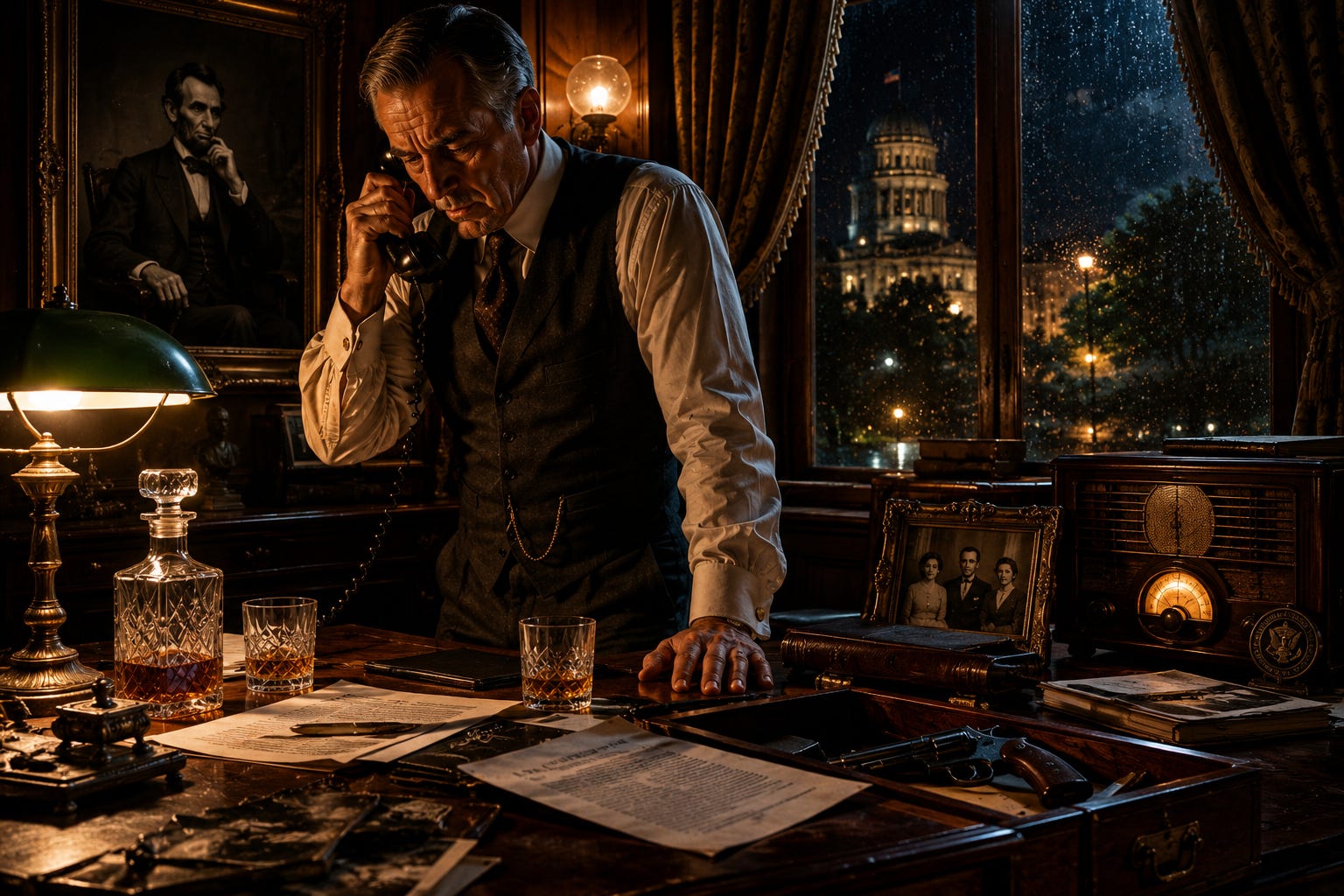
George Pickett sat at his desk, in his study, head drooping, listening to his voice coming out of the radio console nearby. He said nothing as the broadcast aired the recorded speech at the appointed hour of eight p.m. He said nothing as it ended. He began to doodle on some blank paper, then grunted without looking up. “Wanna play Hangman?”
Alben Barkley sat nearby, looking anxiously at his friend. “Come on, now George, this ain’t the end. In fact,” he gave every appearance of brightening up, “This is just the beginning! You can fight ‘em, George, you can fight ‘em! You’re still president. He thinks he’s in charge, but you can control things. Hell, you can go to the people any time you want, just like you did tonight.” He pumped his fist in the air energetically.
“Save it for the county fair, Alben. Don’t want to hear that pablum. It’s over now, until Patton says so.” Pickett shook his head morosely. “If there is a worse place than hell, I am in it.” He looked up at the picture of Abraham Lincoln hanging on the wall behind his desk. “Now I know how he felt.”
“Not the same thing, George. Come on now, he lost the whole shebang. And then he lost his marbles. You’re not going crazy. You’ve just...made an accommodation for a little while. For the good of the country.”
Pickett sighed. If that were only true, he would be happier for it. He did not believe for a moment, though, that it was for the good of the country. Quite to the contrary. The country, it seemed to him, was going to hell.
It had been so much easier in the early years, after the War. The fervor of the founding generation was passed on to the next, and the expansionist conflicts at the turn of the century had fueled a cycle of prosperity and patriotism. Mexico. Nicaragua. Cuba. The Confederacy had spread its tentacles far and wide. The mass of citizenry had been proud, energetic, and optimistic about the future. Until now. Over recent years an unprecedented storm of social protest had arisen and had begun to lash the waters of communal national life with increasing ferocity. It seemed that more and more Southerners were questioning the rightness of their system. Young people, particularly educated young people, were finding it hard to accept that their country was a pariah among nations. They questioned why they couldn’t travel freely to other countries, why their government didn’t enjoy normal relations with other governments, and why they were both feared and jeered by other peoples around the globe.
Just as worrisome, the advent of the great global economic depression had unveiled weaknesses in the South’s banking and financial sectors that had no easy remedy. Capital was drying up inside the country, and investments were not coming in from outside the country. Wages were pegged to the lowest common denominator: slave labor. Pickett fumed about this very fact. It was outrageous that average, God fearing white working men were being elbowed out of jobs by blacks, often by blacks owned by some champagne-guzzling, self-righteous hypocrites in Charleston, or Montgomery, or Houston. Non-slave jobs were getting more and more scarce, southern yeomanry was being squeezed hard, and Pickett could just feel the rising tide of anger and frustration across the country. He worried that he would not have the time to right the ship before the storm upended them all. A new South, The New South, had to become a reality soon, or the country he knew and loved would be fractured forever.
There were other warning signals. Bowman Gray, an old friend and president of AJ Reynolds Tobacco, had called to warn that he was planning to lay off white workers, over a thousand of them, because of the zooming costs of imports such as Turkish tobaccos and French made cigarette paper. He also confided that he was surreptitiously planning to lease black workers to do the work the whites had done. He wanted the government ready to call out the Army and crush any white backlash that might interfere with production at his factories. Pickett knew very well that similar layoffs at the Tennessee Coal, Iron, and Railroad Company the previous year had resulted in vicious street protests in Birmingham. Two days of uncontrolled mob violence followed, resulting in the lynching deaths of dozens of black laborers. In turn, their owners had raised howls of bloody murder. Fortunately, most of the dead property had been insured. In any case, using the Army to suppress a labor action would present an ugly picture to the nation, and ran the risk of diminishing the Army’s luster.
It had done no good to go over this with the Congressional delegation that came to him after Patton’s threatening encounter the prior evening. The Senators and Congressmen who filed into his office at the White House were intent on only one thing and were not shy about expressing themselves. The menace of the Underground Railroad, they said, had to be suppressed, promptly and permanently. The recent upsurge in the number of bombings, acts of arson, bank robberies, kidnappings, and attacks on railroads were all being attributed to the UR. There were so many attacks that it was impossible to know how many bore the imprint of the terrorists and how many were random crimes. And of course, there was the little matter of the spectacular escape of the President’s own body servant from a prisoner train.
They had come, hat in hand, but with the determined air of powerful men who had already rendered judgment. The Vice President, John Nance Garner of Texas, took on the initial role of spokesman for the group. He was an old pol who had grayed in the service of his state and country. He was known affectionately as Cactus Jack and could be as prickly as a dried out prairie cactus when he wanted to.
Garner had wasted no time launching right in. “George, we know General Patton was here today and recommended temporarily placing the country under martial law. We’re in a tough scrape right now, and we all think this is the best way to get out of it.”
“Cactus, I’m the damned president! I’m not going to sit idly by while this son of a bitch tries a palace coup!”
“Well, it’s not a coup, that’s just it. You’re still president, that doesn’t change. Under martial law some of your duties are temporarily transferred to Army jurisdiction. Things like habeas corpus, interstate transport, shit like that. I won’t argue the part about him being a sombitch. The main thing is, the army needs to move where it needs to, when it needs to.”
“It’s illegal.”
Garner signaled Hugo Black, the Attorney General, to respond. He spoke with severe gravity in the high pitched, nasal twang of his native Alabama. “Mr. President, it is legal. That is, it can be made legal provided you sign all the necessary endorsements. The decision is not a Constitutional one, it is a political one. Ultimately, that will be a decision only you can make.”
Pickett felt the net tightening around him. He looked for relief to the Speaker of the House, Claude Swanson. He said nothing, but his overgrown mustache twitched uncontrollably, as if he were aching to pitch in. Swanson simply shook his head vigorously, in a gesture of warning.
A sensation of bile came into Pickett’s throat, and for a moment he felt as if he might vomit. They were all against him, and there was no way out. “And what about you?” he asked Garner bitterly. “You don’t care that your office is being desecrated?”
Cactus Jack let out a roar of laughter. “My office? Desecrated?” He chortled as he unveiled a plug of chewing tobacco from the deep recesses of his waistcoat. “Why, the Vice Presidency isn’t worth a pot of warm piss! You can have it. I want security for my people.”
Pickett was not persuaded, and wanted to argue the matter further. Besides, he didn’t want a bastard like Patton to win. He stood up, both hands clenched into fists that he buried onto the top of his desk, assuming a pugnacious stance. “What if I don’t agree? Then what?”
It was the Kingfish who broke his back. Huey Long, recent Governor and newly elected Senator from Louisiana, was the closest thing to a dictator on the North American continent. For years he had agitated against the central government in Richmond with a populist fervor that bordered on radical militancy. He preached the virtues of the poor and the evils of bureaucracy, and many times had threatened to remove Louisiana from the Confederacy and remake New Orleans into what he called a ‘Free City,’ open for trade with anyone. Including, of course, the North. Pickett hated him with deep conviction and the feeling was quite mutual.
He had been standing quietly at the back of the delegation, holding a straw boater that he had taken off his head to use as a fan. Now he pushed himself forward, his long, tousled hair hanging down his forehead, drenched in sweat. His cheeks turned a bright red as he spoke. “I’ll tell you what, Mr. President. I’ve been waiting my turn, waiting for the right moment to pull the trigger, and here it is. Louisiana will not stand by and watch the country violated by this band of apes you call the UR. I have already spoken to the governor today. If her sisters will not act, then Louisiana will lead the way by declaring a state of emergency, and we will take care of our own. We’ll bring out the State Militia in force. As far as I’m concerned, this Confederacy hasn’t done anything for us since independence, anyway.” He paused for effect. “You can go your way and we’ll go ours. Don’t try to coerce us either way, our rights in this matter are enshrined in the constitution. Hell, our rights are enshrined and consecrated by the blood of our ancestors.”
The room hushed. Speaker Swanson continued to shake his head back and forth, as if contemplating a river too deep to ford. Long’s warning was unmistakable. And more importantly, he could make his threat come true with just a phone call. Folks in Louisiana were wild for Huey Long and would follow wherever he led them.
Hugo Black broke the silence, showing a flash of anger. “Senator, the Constitution stipulates that our states joined their fortunes together in order to form, and I quote, ‘a permanent federal government.’ Besides, this is a time we need patriots, not radicals or revolutionaries.”
Long waved his hat dismissively. “Aw, don’t shovel that shit this way. The country’s going to hell and we all know it. But it ain’t because of the niggers any more than it’s because of the Catholics. Look, I don’t love the blackie any more than the next man, but I’d rather take him than the big assed slave owner who’s taken over half the county and’s eating up everything in sight like a fat faced rat. They walk around spilling coins out of their pockets that they expect us to lap up like little dogs and be grateful to ‘em. They rent their niggers for the best jobs and squeeze ordinary folks just like you would squeeze out a mop. Well, I’m sick of it, ya hear? I’m sick of hearing that at least we’re better than a nigger. Well, you know what I say? Set ‘em all free! That’s right! We’ll know how to deal with them afterwards, but they won’t be taking our jobs for slave wages, I can tell you that.”
An uproar of incoherent shouts drowned out his last few words. Someone shouted “Traitor!” The distinguished Cordell Hull, Secretary of State, turned on the bulky Louisiana Senator with fist upraised as if to strike him in the face.
“Silence!” It was Pickett, standing at his full height and holding a .54 caliber Kerr revolver straight out, with his arm extended, aimed at Huey Long’s chest. The huge gun was a hand me down from his father, a memento that brought back fond memories of his youth, and he kept it permanently in his desk. It was a keepsake, yes, but it was fully loaded. Pickett tried to keep his breathing steady even as he felt a throbbing pain sear across his chest. “Boy, I have four men right outside the door who will drill you on my command. Don’t even have to do it myself.”
Cactus Garner raised both hands upwards. “Now, George, just because he’s nuts, don’t you do anything crazy.”
Crazy was the right word to use. Everyone in the room knew that Pickett was capable of doing something crazy. Crazy, in fact, was what he had done throughout most of his life. Crazy was what he himself had claimed to be after his first wife had died lo these many years ago.
Pickett did not respond. He held the gun straight out and brought the trigger to full cock. The tension in the room became palpable.
Swanson muttered audibly, “He’s going to do it.”
Huey Long stood tall, puffed out his chest, and spit a glom of tobacco onto the floor in Pickett’s direction.
Crazy. For years, friend and foe alike knew that George Pickett could be as unpredictable as the wind. Act crazy, or be crazy, it made no difference. In the world of politics, at war with the Longs and with the Pattons, that seemed to be his greatest strength. In the eye of the everyday public, his huge, crooked smile was his strongest calling card, but being just a little bit insane didn’t seem to hurt too much either. Women still went crazy for him, and men trusted him. When he combined both charm and unpredictability, he was crazy good. With a flashing smile he uncocked the gun and placed it carefully back in the desk drawer. “Well, boys,” he said softly, “That’s enough excitement for now. No need to come to blows.” As he sat down, he made a show of searching his desktop briskly. “Now, where are those papers I need to sign? When this is over, we’ll have some scores to settle, you can bank on it. And,” Pickett looked at the faces gathered before him somberly, “God help us all.”
Now, a day later, Pickett felt an overwhelming sense of grief as he sat in his private study, wondering what he might have done differently. After recording his announcement to the nation earlier in the day, Pickett spent time on trivial paperwork at the Executive Mansion before going home with his friend Barkley. Now he didn’t know what to do with himself. His immediate solution was to dig out a bottle of Jack Daniels from a lower drawer of his desk and lay out two glasses. “This will get me through tonight,” he muttered, half to himself. “Tomorrow will have to take care of itself.”
Barkley gave a soft laugh. “George, you haven’t changed that much since the old days, you know that? You’re unpredictable at times, but you’re very predictable at others. You know, I was a little surprised that you signed those papers. What persuaded you?”
Pickett did not care to answer that question, preferring to empty his glass with one quick and unfeeling swallow. As he poured another measure, he could see Barkley staring at him with eyebrow arched, and without really meaning to, he spoke the first words that came into his mind. “Let me tell you, I read a story as a youngster at VMI, and in the story was a riddle, old as the hills. Now here’s the riddle: A thing there is whose voice is one, two eyes that see, whose feet are four and two and three.” A lustrous smile came to his lips as he saw the look of confusion on his friend’s face. “Can you solve it?”
Barkley knotted his brows in tense thought for a few moments, then relaxed and sipped at his own glass. “If I were not a Christian man, Mr. President, I believe I would tell you to shove that little tale up somewhere where the stars and the moon don’t sparkle, if you know what I mean. What in the name of Beelzebub does that have to do with anything? I know what you’re doing, I’ve known you too long. You’re pretendin’ that you’re an eddicated man, full of stories and stuff, but I know you’re nothin’ but a bull headed, vacant minded hothead full of bullturd with bourbon for brains. Now, I will drink your whiskey, but I won’t put up with your shit.”
Pickett assumed a sphinx-like composure, erased his smile, became completely still, and said nothing.
“You bastard.” Barkley was not smiling.
At that, both men clinked glasses and Pickett was able to give an honest laugh. “Sorry, Alden, but I can’t help it, I’m only human, and that riddle is an example of the story of my life. Riddled with riddles.”
The strident ring of the telephone came as a sudden, startling intrusion. The operator announced that it was Mr. Otley of Buckhead, Georgia. Pickett answered eagerly. It was always good to receive calls from good friends at low moments like this.
“Hey, pal, how y’all doin’? You were awfully fast. You’re the first to call since the address.”
“George, what address? I don’t know anything about any address. That’s not why I called.” Otley sounded tense.
Pickett shot up to a stand, causing Barkley to stand up as well. “What’s wrong? Has something happened? Is Madeline alright?”
There was a short pause. “That’s why I’m calling, George. She’s gone.”
“Gone where? What do you mean gone?”
“Don’t know George. Best as we can figure she disappeared about a few hours or so ago. Maybe earlier this afternoon. Don’t know where.”
Pickett was frantic. “What about Lou Ellen? She wouldn’t go anywhere without her. And Lou Ellen wouldn’t let her out of her sight.”
“She’s right here. Has no idea where Madeline’s gone to.”
The President of the Confederate States of America stood immobile, powerless, unable to think clearly. “You called the Governor? The Guard?”
“Of course. They’re looking now.”
“Alright, I’ll arrange a flight. Coming down, be there by first thing in the morning. I’ll call Governor Talmadge right after I hang up with you. Telegraph with any news. And one more thing…”
“Yes, George.”
“Lou Ellen. That old bitch, this is her fault. Have her whipped. Have her whipped good.”
Chapter 11
“Dr. Lieb, come and look at this, won’t you?”
Jona shifted in his armchair, staring sightlessly in the semidarkness. He was dozing, half dreaming, half roused. I am both asleep and awake, he thought, and then dreamed that he laughed at himself in a fit of vicious ridicule. I am both here and there, then and now. He heard his laughter recede into the distance, becoming nothing more than the exhausted cough of a dying engine.
“Dr. Lieb, come and look at this, won’t you?”
Elfieda lay sleeping on the bed, making small sonorous noises with each respiration. One white leg protruded from underneath the sheets, bare to the hip. From where he sat across the room, Jona could not actually see the blond of her hair, buried in one of the enormous down pillows at the head of the bed. Even so, as he sagged in his torpid state, he could see strands of her golden hair dancing slowly, in a languid rhythm back and forth before his eyes. Like a futile mirage the image both beckoned and mocked, an illusory promise that would remain unfulfilled. Without warning, Marielle’s face blossomed in interposition, looming over him, a moon-pale apparition floating into the forefront of his drowsy imaginings. A pang of sadness struck a deep chord within him as her hair strayed over her cheeks, drifting like a tidal current to and fro, to and fro...
The morning cool made Jona shiver. He wanted to retrieve a blanket from the bed, but was afraid he might awaken Elfieda, and that was something he did not want to do. Right now, he wanted only to rest, to somehow be alone, and to obliterate the last few hours. To dream, perhaps dreaming to forget, perhaps dreaming to imagine, even if it meant he remained conscious enough to know that he was only dreaming.
“Dr. Lieb, come and look at this, won’t you?”
His mind was working slowly, sluggishly, processing fitfully. For some reason, his thoughts kept receding, going backwards to his stay in London. As his eyes began to flicker closed, he could see Doctor Fleming, hunched over and peering intensely into the single lens of a microscope as if he were looking through a knothole in a fence.
Lieb was at Fleming’s laboratory, buried deep within the cavernous Gothic structure of St. Mary’s Hospital, just across from Paddington Station. Alexander Fleming was an acknowledged leader in the field of microbiology. For years he had been both an admired colleague and an envious adversary of Ernest Lieb.
Fleming, dressed stiffly in starched shirt, wide cravat, vest, and long white laboratory coat, was the very image of an academician. As he spoke, a noticeable burr betrayed his Scottish origins. Without any affectation, he maintained a formal, reserved demeanor as he conducted his guest on an invited tour of the laboratory’s cramped facilities. He cautioned Jona that they had only a short time together before Lieb was due to meet the Department head, the renowned Sir Almroth Wright.
They had just entered the laboratory when an assistant at one of the microscope stations let out a cry of surprise. Fleming hurried over and practically yanked the poor fellow out of his seat in order to focus the microscope to his suiting and study the magnified image under the lens. After a few minutes of scrutiny he looked up at Jona.
“Dr. Lieb, come and look at this, won’t you?” He had a certain crispness about him, but was gravely polite and had none of the penetrating intensity of Ernest Lieb.
Jona felt confident of his own skills at the microscope and promptly squinted into the lens. He saw nothing remarkable, however. He shifted the slide on the microscope stage but could only discern what looked like a field of lightly stained clumps of rod-shaped organisms. He looked up at Fleming, who was standing right behind him. “Are they E. coli ?” he asked tentatively.
To Jona’s chagrin, the gray haired scientist said nothing in response, merely nudging his way back over the microscope to take another look into the lens. After a few more moments of study he whispered a few terse instructions to his assistant, and then turned back to Lieb.
“I’m sorry, did you say E. coli? No, not at all, I’m afraid. This is a strain of Salmonella typhi. As you know, the agent responsible for typhoid fever. We are comparing the Salmonella’s growth characteristics in different nutrient environments. These slides were made from a ferrocyanide citrate agar inoculated with a small number of bacteria.”
Jona nodded his head slowly. “Looks quite impressive.”
“Actually, growth appears to be somewhat sparse in this particular medium. Inhibited for some reason.” Fleming stood up briskly. “We have examined Salmonella growth patterns systematically in a series of defined nutrient media. This bacterial strain does much better in Dominick and Lauter agar, or in Salle’s medium.”
It seemed to Jona as if the whole room had come to a sudden halt, with every one of the half dozen technicians frozen at their bench stations and staring silently in his direction. He had the overwhelming sensation that Fleming was peering at him with a look of curious inspection, as if he were an interesting insect. Or, quite possibly, a small microbe that required further evaluation. Humiliated and cowed, Jona could barely bring himself to speak.
“I see, of course...Well, that’s an, an important finding, I presume. I’m sure.”
His host stood still for the barest moment, then gently grasped Jona by the arm as he ushered him out into the hallway. “I can see that you did not follow your father’s work very carefully.”
“No. Not really. Well, maybe sometimes.”
They exited the lab and continued down a long, barren hallway that led to an opaque, obscure terminus bathed in shadows. Fleming walked with hands clenched behind his back and slightly stooped over, looking much like he were following secret directional signs on the floor.
“Your father was a great man, Doctor Lieb, but he was never interested in the sort of thing we do here. This is too small for someone like him. No indeed, he played on the world stage. Pestilence, pandemics, mass deaths, social chaos...These were the scenes he liked to appear in. He would come in, perform his part, then exit stage left. On to the next theater.”
Fleming paused in his words, pursing his lips, but did not slacken his pace. “Well, that could be misconstrued as unkind, I suppose. I am sorry, Dr Lieb, I meant no offense.”
“None taken, of course. Please, call me Jona.”
“Terrible with names, chappie. Dr. Lieb will have to do.”
They reached the end of the corridor. To the left and right, stairs went up and down, disappearing into the recesses of the building. Silently, Fleming gestured towards the ascending stairway on the right. As they climbed, Jona’s left hip and leg began to throb with pain, forcing him to stop and grasp the handrail for support.
“Are you alright, Dr. Lieb?” Fleming stopped in mid step, looking more curious than concerned.
The staircase was deserted, but from high above could be heard the thump and clatter of footsteps moving rapidly up and away from them. They were alone. Jona marshaled his strength and began to climb again. “I’m fine, thank you.” He gave Fleming a bitter look. “I guess this is the biggest stage I get to play on.”
“Sorry about that, dear fellow. No need to be angry, really. Look, as I said, your father was an enormous presence. But he was simply not interested in the kind of nuts and bolts investigation that we blokes do here. You know, the small steps that create the foundation for the big breakthroughs. He was always looking at the big picture.”
“Well, his laboratory was busy with research activity day and night. That is one thing about his work I do know. I’m sure they were investigating the basics as well.”
It was Fleming’s turn to stop. The intonations of his Lowlands accent echoed harshly in the narrow confines of the stairwell. “Night and day, to be sure. Busy little bees, all abother. The truth is, chappie, your father’s laboratory worked night and day to tear down the accomplishments of other investigators all over the world. At the word of Ernest Lieb, any finding, even an important one, was at risk to be ridiculed and withdrawn. Unless, of course, it was work published by one of his cronies. Lickspitters, actually. Frankly, your father has not made an original research contribution in the last twenty years.” Fleming snorted. “He had the brass to criticize me once.”
Jona was too stunned to respond. His mind whirled with a flurry of thoughts that he couldn’t put in order. He had never heard anyone condemn his father in that manner. As they climbed to the next floor Lieb found himself feeling a slow surge of outrage. He wanted to show his anger in some way, but didn’t know quite how to, or know quite what to say. Of course, he didn’t want to create a scene. He was Dr. Fleming’s guest, after all.
Eventually, he muttered out, “Well, that is a unique point of view.”
“Not unique, chappie. Not unique.”
On the next landing they arrived at a large wooden doorway with the words ‘IMMUNIZATION CENTER’ stenciled across it in large letters. In smaller letters underneath was written ‘Almroth Wright, Director’
“Here you are, Dr. Lieb. Sir Almroth has been looking forward to your meeting for weeks, and I would not wish to deprive him of that pleasure, however briefly. Goodbye.” Without extending a hand Fleming bowed curtly, then turned and walked off at a crisp pace.
Jona was on the verge of saying something clever and biting in response, but couldn’t find the right words before Fleming disappeared down the stairs. Only after he vanished from view was Jona able to muster up a muttered, guttural imprecation. “You pompous, jealous, overblown stuffed shirt!” He said it with feeling, wishing the two of them were still face to face.
“My word, and we haven’t even met yet!”
Jona whirled around. A frumpy, short, wild haired apparition, looking like someone freshly arrived from the previous century, stood before him, smiling wickedly. He wore a long, heavy appearing waistcoat embellished by a gold watch chain, a severe, high riding starched collar supporting a partially dissolved bow-tie, and an enormous mustache that completely obscured his upper lip.
He extended a long, thin hand. “You must be Jona Lieb. I am Professor Wright. Nice to meet you at last. I must say I would recognize you anywhere, you are so like your father. Come in, please.”
The office inside surprised Jona by its austere simplicity. He had imagined oak lined walls supporting massive bookcases, and perhaps a display of varicolored limpets in indeterminate stages of preservation, or oddly shaped rock splinters from the Neolithic period. Instead, Wright sat at a spartan wooden desk devoid of ornamentation. A telephone was perched prominently in one corner and a small pile of neatly stacked papers was in the other.
Sir Almroth Wright was a very old friend of his father’s and a close collaborator over the years. He was a pioneer in the development of vaccines, including some groundbreaking work with the strategic concept of mass vaccination. He had long ago argued in favor of mandatory vaccination schedules for children and adults in order to achieve a level of ‘herd immunity’ that would effectively eradicate pools of specific infectious agents from population groups at risk. His greatest achievement was the development of a vaccine against typhoid fever. Ernest Lieb had once told his son that if anyone would one day find the cure for polio it would be Wright.
“I see you and Fleming hit it off.” Wright gave Jona a bemused look.
“My apologies, but he was rude and disrespectful, especially to my father. I thought the idea of my visit was to honor my father’s memory.”
“Well don’t get your knickers in a twist. Your father was one of the giants, and he will be missed. I miss him already. There are others though, not many, like Fleming. He just can’t reconcile himself to someone looking over his shoulder, checking his methods, arguing over his results. Seems angry quite often, as if he had been cheated out of some prize that should have been his.”
An uncomfortable silence settled over both of them. Neither man knew the other, and Jona began to feel that he had exhausted the necessary niceties attendant to his visit. He was suddenly very tired and wanted to return to his hotel. Preparing himself to stand up, he began to shift restlessly in his chair.
Abruptly and without a word, Wright opened a drawer underneath his desk and removed an oversized cloth bound volume. He waved it in the air momentarily, much as if it were a talisman, and placed it carefully in front of himself.
“Would you like to see some pictures of the ancient days?” He asked the question in a subdued, almost reverent voice, as though he were a High Priest about to read from the Book of the Dead. “I pulled this old album out for you to see.”
“Pictures?” Jona inhaled sharply, suddenly attentive. There were not too many pictures of his father in an ordinary or random scene. Most old photos of Ernest Lieb were framed and hanging on a wall, showing him in the setting of a banquet, debate, or speech. Jona felt his temples begin to throb. Informal snapshots were rare. Perhaps he might be seen in some of them as well.
Wright walked over and placed the book in Jona’s outstretched hands, then stood over him like a wary schoolmaster. “Sorry about the loss of clarity of some of these. Used one of those Brownie cameras you Americans make. Taken in difficult circumstances, you know.”
The cover felt somewhat flimsy as it was opened. On the very first page was a large picture of two men, both riding donkeys. One of them was dressed in a dark suit, white shirt, bow tie and wide brimmed hat. The man’s overhanging mustache was accompanied by a sharply shaped beard. The other man rode his donkey in native fashion, with both legs over the left side of the animal. He wore a wrinkled khaki jersey, wide pantaloons over knee length boots, and a tarboosh set solidly on the top of his head. By his side hung a holstered gun. It was his father, looking impossibly young.
Clustered around them was a mass of villagers spilling out of what appeared to be white limestone washed huts. A tall, full-bearded giant in pitch black robes and long flowing hair stood in their midst, a rifle slung diagonally over his shoulder. A dusty Kalymavchi covered the top of his head, making him look gigantic. In the corner of the photograph was a penned note:
To our friend
Adgahigia, 1919
Jona felt his heart skip a beat. “Sir Almroth...was this in Russia?”
“No, not Russia. Armenia. Why do you ask? We met there in May, the first spring after the war. Well, after our war, anyway. In that part of the world, the war never stopped. I was in Baghdad with the British High Commissioner at the time. We were supposed to be in charge there, running the place for their own good, but the bloody Arabs were busy blowing us up. Awful place. Couldn’t wait to get out. Earnest somehow found my whereabouts and cabled me to come to Erzerum, in the western part of what was then Armenia, and to come urgently. Terrible outbreak of typhoid, you know. A million, two million, three million refugees were caught between the Reds coming down from the north and the Turks attacking from the west, both sides advancing on the middle. No scruples or rules in that war, laddie. Once typhoid broke out it hit like a typhoon, swallowing up everything before it. Hundreds of thousands dead, I’m afraid, and little we could do to stop it.” Wright took a wheezy breath and then continued in Jona’s direction. “Well, why?”
“Why what?”
“Why do you ask? About Russia?”
“Oh,” Jona shifted uncomfortably. “I just learned from...just the other night...I was told he went to Russia that year, that’s all.”
Wright became quiet. He sat back in his chair and tented his fingertips together, creating a small sanctuary for himself as he regarded Lieb. “Yes, well that’s quite true,” he intoned softly, then fell silent again. “Why don’t you take a look at the rest of those?” He waved casually at the album in Jona’s lap.
Most of the remaining pictures were of poor quality, many of them blurry. His father appeared in only some of them. In one, he had his arm around the enormous black robed man, both of them smiling broadly into the camera. Jona tapped a finger over the image. “Who is this fellow?”
Wright peered over his desk. “Father Markos. A dear, dear man. Devoted to his faith. The bravest man I have known. Sad story, really.”
“Why sad?” Jona sensed something in Wright. A hesitancy to speak. A reluctance to reveal. A burning to bare witness.
“In the end, he died.”
Just as a sharp breeze flutters and vibrates through the delicate fibrils of a spider web, threatening to dismember it completely, Jona felt something inside begin to quiver. A distant remembrance called to him, wrenching forgotten thoughts from their burial place.
“How?”
“He was killed.”
“How?”
“Your father killed him.”
It was said with a harsh percussiveness, sounding like train wheels rolling repetitively over a break in the track, the sound of one wheel cascading over another, with each noisy shock obliterating the one before. Jona felt no revulsion, no outrage, no disbelief. Images, thoughts, sounds flooded over him and suddenly they coalesced into one coherent stream of memory. He recalled something his father had once told him.
They were together for a long weekend in the summer after his graduation from Harvard, just before entering the School of Medicine. His father had rented a cabin outside of Lennox, in the Berkshires, situated on a lake of crystalline beauty. For some unknown reason, the elder Lieb decided to conquer fly fishing. Jona grinned to himself, remembering. Another accomplishment to achieve, another goal completed, another item of conquest to add onto Earnest Lieb’s lifetime curriculum vitae.
Of course, neither of them knew anything about fly-fishing. A local outfitter, a diminutive man with long black hair knotted at the back named Big Peter was hired to help them. He spent a few hours demonstrating to both Liebs the intricacies of choosing a proper fly, casting with a proper line, and choosing a proper location to fish. Early the next morning he pushed them off in a small rowboat, pointing to a spot in a small cove about a hundred yards away where he thought they should go.
A fine mist hovered just inches over the surface of the still waters, but the dense forest of pines surrounding the lake stood up sharply in dark green relief against a sky that was a blended ruddy blue. Just as they made their first cast of the morning the soft edge of the sun’s disk emerged from a nimbus of golden orange and scarlet clouds.
Jona tossed his line indifferently and stared vacantly at the ripples that spread with perfect symmetry over the motionless water. Nothing else moved.
Earnest Lieb very carefully and very precisely cast his line, then rapidly retrieved it. He cast again and then again, repeatedly reeling in and attempting once more to make a perfect cast, jerking on the line to load it and heaving the rod mightily back and forth as he had been instructed. As the sun rose higher, large beads of sweat rolled down his forehead and cheeks. He continued grimly but was dissatisfied with every toss of the line and eventually threw down his rod in disgust. His face was congested and contorted with anger, an appearance that Jona knew only too well.
Without warning, the elder Lieb picked up the rod and reel and tossed it as far as he could into the lake. As the long pole disappeared into the depths he began to laugh loudly, his voice booming explosively over the placid water. The great Dr. Lieb did not give outward displays of mirth often, and when he did, it was usually with a measured reserve. Even when he appeared to join in the hilarity of others, his eyes had a way of roving rapidly back and forth with the gaze of a predator searching out easy meat.
“Just like Marmara,” he spit out in disgust.
Jona almost let it go, but after a brief hesitation he stretched his legs out languidly, shifted his seating, and asked “What do you mean, dad? What was Marmara?”
His father laughed again; a softer, gentler, more genuine laugh. Jona saw a quick flicker in the older man’s face, a look that came and passed instantaneously, a look that concealed rather than revealed. “The sea of Marmara. I tried fishing there once. It didn’t work out any better than here, though.”
“Why in the sea of Marmara? Isn’t that in Turkey?”
Earnest Lieb dipped his hand into the lake, waving it slowly back and forth, creating small eddies that rocked the boat ever so slightly. “Yes, of course. It’s in Turkey, connecting the Dardanelles with the Bosporus. Tell me, Jona, can there be any more famous bodies of water in the world? Where Europe and Asia meet. Collide would be more apt.”
Jona shook his head. The Dardanelles sounded familiar for some reason. “Why were you there?”
“I was there with an old friend, Mikhael Barzajian.” He looked sharply at his son, still sprawled comfortably at the bow of the little boat. “Didn’t I write you about all this?”
“No.” Jona struggled to remember. In recent years there had often been long lapses between letters from his father as he travelled from one remote outpost to another.
The elder Lieb continued. “Constantinople was a terrible place right after the war. Measles, smallpox, dysentery, tuberculosis, horrible conditions. People starving. No clean water. And getting any help or supplies into there was not easy. Not overland at least. You understand, the Greeks, the Bulgarians, they were stalking the Turkish frontiers like hyenas. To get there myself I took a boat down the Danube to Rustchuk, then the train to Varna over horrible tracks, then a steamer to the City. I went there alone, bringing a shipment of syringes, morphine, cotton gauze, that kind of thing. Also a new medication, an antibiotic that appeared interesting. Barzajian was the Minister of Health, or was supposed to be. By then he was incredibly rich. He built an empire based on medical goods, selling to doctors, hospitals, even selling government supplies back to his own government. We had met years before in a certain way, so I knew him well. Meeting him again was not difficult.”
“Why did you go?” Jona turned around in the boat, facing his father, entranced by the description of an exotic and distant place.
Earnest Lieb continued to splash the warm water with his hand, as if contemplating the blue green depths below. With Jona watching, he carefully cupped his hand, scooped up some water and quickly slurped it in. “What did I just swallow?” he demanded in his sternest professorial tone.
“Dad, I don’t think you’re being serious. Water, of course.”
“Inadequate answer! Not just water. I ingested life forms. Microscopic living creatures of every possible description. Hundreds of thousands, maybe millions. Fungi, protozoa, bacteria in amazing variety, most of them not even known to us as yet. Ingested or inhaled by us constantly, passing through us, part of us. They represent the outer world, blending with our inner world in a continuous spectrum of coexistence. The very well adapted ones, they change our inner world to suit their needs, so that they can thrive within humans successfully. They give us gifts we don’t even know about as they go about their secret lives deep within. Or, instead, they become incorporated into us, becoming a living cog within us, part of our mechanism of life. I sometimes imagine that we are the ones adapting to them. Something rings true about that, at least to me. There are millions upon billions of them, and they were here long before humankind. They’re alive and have just as much biological right to existence as we have...” Lieb stood up in the boat, rocking it, as if he were attempting to stand at a lectern.
“But every once in a while we cross paths with a form of life that is not well adjusted to existence with humans. It creates disease, even death. Some agents rip through whole populations, killing thousands at a time. That’s why I went to Constantinople, Jona. To study. To learn about the outside and the inside. And, to help the sick if at all possible. That’s why. You’ll understand better when you finish your studies.”
It took a few moments for Jona to digest all that the elder Lieb said. He was still young, and excited about his forthcoming medical school studies, and, of course, intended to follow in his father’s footsteps.
“What about Barzajian?”
“He is quite a character. Rich as Croesus. He’s an Armenian, or so he said, and so in those days he kept a small army of bodyguards to protect him from Turkish fanatics. Remember, this was just a few years after one or two million of his countrymen were exterminated. He was safe because he’d been in the inner circle for so long. With his intelligence and with hard work he had climbed high in the Sultan’s government, and in fact he often bragged he was a personal friend of the Sultan himself.” Lieb laughed. “He would do anything to ingratiate himself within the imperial councils of the Seraglio. Here was a Christian who would not hesitate to pray in the Blue Mosque if it would profit him to do so.”
Jona withdrew his rod into the boat, no longer pretending to fish. “What about the Sea of Marmara?”
“Barzajian arranged a day’s cruise on his yacht. About ten of us, British and French diplomats, an industrialist, a Russian who said he was a colonel though I’m sure he was a spy. The sea was choppy and the fishing was awful. No one brought up anything except an occasional crab or octopus. I fished as badly as I did today and behaved as badly. The best part was later. We swam, ate, drank sweet chai, and talked politics. The Sultan was history, finished, kicked out, leaving the military in charge, but no one knew what the Army would do next. A fellow named Mustafa Kemal - you’ve heard of him as Ataturk, haven’t you - was emerging as de facto leader and head of the Army. You have to remember that Turkey had just been carved up by the Allies at the end of the war. Ataturk wanted to get his country back and was determined to do just that. Barzajian talked to us about his own plans for the future. Later, he gave me his honest predictions privately. Ambitious pirate, let me say.”
Their little boat had drifted towards a quiet shoreline strewn with fallen tree trunks and water lilies. Overhanging willow trees provided shade from the full sun. Small wavelets made slapping noises against the bottom of the boat. Jona remembered thinking it was the perfect place to be alone with his father. The elder Lieb seemed content to pause in his narrative and sat back down. To Jona it seemed as if the scene could last a lifetime.
“What ever happened with Barzajian?” He asked the question, not really caring what the answer might be.
“Oh, he has done quite well for himself. People like him always land on their feet. Went to Armenia when the lid blew off in Turkey. Then he became a commissar in the brave new People’s Republic once the communists took over. Can you imagine! Probably the richest bolshevik in Russia! Anyway, he helped me get started in Constantinople, and I helped him later in Armenia.” Lieb hesitated almost imperceptibly.
“How was that, dad?”
Jona knew his father’s moods well. Anger, frustration, satisfaction, and belligerence all spilled out of Ernest Lieb from time to time, each manifesting visibly in the form of a scowl, grimace, or smile. But Jona had never before seen his father with the particular look that came over him at that moment. An opaque, rigid mask contorted into half sneer and half frown framed his face, and his darkened eyes darted back and forth, as if looking for escape from an unexpected entombment.
His words sounded slurred, almost fatigued as he spoke. “Well, there was someone that Barzajian arranged for me to meet there. In Armenia. To assist me in my task. I thought he was a friend. Turned into a traitor, though. Betrayed me and Barzajian, both. I had to deal with the matter the best way I could. I didn’t want to, believe me, but the minister was forever grateful afterwards.”
Ernest Lieb sighed. Jona, sitting opposite his father in the rocking boat, felt his sigh rustle softly through the air, like a dry breeze blowing across a timescape of whitened sands and decaying bones. Jona, sitting a world away and half asleep in his hotel room in Berlin, felt the sigh again, rising slowly and increasing in strength, becoming a gust of wind snapping through the treetops, bending aged boughs to the point of fracture. Jona’s thoughts were swept along, through a latticework of forgotten days and nights, brushing back the husks of long dead thoughts, circling around between Lennox, London, and Berlin.
“It’s time to resurrect them,” Jona thought, “Time to resurrect forgotten years.”
“Doctor Lieb, are you alright?” It was Wright, in London, peering at him quizzically.
“Yes, of course. I think so. It’s just that these pictures... and what you just said... Why would my father kill anyone, much less a man of the cloth? I don’t believe it, and I’ve never heard that said by anyone before.”
“I don’t imagine anyone has. You see, I’m the only one who knows, and your father swore me to secrecy.” Wright put his hand up sharply in a preemptive gesture. “It’s much more complicated than you can imagine.”
Jona scrambled to his feet and leaned both hands on Wright’s desk. “Then tell me.” His words came out in a harsh snarl, surprising both the older scientist and Jona himself.
“Please...Jona. May I call you Jona?”
Lieb nodded and sat down grimly. “Tell me.”
“You can’t know how difficult things were at the time. Awful, really. Look, have you ever tried to guide your way to a primitive village in the dead of night? Do you know how you can find your way there? By the smell. The odor of mounds of offal, rotting refuse, and unwashed beasts travels for miles around if the wind is right, even in the best and healthiest of circumstances. In the midst of a lethal outbreak of disease, though, the stench of death is everywhere, unmistakable, pinpointing places of human habitation as certainly as coordinates on a map. That’s what it was like in the Caucasus that summer.” Wright leaned back in his chair and raised his eyes to the ceiling before continuing, as if reading a script.
“Villages like this one in the picture, Adgahigia, were flooded with the dead and dying. I had never seen anything so horrible, though your father told me the Ukraine was worse. Anything you can imagine was there, just like a living, outdoor textbook of human disease. Typhoid, of course, but more. Leprosy, smallpox, marasmus, cholera, plague, pellagra, kwashiorkor, tuberculosis. And there were other ailments, equally devastating but not physical in nature. Just as visible, though. Insanity, rage, fear, depression and grief seemed to afflict almost everyone we met. Much worse than the front-line trenches during the war.”
“My father described some of these places to me, and I’ve read about poverty, I understand what it must be like. Dad didn’t mind, though. He seemed to thrive on situations that were difficult and dangerous. Tell me about the priest.”
“I met your father as instructed in Erzurum, a vicious, backward town in the Anatolian interior. Exceptional water, though. For some absurd reason the northern Americans had a consulate office there, run by a fellow named Wilkins. Doctor Lieb had already arrived a week before, assembling a team that included two French engineers, our water and sanitation experts. The epicenter of the outbreak was in the south. Your father, though, wanted to go to the north, towards the Russian border, where the disease was spreading and where he thought we could do the most good. He had a large shipment of medications with him, including an investigational agent he hoped to study, and the engineers were to look towards establishing a safe water system. It all looked exciting on paper, but the reality on the ground seemed impossible.”
“Why?” Jona felt himself getting restless. He wanted to shout at Wright to get on with the story, to skip over the engineers, and the outbreak, and every other stupid detail and get to the most important part, the only important part.
“Wilkins told us it was hopeless. He had been there, you see, in 1915 and 1916, and had seen the exterminations. There used to be Armenian settlements all around those parts for centuries. Christian, you know, but the Turks suddenly found that to be inconvenient. Something about a Greater Turkey, drivel like that. Suddenly, everyone had to be totally Turkish, whatever in the world that might mean. Atavistic thinking. Medieval, really. The Armenians were rounded up, very systematically. Never thought the Turks could be so efficient, actually. Wilkins told us what he had seen, the most brutal descriptions. Death marches into the desert, extermination camps, rape, mass hangings, disemboweling of pregnant women, that sort of thing. Poor Wilkins, he and others tried to tell the outside world, but nobody would believe it. Nobody wanted to, and so there was no one to listen. By the time we arrived the fighting had shifted north and east, right into the area we wanted to go. To make things even worse the Bolsheviks were spilling over the border into Armenia from the north, causing more fighting.”
“Dad was just back from Russia, wasn’t he?”
“I believe so, but I don’t recall the details. Ukraine, southern Russia, Volga, those kinds of places. It wasn’t something he talked about. Not his style to talk about the past, anyway. He was a very driven man. Everything was about today, or tomorrow. As far as he was concerned yesterday was gone and not terribly relevant. The only thing of importance was to test the antibiotic samples and save some lives.”
Jona digested that for a moment. What Wright said rang true. Even so, he didn’t trust the old professor. What if he felt some animus towards his father because of a past quarrel? “What about the priest?”
“Your father had a patron in Constantinople who helped us. Someone high up in the government. Thus the wagons, official passes, mules, porters, tents, and so on. Very hush hush, though, his name was never mentioned. This friend was the one who arranged to have Father Markos meet us in Erzerum as we were preparing to depart. He was a native Armenian, he spoke broken English and was fluent in Turkish. Doctor Lieb called the priest a facilitator, someone to help get us into the mountainous areas in the north safely. As we set off it seemed that this fellow knew everybody. It was only later that we learned he was quite famous throughout the countryside. He was actually a monk, some kind of a holy man, originally from a monastery, I believe, called Arkaghagia. God, but that language is awful, isn’t it? The place was renowned in that part of the world for its sacred music, and it was there that Father Markos learned the traditional tonals of their holy neumes. That is what made him so well known, the fact that he was so connected to the past, you see, and to the beauty of their language. What a voice he had! I didn’t understand a word, of course, but the power of his singing was inspiring, especially in the quiet of the dawn. He began his songs of prayer at sunrise every day and completed them at sunset. I believe he could have raised the dead with his chanting...” Wright paused, screwing his face into a tight contortion. “He translated one of his incantations to teach it to me, told me to sing it every morning, it would bring me peace. Utter rubbish, of course, superstitious nonsense, but I can still remember it. You know, it still comes to mind occasionally. I confess that I’ve tried to chant it myself from time to time. Here, it was like this, one has to inhale deeply and sustain the mode.” He intoned the words in a nasal, reedy, thin voice that nonetheless carried surprising power.
Turn your wrath away when the prayerful ones pray
Compassionate Lord spare us and do not let us perish
Raise up one who has collapsed from the fall
Wounded by the enemy
O healer of the sick heal my sickness
It occurred to Jona that Wright seemed lost in his own thoughts, talking and singing as if he were in a trance. “I bet he imagines he’s back there,” Jona thought. “He’s reliving the whole thing. It’s as if he’s with dad and the priest right now.”
Wright continued, speaking in a monotone, his eyes fixed on the ceiling as if transparent beams of remembrance were streaming down from that direction. “It took eleven days of rough travel to arrive at our destination. Only much later did I understand how dangerous that journey was. Along the way Father Markos brokered safe passage through the armed camps of some local warlords, guiding us until we reached Haghpat.”
“What was Haghpat?”
“A mountain. A church. A cloister. A library. Built ages ago, lad, ancient as sin. When we arrived, the local monks had long since been killed, or fled the fighting, or succumbed to starvation or disease. The monastery, including church, chapels, bell tower, and so forth lay spread out on a steep mountain slope with a commanding view, surrounded by a number of small settlements in the valley below. And most importantly, safe water. Deep wells, aquifers, and so on. All in all, a perfect base of operations. Except, of course, that it was at the front lines of a barbaric little war.” The old scientist paused just long enough to take a deep, wheezy breath.
“Father Markos installed us up there, and from then on he was magnificent. He had no fear. Every day he travelled into the local villages, meeting the elders, identifying the sick, and distributing medical supplies. He arranged for many of the very young to flee, escape to Yerevan where it was safe. Every day he risked a chance meeting with Turkish irregulars, and certain death if he were to be caught. He was a priest, you know, and the Turks liked to flay that type alive. As a lesson to the others, you understand how it was.
He kept us informed about the cases of typhoid in the area. It was your father who had the idea of dividing affected villagers randomly into those who received single strength and double strength treatments. We were using a compound of sulfa, but didn’t really know its proper dosing yet. His plan was to analyze the data after a month, and compare death rates on the two different regimens. It would have been a marvelous study. Quite unique, really, conducted in the field as it was.”
Wright paused and sighed audibly. There was no natural light in the room. Illumination was provided by two light bulbs hanging from the center of the ceiling, each encircled by a metal collar, casting a light that gave the elderly professor a sallow, sickly look. He sat back in his chair as if he were ready to close his eyes and sleep.
“Sir Almroth, I insist you tell me what happened.” Jona was frantic to hear the conclusion of the story. “You said my father killed the monk. How?”
“It was not a day in the countryside there, you know. No picnic. Use whatever metaphor you like. There were deeply forested mountains all about, and almost every night the bark and chatter of guns was everywhere. Much more frightening than in France during the war, believe me, because one didn’t know where the enemy was coming from. We didn’t realize it at first, but Father Markos organized a local battalion of militia to protect the area from attack. I only learned of it one day about a week after our arrival when a truck pulled into the little courtyard of the monastery with the priest and a few other men. They began pulling weapons of every type out of the back and piling them in the refectory. Of course, I asked where the guns were from, and Father Markos laughed at me. ‘Dead Turks,’ he said, and waved his hand behind him. When I looked in that direction I could see an enormous fire burning at the top of a nearby mountain. A huge plume of smoke was rising up, you could see it for miles. I asked him what it meant. I remember the look in his eye to this day. ‘Dead Turks burning,’ he said, and launched into a hymn, in that great strong voice of his. He told me he was singing the Lord’s Prayer in its original Aramaic. What a man he was!”
“He doesn’t sound very much like a man of God.”
“By that time he was no longer a man of God. He was a man of belief, though. He believed that it was necessary to fight what he called the invading infidels, to fight for the protection of God’s people, to fight for God’s kingdom on earth. This was how he spoke, you see, very intensely. To me, it was all very antiquated, really, and rather barbarous. I mean, fighting over religion, how savage! But that was why your father liked him, because he was a fighter as well. They struck up quite a friendship, those two. Father Markos was up and down the mountain two or three times a day, riding on a rather robust chestnut mule. Doctor Lieb went along quite often, always with a band of armed men. Sometimes they came back with a sick child or a wounded comrade, sometimes with a new load of guns and ammunition. Of course, I stayed behind, as I was responsible for all the administrative work. Devil of a job, kept me up all hours. Exhausting. And, we had no tea. I did go down to Adgahigia once, though, the day that picture was taken.”
Jona stared at the large picture on the album’s first page carefully. The sun must have been low in the sky, casting long, irregular, sharply contoured shadows on the ground. Wright’s face was partially obscured by a black curve that swept down his jaw and chin, the result of a floppy hat pushed forward on his forehead. Some of the villagers stood in darkness, just emerging from their doorways into the street. They all wore joyous smiles, staring straight at the camera as if casting their own singular beam of light into the lens. Earnest Lieb was captured staring to his left, directly towards the dominant figure of Father Markos standing next to him. The priest was swathed in a long jet black tunic-robe, and wore a tall, tubular kalymavchki that blended imperceptibly into long locks of hair that straddled both broad shoulders. Jona realized with a start that a stack of rifles was piled at the feet of the priest.
“They all look so happy,” he murmured.
“It’s true, that was a happy day. That was the last happy day, in fact. That night the Reds came.” The elderly professor appeared suddenly agitated. He got up from his chair and began to pace behind his desk.
“What Reds?” Jona was dumbfounded by the turn in the story.
“The Reds, Jona, the Reds, the bolsheviks! They slipped into the village that night. They were led by a bastard named Barzajian. I’ll never forget his oily, perfumed hair and pig face. He roared in like an invasive, virulent species, a pathogen of exceptional evil. Claimed he was a commissar, and he wore two stars on his collar, but he was just a common thief, a thug with an armed gang behind him. They were all Armenians, of course, so they were acceptable to the locals, at least in the beginning, but all of them were Red Army, I assure you. By the next morning they were firmly in control after a minor skirmish, and by the next afternoon they had lined up a pitiful group of old men and young boys in the central square and shot them dead. No particular reason that I could fathom. Bastards.
Doctor Lieb and Father Markos descended into the town after an early breakfast, to see what the devil was going on down there. I remember the priest looking somewhat agitated, but that was all. Your father was gone all day. Quite unusual for him, the priest came back in the late morning with six or seven men, all heavily armed. They hurried into the main church of the monastery, Saint Nashan it was called, and Father Markos conducted a short service. I could hear his voice in loud prayer and chanting, and all that sort of thing very easily. Some of the men joined in the chanting. I found it astonishing that even the most illiterate peasants could chant the neumes. Remarkable. Not long afterwards they all came out. Two men went up into the bell tower and the rest barricaded themselves into the refectory. I realized at once that there was trouble, and I sent a man from our team to get your father.”
Jona said nothing. He placed the photo album back on Wright’s desk.
“They came up in the late afternoon. Your father. Barzagian. Thirty or forty armed soldiers. Of course, I told them immediately about the priest and the other men. This was my first encounter with Commissar Barzagian. He strutted around like a peacock in heat, ordering his men here and there. I remember he commanded your father to go to the church library for his own safety, an order that was promptly ignored. Barzagian shouted something in the direction of the refectory, and Father Markos shouted something back, and then a warning shot was fired. The soldiers were posted behind a wall surrounding the monastery and hunkered down. To me, it looked like a stalemate, or a siege.” The elderly professor fingered the album absently and seemed to trace his finger over the large picture on the first page, like a blind man reconstructing a hidden maze.
Jona could not restrain himself. “What happened then? Did my father really kill the priest?”
The question charged across the space between them with the force of an electric spark, galvanizing Wright. He turned sharply towards Lieb. “Yes. Yes, as surely as I am speaking to you at this moment. He caused the whole thing to happen. It was Doctor Lieb who volunteered to go alone into the refectory and speak with Father Markos. He insisted on it. He walked right in as if marching into his own laboratory. He wasn’t long. When he came back out your father looked shaken and pale, obviously distressed. He told us that the priest refused to come out until the antichrists left the sacred grounds of Haghpat, that they were worse than the Turks. Said something strange, also, about not being tricked again.”
“But why? Why move in urgently? Why move in at all?” Jona shook his head in despair. He tried to visualize the scene. A clear summer day with skies dark, dark blue, the kind of blue that can only be seen in the uplands. A fantastic landscape of sharply shaped mountains carpeted with green and amber tree tops rose all around, creating the backdrop for the random spill of somber stone buildings that comprised the monastery. Dusky men in sweat-soaked uniforms crouched behind a low lying, ancient wall, straining to peer cautiously at the straight sided cupola atop the bell tower. Jona could see his father as well, pacing, sweating also, scowling, his mind brimming with ideas, plans, orders. The vision faded rapidly. He continued softly, as if asking the question of himself. “Why do anything?”
“Our supplies, Jona. Our packs, syringes, medications, the sulfa. Also, all our notes and data. Everything was there, stored in the refectory. There would be no treatments without the sulfa. There would be nothing to publish without the data. The priest told him he would blow the whole lot up rather than surrender to the Reds. An entire summer’s worth of work would be destroyed. Your father was frantic to secure the stores. In the blink of an eye, Doctor Lieb and Barzagian exchanged roles. It was your father who commanded the commissar, demanding that his men move in immediately to eliminate the monk and his followers. I’ll never forget, and could scarcely believe, that Lieb called them insurgents, bandits, guerrillas. Just hours before, he and Markos were fast friends.” Wright paused to shake his head.
Jona wondered whether it was with regret or with wonder. “Did they get him? Father Markos?” he asked weakly.
The grey haired professor threw his head back and gave a dry, sarcastic laugh. “Who got who? As the soldiers were ordered forward a furious firing began, shooting coming from all directions. It was a frightening, deafening hell. I remember your father went forward partway with the troops. I couldn’t hear what he was saying, but he seemed to be screaming at them insanely before crouching behind one of those massive, ornately carved stone crosses planted in the ground, what they called a khatchkar. You have seen pictures of them? They’re huge relics and can easily hide a man.
As the men stormed the refectory and reached within a few feet of the building, an enormous blast went off. It was an explosion, a bomb set off from inside that destroyed everything within a hundred meters. A deliberate, destructive suicide. The structure was leveled, nothing was left, merely a gutted shambles and a field of debris. The khatchkar saved your father’s life, without question. He was the only one left alive within the blast area because he crouched behind that cross. The brave commissar and I, along with a few others, were safe behind the wall. I tell you...” Wright swung his gaze towards Jona. His eyes glistened with moisture. “I could hear Father Markos singing at the end. I swear to it. He was chanting a canticle, one of his bloody neumes, right before the bomb went off. The words were still vibrating in the air even after his life was snuffed out.”
Quite suddenly, all the talking was done. A dead silence descended over both men. Jona’s mind was dispassionate, passive, as if absorbing the police report of a routine homicide. A woman strangled in a jealous fury at the hands of her husband, perhaps, or an elderly miser found dead in his doorway one morning, his rooms ransacked. Routine. Something to be expected on a regular basis. An event to be carefully contemplated and deliberated, analyzed and evaluated in a methodical manner, but ordinary nonetheless.
Sir Almroth Wright sobbed once, then rubbed both eyes, attempting to regain his composure. “Lieb made me swear I would tell no one. God knows, he always got what he wanted. But you should know, lad, you should know. After all, he knew. He knew the priest would never give in, but he demanded the attack anyway.”
Jona stared blankly, trying to focus on the moment. He saw that Wright was watching him, inspecting him, observing his behavior. He thought he should say something. “Tell me, Professor, what happened with the research? Did you get any useful data out of it? Which regimen worked?”
Wright swept his hand through the air in a dismissive gesture. Jona heard him speak, but it seemed that the words came to him elliptically, filtered through a thick gauze. “The patients died equally, I’m afraid, and of course the study ended when the explosion destroyed our stockpile. We only had scraps of notes left as documentation. From what we could piece together neither regimen worked, Jona. Despite all our study and knowledge, we were wrong about the correct dosages. We didn’t even really know the proper duration of treatment. We were treating for two or three days at a time, that’s all. And, sadly, some patients died of side effects we didn’t anticipate, some kind of adverse blood effects. Ultimately, there were aspects of the drug we just didn’t know well enough. We were as ignorant about the drug as the villagers.”
Words came to Jona’s tongue, but he bit them down, repressed them even though he wanted to scream them out loud. You mean it was all for nothing? An image of the village picture came floating through his mind, twisting and turning, arching over space, propelling the people in it through languid, dulcimer tones of slowly dissolving time. They died for nothing, Jona...Jona, they agonized for nothing...They suffered for nothing, Jona...
“Jona!” The sound pealed through his brain like a ringing bell. “Jona, darling, wake up!”
His eyes creeped open slowly, cautiously, as if the lids had rusted shut. It was Elfielda, looming over him, hands on both of his shoulders, engulfing him. Disoriented, he was about to ask her to wait a moment while he finished talking to Wright. He wanted to go back and confront the old man, overwhelm him, humiliate him with the proofs of his failures and lies.
Elfieda shook him gently. “Time to wake up.”
Jona looked away from her, acutely aware that she was now fully dressed. He started to speak, but suddenly found his throat filled with phlegm, causing him to croak and then gag. He felt for a moment as if he couldn’t breathe, as if he were drowning in his own secretions.
She encircled his neck with her arms, then kissed him on the cheek lightly. “No need to say anything, darling. Let it rest. Now is time to start a new day. We have to find out about Herr Kohler and your friends.”
Andrews. Kohler. Murphy. The previous night’s events exploded in Jona’s mind, galvanizing him into motion. He got up, looking for his shoes. “Where should we go first?” He looked sharply at Elfieda.
“To your closet. First you get dressed. Then we should begin at your embassy. They will help us.” She paused deliberately, gazing into Lieb’s eyes. She hesitated only briefly, then spoke firmly. “Jona...”
“Now what?” He found her manner intrusive and wanted more than anything to get moving and get outside, away from this room.
“I would like us first to stop somewhere. On the way.”
“Stop? Why?” Annoyance snapped in his words. “I’m not stopping anywhere. I want to find my associates and Doctor Koehler.”
Elfieda stood her ground, raising her chin as she spoke. “No. I would like us to stop somewhere first.”
Jona could not believe what he was hearing. He searched Elfieda’s face, and found her regarding him resolutely. He couldn’t bring himself to speak, merely mouthing the word “Why?”
“Jona, I am not who I said I was. Everything is very different from what you think. I am sorry, but you don’t understand. I want to show you, not tell you. Come with me. Please, come with me. I want you to meet some friends of mine.” She grasped his hands and squeezed gently. “Then you will understand everything.
Chapter 12
There was no consciousness. There was no awareness. Life existed, but it was somewhere else, somewhere unknown. Here was just a space. There were no intersections, no boundaries, no connections, only darkness without end.
Then, suddenly, Bang! Then, again, Bang! Then BANG! BANG! Then an endlessness of bangs, each one exploding closer and closer, each one its own living voice, each voice a whispered shriek of terror. Then the voices became louder, and then they became screams, each one exhaling the name of Joseph Murphy with a long drawn out whistle.
Murphy opened his eyes, then blinked them closed as a geyser of dirt erupted over him. Shards of bark and dark green leaves fell from above like rain. Thick tree branches plummeted downwards with the force of meteors flung by an angry god. The explosions were no longer staccato notes, but had become a continuous salvo of noise and fury. The bombardment had begun an eternity ago. Mostly they were whizz-bangs, with a smattering of Jack Johnsons. The trench mortars were the worst, looking like four foot space ships launching at a leisurely pace from the woods beyond, then streaking downwards until they landed with seismic, obliterating force. There was no point in trying to hide from them; escape was impossible.
He checked his watch quickly even as he burrowed his body deeper into his foxhole. Fifteen minutes. It had started fifteen minutes ago. The Krauts along this part of the line sometimes shelled for five minutes at a time just to make life miserable for the Devil Dogs, but they preferred twenty minute barrages if they were going to come. It looked like they were going to come.
Next to Murphy, not more than four feet away, was Private Malone’s trunk and head. His left arm was cut off just beneath the Indian-head unit designation of the Second Army Division, a shoulder patch the Sixth Marines were forced to wear. The sleeve of his tunic was ripped into rags. He had no waist. His legs were scattered elsewhere. Right next to Malone was Adorno. His right hand was quivering in fear, but he looked alright. Right next to Adorno was Schmidt, huddled at the bottom of their rifle pit.
“Sergeant!” It was Adorno, searching out Murphy with pleading eyes. “Sergeant!” In a sign that he wasn’t thinking clearly, the lame-brained shithead had taken off his gas mask. He seemed to be gasping for air. Murphy ignored him and looked at his watch. Four more minutes. Four more minutes until it ended. Four more minutes until they came. He said nothing. There was nothing to say until the shells stopped falling. Adorno would have to figure things out for himself. Murphy buried himself as deeply as he could into the moist forest peat and waited.
When the bombardment ended, he raised his head cautiously and peered over the low earthen berm he had raised in front of his foxhole. Gingerly, he slipped off his own gas mask and cautiously sniffed the air. He could see through the slanting silhouettes of sunlight streaked with gun powder, but barely. Twenty yards away the tree line gave way to a brown grassy swale descending gradually about two hundred yards to a thin ravine. He knew a narrow creek ran there, but from his elevation he could not see it. The Germans would have to come out of the trees about four hundred yards away, cross the creek and ascend the shallow ravine to get to him. Murphy checked his M1903 Springfield rifle grimly, pressing on the magazine and yanking the bolt action to ensure a round was chambered. His trench gun was slung over his back, weightless in anticipation. He was ready. They were ready. As long as he had at least half the platoon alive he knew it would be murder.
Lieutenant Mauriac tumbled into the foxhole with Murphy. He was their French liaison, cordially hated by everyone. He crawled up next to Murphy, took out his field glasses and began to scan the area to their front. “Zey come,” he said laconically.
“I know, asshole.”
“I will have you shot for zat,” the other said calmly. A meerschaum pipe was clamped casually between his teeth. He took one slow drag on it, even though the tobacco in the bowl was not lit, and played with the white kerchief tied loosely at his neck. Then, after a pause, “The Lieutenant Wade est mort. Dead. You have the command. Remember, zey will bunch up in the declivité, like pigs. You will please slaughter them, yes?” Without another word he slithered off to the next pit.
Everything became dark after that, despite the broad daylight. Steel-dark helmets appeared to be coming out of the woods across the way, giving the illusion through the billowing smoke of somehow becoming disembodied from the rapidly moving uniforms clad in field gray. They were good soldiers, and knew what they were doing. They used every possible artifice to mask themselves as they came past their own tree line. But eventually, they came to the opposite slope and the ravine below. As Murphy watched, they descended. He admired them. He hated them. He wondered about them. They must know they are going to die, he thought.
His own soixant-quinzes opened first, which somehow irritated him. It didn’t take much, since the cannoneers were all assholes anyway. The entire area had been pre-sighted by the gunnery crews, and the carnage inflicted on the Germans from the rain of artillery shells was awful. Then his machine guns began firing. How he loved the sound of the Brownings.
And then, there they were! Right there! The enemy! He stood up and placed his left foot forward as he aimed his rifle, just as if he were standing on the parapet of a great fortress, and began to shoot. That was at a time when he still thought he could be a hero and win the war all by himself. The entire scene then turned crimson, and once again Murphy retreated into his own space, devoid of awareness or feeling. All sights and sounds receded. Something mechanical inside him kept working, kept him standing, kept him shooting, kept him killing…
Murphy tossed in his cot, turning violently, first one way then another as the dream played out in his mind. He felt no real embodiment with the actors in his dream, not even to himself. He watched them all as if he were in a private, exclusive cinema that operated only for him. The characters, Sergeant Murphy, the French Lieutenant, even the Germans, were scripted. They appeared on cue and swaggered through their lines in the same way every time, dream after dream. Murphy, dreaming, gloated as the enemy fell in cornrows before the massed guns of the marines. Murphy, dreaming, winced as a bullet creased the neck of Sergeant Murphy. Murphy, dreaming, sobbed as the Sergeant walked slowly backwards past his dead and dying soldiers, slowly backwards away from Schmidt and Adorno, slowly backwards into the dark recesses of the forest.
The dream had been recurring ever since Murphy was deployed stateside, right after the Armistice. At first it had bothered him, leaving him sleepless and drenched with perspiration. No longer, though. Now it was almost an old friend, a buddy connecting him seamlessly to Schmidt, Mauriac, and even Private Malone, whom he could barely remember in any form other than gruesomely dismembered. By the end of the war they were all dead, but they lived on in the way of old comrades enshrined in a common brotherhood of pain and exhilaration.
At times, when the reverie was over, he might lie in his bed longer, hoping the dream would return to him, and then, rarely, return yet again. It ended in the same way every time, with Sergeant Murphy disappearing into a timeless, undefined place, without sound or color, free of feeling, somewhere outside of this world. Murphy wondered whether it was heaven.
The dream ended.
Murphy shifted onto his side and opened his eyes slowly and deliberately. The small room he was lying in was disturbing, causing a sense of spatial disorientation. Everything was painted a bare, sterile, flat white. The walls, the ceiling, the floor, everything. Even the door was a solid white. There were no bars or windows. The bright lights hanging above from short slender cords abolished all shadows, leaving the impression that the room was structureless. With some effort, Murphy could identify the four corners of the cell, and somehow that was reassuring. It’s not any worse than the Father Caroll Home, he thought. It’s sure a lot cleaner. What a hellhole that was.
As he awakened, he began to feel soreness almost everywhere, especially his right temple. A quick rub there confirmed a tender walnut sized lump. The prior night’s events were somewhat clear, though he could not remember every detail. He had drunk too much, got pissed at everything, got into a fight with some Nazi, got arrested. The one thing he could remember most vividly, though, was the foul sausage breath of the police sergeant shouting and cursing at him as he slapped handcuffs on both his wrists. Murphy could not remember whether he was standing or flat on his back at the time.
They had taken everything from him, including passport, wallet, and watch. He had no idea what time it was. At a cognitive level, he knew that stripping him of his belongings and keeping him in a barren room was meant to depersonalize him, to break him down and leave him vulnerable. Despite his understanding of this basic principle of prisoner management, Murphy felt both anger and fear. Anger at himself for losing control of his emotions the night before, and real fear that he would be left to fester in jail for days on end until help arrived. The end result would not be pretty in any case. Fortunately, Nanny Moran was a few thousand miles away and would be in no position to drill Murphy with the meaning of true fear, at least not for a while.
He was about to swing his legs over and attempt to stand up when he heard a metallic clanging at the door. It shot open and three men clad in stark black uniforms entered briskly. Murphy riveted onto the one in the middle. He recognized the type immediately. Older, ramrod straight, hat starched, uniform crisply tailored and pressed. Everything about him screamed ‘Officer‘. His hat bore the insignia of the Death’s Head. He wore two different kinds of collar tabs, both odd appearing. The tab on the left showed four pips and a stripe. Murphy wasn’t sure what it represented, but four pips certainly denoted a high rank. The tab on the right collar was even stranger, bearing what looked like two parallel lightning bolts in silver. A quick once-over of the other two men confirmed that they were typical enlisted grunts, ready to jump at the officer’s command.
“Good morning Mr. Murphy,” the officer offered up a greeting in a calm, brisk, confident tone. He spoke with a distinct British accent. “I hope you had a comfortable night.”
“Yeah, sure.” The agent gave a bleary-eyed smile. He was determined to behave as well as possible, at least until his release.
“My name is Dost. Obersturmbannführer Dost, at your service.” He stopped abruptly and snapped off a sharp salute, one of those Hitler salutes that everyone was doing, with the arm pushed out like a battering ram.
“I guess you already know who I am.” Murphy considered whether he should extend his hand in return, but decided not to.
Dost nodded curtly, quickly retrieved a pack of cigarettes from his jacket, and extended them out to Murphy. Without a moment’s hesitation he snagged one and put it to his lips. The officer began to fumble for a light. He made a great show of patting all his pockets and removing a wallet, some change, a metal comb, watch and a passport. They were all Murphy’s. After showing them plainly he laid them on the bed before producing a cigarette lighter.
Both men lit up silently. The officer exhaled deeply before speaking in a quiet, confidential voice, as if speaking to a friend during a long tram ride.
“How is your mission going so far?”
“Mission? What mission? Oh, if you mean escorting Lieb on this little trip, not so good right now.” Murphy forced a grin. Every instinct in him fired an alarm, though. The German appeared way too chummy.
The officer laughed gently. “Not so bad as at Bois de Belleau, though, right?”
Murphy regarded Dost warily. The German stared back expectantly. “Not sure what that has to do with anything.”
“We know about your service in your country’s Marine Corps, Mr. Murphy. We know quite a great deal about you, you see. Your service record. Your current employment. You have even been in the newspapers back in America a few months ago, saving your President’s life, apparently. Quite a famous fellow. Very easy to research all these facts about you. Your partner, though, not as easily. He is a bit more mysterious. But I wanted to meet you personally because of Belleau Wood. You were in Sixth Marines?”
Murphy absorbed everything the officer said. He tried to maintain a passive, expressionless demeanor, but inside he began to churn. What did these bastards really know? “That’s right. Third of the Sixth.” He examined Dost carefully. The man was about his age, medium height, and with a thin, sharply angled face. He looked like a schoolteacher. “Why so interested?”
“I was there.” Dost touched his fingers to the brim of his visor briskly, as if to doff his hat. “My first combat assignment. 461st Regiment, June 4th, 1918. My very first day at the front. It is like yesterday to me. We knew of your regiment. You were very tough. I believe your unit was awarded the Croix de Guerre three times, correct? It must have been a high honor to wear the Forragère of the Croix de Guerre over your shoulder. Where were you posted?”
Murphy kept himself from softening. “Just over Boureches. And you?”
“Closer to Lucy. We charged some woods across from a big stone building.”
“The old hunting lodge. I know it, my unit passed right by there on our way up to the line.” There was a moment’s pause. “It was rough in that sector. A lot of good boys didn’t make it home.”
Dost also hesitated. “Yes. Many good boys did not make it home.”
Silence filled the room once again. Murphy could see that the officer’s eyes were wet, gleaming unnaturally in the white glare of the overhead lights. Abruptly, Dost leaned over and clapped the American on the shoulder. “Well, it was long ago. Why did we fight that damn war, anyway? What made us kill each other? We should be friends, should we not?”
“Yeah, I guess so.”
“Very well, then. I have good news for you. You are being released. The Interior Minister himself, Herr Frick, has ruled on this matter. No charges will be brought forward, but please, we must insist on no further trouble from any of your party. Doctor Lieb is an honored guest in our country, and we want no difficulties to become associated with his visit here.”
Murphy’s mind raced. “That’s it? Nothing else? Free just like that?”
“Of course.” Dost smiled broadly. “We are all kameraden now. I must tell you, my friend, that Herr Kohler is the reason that all charges are being dropped. He explained that you were simply defending yourself against a drunkard. We picked up that man as well and later on he confessed everything to us. He is worse than a drunk, his record shows he was a drückberger during the war. You know...” Dost seemed to struggle for the right word. “Drückberger... A coward, a malingerer. Disgusting. Fortunately, Herr Kohler’s testimony was most compelling. He is a Party member, you know.”
Murphy absorbed everything that was said without any change in expression. He stared back blankly, suppressing a sudden pang in the pit of his stomach.
“As for your partner, Mr. Andrews, you will see him shortly. These men will show you to the main gate.” Dost smiled.
Murphy shook his head. He began to think he could just possibly be wrong about these people. Obersturmbannführer Dost seemed like a genuine fellow, almost likable. And from what he said, Kohler had really come through, like a true friend. He puffed on his cigarette as he gathered his things off the bed.
“So, did you stay in the Army after the war?” He asked the question somewhat more gruffly than he wanted to.
“No. I went home to Cologne after the end of hostilities. What your side called an Armistice. I resumed my trade and my life. I was a bookseller. All kinds, but I specialized in English language books. Thackery, Elliott, Hawthorn, Henry James, and so forth. Poetry, too. I love Blake particularly. I can say honestly that his poetry changed my life. You must know these lines, I’m sure: To see a world in a grain of sand, and a heaven in a wildflower, hold infinity in the palm of your hand…how does the rest go?” Dost paused, and giggled softly when Murphy did not respond. “And eternity in an hour. Beautiful, no? Live for a moment within those lines and your life will never be the same. I joined the ranks again later, after the troubles started. And you?”
“Me? I became a Private Dick. I thought you knew that already.”
Dost laughed loudly, tilting his head back with each guffaw. “Yes, of course. I love your expressions. You Americans are wonderful with words. Private Dick. Marvelous.”
This time Murphy gave an honest, deep throated chuckle, without reservations. This Dost fellow really seemed like a good Joe. As he began towards the door, escorted by the two enlisted men, he turned once more towards the German officer. “Say, I noticed your uniform. It’s new to me, I can’t make it out. What outfit are you in?”
Dost reflexively touched the tab on his right collar. “We are SS. Schutzstaffel. The Führer’s personal guard. It is a great honor to serve in the SS, indeed.”
“Yeah, well, see ya ‘round” As Murphy sauntered out of his detention cell he squared his shoulders and began to whistle a tune that popped into his mind. It was a marching tune that was cocky, brash, and arrogant, sung once by young voices, thousands of young voices on the march. It was from a time that was intensely real, terrifying, and deeply emotional. A time that had carved up his living body like a sculpture, creating the person now known as Joe Murphy. It was the greatest time of his life.
You see them on the highway
You meet them down the pike
In olive drab and khaki
Are soldiers on the hike
And as the column passes
The word goes down the line
Good morning Mr. Zip-zip-zip
You’re surely looking fine
Murphy somehow managed to keep whistling and smile at the same time as he passed through the door and into the hallway. So long, you scum sucking SS son of a bitch, he thought. You almost fooled me.
Professor Kohler examined the wood carefully, brushing its surface slowly with his gloved index finger. The room was hushed as he performed his exploration. Two lab assistants stood nearby, and a young woman from the Kaiser Friedrich Museum sat across the table to observe. The room was brightly exposed by natural light flooding in from the windows, and the examination table was further illuminated by large portable surgical lights at either end.

He muttered to himself in a low voice as he inspected the precious work of art, an oil on panel. Every few moments he spoke distinctly, and his words were written verbatim in a rapid hand by one of his assistants. “The panel has been thinned for some reason. It is made of three boards, oriented with the grain running horizontally. Probably linden, in my opinion. Cranach used linden and beech wood quite often.” After an imperious, authoritative pause he went on. “The cradle is sound, also thinned slightly.”
The room remained hushed but for the sound of pencil scribbling on paper. The work was not new to Kohler, he had seen it several times before. It was The Nymph of the Spring, one of the few supine nudes painted by Cranach the Elder. As the assistants turned it over face up, he assessed the composition critically. As was sometimes the case with a Cranach, at first it was disappointing. The early Renaissance German artist had never mastered light and shadow, motion and fluidity. The figure of the nymph, lying on her right side, was highly stylized and very Germanic. At first glance the objects within the space created by the artist were emotive and figurative, almost primitive. But very quickly, Kohler’s eyes absorbed an underlying complexity in the arrangement. Carefully positioned symbols orbited the central figure of the nymph, who reposed calmly in the foreground while a clear spring swirled close by against the near horizon. It streamed out from an edifice of rock, in eternal replenishment of the mythological creature’s water sanctuary. A quiver of arrows hung from a nearby tree, a reminder that beauty was often linked to danger.
The Dryads, the Nereids, the Hyads, all were nature’s nymphs, Koehler thought. Legend said that they believed they would live forever, for eternity, like the gods above. But they did not. They were all destined to die, and didn’t know it. They loved, they laughed, they played, they even slept as if the end would never come. How surprising, how galling, how terrifying for them when the fatal moment arrived. And how cruel.
He examined the female figure that dominated the foreground. She described a sinuous curve, naked but for a diaphanous sheet that draped around her waist. Necklaces, one tight around her neck and one hanging like a pendant over her breast, adorned her body. An eddy of fair hair wound around her head, creating a bright whorl of color. Allure, sensuality, and the silent pulse of the surrounding forest were locked together in an evocative harmony.
“Professor, tell us what you see, and what you are thinking, please.” It was the young curator from the museum, herself one of his former students.
Kohler stared at her absentmindedly, seeing only the splash of brown hair that fell upon her shoulders. He pointed at the painting. “I was just wondering. Look at her. What is she? Who is she? Is she Arethusa, goddess of the mountain stream? Perhaps instead she is Dryope the water nymph, seducing the beautiful Hylas, drawing him to her. Does it matter if we know? Do we need to touch the surface, to feel the brushstrokes made by Cranach centuries ago? Do we care that he was Martin Luther’s friend and godfather to his son? Should we compare this figure to Titian’s nymphs? Or can we simply admire the white flesh of her thighs and her half sleeping smile? Which arc of light, which lens, which prism frames this work of art?”
The young woman blushed, both cheeks turning a peach tinted crimson. Kohler smiled as he saw it, feeling a surge of color in his own cheeks.
She spoke quickly, briskly, severely. “You are correct, Professor. Art must create a connection, a bond that is greater than the scope of the image itself. It cannot be simply abstract.”
“And, it must be driven by purpose, by the will of the artist. Correct?”
“Of course, Professor.”
Kohler nodded, satisfied. He felt all eyes transfixed upon him. How wonderful it is to talk about great art, he thought. How wonderful to still be master of the moment. There was so much more to say about the work he was examining... Shadow, movement, centering, symbolism, sexuality...For some irrational reason Jona Lieb popped into his mind, and then, quickly, his two associates; Murphy, the crazy one, and Andrews, the dark one.
He quickly checked his watch. The two agents were sure to be released by this time. The SS Obersturmbannführer whose name he could not remember had assured him of it. It was a clever ploy, really. The Americans would be told that it was his intercession that resulted in their release. Bravo! He would immediately have their gratitude and trust, Jona’s particularly. The other two did not matter in any case. Kohler congratulated himself. It was just such an outcome he hoped for when he first encountered the police the previous evening. He had produced and flaunted his Party membership card and demanded to speak to the police commander. He made a big show of it until Murphy and Andrews were hauled away. Later, he met with the SS officer privately, and they concocted their plan together, a wonderful plan under the circumstances. A true work of art. By the time Kohler had gotten home it was after midnight, he was exhausted, and sleep could not come quickly enough.
As fate would have it, he had an early morning appointment to examine The Nymph. At first, that seemed unfortunate, as he had hoped to meet with Jona for breakfast at his hotel. Now, however, he felt a deep sense of pleasure as he held Cranach’s masterpiece in his hands. An old friend, Baron von Schenck, had shipped it to the museum from his castle home outside Magdeburg and asked him to confirm the authorship of the work. Of course, it had already been authenticated by Max Friedlander years ago, and its provenance was impeccable.
Kohler shook his head. For some undisclosed reason, Max had decided to step down as director of the Kaiser Friedrich Museum, and was rumored to be leaving Germany altogether. They had worked closely together for years under the tutelage of their mentor, Wilhelm von Bode, the old Empire’s grand master of art history and criticism. It was von Bode who transformed the Kaiser Friedrich into one of the world’s premier museums, rivaling anything in London or New York. Of course, it was not the Louvre, but who could foretell the future? Art had a way of migrating here and there, sometimes bought and sometimes sold, sometimes gifted and sometimes plundered. Museums, and even governments, were sometimes required to transfer works of art to other museums, even to other countries. It had happened before and could certainly happen again. Von Bode had worked assiduously to purchase major works for the museum and develop its staff. It was he who who acquired the Holbeins, Dürers and Rembrandts now housed within the institute’s vast exhibits. It was he who hired a young, eager romantic from Munich just out of University, and posted him to Rooms 23 and 24 at the museum, the salons dedicated to mostly anonymous medieval and early Renaissance German art. It was he whose aspirational instructions to museum staff were to do everything possible to imbue ordinary citizens with the pride of Teutonic kultur. It was he who...It was he who first introduced Kohler to the aggressive dynamo known as Ernest Lieb.
It was a crisp October day in 1909, the five year anniversary of the museum’s opening. The Crown Prince was there that day, and in a high quavering voice gave some introductory remarks. The Director gave a brief oration describing some new acquisitions, the pride in his voice vibrating for the world to hear, and afterwards they all withdrew to the basilica for tea. Kohler, wandering among the crowd in thrilled aimlessness, came across von Bode in a heated discussion with a tall, sandy haired man speaking terribly broken German in a loud voice. Kohler could remember as if it were yesterday.
“Mein Herr!” von Bode had called, “Come meet the enfant terrible from the province of Georgia!”
The man stuck his hand straight out, assuming an aggressive stance. “Hi. Ernest Lieb. Hope you’re more reasonable than your boss!”
Kohler could see that von Bode was visibly tittering, a most unusual occurrence for the Old Man. “Dr. Lieb wishes to meet someone famous. Anyone. He says that I won’t do!”
That was indeed laughable, as the Director was one of the most famous men in the world of art. Kohler joined into the mirthful spirit of the moment. “And what kind of famous person would you like to meet? Someone from Admiralspalast perhaps?” In that era Admiralspalast was an infamous and unsavory Revue Hall known mostly for its accommodating women. Kohler thought the joke was funny.
“Don’t be absurd. I was there the other night. A lot of fun. Can’t beat Vaudeville, though.” Lieb answered in a deadpan, serious voice. He looked about, scanning the room. “How about Professor Planck? I heard he was supposed to be here.”
The remark could not have been more painful. Kohler did not know Max Planck, and did not really understand his accomplishments. Something about the theory of electrical waves. But he did know that Planck was considered the world’s pre-eminent scientist. And a proud German. Sadly, the man’s wife had died just the day before, and he had understandably sent a note that he would not be attending the museum event.
“Are you a physicist, Dr. Lieb?”
“No, not a physicist. A physician. I am a scientist who proves things with my hands. Physicists are philosophers who make up stuff in their heads. I go into the field and work, they go to bed and dream.”
“No time to dream, Doctor?”
“I can dream. But I make my dreams come true. So, what about Planck? If he is here I want to meet him.”
The intensity with which Lieb spoke verged on the manic. Kohler felt almost blown over, but recovered quickly. “He is not here, but there are others nearby you may wish to meet.” He turned towards von Bode and bowed politely. “Sir, may I take the Doctor to Room 67?”
Von Bode gravely bowed his assent in return.
And that was the beginning of their long friendship. They walked up to the museum’s second floor where he introduced Lieb to some old companions. There was Dürer’s Madonna of the Finch, works by Schongauer, and the astonishing Rest on the flight to Egypt by Albrecht Altdorfer. To Kohler’s amazement, Lieb launched into a peroration comparing the use of line and form by Dürer and Altdorfer, and relating their techniques to older German masters like Landauer. By the end of the morning Kohler was in a dizzy spin, overcome by the whirlwind of facts, ideas, opinions and arguments that spilled from Lieb, who hardly allowed a word in interruption. Much of what he said was accurate. A good deal was sheer blather and utter nonsense. All of it was uttered with firm conviction.
Finally, Kohler could not stop himself from blurting out, “Doctor, your mastery of the subject is amazing. Have you been studying for very long?”
Ernest Lieb broke into a grin that lit the room. He had wonderful teeth and a broad, strong chin that dimpled as he smiled. “Just since yesterday, friend.” He spread his arms out, as if embracing the entire panorama of paintings in the room. “I love it, all of it! Thank you.” Then he turned to Kohler and with a wicked, conspiratorial smirk he whispered, “Better than the Borghese.”
Both of them laughed uproariously at that, and it was only then that Ernest Lieb began to ask questions about the works on display. Detailed questions about color, paints, allegory, geometry, layering, mysticism, schools, movements, cathedrals and fables. His curiosity was voracious. With each answer his brow wrinkled, as if some inner adjustments were needed to properly stow the new information as it was received. And there was something more about Lieb, something more than his electric energy and ceaseless intellectual demand. Something about the way his guest looked at him and talked to him made Kohler believe that Lieb knew him, understood him, accepted him. Ernest Lieb knew how to be intimate. By the time they parted that afternoon it was as if they were old friends. When Lieb returned to visit years later, they picked up right where they had left off, much as if they had only parted the day before.
Bells pealed clearly in the distance, a penetrating resonance that startled Kohler from his moments of remembrance. Years of time abruptly crumpled like wastepaper, the words and images on the page distorted into a myriad of meaningless fragments before being tossed in the trash. The Cranach work was still in his hands, the nymph still half asleep. She lived in her own world, uncaring about the bells, about Lieb, or even about Cranach.
Kohler cocked his head to listen. Three sets of chimes vibrated in the distance. Noontime, he thought. The Angelus bells. St. Mark’s bells ringing the faithful to prayer and contemplation. Ringing loudly so the flock can find its way.
He had been contemplating much about himself lately. The earlier gloom and depression he felt upon his return to Germany had lifted. He was actually happy in his work and busily preoccupied with the details of everyday life. He felt somehow that this whole business with the young Lieb might have something to do with it and found himself looking forward to visiting with Jona again. In darker moments it occurred to him the entire undertaking was nothing more than a soporific thrown his way by the regime to bind him and enmesh him ever more closely. But that was surely nonsense. After all, he retained his own free will in the matter, and as a good German he would choose to do his duty as he saw it. There could be no blemish on his conscience in that regard.
He focused his concentration on the Cranach once again. The authenticity of the work was unimpeachable. The master’s private symbol, the Kleinod, a small winged snake, hovered in the upper right corner. His friend, the good Baron from Magdeburg, undoubtedly wanted the painting authenticated again because he was preparing to sell it. Perhaps to someone in New York, or Zurich. Who could know, perhaps even to some person in the exotic land of Georgia. Well, it was indeed a creation of Cranach the Elder, quite authentic, and would undoubtedly bewitch some nouveau riche matron, or seduce a cinema star, or entrance a financial magnate fresh from a boffo day at the Bourse.
Kohler examined the surface through a magnifying glass, and began dictating clearly to his assistant. “Pentimenti seen on the nymph’s upper thigh. Note some erosion and wear in the right upper corner. Retouching in both upper corners.” It was genuine, he thought, but flawed. It was blemished, true, but very valuable nonetheless, and it would undoubtedly sell very dearly. Art could be that way sometimes.
William E. Dodd paced around his desk pensively. He was a contemplative man as a rule. He liked a thoughtful, reasoned approach to any problem, no matter how acute or dire. Decisions and solutions needed to be adequately supported by a structure of logic, fleshed out by empirically derived knowledge. However, he knew that even the strongest pyramids of logic could be founded on phantasms of myth and nonsense. And lies. He was, after all, a historian, and knew that humankind had often blundered into the most obscene of pathways on the basis of finely tuned logic. He was afraid that was precisely what was happening in Germany right now.
Dodd was Ambassador and Plenipotentiary Extraordinaire to the newly proclaimed German Reich. He was fully sensible of the fact that this was an enormously important posting, for a confluence of reasons. Most significantly, the Confederate States of America did not have many other ambassadorial level stations in Europe. Oh, yes, there were embassies in small countries with little to offer, like Estonia, and perhaps soon the legation in Rome would be upgraded. But Germany remained the Southland’s most important strategic contact. And now, as political fervor swept the Nazis into power it was all-important to keep a careful finger on the pulse of events. Germany offered their only keyhole to the doors of the world.
Fortunately, it did seem as if matters had quieted down over the past few months. After the burning down of the Reichstag in February there had been a storm of activity. Hitler had seized authoritarian control of the government in a coup. Dodd could see that it was a completely naked power grab without any substantive justification and had informed his government accordingly. Now Hitler and his henchmen were supreme, and as might be expected they were busily consolidating their control over every possible agency nationwide. Schools, youth groups, newspapers and radio, the judiciary, medical associations, and of course the military; all were devoured by the many headed hydra of the Nazi regime.
On the other hand, there was no more chaos in the streets, industry was purring busily, people were getting back their jobs, and Hitler’s popularity was soaring. From his perch in Berlin, it seemed to Dodd that matters were progressing much better in Germany than in his own country.
He had recently sent a report to Richmond concluding that the Reich was stabilized and that no new or abrupt changes in policy were forthcoming, in the near future at least. He opined that he did not know how long the Nazis would keep power, but right now there was no serious challenge to their authority. Also, it seemed that Hitler did not seek war, but that he was quite serious about resolving the “Jewish question.” In the same cable he requested clarification about his own scope of activity and authority in the aftermath of President Pickett’s declaration of domestic martial law.
The ambassador was a sincere patriot. He loved his country, he loved Carolina, and he loved the rich texture of Southern life. He had written a biography of Jefferson Davis, and in it he had endeavored to explain context and history, culture and geography as the key elements in his hero’s life, and the sphere within which he toiled so arduously to accomplish the birth of a nation. In the short span of his own lifetime Dodd could see it all falling apart. The body politic was dismembered as surely as a bomb might dismember a limb from the torso. He had spoken with the President at length before accepting this posting; he was gratified to know that Pickett accepted the fundamental requirement for slavery reform. The recent turmoil back home only accentuated the need for change.
Morale was low and anxiety was high for everyone on his staff, and Dodd himself had become afflicted by migraine headaches as a result. It was his wife who suggested he go to Nauheim for the cure. Ordinarily Dodd would not consider it, but the French were going for the summer, as were the Swedes and perhaps the Rumanians. It was even rumored that Randolph Hearst, the USA newspaper impresario, might be coming with his mistress. It was well known he was sympathetic to the Nazis, and there was some thought that he might be interested in expanding his news syndicate to major German cities. Perhaps he could be enticed to open bureaus in the CSA as well. That would be quite a feather in Dodd’s hat.
All in all, going to Nauheim to enjoy both the baths and the buzz of informal diplomacy seemed like the right thing to do, and everyone on the staff thought it was a wonderful idea as well. Everyone except Adalius Pecker. Pecker was an atrocious little troll from Texas, an ape-like midget, a disfigured dwarf who slinked around pretending not to be noticed. He was their spy in residence, but he acted more like a mole snooping on Dodd and the embassy staff rather than a professional investigator cultivating sensitive contacts within the German government. The horrid little man came from what was assuredly a village of mud huts named Silverton in Briscoe County. Pecker had taken on the nut brown, skin cracked appearance of the hill people who lived there, and Dodd constantly imagined him skulking among the bone dry arroyos that edged the rolling divide of the Caprock, blending into the background like a mutant chameleon. Not surprisingly, the diminutive spymaster was widely known among embassy staff by the sobriquet of Peckerhead.
When Pecker learned of the upcoming spa excursion he became apoplectic, something that Dodd found to be quite satisfying. It was therefore more than a bit suspicious when the stunted spy called Dodd’s office on the morning of departure and announced that he needed to see the ambassador urgently, within the hour. Dodd’s wife was sure that the evil little creature was simply trying to annoy them as much as possible and suggested that her husband place a large rat trap in the corner of his office, just to see what might happen. She offered to supply the cheese.
Pecker burst into Dodd’s private study without a knock, and he was not alone. A tall, distinguished looking, white haired gentleman was with him. He was dressed in a richly textured, close cut brown serge suit and deep blue poplin shirt. On one of his wide lapels he wore a small red button emblazoned with a Nazi swastika. His wardrobe and his demeanor projected a sense of power and affluence. He appeared somehow familiar, and Dodd was sure they had met before, but he could not recall the man’s name, or remember the circumstances of their encounter.
Adalius Pecker could not restrain himself. “I’ve brought someone very important to meet you.” His broad smirk conveyed his sense of triumph in the moment. “This is Alfred Rosenberg.”
“Ah, Herr Rosenberg, welcome.” Dodd rushed to proffer the man a seat. Alfred Rosenberg was the publisher of Völkischer Beobachter, the newspaper that served as the primary news organ of the Nazi Party. More importantly, he was known to be in the innermost circle of Hitler’s friends and advisors. No one, not even Goering, could claim to be an older or closer friend to the Fuehrer. Dodd had met him years before at a Nazi Party social gathering, a time when Rosenberg appeared much less imposing than he did now.
The German tossed his gray, short brimmed hat, a sharply creased trilby, onto Dodd’s desk, sat down casually and crossed his legs with both hands folded in his lap, as if awaiting drink service at his club. He gazed at Dodd expectantly, and with his head tilted at just the right angle in order to appear both sincere and imperious. Dodd in turn stared back, quite flummoxed.
Pecker broke the silence, mumbling in a low raspy voice. “Mr. Ambassador, we need to talk about the Lieb fellow.”
Dodd glanced nervously between Pecker and Rosenberg. What is the idiot doing? He thought furiously. Why is he talking openly about Lieb? The ambassador had of course been informed of Jona Lieb’s arrival in Berlin. All he knew, though, was that Lieb was traveling on to the CSA to take part in some kind of colloquium to honor his father. Dodd was smart enough to understand there had to be something more to the story, something sensitive that was being kept secret. It was now plain that Pecker and Rosenberg both knew more about it than he did.
“Go on.” He tried to sound as casual as possible.
“Your Excellency, you may be aware that Dr. Lieb’s itinerary will take him ultimately to the city of Atlanta in your country.” Rosenberg spoke with a vague air of distraction, as if he were thinking about where he might be dining that evening.
“Yes.”
“Did you know that he is carrying a communication with him?”
“Hmm...a communication.” Dodd was determined to remain nonresponsive.
Rosenberg laughed softly. “I understand your reservation, Herr Dodd.”
Pecker jumped in, unable to restrain himself. “We know he is carrying a letter for the President, and the people at Prinz Albrecht Strasse believe it is from Roosevelt himself. The thinking is, the Yankees may want to settle up the bill.” Pecker’s voice was oddly melodious, quite out of keeping with his grotesque appearance. “We have this information courtesy of our friend here.” He nodded towards Rosenberg.
“And how do they have this information?”
Rosenberg smiled diffidently, spread his arms, and shrugged. “Well, surely that’s not important right now. What is important is that it is quite true, and we are quite happy to share that intelligence with you.”
Dodd sat on the edge of his desk and stared thoughtfully at the floor. He felt an immediate and intense dislike for the German. Back at Randolph-Macon college he had taught students like Rosenberg; well-heeled, smartly dressed, well mannered, and, lurking underneath, the stink of a smirky smarminess. This particular social caste invariably possessed a bedrock of incredible arrogance. “Did you say ‘share’?”
“Certainly.” Rosenberg edged forward on his chair, projecting an air of complete sincerity. “We do want to share with you. Our countries are kindred spirits, are they not? Tell me Ambassador, as an educated man, have you read the works of Arthur de Gobineau and Houston Stewart Chamberlain? They rank among the great minds of the century. Their philosophic proof of the need for racial and blood purity should be mandatory teaching in your country, of all places. We both share the same beliefs, do we not? We both share the new religion of the blood, is that not true? It is only proper that we share information as well. It is my dream that one day we will be more than friends, we will be allies. Think about it, Mr. Dodd! Germany and the CSA. Almost certainly Italy will join us. Maybe, one day, Japan as well. We could rule the world! You could take Washington, Philadelphia, New York as your own. I would send a crew of correspondents to cover the first sale of Africans in Times Square! The possibilities are endless.”
“All we want is to be left alone, thank you.” Dodd pursed his lips. Was the man trying to lure him into saying something outlandish, something he could bring back to his friend Adolph? Or was he merely out of his mind? He stole a quick glance at Pecker. The contemptible little creature was virtually standing at attention as Rosenberg spoke. At any moment Dodd half expected him to throw out the stiff-armed salute the Nazis were so fond of.
“Look, Ambassador. We just received some disturbing news about Lieb. That’s why we’re here.” Adalius Pecker spoke with a slow, unconcerned, sonorous drawl, but his eyes bored into Dodd with a fierce intensity.
Dodd abruptly felt his skin crawl and a tingling at the nape of his neck. He didn’t know why, but the two men in the room were suddenly frightening to him, as if they were newly unleashed dogs; two unbred, ravenous, unreasoning hounds set loose in the streets. He no longer wanted to talk with them, but was afraid to order them away.
“What is the disturbing news?”
“Well, it’s just this.” Pecker gave a jubilant grin, revealing teeth that looked like irregular, small, unpolished stones snatched from the banks of an upland stream. “Our little messenger boy is gone. Missing. For all we know he’s dead.”