

There was a time when the path for a story was relatively clear.
You wrote a manuscript. You pitched a television show. You developed a film. And then you could spend years trying to convince someone else that your story deserved to exist.
A publisher.
An agent.
A network executive.
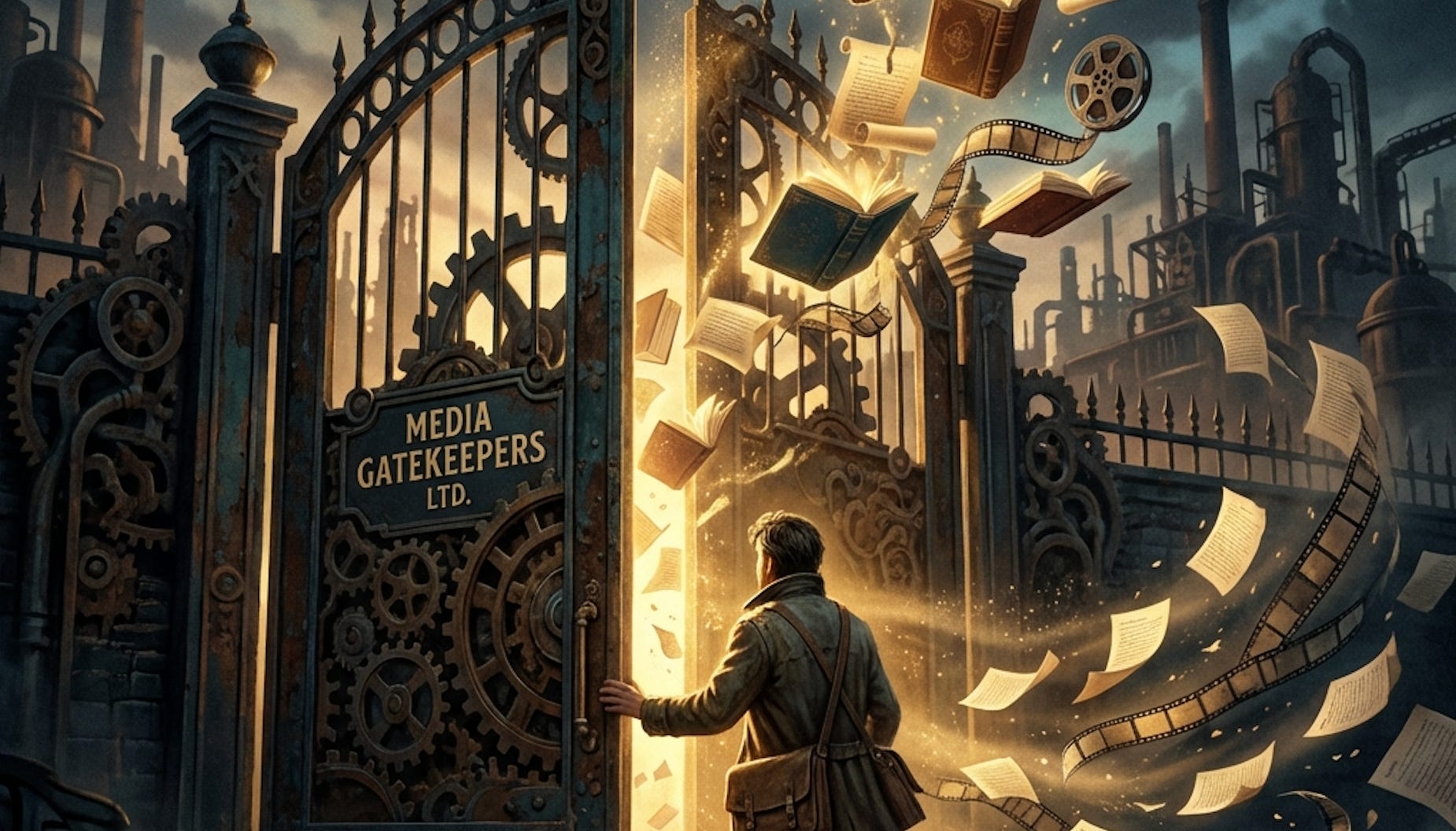
For most of modern media history, storytellers have lived inside systems built on gatekeeping.
Those systems weren’t always malicious. In many cases, they existed because distribution itself was expensive. Printing presses, television airtime, theatrical releases—these were finite resources. Someone had to decide what made it through the gate.
I’ve spent much of my career working inside that system—developing projects, pitching networks, and navigating the long process of trying to bring stories to life through traditional media pathways. I’ve seen firsthand how many great ideas never make it past development, not because they lack merit, but because the system itself has limits.
But over the last twenty years, something fundamental has shifted. As the world of content evolves at a lightning pace, and the institutions that once stood tall are either crumbling or being absorbed into larger conglomerates, writers are beginning to realize something powerful:
We don’t necessarily need the gate anymore.
The Age of Consolidation
Ironically, just as distribution became easier than ever, the media companies themselves became fewer and larger.
The last decade has seen massive consolidation across film, television, and publishing. Studios merged. Networks collapsed into conglomerates. Streaming platforms swallowed entire libraries of content.
And it looks like the consolidation may not be slowing down anytime soon, especially with the looming merger discussions between Paramount and Warner Bros. Discovery.
In theory, consolidation was supposed to create more opportunity. In reality, it has often created the opposite. When a handful of companies control most of the distribution pipelines, the outcome becomes predictable: fewer greenlights, more risk-averse development, and familiar intellectual property dominating the slate.
Having worked in development rooms and pitch meetings for years, you quickly learn how often original ideas are filtered through layers of market considerations before they ever reach an audience. Instead of betting on new voices, the industry increasingly leans on what is already proven.
Franchises, reboots, and sequels have entered their gilded era. Original storytelling becomes harder to justify when a franchise already comes with a built-in audience.
And that leaves many writers—especially new voices—outside the gate.
The Traditional Pathway Problem
For decades, the standard advice to writers was simple: get an agent, get a publisher, and try to enter a studio development pipeline.
But those pathways have always been narrower than people realize.
Thousands of manuscripts land on desks every year. Only a fraction are acquired, and fewer still are meaningfully marketed.
The same dynamic exists in television and film. Development pipelines can be years long, and many projects stall somewhere between concept, pitch deck, and greenlight. Over the years, I’ve worked on projects that spent months—sometimes years—moving through development before a network ultimately decided the timing simply wasn’t right.
The truth many creators quietly learn over time is that talent alone is rarely the deciding factor.
Timing matters. Relationships matter. Market trends matter. And sometimes, the right story simply arrives when the industry isn’t looking for it. For writers, this has historically meant surrendering two very valuable things: control and ownership.
Why Intellectual Property Matters More Than Ever
In today’s media ecosystem, intellectual property is currency.
Every major studio is chasing it. Novels become television series. Podcasts become documentaries. TikTok creators increasingly become both the talent and the producers.
After years working around media development and production, one thing becomes very clear: what studios are truly acquiring is not just a story—they are acquiring the world behind it.
What matters now is not simply the story itself, but who owns that world.
For decades, many creators traded their intellectual property for the chance to be published or produced. That trade made sense when the alternative was obscurity.
But new platforms are beginning to change that calculation.
The Rise of Creator-Owned Platforms
Platforms like Substack represent something the media industry hasn’t seen before: direct distribution between writer and reader.
No studio notes. No network development cycles. No waiting for permission.
A writer can publish a story, build an audience, and prove demand before traditional gatekeepers ever enter the conversation.
From a development perspective, this is a profound shift. For years, creators had to walk into pitch meetings hoping executives would believe an audience might exist for their idea.
Now writers can walk in with proof.
“The audience already exists.”
And in entertainment, that is an extremely powerful sentence.
The Return of the Serialized Story
One of the most interesting shifts happening right now is the revival of serialized storytelling.
Before television. Before film. Even before modern publishing, stories were often released chapter by chapter.
Charles Dickens famously published his novels this way. Readers would wait for the next installment the same way modern audiences wait for the next streaming episode.
Platforms like Substack have quietly recreated that model for the digital era. Writers can release chapters in real time, readers engage as the story unfolds, and communities begin to form around the narrative itself.
As someone who has spent years thinking about story structure across different mediums—film, television, and now serialized fiction—I find this return to episodic storytelling fascinating.
In many ways, it’s closer to the original roots of storytelling than people realize.
Why This Moment Matters
We are living in a strange hybrid era. The traditional media system still exists, but it is no longer the only route.
A writer today has options that didn’t exist even five years ago. Direct-to-reader platforms allow creators to build audiences before publishing. Writers can retain ownership of their intellectual property while developing communities around their work.
This doesn’t mean traditional publishing or film development disappears. Far from it. But it does mean writers can now enter those conversations with leverage. And leverage changes everything.
Why I’m Experimenting Here
After years working in media and storytelling, I’ve seen firsthand how often good ideas get lost inside the machinery of development. Not because they weren’t good, but because they didn’t fit neatly into what the system was looking for at that moment.
Platforms like Substack allow something different. They allow writers to test worlds, characters, and ideas in public. They allow readers to participate in the discovery of a story.
And perhaps most importantly, they allow creators to maintain ownership of the worlds they build.
For me, that’s part of the reason The Last Bloom exists here. Not just as a novel, but as an experiment in what storytelling might look like in the next era.
The Future Belongs to Storytellers Who Own Their Worlds
The entertainment industry will continue to evolve. Studios will merge. Platforms will rise and fall. Technology will change how stories are consumed.
But one thing will remain constant. Stories still begin with a writer. And increasingly, those writers are realizing something important: the most valuable asset in modern media isn’t distribution.
It’s ownership.
Ownership of the world.
Ownership of the characters.
Ownership of the story itself.
And for the first time in a long time, writers have more ways than ever to keep it.